
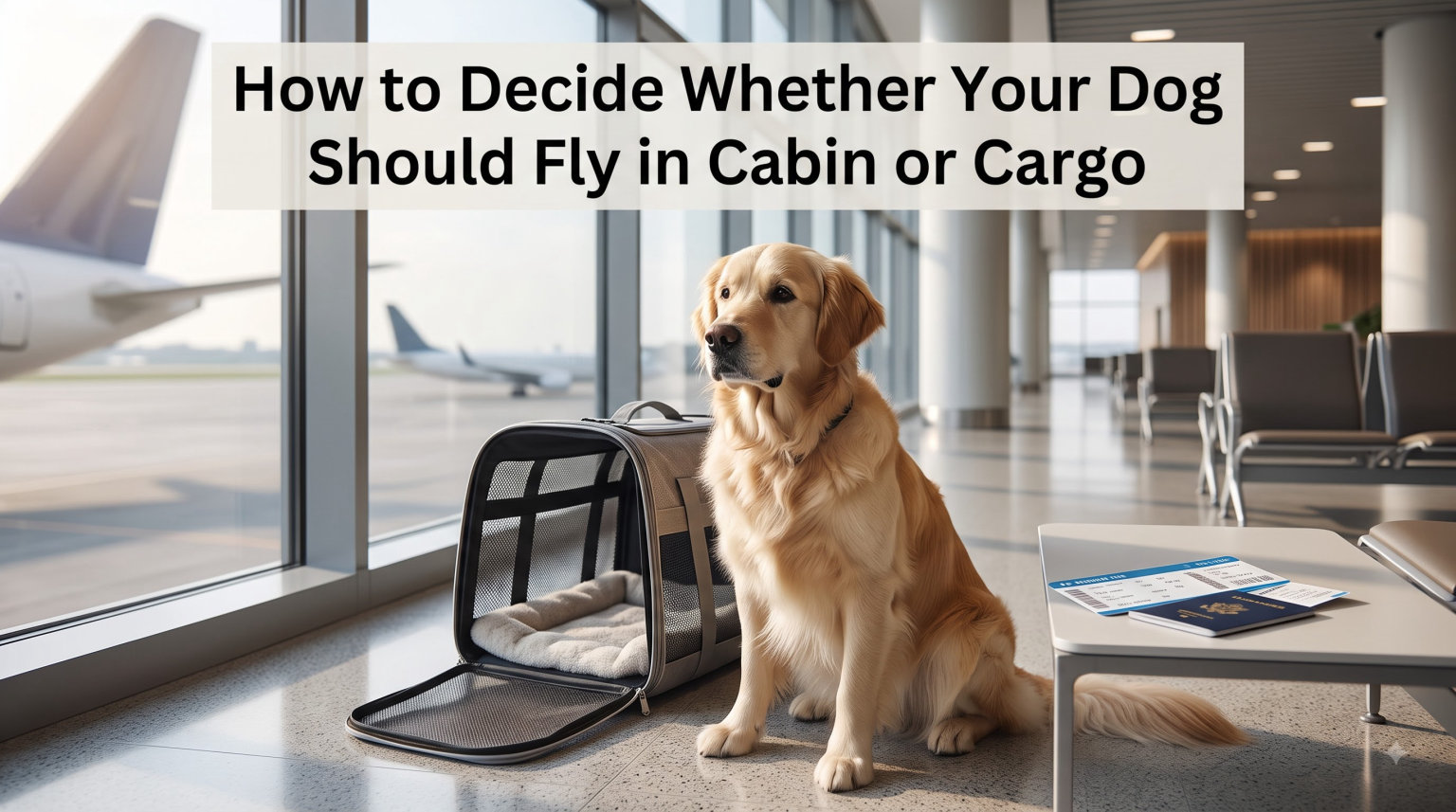
I remember standing in an airport terminal with a 50-pound Border Collie mix and a 12-pound Pomeranian, staring at two different boarding passes and wondering if I had made the right call. One dog would curl up under the seat in front of me. The other would ride in a hard-sided crate somewhere beneath the plane, in a part of the aircraft I had never seen.
That is the decision thousands of dog owners face every year. Should your dog fly in the cabin with you, or travel in the cargo hold? The answer is rarely simple. It depends on your dog’s size, breed, age, temperament, the route, the airline, the weather, and the documentation you can pull together in time.
This guide walks you through every factor that should influence how to decide whether your dog should fly in cabin or cargo. I pulled together airline policies, USDA guidance, CDC import regulations that took effect in 2024, and real stories from dog owners who have been on both sides of this choice. By the end, you will have a clear framework for making the call.
Table of Contents
Cabin Travel: The Basics Every Dog Owner Should Know
Cabin travel means your dog rides in an airline-approved carrier that fits under the seat in front of you. Your dog stays with you the entire flight, which is the single biggest advantage of this option. You can hear your dog, comfort your dog, and respond if something goes wrong.
Almost every major U.S. airline allows small dogs in the cabin on domestic flights. The catch is the size limit. Most airlines require your dog, plus the carrier, to weigh under 20 pounds combined. The carrier itself usually needs to fit within roughly 18 by 11 by 11 inches, though exact dimensions vary by carrier and aircraft.
Some carriers, including JetBlue and Southwest, have tightened restrictions recently. Southwest stopped accepting pets in the cabin entirely as of 2025. JetBlue still allows small cats and dogs in approved carriers, but the cost has gone up. Always check the current policy before you book, because these rules change every year.
Carrier Requirements for In-Cabin Dogs
The carrier must be leak-proof, ventilated on at least two sides, and large enough for your dog to stand, turn around, and lie down. Soft-sided carriers work on most mainline aircraft, but regional jets often have smaller under-seat spaces, so a soft-sided bag may be required.
Your dog stays inside the carrier for the entire flight. The carrier counts as either your personal item or your carry-on, depending on the airline. That means you are sacrificing the ability to bring a separate personal bag on most flights.
Cost of Flying a Dog in the Cabin
Expect to pay between $95 and $200 each way for an in-cabin pet on a domestic U.S. flight. International cabin pet fees run higher, often between $200 and $500. Some airlines charge per flight segment, so a connection can double the fee. Budget airlines that allow pets at all tend to charge the highest fees.
You also need to factor in the cost of an airline-approved carrier if you do not already own one. A good soft-sided carrier runs $35 to $80, while a sturdy hard-sided option costs $60 to $150.
Cargo Travel: How It Works and When It Is the Only Option
Cargo travel means your dog flies in a pressurized, climate-controlled hold beneath the passenger cabin. Your dog rides in an IATA-approved hard-sided crate, handled by airline staff at the cargo terminal. You typically cannot see or access your dog during the flight.
Most airlines treat pets traveling in cargo as either checked baggage or manifest cargo. The difference matters. Checked baggage usually travels on the same plane as you and arrives with the regular luggage. Manifest cargo is handled separately by a freight company and may travel on a different aircraft or schedule.
Cargo is the only realistic option for medium and large dogs that exceed cabin size limits. It is also the only option for many international routes. A 40-pound dog simply cannot fly in the cabin unless it is a trained service animal.
Crate Requirements for Cargo Travel
The crate must meet International Air Transport Association (IATA) standards. It needs to be hard-sided, secure, ventilated on at least three sides, and large enough for your dog to sit, stand, and lie down comfortably. Most airlines require the crate to have a metal door, not plastic clips.
You will need to label the crate with your dog’s name, your contact information, and a “Live Animal” sticker in green letters. A bowl that can be attached to the inside of the door for water is also required. Plan to spend $75 to $250 on a compliant crate if you do not already own one.
Cost of Flying a Dog in Cargo
Cargo fees depend on the weight of your dog plus the crate. Domestic cargo fees typically run between $200 and $600, though some airlines charge by weight, so a 70-pound Great Dane costs considerably more than a 25-pound Beagle. International cargo fees can easily exceed $1,000 when you add veterinary certificates and handling charges.
Cargo travel also requires a health certificate from a licensed veterinarian, usually issued within 10 days of departure. That visit typically costs $50 to $150 on top of the flight fee.
Key Decision Factors: Cabin vs Cargo Comparison
When deciding whether your dog should fly in cabin or cargo, run through these factors in order. Each one can rule out an option on its own.
Size and Weight
If your dog weighs more than 20 pounds, the cabin is almost certainly off the table. Most airlines cap in-cabin pets at the combined weight of the dog plus carrier. Anything heavier must go in cargo.
Some airlines offer slightly larger allowances for passengers in premium cabins. United, for example, allows pet carriers up to 17.5 by 12 by 8 inches in first class on certain aircraft. But this is an exception, not the rule.
Breed and Snout Shape
Brachycephalic (snub-nosed) breeds face heavy restrictions on both ends. Pugs, Bulldogs, Boxers, Pekingese, Boston Terriers, Shih Tzus, and Persian mixes often cannot fly in cargo at all, because their compressed airways make them vulnerable to respiratory distress at altitude.
Many of these same breeds can still fly in the cabin if they meet size requirements. That alone can make cabin travel the only safe choice for some brachycephalic dogs, regardless of owner preference.
Route and Layovers
Direct flights are strongly preferred for any pet, but they are essential for cargo. Every layover adds time on the tarmac, multiple handling transfers, and more opportunities for the crate to be misrouted or delayed. If you cannot book a nonstop, cabin travel becomes a much safer option.
For international travel, cabin availability shrinks. Most transatlantic and transpacific routes do not allow pets in the cabin at all. Cargo or a pet transport service becomes the default.
Weather and Temperature
Most U.S. airlines embargo pets in cargo when ground temperatures fall below 45°F or rise above 85°F. This applies at both origin and destination. If your travel dates fall in a heat wave or cold snap, your dog may not be allowed in cargo even if every other factor lines up.
Cabin travel sidesteps these restrictions entirely, because your dog travels in the temperature-controlled passenger cabin with you.
Stress and Temperament
Cargo is loud, dark, and full of unfamiliar smells. Takeoff and landing create pressure changes that can be uncomfortable. Dogs that are already anxious, reactive, or crate-naive often deteriorate in this environment.
Cabin travel is not stress-free either. The noise, confined space, and proximity to strangers can upset sensitive dogs. But you are right there to comfort them, which most dogs find reassuring.
Cost
Cabin travel is almost always cheaper for small dogs. For larger dogs, you have no choice but to pay the cargo fee. International travel reverses the equation, because cargo fees on long-haul flights often exceed the cost of the passenger ticket itself.
The Step-by-Step Decision Process
Here is how to work through the decision in a logical order. I use this exact process when I help friends plan trips with their dogs.
Step 1: Confirm Your Dog Meets Size Requirements
Measure your dog from nose to base of tail and from floor to top of shoulders. Add 2 inches to each dimension. That is your minimum carrier size. If that carrier does not fit under a standard airplane seat, your dog must go in cargo.
Step 2: Check Breed Restrictions for Both Options
Verify your dog’s breed is not on the airline’s restricted list for cargo. Also check the airline’s breed policy for the cabin, though breed restrictions there are rare. If your dog is a snub-nosed breed and exceeds cabin size, talk to your vet about ground transport alternatives.
Step 3: Book a Direct Flight Only
Layovers add risk. For cargo travel, only book nonstop flights. For cabin travel, layovers are acceptable if your dog can stay with you the whole time and the connection is at least 90 minutes.
Step 4: Verify the Weather Window
If cargo is on the table, check the historical temperature range at origin and destination on your travel dates. If either city has forecasted extremes within 48 hours of your flight, reconsider cargo or shift your travel dates.
Step 5: Apply the 7-7-7 Rule
The 7-7-7 rule is a common guideline among professional pet shippers. Your dog should be at least 7 weeks old, have had no food for 7 hours before the flight, and the trip should take no longer than 7 hours from check-in to landing. The rule is not a law, but it captures three sensible minimums: age, fasting, and trip length.
Trips longer than 7 hours generally mean connecting flights or international sectors, both of which increase cargo risk. For longer trips, cabin travel or a ground transport service becomes a safer choice.
Step 6: Schedule a Vet Visit and Health Certificate
Book a vet appointment within 10 days of departure. The vet will confirm your dog is healthy enough to fly, update vaccinations if needed, and issue the USDA-endorsed health certificate most airlines require.
For international travel, requirements expand. You may need a microchip, a rabies titer test, or specific import permits depending on the destination country.
Step 7: Crate Train Before the Flight
Whether your dog flies in cargo or in a cabin carrier, crate training reduces stress dramatically. Start at least 4 to 6 weeks before the flight. Use treats, short sessions, and positive reinforcement. A dog that walks calmly into its crate on travel day will handle the experience far better than a dog that has never been inside one.
Safety Considerations for Both Options
No flight is zero risk. Roughly 0.5 million pets fly in the United States each year, and a small fraction experience injury, loss, or death. The majority of incidents involve cargo travel, often tied to extreme temperatures or inadequate crate ventilation.
Cargo Hold Conditions
The cargo hold is pressurized and climate-controlled on most commercial jets. Noise levels are higher than in the cabin, and lighting is dim. Pets are loaded last and unloaded first, which means more time waiting on the tarmac where conditions are not regulated.
Some owners worry about turbulence. Modern aircraft handle turbulence well, and the crate is strapped down. The bigger risks are temperature exposure during ground handling and rough handling by airline staff. Choosing a direct flight during mild weather cuts both risks substantially.
Cabin Considerations
In the cabin, your dog is exposed to dry air and recirculated ventilation. Long flights can lead to mild dehydration. Bring a collapsible water bowl and offer water during any layover.
There is also a small risk of escape during security screening. TSA agents may ask you to remove your dog from the carrier for the X-ray conveyor. Keep a short leash attached and a firm grip on the harness.
CDC Import Regulations for International Travel
The U.S. Centers for Disease Control and Prevention updated dog import rules in 2024, and the changes remain in effect for 2026. Any dog entering the United States, including returning service dogs and pets that have only been abroad briefly, must meet the new requirements.
The rule has three tiers based on where the dog has been in the past six months. Dogs from dog rabies-free or low-risk countries need a microchip, a current rabies vaccination, and a CDC Dog Import Permit submitted online at least 30 days before arrival.
Dogs from high-risk countries face additional steps, including a CDC-issued permit, a rabies serology titer test from a CDC-approved lab, and entry through a designated port of entry with a CDC-registered facility.
These rules apply regardless of whether the dog flies in cabin or cargo. They apply to service dogs too, with limited exceptions for handlers traveling with documented service dogs trained in the United States.
Service Dogs and Emotional Support Animals
Service dogs trained to perform tasks for a person with a disability can fly in the cabin at no charge, regardless of size. They sit at their handler’s feet rather than in a carrier. The airline may ask for documentation that the dog is a trained service animal but cannot require it to fit in a carrier.
Emotional support animals no longer have special status under U.S. Department of Transportation rules. Airlines treat them as regular pets, which means they must meet size and carrier requirements like any other dog.
If your dog qualifies as a service animal, the cabin is guaranteed regardless of weight. If your dog does not, the size limit applies.
Real Experiences from Dog Owners
I pulled some stories from dog travel forums that capture what this choice actually feels like in practice.
One owner flying a Border Collie from Denver to Boston wrote: “I almost put her in cargo because the cabin fee was over $200 and I was saving money for the trip. Then I read three forum posts from people whose dogs came out of cargo shaking for days. I paid the cabin fee and never looked back.”
Another owner with a 65-pound Husky had no cabin option. They shared: “We drove 200 miles out of our way to catch a direct flight instead of a connection. The crate was $180, the cargo fee was $450, and the vet visit was $120. Worth every penny. Our Husky walked out of the cargo area like nothing happened.”
A brachycephalic owner described a different challenge: “Our French Bulldog was too big for the cabin and not allowed in cargo. We ended up driving him cross-country instead. It took four days, but it was the only safe option.”
These stories line up with what veterinarians and professional pet shippers say. Direct flights, mild weather, and crate training dramatically reduce cargo incidents. Cabin travel removes most of the risk, but only if your dog fits.
Airline Policy Snapshot for 2026
Policies shift every year, so always confirm with the airline before booking. Here is a general snapshot of how the major U.S. carriers handle cabin and cargo pet travel.
American Airlines allows small cats and dogs in the cabin on most domestic flights for a flat fee, plus checked pet service for larger dogs on specific routes. Delta allows in-cabin pets on domestic flights and offers cargo service through Delta Cargo. United allows in-cabin pets plus PetSafe cargo for medium and large dogs on many routes. Alaska Airlines allows in-cabin pets and offers cargo service on partner flights.
JetBlue allows small dogs and cats in the cabin. Frontier charges a higher pet fee for cabin travel. Southwest does not allow pets in the cabin as of 2026. Spirit and Allegiant have limited pet programs and generally only accept service animals in the cabin.
For international travel, Lufthansa, KLM, and Air France offer cargo service on most routes. Some carriers like Turkish Airlines and Qatar Airways allow small dogs in the cabin on certain long-haul flights, with advance booking required.
Final Decision Framework: Cabin, Cargo, or Neither
Here is a simple way to settle the question before you book.
Choose cabin if your dog weighs under 20 pounds, the carrier fits under the seat, the route is domestic or allows cabin pets, and your dog tolerates confined spaces. Cabin is the lowest-stress option for both of you.
Choose cargo if your dog is too large for the cabin, the breed is not brachycephalic, the route allows pets in cargo, the weather is mild at both ends, you can book a nonstop, and you can crate train your dog in advance. Cargo is a reasonable choice for medium and large dogs under the right conditions.
Choose neither if your dog is brachycephalic and over the cabin size limit, if the only available flight is a long connection in extreme weather, or if your dog is elderly, sick, or severely anxious. Ground transport by car, a professional pet transport service, or a pet-friendly road trip are all safer options in these cases.
Frequently Asked Questions
Is it better to fly a dog as checked baggage or cargo?
It depends on your dog’s size, breed, and temperament. For small dogs that meet under-seat carrier dimensions, traveling in the cabin is almost always safer and less stressful. For larger dogs, cargo is the only option, and a direct flight during mild weather is the safest way to do it. Many airlines treat checked baggage and cargo similarly in practice, though manifest cargo often offers more handling visibility.
What is the 7 7 7 rule for dogs?
The 7-7-7 rule is a guideline used by professional pet shippers. It recommends that your dog be at least 7 weeks old, fast for 7 hours before the flight, and that the total trip duration not exceed 7 hours. It is not a law but a sensible set of minimums for safe air travel with dogs.
Is it stressful for dogs to fly in the cabin?
Yes, but usually less stressful than cargo. Cabin dogs experience dry air, recirculated air, confined space, and engine noise, but they remain with their owner, which most dogs find calming. Anxious dogs may still struggle, especially during takeoff and landing pressure changes. Crate training and short practice sessions at home can help.
Can a 40lb dog fly in a cabin?
Almost never, except for trained service dogs. Most airlines cap combined dog plus carrier weight at 20 pounds for in-cabin pets, and a 40-pound dog simply does not fit. Your only options for a dog that size are cargo or ground transport.
What dogs are not allowed to fly in cargo?
Most airlines restrict brachycephalic (snub-nosed) breeds from cargo travel, including Pugs, Bulldogs, Boston Terriers, Boxers, Pekingese, and Shih Tzus. Some airlines also restrict very young puppies under 8 weeks, pregnant dogs, and dogs with severe medical conditions. Each airline publishes its own restricted breed list.
How much does it cost to fly a dog in cargo?
Domestic cargo fees range from $200 to $600 depending on the airline, route, and combined weight of dog plus crate. International cargo fees can exceed $1,000 once you add required veterinary certificates, import permits, and handling charges. Plan for at least one vet visit within 10 days of departure.
Conclusion
Deciding whether your dog should fly in cabin or cargo comes down to a handful of concrete factors: size, breed, route, weather, and how well your dog handles stress. Cabin travel is the safest option when your dog fits, and it removes most of the variables that worry owners.
For larger dogs, cargo can work well with a direct flight, mild weather, and proper crate training. For brachycephalic breeds that exceed cabin size, or for trips in extreme weather, ground transport or a professional pet shipping service is often the safer call.
Run through the size, breed, route, and weather checks in that order, and the answer becomes much clearer. Whatever you decide, plan early, talk to your vet, and book a nonstop flight whenever possible.