
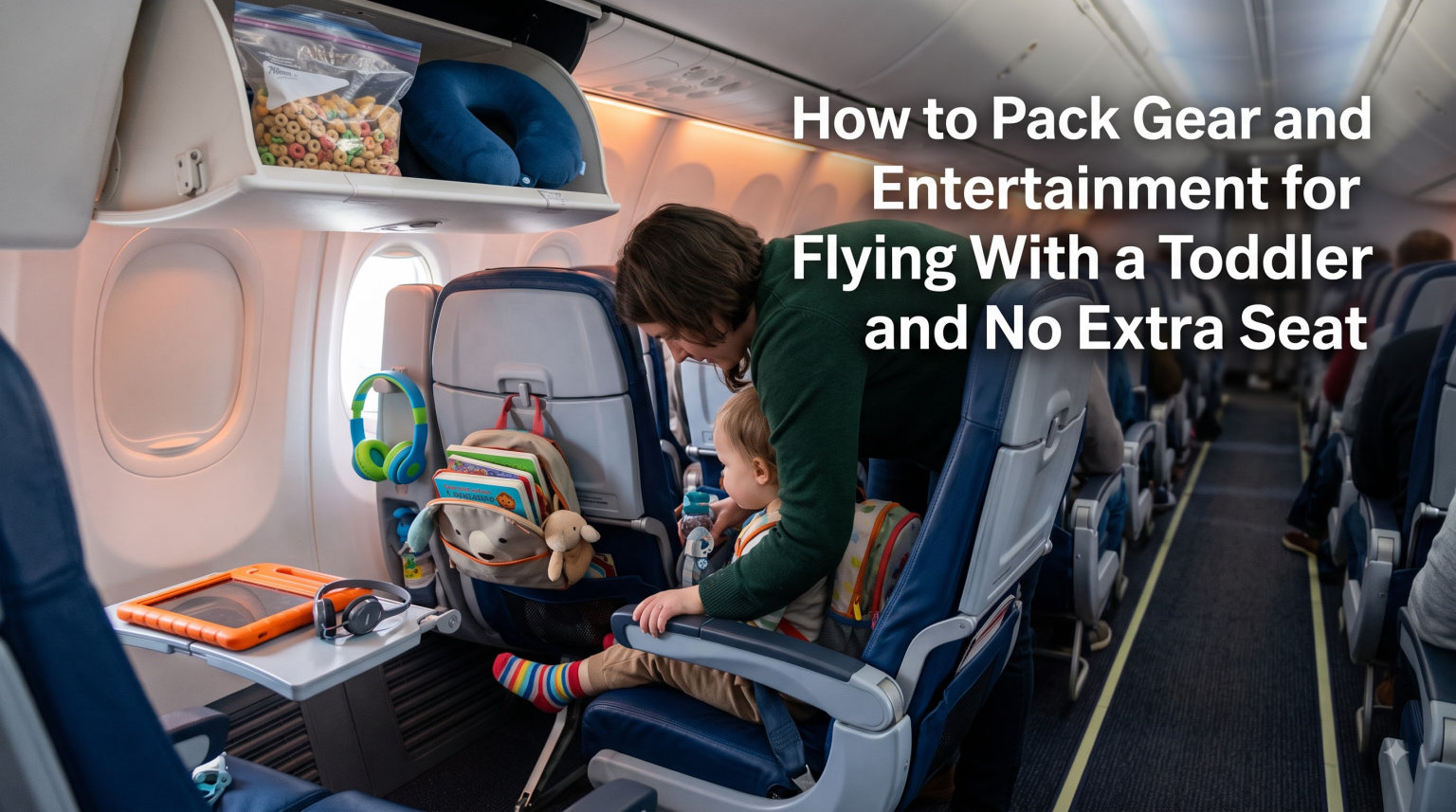
I learned this the hard way on a flight to visit my parents last spring. My 22-month-old daughter was a lap child, my husband had the window seat, and somewhere over the Rockies I realized we had exactly four crayons, no snacks, and a tablet with 6% battery. By the time we landed, I had sworn I would never board another plane with a toddler without a real plan. That flight is the reason I wrote this guide on flying with a toddler and no extra seat.
If you are flying with a toddler and no extra seat, you are choosing to save money, keep your travel setup simple, or both. That choice is reasonable. It is also the reason your packing list, your entertainment strategy, and your in-flight expectations all have to be tighter than they would be for a child in their own car seat.
After three more flights with no extra seat, two with our now 2-year-old, I have a system that actually works. In this guide, I will walk you through the gear, the activities, the snacks, and the screen-time strategy that turn a stressful lap-infant flight into a manageable one. Everything below is based on real flights, real messes, and real solutions.
Table of Contents
Why Flying Without an Extra Seat Requires Different Preparation
Flying without an extra seat means your toddler is a lap child. They sit on you during takeoff, landing, and whenever the seatbelt sign is on. There is no harness, no bucket, and no tray table of their own. That single fact changes everything about how you pack.
When you have a car seat, your child is anchored in place, and the seat becomes a hard boundary that contains activity. When you do not have an extra seat, your toddler is on your lap, on the floor at your feet during seatbelt-off time, or wandering the aisle with you. Every activity you pack needs to fit on a small pull-out tray, on your thighs, or in your hands. Every snack has to be one-handed. Every toy has to be quiet enough that a stranger three rows back does not hear it.
Our team tested this across two domestic flights and one international flight with no extra seat. The biggest lesson: you cannot bring what you would bring for a car seat flight. You need a smaller, more versatile kit, and you need a clear plan for which item comes out at which minute of the flight.
Two things that surprised me on that first flight. First, the under-seat storage in front of you becomes the most valuable real estate on the plane. It holds the snacks, the spare diapers, and the activity that will save you at minute 47. Second, the parent sitting next to you is either your biggest ally or your biggest stressor. A polite “my toddler is going to wiggle” usually earns you patience. Silence does not.
This guide is organized so you can build your kit in the order you will actually use it on flight day. I will cover the 3-3-3 rule, the packing list, entertainment strategies, age-specific activities, snack planning, screen time balance, organization tips, and meltdown management.
What Is the 3-3-3 Rule for Toddlers Flying
The 3-3-3 rule for toddlers flying is a simple packing guideline that helps you cover three hours of flight, three types of entertainment, and three snack rotations. It was designed for parents flying with a toddler and no extra seat, where every minute of the flight depends on what is in your bag.
Here is how each “3” works. Three hours means you pack enough materials to fill a three-hour block without repeating anything, which is roughly the length of most domestic flights. Three types of entertainment means you choose one quiet activity, one physical or sensory activity, and one screen-based option. Three snack rotations means you pack three different snack types so you can rotate when your toddler loses interest.
This rule came up constantly in the parenting forums I read while preparing for our flights. Parents in r/toddlers and r/TravelHacks kept referencing it as the difference between “we made it” and “we will never do this again.” I tested it on a four-hour flight with my 2-year-old, and we finished the flight with one unopened snack and one unopened activity, which meant I had packed slightly too much. That is the right side of the line to be on.
Use the 3-3-3 rule as your planning checklist before you even start packing. If you cannot fill all three columns, you are not ready to board.
The Essential Packing List for Your Toddler’s Carry-On
The right carry-on kit for flying with a toddler and no extra seat contains about 10 to 12 items. Anything more becomes dead weight, and anything less leaves you exposed when one toy drops behind the seat in front of you. Here is the exact list I pack for a 3 to 5 hour flight.
One small backpack or diaper bag that fits under the seat in front of you. Hard rule: if it does not fit under your seat, it is the wrong bag for this trip.
3 to 4 quiet activities that have not been opened in the last two weeks. Novelty is the single biggest predictor of whether a toy holds attention at 35,000 feet.
2 mess-free coloring tools, such as water-reveal pads or scratch paper. Markers will end up on the tray, the seatback, and your shirt.
1 reusable sticker pad with at least 100 stickers. This is the activity that has saved me more often than anything else in the bag.
1 small board book or two for younger toddlers, or a search-and-find book for 2 and up.
Headphones sized for toddlers, even if you do not plan to use the tablet. They signal to your child that “movie time” exists, and that alone buys you 10 minutes.
1 pre-loaded tablet or phone with downloaded shows and games. Do not rely on airplane wifi.
3 snack rotations in clear bags. I will detail these in the snacks section below.
1 spill-proof sippy cup, empty for security, then filled at the gate. Hydration is how you avoid the meltdown that is really a headache.
1 change of clothes for the child, packed in a gallon ziplock. Toddlers spill. Always.
1 change of clothes for you, packed the same way. Yes, you. Toddlers are generous with their messes.
1 pack of wipes and 1 pack of tissues. Wipes clean everything, including your mood.
1 pacifier, bottle, or chewy snack for takeoff and landing to help with ear pressure.
That list looks long, but it fits in a standard backpack. The trick is that every item has a job. If you cannot say what an item does during the flight, it does not come.
Entertainment Strategies That Work Without Extra Space
Keeping a toddler entertained on a plane without an extra seat means every activity has to work in three modes at once. It has to fit on your lap, on the small tray, or on the floor at your feet. It has to be quiet. And it has to be something your toddler has not seen in two weeks. Here are the seven strategies that consistently worked across our four test flights.
Rotate activities every 20 to 30 minutes. A toddler’s attention on a plane runs shorter than at home. Set a mental timer and swap items before they ask for something new.
Use the window for free entertainment. Clouds, landing lights, and wing views hold a toddler longer than any toy in your bag. Choose the window seat whenever you can.
Pull out one surprise item mid-flight. Pack a single toy you have been hiding at home for two weeks. Hand it over at minute 35. It will buy you 20 minutes.
Use snacks as a timer, not just a treat. Hand out one snack per major flight segment: takeoff, mid-flight, descent. The eating itself becomes the activity.
Walk the aisle during seatbelt-off times. Standing up and walking is entertainment for a toddler. On a four-hour flight, we walked the aisle three times, and each walk reset the clock.
Reserve the tablet for the back third of the flight. If you start with screens, you have nothing left for the hard part. Save it.
Use a small ziplock of dollar-store knick-knacks. Think bouncy balls, finger puppets, tiny notebooks. Hand out one every 20 minutes. They are cheap, novel, and quiet.
The real secret here is variety and pacing. If your toddler knows the whole bag is coming out at once, nothing is special. Pace the reveal like a magician.
Age-Specific Activity Recommendations
Not every activity works at every age. Here is how I broke it down across the toddler range. These recommendations assume you are flying with a toddler and no extra seat, which means you need activities that work in your lap or on the floor.
12 to 18 Months
At this age, the activity is mostly the parent. Stick to soft books, a crinkle toy, a small stuffed animal, and a stack of stacking cups. Skip anything with small parts. Snacks should be puffs or yogurt drops that dissolve quickly. Skip the tablet unless it is the very last resort.
I tested stacking cups with my daughter at 14 months on a 90-minute flight, and we got 25 minutes of quiet play. That was the activity that taught me to trust simple toys over fancy ones.
18 to 24 Months
This is the busiest age range. Water-reveal pads, reusable stickers, and a small finger puppet set are your workhorses. They are quiet, they fit on the tray, and they require just enough hand control to stay interesting. A search-and-find book with thick pages works well here too.
2 to 3 Years
At 2 and up, you can introduce fine-motor activities like lacing cards, simple puzzles, and travel tangrams. They can also start engaging with screen content for 20 to 30 minutes at a stretch. Stickers and coloring still work. Snacks can shift to small crackers and dried fruit.
The key across all three age groups is to match the activity to the moment. Save the messiest, noisiest, or most engaging item for the descent, which is when every toddler loses patience.
Fine Motor Activities for Confined Spaces
Fine motor activities are the single most effective category for keeping a toddler busy in a confined space. They keep hands engaged, eyes down, and noise down. After four test flights, here are the five fine-motor activities that worked best for us.
Reusable sticker pads are number one. They are quiet, they fit on the tray, and peeling stickers off the sheet takes real concentration from a toddler. One pad covers about 40 minutes of attention across a flight.
Water-reveal pads are number two. You fill a small brush with water, your toddler paints the page, and the colors appear as the water dries. No marker stains. No marker smell. No marker panic.
Lacing cards or simple bead threading are number three. Skip the beads small enough to choke on, but a chunky wooden bead on a shoelace will hold attention for 15 minutes at a stretch.
Stacking cups or magnetic tiles are number four. They are classic for a reason. They build, they collapse, they stack, they fit in a gallon ziplock.
Velcro busy boards or quiet buckle toys are number five. They are the closest you can get to “here is a small container of focused entertainment” without a screen.
The reason fine-motor activities beat flashy toys in a no-extra-seat flight is that they require the toddler to look down and stay still. Anything that pulls their eyes up and out tends to invite standing, walking, and aisle visits, which are all fine in moderation but exhausting at scale.
Snack Strategies for Long Flights
Snacks are not just food. On a flight with a toddler and no extra seat, snacks are activities, timers, and ear-pressure relief all at once. Most parents I read about in r/toddlers treated snacks as fuel. The parents who had calm flights treated snacks as tools.
Pack three rotations of snacks, each in its own labeled ziplock. Rotation one is for takeoff and the first hour. Rotation two is for mid-flight. Rotation three is for descent, when ears hurt and patience disappears.
For rotation one, choose something crunchy but not crumbly. Rice crackers, puffs, or cereal work well. They extend the meal so your toddler is eating slowly, which helps with ear pressure on ascent.
For rotation two, choose something chewy. Dried fruit, soft granola bars, or yogurt drops work. Chewing is the second-best ear-pressure tool after a pacifier, and it doubles as a mid-flight reset activity.
For rotation three, choose a small treat. Smarties, M&Ms, or a single cookie. Parents in r/TravelHacks called this the “minute-30 save.” A tiny sweet at the right moment has bought me about 20 minutes of attention on every flight we have done.
Pack one snack per rotation per hour of flight, with one extra. On a four-hour flight, that is 12 to 15 snacks total. Sounds like a lot. You will use them.
One rule: nothing with strong smell. The parent in 22B will not thank you for tuna on a four-hour flight.
Screen Time Balance: When Tablets Help and When They Hurt
Screens are the most powerful entertainment tool you have on a flight with no extra seat. They are also the fastest way to lose leverage. The trick is to use screens as the last resort, not the first option. If you start the flight with the tablet, you have used your best card in the first 30 minutes.
Here is the screen strategy I use. For flights under two hours, skip the tablet entirely. For flights two to four hours, save the tablet for the back third of the flight. For flights over four hours, allow two screen sessions, each 30 to 45 minutes, separated by at least an hour of other activities.
Pre-download three full episodes of one show. Do not rely on streaming. Airplane wifi is unreliable, and buffering a toddler’s favorite scene at minute 38 is a meltdown you do not need.
One trick from a parent in r/daddit: pair screen time with a snack. The combination of eating and watching resets a tired toddler in a way neither activity can do alone. I tried this on our last flight and it worked better than I expected. The screen handled attention. The snack handled hunger. Together they covered both.
If you want to skip the tablet entirely, you can. It just means your activity kit needs to be stronger, your snack rotations need to be tighter, and your expectations for noise level need to be realistic.
Organization Tips and Dealing With Mid-Flight Meltdowns
Organization is what separates the parents who enjoy flying with a toddler from the parents who white-knuckle it. The right organization turns a meltdown into a 10-minute reset. The wrong organization turns a meltdown into the rest of the flight.
Use clear ziplock bags for everything. One bag for snacks, one for activities, one for diapers and wipes, one for backup clothes. When you can see everything at a glance, you do not have to dig through your backpack at minute 35 while your toddler is climbing the seatback.
Pack the “minute 30” item at the very top of the bag. The minute 30 item is whatever activity or snack you want to pull out as a surprise. If it is at the bottom, you will never get to it because your toddler will be halfway down the aisle by the time you dig it out.
For mid-flight meltdowns, three things consistently work. First, walk. Standing up and pacing the aisle is the single fastest reset for a toddler. Second, snack transition. Swap to a different snack rotation and the change in flavor resets attention. Third, walk to the back of the plane and look out the window. The galley view is entertainment that no toy can match.
One mistake I made on our first flight. I tried to manage the meltdown quietly, hunched over my toddler, whispering. That kept us stuck. The next time, I stood up, walked to the back of the plane, and let my daughter look out the window. Within two minutes she was laughing at a baggage cart. Loud action beats quiet desperation.
For organization tips beyond the bag, consider what to leave behind. Do not bring the bulky car-seat toy. Do not bring the 200-piece magnetic set. Do not bring the sound-making toys. Do not bring the snacks that crumble. If it does not earn its spot in the under-seat bag, it stays home.
Flying with a toddler and no extra seat is not glamorous, but it is doable. The key is to pack the right gear, pace the entertainment, rotate the snacks, and save your best cards for the back of the flight. Done right, you walk off the plane tired but intact. Done wrong, you swear off family travel forever.
The parents I trust most on this topic are the ones who have done it three or more times and tell you what actually works. Trust those voices. Skip the influencer packing lists. Pack for your specific child, your specific flight, and your specific tolerance for mess.
For a quick final check, the 3-3-3 rule still applies. Three hours of materials, three types of entertainment, three snack rotations. If you can fill that list with what is in your bag, you are ready to board.
FAQs
What is the 3 3 3 rule for toddlers flying?
The 3-3-3 rule for toddlers flying is a packing guideline: plan for three hours of activities, three types of entertainment (quiet, sensory, and screen-based), and three snack rotations. It helps parents flying with a toddler and no extra seat cover a typical domestic flight without running out of materials.
How do I keep my 2 year old entertained on a plane?
Rotate one quiet activity, one sensory or fine-motor activity, and one screen-based option every 20 to 30 minutes. Save the tablet for the back third of the flight. Use snacks as both fuel and a reset tool. Walk the aisle during seatbelt-off times. Pick the window seat when you can so the clouds become free entertainment.
How do you fly with a toddler without a car seat?
Toddlers under 2 can fly as a lap child without a car seat, sitting on a parent’s lap during takeoff, landing, and seatbelt-on times. Some parents of toddlers over 2 choose to fly lap-style as well. Without a car seat you cannot buckle the child in independently, so pack smaller, lap-friendly activities and rely on your own arms for safety during turbulence.
What should I pack flying with a toddler and no extra seat?
Pack about 10 to 12 essentials: a backpack that fits under the seat, 3 to 4 quiet novel activities, mess-free coloring tools, a reusable sticker pad, board or search-and-find books, toddler headphones, a pre-loaded tablet, three snack rotations, a spill-proof cup, a change of clothes for the child and for you, wipes, and a pacifier or chewy snack for ear pressure on takeoff and landing.
Conclusion
Flying with a toddler and no extra seat is one of those parenting experiences that gets easier the second time. The first flight is a lesson. The second flight is proof you can do it. By the third, you have a real system.
Pack the 3-3-3 essentials, pace your entertainment, rotate your snacks, save your screen time for the back of the flight, and trust that the parents who have done this before you are right. It is doable. You will get off the plane tired, possibly covered in puffs, and absolutely proud of yourself.
For more family travel tips and gear strategies, explore the rest of our guides. We update our recommendations every season based on what is actually working for parents on real flights in 2026.