
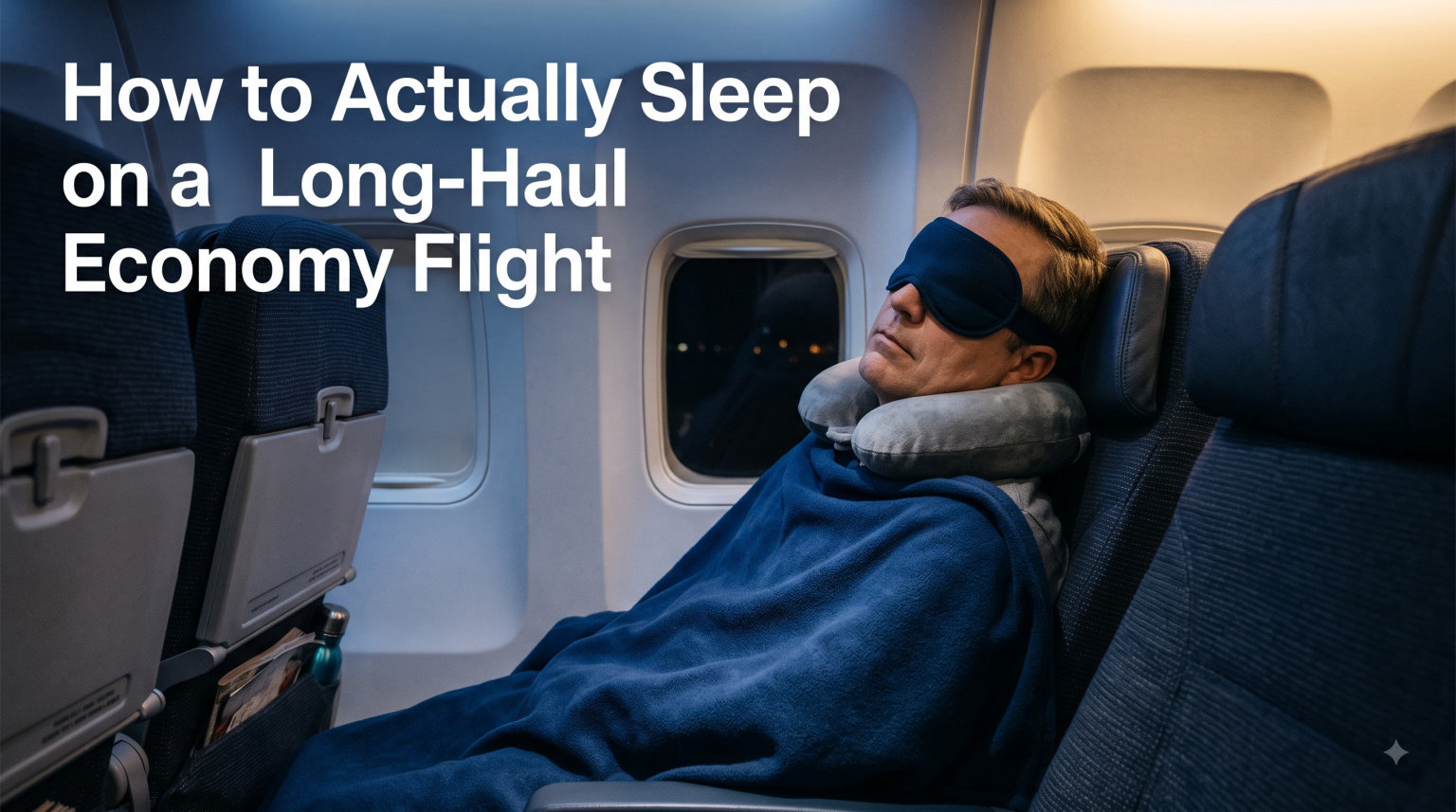
Learning how to actually sleep on a long-haul economy flight comes down to four things: picking the right seat, building a dark and quiet sleep environment, preparing your body before you board, and managing your mindset at 35,000 feet. That is the short answer, and it is what I have refined over dozens of overnight international flights where I had no choice but to make economy work.
I have spent more hours than I care to count curled upright in seat 42C, nodding into the stranger’s shoulder next to me, waking up with a neck that clicks for a week. Most of the standard advice online reads like it was written by someone who flies business class and Googled the rest. This guide is built on what actually works when the legroom is 30 inches and the cabin lights snap on three hours before landing.
Whether you are flying a 13-hour haul to Asia, a red-eye across the Atlantic, or a multi-stop international itinerary, the strategies here apply. I will walk you through seat selection, sleep accessories, pre-flight preparation, sleep aids, breathing techniques, what to wear, and even how to handle the flight if you are a nervous flyer who cannot switch off. By the end you will have a repeatable routine you can use on every overnight flight in 2026 and beyond.
Table of Contents
Quick Checklist: The 7 Non-Negotiables
If you only remember seven things from this entire guide, make it these. I have ranked them roughly in order of impact, based on what made the biggest difference for me personally.
- Pick a window seat near the front of the plane. You get a wall to lean against, fewer interruptions, and a smoother, quieter ride.
- Bring a proper eye mask. Cabin light is the number one thing wrecking your sleep cycles. Block it completely.
- Use noise-canceling headphones or quality earplugs. Engine drone, crying babies, and chatterting seatmates add up fast.
- Wear a travel pillow correctly. Most people put it on backwards. More on that below.
- Layer up. Cabins run cold, and the thin airline blanket will not save you.
- Hydrate hard for 24 hours before the flight. Dehydration fragments sleep and worsens jet lag.
- Time your sleep to your destination, not your departure city. This is the single biggest jet lag lever you control.
Print this list, screenshot it, do whatever works. Now let me break each of these down in detail.
How to Actually Sleep on a Long-Haul Economy Flight: Seat Selection Strategy
Your seat choice decides roughly half of whether you will sleep. I cannot overstate this. You can have the best travel pillow money can buy and it will not matter if you are stuck in a middle seat next to a galley.
Window Seat Wins, Every Time
A window seat gives you a vertical surface to lean your head against, which is something no aisle or middle seat can offer. You also control the window shade, meaning you decide when light comes in. Critically, nobody climbs over you to use the restroom, which on a 12-hour flight is the difference between sleeping in two three-hour blocks versus four fragmented naps.
The only real downside of the window is that you are trapped if you need the bathroom. My rule: go right before boarding, hydrate early in the flight, taper fluids two hours before you plan to sleep, and use the restroom right before settling in.
Front of the Plane Is Quieter and Smoother
Seats near the front experience less engine noise and less turbulence. The nose of the aircraft flexes less in rough air, so if you are prone to motion sickness or anxiety, the front third is your friend. The back of the plane is louder, bumpier, and closer to the bathrooms.
Avoid the Restroom and Galley Rows
The rows directly adjacent to lavatories and galleys are the worst on the aircraft. You get foot traffic, the smell of the bathroom, the beep of the call button, and flight attendants congregating. Use SeatGuru or the airline’s own seat map reviews to identify and avoid these rows. Bulkhead seats offer extra legroom but sometimes mean bassinets for infants, so check the reviews.
What Is the 3 Seat Economy Trick?
The “3 seat economy trick” is a strategy where you book a window and an aisle in the same row on a three-seat configuration, hoping the middle stays empty. If it does, you and your travel partner each get extra space and effectively a bed across the middle. If the flight fills up, you politely offer the middle passenger your aisle or window so you can sit together, which most people happily accept.
This works best on midweek flights, red-eyes, and routes that are not heavily trafficked. Check the seat map 24 to 48 hours before departure. If the middle seat is still open, your odds are decent. I have pulled this off twice and it genuinely turned a rough overnight into a near-flat sleep.
Build Your In-Flight Sleep Environment
Once you are in your seat, your job is to turn it into a sleep cave. Your brain needs three signals to wind down: darkness, quiet, and a stable temperature. Here is how I engineer all three.
Block Every Scrap of Light
Cabin lights, seatmate reading lights, the glow of a tablet, the sunrise pouring through a cracked shade at the wrong hour. All of it suppresses melatonin and tells your brain it is daytime. A good eye mask solves this instantly.
I recommend a 3D contoured eye mask that sits away from your eyelids rather than pressing on them. The flat airline masks crush your eyelashes and let light leak in around the nose. Spend ten dollars on a contoured mask with a nose bridge and you will never go back.
Kill the Noise
Noise-canceling headphones are, in my experience, the single highest-impact accessory for sleeping on a plane. Active noise cancellation targets the low-frequency engine rumble that fatigues you over hours. On top of that, layer brown noise, rain sounds, or a sleep podcast to mask the human sounds that ANC cannot fully eliminate.
If headphones are out of budget, foam earplugs rated 32 to 33 decibels get you 80 percent of the way there for under five dollars. I always pack both. Earplugs as a baseline, headphones on top when I want audio.
Manage Cabin Temperature
Airplane cabins typically run between 68 and 75 degrees Fahrenheit, but the perceived temperature swings wildly depending on airflow, time of flight, and your seat position. You will feel cold at altitude because your body is not moving and circulation drops.
The forum trick that has served me well: wear or carry a puffy jacket or large scarf. It doubles as a blanket, a lumbar roll, or something to bundle under your neck. Layer loose, breathable clothing in natural fibers so you can add or remove without leaving your seat.
Master Your Travel Pillow (Most People Use It Wrong)
Here is the thing nobody tells you about travel pillows: the standard U-shaped pillow, worn around the back of your neck, does almost nothing for forward head nod. Your head falls forward, the pillow sits uselessly behind your neck, and you jerk awake ten minutes later.
Wear It Backwards or Forwards
Rotate the pillow so the thick support sits under your chin, in the front. Now when your head nods forward, the pillow catches it. This sounds obvious but I watched my wife do this on a flight to Tokyo and it changed my entire approach. Some newer travel pillows are designed as a front-supporting brace specifically for this reason.
If you have a backpack or small personal item, place it on your lap, fold a sweater on top, and rest your chin on it. This is a genuine forum-tested hack that mimics a desk nap position and works surprisingly well in a pinch.
Memory Foam vs Inflatable
Memory foam offers better support and comfort but takes up bag space. Inflatable pillows pack to nothing but feel flimsy and need frequent reinflation. For a long-haul flight where sleep is the priority, I always choose memory foam. For a short hop where sleep is a bonus, inflatable is fine.
Look for a pillow with a snap closure so it attaches to the outside of your carry-on, and a washable cover. Cabin air is dry and recirculated, and you do not want last flight’s germs against your skin.
Pre-Flight Preparation: Start 48 Hours Before Wheels Up
What you do in the 48 hours before your flight matters as much as what you do on the plane. Here is the preparation routine I follow on every international overnight.
1. Shift Your Sleep Schedule Early
Two to three days before departure, start moving your bedtime by 30 to 60 minutes per day toward your destination timezone. Going east? Go to bed and wake up earlier. Going west? Push later. This small shift dramatically reduces jet lag because your circadian rhythm has a head start instead of slamming into a wall on arrival.
2. Hydrate Aggressively
Cabin humidity sits around 10 to 20 percent, drier than most deserts. Dehydration thickens your blood, worsens circulation, fragments sleep, and amplifies jet lag. Drink extra water for a full 24 to 48 hours before the flight, not just chugging at the gate. Then taper off two hours before sleep so you are not waking for the restroom.
3. Skip Caffeine the Day Of
No coffee, no energy drinks, no caffeinated tea after morning on your flight day. Caffeine has a half-life of five to six hours, meaning that 2 p.m. espresso is still circulating in your bloodstream at midnight. This is non-negotiable if sleep is your goal.
4. Avoid Alcohol Before and During
A glass of wine might make you drowsy, but alcohol destroys sleep architecture. It suppresses REM sleep, fragments your sleep cycles, dehydrates you further, and worsens jet lag. The drowsy feeling is a trap. Skip it and you will arrive far more rested.
5. Eat Light and Early
Heavy meals before or during a flight cause indigestion and raise your core body temperature, both of which fight sleep. Eat a light meal two to three hours before you want to sleep, ideally something lean and low in sugar. Avoid the greasy airport options.
Sleep Aids: What Actually Works at 35,000 Feet
Sleep aids can help, but they are not magic, and some carry real risks in a pressurized cabin at altitude. Here is what the evidence and my experience support, and what to avoid.
Melatonin: Timing Is Everything
Melatonin is a hormone your brain releases to signal it is time to sleep. As a supplement, it works well for shifting your sleep schedule, which is exactly what you need on a long-haul flight crossing time zones.
The critical mistake people make is taking melatonin when they board. It needs to be taken at your destination’s bedtime, not your departure city’s bedtime. Take 0.5 to 3 milligrams about 30 to 60 minutes before you want to sleep, timed to when night falls where you are landing. Forum consensus, which matches my experience, is that taking it too early does little or leaves you groggy on arrival.
Natural Options Worth Trying
If melatonin is not your preference, several natural supplements support relaxation without knocking you out. Magnesium glycinate helps relax muscles and calm the nervous system. Valerian root has mild sedative effects. Chamomile tea, warm and decaffeinated, is a gentle ritual that signals your body it is time to wind down.
I pack magnesium and chamomile tea bags on every flight. They will not put you to sleep against your will, but they take the edge off and pair well with the breathing techniques below.
Warning About Prescription Sleep Aids
Prescription sleep medications like zolpidem can knock you out, but they come with real risks on a plane. Being deeply sedated and immobile in a cramped economy seat increases the risk of deep vein thrombosis, a blood clot that can form in your legs during long periods of inactivity. You also risk grogginess on arrival and a disorienting, lower-quality sleep that does not actually refresh you.
If you use prescription sleep aids, talk to your doctor about doing so on a flight, get up and walk every two hours, and wear compression socks. Most sleep specialists recommend against pharmaceutical knockouts on long flights unless you have a specific medical reason.
Calm Your Body and Mind: Breathing and Relaxation
Sleep is as much a mental skill as a physical one. If you climb into your seat wired and anxious, no amount of melatonin will fix it. Here are three techniques I rotate through on every flight.
The 4-7-8 Breathing Technique
Inhale through your nose for four counts, hold for seven, exhale through your mouth for eight. Repeat four times. This pattern, popularized by Dr. Andrew Weil, slows your heart rate and activates the parasympathetic nervous system, which is responsible for rest and digestion. It sounds too simple to work, but I have talked myself down from wide-eyed anxiety into actual sleep using this method.
Progressive Muscle Relaxation
Starting at your toes, tense each muscle group for five seconds, then release. Work your way up your body: feet, calves, thighs, glutes, abdomen, shoulders, arms, face. By the time you reach your forehead, your body is genuinely looser and your mind has had something monotonous to focus on instead of the flight.
Sleep Podcasts and Brown Noise
Brown noise is deeper and richer than white noise, and many people find it more soothing for sleep. Pair it with a sleep podcast designed to bore you to sleep, not entertain you. Avoid plot-driven audiobooks or anything that pulls your attention. The goal is gentle, low-stakes sound that gives your racing mind something neutral to land on.
Dress for Sleep, Not for the Departure Gate
What you wear on the plane affects how well you sleep more than most people realize. Tight waistbands, stiff jeans, and stiff shoes all fight against relaxation.
Choose loose layers in natural, breathable fibers like cotton, merino wool, or bamboo. Avoid synthetic materials that trap heat and make you sweat, then chill when the cabin cools. A base layer, a mid layer, and a puffy outer layer gives you three temperature settings without taking up much room.
Wear compression socks. They improve circulation, reduce leg swelling, and lower the risk of deep vein thrombosis on long flights. This is not optional for flights over four hours in my book. Slip-on shoes make security and bathroom trips easy, and you can ditch them entirely under your seat once you are settled.
Finally, bring a clean pair of socks for sleeping. There is something about putting on fresh socks that signals to your brain the day is done and sleep is next.
Survival Tips for Nervous Flyers Who Cannot Sleep
This section is for the travelers who lie awake in their seat not because of light or noise, but because every bump sends their heart rate up. None of the standard guides address nervous flyers, and that is a real gap because anxiety is one of the most powerful sleep blockers there is.
Pick an Aisle Seat for a Sense of Control
For nervous flyers, the standard window-seat advice can backfire. A window offers no escape route and a direct view of the wing flexing in turbulence. An aisle seat gives you a sense of control, the ability to get up, and a line of sight to the flight attendants who remain calm no matter what.
Cut Caffeine Entirely
For nervous flyers, caffeine is rocket fuel for anxiety. Cut it 24 hours before your flight, not just the day of. That means coffee, black tea, energy drinks, some sodas, and chocolate. You want your baseline as calm as possible.
Tell the Flight Attendants
This sounds silly but it works. When you board, quietly tell the flight attendant at your door that you are a nervous flyer. They deal with this constantly and will check on you, explain turbulence, and bring water. Knowing someone is aware of you reduces the isolated, trapped feeling that fuels anxiety.
Shift Your Attention Outward
Anxiety thrives on inward focus. Counter it by directing your attention outward: count objects in the cabin, name what you hear, focus on the breathing technique above. The goal is not to suppress the anxiety but to give your brain a different job. Sleep often follows once the threat response settles.
Budget vs Premium: What Is Actually Worth the Money
You can spend ten dollars or three hundred dollars outfitting yourself for plane sleep. Here is what is worth investing in, based on where I have seen the real return.
Worth the Splurge
Noise-canceling headphones. This is the single biggest upgrade you can make. A solid pair from a reputable brand runs 150 to 300 dollars but transforms every flight for years. If you fly more than twice a year, this pays for itself in sanity.
A quality travel pillow. A thirty to fifty dollar memory foam pillow with proper front support outperforms the ten dollar airport kiosk version dramatically. It supports your head, lasts hundreds of flights, and saves your neck.
Save Your Money Here
Eye masks. A ten dollar contoured 3D mask performs as well as a forty dollar silk one for blocking light. Buy two so you have a backup.
Eearplugs. Foam earplugs cost pennies and work nearly as well as fifty dollar custom-molded ones for occasional travelers. Buy in bulk.
Compression socks. A fifteen dollar medical-grade pair from a pharmacy works as well as the forty dollar travel-branded version. Look for 15 to 20 mmHg graduated compression.
Foot Hammocks and Leg Elevation: Worth It?
Foot hammocks, the small fabric slings that attach to your tray table and cradle your feet, are a niche accessory that barely gets mentioned online. My honest take: they help relieve lower-back pressure on very long flights by letting you elevate your feet slightly, but they are not a sleep breakthrough. If you struggle with leg and back discomfort, try one. If you do not, skip it.
Frequently Asked Questions
What is the 3 seat economy trick?
The 3 seat economy trick is when you and a travel partner book the window and aisle seats in a three-seat row, leaving the middle empty. If it stays open, you each get extra space and can stretch across the middle seat to sleep. If the flight fills up, you offer the middle passenger your window or aisle so you can sit together, which most people happily accept. It works best on midweek flights and less-traveled routes.
How do you survive a 12 hour flight in economy?
To survive a 12 hour economy flight, pick a window seat near the front, bring a contoured eye mask and noise-canceling headphones, wear loose layers and compression socks, hydrate for 24 hours beforehand, skip caffeine and alcohol, eat light, time a small dose of melatonin to your destination bedtime, and use breathing techniques to wind down. Get up and walk every two hours to keep your circulation moving.
How to make economy class less miserable?
Make economy class less miserable by controlling the three things that wreck comfort: light, noise, and temperature. Use a contoured eye mask for total darkness, noise-canceling headphones or earplugs for quiet, and layered natural-fiber clothing plus a puffy jacket for warmth. Add a front-facing travel pillow for neck support, compression socks for circulation, and a small kit with lip balm, moisturizer, and a toothbrush to feel human on arrival.
What helps you sleep on a long haul flight?
What helps most is a combination of strategic seat selection, a dark and quiet sleep environment, proper head and neck support, pre-flight schedule shifting, light hydration, and well-timed melatonin taken at your destination bedtime. Natural options like magnesium, valerian root, and chamomile tea can take the edge off. Breathing techniques such as 4-7-8 breathing and sleep podcasts help calm a racing mind.
Is it safe to take melatonin on a plane?
Melatonin is generally safe on a plane when used in small doses of 0.5 to 3 milligrams and timed to your destination’s bedtime. It is a hormone your body produces naturally and is not a sedative, so it will not knock you out. Avoid combining it with alcohol, and talk to your doctor if you take other medications or have a sleep disorder. Prescription sleep aids carry more risk and should be discussed with a physician before using on a flight.
Conclusion
Learning how to actually sleep on a long-haul economy flight is not about one magic accessory or supplement. It is about stacking small advantages: a window seat, total darkness, blocked noise, a pillow that actually catches your head, a hydrated and caffeine-free body, well-timed melatonin, and a calm mind. None of these alone will put you to sleep, but together they make sleep possible in a seat that was never designed for it.
Pick two or three changes to try on your next flight and build from there. The first overnight you actually wake up rested, you will understand why all of this is worth the effort. Safe travels, and here is to arriving refreshed in 2026.