
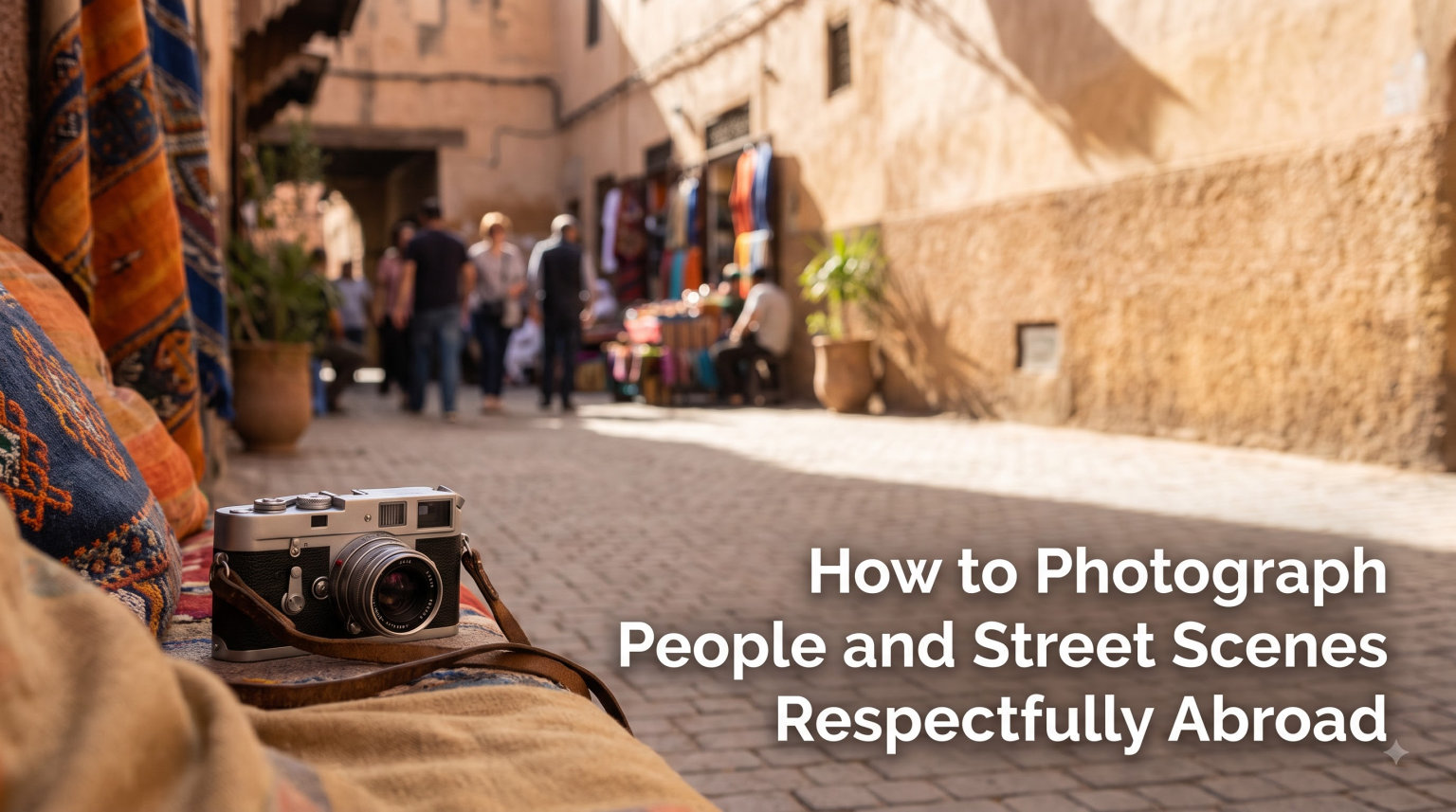
A vendor in a Marrakech market once turned his camera on me while I was fumbling with my own. For ten uncomfortable minutes, I understood exactly what it feels like to be on the other side of the lens. That single moment reshaped how I think about photographing people in countries that are not my own.
Many travelers feel a knot in their stomach when they want to photograph strangers abroad. You want authentic images, but you also do not want to be the oblivious tourist pointing a lens at someone’s life without a second thought. The tension between capturing a great shot and respecting another person’s dignity is real.
This guide breaks down exactly how to photograph people respectfully abroad. You will learn practical permission scripts, regional cultural differences, legal basics for public and private spaces, and smart alternatives when direct portraits are not possible. Whether you are shooting street scenes in Tokyo or market life in Ghana, these principles will help you create images that honor the people in them.
Table of Contents
The Golden Rule of Ethical Travel Photography
Ethical travel photography starts with one simple principle: treat the people you photograph the way you would want to be treated if a stranger pointed a camera at you. If you would feel uncomfortable, exploited, or confused in their position, you should not take the shot. This golden rule cuts through every complicated situation you will encounter abroad.
When I think back to that market in Marrakech, I remember how exposed I felt. A stranger was documenting my awkwardness without asking, without speaking to me, and without any exchange. That experience taught me that photography is never one-directional. Every photo involves a relationship between the photographer and the subject, even if that relationship lasts only a few seconds.
What Informed Consent Means in Photography
Informed consent in photography means your subject understands that you want to take their picture, agrees to it, and has a genuine opportunity to decline. A quick nod after you raise your camera is not informed consent. That gesture is often a polite deflection, not permission.
True informed consent happens when you make your intentions clear before the shutter clicks. You communicate through words, gestures, or a smile and raised camera. Then you wait for an actual response. If the response is ambiguous, treat it as a no.
Documentary Photography vs Portrait Photography
Documentary photography captures people as they are, going about their lives, often without posing. Portrait photography is a collaboration between photographer and subject, where both agree to create a specific image. The ethical expectations differ for each approach.
For documentary street scenes, the ethical standard is lower because you are capturing a scene rather than singling out an individual. But if a person becomes the clear focus of your frame, you are drifting into portrait territory. At that point, permission becomes important regardless of your original intent.
Photographers on Reddit’s street photography communities often debate this line. The general consensus is that if someone is recognizable in your photo and they are the subject rather than background context, you owe them enough respect to at least consider their comfort.
How to Ask Permission to Photograph People Abroad
Asking permission to photograph someone abroad is simpler than most beginners think. The key is to make the request before raising your camera, keep it light and friendly, and always be ready to accept a no without pushing. People respond far better to genuine human connection than to a lens pointed at their face.
Here is a step-by-step approach I have used across more than thirty countries:
Step 1: Make eye contact and smile before anything else. A warm expression signals that you see them as a person, not a subject.
Step 2: Start a brief conversation if the language barrier allows it. Ask where they are from, compliment their stall, or comment on the weather. Even thirty seconds of interaction changes the dynamic entirely.
Step 3: Raise your camera slowly while pointing to it, then look at them with a questioning expression. This universal gesture works across nearly every culture. If they nod or smile, you have your answer. If they wave you off or look away, move on immediately.
Step 4: After taking the photo, show them the result on your camera screen. This simple act of sharing transforms the interaction from extraction into exchange.
Step 5: Say thank you in their language. Even a badly pronounced attempt shows respect and effort.
Permission Scripts for Different Scenarios
Different settings call for different approaches. Here are practical scripts I have refined through years of trial and error:
In a market: Browse the stall first, buy something small if you can, then ask. “Your products are beautiful, could I take a photo?” The transaction creates goodwill and gives you a natural reason to be there.
On the street: Keep it quick and genuine. “I love your style, would you mind if I took your photo?” Confidence matters more than perfect phrasing.
In a rural village: Find the village elder or local authority figure first. Explain who you are and why you are photographing. Getting community buy-in before approaching individuals prevents misunderstandings.
At a religious site: Always check for signage first. Many temples, mosques, and churches have specific photography rules. When in doubt, ask an official or priest before photographing worshippers.
Overcoming Language Barriers
Language barriers are the most common reason travelers skip asking permission. But you do not need fluency to communicate respect. A translation app on your phone can bridge most gaps in under ten seconds.
Before a trip, I learn five key phrases in the local language: hello, thank you, may I take a photo, beautiful, and sorry. These five phrases have opened more doors than any expensive lens I own. People appreciate the effort even when your pronunciation is terrible.
Body language does the rest. Pointing to your camera, smiling, and gesturing toward the person with a questioning look communicates your intent clearly. The universal language of respect is louder than any spoken word.
Cultural Sensitivity and Legal Basics by Region
Cultural attitudes toward photography vary dramatically around the world, and understanding these differences before you travel prevents embarrassing or dangerous mistakes. What is acceptable in Berlin might be offensive in Riyadh, and what passes without comment in Bangkok could get you arrested in Abu Dhabi. Research is not optional. It is part of being a responsible photographer abroad.
Pre-Travel Research Checklist
Before photographing people in any new country, work through this checklist:
Check the local photography laws, especially regarding publishing photos of identifiable people. Research religious and cultural restrictions on photography at sacred sites. Learn whether there are communities or neighborhoods where photography is culturally inappropriate. Find out if permits are required for professional or commercial photography. Read recent traveler reports about local attitudes toward cameras.
Regional Attitudes Toward Photography
Here is what I have learned about cultural differences across major regions:
In Middle Eastern countries, photographing women is often culturally sensitive and sometimes legally restricted. Always ask permission, and accept that many women will decline. Government buildings, military installations, and airports are frequently off-limits. Countries like the UAE and Saudi Arabia have strict laws about photographing certain subjects, and violations can result in detention.
In East and Southeast Asia, attitudes are generally more relaxed in tourist areas, but rural communities and indigenous groups may have specific concerns. In Japan, for example, photography is common on streets, but some areas have started posting no-photography signs due to tourist overload. In Southeast Asian countries like Thailand and Cambodia, monks have specific rules about being photographed, especially with or near women.
In African countries, reactions vary widely by region and community. Some communities, particularly in East Africa, have grown wary of photographers due to decades of exploitative documentary photography. Always approach with extra sensitivity, and consider working through a local guide who understands community dynamics.
In European countries, street photography is generally accepted, but privacy laws are actually stricter than many people realize. France and Germany have strong portrait rights that give subjects control over how their image is used commercially. The legal standard may differ from the ethical one, but both deserve attention.
Legal Rights vs Ethical Responsibilities
Can you legally photograph someone without their permission in public? In most countries, yes. Public spaces generally carry no expectation of privacy, meaning photographers have broad legal rights to capture what they see. But this is where the Rick Steves travel forum makes an important point that every traveler should hear: the legal answer and the ethical answer are two different questions.
Just because you can photograph someone does not mean you should. Laws set the floor for acceptable behavior. Ethics should set a higher standard. A traveler who hides behind legal rights while making locals uncomfortable is not a good photographer. They are just a legal one.
Restricted Areas and Sensitive Subjects
Certain subjects are restricted or sensitive almost everywhere. Avoid photographing military installations, police officers, border crossings, airports, government buildings, and critical infrastructure like dams and power plants. Many countries treat these as security matters, and the consequences can be serious.
Religious sites deserve special caution. Some prohibit photography entirely, others allow it in certain areas but not others, and many have different rules for the exterior versus the interior. When I visited a temple in Myanmar, photography was welcome in the courtyard but forbidden inside the prayer hall. These nuances matter, and signage is not always in English.
Children Photography Ethics
Here is the clearest rule in this entire guide: do not photograph children without explicit permission from their parents or guardians. This is the one area where nearly every experienced travel photographer, every ethics guide, and every responsible tourism organization agrees completely.
The impulse to photograph a smiling child in a colorful setting is understandable. But children cannot give informed consent, and photographing them raises serious safeguarding concerns. In some countries, doing so without permission can result in confrontation or legal trouble. When you see a child you want to photograph, find their parent, explain what you want, and accept whatever answer you receive.
Smart Alternatives When Direct Portraits Are Not Possible
When you cannot photograph people directly, you have more creative options than you might realize. Focusing on environmental details, hands at work, market produce, architectural textures, and candid wide scenes lets you capture the spirit of a place without making anyone uncomfortable. Some of my favorite travel photos contain no recognizable faces at all.
The “creepy” feeling that many beginners on photography forums describe usually comes from the sense of sneaking a shot. This feeling disappears when you shift your attention to subjects that do not involve a person’s identity. A weathered fisherman’s hands mending a net, the organized chaos of a spice market, or the play of light through a narrow alley all tell powerful stories without singling anyone out.
Capturing Street Scenes Without Faces
Wide environmental shots capture the energy of a street without focusing on individuals. Position yourself where foot traffic creates natural movement, use a slower shutter speed to suggest motion, and let the scene speak for itself. Silhouettes against bright backgrounds, backs of people walking away, and shots where figures are small within the frame all reduce the privacy concern while preserving the documentary feel.
Details tell stories too. A close-up of hands making bread, feet in colorful sandals, or goods arranged on a market table conveys culture and daily life powerfully. These images often resonate more deeply than a posed portrait because they feel authentic and unselfconscious.
Handling Rejection Gracefully
You will be told no. Probably often. This is not a failure. It is a normal part of respectful travel photography, and how you handle rejection matters as much as how you handle permission.
When someone declines, smile, nod, and walk away. Do not negotiate, do not explain why the photo would be great, and do not try again from a different angle. Persistence in the face of a no is what gives street photography a bad reputation. Accept the answer with the same grace you hoped for when you asked.
Forum discussions reveal that rejection is far more common than confrontation. Most people who do not want to be photographed simply wave you off or turn away. The dramatic confrontations that travelers fear are rare, and they almost always happen when someone feels they were photographed secretly without consent.
Photography as Cultural Exchange
The most meaningful approach to travel photography treats it as an exchange rather than an extraction. You are not just taking a photo. You are participating in a moment of cultural connection, however brief.
Spend time with people before and after photographing them. Ask about their lives, share something about yours, and show genuine interest. When I spent an afternoon with a family in rural Vietnam, the photos I took at the end of our visit were completely different from anything I could have captured as a passing stranger. The trust was visible in every frame.
Should You Pay for Photographs?
Payment for photographs is one of the most debated topics in ethical travel photography. The general guidance from responsible tourism organizations is to avoid paying for posed photos because it can create transactional expectations and undermine authentic interactions.
However, there are exceptions. In some cultures, tipping is a normal part of the exchange. If someone has given you significant time, such as a market vendor who posed for multiple shots, a small tip or purchase from their stall is appropriate. If you are photographing a performer, artisan, or someone whose livelihood depends on their craft, paying is not exploitation. It is fair compensation.
The key distinction is between compensating someone for their time and paying someone to perform for your camera. The first respects their labor. The second turns them into a prop.
Technology Tips for Giving Back
One of the best ways to make photography an exchange is to give something back to your subject. A small portable photo printer, like a Polaroid or Instax camera, lets you hand someone a physical print on the spot. I have seen faces light up in places from Peru to Indonesia when I handed over a small instant photo.
If you do not carry a printer, offer to email or message digital copies. This requires exchanging contact information, which itself deepens the connection. Some of my most rewarding photography relationships started with a promise to send photos and turned into ongoing conversations.
Camera Settings for Respectful Street Photography
If you are photographing busy street scenes, a few technical choices help you work quickly and unobtrusively. Use a wide aperture for environmental portraits so you can shoot in available light without flash. A shutter speed of at least 1/250 freezes moving subjects. Pre-focus your lens to a comfortable working distance so you do not fumble when the moment arrives. Working quickly shows respect for your subject’s time.
The 80/20 rule in photography, which comes up frequently in SERP questions, means spending 80 percent of your effort on composition, connection, and context, and 20 percent on technical settings. The best street photographers are not the ones with the sharpest images. They are the ones who made their subjects feel comfortable enough to be themselves.
Frequently Asked Questions
What are the ethical considerations in travel photography?
The main ethical considerations in travel photography are obtaining informed consent, respecting cultural and religious sensitivities, avoiding exploitation of vulnerable communities, being transparent about your intentions, and treating photography as a cultural exchange rather than extraction. Always ask yourself whether the person in your frame would feel respected by how you are capturing and using their image.
Can you legally photograph someone without their permission?
In most countries, you can legally photograph people in public spaces without explicit permission because public spaces carry no expectation of privacy. However, laws vary significantly by country, and using photos commercially typically requires a model release. Legal permission does not equal ethical permission, so always consider both the law and the impact on your subject.
Is it ethical to take photos of people in public?
Taking photos of people in public can be ethical if you follow basic principles: ask permission when someone is the clear focus of your image, avoid photographing people in vulnerable or compromising situations, never photograph children without parental consent, and be transparent about your intentions. Wide street scenes where no individual is singled out are generally more ethically straightforward than tight portraits of strangers.
What is the 80 20 rule in photography?
The 80/20 rule in photography suggests spending 80 percent of your effort on connection, composition, and storytelling, and 20 percent on technical camera settings. In street and travel photography specifically, this means prioritizing the relationship with your subject and the meaning of the image over perfect exposure or sharpness. The most memorable photos come from moments of genuine human connection, not technical perfection.
How do you photograph street scenes while traveling?
To photograph street scenes while traveling, research local customs and laws first, walk areas without your camera to understand the rhythm of a place, use a wide or standard lens for environmental context, work quickly to avoid disrupting the scene, and capture details and movement rather than singling out individuals. Focus on telling the story of the place through atmosphere, light, and the energy of daily life rather than posed portraits.
Putting It All Together
Learning how to photograph people respectfully abroad is not about memorizing a list of rules. It is about developing a mindset that puts human dignity above the perfect shot. When you treat every person in your frame as a collaborator rather than a subject, your photography changes in ways that go far beyond technique.
The travelers who create the most powerful images are not the ones with the best gear or the most aggressive approach. They are the ones who take time to connect, who accept rejection without resentment, and who give back as much as they take. That approach produces photos with something no camera setting can replicate: genuine trust between photographer and subject.
As you head out on your next trip, carry these principles with you alongside your camera. Research your destination, learn a few words of the local language, ask before you shoot, and be generous with your gratitude. The best travel photographs are not taken. They are shared.