
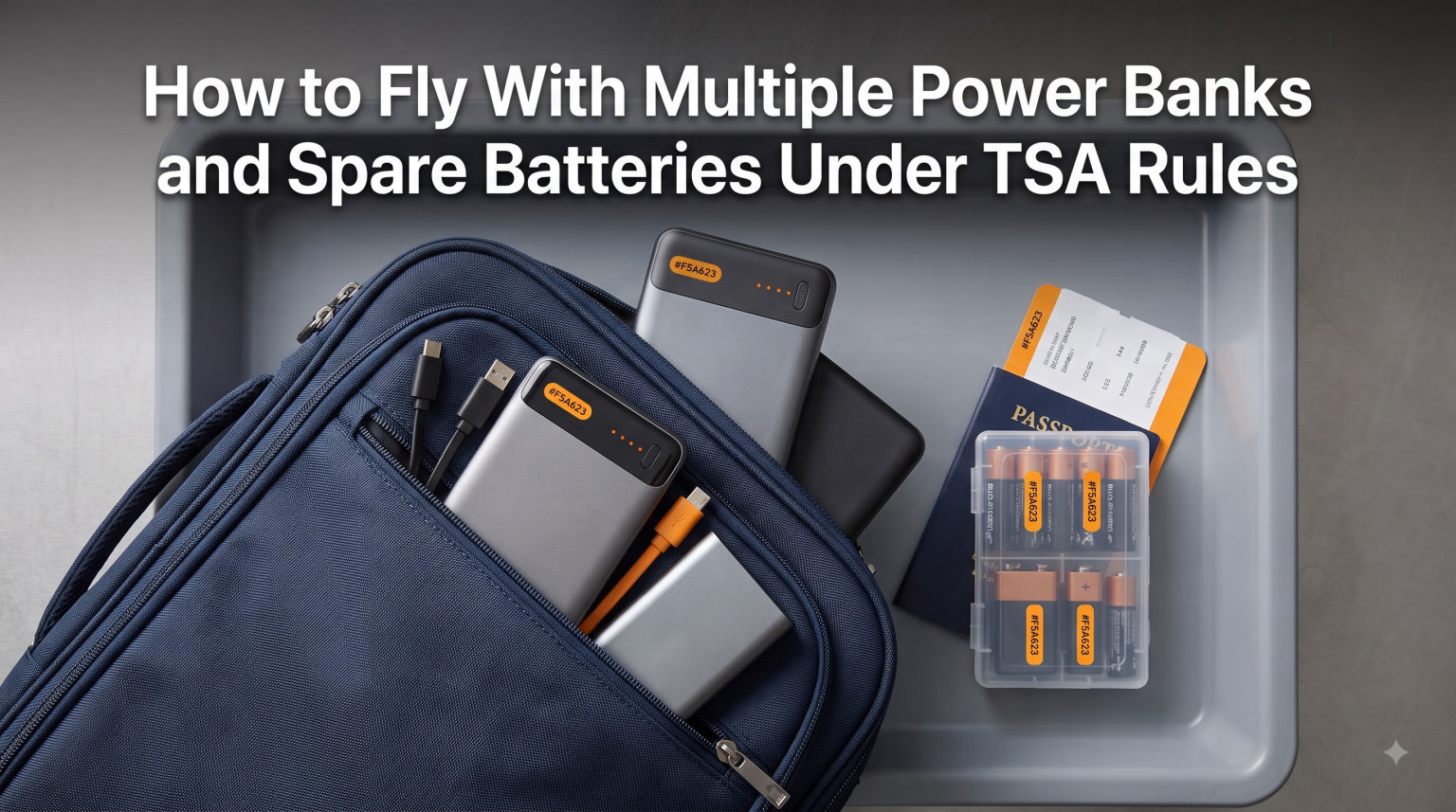
Yes, you can fly with multiple power banks and spare lithium batteries under TSA rules, but they must go in your carry-on baggage, stay under specific watt-hour limits, and have their terminals protected. The most important rule to remember is simple: spare lithium batteries, including all power banks and portable chargers, are prohibited in checked luggage under FAA regulation 49 CFR 175.10(a)(18).
If you are traveling with several devices, a phone charger, a laptop, camera gear, or a drone, you probably have more lithium batteries in your bag than you realize. Understanding how to fly with multiple power banks and spare batteries under TSA rules keeps you compliant, avoids confiscation at security, and helps you board without stress.
Our team has dug through the TSA, FAA, and major airline policies, cross-referenced forum discussions from real travelers, and broken down the math so you do not have to guess. This guide covers the watt-hour limits, the mAh-to-Wh conversion formula, quantity rules for multiple power banks, terminal protection methods, airline-specific variations including the new 2026 American Airlines visibility requirement, and exactly what to do if your carry-on gets gate-checked.
Table of Contents
The Quick Rules at a Glance
Here are the core TSA and FAA rules for power banks and spare lithium batteries, current as of 2026. Every rule below applies to flights departing from or within the United States.
- Carry-on only: All spare lithium batteries and power banks must be packed in carry-on baggage. They are banned from checked luggage.
- Under 100 watt-hours (Wh): Allowed in carry-on with no special approval needed. No quantity limit for personal use.
- 101 to 160 Wh: Allowed only with advance airline approval. Maximum 2 spare batteries per passenger.
- Over 160 Wh: Prohibited on passenger aircraft entirely.
- Terminal protection required: Spare battery terminals must be protected against short circuits using original packaging, tape, or individual pouches.
- Devices with installed batteries: Laptops, phones, and cameras with batteries inside can go in either carry-on or checked bags.
Carry-On vs Checked Bag: The One Rule That Matters Most
The single most important TSA rule for power banks and spare batteries is this: they must travel in your carry-on bag, never in checked luggage. This applies to every type of spare lithium-ion battery, including power banks, portable phone chargers, external battery packs, charging cases, and loose spare batteries for cameras or laptops.
The reason comes down to fire safety. Lithium-ion batteries can experience thermal runaway, a chemical reaction that generates intense heat and can ignite surrounding materials. In a checked luggage hold, a battery fire is invisible and extremely difficult for the crew to reach. In the cabin, flight attendants can detect a problem early and respond immediately using fire containment bags or extinguishers.
The FAA enforces this rule under 49 CFR 175.10(a)(18), which classifies spare lithium batteries as hazardous materials when packed in checked baggage. TSA officers at security checkpoints are trained to identify loose lithium batteries during x-ray screening, and checked bags are scanned separately for prohibited hazmat items before loading.
One distinction that trips people up: a battery installed inside a device (like your laptop battery or phone battery) can travel in either carry-on or checked luggage. It is only spare or uninstalled batteries that are restricted to carry-on. If your power bank is removable from a device, treat it as a spare battery.
Watt-Hour Limits Explained: 100Wh, 160Wh, and Beyond
TSA and FAA rules sort lithium-ion batteries into three tiers based on their energy capacity, measured in watt-hours (Wh). The tier your battery falls into determines whether it can fly and whether you need airline approval.
Tier 1: Under 100 Wh (standard). This covers the vast majority of consumer power banks. No airline approval is needed. You can bring these in your carry-on bag for personal use without quantity restrictions. Most phone chargers, including 10,000mAh and 20,000mAh power banks, fall into this category.
Tier 2: 101 to 160 Wh (with airline approval). Batteries in this range are allowed only if you get advance approval from your airline. You are limited to a maximum of 2 spare batteries in this tier per passenger. These are typically larger power stations or professional equipment batteries.
Tier 3: Over 160 Wh (prohibited). No spare lithium-ion battery exceeding 160 Wh is permitted on passenger aircraft. If you need to transport a larger battery, it must ship as cargo under separate hazmat regulations.
Lithium metal batteries (non-rechargeable, like some watch and camera batteries) follow a different standard: they are limited to 2 grams of lithium content, which roughly translates to about 8 grams equivalent. Most consumer lithium metal batteries fall well under this limit.
How to Calculate Watt-Hours from mAh
Most power banks advertise their capacity in milliamp-hours (mAh), but TSA and FAA rules are written in watt-hours (Wh). You need to convert mAh to Wh to know which tier your battery falls into. The formula is straightforward.
The mAh to Wh formula: Wh = (mAh x voltage) / 1000
Most power banks use lithium-ion cells with a nominal voltage of 3.7 volts. Using 3.7V as the standard voltage, the simplified formula becomes: Wh = mAh x 3.7 / 1000.
Here is how common power bank sizes convert:
- 5,000mAh: 5,000 x 3.7 / 1000 = 18.5 Wh (well under the limit)
- 10,000mAh: 10,000 x 3.7 / 1000 = 37 Wh (comfortably allowed)
- 20,000mAh: 20,000 x 3.7 / 1000 = 74 Wh (allowed, no approval needed)
- 26,800mAh: 26,800 x 3.7 / 1000 = 99.2 Wh (just under 100Wh, still allowed)
- 27,000mAh: 27,000 x 3.7 / 1000 = 99.9 Wh (right at the line, check your specific battery)
- 30,000mAh: 30,000 x 3.7 / 1000 = 111 Wh (over 100Wh, requires airline approval)
- 40,000mAh: 40,000 x 3.7 / 1000 = 148 Wh (requires airline approval, max 2 per passenger)
The exact voltage matters. Some larger power banks list their Wh rating directly on the label. Always check the printed specifications on your battery first. If the Wh is printed, use that number. If only mAh is listed, use the formula above with 3.7V.
A common question from travelers: Can I bring two 20,000mAh power banks on a plane? Yes. Each 20,000mAh bank is approximately 74 Wh, well under the 100Wh threshold. You can bring multiple banks under 100Wh without quantity restrictions for personal use.
Quantity Limits: How Many Power Banks Can You Bring?
This is where confusion sets in for most travelers. The FAA and TSA rules create two different quantity scenarios depending on the watt-hour rating of your batteries.
For power banks under 100 Wh: There is no specific numeric limit for personal use. The FAA states that “loose lithium batteries” for personal electronics are permitted in carry-on baggage. In practice, this means you can bring several standard power banks, spare camera batteries, and phone charging cases as long as they are each under 100 Wh and properly protected.
For batteries between 101 and 160 Wh: You are limited to a maximum of 2 spare batteries per passenger, and you must obtain advance approval from the airline. This limit applies per person, not per bag.
Airline-specific policies may tighten these rules. For example, American Airlines limits passengers to 2 portable chargers per person while onboard, and Southwest Airlines restricts customers to a single power bank in the cabin. We cover these variations in detail in the airline section below.
If you are a photographer, drone operator, or heavy electronics user wondering whether you can carry 3 or more spare lithium batteries: the answer is yes, as long as each battery is under 100 Wh, they are all in your carry-on, and their terminals are protected. The “2 battery” limit applies only to batteries in the 101 to 160 Wh range.
Terminal Protection: How to Prevent Short Circuits
TSA and FAA rules require that all spare lithium batteries have their terminals protected against short circuits. A short circuit happens when the positive and negative terminals of a battery come into contact with metal objects like keys, coins, or other batteries. This can cause rapid discharge, overheating, and fire.
There are several acceptable methods for terminal protection:
- Original retail packaging: Keep batteries in their original blister pack or box.
- Electrical tape: Place tape over the exposed terminals of each battery.
- Individual plastic cases: Use dedicated battery cases or sleeves, which many power banks and camera batteries ship with.
- Original battery pouches: Many spare batteries come with a small cloth or plastic pouch designed to isolate the terminals.
Do not simply toss loose batteries into a bag with metal items. TSA officers may flag unprotected spare batteries during screening, and improperly packed batteries can be confiscated. For power banks with built-in USB ports, the terminals are typically recessed or covered by design, but exposed metal contact points should still be covered.
One tip from frequent travelers on travel forums: keep each spare battery in its own clear plastic bag or dedicated slot in your carry-on. This makes screening faster and keeps terminals isolated from each other and from other metal objects.
Airline-Specific Power Bank Rules You Need to Know
TSA and FAA rules set the baseline, but individual airlines can impose stricter limits. If you are flying within or departing from the United States, check your specific airline’s policy before you pack. Here are the current rules for major US carriers.
American Airlines: Limits passengers to 2 portable chargers per person while onboard, with each charger not exceeding 100 Wh. As of 2026, American Airlines requires that power banks remain visible and easily accessible during the flight. They recommend storing power banks in the seatback pocket rather than in the overhead bin or under the seat in a closed bag. This visibility requirement was introduced to help crew respond quickly if a battery begins to overheat.
Southwest Airlines: Restricts customers to a single power bank per passenger. The power bank must be carried in the cabin, must not be placed in checked luggage, and must not exceed 100 watt-hours. Southwest has been increasing enforcement of this policy, with multiple travelers on Reddit reporting that gate agents now actively check for power banks and spare batteries during boarding.
United Airlines: Follows the standard FAA limits. Spare lithium batteries up to 100 Wh are allowed in carry-on with no special approval. Batteries between 101 and 160 Wh require advance approval and are limited to 2 per passenger. United does not currently specify a numeric cap on standard power banks for personal use.
Delta Air Lines: Also follows FAA baselines. Power banks and spare batteries must be in carry-on baggage. Delta recommends keeping battery terminals protected and advises passengers to remove spare batteries from bags if the bag must be gate-checked.
The key takeaway: TSA rules are the floor, not the ceiling. An airline can always impose tighter restrictions, and those restrictions take precedence once you are on their aircraft. When in doubt, check your airline’s website or call their customer service line before your flight.
What Happens If You Break the Rules
Violating TSA and FAA battery rules carries real consequences. At the security checkpoint, TSA officers who find loose lithium batteries in checked baggage or oversized batteries without approval will confiscate them. You will not be fined at the checkpoint, but you will lose your device.
The more serious consequences come from the FAA’s civil penalty authority. Passengers who violate hazmat regulations by packing spare lithium batteries in checked luggage can face civil penalties. The FAA has actively enforced these rules, particularly against passengers who attempt to transport prohibited batteries or who fail to declare large batteries requiring approval.
Real-world reports from travel forums paint a consistent picture. Reddit users on r/tsa and r/traveladvice describe having power banks pulled from checked bags during x-ray screening, with the bags held back and the batteries confiscated before loading. Travelers describe the experience as stressful, especially when it results in a delayed or missed bag.
The simplest way to avoid all of this: pack every power bank and spare battery in your carry-on, keep them under 100 Wh, protect the terminals, and check your airline’s specific quantity limits before you fly.
Gate-Checking and Power Bank Anxiety
One of the biggest pain points travelers raise in forums is gate-checking. When overhead bin space runs out, airlines ask passengers to gate-check their carry-on bags. If your power banks are inside that bag, you have a problem, because those bags go into the cargo hold where spare lithium batteries are prohibited.
Here is what to do if you face a gate-check situation:
- Remove power banks before handing over the bag. Take all spare batteries and power banks out and place them in your personal item (purse, small backpack, or pocket).
- Keep a small pouch ready. Pack a small zip pouch with your power banks and chargers that you can grab quickly when gate-checking is announced.
- Be proactive. If you know your flight is full and gate-checking is likely, move your power banks to your personal item before boarding.
- Speak up. If a gate agent tries to take a bag with power banks inside, politely explain that FAA regulations require spare lithium batteries to stay in the cabin. They are trained on this rule.
Reddit users report that gate agents are generally aware of the rule and will accommodate passengers who need to remove batteries. The anxiety comes from not knowing the rule yourself, which is why understanding the carry-on requirement ahead of time is so important.
Packing Checklist for Power Banks and Spare Batteries
Use this checklist before every flight to stay compliant with TSA rules and airline policies.
- Calculate the watt-hour rating of every power bank using the mAh-to-Wh formula, or check the printed label.
- Confirm every spare battery and power bank is under 100 Wh, or obtain airline approval for batteries between 101 and 160 Wh.
- Pack all power banks and spare batteries in your carry-on bag, never in checked luggage.
- Protect all battery terminals using original packaging, electrical tape, or individual cases.
- Check your airline’s specific power bank limit (Southwest allows 1, American allows 2, check United and Delta policies).
- Keep a small pouch accessible so you can quickly remove batteries if your carry-on gets gate-checked.
- If flying American Airlines, plan to keep power banks visible during the flight in a seatback pocket.
- Remove any damaged, swollen, or recalled batteries from your travel kit. These are prohibited on aircraft.
- For international flights, research the destination country’s aviation authority rules, which may differ from TSA baselines.
Damaged and Recalled Batteries
The FAA prohibits damaged or recalled lithium batteries on passenger aircraft entirely. This includes batteries that are swollen, dented, leaking, or showing signs of overheating. If your power bank has expanded, feels hot to the touch when not in use, or has a cracked casing, do not bring it on a plane.
Recalled batteries are subject to a specific prohibition. If a manufacturer has recalled your battery model, you cannot fly with it regardless of its condition or watt-hour rating. Check the Consumer Product Safety Commission recall database before traveling if you have any concerns about a specific battery model.
Dispose of damaged or recalled batteries at a designated recycling center or electronics retailer that accepts lithium batteries. Never throw a swollen lithium battery in regular trash or recycling.
Smart Bags and Built-In Batteries
If you travel with a smart bag that has a built-in battery for USB charging or GPS tracking, the battery must be removable. The FAA requires that the battery be taken out of the bag before it can be placed in checked luggage. If the battery cannot be removed, the entire bag must travel as carry-on.
Several major airlines have specific smart bag policies. Most require you to remove the battery before checking the bag, and the removed battery must then travel in your carry-on. If your smart bag battery exceeds 100 Wh, the same approval and quantity rules apply as for any other spare battery.
International Flight Considerations
TSA rules apply to flights departing from and within the United States. If you are flying internationally, the destination country’s aviation authority sets the rules for your return or connecting flights. Most international authorities follow similar guidelines to the FAA, but there are differences.
The International Civil Aviation Organization (ICAO) provides guidance that most countries adopt, including the 100Wh standard limit and the carry-on-only requirement for spare batteries. However, enforcement levels and specific quantity caps vary. Some international airlines are stricter than US carriers about the number of power banks allowed per passenger.
For flights to or from Europe, the European Union Aviation Safety Agency (EASA) follows rules closely aligned with FAA standards. For flights in Asia, check the specific airline, as carriers like Singapore Airlines, Cathay Pacific, and ANA may have their own quantity limits. Always verify the rules for your specific carrier and route.
Frequently Asked Questions
Can I bring multiple power banks on a flight?
Yes, you can bring multiple power banks on a flight as long as each one is under 100 watt-hours, they are all packed in your carry-on baggage, and their terminals are protected. The FAA does not set a specific numeric limit for personal-use power banks under 100 Wh. However, individual airlines may impose their own caps, so check your carrier’s policy before flying.
Can I bring two power banks on a plane?
Yes, you can bring two power banks on a plane. As long as each power bank is under 100 watt-hours and packed in your carry-on bag, there is no FAA restriction on bringing two. Southwest Airlines limits passengers to one power bank, so check your airline if you plan to bring more than one.
How many spare batteries can you bring on a plane?
For spare lithium batteries under 100 watt-hours, there is no specific FAA quantity limit for personal use. For batteries between 101 and 160 watt-hours, you are limited to 2 spare batteries per passenger and must obtain advance airline approval. All spare batteries must be in carry-on baggage with terminals protected.
Can I bring two 20000mAh power banks on a plane?
Yes, you can bring two 20,000mAh power banks on a plane. A 20,000mAh power bank at 3.7 volts equals approximately 74 watt-hours, which is well under the 100 Wh limit. Both power banks must be in your carry-on baggage. Check your airline’s specific quantity policy, as Southwest limits passengers to one power bank.
How strict is TSA with power banks?
TSA enforces power bank rules consistently. Officers are trained to identify lithium batteries during x-ray screening, and spare batteries found in checked luggage will be confiscated. Power banks over 160 watt-hours are prohibited entirely. TSA generally allows standard consumer power banks under 100 Wh in carry-on bags without issue, but individual airlines may enforce stricter quantity limits.
Do power banks have to be in carry-on luggage?
Yes, all power banks and spare lithium batteries must be packed in carry-on luggage. They are prohibited in checked baggage under FAA regulation 49 CFR 175.10(a)(18). This rule exists because lithium battery fires in the cargo hold are difficult for flight crews to detect and control. Batteries installed inside devices like laptops and phones can go in either carry-on or checked bags.
Is 30000mAh power bank allowed in flight?
A 30,000mAh power bank at 3.7 volts equals approximately 111 watt-hours, which exceeds the 100 Wh standard limit. You can bring it on a flight only if you obtain advance approval from your airline, and it counts toward the maximum of 2 spare batteries over 100 Wh per passenger. Without airline approval, a 30,000mAh power bank will not be allowed.
Can a passenger carry 3 spare lithium batteries?
Yes, a passenger can carry 3 or more spare lithium batteries if each one is under 100 watt-hours and they are packed in carry-on baggage with terminals protected. The 2-battery limit applies only to batteries in the 101 to 160 watt-hour range. Standard camera batteries, phone batteries, and power banks under 100 Wh have no specific FAA quantity cap for personal use.
Final Thoughts on Flying With Power Banks
Flying with multiple power banks and spare batteries under TSA rules is straightforward once you know the key principles. Pack everything in your carry-on, keep each battery under 100 watt-hours, protect the terminals, and check your airline’s specific quantity policy before you fly.
The rules exist for good reason. Lithium battery fires are serious, and keeping spare batteries in the cabin gives flight crews the ability to respond. By following the guidelines in this guide, you can travel with all the devices and chargers you need without worrying about confiscation, delays, or safety issues.
Before your next trip, calculate your watt-hours, pack a dedicated battery pouch, and verify your airline’s policy. A few minutes of preparation will save you from a stressful encounter at the security checkpoint or the boarding gate.