
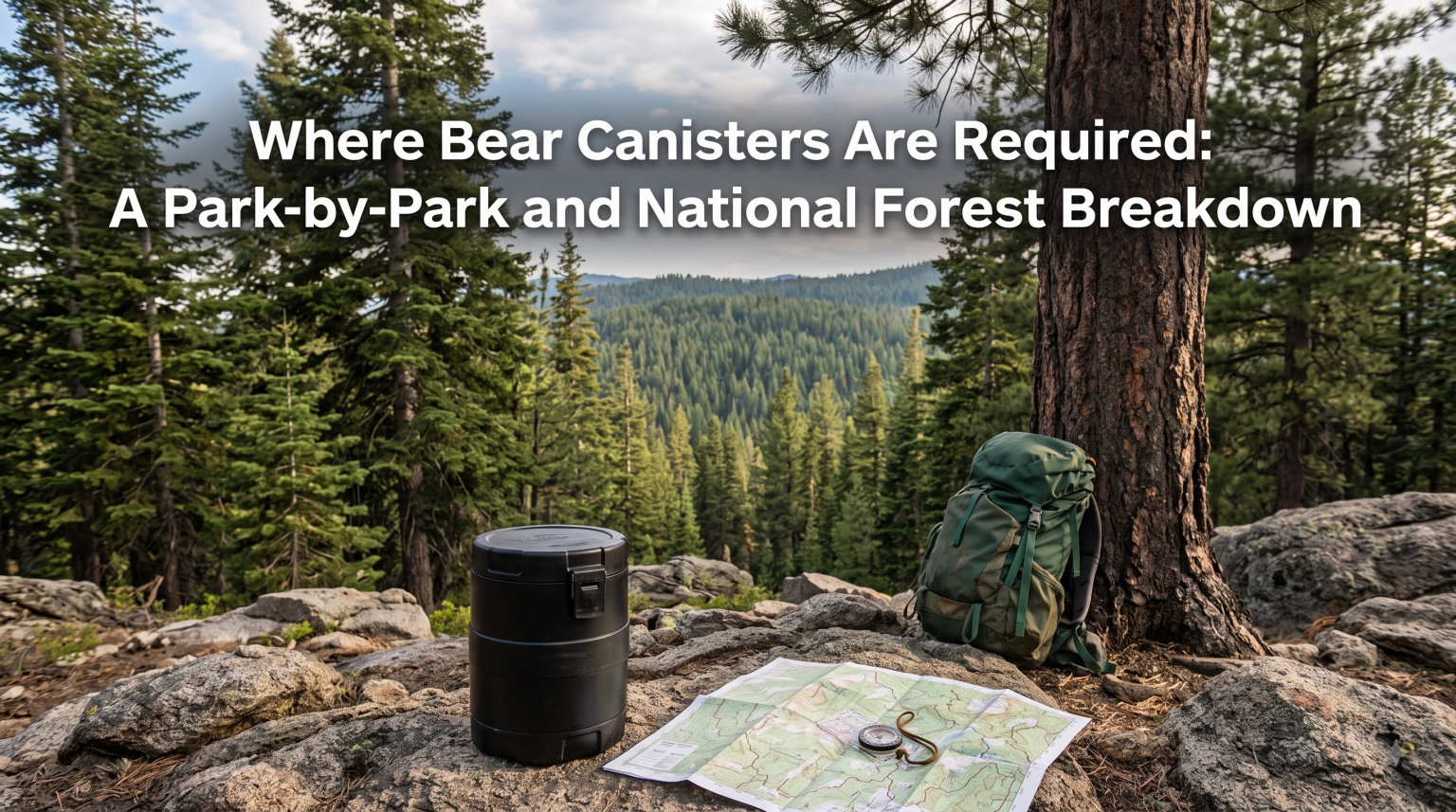
I’ve spent more than 200 nights in the backcountry, and the single piece of gear I never argue about packing is a bear canister. Not because I fear bears, but because I’ve watched a sow black bear rip through a friend’s Ursack in under four minutes near Tuolumne Meadows.
That moment rewired how I plan trips. Bear canister requirements aren’t a bureaucratic suggestion. They’re the difference between a recovering bear population and a dead food-conditioned bear. In 2026, the rules governing where bear canisters are required continue to expand as both black and grizzly bear populations grow across the West.
This guide breaks down every major national park, national forest, and long-distance trail with current bear canister requirements. Whether you’re planning a weekend in Yosemite, a section hike of the Pacific Crest Trail, or a trip to Denali, you’ll know exactly where hard-sided canisters are mandatory, where they’re seasonally required, and where you can save weight by going with a bear hang instead.
Table of Contents
Why Bear Canisters Matter for Wildlife and Hikers
Bear canister requirements exist because food-conditioned bears kill humans, and humans kill bears. That cycle is the entire reason the Interagency Grizzly Bear Committee and the Sierra Interagency Black Bear Group push for mandatory bear-resistant food storage in bear country.
When a bear gets into human food, it associates people with an easy meal. The next encounter rarely ends well. According to the National Park Service, food-conditioned bears are often relocated once and euthanized the second time they return. A single canister across multiple trips can keep a bear alive.
Beyond the wildlife argument, bear canisters protect your food and your trip. I’ve had raccoons chew through dry bags overnight in the Sierra, and mice contaminate food in a single evening. A hard-sided container solves both problems and keeps your backcountry food secure for the entire length of your trip.
The Legal Foundation Behind Bear Canister Requirements
Federal law requires proper food storage in wilderness areas managed by the U.S. Forest Service and National Park Service. Individual wilderness managers set specific rules, which is why bear canister requirements vary so much between parks and forests even when they’re adjacent to each other.
Most regulations trace back to the Wilderness Act of 1964 and the Code of Federal Regulations (36 CFR 261.58). Park superintendents and forest supervisors issue specific orders that determine which container qualifies as a bear-resistant food storage container in their jurisdiction.
National Parks With Year-Round Bear Canister Requirements
Year-round bear canister requirements apply in seven national parks where human food access has created chronic problems with food-conditioned bears. In these parks, every overnight visitor must carry an IGBC-approved canister or rent one at the visitor center.
Yosemite National Park
Yosemite requires bear-resistant food storage canisters for all overnight backcountry use, year-round, no exceptions. The park maintains a specific list of approved canisters, including the BearVault BV500, BearVault BV450, Bearikade Weekender, and Garcia Machine bear canisters.
Bear hangs are not permitted in Yosemite. This rule has been in place since 2026, when bears across the park learned to defeat bear hangs in less than two minutes. Rangers actively patrol trailheads and check packs, especially at the Lyell Canyon, Half Dome, and High Sierra camps.
You can rent a BearVault BV500 at the Yosemite Wilderness Center for a fee. Reservations are recommended from May through September, when rental inventory runs out by 10 a.m. most days.
Sequoia and Kings Canyon National Parks
Sequoia and Kings Canyon require bear-resistant food storage canisters in most wilderness zones, year-round. The General Grant Grove area and the John Muir Wilderness sections within these parks carry the requirement, including popular routes like the High Sierra Trail and the Rae Lakes Loop.
The parks accept canisters certified by the IGBC. Bear hangs are not a valid alternative. The rules apply to all overnight stays, including day hikers who camp along the route.
Rocky Mountain National Park
Rocky Mountain National Park requires bear-resistant food storage in all backcountry campsites, year-round. This rule took effect in 2026 and replaced the old bear-hang cable system that the park had maintained for decades.
Approved canisters include the BearVault BV500, Bearikade Weekender, and Garcia Machine containers. The park maintains a small rental program at the Beaver Meadows and Kawuneeche visitor centers, with daily fees that undercut most commercial rentals.
Olympic National Park
Olympic National Park requires bear canisters for all overnight backcountry use along the Pacific Coast, the Hoh rainforest, and the alpine interior. The rule is year-round and applies to all wilderness zones.
Olympic maintains a specific approved canister list that includes the BearVault BV500, Bearvault BV450, Bearikade Weekender, and the old-school Garcia Machine. Ursacks are not approved in Olympic’s coastal wilderness, where black bears have learned to chew through the fabric in minutes.
Glacier National Park
Glacier National Park requires bear-resistant food storage in all backcountry campsites, year-round. The park spans grizzly bear territory, and food storage rules are taken seriously by rangers at every trailhead.
Bear hangs and Ursacks are not accepted. IGBC-approved hard-sided canisters are required. Glacier maintains a rental program at the Apgar Visitor Center and the Many Glacier ranger station, with availability running out during peak July and August travel.
Denali National Park
Denali requires bear-resistant food storage for all overnight backcountry travel, year-round. The park is home to grizzly bears, and the rules extend to the entire wilderness zone, including the usually busier Savage River and Wonder Lake areas.
Most Denali visitors use the park’s rental program at the Backcountry Information Center. The daily fee is reasonable, and the canisters are inspected and cleaned between trips.
Great Smoky Mountains National Park
Great Smoky Mountains shifted to bear canister requirements in 2026 for most backcountry campsites, replacing the old bear cable system. The rule applies year-round to overnight users in the backcountry zone.
The park maintains a small rental supply at the Sugarlands Visitor Center and the Oconaluftee Visitor Center. Tan colored BearVault BV500 and BV450 canisters are most common, and IGBC certification is required.
National Parks With Seasonal Bear Canister Requirements
Seasonal bear canister requirements apply to parks where bear activity peaks during specific months. Outside the seasonal window, hikers may be able to use bear hangs or cable systems, depending on park rules.
Yellowstone National Park
Yellowstone requires bear-resistant food storage in all wilderness areas from April 1 through October 31. This seasonal rule applies to overnight backcountry users across the entire park.
Outside the seasonal window (November through March), bear hangs are permitted in most Yellowstone backcountry zones, though the park still recommends carrying a canister. The approved canister list includes all IGBC-certified products, plus several park-specific approved models.
Grand Teton National Park
Grand Teton requires bear-resistant food storage from April 1 through October 31. The rule applies to all overnight trips in the Teton wilderness, including the popular Paintbrush Divide and Cascade Canyon routes.
From November through March, bear hangs are allowed. The park’s approved canister list matches IGBC standards, with the BearVault BV500 and Bearikade Weekender being the most common choices.
Grand Canyon National Park
The Grand Canyon requires bear-resistant food storage in the Inner Canyon corridor, year-round, but only in the corridor zone. Above the rim and in most outlying wilderness areas, bear hangs are allowed.
The corridor rule applies to Bright Angel Campground, Cottonwood Campground, and Indian Garden. Rim-to-rim runners and overnight backpackers in the corridor must carry an IGBC-approved canister.
North Cascades National Park
North Cascades requires bear-resistant food storage in most backcountry zones from June 1 through October 31. Outside that window, bear hangs are permitted in most areas.
The park shares wildlife management with the Okanogan-Wenatchee National Forest, which maintains its own seasonal canister requirements on the eastern approach.
National Forests With Bear Canister Requirements
National forest land falls under U.S. Forest Service jurisdiction, and rules vary by forest and ranger district. I’ve listed the most common forests with bear canister requirements, organized by region.
California National Forests
The Inyo, Sierra, and Humboldt-Toiyabe National Forests all require bear-resistant food storage in designated wilderness zones. The rule applies to the Mount Whitney, John Muir, and Hoover wilderness areas, with year-round enforcement in most cases.
Sequoia and Stanislaus National Forests have requirements in the Emigrant and Carson-Iceberg wilderness zones. The Eldorado and Tahoe National Forests require canisters in the Desolation Wilderness and Mokelumne Wilderness zones, respectively.
Colorado National Forests
The San Juan, Gunnison, and White River National Forests require bear-resistant food storage in most designated wilderness areas. The rule applies to the Weminuche, Maroon Bells-Snowmass, and Flat Tops wilderness areas, with year-round enforcement.
Pike and San Isabel National Forests require canisters in the Lost Creek Wilderness and parts of the Collegiate Peaks Wilderness. Routt National Forest requires canisters in the Mount Zirkel Wilderness.
Wyoming National Forests
Bridger-Teton National Forest requires bear-resistant food storage in the Teton, Washakie, and Gros Ventre wilderness areas year-round. The rule applies to all overnight backcountry camping.
Shoshone and Bighorn National Forests have similar requirements in their wilderness zones. The Medicine Bow National Forest requires canisters in the Snowy Range Wilderness area.
Washington National Forests
The Okanogan-Wenatchee and Mt. Baker-Snoqualmie National Forests require bear-resistant food storage in the Alpine Lakes, Glacier Peak, and Pasayten wilderness areas, with year-round enforcement.
Gifford Pinchot National Forest requires canisters in the Goat Rocks Wilderness. Olympic National Forest is a separate jurisdiction, but the rules are similar to the surrounding national forests.
Montana and Idaho National Forests
Flathead, Lolo, and Beaverhead-Deerlodge National Forests (Montana) require bear-resistant food storage in most wilderness zones, especially in grizzly bear territory. The rule applies year-round.
The Clearwater, Nez Perce, and Sawtooth National Forests (Idaho) have similar requirements in their wilderness areas, including the Selway-Bitterroot and Sawtooth zones.
Long-Distance Trail Bear Canister Requirements
Long-distance trails cross multiple jurisdictions, so bear canister requirements can change from one section to the next. Thru-hikers need to plan for the strictest jurisdiction along the route.
Pacific Crest Trail (PCT)
The PCT crosses federal land in California, Oregon, and Washington. Bear canister requirements apply in the Sierra Nevada section of California, including Yosemite, Sequoia, and Kings Canyon National Parks, plus the Inyo, Sierra, and Humboldt-Toiyabe National Forests.
Most PCT thru-hikers send a bear canister ahead for the Sierra section. Outside the Sierra, the trail crosses national forest land where canister requirements are less consistent, but a canister is still recommended.
Appalachian Trail (AT)
The AT does not have system-wide bear canister requirements. Most of the trail runs through national forest land where bear hangs are permitted, and Great Smoky Mountains National Park is the only major jurisdiction with mandatory canisters.
Thru-hikers typically don’t carry a bear canister on the AT. Local regulations apply in the Smokies, and some state parks along the trail have specific food storage rules.
Continental Divide Trail (CDT)
The CDT crosses federal land in Montana, Wyoming, Colorado, and New Mexico. Bear canister requirements apply in the San Juan, Weminuche, and Flat Tops wilderness areas, plus Yellowstone and Grand Teton National Parks.
CDT thru-hikers typically carry a bear canister for the Colorado and Wyoming sections. In New Mexico, the trail crosses the Gila Wilderness, where bear hangs are generally permitted.
John Muir Trail (JMT)
The JMT runs through Yosemite, Sequoia, and Kings Canyon National Parks, all of which require bear-resistant food storage. Every overnight user on the JMT must carry an IGBC-approved canister.
The JMT has a specific bear canister requirement that applies to the entire trail, regardless of which park you start in. Rental canisters are available at the Yosemite Wilderness Center, and most JMT permits include a canister as part of the backcountry permit fee.
State-by-State Bear Canister Requirements
State-by-state rules vary widely. I’ve summarized the key states with extensive bear country and meaningful bear canister requirements.
California
California has the most extensive bear canister requirements in the country. The state manages the Sierra Nevada bear population through coordinated regulations across state and federal land.
Bear canisters are required in Yosemite, Sequoia, Kings Canyon, Lassen Volcanic, and most Sierra Nevada wilderness zones. The state parks in the Sierra require canisters for overnight backcountry use as well.
Colorado
Colorado requires bear-resistant food storage in the Weminuche, Maroon Bells-Snowmass, Flat Tops, Mount Zirkel, and Lost Creek wilderness areas. The rule applies year-round to overnight backcountry users.
Outside designated wilderness, Colorado state parks have their own food storage rules. The state also requires canisters in the Collegiate Peaks Wilderness, including the famous Four Pass Loop.
Alaska
Alaska requires bear-resistant food storage in all bear country, including Denali, Katmai, and Lake Clark National Parks. The rule applies to all overnight backcountry camping in grizzly bear habitat.
Alaska’s bear canister rules are stricter than most Lower 48 states because grizzly bear densities are higher. IGBC-approved canisters are required, and bear hangs are not permitted in most parks.
Washington
Washington requires bear-resistant food storage in Olympic, North Cascades, and Mount Rainier National Parks. The rule applies year-round in Olympic and seasonally in North Cascades and Mount Rainier.
Washington state parks in the Cascades have additional requirements, especially in the Cascade Loop and Mount Si areas. The Okanogan-Wenatchee and Mt. Baker-Snoqualmie National Forests require canisters in their designated wilderness zones.
Wyoming
Wyoming requires bear-resistant food storage in Yellowstone, Grand Teton, and most Bridger-Teton National Forest wilderness areas. The rule applies year-round in most cases.
Wyoming state parks in the Tetons and Wind River Range have additional requirements. The Wind River Range has seen multiple bear encounters in recent years, and canister use is strongly recommended even where not required.
Understanding IGBC Certification
IGBC stands for the Interagency Grizzly Bear Committee, a coalition of federal, state, and tribal agencies that sets standards for bear-resistant products in grizzly bear habitat. The Sierra Interagency Black Bear Group (SIBBG) sets similar standards for black bear country in the Sierra Nevada.
To be IGBC-certified, a bear canister must pass a 60-minute test with captive grizzly bears. The canisters are tested at the Grizzly and Wolf Discovery Center in West Yellowstone, Montana, and only products that survive the test make the approved list.
Common Approved Canisters
The BearVault BV500 is the most widely used IGBC-approved canister. It weighs 2 pounds 12 ounces and holds about 700 cubic inches of food. The BV450 is a smaller version that’s popular with ultralight hikers.
The Bearikade Weekender is the lightest IGBC-approved canister, weighing 1 pound 11 ounces. It’s only available direct from the manufacturer, and production runs sometimes sell out months in advance.
The Garcia Machine bear canister is the oldest IGBC-approved design. It’s heavier than the BearVault but cheaper, and remains the most common rental canister at national park visitor centers.
Ursack is not IGBC-approved for most grizzly bear country. The fabric versions can be defeated by persistent grizzlies, although the Ursack Major and AllMitey lines are increasingly accepted in black bear country.
Bear Canisters vs. Bear Hangs
Bear hangs are still permitted in many national forest wilderness areas, but most national parks have moved to mandatory canisters. The reason is simple: scientific testing has shown that bears can defeat a properly hung bear bag in under four minutes.
The standard PCT method of hanging a bear bag requires throwing a rope over a branch at least 15 feet off the ground and 6 feet from the trunk. In the Sierra Nevada, biologists have documented bears defeating this method in under 90 seconds.
Hard-sided canisters eliminate the human-error component of food storage. You don’t need to find the right tree, you don’t need to throw a rope, and you don’t need to worry about bears learning your route. Set the canister 100 feet from your camp, and you’re done.
Penalties for Non-Compliance
Penalties for not carrying a bear canister where required typically start at fines of $500 to $5,000, depending on the jurisdiction. Most parks and forests issue mandatory court appearances, and repeat offenders can have their backcountry permits revoked.
In Yosemite, non-compliance fines typically start at $250 for first-time offenders and can exceed $5,000 for repeat offenders. The park also reports violations to the federal court system, which can result in additional penalties.
Beyond fines, rangers can require you to leave the wilderness. If you’re caught without a canister on a multi-day trip, you’ll be asked to hike back to the trailhead, which can be a serious safety risk in remote terrain.
Where to Rent Bear Canisters
Most major national parks with canister requirements run rental programs at visitor centers and ranger stations. Rental fees typically range from $5 to $10 per day, with multi-day discounts available.
Yosemite, Grand Teton, Yellowstone, Rocky Mountain, Glacier, and Denali all maintain on-site rental programs. Inventory runs out during peak season, so reserve your canister when you pick up your backcountry permit.
Outdoor outfitters near major trailheads also rent canisters. In the Sierra, outfitters in Bishop, Lone Pine, and Mammoth Lakes rent canisters for the JMT and Mt. Whitney routes. In the Rockies, outfitters in Estes Park, Grand Lake, and Jackson rent canisters for the Colorado and Wyoming wilderness.
Some thru-hiker services ship canisters along the route. For the PCT, services like BearVault Forward and Zero Resupply ship canisters to specific trail mile markers for a flat fee. This option is popular with Sierra section hikers who don’t want to carry a canister from the start.
Tips for Using Bear Canisters Effectively
My first bear canister trip was a disaster. I packed the canister with food, opened it four times to organize, and lost track of everything. Here’s what I’ve learned since:
First, plan your meals to fit the canister. The BV500 holds about 7 days of food for one person, but only if you pre-measure and use dehydrated meal pouches. Loose bags of trail mix waste a lot of space.
Second, store the canister 100 feet from your camp, downwind if possible. This prevents curious bears from approaching your tent while you’re handling the canister at night.
Third, keep the canister closed except when packing or cooking. Open canisters attract bears with smell, and even a few seconds of exposure can put your food at risk.
Fourth, pack a small towel to wipe down the canister after meals. Food residue on the outside is a major attractant, and a quick wipe at night keeps the smell down.
Fifth, use a canister pad to reduce noise. Many squirrels and marmots will chew on hard plastic canisters if they hear food inside. A foam pad wrapped around the canister reduces noise and discourages wildlife.
What to Do If You Don’t Have a Bear Canister
If you arrived at the trailhead without a canister and the park requires one, you have a few options. First, check the visitor center or ranger station for rental availability. Most parks keep a small inventory for walk-ins, especially early in the morning.
Second, ask about donation canisters. Many parks have a small supply of donated canisters that they lend to hikers in need. You may be asked to leave a credit card or fill out paperwork.
Third, switch your trip. If you can’t get a canister, you’ll need to hike somewhere without canister requirements. Most national forest wilderness areas in the lower 48 still allow bear hangs, which means you can plan a last-minute reroute.
Fourth, do not try to use a bear hang where canisters are required. Rangers will issue citations, and bears will get your food. The risk isn’t worth the saved weight.
FAQs
Where are bear canisters mandatory?
Bear canisters are mandatory in most U.S. national parks that have active bear populations, including Yosemite, Sequoia, Kings Canyon, Rocky Mountain, Olympic, Glacier, and Denali. National forests with mandatory canisters include the Inyo, Sierra, HumboldToiyabe, San Juan, Gunnison, White River, and Bridger-Teton forests.
Are bear canisters required in Yellowstone?
Yellowstone requires bear-resistant food storage in all wilderness areas from April 1 through October 31. Outside the seasonal window, bear hangs are permitted in most backcountry zones.
Are bear canisters required in Yosemite?
Yosemite requires IGBC-approved bear canisters for all overnight backcountry use, year-round. Bear hangs are not permitted. The park maintains a rental program at the Yosemite Wilderness Center.
Which bear canisters are approved?
Approved canisters include any product certified by the Interagency Grizzly Bear Committee (IGBC). The most common models are the BearVault BV500, BearVault BV450, Bearikade Weekender, and Garcia Machine bear canisters. Each park may have a specific approved list, so check before your trip.
What happens if I don’t have a bear canister where required?
Penalties typically start at $500 and can exceed $5,000 for repeat offenders. Most rangers will require you to exit the wilderness, and you can be issued a federal citation. Beyond the fine, non-compliance teaches bears to associate humans with food, which often leads to that bear being euthanized.
Do I need a bear canister for the PCT?
The PCT requires bear-resistant food storage in the Sierra Nevada section of California, including Yosemite, Sequoia, and Kings Canyon National Parks. Most thru-hikers send a canister ahead to the Sierra. The trail outside the Sierra has fewer requirements, but a canister is still recommended.
Conclusion
2026 Where bear canisters are required spans more than 60 federal units, including major national parks like Yosemite, Yellowstone, Grand Teton, Olympic, Rocky Mountain, and Denali, plus national forests across the Sierra, Cascades, and Rockies. The rules change every year, so always check the park’s official website before your trip.
If you only remember one thing from this guide, remember this: a bear canister is cheaper than a citation, easier than a bear hang, and keeps bears alive. Plan for the strictest jurisdiction on your route, and you won’t have to worry about compliance in the more relaxed areas.