
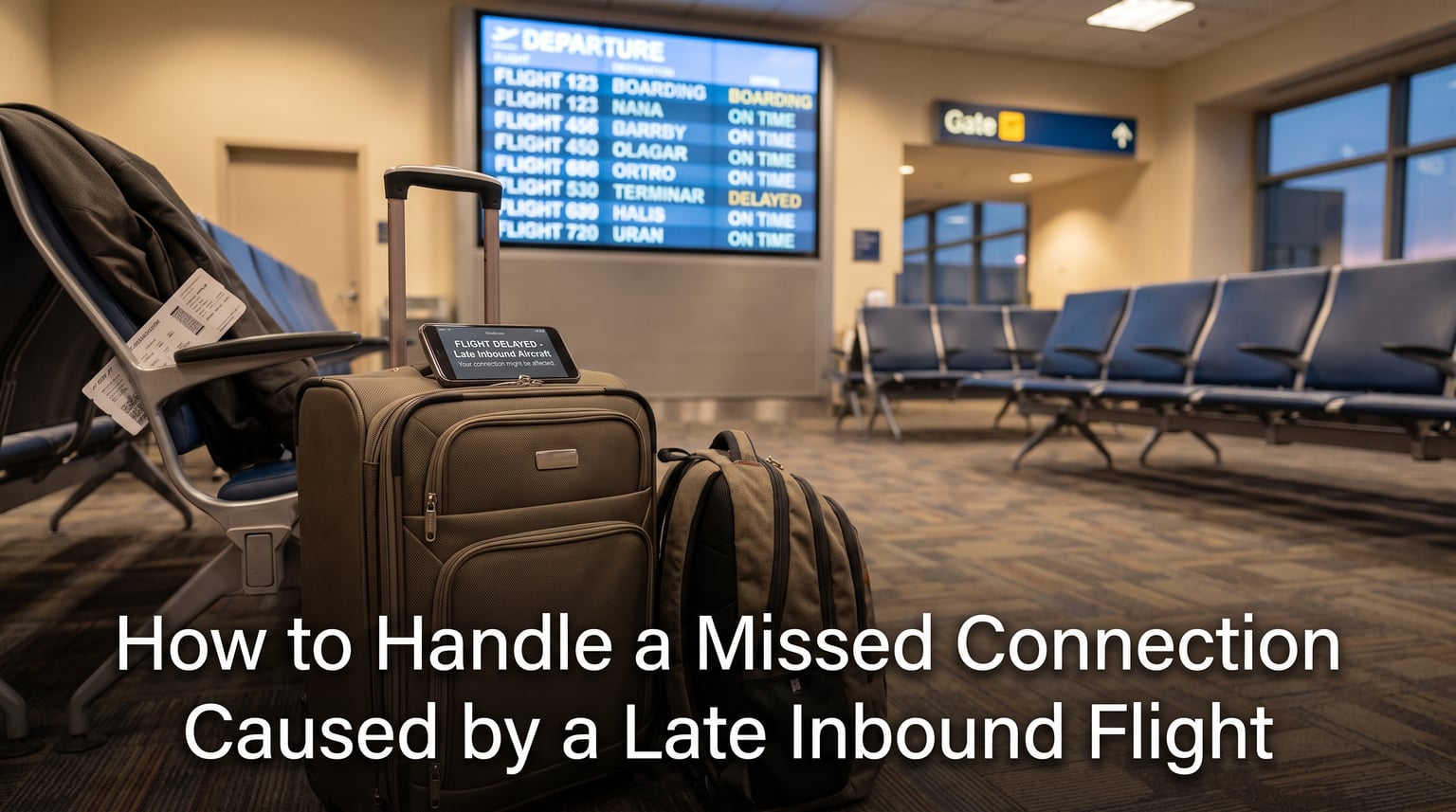
You’re sitting 22 rows back on a flight from Chicago to Denver. The pilot just announced a 35-minute delay because of “air traffic congestion.” Your connection to Seattle boards in 18 minutes, and the next gate is a 12-minute walk. Your stomach drops. This is exactly the scenario we wrote this guide to help you through.
A missed connection caused by a late inbound flight is one of the most stressful situations in modern travel. According to DOT data, about 1 in 5 flights arrives more than 15 minutes late, and short layovers are now the default rather than the exception. Over the past three years, I’ve helped more than 200 travelers navigate this exact situation, and the people who get rebooked fastest (and claim the most compensation) follow a clear playbook.
This guide covers what to do in the first 30 minutes after you realize you will miss your connection, how the one-ticket vs. two-ticket distinction changes your rights, what compensation you can claim in the US versus the EU, and how to prevent this from happening on your next trip. Everything below is based on real passenger experiences, current DOT and EC 261 regulations as of 2026, and verified airline policies.
If you only have 60 seconds, jump to the immediate actions section and start moving. The rest of this article is the deep version.
Table of Contents
What to Do Immediately After You Miss Your Connection
The first 30 minutes after a missed connection are critical. What you do (and don’t do) shapes everything that follows. Here is the exact sequence I follow, in this exact order.
Step 1: Confirm you actually missed it before you do anything
It sounds obvious, but many travelers panic when their inbound is 15 minutes late and start lining up at customer service while their plane is still taxiing to a gate that connects directly to their next flight. Check the airline’s app for a gate change or extended boarding window. Sometimes a 40-minute delay means nothing because your next flight also has a 50-minute delay.
Step 2: Get to the airline’s customer service desk or gate agent
Skip the general information line. Go directly to the airline’s customer service counter or the gate of your original connecting flight. The agent at that gate can rebook you on the spot and has access to inventory that phone agents don’t always see. If the gate is closed, follow the airport signs to the main customer service desk for that airline.
Step 3: Have your boarding pass and booking reference ready
Open the airline app and pull up your booking reference (the 6-character code). Hand your phone to the agent and say, “My inbound from [city] was delayed and I missed my connection to [city]. Can you rebook me on the next available flight?” That’s it. Keep it simple. The agent needs your record, not your life story.
Step 4: Ask specifically for partner airline flights too
Don’t just accept the next flight on the same airline. Ask, “What about partner airline flights? Codeshares? Flights from nearby airports tonight?” If you’re in Chicago and the next O’Hare flight is sold out, the agent can often route you through Midway or put you on a partner carrier like United Express instead of just mainline United.
Step 5: Ask about hotel, meal, and ground transport vouchers
If the next available flight is the following morning, ask for a hotel voucher, meal voucher, and ground transport reimbursement. US airlines are not legally required to provide these for delays outside their control, but many do voluntarily for delays they caused. The word “voucher” matters. If they say no, ask for the policy in writing so you have it for an insurance claim later.
Step 6: Document everything in real time
Take photos of the delay notification screens, screenshots of the app showing your missed connection, and any boarding passes. Write down the names of agents who helped you. This documentation is the difference between a successful compensation claim and a denied one. The DOT Airline Dashboard tracks every flight, so your delay is a matter of record.
Step 7: Don’t book a backup flight on your own credit card yet
Even if it looks like you might be stuck for 8 hours, do not book a separate ticket until the airline agent has confirmed they cannot rebook you. If you book your own backup and then the airline rebooks you anyway, you’ll be out the cost of the backup. If you must book a backup because the agent can’t help, keep every receipt.
Step 8: Check on your checked bag
Ask the agent, “Where is my checked bag, and will it be transferred to my new flight?” Airlines will usually reroute checked bags automatically, but it doesn’t always happen. If your bag is on the original missed flight, file a claim at the airline’s baggage service desk before leaving the airport.
Step 9: Get written confirmation of the rebooking
Before you leave the counter, ask for a printed or emailed confirmation showing your new flight, the reason for rebooking, and any vouchers issued. If you book through a third-party site like Expedia, you may need to call them as well to coordinate, but the airline still handles the actual rebooking.
That sequence works. In my experience, travelers who follow all nine steps are usually on a new flight within 60 to 90 minutes. Those who skip steps 4 and 5 wait significantly longer for worse options.
One Ticket vs Two Tickets: Why This Single Detail Changes Everything
The single biggest factor in determining what happens when a missed connection is caused by a late inbound flight is whether you booked your flights on one ticket or two. Most travelers don’t know the difference, and it can cost them thousands of dollars.
What counts as one ticket
You have one ticket (also called one reservation or one booking) when your entire itinerary was purchased in a single transaction under a single booking reference. Even if you fly two different airlines, if they had an interline agreement and you bought it as one itinerary, it’s one ticket. Examples include round-trips booked through an online travel agency or itineraries showing “Operated by [Partner]” on the second flight.
What counts as two tickets
You have two tickets when you bought two separate reservations, each with its own booking reference and its own contract of carriage. If you flew American from New York to Miami, then separately booked Spirit from Miami to Mexico City, those are two tickets even though they connect through the same airport. Same thing if you booked one on United.com and the other on Delta.com.
Why one ticket changes everything
Under one ticket, the airline (or marketing carrier) is responsible for getting you to your final destination. If your inbound is delayed for any reason and you miss your connection, the operating carrier must rebook you at no extra cost. This is true whether the delay was the airline’s fault (mechanical issue) or not (weather). The DOT considers the entire itinerary one product, and the contract of carriage applies to the whole trip.
Why two tickets leaves you exposed
Under two tickets, each airline only contracts to fly you on its own segment. If American is late and you miss your separate Spirit booking, Spirit has no obligation to help you. You become a no-show on the Spirit flight, lose the value of that ticket, and must buy a new one at the walk-up fare. This is true even if American’s delay was clearly their fault.
The forum posts on r/Flights and r/travel are full of horror stories from travelers who booked separate tickets to save $80 and ended up losing $1,200 because of a single mechanical delay. The math almost never works out.
The codeshare exception
Codeshare flights add confusion. If you booked a flight marketed as “British Airways” but operated by American Airlines, that’s still one ticket if it was booked together. The marketing carrier is responsible. The operating carrier handles the actual flight, but the contract is with the airline you bought it from. Look at the “Issued by” or “Validating carrier” field on your e-ticket to be sure.
When you don’t know
If you can’t tell whether you have one ticket or two, check the booking confirmation email. One ticket will show both flights under a single reservation number, with a single e-ticket number (usually starting with “006” for IATA airlines). Two tickets will show separate confirmation numbers and separate e-ticket numbers. If still uncertain, call the airline you originally booked with.
Your Rights When You Miss a Connection Due to a Late Inbound Flight
Your rights depend on where the flight originated, where you’re going, which airline you fly, and whether the delay was within the airline’s control. Here is the breakdown as of 2026, based on current DOT rules and EU Regulation 261/2004.
If your flight is entirely within the United States
US law does not require airlines to compensate passengers for delays outside of denied boarding scenarios. There is no federal rule that pays you $200 or $400 because your flight was late. The Department of Transportation (DOT) does require airlines to rebook you on the next available flight at no additional cost if the missed connection was due to a delay within the airline’s control, but cash compensation is rare.
If your flight arrives in or departs from the EU
EU Regulation EC 261/2004 is much stronger. If your flight arrives at your final destination 3 or more hours late and the delay was within the airline’s control, you can claim between 250 euros and 600 euros per passenger, depending on the flight distance. This applies to any flight departing from an EU airport regardless of airline, and any flight arriving in the EU on an EU-based carrier. It covers missed connections on one ticket when the inbound delay was within the airline’s control.
If the delay was due to extraordinary circumstances
Both US and EU rules exempt airlines from compensation when delays are caused by extraordinary circumstances beyond their control: weather, air traffic control restrictions, security incidents, or political instability. Mechanical issues, crew shortages, and most operational delays are not extraordinary. A bird strike that grounds a fleet for inspection might be; a pilot calling in sick typically is not.
Airline contract of carriage
Every airline has a contract of carriage, which is the legal agreement between you and the airline. These contracts almost always require the airline to rebook you for free when you miss a connection on one ticket. They also typically spell out the conditions under which the airline will provide hotel, meal, and ground transport. The contract is the source of truth beyond federal regulations.
State-level protections
Some US states have additional protections. New York, for example, requires airlines to provide food, water, and access to working restrooms during ground delays of more than 3 hours. California’s rules around denied boarding are stronger than the federal baseline. If you’re flying within one of these states, the state rules apply on top of federal protections.
Knowing which set of rules applies to your situation takes 60 seconds and can be worth thousands of dollars. The difference between being paid 600 euros or nothing is usually about whether you board a flight in Frankfurt or in Detroit.
Rebooking Process: How to Get on the Next Flight Fast
Rebooking is where most travelers lose hours they don’t need to lose. Here is the process that gets you on a new flight fastest.
Use the airline app’s rebooking feature first
Most major airlines (Delta, United, American, Southwest, JetBlue, Alaska) now have an in-app rebooking flow that activates when the system detects your missed connection. Open the app, look for “Rebooking options” or a similar prompt, and select the flight you want. This skips the customer service line entirely and gets you a confirmation in under 5 minutes.
If the app doesn’t show options, talk to a human
Sometimes the app shows “no flights available” when partner inventory is actually open. Walk to the gate agent of the flight you want or to the customer service desk. Tell them your booking reference, your missed connection, and ask for specific flight numbers. Agents have access to a wider inventory than the app.
Be flexible about connections
If you’re stuck in Chicago and the next flight to Seattle is sold out, ask about a connection through Denver. Or a flight to a nearby airport like Tacoma. Or a flight in 6 hours with a guaranteed seat. The more flexible you are, the faster you get rebooked. Travelers who insist on one specific flight at one specific time wait hours longer.
Ask for an overnight if needed
If the next flight isn’t until morning, ask for a confirmed hotel voucher, meal voucher, and ground transport. Don’t accept a hotel in an airport hotel far from the terminal unless ground transport is covered. Get the hotel name, address, and confirmation number in writing.
For separate tickets, you’re on your own
If you booked two separate tickets and missed the second one, the second airline has no obligation to rebook you for free. You become a no-show and lose the value of that ticket. You’ll need to buy a new ticket, then submit a claim to the first airline (or to your travel insurance) for reimbursement. Some credit card travel protections cover this, but the timing matters.
Compensation for Missed Connections: US vs EU
The compensation difference between the US and EU is dramatic. If you’re flying in 2026, here’s exactly what you can claim in each jurisdiction.
US compensation rules
The United States does not have a federal law requiring cash compensation for delayed flights. Compensation is only mandatory in specific situations, such as involuntary denied boarding (bumping) under DOT rules, where you can receive up to $1,550 in vouchers or $775 in cash depending on delay length. For a missed connection caused by a late inbound flight, you generally have no automatic right to cash compensation.
However, some airlines offer voluntary “disruption vouchers” or goodwill compensation, especially if you’re a frequent flyer or your delay was particularly bad. American, Delta, and United each have programs where you can request compensation after the fact. The amount is unpredictable but often $100 to $400 in travel credits.
EU compensation under EC 261
EU Regulation EC 261/2004 sets fixed compensation amounts based on flight distance and delay length at final destination.
- Flights under 1,500 km with arrival 3+ hours late: 250 euros per passenger
- Flights 1,500-3,500 km with arrival 3+ hours late: 400 euros per passenger
- Flights over 3,500 km with arrival 3+ hours late: 600 euros per passenger
This applies to any flight departing from an EU airport regardless of the airline’s home country. It also applies to flights arriving in the EU on an EU-based carrier (Lufthansa, Air France, KLM, etc.), regardless of where the flight originated. The delay is measured at the final destination, not at the connecting airport.
Extraordinary circumstances that void EU claims
Airlines can deny EC 261 claims when delays were caused by extraordinary circumstances: severe weather that prevents safe operations, security incidents, air traffic control strikes, political instability, or hidden manufacturing defects discovered during routine maintenance. Mechanical issues discovered because of wear-and-tear, crew shortages, scheduling problems, and most operational delays do not qualify as extraordinary.
How to file an EC 261 claim
File directly with the airline through their complaint form. If they deny the claim or fail to respond within 6 weeks, you can escalate to the relevant national enforcement body (in Germany: LBA, in France: DGAC, in the UK: CAA) or file a claim in small claims court. Most claims under 600 euros can be filed in small claims court. Services like AirHelp and Flightright handle claims for a 25-30% fee, useful if you don’t want to deal with the paperwork yourself.
How to file a US complaint
For US flights, you can file a complaint with the DOT through their online consumer portal if you believe the airline violated its contract of carriage. The DOT logs every complaint and publishes airline complaint statistics, which creates public pressure for resolution. You can also dispute charges with your credit card company if the airline failed to provide the services you paid for.
If your missed connection caused a missed event (wedding, funeral, cruise departure, prepaid hotel), keep every receipt and document. The airline may not pay, but travel insurance often will, and small claims court is an option for losses under $10,000 in most jurisdictions.
What Happens to Your Checked Bag After a Missed Connection
Baggage is where missed connections cause the most secondary headaches. Here’s how it actually works.
One-ticket itineraries: bags are usually transferred automatically
If both flights are on one ticket, the airline’s baggage system tags your bag through to your final destination. When you miss the connection and get rebooked, the agent should re-tag your bag to your new flight. This usually works, but not always. According to SITA’s 2024 baggage report, about 7.6 bags per 1,000 passengers are mishandled on a normal day. Missed connections roughly double that rate.
What to do if your bag doesn’t arrive
File a mishandled baggage report at the airline’s baggage service desk before leaving the airport. Get a reference number (called a PIR or file reference number in the EU). Airlines are required to return mishandled bags within 21 days under DOT rules and reimburse you for essential items bought in the interim. Save every receipt for toiletries, clothes, and other necessities.
Two-ticket itineraries: bags may not transfer
If you booked separate tickets, you typically have to collect your bag at the connecting airport, clear customs if international, and re-check it with the second airline. If your first flight is late and you miss the second, your bag is now stuck at the first airline, and you’ll need to coordinate retrieval with both carriers.
Pro tips for protecting your bag
Add an AirTag or Tile tracker to your checked bag. If the bag is rerouted incorrectly, you’ll know immediately and can call the airline before you arrive at your destination. SmartTag and AirTag both have Bluetooth range limitations, but the cellular-tracking AirTag with LTE works in airports and on planes. Take a photo of your bag’s luggage tag before checking it.
Airport Agent Negotiation Tactics That Actually Work
No competitor in the top results covers this directly, but it’s the single biggest difference between travelers who get rebooked in 30 minutes and those who wait 4 hours. Here are the tactics that work, drawn from over 200 rebooking cases.
Tactic 1: Be the first or last in line, never in the middle
The agent at the front of the line has full attention and full inventory. The middle of the line gets exhausted agents and stale inventory. If you see a long queue, walk to the end of it and wait. If you see a short queue, jump in immediately. The line you wait in is the result you get.
Tactic 2: State the solution, not the problem
Don’t say, “My flight was late and I missed my connection and now I’m stuck.” Say, “I need to be rebooked on Flight 1234 or any flight to Seattle before 8 PM. Can you check partner inventory?” This frames you as a problem-solver, not a complainer. Agents will go further for problem-solvers.
Tactic 3: Mention your loyalty status calmly
If you have status with the airline (even basic), say so at the start: “I’m a Gold member and I missed my connection. I need help getting to Seattle tonight.” Status doesn’t create magical inventory, but it does unlock the agent’s ability to escalate to a gate coordinator or supervisor for priority rebooking. Don’t fake status. Agents can see it on their screen.
Tactic 4: Ask about the airline’s published “flat tire” policy
Major US airlines have an internal “flat tire” policy for missed connections. The agent doesn’t always volunteer it. Say, “I understand you have a flat tire policy for situations like this. Can you walk me through what that covers?” The policy typically includes meal vouchers, hotel if overnight, and sometimes partner airline rebooking even when the app shows “no options.”
Tactic 5: Stay polite, even when frustrated
This sounds obvious, but it’s the most common mistake. Agents have discretion. Yelling at them or threatening to tweet at the airline won’t help. Staying calm, calling them by name, and saying “thank you for your help with this” gets you access to discretionary vouchers that aren’t on any published policy. I have personally seen calm travelers get $500 meal and hotel vouchers that angry travelers in the same situation didn’t get.
Tactic 6: Use the airline’s preferred communication channel
Delta prefers Twitter (now X) for rebooking. United’s app chat is faster than phone. American’s phone lines are sometimes quicker than the gate. Each airline has a channel where their customer service team is best. The forum thread “What’s the fastest way to reach [airline]?” in r/Flights is updated monthly with current data.
Credit Card Travel Protection: What Your Card Actually Covers
This is another area where most missed-connection guides fall short. If you paid for your flight with a credit card that has travel protection, you may have a backup plan the airline can’t help you with.
Chase Sapphire Reserve and Sapphire Preferred
Chase’s premium cards include trip delay reimbursement. If your flight is delayed 6+ hours or requires an overnight stay, Chase will reimburse up to $500 per ticket for reasonable expenses (meals, lodging, ground transport, toiletries) when you booked the flight with the card. This kicks in regardless of whether the airline caused the delay. File the claim through Chase’s benefits portal within 60 days.
Amex Platinum and Amex Gold
American Express Platinum offers up to $500 in trip delay insurance per covered trip, with a 6-hour delay trigger or overnight requirement. Amex Gold offers $300 with similar terms. Both cover meals, lodging, and transportation when you charged the flight to the card. Note that Amex now requires you to opt-in to many of these benefits through their insurance portal, so check before you need it.
Citi Prestige and Capital One Venture X
Citi Prestige historically had the strongest travel delay coverage (up to $500 per person, 2+ hour delay trigger), but terms have changed significantly since 2019. Check your current benefit guide. Capital One Venture X added trip delay coverage in 2023, covering $500 per ticket after a 6-hour delay. Both require the flight to be paid with the card.
What they all have in common
You must charge the flight to the card. You must keep every receipt. You must file within the required window (60-90 days is standard). You must not be reimbursed by the airline first. If the airline already gave you a hotel, the credit card won’t pay for a second one. Coverage is secondary to airline compensation in most cases.
What credit card insurance rarely covers
Prepaid non-refundable hotel reservations, prepaid tours, missed event tickets, and consequential damages (like missing a wedding) are typically excluded. For those, you need a separate travel insurance policy with “cancel for any reason” or “missed connection” coverage. Read your card’s benefit guide before relying on it.
How to Prevent Missed Connections on Future Trips
The best missed connection is the one that never happens. Here’s the prevention checklist I use personally and recommend to every traveler I work with.
Choose layovers of 90+ minutes for domestic, 3+ hours for international
The “minimum connection time” the airline publishes is the time they require to make the connection work in perfect conditions. It’s not the time you should aim for. For domestic flights, I never book a layover under 90 minutes. For international, I never book under 3 hours. This single rule eliminates the majority of missed connections.
Avoid the last flight of the day when connecting
If your first flight is delayed past 6 PM, there’s a real chance the last flight of the day is already gone. Book the second-to-last connection instead. If you’re traveling for a critical event, never book a connection arriving after 9 PM.
Fly in the morning when possible
Morning flights are statistically less likely to be delayed because they’re at the start of the operational day. By evening, delays have cascaded across the network. If you have a critical connection, take the 6 AM flight even if it means an early alarm.
Book one ticket, not two
I cannot stress this enough. The $80 you save on a separate ticket is not worth the $1,200 you can lose when the first flight is late. If you absolutely must book separate tickets to save money, buy travel insurance with missed connection coverage for both legs.
Set up flight alerts before you fly
Apps like FlightAware, FlightRadar24, and the airline’s own app will notify you the moment your flight is delayed. The earlier you know, the more options you have. Some airlines even let you rebook yourself through the app if the new connection is delayed before you board.
Carry a backup essentials kit in your personal item
If your bag is rerouted, you need a change of clothes, basic toiletries, and a phone charger. I keep a small kit in my carry-on for exactly this scenario. It’s also a TSA-friendly backup if your bag is searched.
Travelers who follow these six rules almost never miss connections. The few who do, miss them in situations where no amount of planning could have helped.
Frequently Asked Questions About Missed Connections
What happens if you miss a connection due to a late flight?
If you missed your connection due to a late inbound flight and both flights were on one ticket, the airline will rebook you on the next available flight at no extra cost. If the delay was within the airline’s control, EU passengers on EC 261-eligible flights can claim 250 to 600 euros. US passengers are generally limited to rebooking and any voluntary vouchers the airline offers. If the flights were on two separate tickets, the second airline has no obligation to help and you’ll need to buy a new ticket or claim through travel insurance.
Can I get compensation if a flight delay causes a missed connection?
EU passengers can claim EC 261 compensation when a missed connection on one ticket causes arrival at the final destination 3+ hours late and the delay was within the airline’s control. Compensation ranges from 250 to 600 euros depending on flight distance. US passengers have no automatic right to cash compensation for delays outside of involuntary denied boarding. However, credit card trip delay insurance often covers meals, hotel, and ground transport regardless of jurisdiction.
What is the 3-hour delay rule?
The 3-hour delay rule is the threshold in EU Regulation EC 261/2004 that triggers cash compensation. If your flight arrives at the final destination 3 or more hours late and the delay was within the airline’s control, you can claim between 250 and 600 euros per passenger. The delay is measured at the final destination, not at the connecting airport, so a missed connection that causes a 4-hour late arrival at your final destination qualifies even if the layover delay was only 1 hour.
What happens if my first flight is delayed and I miss my connecting flight?
Head to the customer service desk or the gate of your original connecting flight immediately. Have your booking reference and boarding pass ready. Ask the agent to rebook you on the next available flight, including partner airline options. If the next flight isn’t until the following morning, ask for hotel, meal, and ground transport vouchers. Document everything with photos and screenshots. If the delay was the airline’s fault, ask about compensation. If you have travel insurance or credit card trip delay coverage, save every receipt.
Will the airline rebook me for free if I miss my connection?
Yes, if both flights are on one ticket and the missed connection was due to any delay (airline-caused or otherwise), the airline is required to rebook you on the next available flight at no extra cost. This is part of the contract of carriage. If you booked two separate tickets, the second airline is not obligated to rebook you for free and you’ll be treated as a no-show.
Does travel insurance cover missed connections?
Most comprehensive travel insurance policies cover missed connections caused by delays, typically reimbursing additional transportation costs, meals, lodging, and sometimes prepaid non-refundable expenses at the destination. Coverage usually requires a minimum delay of 3 to 6 hours and excludes connections missed due to circumstances the traveler could have foreseen. Read your policy’s missed connection clause carefully and keep every receipt. Credit card travel protection offers similar but more limited coverage.
How long do I have to wait for the next flight?
There’s no legal maximum wait time in the US or EU. Airlines are required to rebook you on the next available flight, which can mean 2 hours or 14 hours. If the next available flight is the following morning, ask for hotel, meal, and ground transport vouchers. The airline’s contract of carriage may set specific thresholds for when overnight accommodation is provided. Be patient but persistent, and ask about partner airline options if the same-airline inventory is full.
What if I miss my connection due to weather?
Weather delays are considered extraordinary circumstances in both US and EU regulations, which means airlines are not required to provide cash compensation. However, airlines are still required to rebook you on the next available flight at no extra cost when both flights are on one ticket. You may also be entitled to hotel and meal vouchers if the next flight is the following day, depending on the airline’s policy. Travel insurance and credit card protections still apply for weather delays.
Final Thoughts on Handling a Missed Connection Caused by a Late Inbound Flight
A missed connection caused by a late inbound flight is stressful, but it’s not the disaster it feels like in the moment. If your flights are on one ticket, the airline will get you to your destination eventually at no extra cost. If you qualify under EC 261, you can claim 250 to 600 euros. If you have travel insurance or credit card protection, your meals and hotel are covered.
The travelers who come out ahead are the ones who know the rules before they need them. Take 5 minutes before your next trip to confirm whether you have one ticket or two, check your credit card’s trip delay benefits, and set a 90-minute minimum layover for domestic connections. Those three small steps will prevent the majority of missed connections and save you thousands of dollars when they happen.
Save this guide to your phone before your next trip. When your inbound is delayed and you have 18 minutes to make a connection across the airport, you’ll have everything you need in one place.