
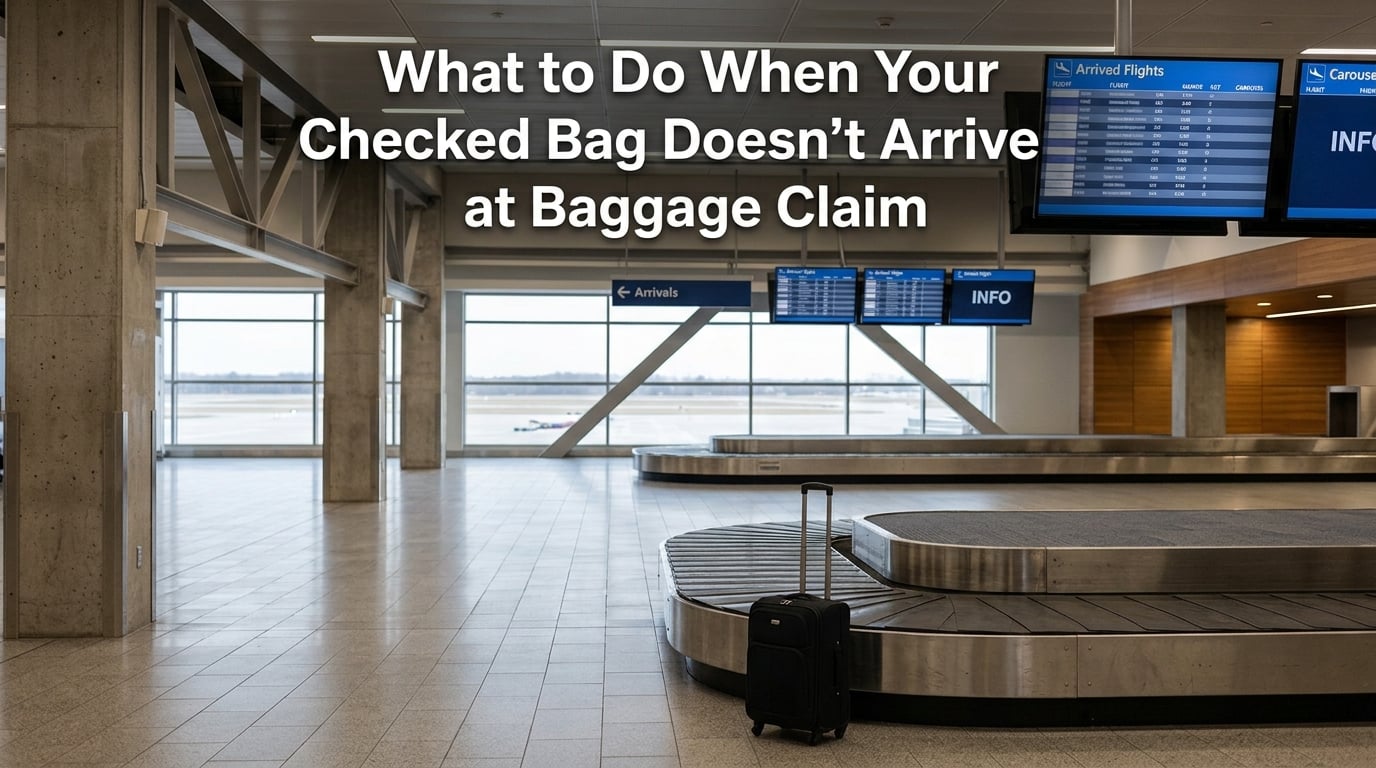
You stand at the carousel watching the last suitcase circle around. Other passengers grab their bags and head for the exit. Yours is nowhere in sight. If your checked bag doesn’t arrive at baggage claim, the steps you take in the next 30 minutes can make the difference between getting your luggage back the same day and spending weeks chasing an airline for answers.
The single most important thing you can do is act before you leave the airport. Airlines trace mishandled luggage using a system that starts the moment you report the problem. Every minute you wait makes the trail harder to follow.
I have helped friends and family navigate this exact situation more times than I care to count, and the pattern is always the same. The travelers who file a report immediately, keep their receipts, and follow up consistently get their bags back faster and recover more of their expenses. The ones who go home hoping for the best end up fighting for every dollar.
This guide walks you through every step of the process, from the moment you realize your bag is missing to the compensation you are entitled to under U.S. and international law. Whether you are dealing with a delayed bag on a domestic flight or lost luggage on an international trip, you will know exactly what to do and what to demand.
Table of Contents
Immediate Steps When Your Checked Bag Doesn’t Arrive at Baggage Claim
The first few minutes after you realize your bag is missing are the most important. Here is exactly what to do, in order, so you do not waste time or miss a critical deadline.
Step 1: Stay Calm and Do Not Leave the Airport
Your instinct might be to head to your hotel and deal with it later. Resist that urge. Filing a report before you leave the airport is the single most critical step in the entire process. Once you walk out those doors, airlines have far less incentive to help you, and the documentation process becomes significantly harder.
Mishandled luggage is common. Airlines globally mishandle roughly 25 million bags per year, and the vast majority are reunited with their owners within 48 hours. Your bag is most likely sitting on the next flight or stuck at a connecting airport.
Step 2: Wait a Reasonable Amount of Time
Give the carousel 20 to 30 minutes after the first bags appear. Late-arriving cargo and last-minute container loads sometimes come out in a second wave. If you flew on a large aircraft, bags can continue arriving for quite a while after the initial rush.
Some airlines, including Delta, have offered baggage service guarantees where you can request compensation if bags are not on the carousel within 20 minutes. Ask about this at the baggage desk, because not all agents volunteer the information.
Step 3: Check Other Carousels and Oversize Areas
Before panicking, walk the baggage claim area. Bags sometimes end up on the wrong carousel, get pulled aside for inspection, or are placed in the oversize luggage area. Check with the airline’s baggage service office if you see bags from your flight on a different belt.
Step 4: Head to the Baggage Service Office
Every airline maintains a baggage service office in the baggage claim area or nearby. Look for signs or ask an airline representative. This is where you will file your report and get the tracking process started.
Bring your baggage claim tag, boarding pass, and identification. The agent will need these to pull up your flight information and create a report.
Step 5: File a Report Before You Leave
Tell the agent your bag did not arrive and you need to file a report. They will create what is called a Property Irregularity Report, or PIR. This is your official record that the airline mishandled your luggage. Insist on filing it before you leave the airport, even if the agent suggests you can do it online later.
Travelers on forums consistently report the same advice: file the claim before you leave the airport. This is not optional. It is the foundation of everything that comes next.
How to File a Property Irregularity Report (PIR)
A Property Irregularity Report is the official document airlines use to track and resolve mishandled baggage. Think of it as the case file for your missing bag. Without it, the airline has no formal record of your problem.
What Information You Need to Provide
The baggage agent will ask for specific details to create your PIR. Having this information ready speeds up the process significantly.
You will need your baggage claim tag, which is the sticker receipt attached to your boarding pass when you checked in. The agent also needs your flight number, travel date, contact information, and a description of your bag including color, brand, size, and any distinguishing features like ribbons or stickers.
What You Receive in Return
The agent will give you a PIR number, which typically looks like a combination of letters and numbers (for example, ABC12345678). This is your reference number for all future communication with the airline. Write it down, photograph it, and store it somewhere you will not lose it.
You should also receive information about how to track your bag online, the airline’s baggage policy, and an estimate of when you might hear back. If the agent does not volunteer this information, ask for it directly.
Understanding WorldTracer
Most major airlines use a shared tracking system called WorldTracer, which connects more than 400 airlines and 2,200 airports worldwide. When your PIR is filed, your bag enters this system, and any airport that scans your bag can match it to your report.
You can often check the status of your bag using the airline’s website or app with your PIR number. Some airlines also allow you to track through the WorldTracer portal directly.
Key Documents to Keep
Hold on to every piece of paper and digital record related to your missing bag. You will need these for any reimbursement or compensation claim.
Your PIR number and a copy of the report
Your baggage claim tags
Your boarding passes
Receipts for all essential purchases you make while waiting
Photos of your bag taken before your trip
Any written communication with the airline
How to Track Your Missing Bag
Once your PIR is filed, tracking begins. But you should not just sit back and wait. Active tracking gives you information and leverage if things drag on.
Using Airline Apps and Websites
Most major airlines offer real-time baggage tracking through their mobile apps. Enter your PIR number or scan your baggage tag, and you can often see the last scan location of your bag. Airlines like Delta, American, and United have invested heavily in this technology over the past few years.
Check the app daily. If the status has not changed in 48 hours, call the airline’s baggage service line and ask for an update. Keep a log of every call, including the date, time, agent name, and what they told you.
Using AirTag and Smart Tracking Devices
If you placed an Apple AirTag, Samsung SmartTag, or Tile in your checked luggage, you have a powerful advantage. These devices use crowdsourced Bluetooth networks to report their location independently of the airline’s system.
Many travelers have located their bags using AirTags even when the airline had no idea where the luggage was. One traveler on a travel forum reported finding their bag stuck at a connecting airport while the airline’s system showed it as in transit. The AirTag pinpointed the exact airport.
If your AirTag shows your bag at a specific airport, share that information with the airline’s baggage service team. Some airlines now accept third-party tracking data to help locate bags faster. You can also share your AirTag location link directly with airline staff so they can see the real-time position.
Following Up With the Airline
Call the airline every 24 to 48 hours for an update if you have not heard anything. Be polite but persistent. Ask specific questions: Has my bag been scanned recently? Is it on a flight to my airport? What is the estimated delivery date?
Document every interaction. If an agent promises delivery by a certain date and it does not happen, you have evidence to support an escalation or DOT complaint later.
Requesting Delivery to Your Location
When the airline locates your bag, ask them to deliver it directly to your home, hotel, or accommodation. This is standard practice and should not cost you anything. Most airlines use courier services for bag delivery, and you can usually schedule a delivery window that works for you.
Forum users consistently recommend requesting delivery rather than returning to the airport. The airline created the problem, and delivering the bag is their responsibility.
Compensation and Reimbursement: What You’re Owed
This is where most travelers leave money on the table. Airlines are legally obligated to compensate you for delayed and lost luggage, but they will not hand it over unless you ask and provide documentation.
Domestic Flight Compensation Limits
For flights within the United States, the Department of Transportation sets maximum liability for lost, delayed, or damaged baggage. As of 2026, the DOT limit is $3,800 per passenger on domestic flights. This covers the value of your bag and its contents, subject to the airline’s depreciation calculations.
This is a maximum, not a guarantee. Airlines will ask for receipts or proof of value for the items in your bag, and they may depreciate the value based on age. The actual amount you receive depends on what was in your bag and how well you can document it.
International Flight Compensation and the Montreal Convention
International flights operate under a different set of rules. Most international carriers are governed by the Montreal Convention, an international treaty that sets liability limits using Special Drawing Rights (SDR), a unit created by the International Monetary Fund.
The current Montreal Convention limit is approximately 1,288 SDR per passenger, which translates to roughly $1,700 to $1,750 depending on exchange rates. This is significantly lower than the domestic limit, which catches many travelers by surprise.
If you are flying internationally, ask the airline whether the Montreal Convention applies to your route. Some flights between certain countries may be governed by older treaties with even lower limits.
Reimbursement for Essential Purchases
While your bag is delayed, you can buy essential items and submit the receipts to the airline for reimbursement. Airlines generally cover reasonable expenses like clothing, toiletries, and other necessities you need while waiting for your bag.
The key word is reasonable. A traveler on a forum put it plainly: buy what you need when you need it, keep the receipts, and file a claim. The airline will pay it. Do not go on a shopping spree for luxury items, because the airline will reject those charges.
Every airline sets its own daily allowance for delayed baggage expenses, typically ranging from $50 to $150 per day. Ask the baggage agent what the airline’s policy is before you start shopping, so you know what to expect.
Getting Your Baggage Fee Refunded
If you paid a checked bag fee and your bag is lost, you are entitled to a refund of that fee. The DOT explicitly states that consumers are entitled to a refund of baggage fees when the airline declares the bag lost.
This refund is separate from your compensation claim. Do not let the airline apply your baggage fee refund toward your overall compensation total. They are distinct obligations.
When a Bag Is Officially Declared Lost
Airlines do not immediately classify a missing bag as lost. The typical waiting period is 14 to 21 days, after which the bag is officially declared lost and you can file a final claim for the full value of the bag and its contents.
Once declared lost, submit your claim with receipts, photos, and any other documentation of value. The airline will process the claim and issue payment according to the applicable liability limits.
Credit Card Coverage and Insurance Options
Airline compensation is not your only source of reimbursement. Several other coverage layers can fill the gaps, especially for international travelers dealing with the lower Montreal Convention limits.
Credit Card Baggage Protection
Many premium travel credit cards offer baggage delay and loss protection as a cardholder benefit. If you purchased your flight ticket with an eligible card, you may have secondary coverage that kicks in when the airline’s compensation falls short.
For example, some cards offer up to $3,000 for lost luggage and up to $500 per day for delayed baggage after a waiting period of 6 to 12 hours. The coverage varies widely by card, so check your card’s benefit guide before you travel.
Forum users consistently recommend using a travel credit card for flight purchases specifically because of this benefit. One traveler noted their credit card covered everything the airline would not, turning a stressful situation into a minor inconvenience.
Travel Insurance Policies
Standalone travel insurance policies often include baggage delay and loss coverage. If you purchased travel insurance for your trip, check your policy for baggage provisions. These policies typically offer broader coverage than credit card benefits and may cover items the airline excludes.
Travel insurance baggage coverage usually requires the same documentation as an airline claim: your PIR, receipts, and proof of value. File with your travel insurance provider after you have filed with the airline, since most policies are secondary coverage.
Homeowner’s and Renter’s Insurance
Your homeowner’s or renter’s insurance policy may cover personal belongings even when they are away from home, including lost or stolen luggage. This is a last-resort option that most travelers overlook.
Filing a claim with your homeowner’s insurance can affect your premiums and may carry a deductible, so weigh the cost before pursuing this route. But for high-value losses that exceed airline and credit card limits, it can be worth exploring.
One important caveat: most policies exclude items like cash, jewelry, and electronics unless you have scheduled them separately. Review your policy or call your insurance agent to understand what is covered.
What to Do If the Airline Is Unresponsive
Sometimes the airline stops responding. Your calls go unanswered, your emails get generic replies, and your bag seems to have vanished into thin air. You still have options.
Escalate Within the Airline
Ask to speak with a supervisor or the baggage service manager. Higher-level staff have more authority to resolve cases and can sometimes cut through bureaucracy that frontline agents cannot. Put your complaint in writing and send it through every available channel: email, the airline’s online complaint form, and social media.
Airlines pay close attention to public complaints on platforms like X (formerly Twitter). A polite but public message about your missing bag often generates a faster response than a private email.
File a Complaint With the Department of Transportation
If you have exhausted your options with the airline, file a formal complaint with the DOT. The DOT requires airlines to respond to consumer complaints within a specific timeframe, and airlines take DOT complaints seriously because they are tracked publicly.
You can file a DOT complaint online through the aviation consumer protection portal. Include your PIR number, flight details, a timeline of your communications with the airline, and the specific resolution you are seeking.
Forum users who have filed DOT complaints report significantly faster responses from airlines after the complaint is logged. The airline suddenly finds the resources to track down your bag or process your claim.
Consider Small Claims Court
For smaller claims that the airline refuses to pay, small claims court is a realistic option. Filing fees are typically low, and you do not need a lawyer. Bring your PIR, receipts, correspondence, and documentation of the bag’s value.
Many airlines settle claims rather than send a representative to court. The mere act of filing can motivate the airline to resolve your case.
Prevention Tips for Future Trips
The best way to deal with lost luggage is to reduce the chances of it happening in the first place. Here are the most effective strategies travelers use.
Book Nonstop Flights When Possible
Connecting flights are the leading cause of mishandled luggage. Every transfer is an opportunity for your bag to miss a connection or end up on the wrong aircraft. When nonstop flights are available and affordable, they significantly reduce your risk.
Use a Tracking Device
Place an AirTag or similar tracking device in every checked bag. This costs about $30 and gives you independent location data that does not depend on the airline’s system. It is the single best investment you can make for peace of mind.
Photograph Your Bag and Contents
Before you zip up your suitcase, take photos of the bag itself and its contents. These photos serve as documentation of what you packed and the condition of your luggage. If your bag is lost or damaged, you have visual proof to support your claim.
Check In Early and Verify Your Tag
Arrive at the airport with enough time to check your bag properly. Late check-ins increase the chance your bag does not make it onto your flight. Before the agent takes your bag, check the destination code on the luggage tag to make sure it matches your final airport.
Keep Valuables in Your Carry-On
Never check items you cannot replace or live without. Medications, electronics, jewelry, important documents, and one change of clothes should always go in your carry-on. If your checked bag is lost, you will still have the essentials.
FAQs
What to do if a bag doesn’t show up at baggage claim?
Go directly to your airline’s baggage service office in the baggage claim area and file a Property Irregularity Report before you leave the airport. The agent will create a tracking number, explain the airline’s reimbursement policy for essential purchases, and start searching for your bag through the WorldTracer system.
What happens if a checked bag doesn’t arrive?
The airline enters your bag into a global tracking system called WorldTracer, which connects over 400 airlines and 2,200 airports. Most delayed bags are located and delivered within 48 hours. If the bag is not found within 14 to 21 days, the airline officially declares it lost and you can file a claim for full compensation.
Can you get compensation for your bag not arriving?
Yes. For domestic U.S. flights, airlines are liable up to $3,800 per passenger for lost or delayed baggage under DOT regulations. International flights are governed by the Montreal Convention, with limits around $1,700 per passenger. You can also get reimbursed for essential purchases like clothing and toiletries while you wait.
What is the 20 minute baggage claim rule?
Some airlines, including Delta, offer a baggage service guarantee where passengers can claim a bonus if their checked bags are not on the carousel within 20 minutes of the aircraft parking at the gate. The specific reward varies by airline and program, so ask at the baggage service desk if your flight qualifies.
Key Takeaways for When Your Luggage Goes Missing
When your checked bag doesn’t arrive at baggage claim, your actions in the first hour matter most. File a Property Irregularity Report before you leave the airport, get your PIR number, and start tracking your bag immediately through the airline’s app or WorldTracer.
Keep every receipt for essential purchases, document your bag and its contents, and follow up with the airline every 24 to 48 hours. Remember that you are entitled to compensation: up to $3,800 on domestic flights and around $1,700 internationally, plus reimbursement for necessities while you wait.
If the airline stalls, escalate to a supervisor, file a DOT complaint, and lean on your credit card or travel insurance for secondary coverage. And for your next trip, pack an AirTag, book nonstop flights when you can, and photograph everything before you check it in. A little preparation goes a long way when the worst happens.