
Last summer I watched a man at Rome Termini station lose his phone in under four seconds. A woman bumped into him, he turned to apologize, and a second hand slipped his iPhone out of his open backpack pocket. He never felt it happen. That scene has stuck with me because the victim looked exactly like me on my first trip abroad.
I have been robbed on the Metro in Paris. I have had a wallet returned by a stranger in Barcelona. I have lost a camera in Marrakech and a guidebook in Prague. Every trip taught me something the travel blogs never quite prepared me for: pickpockets are faster, calmer, and more creative than tourists expect. They are not lurking in shadows. They are standing next to you, holding a baby, dressed like a tourist, working in pairs.
This guide is everything I wish I had known before my first solo trip. I will walk you through the exact steps I now use to protect valuables from theft and pickpockets while traveling, the gear that actually works, the habits that prevent 90% of common theft, and what to do in the awful minutes after something goes missing. No fear-mongering. No paranoia. Just a layered defense plan that lets you enjoy the trip.
Table of Contents
Pre-Trip Preparation: Your First Line of Defense
The best theft never happens because someone was watching when you left the hotel. It happens because you walked out the door with everything in one place and no backup plan. Before I pack a single shirt, I spend an hour on three preparation steps that have saved me more than once.
Make Copies of Critical Documents
I photograph my passport, driver’s license, credit cards, and travel insurance card, then upload them to an encrypted cloud folder. I also email a copy to myself and to a trusted family member. If my passport disappears in a foreign country, I can prove who I am at the embassy within minutes instead of hours.
Carry one printed photocopy of your passport in your luggage separate from the original. Keep another in your hotel safe. The goal is redundancy. If a pickpocket gets the original, you still have proof of identity for the consulate.
Spread Your Valuables Across Multiple Locations
Never put all your cash, all your cards, and your passport in the same bag. Split them. I keep my passport and a backup credit card in a money belt under my shirt. I carry one credit card and a small amount of local currency in my front pocket. The rest of my cash stays in the hotel safe.
This is the “if you lose everything in one moment” rule. A single snatch-and-grab should never wipe out your entire trip. If a thief gets my day wallet, I still have my passport, my backup card, and emergency cash waiting back at the hotel.
Set Up Digital Protection Before You Leave
Two phone steps take five minutes and prevent weeks of headaches. First, enable a SIM PIN so a stolen phone cannot be used on a different network. Second, turn on Find My iPhone or Find My Device so you can locate, lock, or wipe the phone remotely if it disappears.
I also set up a phone unlock PIN that is different from every other PIN I use, and I enable two-factor authentication on my banking and email apps. These are simple moves, but they stop a stolen phone from becoming a stolen identity.
What Pickpockets Actually Target (And Why)
Understanding what thieves want is half the battle. Most pickpockets are opportunists. They want quick, easy targets. If they have to choose between fumbling with a money belt or moving on to the tourist with the open handbag, you already know who they pick.
Phones Are Now the #1 Target
Five years ago pickpockets targeted wallets. Today, your phone is worth more, easier to resell, and contains your bank apps, your email, your photos, and your airline tickets. A Reddit user in the r/travel community put it bluntly: “Phone theft went from rare to weekly where I live in Barcelona.” Solo travelers report the same pattern across Rome, Paris, and Lisbon.
Phones are also the easiest grab because they sit in back pockets, on cafe tables, and in hand while you check maps. They are visible. They are loose. They are the first thing a thief reaches for.
Wallets, Cash, and Passports
Cash in any currency is gold. Foreign banknotes are untraceable. Passports are even better because they can be sold for identity fraud. Credit cards sit in the middle. They are valuable but easy to cancel, so experienced thieves prefer phones and cash.
If you have to choose between losing one item, let it be the wallet you can cancel remotely. Protect the phone and the passport most aggressively.
How Pickpocket Distraction Tactics Work
Pickpockets almost always work in pairs. One creates a distraction. The other takes the item. The distraction looks innocent: a spilled drink, a child crying, someone asking for directions, a sudden commotion across the street, a woman asking you to sign a petition. By the time you turn back, your pocket is lighter.
The single best defense is to step away from any unsolicited interaction in a crowded area. Even polite ones. Especially polite ones.
Money Belts, Neck Stashes, and Hidden Storage Solutions
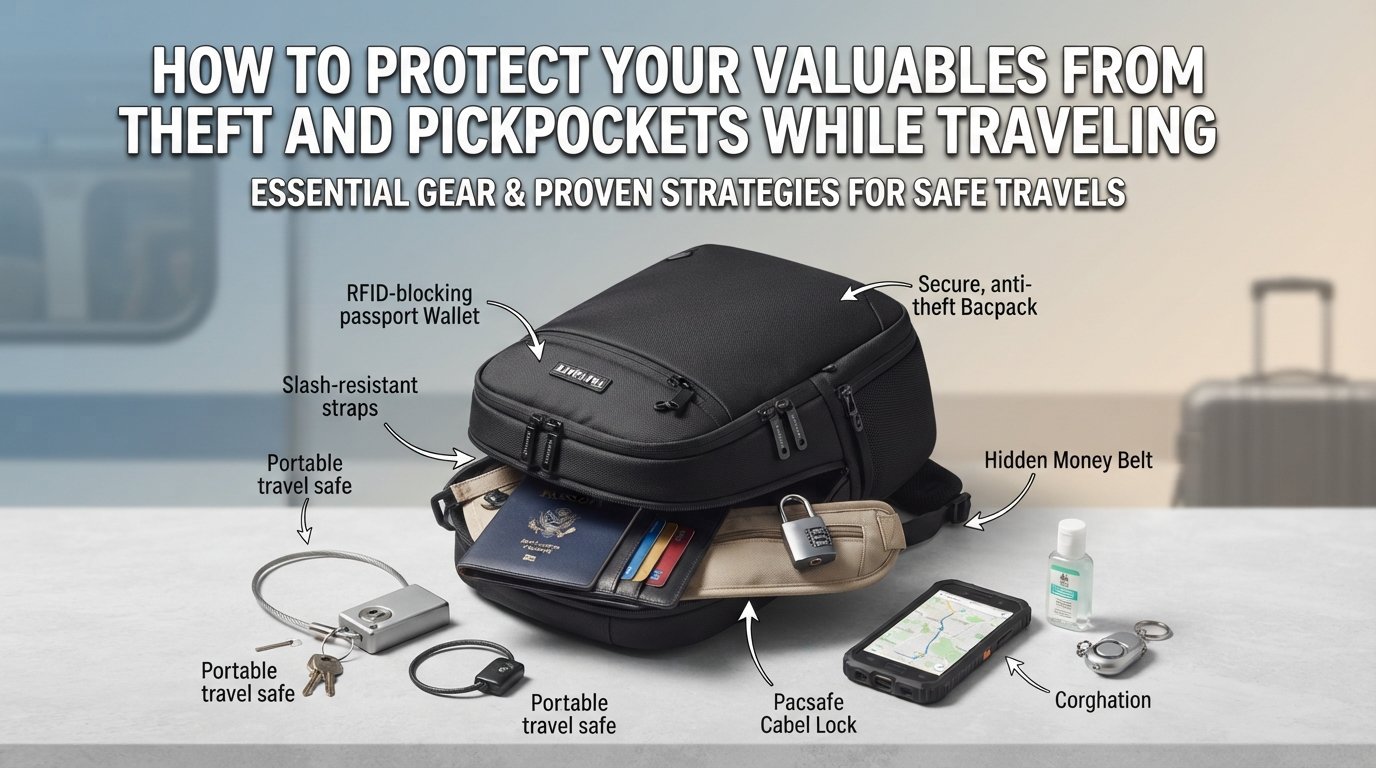
A money belt is a thin zippered pouch worn under your clothes against your stomach. It looks dorky. It works brilliantly. I have worn one in 23 countries and never had anything stolen from it because pickpockets cannot reach under your shirt and into your waistband in a public place without you noticing.
Money Belts: How to Wear One Properly
Buy one made of soft, breathable material with a wide elastic strap. Wear it under your shirt, not over it. Position it across your lower abdomen, not your lower back. The lower-back position is uncomfortable and makes it harder to reach discreetly.
Only put your passport, your backup credit card, and a small amount of emergency cash in it. Do not use it as your main wallet. You want to access it rarely, ideally once a day back at the hotel. Every time you unzip it in public, you advertise where it is.
Neck Stashes vs Money Belts
A neck stash is a small pouch worn under your shirt on a thin cord. It is faster to access than a money belt because you do not have to lift your shirt. It is also slightly more visible if a thief feels the cord. For short city breaks I prefer a money belt. For longer trips with frequent border checkpoints, I switch to a neck stash because I have to show my passport multiple times a day.
Hidden Clothing Pockets and Secret Spots
Travel-specific shirts and pants now come with hidden zippered pockets sewn into seams. They look like ordinary clothes. They feel ordinary. They are not. I always pack at least one pair of zip-pocket pants and one button-pocket shirt for crowded days in busy cities.
Other clever storage spots seasoned travelers swear by: a small pill jar for emergency bills tucked in a shoe, a hidden pocket sewn inside a jacket lining, and a dummy wallet in your back pocket with old cards and a small amount of cash. The dummy wallet is a brilliant forum-tested idea. If a mugger demands your wallet, you hand over the dummy. The real one stays with you.
Choosing the Right Anti-Theft Bag for Your Trip
Your bag is your mobile fortress. Choose the wrong one and you are constantly fending off hands. Choose the right one and you forget about theft for most of the day.
Crossbody Bags Beat Backpacks in Crowds
In tight crowds, a backpack becomes a liability. You cannot see behind you. Strangers can unzip the back pocket without you noticing. A well-designed crossbody bag sits in front of your body where your eyes and hands can guard it.
Look for a crossbody with a wide, slash-proof strap that goes across your chest, not just over one shoulder. The strap should clip in front, not on the side, so a thief cannot slide the bag around to your back. Front-clip crossbody bags are the single biggest upgrade most travelers never make.
Locking Zippers and Slash-Proof Materials
Locking zippers are zippers that clip together at the pull, so a thief cannot open the bag with one hand while you are distracted. They cost almost nothing to add and stop almost every casual pickpocket attempt.
Slash-proof bags have cut-resistant fabric and steel cables woven into the straps. They prevent the slash-and-run technique where a thief slices your bag open with a razor and grabs the contents in one motion. For high-risk cities like Barcelona, Rome, and Prague, I never travel without one.
Anchoring Your Bag at Restaurants and Cafes
One of the most common restaurant thefts is the chair-back snatch. You sit down, hang your bag on the chair behind you, and the bag disappears when you are distracted by your food. The fix is simple. Loop a strap around your leg or around the chair leg. If someone tries to take it, you feel the pull.
The Solo Traveler World team tested this technique across 14 countries and reports zero successful bag grabs in over 200 restaurant stops. Anchoring works because the thief has to commit to a longer attempt in plain view.
Crowd Safety and Vigilance Techniques
Crowds are the pickpocket’s office. Tour groups, transit hubs, street markets, festivals, and religious sites are where most theft happens. The good news is that crowds are predictable once you know the patterns.
Spot the Common Distraction Patterns
I have learned to walk away from three specific situations without hesitation. First, anyone who approaches me with a clipboard, a petition, or a bracelet to tie on my wrist. Second, anyone who spills something on me, especially a child. Third, anyone who bumps into me from behind in a transit station. All three are textbook setups.
Pickpocket teams share scripts the way salespeople share pitches. Once you have seen one “spilled drink” scam, you have seen a hundred of them. The instant your brain flags the pattern, walk in the opposite direction.
Train Stations, Buses, and Tourist Hotspots
Train stations are the most common location for theft in Europe. The crowds are dense, the pace is rushed, and travelers are loaded down with luggage they cannot easily manage. I keep my crossbody bag in front of me at all times in stations, and I never set my phone on a counter or bench.
Bus stations, ferry terminals, and the security lines at airports follow the same pattern. Anywhere you slow down or stop moving is where pickpockets strike. Keep one hand on your bag whenever you stand still.
The ‘Look Back’ Technique That Saved My Camera
One habit I picked up from a seasoned travel journalist has saved me twice. When I stop moving for any reason, I look behind me before doing anything else. It is a quick scan. It takes one second. It breaks the assumption that a thief can stand behind me unobserved.
Pickpockets pick the tourist who is staring at a map or fumbling with a ticket. The moment you turn and make eye contact, they move on. Looking back is the cheapest security system in the world.
Phone and Electronic Device Security
Your phone is now your wallet, your map, your boarding pass, your camera, and your translator. Losing it is a five-alarm emergency. Treat it like the $1,000+ piece of equipment it is.
Phone Tethers, Lanyards, and Wrist Straps
Reddit travelers are passionate about phone tethers for one reason. They work. A phone lanyard or wrist strap clips your phone to your wrist or neck, so even if a thief grabs it, it does not leave your body.
One r/solotravel user summed up the forum consensus: “No pocket feels safer than just holding my phone with a wrist strap.” I have used a phone tether in markets in Marrakech, on trains in India, and at festivals in Berlin. The phone stayed put every time, even when someone gave my pocket a real tug.
Set Up SIM PIN Lock and Find My Phone
A SIM PIN locks your SIM card so a stolen phone cannot be inserted into another device and used. Without a SIM PIN, a thief has your phone number immediately, which means they can intercept SMS verification codes for your bank.
Find My iPhone and Find My Device let you locate, lock, and erase a stolen phone remotely. I set both up before every trip. If my phone disappears, I can lock it from a borrowed laptop within minutes and wipe it clean before any data is exposed.
RFID Blocking Wallets and Card Sleeves
RFID skimming is when a thief waves a small reader near your pocket or bag and reads your contactless credit cards without ever touching them. It is rare but real. An RFID-blocking wallet or card sleeve blocks the signal and stops the scan.
I do not panic about RFID skimming because most modern credit cards have built-in limits that prevent large unauthorized charges. But I do keep my main debit card in an RFID sleeve whenever I am in a high-tourist area. It is cheap insurance.
Hotel Room Safety: Locking Down Your Base
Your hotel room is where you drop your guard. That is exactly when hotel-room theft happens. From sticky-fingered housekeeping to unsecured safes, the room itself is part of the risk surface.
Use the Hotel Safe Correctly
Hotel safes are not vaults, but they stop casual theft. Use them for your passport, your backup credit cards, and any cash you do not need that day. Set your own PIN, not the default one the staff uses. If the safe has a key override, ask the front desk how it works and whether staff can access it without your permission.
For ultra-secure storage, ask if the hotel has a front-desk safe for valuables. Many hotels will lock your items in a more secure safe behind the front desk for free. Use that for jewelry or anything you cannot replace.
When to Trust the Front Desk
A sealed envelope with your name, room number, and item list, signed by the staff member who locks it away, gives you a paper trail. Do this whenever you leave significant valuables at the desk. The paper trail matters for insurance claims if anything goes missing.
Door and Window Security Checks
The deadbolt and the door wedge are your friends. I carry a small travel door alarm that attaches to any door and shrieks when opened. It costs almost nothing and has startled at least one potential intruder out of a room in Buenos Aires.
Check the windows when you arrive. Make sure they actually lock. In older European hotels, window latches are sometimes decorative. A piece of tape over the latch lets you know if anyone has opened the window while you were out.
Regional Risks: Europe, Asia, and Latin America
Pickpocket patterns shift by region. What works in Rome is not what works in Bangkok. A smart traveler adjusts the playbook based on the local threat.
Europe’s Top Pickpocket Cities
Barcelona, Rome, Paris, Prague, and Amsterdam lead European pickpocket statistics. The Sagrada Familia in Barcelona and the Eiffel Tower in Paris are particularly risky. Crowds, distracted tourists, and a long history of organized petty crime make these cities magnets for thieves.
In these cities, I wear my money belt every day, keep my crossbody bag in front of me, and avoid putting my phone in my back pocket. The defensive posture is constant but unobtrusive. Most visitors never notice I am doing anything.
Southeast Asia and Market Crowds
Southeast Asia sees less pickpocketing and more bag-slashing and motorbike phone-grabs. Markets in Bangkok, Hoi An, and Phnom Penh are known for the slash-and-grab, where a thief on a motorbike rides past and snatches your phone out of your hand.
Defense: keep your phone off the street-side, never take photos near the curb, and step away from the road when you check maps. A crossbody bag with a slash-proof strap handles the bag-slashing problem.
Latin America: A Different Playbook
Latin America trends toward more aggressive theft. Robbery at knifepoint is rare but possible in cities like Caracas, Lima, and parts of Mexico City. The defense here is to never look wealthy. Leave the wedding ring at home, leave the fancy camera at the hotel, and carry only the cash you need for the day in your pocket.
I also avoid walking with my phone out at night in unfamiliar neighborhoods, and I never use my phone as a map on quiet streets after dark. The phone-out-and-distracted tourist is the easiest target in any city.
What to Do Right After a Theft
Even with perfect preparation, theft happens. The first ten minutes after a loss determine how much damage you take. Here is the playbook I follow in order.
Immediate Steps to Limit Damage
Step one. Find a safe place. A cafe, a hotel lobby, a police station. Do not chase the thief. Do not argue with anyone on the street. Get off the street first. Step two. Take stock of exactly what is missing. Phone, wallet, passport, bag. Write it down. Step three. Lock or wipe your phone remotely from any device you can borrow.
Step four. Cancel every credit and debit card that was in the lost wallet. Most bank apps let you freeze a card in seconds. Do this before you file any reports.
Cancel Cards and File Police Reports
Call your bank. Call your credit card company. Call your phone carrier to suspend your line. Call your travel insurance hotline. Most policies require a police report within 24 hours to process a claim, so file one as soon as you can, even if it feels pointless.
Police reports in foreign countries are usually short and cheap. Bring your photocopy of the passport. The officer will write a one-page report in the local language and give you a copy with a reference number. That number is what your insurance company needs.
Insurance Claims and Digital Recovery
File your travel insurance claim with the police report, receipts for any emergency purchases (transport, replacement essentials, embassy fees), and a written timeline. The clearer your documentation, the faster the claim.
For digital recovery, change every password stored on your phone from a borrowed device. Rotate the passwords on your email, your bank, your social media, and any apps that store payment info. Yes, all of them. It is a pain. It is faster than cleaning up identity theft later.
Frequently Asked Questions
What travel items prevent pickpockets?
The most effective anti-pickpocket items are money belts worn under clothing, crossbody bags with locking zippers and slash-proof straps, RFID-blocking wallets, phone tethers or wrist straps, and dummy wallets for decoy use. Travel clothing with hidden zippered pockets and small Bluetooth trackers placed inside bags and passports also help recover lost items quickly.
Are crossbody bags good for avoiding pickpockets?
Yes, crossbody bags are one of the best anti-theft bag choices for travel. Worn across the chest with a wide, slash-proof strap and a front clip, they keep the bag in your line of sight and within reach of your hands. Front-clip crossbody designs are far safer than shoulder bags or backpacks in crowded areas.
What items do pickpockets usually steal?
Pickpockets target phones first because they are valuable, easy to resell, and contain bank and email access. Wallets with cash and credit cards are the second most common target. Passports are also prized for identity fraud. Cameras, jewelry, and loose cash in accessible pockets round out the typical theft list.
How to carry a phone to avoid pickpockets?
Use a phone tether, lanyard, or wrist strap that physically attaches the phone to your body. Carry it in a front pocket or zipped interior pocket rather than a back pocket or open bag. Avoid placing your phone on cafe tables or street-side ledges where it can be grabbed by passing motorbikes or opportunistic hands.
How do I use a money belt properly?
Wear the money belt under your shirt, not over it, positioned across your lower abdomen. Only carry your passport, one backup credit card, and a small amount of emergency cash inside. Access it only in private, ideally once a day at the hotel, so pickpockets cannot identify the location by watching you unzip it in public.
What should I do if my wallet is stolen abroad?
Find a safe place immediately, then list exactly what is missing. Cancel every credit and debit card from a borrowed phone or device. Lock or wipe your phone remotely if it was taken. File a police report within 24 hours to support an insurance claim. Finally, change passwords for any accounts accessible from the stolen device.
Final Thoughts
Protecting your valuables from theft and pickpockets while traveling is not about fear. It is about layers. A money belt under your shirt. A crossbody bag with locking zippers in front of your body. A phone tether on your wrist. A backup set of cards in the hotel safe. A SIM PIN and Find My Phone turned on before you leave the airport. Each layer is small. Together, they stop almost every opportunistic theft.
The goal is not to become a fortress. The goal is to walk through busy train stations, crowded markets, and long festival days with your attention on the trip, not on your pockets. Use this guide before your next trip, and you will spend less time guarding your bag and more time actually traveling.