
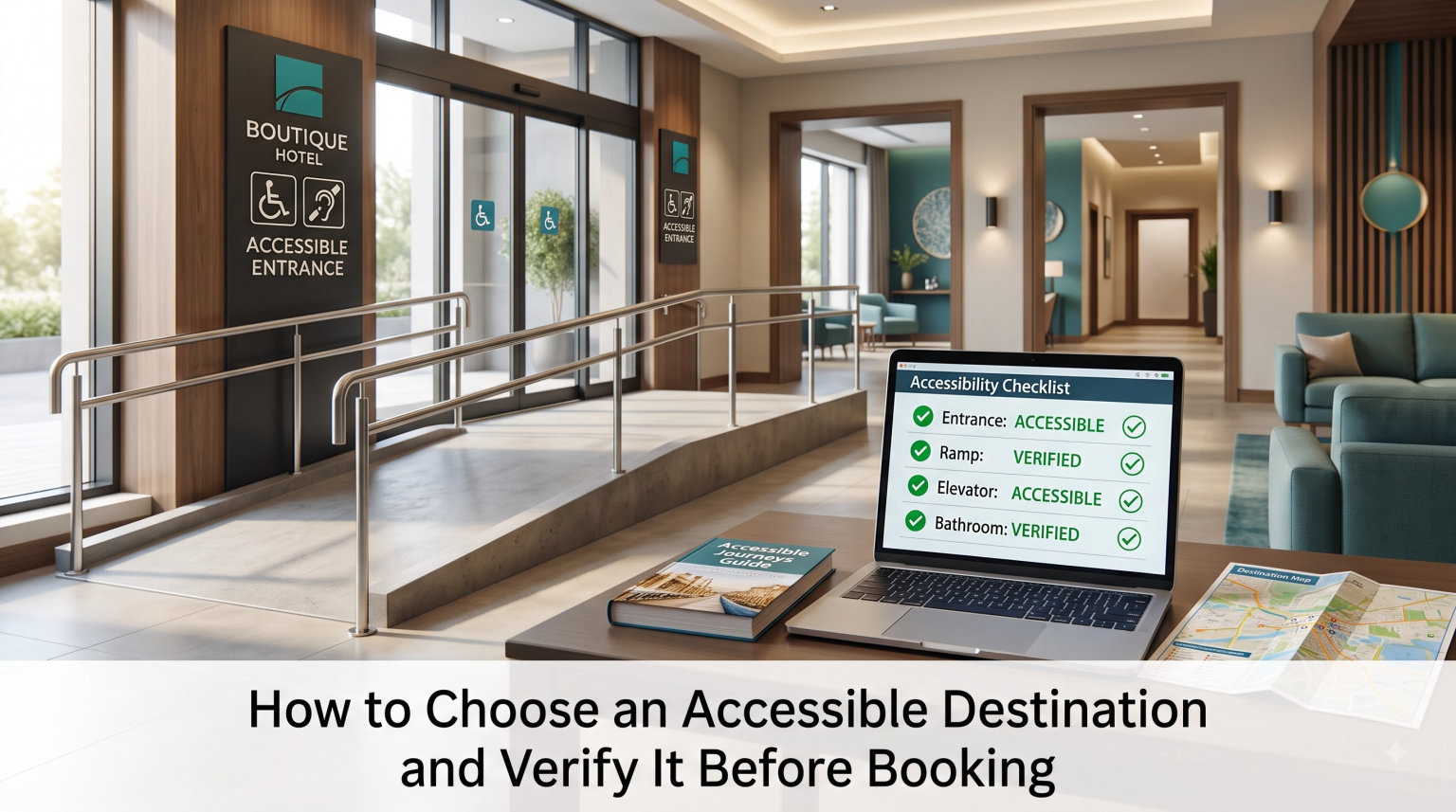
Booking a trip is exciting, but when you travel with a disability or limited mobility, the excitement often comes with a nagging question: will the destination actually be accessible when I arrive? You are not alone in worrying about this. Millions of travelers with mobility, sensory, or cognitive needs have experienced the gut punch of arriving somewhere only to find that “accessible” meant a single grab bar and a narrow doorway.
Learning how to choose an accessible destination and verify it before booking can mean the difference between a dream vacation and a stressful ordeal. One Reddit user in the r/travel community shared that they “booked a stay third party and noted I would need an accessible room, and when I arrived, nothing was accessible.” Unfortunately, stories like this are common because the word “accessible” is used loosely by hotels, airlines, and booking platforms without standardized verification.
The good news is that with the right research approach, verification tools, and a specific checklist of questions, you can confidently book trips that meet your needs. In this guide, I will walk you through a step-by-step process for researching destinations, using trusted verification platforms, contacting providers with exact questions, and building a verification checklist with real measurements that leaves nothing to chance.
Whether you use a wheelchair, travel with a scooter, move with a walker or cane, or are planning a trip for a senior family member with reduced mobility, the methods in this guide apply to your situation. By the time you finish reading, you will have a repeatable system you can use for every future trip.
Table of Contents
Understanding the Four Types of Accessibility
The four types of accessibility are mobility accessibility, sensory accessibility, cognitive accessibility, and digital accessibility. Each addresses a different barrier that travelers face, and most people need a combination of more than one.
Mobility accessibility is what most people think of first. It covers wheelchair ramps, step-free routes, wide doorways, roll-in showers, elevators, and accessible parking. If you use a wheelchair, scooter, walker, or cane, this category directly affects your ability to move through a destination.
Sensory accessibility serves travelers with visual or hearing impairments. This includes features like hearing loop systems in theaters, braille signage in hotels, visual alerting systems for fire alarms, and audio descriptions at museums. Travelers who are deaf or hard of hearing need visual fire alarms and captioned content, while blind or low-vision travelers need tactile and audio navigation aids.
Cognitive accessibility supports travelers with intellectual disabilities, autism, dementia, or conditions that affect information processing. Quiet spaces in airports, simplified wayfinding signage, and pre-visit guides that show what to expect all fall under this category.
Digital accessibility refers to whether websites and apps used for booking and navigation meet standards like WCAG 2.1. If a hotel’s website is incompatible with screen readers or lacks keyboard navigation, that signals a broader lack of accessibility awareness. I will cover this in detail later because it is an often-overlooked warning sign.
Understanding these four categories helps you ask better questions and avoid destinations that claim to be accessible but only address one dimension. A truly accessible destination considers all four.
Step 1: Research Accessible Destinations with Strong Infrastructure
Choosing the right destination starts with looking at the overall accessibility infrastructure of a city or country. Some places have invested heavily in barrier-free design, while others present constant obstacles like cobblestone streets, missing curb cuts, and historic buildings with entrance steps.
Start your research by identifying destinations known for strong accessibility laws and infrastructure. The United States leads the world here. One Reddit user in r/disability put it bluntly: “There really isn’t a more accessible country in the world for wheelchair users than the US.” Cities like Washington D.C., Seattle, Las Vegas, and San Antonio have extensive curb cuts, accessible public transit, and ADA-compliant accommodations.
Beyond the US, consider destinations with strong accessibility reputations. Barcelona, Berlin, Copenhagen, Sydney, and Tel Aviv are frequently recommended by disabled travelers for their step-free public transit, accessible beach entrances, and well-maintained infrastructure.
Types of Accessible Destinations to Consider
Each destination type has different accessibility considerations. Here is what to expect from each category.
Modern cities generally offer the best accessibility. Look for cities with accessible metro systems, level boarding on buses, and newer hotel stock built to ADA or equivalent standards. Urban centers also tend to have more accessible restrooms and smoother terrain.
National parks in the US have made remarkable progress. As one Reddit traveler noted, “Even the National Parks are surprisingly accessible in the USA.” Many parks now offer paved boardwalks, accessible trails, and beach wheelchairs at visitor centers. Check the specific park’s accessibility page before planning.
Beaches require extra verification because sand and water access remain the most challenging environments for wheelchair users. Look for destinations with beach accessibility mats, boardwalks extending to the waterline, and beach wheelchair loaner programs. This is a significant content gap I will address more in the checklist section.
Historic sites present unique challenges. Many predate accessibility laws and may have narrow doorways, uneven flooring, and no elevators. However, some historic destinations have added ramps and accessible routes while preserving their character. Always verify specific routes before booking.
Green Flags and Red Flags During Research
Green flags include detailed accessibility pages on official tourism websites, photos showing ramps and accessible features, mentions in disabled travel communities, and third-party accessibility certifications. A destination that publishes exact measurements rather than vague “accessible” claims is showing transparency.
Red flags include a complete lack of accessibility information, generic statements like “we accommodate all guests,” and destinations where you can only find accessibility info by calling. If the official website treats accessibility as an afterthought, the destination likely does too.
Use Google Street View as a free pre-visit tool. A Facebook community member shared this tip: “Google Street View can help show you steps and terrain before arriving.” Drop the little figure near hotels, attractions, and transit stops to check for curb cuts, ramps, and street conditions yourself.
Step 2: Use Verification Platforms and Third-Party Reviews
Verification platforms do the on-the-ground work of checking accessibility claims so you do not have to rely solely on what hotels and attractions say about themselves. Using these platforms is the single most effective way to separate genuinely accessible destinations from those that just market themselves that way.
Several platforms specialize in accessibility verification, each with different strengths. Understanding what each offers helps you build a complete picture before booking.
Wheel the World: The Gold Standard for Verified Accessibility
Wheel the World stands out because it sends trained assessors to physically visit and map hotels and attractions. Their “Destination Verified” program is the closest thing to a guarantee in accessible travel. Properties must pass an in-person assessment covering room dimensions, bathroom features, common area access, and transportation connections.
When a property is Accessibility Verified by Wheel the World, you can see exact measurements for door widths, bed heights, bathroom configurations, and turning radius clearances. This level of detail is exactly what is missing from most booking platforms. Use Wheel the World to find destinations and accommodations that have already been vetted by people who understand mobility needs.
AccessNow: Crowdsourced Accessibility Maps
AccessNow takes a community-driven approach, letting users rate and review the accessibility of venues worldwide. Reviews come from actual disabled travelers, which adds authenticity that hotel self-reports cannot match. You can filter by location and accessibility type to find restaurants, attractions, and accommodations reviewed by people with similar needs.
The strength of AccessNow is its real-world perspective. A reviewer might note that a restaurant has a ramp at the entrance but the accessible restroom is down a narrow hallway, information you would never get from the venue’s website.
accessibleGO: Travel Booking Built for Accessibility
accessibleGO combines accessibility information with an actual booking platform. It filters hotels, flights, and car rentals by specific accessibility features so you only see options that match your needs. This saves time compared to searching mainstream booking sites and then separately verifying accessibility for each option.
Google Maps and Street View as Free Verification Tools
Do not overlook Google’s free tools. Street View lets you virtually walk routes from hotels to attractions, checking for curb cuts, steps, and terrain conditions. Google Maps user reviews sometimes mention accessibility details that official descriptions omit. Combine Google’s visual tools with specialized platforms for a well-rounded verification approach.
Community Forums and Facebook Groups
Real traveler communities provide unfiltered advice. The Facebook groups “Wheel the World Travel Community” and “Accessible Travel Club” have thousands of members who share first-hand experiences. Reddit communities like r/travel and r/disability have searchable threads where you can find destination-specific accessibility reports.
These communities are valuable because members have no financial incentive to oversell a destination. When someone says a beach was impossible to access in a wheelchair, they are sharing a genuine experience to save others from the same disappointment.
Step 3: Contact Providers Directly with Specific Questions
Direct contact with hotels, airlines, tour operators, and attractions is non-negotiable when verifying accessibility. Online descriptions are often vague, outdated, or simply wrong. A phone call or detailed email can reveal the truth before you commit your money and your safety.
The key to effective direct contact is asking specific, measurable questions. Never ask “Is your hotel accessible?” because the answer will almost always be yes. Instead, ask about exact dimensions, equipment specifications, and specific routes through the property.
Essential Questions to Ask Hotels About Room Accessibility
Ask for exact measurements on every critical feature. Here are the questions that will tell you whether a room actually works for your needs.
Ask about door widths: “What is the exact width of the room entrance door and the bathroom door?” ADA standards require at least 32 inches of clear width, but many older buildings fall short. If the answer is vague, ask the staff to physically measure it while you are on the phone.
Ask about the bathroom configuration: “Does the accessible bathroom have a roll-in shower with no threshold, or a tub with grab bars? What is the turning radius inside the bathroom?” The minimum turning radius for a wheelchair is 60 inches in diameter. Anything less makes the bathroom unusable.
Ask about grab bar placement: “Where exactly are the grab bars located relative to the toilet and shower? Are they wall-mounted at the correct height of 33 to 36 inches?” Improperly placed grab bars are useless even when present.
Ask about bed height: “What is the height of the bed from the floor to the top of the mattress?” Standard accessible bed height is around 20 to 23 inches. Beds that are too high or too low create transfer problems for wheelchair users.
Ask about accessible routes: “Is there a step-free route from the parking area to the room, and from the room to the hotel restaurant, pool, and lobby?” Ask specifically about thresholds and ramps. A “step-free” claim that ignores a two-inch threshold at the entrance is misleading.
Ask about visual and hearing accessibility features if relevant: “Does the room have visual fire alarms, doorbell notification lights, and closed captioning on the television?” Ask about hearing loop availability in meeting rooms and common areas.
Phone Versus Email: Which Works Better
Call first to get immediate answers and gauge how knowledgeable the staff is. If staff members cannot answer specific measurement questions, that itself is a red flag about the hotel’s accessibility awareness. Follow up with an email summarizing what you were told and asking them to confirm in writing.
Having answers in writing creates accountability. If something is wrong when you arrive, you have documentation of what was promised. One Reddit traveler learned this the hard way after arriving at a room that did not match what was described.
Questions to Ask Airlines and Transportation Providers
For air travel, book directly with the airline and call their accessibility services line. Ask about aisle wheelchair availability, priority boarding procedures, lavatory dimensions on your specific aircraft, and how mobility equipment will be handled. Confirm their procedure for requesting airport wheelchair assistance and ask for a confirmation reference number.
For trains and buses, ask about platform access, boarding assistance, designated wheelchair spaces, and accessible restroom availability onboard. Ask whether staff will assist with boarding and how much advance notice is required.
What Proof Do You Need for Accessible Tickets
Most airlines and transportation providers do not require medical proof or documentation to request accessibility accommodations. Under the US Air Carrier Access Act, airlines cannot demand proof of disability. However, if you are traveling internationally, some countries and carriers may request a medical certificate or a doctor’s note for certain services like stretcher accommodation or medical equipment transport.
For accessible seating at concerts, theaters, and sporting events, venues generally do not require proof either, but accessible seating sections are limited. Book early and be prepared to explain your specific seating needs when ordering tickets.
Step 4: Build Your Verification Checklist with Exact Measurements
A detailed verification checklist with exact measurements is your most powerful tool for confirming accessibility before booking. No major competitor provides this level of detail, which is exactly why having your own checklist gives you an advantage when evaluating accommodations.
Print or save this checklist and use it every time you evaluate a hotel, vacation rental, or attraction. These measurements are based on ADA accessibility standards and real-world recommendations from disabled travelers.
Room and Entrance Checklist
Room entrance door: minimum 32 inches clear width. Bathroom door: minimum 32 inches clear width. Threshold height at all doorways: maximum 0.5 inch beveled. Turning radius inside the room: minimum 60 inches diameter. Bed height from floor to mattress top: 20 to 23 inches. Clear space beside the bed for wheelchair transfer: minimum 36 inches wide. Electrical outlets height: 15 to 48 inches from floor. Peephole in door: maximum 43 inches from floor, or a window at wheelchair height.
Bathroom Accessibility Checklist
Shower type: roll-in shower with no threshold, or accessible tub with transfer seat. Roll-in shower dimensions: minimum 36 by 36 inches. Shower seat: folding wall-mounted or free-standing, at 17 to 19 inches height. Handheld showerhead: mounted on adjustable slide bar, reachable from seated position. Grab bars: wall-mounted beside toilet at 33 to 36 inches height, and inside shower at 33 to 36 inches height. Toilet seat height: 17 to 19 inches from floor. Clear floor space beside toilet: minimum 60 inches turning radius. Sink clearance: minimum 29 inches from floor to bottom of sink, with insulated pipes to prevent leg burns. Faucet controls: lever or motion-activated, reachable from seated position. Mirror height: bottom edge no higher than 40 inches from floor.
Common Area and Property Checklist
Main entrance: step-free with ramp at maximum 1:12 gradient (one inch of rise per 12 inches of run). Ramp width: minimum 36 inches clear. Door at main entrance: minimum 32 inches clear width, ideally automatic. Lobby flooring: level, firm, and slip-resistant. Elevator door width: minimum 36 inches. Elevator interior dimensions: minimum 54 by 68 inches to accommodate wheelchair turning. Pool access: zero-entry ramp, sloped entry, or pool lift. Restaurant access: step-free route with tables at 28 to 34 inches height and 27 inches knee clearance underneath. Accessible parking: spaces within 200 feet of accessible entrance, with access aisle minimum 60 inches wide.
Beach Accessibility Checklist
Beach access is one of the most under-researched areas in accessible travel, yet it is a top request from disabled travelers. One ALS forum member reported finding “zero accessible beaches along the East Coast with beach wheelchairs,” highlighting how critical advance research is.
Look for: beach accessibility mats or boardwalks extending from parking area to the waterline. Beach wheelchair loaner programs at lifeguard stations or visitor centers. Accessible parking within 200 feet of the beach access point. Accessible restrooms and changing facilities near the beach entrance. Paved or firm-surface pathways connecting parking, restrooms, and beach mats.
Call ahead to confirm beach wheelchair availability and reservation requirements. Some beaches have chairs but only during peak season, and popular destinations may have long waitlists.
Step 5: Plan Accessible Transportation Door to Door
Transportation is where many accessible trips break down. A destination can have perfect hotels and attractions, but if you cannot get from the airport to your room, the trip fails. Planning accessible transportation means mapping every leg of your trip from departure to return.
Air Travel Accessibility
Book flights at least 48 hours in advance and immediately call the airline’s accessibility services line to register your needs. Request airport wheelchair assistance, aisle wheelchair service if needed, and priority boarding. Confirm how your mobility device will be stored and whether it fits through the cargo door of your specific aircraft.
Ask the airline for the lavatory dimensions on your flight. Wide-body aircraft on long-haul routes typically have one accessible lavatory with a minimum 60-inch turning radius. Narrow-body domestic aircraft generally do not have lavatories large enough for wheelchair users.
Tag your mobility device with clear instructions for handling, and photograph it before check-in. If damage occurs, you have documentation for claims. Never check essential mobility equipment that you cannot survive without for 24 hours, as delays happen.
Accessible Ground Transportation at Your Destination
Research accessible taxi, rideshare, and shuttle options before you land. In the US, Uber and Lyft offer wheelchair-accessible vehicle options in many cities. Confirm availability in your specific destination because coverage varies significantly by city.
For public transit, check whether buses have kneeling features and ramps, and whether subway or metro stations have functioning elevators. Transit agency websites often have accessibility pages listing which stations have elevator access. Call transit agencies to confirm elevator status, because out-of-service elevators are a frequent problem.
For car rentals, major companies like Hertz, Avis, and Enterprise offer hand controls, spinner knobs, and other adaptive equipment at no extra charge. Reserve adaptive equipment at least 72 hours in advance, as availability is limited.
Mobility Equipment Rental at Your Destination
If you prefer not to travel with your own wheelchair or scooter, research rental companies at your destination. Companies like accessaloo and local medical supply stores rent wheelchairs, scooters, hospital beds, and shower chairs for travel.
Confirm delivery and pickup logistics before booking. Some companies deliver to hotels, while others require pickup. Verify that the rental equipment meets your specifications, including seat width, weight capacity, and battery range for scooters.
Service Animal Travel Considerations
If you travel with a service animal, research destination-specific regulations. In the US, the ADA protects service animal access in public accommodations. International destinations vary widely, with some requiring quarantine, health certificates, or import permits.
Carry your animal’s vaccination records and any required documentation. Confirm that your hotel accepts service animals and ask about relief areas on the property. For air travel, notify the airline in advance and ask about relief areas at connecting airports.
Digital Accessibility: What Booking Websites Tell You
A travel provider’s website is often a preview of their accessibility commitment. If their own digital presence is inaccessible, their physical accessibility is likely equally neglected. Digital accessibility for travel websites is measured against WCAG 2.1 guidelines, the same international standards that govern web accessibility.
WCAG 2.1 evaluates websites on four principles: content must be perceivable, operable, understandable, and compatible with current and future assistive technologies. For a travel booking site, this means images should have descriptive alt text for screen reader users. Forms should be navigable by keyboard alone. Color contrast should meet minimum ratios for low-vision users. Video content should include captions and transcripts.
Red Flags in Booking Platform Accessibility
Watch for websites where you cannot complete a booking using only a keyboard, where images lack alt text, or where booking forms trap screen reader users. These are not just inconveniences for disabled travelers. They signal that the company has not invested in accessibility training or testing.
A hotel or destination that publishes a detailed accessibility page with specific measurements, photos, and contact information is demonstrating a genuine commitment. One that buries accessibility in a FAQ or forces you to call during business hours to get any information is telling you something about their priorities.
Why Website Accessibility Predicts Physical Accessibility
Organizations that invest in digital accessibility tend to invest in physical accessibility too. Accessibility is usually a cultural commitment, not a one-off checkbox. If a hotel’s website works well with assistive technology, there is a reasonable expectation that the hotel itself was designed with accessibility in mind.
Use this correlation as a screening tool during your research phase. Eliminate providers whose websites fail basic accessibility tests, and focus your verification energy on providers who demonstrate awareness across both digital and physical dimensions.
Accessible Travel Resources and Communities
No single platform or tool covers every aspect of accessible travel. Building a toolkit of resources and communities gives you multiple perspectives and verification sources. Here are the most valuable resources that experienced disabled travelers rely on.
Verification Platforms
Wheel the World provides verified accessibility assessments for destinations worldwide. AccessNow offers crowdsourced accessibility reviews for specific venues. accessibleGO combines accessibility filtering with a booking platform. Sage Traveling specializes in accessible European travel with destination-specific expertise.
Community Forums and Social Media Groups
The Facebook groups “Wheel the World Travel Community” and “Accessible Travel Club” connect thousands of disabled travelers who share advice, reviews, and support. These groups are particularly valuable for finding answers about destinations that mainstream travel sites overlook.
Reddit communities like r/travel, r/disability, and r/askhotels contain searchable archives of real traveler experiences. The TripAdvisor accessible travel section also offers destination-specific reviews from disabled travelers.
Government and Official Resources
The US Department of Transportation provides information on air travel rights under the Air Carrier Access Act. The ADA National Network offers guidance on accessibility standards for public accommodations. National park websites publish accessibility guides listing accessible trails, facilities, and programs.
For international travel, the US State Department’s country-specific information pages include notes on accessibility conditions and the UK Foreign Office provides similar guidance for British travelers.
What Is the Best Travel for Seniors with Limited Mobility?
The best travel for seniors with limited mobility combines destinations with excellent accessibility infrastructure, accommodations with verified accessible rooms, and transportation that minimizes physical demands. Cruises are particularly well-suited for seniors because they offer accessible cabins, onboard medical care, and multiple destinations without the need to pack and unpack repeatedly.
Guided accessible tours through companies like Wheel the World and Sage Traveling handle logistics, provide accessible vehicles, and confirm attractions are vetted before arrival. For independent travel, all-inclusive resorts in destinations like Florida, Arizona, and the Caribbean offer flat terrain, accessible pools, and on-site amenities that reduce the need to travel off-property.
FAQs
How do I choose a destination?
Start by identifying destinations known for strong accessibility infrastructure, such as US cities with ADA-compliant transit and hotels. Use verification platforms like Wheel the World and AccessNow to find vetted accessible properties. Check community forums for real traveler experiences, use Google Street View to assess terrain and curb cuts, and always contact providers directly with specific measurement questions before booking.
What proof do you need for accessible tickets?
Most airlines and venues do not require medical proof to request accessibility accommodations. Under the US Air Carrier Access Act, airlines cannot demand documentation of disability. Some international carriers may request a medical certificate for certain services like stretcher accommodation or medical equipment. For accessible event seating, book early and describe your specific needs when ordering.
What are the 4 types of accessibility?
The four types of accessibility are mobility accessibility (ramps, wide doors, roll-in showers, elevators), sensory accessibility (hearing loops, braille signage, visual alarms, audio descriptions), cognitive accessibility (quiet spaces, simplified signage, pre-visit guides), and digital accessibility (WCAG 2.1 compliant websites and apps compatible with assistive technology).
What is the best travel for seniors with limited mobility?
Cruises are ideal for seniors with limited mobility because they offer accessible cabins, onboard medical care, and multiple destinations without repacking. Guided accessible tours through companies like Wheel the World handle logistics with accessible vehicles. All-inclusive resorts in flat destinations like Florida and Arizona provide accessible pools and on-site amenities that reduce off-property travel demands.
Conclusion
Knowing how to choose an accessible destination and verify it before booking transforms travel from a gamble into a confident, repeatable process. Research destinations with strong infrastructure, use verification platforms like Wheel the World and AccessNow, contact providers with specific measurement questions, build your checklist, and plan every leg of transportation in advance.
The tools and strategies in this guide work because they are built on real measurements and real traveler experiences, not vague marketing claims. Start planning your next trip with the checklist from Step 4, join the communities in the resources section, and travel with the confidence that comes from knowing exactly what to expect when you arrive.