
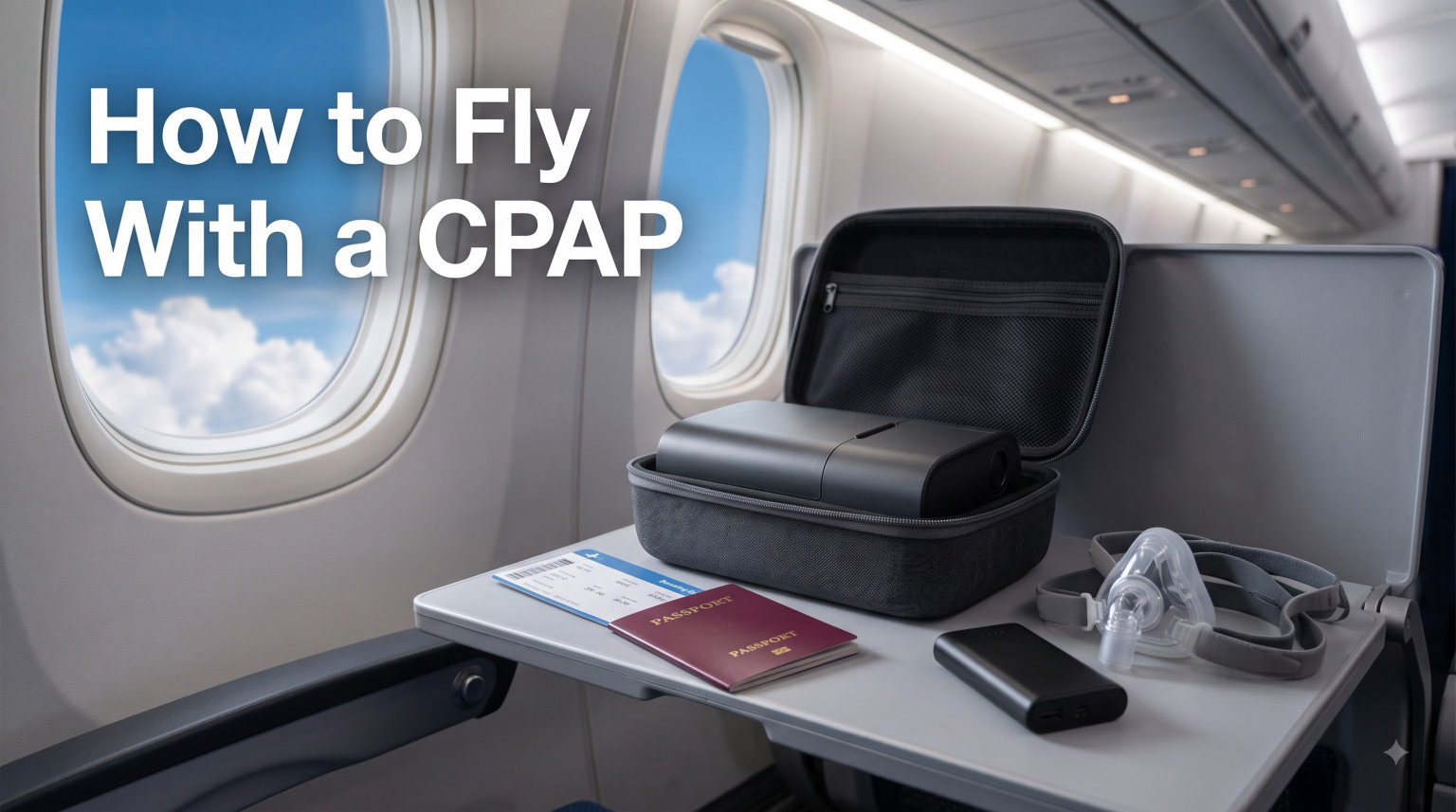
I remember the first time I flew with my CPAP machine. I stood at the TSA checkpoint with a rolling case full of tubing and a hundred questions, wondering if I would clear security in time to make my flight. That experience taught me that learning how to fly with a CPAP machine is less about complicated rules and more about knowing what to expect before you reach the airport.
Whether you’re heading out for a vacation, a business trip, or an international adventure, your CPAP therapy should never be the reason you cancel a flight. CPAP machines are classified as medical equipment by the TSA and by every major airline, which means they get special treatment when you travel. In this guide, I will walk you through everything I have learned from years of flying with a CPAP, including the carry-on rules, TSA screening process, the 4-hour rule, and how to handle international flights.
Table of Contents
Understanding the Rules for Flying With a CPAP Machine
A CPAP machine is classified as a medical device and an assistive device for travelers. Under current U.S. Department of Transportation rules, airlines must allow passengers to bring portable medical equipment on board, and it does not count against your carry-on limit. This is true for domestic flights and for most international flights on U.S. carriers.
In plain English, this means you can bring your CPAP machine on the plane in addition to your regular carry-on bag and personal item. You don’t have to choose between your laptop bag and your sleep apnea machine. Most airlines store it in the overhead bin or under the seat in front of you, just like any other carry-on item.
Beyond the airline rule, the TSA also exempts CPAP machines from standard carry-on restrictions. You can bring distilled water for your humidifier, your mask, your tubing, your filters, and even a battery pack for your CPAP to power the device during long flights. All of these items are allowed in both carry-on and checked baggage, although I always recommend keeping your CPAP with you in the cabin.
Why does this rule exist? Sleep apnea is a recognized medical condition, and skipping CPAP therapy during travel can lead to daytime fatigue, high blood pressure, and serious health risks. The federal government recognized years ago that people who rely on CPAP therapy need consistent access to their machines, and the rules around air travel reflect that. Knowing this makes the entire airport experience less stressful because you understand the law is on your side.
Pre-Flight Checklist for Flying With a CPAP
Before I head to the airport, I run through this short checklist. It takes about ten minutes and saves me from stress at the security checkpoint and at the gate.
- Empty the humidifier chamber completely and dry it thoroughly with a clean towel.
- Pack your CPAP in its dedicated travel case or a clear plastic zip-top bag.
- Place a luggage tag or label on the outside of your case with your name and contact info.
- Bring your prescription or a printed doctor’s note, even though TSA rarely asks for it.
- Charge your CPAP battery pack if you plan to use the device on the plane.
- Pack a spare mask cushion, extra filters, and a backup length of tubing.
- Carry a copy of your airline’s medical device policy saved on your phone.
- Confirm your seat assignment if you need a bulkhead row for in-flight CPAP use.
- Place your device in a clear bag so the security screening moves quickly.
If you take nothing else from this article, take this checklist. It is the single most useful thing I do for every flight I take. I have run through it on more than 30 flights in the last decade, and I have never had an issue at security or boarding.
How to Fly With a CPAP Through TSA Security
Going through TSA with a CPAP machine is straightforward once you know the steps. The screening officers see these devices every day, so there is no reason to feel anxious. I usually move through TSA faster than the travelers in front of me, because my CPAP is already in its bin before they finish removing their laptops.
- Remove your CPAP from its travel case when you reach the X-ray belt.
- Place the machine in a clear plastic bin by itself, along with the mask and tubing if you prefer.
- Send your travel case, power cord, and any other electronics through the X-ray as normal.
- Tell the TSA officer that the device is a CPAP machine if they ask, though most will already know.
- Wait for the officer to swab the machine for explosive residue if requested, then continue through.
Your CPAP will go through the X-ray scanner just like a laptop. The TSA does not require you to remove the mask or tubing. I have never had a machine flagged, but in the rare event yours is, the officer will perform a manual inspection or a pat-down of the equipment. This is rare and harmless.
One tip from my own experience: keep your machine in a clear plastic bag inside the case. If the bin at the security line is dirty, you don’t want the air intake of your device sitting directly on it. A gallon-size zip-top bag works perfectly and weighs almost nothing. I also keep the mask and tubing in a separate small bag so they stay clean if the security bins are damp.
If you use a humidifier, leave the chamber empty. Some travelers put the chamber in the bin with the machine, but TSA may treat a chamber with water residue as a separate screening item. Emptying and drying it before you fly eliminates any extra questions.
Airline Policies and Documentation for CPAP Travel
You do not need a doctor’s note to fly with a CPAP machine in the United States. TSA has stated clearly that medical devices are allowed through security, and the agency does not require prescriptions or written documentation for routine CPAP travel. That said, I still carry a copy of my prescription in my travel bag. If a check-in agent gives you trouble, the prescription resolves the issue in about thirty seconds.
When you arrive at the gate, the gate agent or flight attendant may ask what is in your extra bag. Simply tell them it is a CPAP machine and that it is a medical device. They will tag it and let you board. Most flight attendants are familiar with CPAP travel because they see it on nearly every long-haul flight.
For international flights, the rules are similar but not identical. The European Union, Canada, Australia, and most of Asia follow the same general principle of allowing medical equipment on board. However, some international carriers require advance notice, especially if you plan to use the CPAP during the flight. I recommend calling your airline at least 48 hours before departure. This is the single best thing you can do for a smooth international trip.
Some airlines go further than the federal rules. For example, certain carriers will let you pre-board the plane if you have a CPAP, so you have extra time to set up. A few even let you store your machine in a coat closet near the front of the plane if the overhead bins are full. None of this is required, but it never hurts to ask when you call ahead.
Preparing Your CPAP Machine for the Flight
The biggest mistake I see travelers make is leaving water in the humidifier chamber. Cabin pressure changes during flight can cause the water to expand and leak into the machine, damaging the electronics. Before you pack your CPAP, remove the humidifier chamber, empty it completely, and dry it with a clean towel. Then reattach it to the machine so it does not get lost.
Next, turn on the airplane mode feature if your CPAP has one. Most modern machines, including the ResMed AirSense 10 and AirSense 11, have a setting that disables the cellular modem. This is required by the FAA on most U.S. flights, although a few carriers still allow the modem to remain active. The airplane mode setting is usually found in the My Options menu under Connectivity. If you can’t find it, leave the machine in airplane mode by default as it does not affect therapy.
Finally, pack your device in a padded travel case. The manufacturer case is fine, but I prefer a hard-shell case with foam inserts for extra protection. Wrap the tubing loosely and place the mask in a small pouch so it doesn’t press against the screen. Add a label on the outside that says “Medical Device” so the gate agents know exactly what it is. This is especially useful if you have a connecting flight and a different TSA crew screens you at a smaller airport.
The 4-Hour Rule and In-Flight CPAP Use
The 4-hour rule is a guideline from the FAA that applies to battery-powered medical devices, including CPAP machines. It states that the battery capacity of your portable electronic device should be sufficient to cover at least 150 percent of the expected flight time, or four hours of operation, whichever is greater. In practice, this means your CPAP battery should be able to run for at least four hours without recharging.
This rule matters because most aircraft do not have power outlets in the economy cabin. If you take a long-haul flight and plan to sleep with your CPAP, you need a battery pack large enough to last the entire flight. A standard CPAP runs at 30 to 60 watts depending on pressure settings, so a 150 to 200 watt-hour battery pack will usually cover a 7 to 8 hour flight.
Can you actually use your CPAP during the flight? Yes, on most airlines you can. You will need to position the mask so it does not interfere with the seatbelt sign and you may need to use bottled water instead of the humidifier, since the cabin air is very dry. The flight attendants may also dim the cabin lights or move you to a bulkhead seat if you ask, especially on overnight flights. A simple sentence to the lead flight attendant when you board is usually enough to arrange this.
A good rule of thumb is to bring one battery for every 4 to 6 hours of expected flight time. If your flight is 8 hours, bring two batteries or one large battery rated at 200 watt-hours or higher. Always fully charge the battery the night before, and bring the charging cable in your carry-on so you can top it up at the gate if needed.
Battery, Power, and International Travel Considerations
If you fly international, voltage becomes a real concern. Most CPAP machines are dual voltage, meaning they work on both 110V (U.S.) and 220V (Europe, Asia, most of the world). Check the back of your power brick. If you see a range like “100-240V” printed on the label, you only need a plug adapter. If you see a single voltage like “120V” only, you need a voltage converter as well.
For battery options, you have three main choices. First, a manufacturer-specific battery like the ResMed Power Station II, which is designed for your exact machine. Second, a universal lithium battery pack with a DC outlet, which works with most modern CPAPs and also charges your phone. Third, a portable power station like those made for camping, which gives you multiple nights of therapy but is heavy and bulky.
I always travel with option one or option two. The travel CPAP battery packs are FAA-approved for carry-on and they fit in the same bag as your machine. For multi-night trips where you don’t have reliable power, a portable power station is worth the extra weight.
If you are crossing time zones, your pressure settings may need to be adjusted for altitude. Some CPAP machines, including the AirSense 11, automatically adjust pressure for changes in elevation. Older machines will need a manual adjustment. Check your device manual before international flights to higher altitude cities like Denver, Mexico City, or Johannesburg. The wrong pressure setting during the flight can cause uncomfortable therapy or even mask leaks.
One more thing to remember on a long international flight: most airlines restrict the size of lithium batteries you can carry on. The FAA limit is 100 watt-hours per battery without airline approval, and up to 160 watt-hours with airline approval. Anything larger must be checked or shipped separately. Always check your airline’s specific battery policy before you pack. Most airlines post this information in the special baggage section of their website.
At Your Destination and Backup Supplies
Once you land, your CPAP routine should not change. The only difference is the water source. Hotel tap water contains minerals that can build up in your humidifier chamber over time, so I always bring a small bottle of distilled water for the first night. You can usually buy more at a local pharmacy or grocery store once you arrive.
Pack a backup supply kit in your checked luggage just in case. This includes a second mask cushion, a spare filter, an extra length of tubing, an extra headgear strap, and a small bottle of CPAP cleaning wipes. If your carry-on bag is lost or delayed, you can still use your machine the same night without risking a skin reaction from a dirty mask.
Finally, take a few minutes at your hotel to clean the machine before you use it. Wipe down the mask, rinse the humidifier chamber, and let everything air dry for about 30 minutes. This is one of those small habits that pays off in better sleep and fewer problems with your equipment over time. I also recommend wiping down the power cord and the outside of the machine, because hotel rooms can be dusty and the air intake can pull that dust straight into your therapy.
Frequently Asked Questions About Flying With a CPAP
Do I need a doctor’s note to fly with my CPAP machine?
No, you do not need a doctor’s note to fly with a CPAP machine in the United States. TSA treats CPAPs as permitted medical devices, and no prescription is required for security screening. That said, I recommend carrying a copy of your prescription anyway, because a check-in agent may ask for it if they are unfamiliar with medical equipment rules.
How do I get through TSA with a CPAP machine?
Remove your CPAP from its travel case and place it in a clear plastic bin at the X-ray belt. The machine will go through the standard X-ray scanner like a laptop. You can leave the mask and tubing inside the case or send them through separately. Tell the TSA officer it is a CPAP machine if asked, and you’re done.
What is the 4-hour rule for CPAP?
The 4-hour rule is an FAA guideline that requires battery-powered medical devices, including CPAP machines, to have enough battery capacity to run for at least 150 percent of the expected flight time, with a minimum of four hours. Bring a battery pack rated for at least four hours of CPAP use if you plan to sleep during any flight over four hours.
Where do you pack a CPAP when flying?
Pack your CPAP in a dedicated travel case as a carry-on item, never in checked luggage. Major airlines allow medical devices as an extra carry-on, so it does not count against your normal bag allowance. Store it in the overhead bin or under the seat in front of you during the flight, exactly like any other carry-on.
Can I use my CPAP during the flight?
Yes, most airlines allow you to use your CPAP during the flight. You will need a battery pack since very few economy cabins have power outlets. Let the lead flight attendant know when you board so they can dim the cabin lights and avoid disturbing you during sleep therapy.
Does a CPAP count as my carry-on?
No, a CPAP machine does not count as your carry-on bag. Under DOT rules, medical devices are an extra allowed item, so you can bring your CPAP plus your normal carry-on and personal item. This rule applies to all U.S. airlines and most international carriers as well.
Final Thoughts on How to Fly With a CPAP
Learning how to fly with a CPAP machine is one of those things that gets easier every time you do it. The rules are clear, the equipment is allowed, and the screening process is the same one you have been through a hundred times. Once you have done it once, you will wonder why you were ever worried.
Empty the humidifier, pack the machine in a clear bag, bring a battery pack, and call your airline 48 hours before departure. Those four steps cover 95 percent of what you need to know. The rest is just bringing a spare mask cushion and a small bottle of distilled water for your first night. Safe travels, and sleep well on your next flight.