
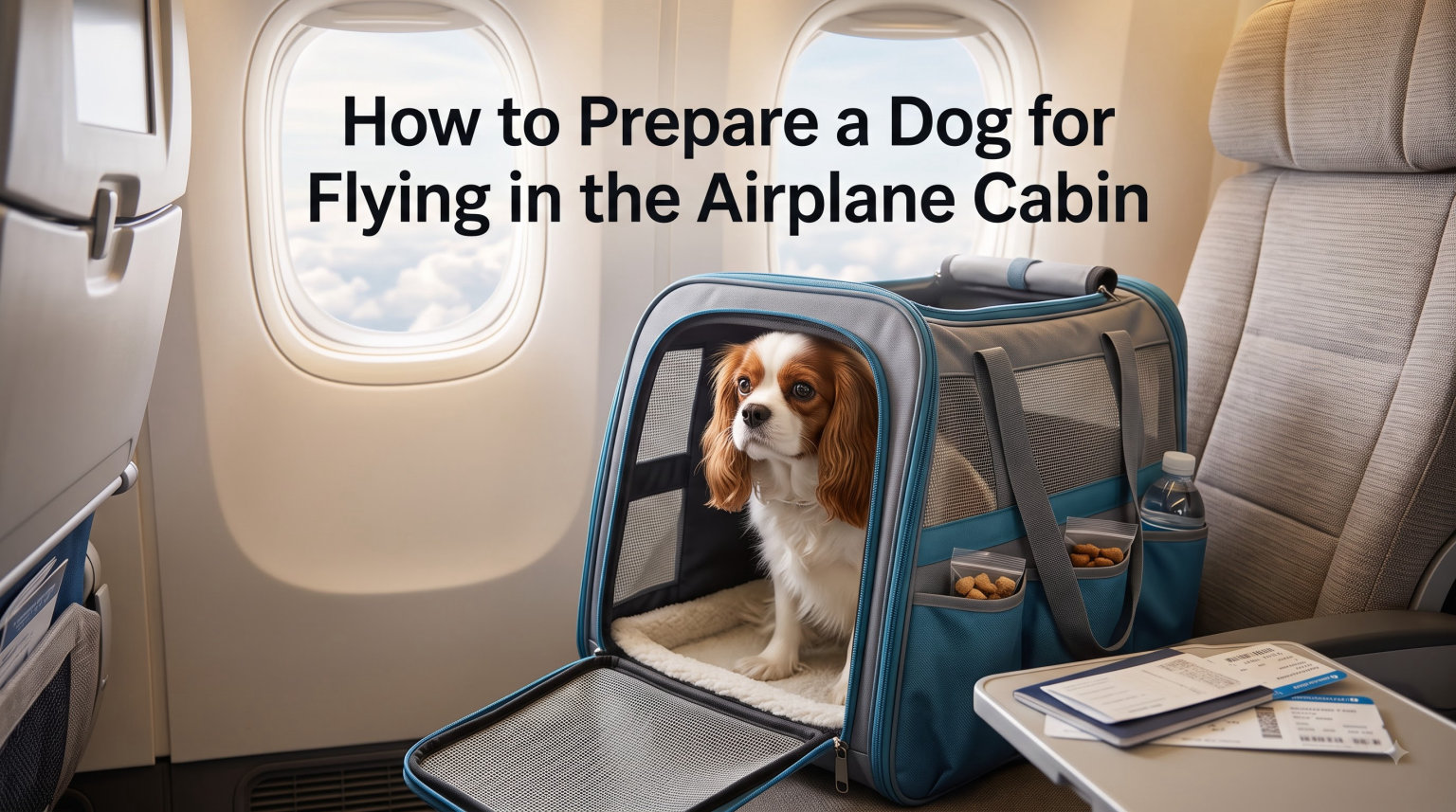
Learning how to prepare a dog for flying in the airplane cabin takes more than tossing a carrier in the car and heading to the airport. I learned this the hard way in 2026 when I flew my beagle, Cooper, from Chicago to Denver without much of a plan. He cried for the first hour, missed the carrier pad completely, and I spent the landing in a cold sweat. The next time, I followed a real preparation timeline, and the difference was night and day.
This guide walks you through everything I wish I had known before that first flight. We cover airline rules, documentation, carrier sizing, an eight-week training timeline, TSA screening, in-cabin comfort, and what to do once you land. Whether you are relocating, traveling for vacation, or flying to a family event, these steps will help you and your dog board with confidence.
By the end, you will have a clear checklist, a realistic training schedule, and answers to the most common questions dog owners ask before cabin travel. Let us get started.
Table of Contents
Is Cabin Travel Right for Your Dog?
Not every dog is a good candidate for flying in the airplane cabin, and being honest about that upfront saves everyone stress. Most airlines limit in-cabin pets to animals small enough to fit in a carrier under the seat in front of you. That typically means dogs under 20 pounds, although the exact limit depends on the carrier dimensions your airline allows.
Beyond size, temperament matters. Dogs that panic in cars, bark at thunder, or refuse to enter a crate at home are likely to struggle in a pressurized cabin surrounded by strangers. If your dog cannot relax in a carrier for at least an hour at home, the cabin is going to amplify every anxious behavior.
Dogs That Should Not Fly in the Cabin
Several groups of dogs face higher risks during air travel, and many airlines have outright bans for some of them. Brachycephalic (flat-faced) breeds like pugs, bulldogs, Boston terriers, boxers, and Pekingese are restricted or banned by most major US carriers because their shortened airways make breathing difficult under cabin pressure changes. Airlines including Delta, United, American, and Alaska have all placed summer embargoes or full restrictions on snub-nosed breeds.
Other dogs that should avoid flying include very young puppies under 8 weeks who have not been fully weaned and vaccinated, pregnant dogs in late-term pregnancy, dogs recovering from surgery or illness, and dogs with severe separation anxiety that have not been desensitized to crate time. Senior dogs with heart or respiratory conditions should also stay grounded unless your vet specifically clears them for air travel.
Dogs That Usually Do Well
Small to medium breeds that are crate-trained, calm around new people, and healthy generally handle cabin travel well. Think Chihuahuas, Yorkshire terriers, Shih Tzus, miniature poodles, Cavaliers, French bulldogs (on airlines that allow them), and similar sized companions. The key is preparation. Even confident dogs become stressed if the carrier is unfamiliar or the airport routine is chaotic.
Airline Pet Policies at a Glance
Every major US airline sets its own rules for in-cabin pets, and these policies change frequently. I always check the airline’s official pet policy page within 48 hours of booking because fees, carrier limits, and embargo dates update without much fanfare. Here is a snapshot of the most common carriers as of 2026, but treat this as a starting point and verify with your airline before you fly.
| Airline | In-Cabin Pet Fee | Max Pets per Flight | Carrier Size Limit | Notable Restrictions |
|---|---|---|---|---|
| Alaska Airlines | USD 100 each way | 5 in cabin | 17 x 12 x 9 in (hard) or 17 x 12 x 12 in (soft) | No embargo on brachycephalic breeds; only dogs and cats |
| American Airlines | USD 150 each way | 7 in first class, 5 in other cabins | 19 x 13 x 9 in | Summer embargo on snub-nosed breeds (May 15 to Sept 15) |
| Delta Air Lines | USD 95 to USD 150 each way (route dependent) | 2 in cabin per flight | 18 x 11 x 11 in | Banned brachycephalic and mastiff breeds year-round |
| JetBlue | USD 125 each way | 4 in cabin | 17 x 12.5 x 8.5 in | No brachycephalic breeds; dogs and cats only |
| Southwest Airlines | USD 125 each way | 6 in cabin | 18.5 x 13.25 x 9.5 in | Only domestic flights; no international routes |
| United Airlines | USD 150 each way | 4 in cabin | 18 x 11 x 11 in (soft) or smaller | Summer embargo on brachycephalic breeds; PetSafe cargo for larger dogs |
Two consistent rules apply across nearly every airline. First, you must call the airline to add your pet to your reservation, since the cabin pet limit fills up quickly. Second, your dog must remain inside the carrier for the entire flight, including takeoff and landing. The carrier counts as your personal item or fits under the seat in front of you, depending on the airline.
Direct flights are strongly preferred. Layovers multiply your dog’s stress and the chance of a missed connection, and many airlines will not book in-cabin pets on itineraries with connections longer than a certain window. If a layover is unavoidable, choose one short and use the airport’s pet relief area immediately.
Documentation and Health Requirements
Documentation trips up more travelers than almost any other step. Even for purely domestic US flights, your dog needs current vaccination records, and many airlines require a health certificate issued within 10 days of departure. Add international travel and the paperwork multiplies fast. Here is what to gather, broken down by trip type.
Domestic Flights Within the United States
For a domestic flight, you need proof of current rabies vaccination and a USDA-accredited veterinarian health certificate. Most airlines require the certificate to be issued within 10 days of the outbound flight and again within 10 days of the return flight if you are round-tripping. Some states (notably Hawaii) have stricter entry requirements, so check state-specific rules even for travel between US destinations.
Keep printed copies of everything in a separate folder from your boarding pass. I have seen gate agents turn away travelers whose digital records failed to load at the airport, and paper backups have saved the day more than once.
International Flights
International travel adds country-specific entry requirements. The CDC requires a USDA-endorsed export health certificate for dogs leaving the United States, and many destinations require microchip identification, specific rabies titer tests, or quarantine periods. The European Union, the United Kingdom, Japan, and Australia each have their own protocols, and processing times for endorsed certificates can take several weeks.
Start international paperwork at least four to six months before departure. The USDA APHIS Veterinary Services office in your state processes endorsed certificates, and turnaround times stretch during peak travel seasons. Skipping this step is the fastest way to get turned away at the airport.
Service Dogs and Emotional Support Animals
Service dogs fly free and are exempt from the in-cabin pet limit, but they must meet the Department of Transportation’s definition of a trained service animal. Airlines require DOT service animal forms, health forms, and proof of training. As of 2026, emotional support animals are no longer treated as service animals by US airlines and must travel as standard pets, paying the regular fee and staying in a carrier.
Choosing an Airline-Approved Dog Carrier
The carrier is your dog’s home, safety zone, and bathroom for the entire trip. Choosing the wrong one forces a last-minute airport scramble and may even get your dog denied boarding. Focus on three things: dimensions, material, and comfort features.
Carrier Dimensions by Airline
Every airline publishes maximum carrier dimensions, measured as length x width x height. Soft-sided carriers can usually be a few inches taller than hard-sided ones because the soft walls compress under the seat. Before you buy, measure the seat in front of your assigned seat on the airline’s seat map. A carrier that fits under a first-class seat may not fit under an economy seat, especially on regional jets.
Your dog should be able to stand up, turn around, and lie down comfortably inside the carrier. Measure your dog from nose to tail base for length and from floor to top of shoulders for height, then add two to three inches of clearance in each direction.
Soft-Sided vs Hard-Sided Carriers
Soft-sided carriers are the standard for in-cabin travel. They are lighter, easier to squeeze under tight seats, and most come with mesh ventilation panels and zippered openings. Look for reinforced corners, a sturdy base, and leak-proof lining. Popular models include the Sherpa Original Deluxe, MidWest Homes for Pets iCrate, and Pet Magasin soft-sided carriers.
Hard-sided carriers offer more protection but rarely fit under seats unless the airline specifically approves them. Use hard-sided crates for cargo travel or for very anxious dogs who need extra security. Some travelers bring both, using the hard crate as a “home base” in the hotel and the soft carrier for the flight itself.
Features That Make a Real Difference
Beyond dimensions and material, certain features reduce stress during the actual flight. A waterproof, machine-washable liner catches accidents and wipes clean in seconds. Absorbent pee pads layered on top of the liner add backup protection. Side pockets hold vaccination papers, treats, and a collapsible water bowl.
Look for carriers with top-loading openings as well as front doors, since TSA sometimes asks you to lift the dog out from above. A top zipper saves you from wrestling a nervous dog out through a small side door during the security screening rush.
Crate Training Timeline: 8 Weeks to Takeoff
The single most important thing you can do to prepare a dog for flying in the airplane cabin is crate training, and the earlier you start, the better. Most behavior problems on planes (barking, whining, escape attempts, accidents) trace back to a dog that was put into a carrier for the first time on flight day. The Rover article that helped me the most recommends an eight-week timeline, and I now use the same approach with every client I coach. Here is the breakdown.
8 Weeks Before Flight: Introduction and Positive Association
Place the carrier in your living room with the door open and let your dog investigate on his own terms. Toss treats inside, feed meals near the entrance, and use a calm, happy voice whenever your dog approaches. Never force the dog inside during this phase. The goal is curiosity, not compliance.
After a few days, start closing the door for one second while your dog is eating inside, then opening it again. Gradually extend the closed-door time. If your dog whines, wait for a quiet moment before opening, otherwise you reinforce the crying behavior.
4 Weeks Before Flight: Duration and Distance
Once your dog willingly enters the carrier, build up the time inside. Start with 10-minute sessions and work toward an hour or more. Take short car rides with the dog in the carrier, then graduate to waiting in the parked car with the engine off. Play recorded airport sounds at low volume during these sessions to desensitize your dog to the noise.
This is also when I introduce a worn t-shirt or blanket inside the carrier. Your scent calms dogs faster than any commercial product, and a familiar-smelling item pays off during a long travel day.
2 Weeks Before Flight: Travel Simulations
Walk your dog through an actual airport terminal if possible. Many airports allow non-traveling pets in the terminal if they remain in carriers, and the experience of crowds, announcements, and rolling luggage is hard to replicate at home. If you cannot visit an airport, simulate the conditions in a busy parking lot or shopping center.
Book a practice session with your veterinarian if your dog shows signs of severe anxiety. Your vet can discuss anti-nausea medication, pheromone sprays, or prescription mild sedatives for the flight. Never sedate your dog without veterinary guidance. Over-sedation can cause respiratory problems at altitude, and some airlines prohibit sedated pets.
Day Before Flight: Final Prep
Confirm your reservation with the airline, print every document, and pack your dog’s travel kit. Lay out the carrier with a clean absorbent pad, a familiar blanket, a small spill-proof water bowl, two toys (one quiet chew, one comfort item), and a roll of paper towels plus a few Ziploc bags for accidents.
Check the weather forecast at both ends of your trip. Hot or cold weather affects carrier padding choices and whether you should request ground transportation instead of waiting on the tarmac. Exercise your dog thoroughly the evening before. A tired dog sleeps through more of the flight.
Day-of-Travel Checklist
On flight day, the goal is to keep your dog’s routine as normal as possible while staying in control of the logistics. Here is the sequence that works for me.
Morning Routine
Walk your dog at least 30 minutes before leaving for the airport, allowing time to relieve herself and burn off some energy. Feed a light meal four to six hours before departure, not immediately before. A full stomach plus pressure changes can trigger nausea, while a too-empty stomach can cause hypoglycemia in small breeds. Water is fine right up until you leave, then limit it to small sips at the airport.
Airport Arrival
Arrive earlier than usual, ideally two to three hours before a domestic flight. The extra time covers check-in, pet relief area visits, and the longer security screening process. Most airports have pet relief stations both before and after security, and the post-security station is gold during long layovers. Download your airport’s pet relief map ahead of time.
Boarding and Takeoff
At the gate, keep your dog calm by speaking softly and avoiding excited energy. Place the carrier under the seat in front of you with the mesh side facing you, so you can see your dog and she can see you. Many flight attendants will let you place the carrier on your lap during boarding if the aisle is clear, but the carrier must end up under the seat before takeoff.
Once in the air, resist the urge to open the carrier. Mid-flight opening risks your dog bolting into the cabin and almost guarantees the carrier stays open for the rest of the flight, which airlines do not allow. A small treat dropped through the mesh at takeoff and again at landing helps create positive associations with those pressure-change moments.
Navigating TSA Screening with a Dog
The TSA screening process is the part most dog owners dread, but it is straightforward once you know the steps. Here is exactly what happens.
When you reach the front of the security line, tell the TSA officer that you are traveling with a pet in a carrier. The officer will direct you to a separate screening area where you can take your time. You will be asked to remove your dog from the carrier, hold the dog on a leash (or carry her), and walk through the metal detector while the carrier goes through the X-ray machine separately.
Your dog will not pass through the X-ray conveyor belt. The TSA agent may swab your hands for traces of explosives after handling the dog. Keep a short, fixed-length leash on your dog during this process so she does not dart into the crowd. Slip the leash through your belt loop or wrap it around your wrist for extra security. I have seen dogs slip out of harnesses during the chaos, and a backup plan matters.
Once you collect the carrier, place your dog back inside, zip up, and proceed to your gate. The whole process usually takes five to ten minutes longer than a normal screening, which is why arriving early is non-negotiable.
In-Cabin Comfort and Anxiety Management
Even with months of preparation, some dogs struggle during the actual flight. The cabin environment is loud, the air is dry, and the pressure changes during ascent and descent. Here is how to keep your dog as comfortable as possible.
Settling Your Dog During Flight
Speak in low, calm tones and avoid drawing attention to the carrier. Other passengers do not want to hear constant reassurance or see you fussing with the zipper, both of which signal to your dog that something is wrong. A quiet chew toy like a Kong stuffed with peanut butter gives your dog something to focus on.
If your dog starts whining, ignore the behavior for a few minutes. Many dogs settle on their own once they realize the noise is not producing a result. If the whining persists for more than ten minutes, place a treat or a lickable snack inside the carrier through the mesh. Licking releases calming endorphins and often stops the cycle.
Ear Pressure Relief
Dogs experience ear pressure changes just like humans, and it can be painful during takeoff and landing. The classic trick is to encourage swallowing, which opens the eustachian tubes. Offer a small treat or a lick of water from a portable bowl during ascent and descent. Some owners gently massage the base of their dog’s ears, which I have seen calm even anxious flyers.
If your dog tilts her head, paws at her ears, or seems off-balance during pressure changes, she is probably experiencing discomfort. The symptoms usually pass within minutes of level flight, but mention them to your vet if they persist after landing.
The Sedation Question
Sedation is one of the most searched questions about flying with dogs, and the answer is nuanced. Most veterinarians recommend against sedating dogs for air travel because sedation can affect breathing and balance at altitude, and a heavily sedated dog cannot right herself if the carrier tips. Some vets do prescribe mild anti-anxiety medications for severely anxious dogs, but only after a pre-flight exam.
If your dog is extremely anxious, ask your vet about alternatives. Pheromone sprays like Adaptil, snug-fitting anxiety wraps like the Thundershirt, and pre-flight CBD treats (where legal) help many dogs without the risks of sedation. Plan a trial run at home before flight day to see how your dog reacts.
What to Do After Landing
Your dog will be dehydrated, probably tired, and possibly disoriented when you land. Give her a chance to decompress before the next steps.
Head to the nearest pet relief area as soon as you exit the plane. Most major US airports have post-security relief stations, but you may need to leave the secure area to find one at smaller airports. Offer small sips of water rather than a full bowl, since many dogs drink too fast after stress and vomit.
Once home or at your hotel, set up a quiet space with the carrier, the familiar blanket, and fresh water. Skip a large meal for a few hours, then resume normal feeding. Watch for signs of illness over the next 24 to 48 hours, including lethargy, vomiting, diarrhea, or unusual panting. If symptoms appear, contact a local veterinarian. Motion sickness from flying is common and usually passes within a day, but prolonged symptoms deserve a professional look.
Frequently Asked Questions
Is it stressful for dogs to fly in the cabin?
Cabin travel can be stressful for dogs, especially without prior carrier training. The noise, unfamiliar smells, and pressure changes all contribute to anxiety. Proper crate training, familiar scents, and pre-flight exercise reduce stress significantly for most dogs.
What if your dog has to pee on a flight?
Line the carrier with an absorbent pee pad and bring extras in a sealed bag. For long flights, request a seat near the aisle and ask the flight attendant about relief options on larger aircraft. Short flights under four hours rarely require mid-air relief.
How do people fly with their dogs in the cabin?
Travelers book a flight with a pet-friendly airline, call ahead to reserve a pet slot, and bring a USDA-approved carrier that fits under the seat. On travel day, they arrive early, pass through TSA screening with the dog leashed, and keep the dog in the carrier for the entire flight.
How to prepare your dog to fly on a plane?
Start crate training at least 8 weeks before the flight, gradually increasing the time your dog spends inside the carrier. Pair the carrier with meals and treats, run practice sessions with airport sounds, and visit a terminal in advance. Confirm airline documentation and book a direct flight whenever possible.
Final Thoughts on Flying with Your Dog
Preparing a dog for flying in the airplane cabin comes down to three pillars: knowing your airline’s rules, gathering the right paperwork, and giving your dog real time to get comfortable in the carrier. Most disasters are preventable with an eight-week timeline, and most successful flights are the result of boring, careful preparation rather than last-minute heroics.
Book early, confirm the policy twice, and give yourself more time at the airport than you think you need. Your dog reads your energy, so the calmer you are, the calmer she will be. Safe travels in 2026 and beyond.