
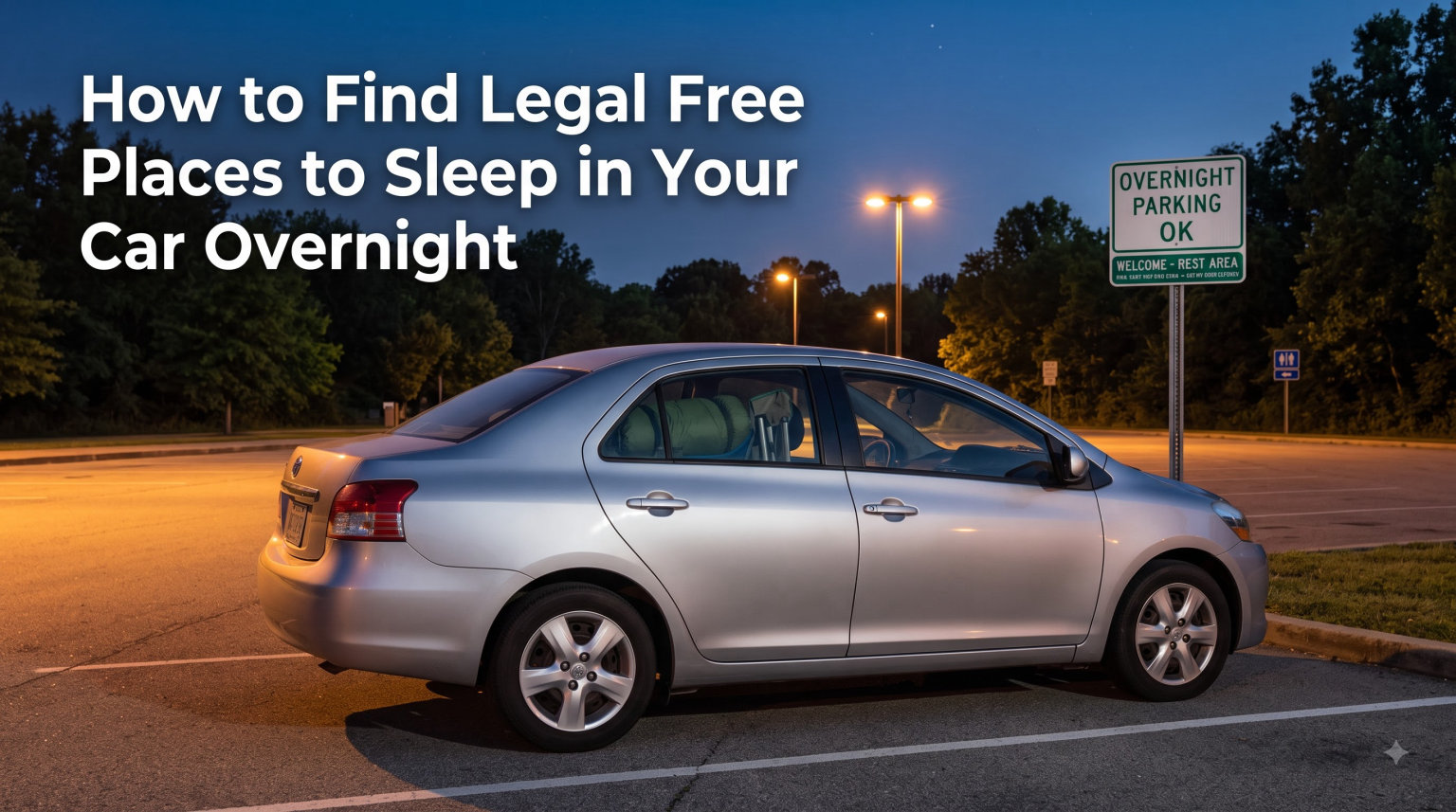
I have spent the last three years sleeping in my car on road trips, and the single most useful thing I learned early on is that where you park decides everything about your night. The wrong spot brings knocks at 2 a.m. The right spot gives you quiet, safety, and a free sunrise. This guide on how to find legal free places to sleep in your car overnight covers what actually works across the United States in 2026.
Our team has compared dozens of guides, cross-checked state laws, and pulled real advice from road trip forums to build this resource. You will learn about BLM land, rest areas, business parking lots, the best apps, and the legal details that keep you safe from tickets or a DUI charge.
Table of Contents
Legal Free Places to Sleep in Your Car Overnight: What the Term Really Means
Legal free places to sleep in your car overnight are designated public or permitted private spots where you can park and rest without paying fees or breaking local laws. They include BLM land, National Forests, certain rest areas, and business lots that explicitly allow overnight parking. Illegal spots are any private lot without permission, posted no-parking zones, and some urban streets with local ordinances against overnight stays.
Legality matters because fines, towing fees, and even criminal charges can follow a single bad choice. I have seen friends lose $250 on a single overnight ticket, and I have read forum stories of people woken by police at 3 a.m. for sleeping in a grocery store lot.
Three groups rely on this guide the most: long-distance road trippers trying to stretch a budget, full-time van lifers moving between free spots, and people experiencing housing instability who need safe overnight options. Each group has slightly different needs, and the best legal options often overlap.
Types of Free Overnight Parking Locations
The main types of free overnight parking locations in the United States are public lands, rest areas, business lots, and street parking where allowed. Here is the full list of where you can legally sleep in your car overnight without paying a fee.
BLM land and National Forests: Dispersed camping is free and legal almost everywhere on these public lands, often with a 14-day stay limit.
Rest areas and welcome centers: Many states allow overnight stays, though some limit parking to a few hours. Always read the posted signs.
Truck stops (Loves, Pilot Flying J, TA): Designed for drivers, these are 24-hour, well-lit, and free for car sleepers if you park in a regular car spot.
Walmart parking lots: Historically welcoming, though policies now vary by store. Always ask the manager first.
Casino parking lots: Most casinos allow free overnight parking, especially in Nevada and the Southwest.
Churches: Some churches host travelers through programs like Harvest Hosts or simply allow a discreet night.
Cracker Barrel restaurants: Many locations welcome one-night RV and car parking with prior permission.
24-hour gyms (Planet Fitness, etc.): Some members park overnight in their lots, but policies vary.
Trailheads and visitor centers: National Park trailheads and Forest Service visitor centers sometimes allow overnight parking, especially in Western states.
Residential streets in permissive towns: Some cities allow overnight street parking with no posted restrictions.
This list is the most reliable answer to the question “where can I go to sleep in my car for free?” Every option above is either explicitly legal or granted by the property owner.
BLM Land and National Forest Camping
BLM land and National Forest camping are the gold standard for free, legal car sleeping in the American West. The Bureau of Land Management manages roughly 245 million acres, and most of it is open to dispersed camping at no cost. Dispersed camping means pitching a tent or parking your car outside a developed campground, usually with no facilities.
The rules are simple. You can camp for up to 14 days in any one spot within a 25-mile radius. After 14 days you must move at least 25 miles away. You do not need a permit for dispersed camping in most cases. You do need to follow Leave No Trace principles: pack out trash, use existing fire rings, and avoid damaging vegetation.
National Forests work the same way in most regions. The Forest Service manages 193 million acres across 154 forests. You can usually dispersed camp for free for up to 14 days, though some areas require a free permit or have seasonal fire restrictions.
How do you actually find these spots? Use freecampsites.net, the USFS website, or the BLM’s recreation.gov portal. Look for areas marked as “National Forest” or “BLM” on Google Maps and check for nearby forest roads. Most BLM and Forest Service land sits within an hour of a highway, which is why road trippers love them.
I have personally slept on BLM land near Moab, Utah, and outside Bishop, California. Both nights were quiet, free, and came with views that rival any paid campground.
Rest Area Rules and Overnight Parking
Rest areas and welcome centers allow free overnight parking in many states but have varying time limits. The safest answer is to read the posted signs at each location, because rules change from state to state and even from rest area to rest area.
States that explicitly allow overnight stays at rest areas include Arizona, California (with some limits), Nevada, Wyoming, and parts of New Mexico. States that restrict overnight parking include Massachusetts, New York, and Pennsylvania, where signs usually cap stays at 2 to 4 hours.
Most rest areas have 24-hour bathrooms, vending machines, picnic tables, and well-lit lots. They sit right off the highway, which makes them convenient for road trippers. The downside is highway noise, occasional police patrols, and the constant stream of trucks pulling in.
For rest area safety, I always park in a well-lit corner near the bathrooms, lock the doors, and close the curtains. I also avoid rest areas near major cities, where local police sometimes run overnight patrols.
Forum users on r/roadtrip consistently rate rest areas as a good middle-ground option: more secure than a side street, less remote than BLM land. Just confirm the rules before you turn the engine off.
Business Parking Lots: Walmart, Truck Stops, and Casinos
Business parking lots are the most convenient free overnight parking option for road trippers, and three chains are especially welcoming. Walmart parking lots historically allowed overnight stays, truck stops like Loves and Pilot Flying J are 24-hour and built for sleepers, and casinos in Nevada and beyond routinely allow free overnight parking for visitors.
Walmart officially changed its corporate policy in 2018 to allow each store to set its own overnight parking rules. Some stores still welcome travelers, while others post no-overnight-parking signs. The reliable rule is to walk inside, find a manager, and ask permission. Most managers will either say yes or point you to a legal alternative.
Truck stops are a different story. Loves, Pilot Flying J, TA, and Petro are designed for sleeper cabs, and they welcome car sleepers in their standard parking spots. You get 24-hour restrooms, well-lit lots, fast food, and a population of other travelers who are also sleeping in their vehicles. Many forum users rate truck stops as the safest urban overnight option.
Casinos from Las Vegas to Biloxi often allow free overnight parking in their massive lots. The deal is usually simple: park for free if you visit the casino, or sometimes even if you do not. Always check for posted signs and look for RV-friendly areas.
Etiquette matters at all business lots. Buy something small from the business if you can, keep your engine off, use your headlights minimally when leaving, and never leave trash. A bad review from one inconsiderate sleeper can shut down a parking option for everyone.
Apps for Finding Free Overnight Parking
The best apps for finding free overnight parking are freecampsites.net, iOverlander, AllStays, and Google Maps with the right filters. Each tool fills a slightly different gap, and combining them is what experienced road trippers do.
freecampsites.net is free and crowdsourced, with thousands of BLM spots, forest roads, and even some business lots. iOverlander is built for overlanders and van lifers, with user reviews and filters for free, paid, and wild camping. AllStays is a paid app with detailed coverage of Walmart, Cracker Barrel, and rest areas, including which locations allow overnight parking.
Google Maps itself is underrated. Search “BLM land” or “National Forest” near your route, then zoom in on forest roads to find dispersed camping areas. The satellite view often shows existing campfire rings, which signal that others have camped there legally before you.
My routine is to open freecampsites.net first to scout the area, then cross-check with iOverlander for recent user reviews. If both apps agree a spot is safe and free, I drive there with confidence.
How to Sleep in a Car Without Getting a DUI
You can sleep in a car without getting a DUI by sleeping in the back seat or passenger side, keeping your keys out of the ignition, and turning the engine fully off. The risk is real: in many states, having your keys within reach of the driver’s seat while intoxicated can lead to a DUI charge, even if the car is parked and turned off.
States like California, Florida, and Pennsylvania have used “actual physical control” of the vehicle to charge sleeping drivers with DUI. The key facts prosecutors look for are whether you were in the driver’s seat, whether the keys were accessible, and whether the car was running or could easily be started.
Follow these steps to sleep safely without a DUI risk:
Park your car and turn off the engine completely.
Move to the back seat or passenger seat before falling asleep.
Place your keys in the trunk or far outside your reach, ideally in the glove box on the passenger side or in a bag at the back of the car.
Do not sleep in the driver’s seat, especially if you have had any alcohol.
If you are intoxicated, ask a sober friend to drive you or call a rideshare.
I keep my keys in my front door pocket or in my luggage at the back of the car, never near the ignition. This single habit has protected me from the worst-case scenario every time I have slept in my car after a long day.
Safety Tips for Overnight Car Sleeping
The most important safety tips for overnight car sleeping are choosing a well-lit, busy location, locking all doors, keeping one window cracked for ventilation, and telling a friend your exact spot. Sleeping in your car is generally safe when you take basic precautions, but it does carry risks that are easy to reduce.
Pick a location with other people around. Truck stops, casino lots, and busy Walmart lots are safer than isolated forest roads for first-timers. Once you have experience, dispersed camping on BLM land offers quiet and security in a different way: distance from other people.
Visibility and concealment both matter. Cover your windows with curtains or sun shades so no one can see valuables inside. Park where other cars are visible from the road, not in deep corners where you cannot be seen. Move if something feels off, even if you cannot explain why.
Ventilation is critical. Carbon monoxide is a real risk if you run the engine for heat. Crack a window at least an inch, even in cold weather, and never sleep with the engine running in an enclosed space. In summer, use a battery-powered fan and park in shade to avoid overheating.
Communication is the safety tip most beginners skip. Text a friend the exact address or GPS pin of where you are parking, and check in by morning. If you are traveling solo, share your route with family and set a check-in time. This habit alone can save your life in an emergency.
Women road trippers on r/urbancarliving often emphasize sticking to well-lit, busy locations and trusting gut feelings over saving $20 on a remote spot. I follow the same rule: a slightly less convenient location is almost always worth the safety trade.
Overnight Car Sleeping Preparation Checklist
A good overnight car sleeping checklist covers pre-trip preparation, on-the-road essentials, and at-location safety checks. Print this list or save it on your phone before your next road trip.
Before you leave:
Research your route and pre-scout two or three free parking options.
Download freecampsites.net, iOverlander, and AllStays offline maps.
Fill up gas and check tire pressure.
Pack window covers or sun shades for privacy.
Charge your phone and bring a backup battery bank.
At your parking location:
Park in a well-lit, visible area near other cars.
Lock all doors and close the windows to a one-inch crack.
Move your keys out of reach before sleeping.
Cover windows and stash valuables out of sight.
Text your exact location to a friend or family member.
Before you leave in the morning:
Check the area for any new posted signs about overnight parking.
Pick up any trash, even if it is not yours.
Move on if you plan to stay longer than the local rules allow.
FAQs
Where can I go to sleep in my car for free?
You can sleep in your car for free at BLM land, National Forests, certain rest areas, truck stops like Loves and Pilot Flying J, casino parking lots, and some Walmart or Cracker Barrel locations with manager permission. Free apps like freecampsites.net and iOverlander show user-reviewed spots across all 50 states.
Where to sleep if you’re homeless in a car?
If you are homeless and sleeping in your car, prioritize 24-hour businesses like Loves or Pilot Flying J truck stops, casino lots, and 24-hour Walmart locations. Many cities also run safe parking programs that provide legal overnight spots with restrooms and security. Reach out to a local shelter or 211 hotline for current program details.
Where is it acceptable to sleep in a car?
Sleeping in a car is acceptable on BLM land and in National Forests under dispersed camping rules, at rest areas that allow overnight stays, and on any private property with the owner’s permission. Always check posted signs and follow the 14-day stay limit on public lands.
How to sleep in a car without DUI?
Sleep in the back seat or passenger side, never the driver’s seat. Move your keys out of reach, ideally in the trunk or glove box on the passenger side, and turn the engine completely off. In many states, having keys near the ignition while intoxicated can lead to a DUI charge even if the car is parked.
Final Thoughts on Free Overnight Car Sleeping
Learning how to find legal free places to sleep in your car overnight is a skill that pays for itself on the first road trip. Start with BLM land and truck stops, layer in the right apps, and always check local rules before you turn the engine off.
Our team’s biggest takeaway from three years of testing these spots is this: legality and safety almost always line up. The same locations that are legal also tend to be the safest, the quietest, and the easiest to leave in the morning. Drive safely, sleep well, and enjoy the open road in 2026.