
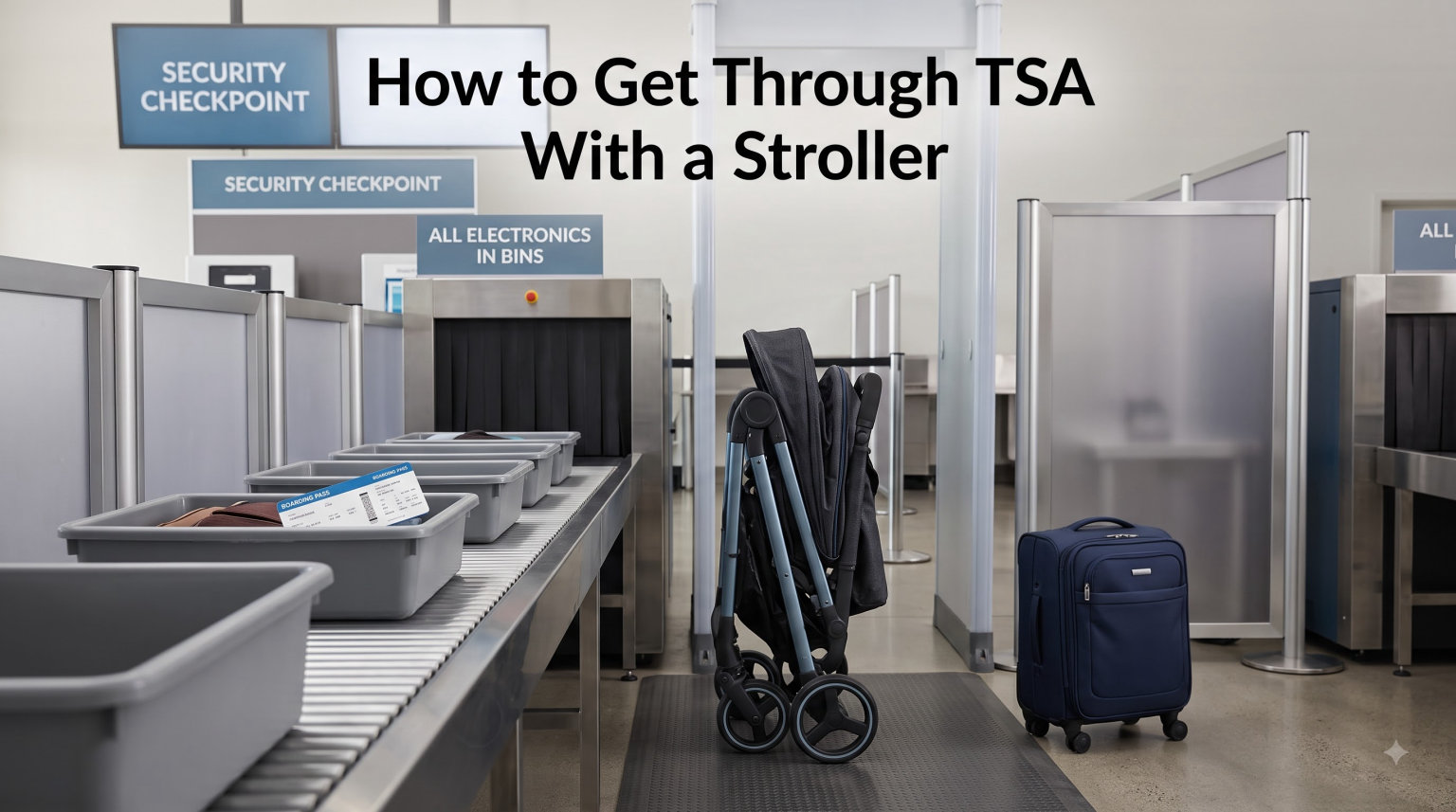
I still remember the first time I flew solo with my daughter and a stroller. I stood in the security line, sweaty-palmed, holding a baby who refused to be put down, watching other parents glide through with what looked like military precision. The truth is, getting through TSA with a stroller is easier than you think once you know the rules. After dozens of trips with my kids, I can walk you through exactly how to get through TSA with a stroller without the stress.
This guide breaks down the official TSA rules, the exact screening process, and the parent-tested tricks I wish I had known on day one. Whether you’re flying with a full-size travel system or a compact umbrella stroller, the steps are essentially the same. I’ll also cover what happens when you bring a car seat, how TSA PreCheck changes the experience, and the liquid exception that lets you bring breastmilk and formula through security.
Table of Contents
TSA Stroller Rules: What You Need to Know Before You Go
The Transportation Security Administration (TSA) allows strollers through airport security checkpoints. According to the TSA’s official Traveling with Children page, strollers, umbrella-strollers, and similar wheeled gear are permitted at the checkpoint. You have two main options: take the stroller through the X-ray screening, or gate check it before boarding.
You don’t need to remove your stroller from its bag if you’re gate checking. If you do bring it through the checkpoint, you’ll need to fold it flat and send it through the X-ray machine along with any items in the basket or pockets. TSA officers will guide you on whether to send it through the belt or have it manually inspected.
Knowing these rules before you arrive eliminates most of the confusion. The TSA contact center and TSA Cares helpline (855-787-2227) can answer specific questions ahead of your trip if you have a unique situation.
How to Get Through TSA With a Stroller: Step-by-Step Process
Here is the exact step-by-step process I follow at every airport. The first time you do it, allow extra time. After that, it becomes second nature.
- Arrive early. Budget at least 30 extra minutes beyond your normal airport arrival time. Families with strollers and small children are typically allowed to use the family lane, but lines still build.
- Empty the stroller basket and pockets. Pull out diaper bags, snacks, blankets, and any loose items. These need to go through the X-ray separately.
- Remove your child from the stroller. TSA requires children to be carried or walked through the metal detector. You cannot push your child through the checkpoint in the stroller.
- Fold the stroller flat. Collapse the stroller as flat as possible. Umbrella strollers take seconds; full-size travel systems need a moment but fold quickly once you know the trigger.
- Send the stroller through the X-ray belt. Place it on the conveyor belt like a piece of luggage. If it’s too large for the belt, TSA officers will bring it through the larger X-ray scanner and manually screen it.
- Carry your child and walk through the metal detector. Hold your child in your arms or in a baby carrier. If you alarm, expect a wand pat-down.
- Wait for the stroller on the other side and reassemble. Once cleared, pick up your stroller, pop it back open, and reload your bags. Many parents use this moment to settle the child back into the seat.
That’s it. The whole process takes three to five minutes once you’ve done it a few times. The biggest mistake I see first-time parents make is trying to lift the stroller onto the belt alone. Don’t. TSA officers will help you, and oversized strollers usually go through a separate scanner.
What Happens to Your Stroller During X-Ray Screening
Your stroller goes through the same X-ray machine that screens carry-on bags. If the image is clear, the stroller comes out the other side and you reassemble it. If something in the image triggers concern, a TSA officer will perform a manual inspection. This usually means a quick wipe-down with an Explosives Trace Detection swab.
Larger strollers that don’t fit on the belt are sent through a separate, larger X-ray unit. A TSA officer will escort it around. You don’t need to chase it. The image is reviewed by a TSA officer in another room, and you typically get the stroller back within a minute or two.
Items left in the stroller basket slow down the screening. Loose toys, sippy cups, and blankets all appear as unclear masses on the X-ray. Take 30 seconds before reaching the belt to unload everything. I keep a small packing cube for “stroller basket” items so I can transfer them in one move.
Gate Check vs. Bringing Your Stroller Through Security
You have two choices for your stroller at the airport. Either bring it through the security checkpoint and use it inside the terminal, or drop it off at the gate before boarding. Both are free on every U.S. airline. None of them charge you extra for a stroller.
Bringing the stroller through security is the better choice for most families. You have a place for your child, your bags, and your coffee while you wait at the gate. After the X-ray, you walk to the gate, use the stroller in the airport, and then gate check it at the jet bridge before boarding.
Gate checking means you hand the stroller to a flight attendant at the top of the jet bridge. It gets tagged and stored in the cargo hold, then returned to you plane-side or at the jet bridge when you land. Most parents report gate-checked strollers come back clean and undamaged, but a stroller travel bag adds protection if you have a nicer model.
Check your stroller at the ticket counter only if you don’t need it at the gate. Some parents do this with cheaper umbrella strollers because they don’t want to manage it through the terminal. For most families, gate checking is the sweet spot.
Can You Babywear Through TSA Instead of Using a Stroller?
Yes, babywearing through TSA is allowed and often easier for newborns and small infants. TSA officers may ask you to remove your child from the carrier for the X-ray image. If your baby is sleeping, you can ask for a modified screening where the officer swabs the carrier instead.
Babywearing makes sense if you have a young infant who is content in the carrier and you have minimal carry-on. It’s faster than folding a stroller. The trade-off is that you have no place to put your bags, your child, or yourself when you need a break.
For most parents of babies six months and older, the stroller is still the better tool. It carries the child, the diaper bag, and your personal item. You can collapse it at the gate and gate check it in 30 seconds. Hybrid approach: babywear through security, then ask for the stroller back at the gate if you gate checked it earlier.
TSA PreCheck With a Stroller and Baby: Is It Worth It?
TSA PreCheck is a strong fit for families who fly more than twice a year. With PreCheck, you don’t remove laptops, liquids, or shoes, and the lines are typically shorter. Children under 12 can join a parent in the PreCheck line, even without their own Known Traveler Number.
The screening process is the same with or without PreCheck when you have a stroller. PreCheck doesn’t change the requirement to fold and X-ray the stroller. What PreCheck does is shorten the line and reduce the chance of a long wait with a cranky toddler.
Applying for PreCheck costs $78 for five years and takes about 10 minutes online plus a 10-minute in-person appointment. Global Entry ($100) includes PreCheck and is even better for international families. Some credit cards reimburse the application fee, so check yours before paying.
Add your Known Traveler Number (KTN) to each family member’s airline profile when you book. If your child is under 18, they travel on your PreCheck eligibility. No separate KTN is required for the kids.
Breastmilk, Formula, and Liquids: How TSA Screens Baby Food
Breastmilk, formula, and toddler drinks are exempt from the 3.4-ounce liquid rule. You can bring reasonable quantities through the checkpoint for your traveling child. TSA officers may screen these liquids separately, including opening containers for additional testing.
Pack liquids in clear, separate containers so the officers can access them quickly. Ice packs and cooling accessories are also allowed, but they must be fully frozen at the checkpoint. Partially melted packs can be flagged because TSA can’t tell if the gel inside is liquid or solid.
You don’t need to declare liquids in advance. Just pull them out at the checkpoint when asked. If your child is drinking from a bottle at that moment, finish it before screening. TSA officers will likely screen the empty bottle or send it through the X-ray.
If you have a medical need or a specialized formula, TSA Cares can coordinate a smoother experience. Call 72 hours before your flight to arrange a passenger support specialist at the checkpoint.
Tips for Traveling Alone Through TSA With a Stroller and Baby
Solo travel with a stroller is the toughest case. You have no extra hands and no one to hold the baby while you fold the stroller. I’ve done it dozens of times. Here’s what works.
First, babywear through security. Skip the stroller at the checkpoint. Wear your baby in a structured carrier, fold the stroller single-handedly, and send it through the X-ray. This cuts the entire process in half.
Second, gate check the stroller. You don’t need to wrestle it through the terminal. Bring a lightweight umbrella stroller just for the airport, then pick up a rental or your stored stroller at the destination.
Third, ask for help. TSA officers and airline staff are trained to assist parents traveling alone. Most airports have a family lane or a passenger support agent who can take the stroller through the belt while you walk through the metal detector with the baby.
Fourth, pack light. The fewer bags you carry, the easier the screening. A single carry-on with diapers, wipes, two changes of clothes, and one feeding item is enough for most flights under four hours. Everything else can be checked.
Screening a Double Stroller or Travel System at TSA
Double strollers and full travel systems work the same way at the security checkpoint. They fold, they go through X-ray, and you walk through the metal detector with your child. The catch is that double strollers are larger and usually don’t fit on the standard belt.
TSA will route your double stroller through the oversized X-ray scanner. An officer will escort it for you. You don’t need to lift it. Give yourself an extra five minutes compared to a single stroller because the manual inspection step takes slightly longer.
Travel systems (infant car seat attached to a stroller frame) are bulkier but follow the same process. Detach the car seat if you want to bring it onto the plane. Otherwise, the whole system folds and screens as one unit.
If you have twins, the easiest airport setup is to babywear one and use a single stroller for the other. Saves time at security and avoids the cumbersome double-fold.
What About Car Seats at the TSA Checkpoint?
Car seats go through the same X-ray process as strollers. If your car seat is on the stroller frame, fold the whole system and send it through. If you’re carrying the car seat separately, place it on the belt like a piece of luggage.
You can also gate check a car seat for free on every U.S. airline. Most parents prefer this because car seats are bulky and hard to store on the plane. Gate-checked car seats come back with the stroller at the destination.
If you buy a seat for your child (recommended for any child under 2 traveling on a car seat), bring the car seat on board. It screens at the checkpoint, then installs in the airplane seat. Remember that car seats must be FAA-approved with a sticker that says “This restraint is certified for use in motor vehicles and aircraft.”
Booster seats are not FAA-approved for aircraft use. Gate check boosters if you need them on the ground at your destination.
Diaper Bag Packing Tips for Faster TSA Screening
How you pack your diaper bag affects how fast you get through security. Most families over-pack for the flight and under-pack for the screening. The goal is to make every item visible or easy to remove in two seconds.
Use a backpack-style diaper bag rather than a tote. Backpacks keep your hands free, distribute weight evenly, and let you set the bag down on the X-ray belt without spilling. A tote filled with loose items creates a tangled mess at the checkpoint.
Organize by category. I keep liquids (bottles, sippy cups, creams) in one clear zip pouch on top of the bag. Snacks go in a second pouch. Diapers and wipes go in the main compartment. When TSA asks to see liquids, I unzip the top pouch and hand it over. No rummaging through the entire bag.
Skip the bulky items. You don’t need five changes of clothes for a two-hour flight. Two changes of clothes, one backup outfit for the parent, a small pack of wipes, two diapers per hour of travel, and one snack per hour covers most situations. Everything else can wait under the seat in front of you.
What to Expect With Multiple Children at the TSA Checkpoint
Two or three kids through the security line is a logistics puzzle. The good news is that TSA expects parents with multiple young children and most officers will jump in to help. Here is the sequence that works for most families.
Put the oldest child in charge of the bin. Hand them a TSA-compliant bin and ask them to load all the small items: shoes, jackets, tablets, liquids. Older kids can carry their own backpacks through the metal detector. This frees you to manage the stroller and the youngest child.
Keep the youngest child in a baby carrier until you reach the front of the line. Then fold the stroller, transfer the baby to your arms, and walk through the metal detector. The older children go through the metal detector with you or with the next adult in your group.
Ask for a passenger support specialist if you have three or more children under five. Most airports have one on staff during peak hours. They will physically help you unload the stroller and manage the screening. Don’t be shy about asking. It’s exactly what they are there for.
International Airport Variations Worth Knowing
U.S. TSA rules govern the airports you depart from in the United States, but international airports follow their own security agencies. Most follow the same basic pattern: stroller through X-ray, child carried through the metal detector. Some airports have additional restrictions.
European airports under the European Union often require you to remove electronics larger than a phone from your bag. This affects tablets and gaming devices for older children. Pack these in an easy-access pocket so you can pull them out at the European security checkpoint.
Canadian airports (CATSA) follow procedures similar to TSA. Australian and New Zealand airports are stricter on liquids. Japanese and Korean airports are organized and family-friendly but may require a stroller size check at the gate. Check the local airport’s website before international travel with a stroller.
When in doubt, contact your airline’s family travel desk. Major carriers have dedicated support lines for parents flying with infants and small children. They will tell you exactly how the destination airport handles strollers and what to expect at the security checkpoint.
Frequently Asked Questions About Getting Through TSA With a Stroller
Can I push my stroller through TSA security?
No. TSA requires you to remove your child from the stroller before reaching the security checkpoint. You must fold the stroller flat and send it through the X-ray machine, then carry your child through the metal detector.
Can you skip the TSA line with a baby?
Most airports have a family or accessible lane that lets parents with small children move to the front. You cannot skip the line entirely, but family lanes are typically faster than the general line. TSA PreCheck is the most reliable way to shorten your wait when traveling with a baby.
Is it better to check or gate check a stroller?
Gate checking is better for most families. You keep the stroller with you through the terminal, use it until you board, and leave it at the jet bridge. The airline returns it plane-side at your destination. Checking at the ticket counter means you have no stroller inside the airport and risk damage from baggage handling.
Can you go through TSA with a baby in a stroller?
No. Children cannot ride in the stroller through the security checkpoint. You must remove the child, fold the stroller, and walk through the metal detector with the baby in your arms or in a baby carrier.
Can I wear my baby through TSA instead of using a stroller?
Yes. Babywearing through TSA is allowed and is often faster for solo travel. TSA may ask you to remove the baby from the carrier for the X-ray image. You can request a modified screening if your baby is sleeping.
Do you have to pay extra for a stroller on airplanes?
No. U.S. airlines do not charge extra fees for strollers. You can gate check a stroller for free on every major airline, and most airlines also let you check a stroller at the ticket counter at no charge.
Final Thoughts on Getting Through TSA With a Stroller
The first time feels like a lot, but knowing how to get through TSA with a stroller turns it into a five-minute routine. Empty the basket, lift the baby, fold the stroller, send it through X-ray, walk through the metal detector, and reassemble on the other side. TSA officers are trained to help families, and the rules I’ve covered here are confirmed on the official TSA.gov traveling with children page.
If you fly even a few times a year with a child, TSA PreCheck pays for itself in time and stress savings. Liquid exceptions for breastmilk and formula are real and well established. For unique situations, the TSA Cares helpline at 855-787-2227 is staffed weekdays and can pre-arrange support at your checkpoint. Safe travels in 2026 and beyond.