
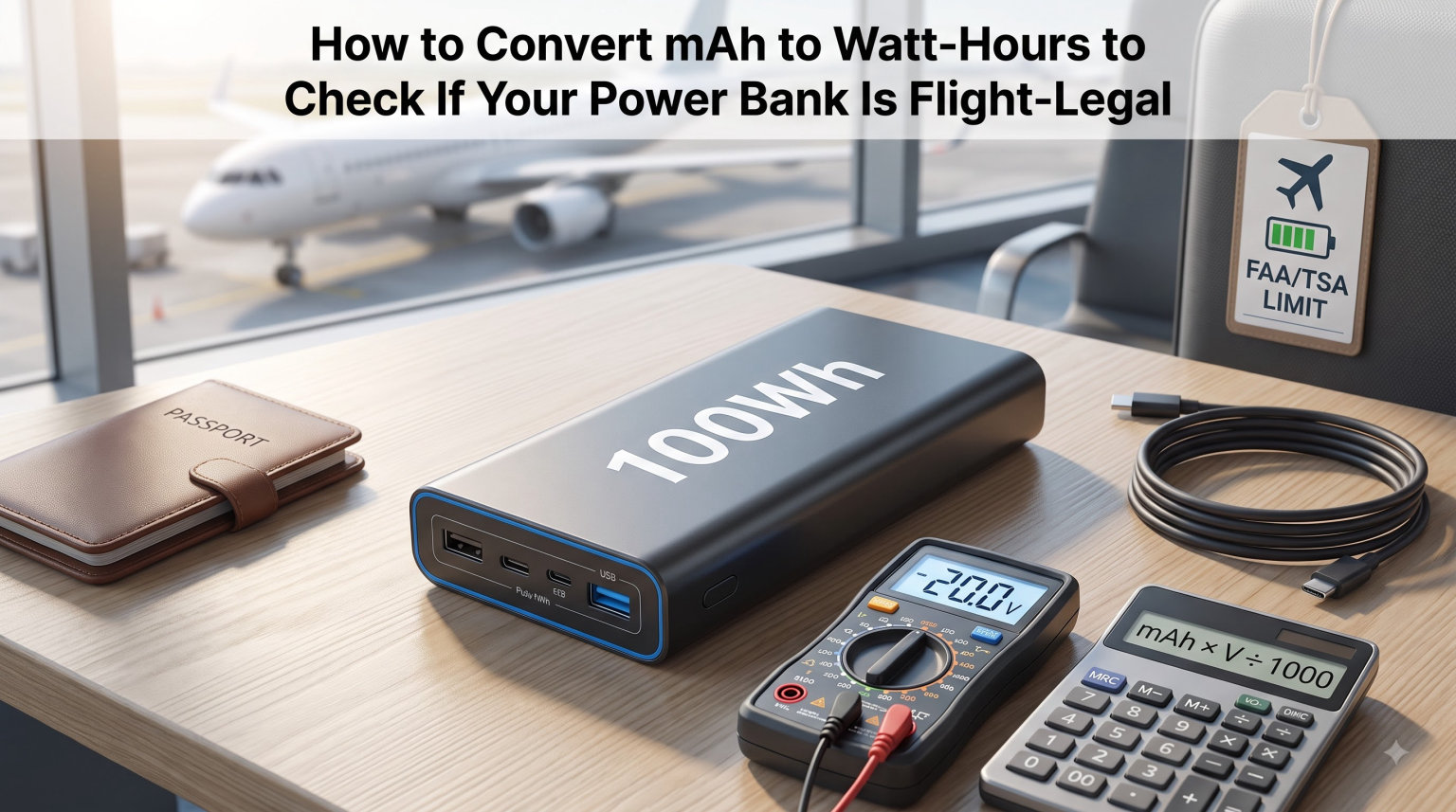
I learned this the hard way at a TSA checkpoint in 2024, watching a traveler unpack three power banks because none of them showed watt-hours on the label. The officer did not care about the 20,000mAh printed in giant letters. He wanted watt-hours. That scene is the reason I wrote this guide on how to convert mAh to watt-hours to check if your power bank is flight-legal, because the math is short, the rules are strict, and the conversion is the only thing standing between you and a confiscated charger.
Airlines restrict lithium batteries by watt-hours (Wh), not milliamp-hours (mAh), because Wh measures actual stored energy. If you walk up to security with a 30,000mAh bank but cannot tell the officer how many Wh that holds, you risk losing the device or being turned away at the gate. This article gives you the formula, the voltage trap most people miss, a quick reference chart, and the 2026 rules from TSA, FAA, EASA, and even Japan’s new in-flight update.
Table of Contents
What mAh and Watt-Hours Actually Measure
Milliamp-hours (mAh) measure electric charge, which is how many milliamps a battery can deliver for one hour. Watt-hours (Wh) measure total energy, which is how much work the battery can actually do over time. The difference matters because voltage sits between charge and energy.
Think of a water tank: mAh tells you how much water is in the tank, but Wh tells you how much pressure that water can deliver. Voltage is the pressure. Two batteries with the same mAh can hold very different amounts of energy if they run at different voltages, and that is exactly why airlines prefer the Wh number.
For lithium-ion power banks, the nominal voltage of the internal cells is almost always 3.7V. The 5V, 9V, or 12V printed on the USB port is the output voltage after a boost converter, not the voltage you use for airline math. Remembering that one fact prevents 90% of the mistakes I see in travel forums.
Why Airlines Use Watt-Hours Instead of mAh
Airlines limit lithium batteries by Wh because Wh directly correlates with the chemical energy that can ignite during a thermal runaway event. A 100Wh lithium-ion cell contains more stored energy than a 27Wh one, and the FAA, TSA, EASA, and IATA all agreed decades ago that 100Wh is the safe threshold for cabin baggage without airline approval.
mAh is a marketing number. Manufacturers love it because 20,000mAh looks bigger than 74Wh, even though those two figures describe the same battery. Travelers love it for the same reason. But security officers are trained to ask for Wh, and they will not accept mAh as a substitute.
If you cannot find a Wh rating on your power bank, that does not mean the device is illegal. It usually means the label faded or the manufacturer followed the looser convention. Either way, you can calculate Wh from mAh in under ten seconds using the formula in the next section.
The Conversion Formula for mAh to Watt-Hours
To convert mAh to watt-hours, multiply the mAh rating by the nominal voltage (3.7V for almost all consumer power banks) and divide by 1000. The formula is:
Wh = (mAh x V) / 1000
Step-by-step example with a 20,000mAh power bank: take 20,000, multiply by 3.7, then divide by 1000. That gives you 74Wh. Step-by-step example with a 26,800mAh power bank: take 26,800, multiply by 3.7, then divide by 1000. That gives you 99.16Wh, which is right at the 100Wh limit.
Round up, never down, when you are doing this calculation at home. TSA officers round up. Airlines round up. If your math gives you 99.16Wh, treat it as 100Wh and assume you will need airline approval to bring a second battery. The math is your friend, and overestimating is safer than underestimating.
The Voltage Trap: Why 3.7V Matters More Than 5V
The biggest mistake travelers make is using 5V (the USB output voltage) instead of 3.7V (the cell nominal voltage) in the formula. A 20,000mAh bank at 5V would calculate to 100Wh, which sounds illegal. The same bank at 3.7V calculates to 74Wh, which is clearly under the limit.
Which number is right? The 3.7V number. The 5V figure includes the energy added by the boost converter, which pulls extra current from the cell to raise the voltage. That extra energy does not come from nowhere. It comes at the cost of total capacity, so the real stored energy is the 74Wh number.
Some manufacturers print two mAh ratings on the box: a cell capacity (3.7V) and a rated output capacity (5V at lower mAh). Use the 3.7V cell capacity. That is the figure airlines and safety regulators care about, and it is the only one that produces a trustworthy Wh result.
Quick Reference Chart: Common Power Bank Sizes
Below is a quick reference table for the most common power bank capacities. All values assume a nominal voltage of 3.7V. Wh is rounded to one decimal place.
| Capacity (mAh) | Watt-Hours (Wh) | Flight Status |
|---|---|---|
| 5,000 mAh | 18.5 Wh | Green zone – allowed everywhere |
| 10,000 mAh | 37 Wh | Green zone – allowed everywhere |
| 20,000 mAh | 74 Wh | Green zone – allowed everywhere |
| 26,800 mAh | 99.2 Wh | Yellow zone – airline approval may be needed for spares |
| 27,000 mAh | 99.9 Wh | Yellow zone – often used as the de facto 100Wh limit |
| 30,000 mAh | 111 Wh | Yellow zone – airline approval required for spares |
| 40,000 mAh | 148 Wh | Red zone – airline approval required, often refused |
| 50,000 mAh | 185 Wh | Red zone – banned by most airlines |
Print this chart or screenshot it before you pack. It covers roughly 95% of the power banks sold on Amazon, Best Buy, and AliExpress, and it gives you a fast answer when you are standing in line at the security checkpoint.
Airline Battery Limits in 2026: 100Wh and 160Wh Thresholds
The international rule, enforced by IATA and adopted by TSA, FAA, EASA, and most major airlines, splits lithium power banks into three zones:
- Under 100Wh: Carry-on allowed. No airline approval needed. Up to 20 spare batteries typically permitted (limits vary by carrier).
- 100Wh to 160Wh: Carry-on allowed, but only with prior airline approval. Most carriers cap spares at 2 units.
- Over 160Wh: Banned from both cabin and checked luggage on virtually all commercial flights.
The 100Wh threshold is the headline rule. It is the figure TSA quotes on its official “What Can I Bring?” page, and it matches the FAA’s Pack Safe guidance for lithium-ion spares. Anything under 100Wh clears security without paperwork in most cases.
The 160Wh ceiling is the upper limit, not a separate allowance. A 150Wh power bank is technically allowed with airline approval, but most carriers refuse to issue that approval because the safety margin is too thin. Treat 160Wh as a hard cap, not a friendly zone.
Carry-On vs Checked Luggage: Where Power Banks Belong
Power banks belong in your carry-on bag, period. The FAA, EASA, IATA, and virtually every national aviation authority prohibit spare lithium-ion batteries in checked luggage because a fire in the cargo hold cannot be suppressed the way a cabin fire can.
If a battery overheats in the cabin, a flight attendant can use a thermal containment bag, douse it with water, or move it to the lavatory to isolate it. If the same battery ignites in the cargo hold, the crew cannot reach it, and the fire can destroy the aircraft’s flight control systems before the pilots notice.
That is why even a 5,000mAh lipstick-sized charger must travel in the cabin. The rule is not about capacity. It is about access. Keep the power bank in your personal item or carry-on, never in a suitcase that goes under the plane.
What to Do When the Label Is Faded or Missing
A worn or missing label is one of the most common problems travelers describe in r/tsa and r/batteries. Here is what to do before you fly.
Step 1: Look up your power bank’s model number on the original retailer’s website (Amazon order history works). The product page will list the rated capacity in Wh. Screenshot it.
Step 2: Calculate Wh from mAh using the formula above. If your bank still shows a legible mAh number, you can derive Wh in seconds.
Step 3: Weigh the power bank. A rough rule of thumb: 100Wh of lithium-ion weighs about 500g to 600g. If your 30,000mAh bank weighs 600g, it is probably around 100Wh. This is not precise, but it is a useful sanity check.
Step 4: Bring the original box, the receipt, or a digital photo of the spec sheet. TSA officers in my experience accept a printed or phone-screen image showing the Wh rating from the manufacturer. It is not a guarantee, but it shifts the conversation from “I do not know” to “here is the proof.”
Step 5: If all else fails, leave the unlabeled battery at home. A $40 power bank is not worth missing a flight over. Buy a clearly labeled replacement at any airport electronics shop after you land.
Japan’s 2026 In-Flight Power Bank Rule Update
Japan introduced a stricter rule that took effect in 2026. On flights operated by Japanese carriers (JAL, ANA, and their codeshare partners), passengers cannot use power banks to charge devices during flight, even if the power bank is under 100Wh and stored correctly in the cabin.
The Japanese Ministry of Land, Infrastructure, Transport, and Tourism cited a string of in-cabin lithium fires as the reason. The rule is not a capacity ban. You can still bring power banks under 100Wh in your carry-on. You simply cannot deploy them as in-flight chargers.
If your itinerary includes a JAL or ANA flight, plan to charge your laptop, phone, or Steam Deck from a seat-back USB port or from a wall outlet at the airport gate. Power banks remain useful for layovers, but they become dead weight on board Japanese carriers until the rule is revised.
How to Verify a Power Bank Is Flight-Legal Before You Fly
This pre-flight checklist takes under two minutes and saves you the hassle of an airport security conversation.
- Find the Wh rating on the label, the box, or the manufacturer’s website.
- If only mAh is printed, multiply by 3.7 and divide by 1000 to get Wh.
- Round up. If your bank is 99.2Wh, treat it as 100Wh.
- Check the zone: under 100Wh is green, 100Wh to 160Wh is yellow and needs airline approval, over 160Wh is red.
- Confirm the power bank is in your carry-on, not checked luggage.
- For Japan flights, confirm you do not need to use the bank during flight.
- Take a phone photo of the spec sheet in case the label is hard to read.
If you complete all seven steps without a red flag, you are clear to board. If step 4 lands you in the yellow zone, call your airline at least 48 hours before departure to request approval. Most carriers require written approval, so email beats phone for this.
Frequently Asked Questions
Is a 160Wh power bank TSA approved?
A 160Wh power bank is the upper ceiling for FAA and TSA rules, but it is not automatically approved. You must get prior airline approval before bringing it in your carry-on, and most carriers refuse that approval. Anything over 160Wh is banned from both cabin and checked luggage.
Can I bring a 30000mAh power bank on a plane?
A 30,000mAh power bank at 3.7V nominal voltage equals 111Wh, which sits in the 100Wh to 160Wh yellow zone. You can bring it in your carry-on only with prior airline approval, and most carriers cap spares at two batteries in this range.
Is a 20000mAh power bank allowed in flight carry-on?
Yes. A 20,000mAh power bank at 3.7V equals 74Wh, which is well under the 100Wh limit. You can bring it in your carry-on without airline approval, and you can pack up to 20 spares on most carriers (always check your specific airline).
Can I fly with a 40,000 mAh power bank?
A 40,000mAh power bank at 3.7V equals 148Wh, which falls in the 100Wh to 160Wh yellow zone. You can fly with it only in your carry-on and only with prior airline approval. Most carriers refuse approval above 160Wh, so check before you pack.
Final Thoughts
The mAh to watt-hours conversion is one line of math, but it is the difference between a smooth boarding and a missed flight. Memorize Wh = (mAh x 3.7) / 1000, round up, and double-check the 100Wh and 160Wh thresholds before you pack. Whether you are carrying a 10,000mAh travel charger or a 40,000mAh laptop companion, knowing the actual Wh rating is the only way to confirm your power bank is flight-legal.