

A stored RV is not a sealed box. It breathes through slide-out seals, bath vents, the fridge drain and a dozen small gaps, and in a humid climate that outside air finds its way in and condenses on the first cold surface it touches. Closed up and forgotten from October to March, that moisture is what breeds black spotting on the shower walls, a musty smell in the bedroom slide, and swollen cabinet frames that cost real money to repair.
That is why the best RV dehumidifiers for winter storage are chosen on one question first: what power do you have at the storage site, and how cold does it get? Nothing else in the spec sheet matters as much. A machine rated to pull 15 pints a day at 86 degrees and 80 percent relative humidity is a very different tool in a 40 degree storage barn, and marketing pages rarely explain that gap.
We spent weeks going through the specs, wattage draw, cold-weather behaviour and owner reports behind the 10 machines below, and cross-checked the setup questions against owners on the iRV2, MyGrandRV and RVLiving communities. Our focus was never a camping-trip machine. Everything here is judged on whether it can run unattended in a dark, cold trailer for weeks and still be doing something useful in February.
One owner on the MyGrandRV forum reported pulling close to 20 gallons out of a multi-slide trailer in ten days of storage, with a 2-gallon reservoir filling roughly every 22 hours at about 80 percent outdoor humidity. That is the kind of number that changes how you plan a season: a small tabletop tank that needs emptying twice a day is not a storage plan.
Table of Contents
Top 3 Best RV Dehumidifiers for Winter Storage (October 2026)

SEEKR by Caframo Stor-Dry 9406
- 1000 cu ft air flow
- 70 watt draw
- 110V continuous
- Corrosion-proof metal housing

Davis Air-Dryr 1000
- 1000 capacity rating
- No moving parts
- Thermal cut-off switch
- No tank to empty

All 10 Storage Picks at a Glance in 2026
Every machine below is rated for a specific volume or compartment, not for a whole trailer. The features column tells you what each one is built around, and the full reviews cover how that holds up over a season.
| Product | Specifications | Action |
|---|---|---|
| SEEKR by Caframo Stor-Dry 9406 |
|
Check Latest Price |
| Davis Instruments Air-Dryr 1000 |
|
Check Latest Price |
 Ironwood Pacific Drywave 1000 Ironwood Pacific Drywave 1000 |
|
Check Latest Price |
 Eva-Dry EDV-365 Desiccant System Eva-Dry EDV-365 Desiccant System |
|
Check Latest Price |
 briidea Metal Air Dryer briidea Metal Air Dryer |
|
Check Latest Price |
 Camco Moisture Absorber Bucket Camco Moisture Absorber Bucket |
|
Check Latest Price |
 Sunny Home 30 Pack Absorbers Sunny Home 30 Pack Absorbers |
|
Check Latest Price |
| Better Boat Hanging Bag 4 Pack |
|
Check Latest Price |
 STAR BRITE No Damp Absorber STAR BRITE No Damp Absorber |
|
Check Latest Price |
 Camco Mini Dehumidifier 44195 Camco Mini Dehumidifier 44195 |
|
Check Latest Price |
1. Caframo Stor-Dry 9406 – Best for 120V Storage Bays
SEEKR by Caframo Stor-Dry 9406 110V Warm Air Circulator & Dehumidifier – 75W
1000 cu ft air flow
70 watts
110V continuous
Metal housing
Pros
- Silent run with no moving parts to wear
- 70 watt draw suits months of continuous use
- Corrosion-proof metal housing
- Gentle warmth discourages condensation
Cons
- Single-speed fan gives limited airflow control
- Bulkier than a passive absorber
This is the machine we would hand someone who has a powered storage bay and one long, low RV. It moves 1000 cubic feet of air an hour and draws 70 watts, which is the number that matters most for a machine running unattended for four months. At that draw, a season of continuous operation costs a few tens of kilowatt hours, not a power bill.
Owners on boat and RV forums treat it as layup equipment rather than a camping accessory, and the 976 reviews lean strongly positive, with 73 percent five-star. The quiet operation is the detail people mention most: there is no compressor cycling on and off, so no rattling duct work at 4 a.m. in a trailer someone is sleeping in.
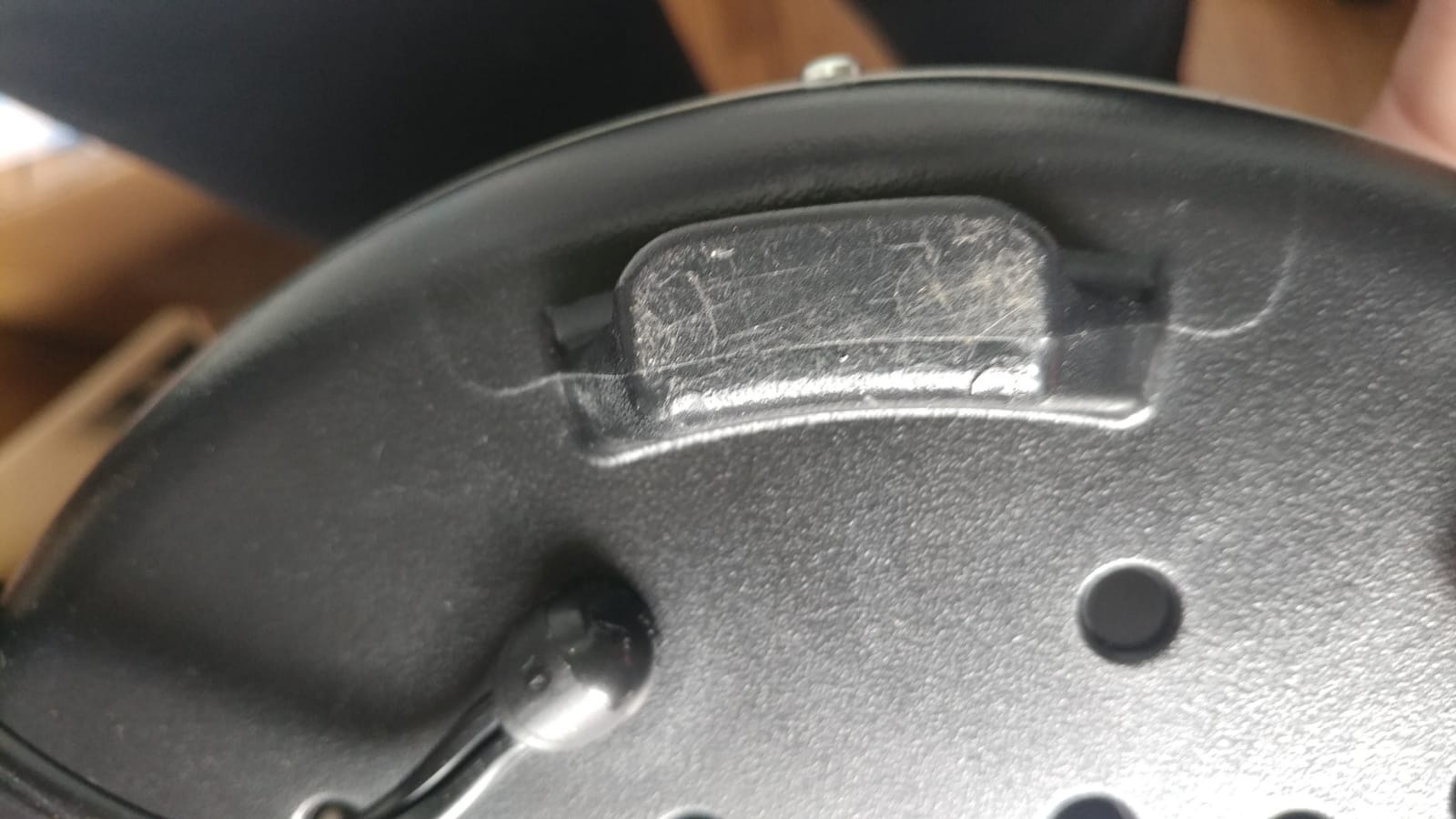
The metal housing matters more than it sounds. Sheet metal in a damp storage barn corrodes from the inside out, and this one is built for that environment. The fan circulates air across a warm element, which nudges the interior temperature up just enough to stop surface condensation forming on walls and cabinet fronts.
It runs on continuous operation mode at a single speed, and that is the main limitation. You cannot push harder through a sealed interior with the doors and windows closed, so a 40-foot coach needs more than one, or a plan to relocate it. The controls are minimal too: one switch, no settings to get wrong while you are standing in a dark facility.
Where the 1000 cubic foot rating is useful
The rating describes enclosed volume, not floor area, and it holds up best in a space with a low ceiling, limited furnishings and poor circulation, which is exactly the interior of a parked trailer. Owners report steady, quiet drying over a full winter in rigs of this class. In an open storage shed, the same machine covers a much larger volume of shared air and the effect per cubic foot drops sharply.
Because it produces no condensation, there is no reservoir to fill, no drain hose to run and nothing to service beyond a wipe of the grille. That is the whole argument for a warm-air storage dryer over a compressor unit in a cold building: fewer failure points, far less power, and no 41 degree floor.
Where it will disappoint you
It does not lower relative humidity on a read-out, because there is no sensor. You are managing by feel and by observation, which is fine for a season of prevention and useless if you want a target number. It is also a warm-air device, not an extraction device: it removes moisture by keeping surfaces above the dew point, not by pulling water out of the air.
A single speed is one reason to buy this as a second machine for a large coach rather than a first machine for a small trailer, where a 1000 cubic foot rating is more capacity than the interior needs. For a 20-foot trailer, the Davis below covers a similar volume with a higher rating from a wider group of owners.
2. Davis Instruments Air-Dryr 1000 – Best Value Storage Dryer
Davis Instruments Air-Dryr 1000 Dryer
1000 capacity rating
2.2 pounds
Thermal cut-off switch
No tank to empty
Pros
- No moving parts to break
- Essentially silent
- No tank to empty
- Thermal cut-off allows continuous duty
- Adds gentle warmth to a cold space
Cons
- Works best in small enclosed areas
- Larger footprint than expected
The Davis also earns a 4.6 star rating across 1091 reviews, with 80 percent of owners giving five stars and only 3 percent giving one. It is also the simplest thing here to justify: a plastic housing, no fan, no motor, no water, and a thermal cut-off switch that makes continuous operation the design intention rather than a stretch.
Davis markets it to boats, RVs, cabins and vacation homes, and the reviews reflect that owner base closely. People report the same result repeatedly: put it in a stored trailer, leave it, come back in the spring, and find no mould where they expected it. The added warmth is a genuine secondary benefit in a metal trailer in a cold month.
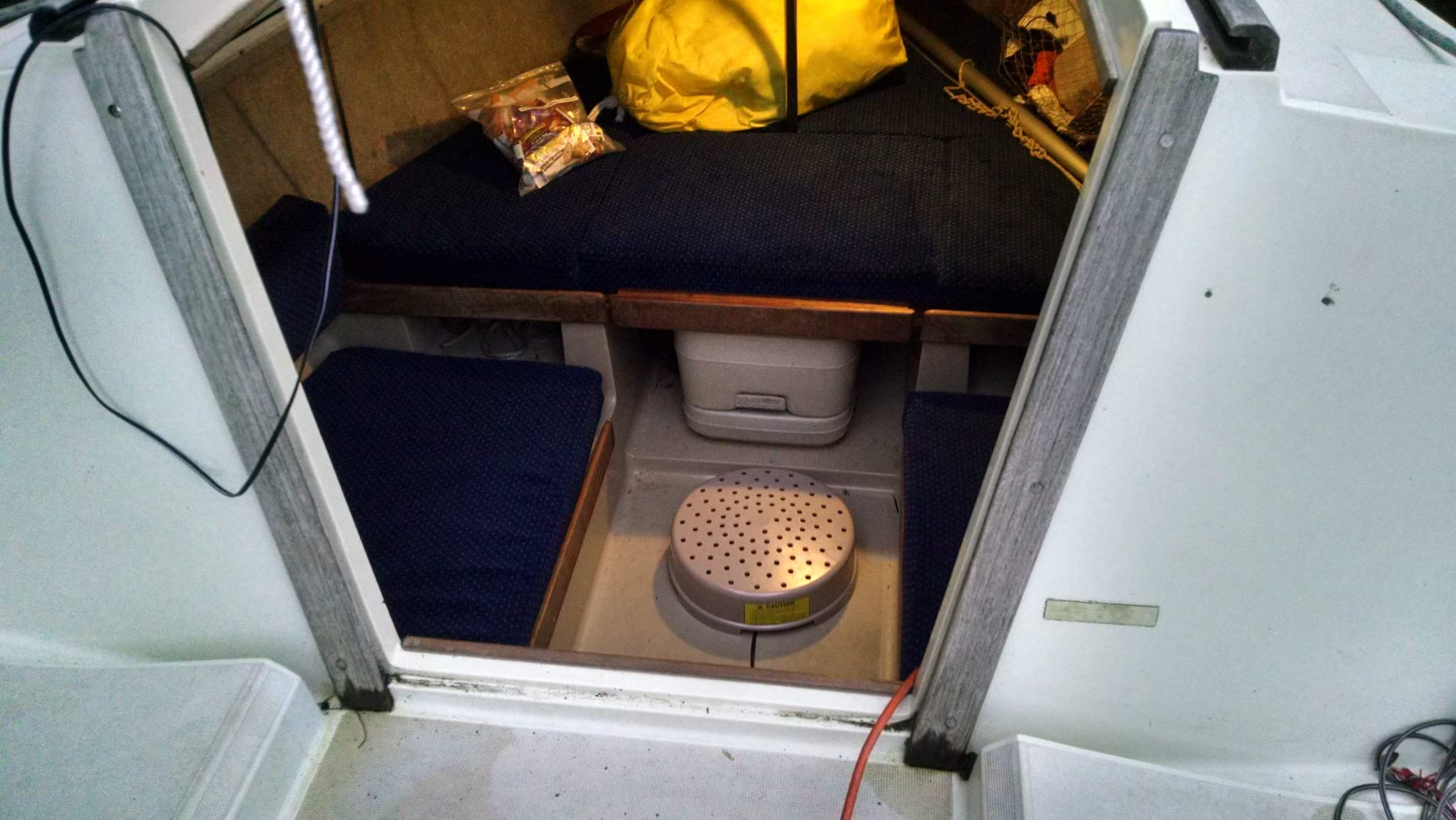
The 1000 rating is more generous than the cubic-foot ratings on the machines around it, so treat it as a class of coverage rather than a promise. The natural convection pattern works best in a closed box where the air has nowhere to escape, which is a camper van or a small travel trailer with the slide in and the door shut.
There is no noise to describe, and that matters for a machine that lives in a space next to a bedroom. At 2.2 pounds it is also one of the easiest to carry in from a car, position under a cabinet, or move between the front and rear of a rig mid-season.
Why owners rate it so highly
Zero maintenance is the reason. There is no filter, no coil, no tank, no moving parts, and nothing that can fail while nobody is there to notice. When you are choosing equipment to run unattended in a storage building for four months, the absence of failure points is worth more than a specification sheet improvement.
It is also one of the very few options here that is safe by design for unattended use. The thermal cut-off switch cuts the heat if internal temperature climbs, which is the standard a storage machine should meet. Buyers in the reviews frequently mention running it through multiple storage seasons.
Where it falls short
Convection is slow. Owners with larger rigs report that a big open interior takes weeks rather than days to shift, and that the effect is concentrated near the unit. If you own a 35-foot fifth wheel with three slides, one of these in the middle of the floor is not a complete answer, and the manual move you never make will decide how well it works.
The other catch is footprint. At 13.5 inches square, it is bigger than its weight suggests, and reviewers flag it directly as roughly pizza-circumference wide. Plan the spot before you buy, because in a narrow aisle between a slide and a wall it can block the walk-through.
3. Ironwood Pacific Drywave 1000 – Best for Enclosed Cargo Volumes
Ironwood Pacific Drywave 1000 Air Dryer
Natural convection to 1000 cu ft
120 watts
Thermal cut-off switch
Unscented
Pros
- No moving parts
- 120 watt draw
- Thermal cut-off switch
- Warms air to prevent condensation
Cons
- Limited to enclosed spaces up to 1000 cu ft
- No fan-driven circulation
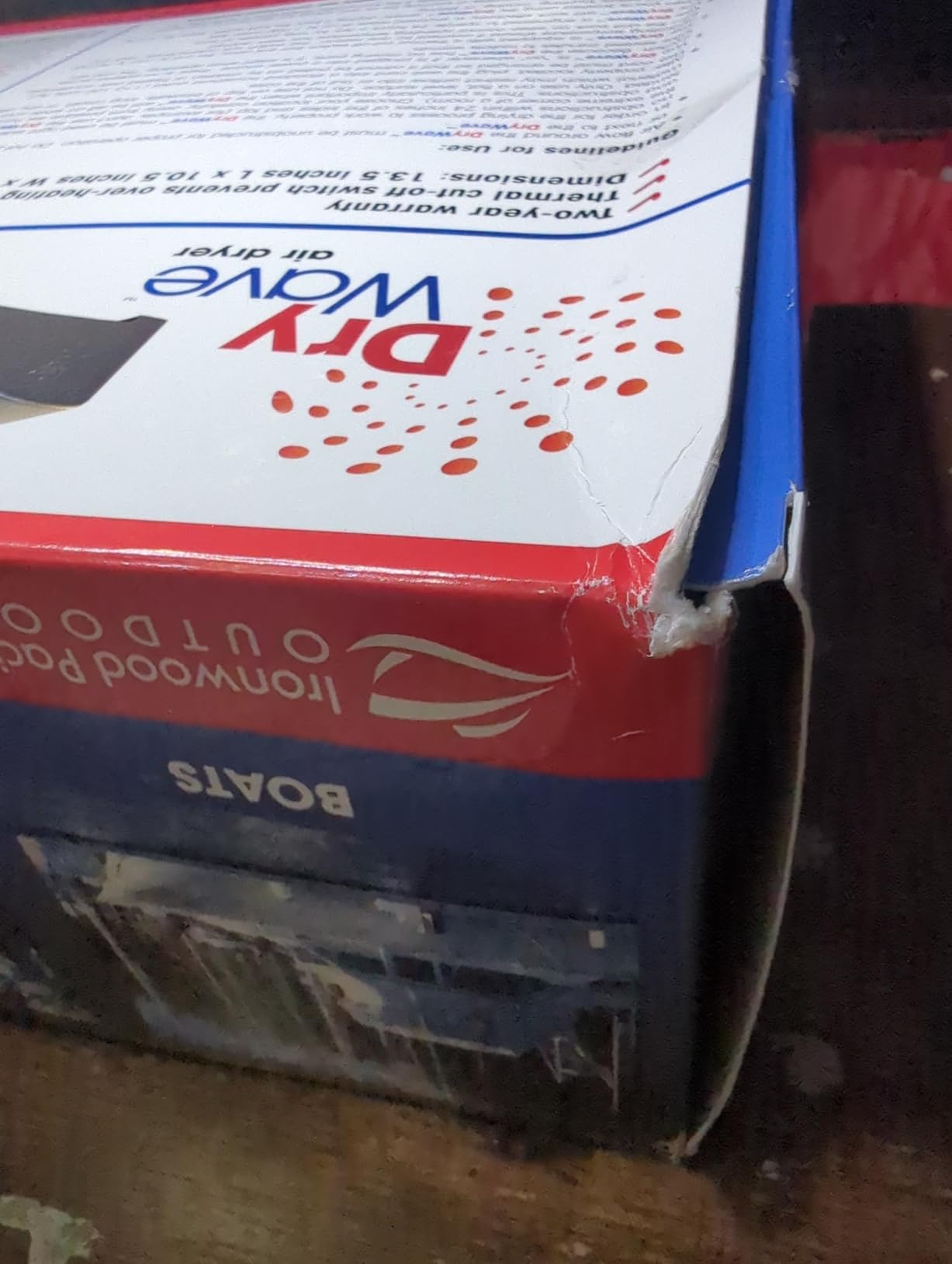
The Drywave 1000 is one of the most basic designs here: an aluminium air warmer that moves heat into enclosed space to stop condensation forming. It is 2.5 pounds, unscented, thermally insulated, and rated by the manufacturer to 1000 cubic feet on natural convection with no fan at all.
That makes it the counterpart to the Davis rather than a rival, and the two get chosen on power draw and safety cut-off. At 120 watts it pulls more than the Stor-Dry and about the same as a single household bulb, which owners describe as running cost close to nothing across a season. Its thermal cut-off switch does the same protective job as the Davis, and for a storage bay that never sees sunlight and stays damp all winter, adding a few degrees of ambient warmth is a legitimate way to keep the dew point away from your interior surfaces.
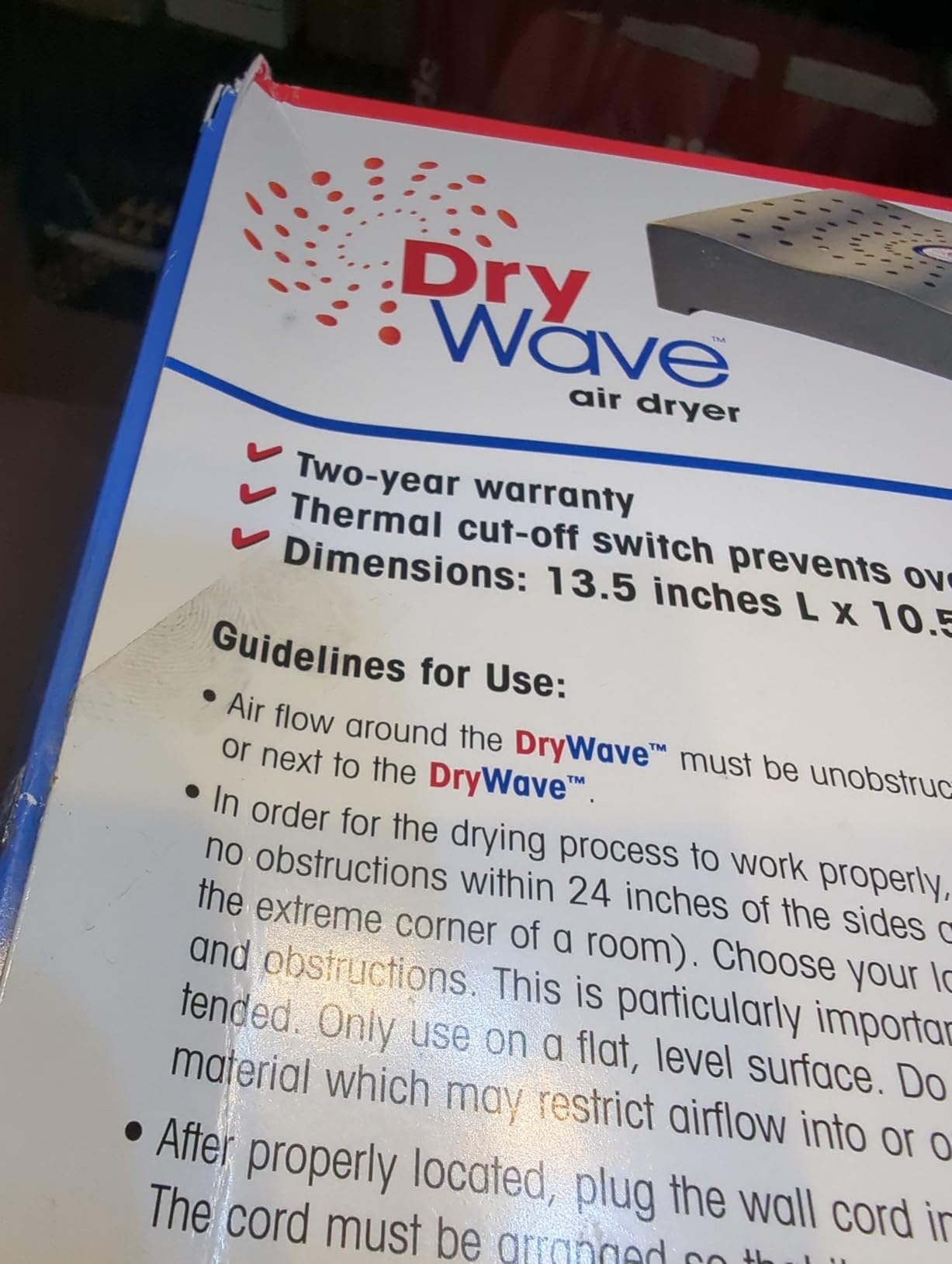
Review sentiment is warm, with 78 percent five-star across 542 ratings, and the consistent theme is silent, continuous, no-moving-parts drying in a boat or trailer. Because the medium is air temperature rather than water or desiccant, there is no reservoir, no coil and nothing to refill.
The design is genuinely zero-fail as a concept. There is no bearing, no motor, no refrigerant loop and no water path. If the power is on, it is working, and if the power is off nothing is lost.
Where a convection dryer is the right call
It fits the same situations as the Davis: a small travel trailer, a Class B van, a boat hull interior, a cabin. Any enclosed space up to about 1000 cubic feet where the doors and windows stay shut and outside air is a threat rather than an asset. The unscented, no-liquid design is also kind to leather, electronics, tools and upholstery.
Because there is no moving air, aim it at the surfaces that matter: a front bulkhead, the underside of a slide floor, a corner where the carpet meets the wall. In practice that means placing it where the coldest surfaces are, not in the middle of the floor for tidiness.
Where it falls short
Natural convection is the limit. With no fan, warm air stratifies and the top of the volume does the work while the floor stays cold, so the effective zone is smaller than the rating suggests. In an open-sided shelter or a shared facility it is close to useless, because the volume it works on is not closed.
There is also no readout of any kind and no timer. You are relying on the ambient rise it produces, so it needs a stable, uninterrupted power supply for the whole season. In a facility with a metered pedestal and predictable billing, that is fine.
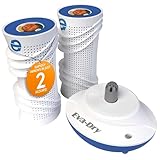
4. Eva-Dry EDV-365 – Best Regenerable Desiccant System
Eva-Dry EDV-365 Rechargeable Dehumidifier System, Up to 400 Cu Ft
Two silica gel cylinders
400 cu ft each
Renews in 2 hours
220 watt base
Pros
- One cylinder works while the other renews
- Regenerates in about 2 hours
- Color-change beads show when full
- Chemical-free and non-corrosive
- No electricity inside the RV
Cons
- Renewal routine every few days
- Replacement cylinders need the included base
- Board failures reported with no parts
This is the category of machine that answers a question the others cannot: what do you do when the storage site has no power at all and it is genuinely cold. A desiccant system draws moisture into silica gel beads by absorption rather than condensation, so there is no operating temperature floor. It works below freezing because nothing inside it needs to evaporate.
The EDV-365 ships with two cylinders, a blower base, hooks and a brush. One cylinder collects moisture in the space you choose while the second regenerates, then you swap. Each cylinder covers up to 400 cubic feet, so you can put one in a closet and one in a storage bay and get roughly 800 cubic feet of coverage from a single base.
The regeneration cycle is the detail that makes it practical. A full cylinder goes on the blower base and is restored in about two hours, with no oven and no watching. The beads change from orange when dry to green when loaded, so you can tell at a glance across a dark storage building whether anything needs a swap. The base draws 220 watts, but only while you are standing next to it.
Because the medium is inert silica gel, there is no liquid, no spill risk and no corrosion concern around tools, electronics, ammunition, leather or clothing. Over a decade, with the renewal cycle, that avoids the recurring cost that a season of disposable bags adds up to.

How to use it across a whole trailer
Treat it as a compartment tool, not a whole-RV tool. The strongest results in owner reviews come from placing a cylinder inside a closed wardrobe, a bathroom cabinet or an under-bed storage box, where the trapped air is the dampest part of the trailer. Hanging one in the middle of the living area helps with general humidity but will not fix a mould spot forming behind a wall panel.
A workable routine is a visit every two or three days during the first month, when residual dampness is highest, then weekly once the space has dried out. For a storage lot with no electricity, this is the only category in the guide that runs at all without a power supply, which is why owners on storage forums keep recommending desiccant for unpowered sites.
Where it falls short
It is a babysitting routine in a way a warm-air dryer is not. Someone has to make that visit, and a storage lot that charges for access, or a facility two hours away, will collect a lot of saturated cylinders. Owners who expected a hands-off season account for a large share of the 12 percent one-star reviews.
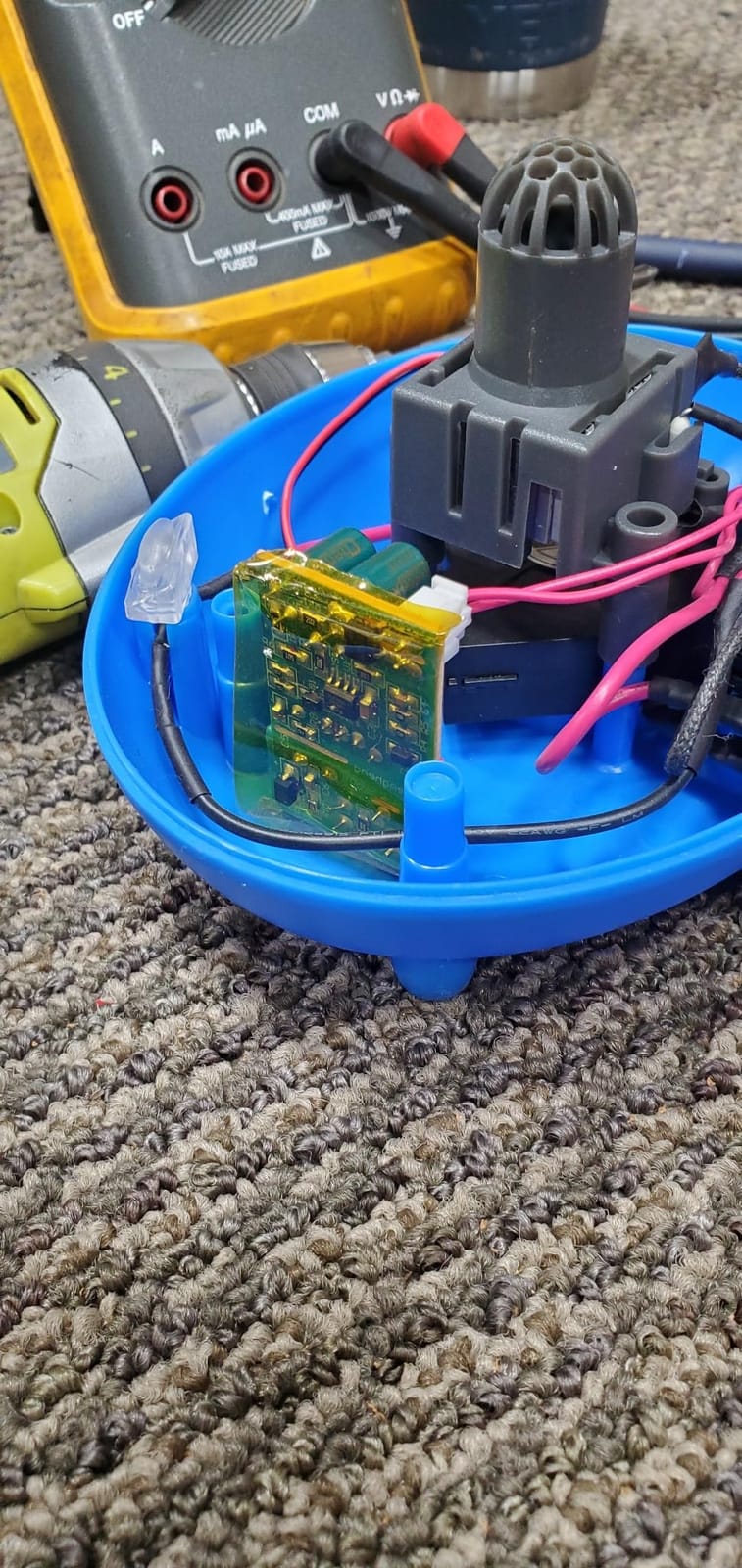
Replacement cylinders also regenerate on the included base only, and a reported failure mode is a failed circuit board on the base with no parts available. That is a single point of failure for the whole system, and it is worth knowing before you plan a season around it.
5. briidea Air Dryer – Best for a Permanent Screw-Mount Install
briidea Air Dryer Made by Durable Material, Suitable for Ships, RVs, Storage Rooms
Rust-proof metal shell
Low wattage draw
Thermal cut-off switch
Three mounting feet
Pros
- All-metal body resists corrosion
- No moving parts so it runs silently
- Low wattage suits 24 hour use
- Thermal cut-off switch
- Mounting feet take screws
Cons
- Listed dimensions are inaccurate
- Passive warm-air design only
Every other warm-air machine in this guide is designed to be picked up and moved. The briidea is designed to be screwed down. It has three support feet that accept screws so the unit cannot shift or get knocked over in a trailer, a sheet metal shell with a rust-proof coating, and an internal thermal cut-off switch to guard against overheating.
That makes it the sensible choice for a storage bay you drive up to, and for anyone who has watched a free-standing heater wander across the floor. Reviewers on RV and boat forums report consistent mildew prevention in winter layup at a very low running cost, and the 123 ratings sit at 4.3 stars.
The operating mode is continuous, and because there are no moving parts there is nothing to wear out or to foul. There is no tank, no filter, no readout and no timer. You fix it in place, plug it in, and it warms and dries the enclosed space for as long as the power holds.
Plan the footprint before ordering
The most repeated piece of feedback in the reviews is that the published dimensions are wrong. Owners consistently report a unit far larger than the listed 5 by 5 by 2 inches, with a real footprint closer to 12 inches across and around 5 inches high. At 3.3 pounds it is not a shelf item, so measure the intended spot and confirm clearance around it.
For a fixed location, choose somewhere low and in the middle of the enclosed volume, with airflow free above and below it. Because the warming effect is passive, height and obstruction matter more than raw wattage.
Where it fits and where it does not
It is a good match for a permanently stowed boat hull, a cargo section of a bus conversion, a shed, a pumping room, a basement corner, or a storage bay in an RV that is not being lived in during the season. The metal shell tolerates a damp environment far better than a plastic housing, and corrosion is the main reason storage equipment fails over a long layup.
It will not do anything in an open-sided shelter, and it is a warmer, not an extractor. If your goal is to bring a specific relative humidity number down in a large coach with three slides, a screw-mounted warm-air box in one corner is not enough on its own. Use it alongside passive absorbers in the closed compartments.
6. Camco Moisture Absorber Bucket – Best Large-Capacity Passive Bucket
Camco Moisture Absorber Bucket – Features Fast-Acting Moisture-Absorbing Agent – No-Fragrance Beads – Use with RV Storage, Camper Organization & More (44282)
5 pound bucket
Absorbs 3x its weight
10 fl oz collected
Unscented beads
Pros
- Absorbs about three times its own weight
- Fragrance-free beads
- Removes musty smell rather than masking it
- Bucket moves easily between compartments
- No electricity needed
Cons
- Single-use
- Passive absorption is slow
The Camco bucket is the classic RV layup product, and at 1,188 ratings it is one of the most heavily reviewed passive absorbers here. The 5 pound container holds fragrance-free beads that absorb roughly three times their own weight in water, collecting it in a 10 fluid ounce tank at the bottom so you can see when it is spent.
Because the bucket is passive, it works with no power and no temperature floor. That makes it the fallback for any storage arrangement where electricity is unavailable, unreliable or simply not worth the effort, and one you can pick up on a supply run rather than install.
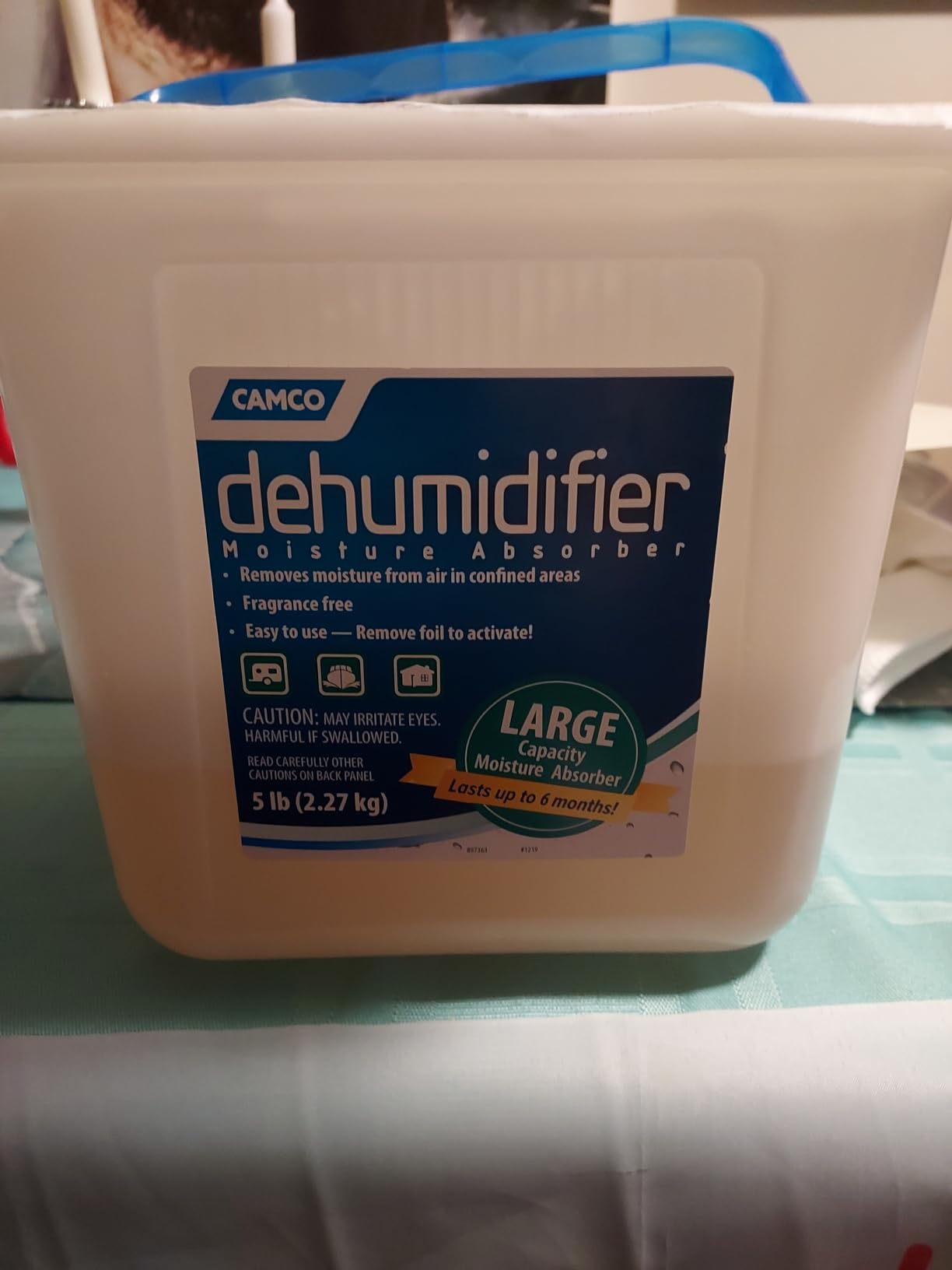
It is 6.1 pounds full and about 8.75 inches across, which is a genuinely useful size: it fits under a sink, beside a wheel well, inside a storage bay door, or against a bathroom wall, and it is heavy enough that it will not be tipped over by a pet or a gust when a door opens. Owners report 74 percent five-star ratings across the 1,188 reviews, and the recurring praise is that it removes the musty smell rather than covering it with fragrance.
The design is also honest about its limits. It is a single-use item: when the contents turn gel-like it goes in the bin, and there is no refill. Most people run two or three of them across a trailer for a season and treat replacement as part of the annual storage kit.

Placement beats quantity
A single bucket in the middle of a 30-foot trailer does very little. The same bucket inside a closed wardrobe, or in the cavity behind a bathroom wall where pipes run through cold exterior surfaces, does a great deal. Concentrate them in the small closed volumes, which is where relative humidity runs highest and where mould appears first.
For a season plan, set them at the start of storage, check the visible tank level on your next visit, and swap anything that has turned to gel. In a humid coastal or Gulf Coast winter, expect a bucket to give out sooner than in a dry inland climate.
Where it falls short
Passive absorption is slow compared with any powered machine, and this is a comfort product rather than a preventive system if the trailer is genuinely wet. Owners on storage forums report swapping passive absorbers for an electric unit after passive bags were exhausted inside a week, which is a fair signal that passive alone is not enough in a high-humidity climate.
There is also no way to tell how much moisture is left in the air. You are reacting to a visible tank level rather than managing toward a target. For a lightly damp storage bay that is perfectly adequate; for a seaside site after a wet autumn, pair it with a second approach.
7. Sunny Home 30 Pack – Best for Spreading Across Many Compartments
Sunny Home (30 Pack) Moisture Absorbers 9.17oz, Unscented, Odor Eliminator, Dehumidifier and Deodorizer for Closet, Bathroom, Kitchen in Home & RVs.
30 packs at 9.17 oz
Absorbs up to 14x weight
Waterproof felt liner
Unscented
Pros
- Thirty packs cover many compartments at once
- Absorbs up to 14 times its own weight
- Waterproof liner prevents leaks
- Unscented
- Peel foil activation
Cons
- Slower than flake absorbers
- Foil seal separates easily
- Not refillable
When the problem is a trailer with many small closed spaces rather than one large volume, the practical answer is many small absorbers rather than one big one. This 30 pack covers the whole layout in a single purchase, with 525 ml refined calcium chloride containers rated to absorb up to 14 times their own weight in moisture.
At 1,605 ratings it is one of the most heavily reviewed items in the guide, behind only the Better Boat hanging bags. Its 4.3 star average is a deliberately honest number: the satisfaction is broad but not universal, and the reviews split on exactly the two things you would want to know, which is how quickly water appears and how long one unit lasts.
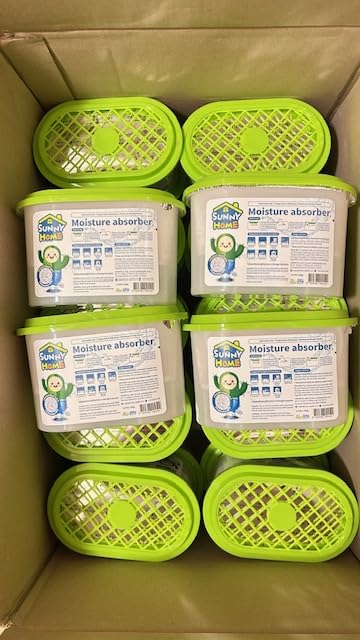
Owners in gun safes, closets and campers find each container effective for roughly three months, which lines up well with a winter season. A waterproof felt liner and lid stop collected water escaping, the material is unscented so nothing is added to your stored clothing or cabinetry, and activation is as simple as peeling the foil and closing the lid.
Each container measures about 3.9 by 5.3 by 3.9 inches and weighs under 11 ounces, so they sit on a shelf, in a locker or on the floor of a storage bay without thought. The stackable format is what makes them easy to distribute: one per closet, one per bathroom cabinet, one in each slide-out cavity.

Use them where a dehumidifier cannot reach
There is no machine in this guide that fits inside a wall cavity, under a bed platform, or in a plumbing bay behind a bathroom. That is the gap the 30 pack fills. Once a winter, walk the trailer and place a unit in each enclosed volume: wardrobes, under-bed boxes, bathroom vanities, the front cargo bay, and the interior of any slide that will not be pulled in.
Because the felt liner contains the liquid, you can stand one upright in a locker without a tray. That matters more than it sounds, because a leak inside a wardrobe in a stored trailer is exactly the failure you are trying to prevent.
Where it falls short
Two honest weaknesses appear repeatedly. First, collection is slower than flake-style absorbers, and some owners report containers going several weeks without visible water in genuinely humid spaces, which makes placement timing harder to judge. Second, the foil seal separates easily, so opening one needs a little care and a steady hand.
They are also not refillable. Once full, the whole container is discarded, and over a wet winter in a large coach the annual replacement count adds up. Treat them as a second layer behind a powered machine rather than the primary control, and check the tanks during any visit to the storage site.
8. Better Boat Hanging Bag 4 Pack – Top Rated Passive Option
4 Pack Moisture Absorber Hanging Bags, Boat Dehumidifier with Charcoal
Four hanging bags
Activated charcoal
8 fl oz tanks
Unscented
Pros
- Activated charcoal removes musty odor
- Hanging design needs no shelf space
- Four bags cover several compartments
- Unscented
- No electricity or refilling
Cons
- Disposable once saturated
- Coverage limited to small compartments
This one carries a 4.6 star rating with the strongest satisfaction behind it in the set, at 77 percent five-star and only 2 percent one-star across 1,847 ratings. It is a passive absorber in hanging bags, built by a marine supplier for boats, and it transfers directly to RV storage because the problem is identical: a closed, damp, badly ventilated space.
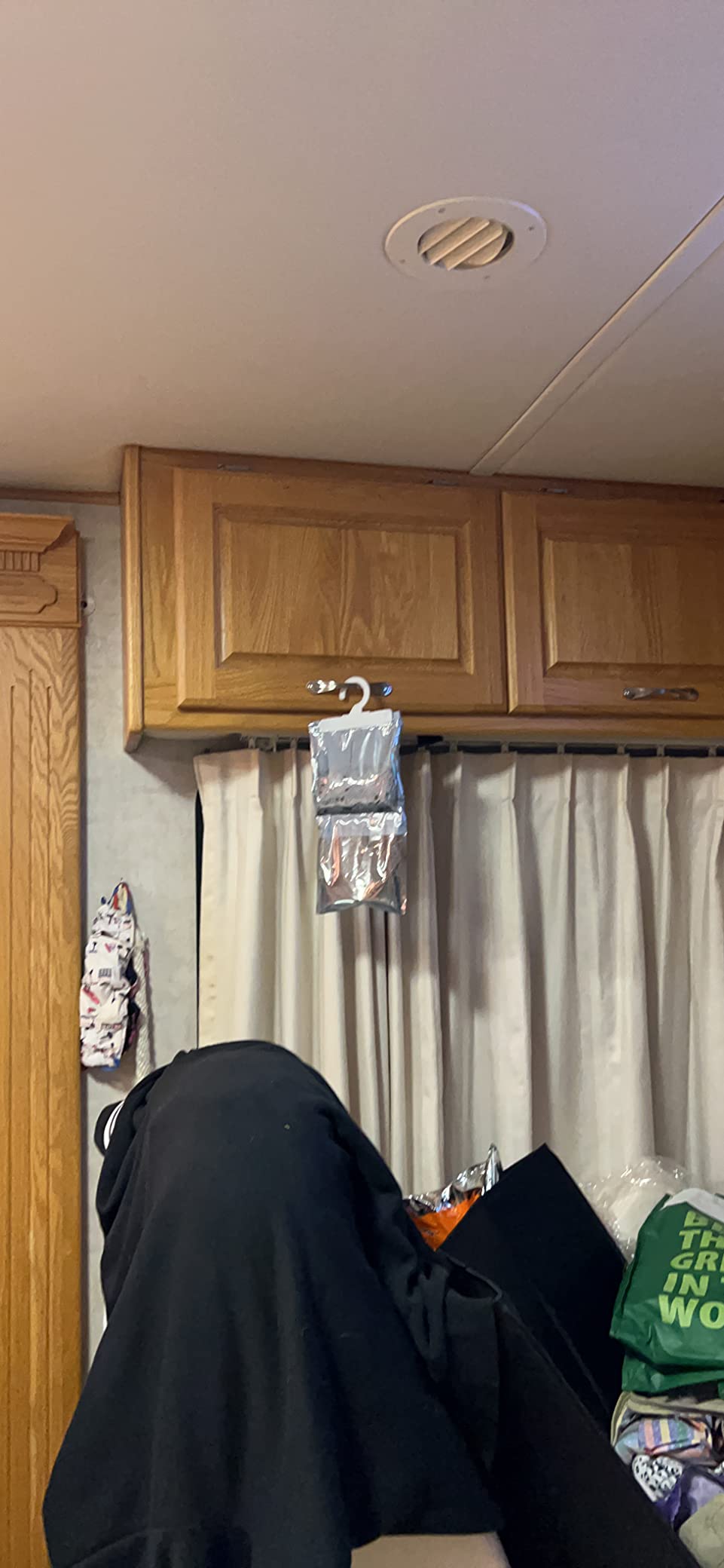
Each bag holds 8 fluid ounces and hangs from a hook, which means it needs no shelf, no floor space and no tray. For a storage bay with rafters, a rod, a wardrobe rail or a shower curtain rod, that is the difference between a unit you actually deploy and one that stays in the packaging.
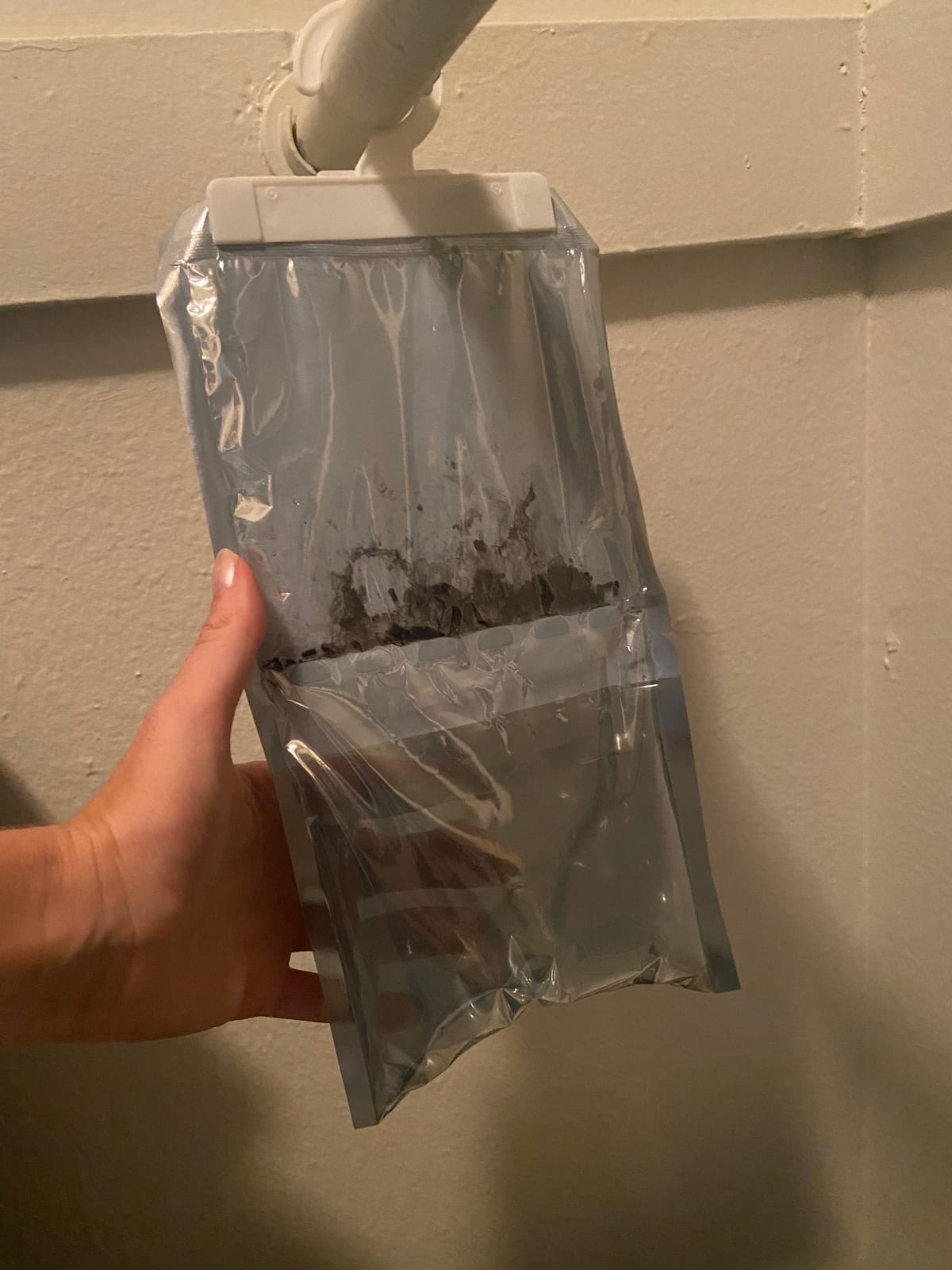
The differentiator against other passive options is activated charcoal in the bag. Other absorbers manage moisture; the charcoal also neutralises the musty smell that owners describe as the thing they most want gone after a wet autumn. Nothing is fragranced, so it removes odour rather than masking it with a scent that permeates your upholstery for a year.
Four bags in one pack means you can cover a wardrobe, a bathroom, a storage bay door cavity and a slide-out interior in a single purchase. At two pounds for the pack they are light enough to reposition during a single visit.
What it is genuinely good at
Small enclosed compartments, consistently, over a full season. Wardrobes, under-bed storage, vanities, lockers with a rod, and the cavity inside a slide-out are all within its reach, and the review consensus is that odour control in those spaces is reliable. It also costs nothing to run and has no temperature limit whatsoever, which is why absorbers of this type keep coming up on storage forums when there is no power.
Its portability is underrated. You can move four bags between two RVs, or carry them inside a camper you did not intend to store, without thinking about it. For a fleet owner or a family with a trailer and a boat, that flexibility is worth more than raw capacity.
Where it falls short
It is disposable and it is small. Each bag must be replaced once saturated, and coverage per bag is limited to a small enclosed compartment, so a large coach would need a dozen bags to cover roughly the ground the Caframo machine covers with a single mounted box.
There is no measurement of any kind, no active drying, and no way to know that a bag is nearly spent. If your site is genuinely damp, bags alone will not hold the whole trailer; use them in the closed volumes and put a powered machine in the living space.
9. STAR BRITE No Damp – Best Simple Bucket for Closets and Heads
STAR BRITE No Damp Moisture Absorber & Dehumidifier – Simple, Portable, Humidity Control for Boats, RVs, Seasonal Homes & More – Prevent Musty Odor & Moisture Damage
340 ml crystals
12 fl oz collected
Sized for closets and heads
No power needed
Pros
- Bucket design will not overflow when disposed of
- Portable and fits closets and heads
- Guards against corrosion and damp staining
- Backed by a 50 year marine brand
- No electricity needed
Cons
- Disposable once the crystals dissolve
- Gradual passive absorption only
STAR BRITE is a marine and auto care brand with a 50 year track record, and the No Damp absorber is a compact unit at 340 ml of crystals collecting into a 12 fluid ounce tank. It is a countertop-sized bucket, not a room-sized device, and that is exactly where it is useful.
The 4.75 by 4 by 4 inch footprint and 12 ounce weight mean it goes into a bathroom vanity, a wardrobe base, a galley cabinet or a boat head without rearranging anything. Rated for a small enclosed area, it is honest about the fact that this is a compartment tool, and no one is claiming it treats a whole trailer.
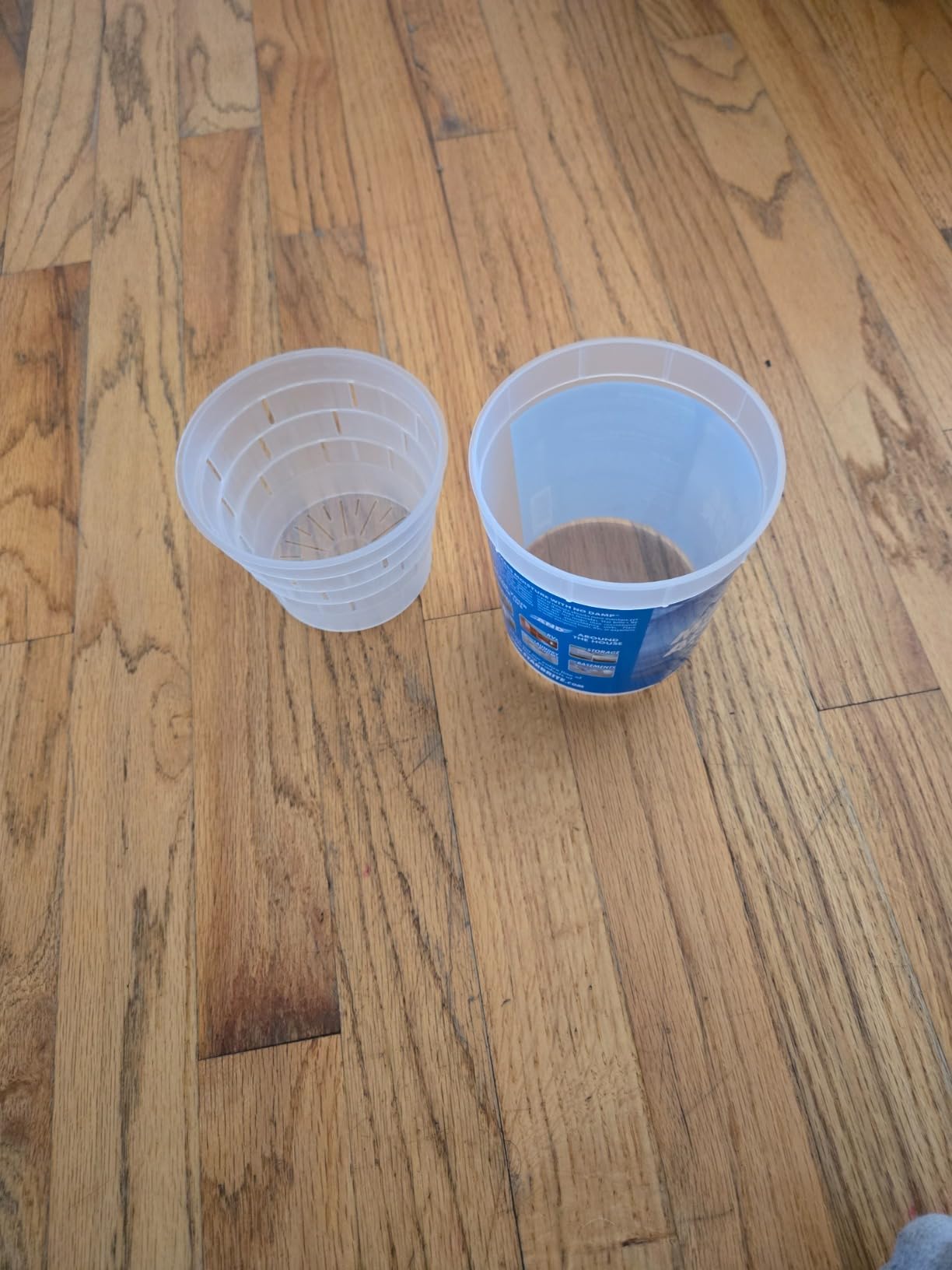
The design detail owners appreciate most is the contained deposit. Moisture is held in the bucket and will not overflow when you tip it out, which matters when you are handling it over a storage bay floor or in a confined galley. It guards against corrosion and humidity staining on electronics and metal fittings, and it works with no electricity at all.
At 470 ratings the 4.2 average is near the low end of this lineup, but the profile is informative: 64 percent five-star, and a distinct 11 percent group at three stars describing slow or modest moisture pickup. Marine users still rely on it year after year for stored boats and RVs to reduce damp and musty smell.
Where a small bucket is the correct answer
Anywhere space is the constraint. A 12 ounce bucket fits inside a cabinet under a sink, inside a slide-out storage bay, or in a boat compartment where nothing larger will go. In those spots it does the one job passive absorption is genuinely good at, at zero running cost and with no maintenance.
It also works well as a spread-out system, with one in each of the wettest spots rather than one in the middle of the trailer. Multiple sizes are offered in the range, so you can match the bucket to the compartment once you have measured it.
Where it falls short
The 11 percent three-star cohort describes the honest ceiling here: this is a gradual absorber with no active drying, so results build slowly and are not dramatic. In a genuinely damp storage building after a wet autumn, it will not keep a trailer at a target relative humidity on its own.
It is also disposable once the crystals dissolve, and because it holds less than the Camco bucket you will be replacing units more often across a large layout. Use it where space forbids anything larger, and put your main capacity elsewhere.
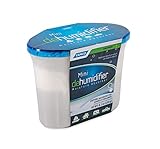
10. Camco Mini Dehumidifier 44195 – Best for Tight Compartments
Camco Camper/RV Mini Dehumidifier – Moisture Absorber for Small Spaces – Fragrance Free (44195)
10.5 oz capacity
Calcium chloride active
Compact container
Unscented
Pros
- Very compact for small compartments
- Absorbs up to three times its weight
- Fragrance free
- No electricity needed
- Water level is visible in the container
Cons
- Listed 1 by 1 by 1 inch dimensions are inaccurate
- Small capacity means frequent changes
- Will not materially reduce humidity in damp spaces
The smallest item here, and the one for the hardest fitting problems. The Camco 44195 holds 10.5 ounces of calcium chloride and collects in a 0.7 litre tank, at 8.11 ounces packed. It is the version of the absorber bucket you can put inside a wall cavity, a small locker, or the tight space behind a bathroom vanity where nothing else will sit.
Like the other passive products here it needs no electricity, which is its defining advantage in an unpowered storage lot. The active ingredient is calcium chloride, it is fragrance free so nothing is added to stored fabrics, and the collected water is visible in the container, so you can see when it needs changing without opening anything.
At 156 ratings and 4.2 stars, the feedback is narrower and more cautious than for the bigger items, and 61 percent gave five stars. The consistent praise is that it works for camper and trailer storage where you can watch water accumulate, and that it is easy to tuck into small compartments.
Where a mini absorber earns its place
It is a gap filler. Slide-out interior cavities, wall panels, under-bed boxes, galley cabinets, and the pocket behind a wet bay are all places where a bucket will not fit and a machine would be absurd. A handful of these across those spots costs almost nothing to run and adds up quickly.
Because the tank is visible, the unit doubles as a simple indicator. In a compartment you can check during a visit, the level of collected water tells you whether that space has been damp, which is genuinely useful information when you are deciding where a real machine should go next season.
Where it falls short
Do not plan around it. At 10.5 ounces of absorbent, the capacity is small enough that in a damp space it will be spent quickly, and the review consensus is clear that it indicates humidity rather than solving it. Reviewers also flag that the published 1 by 1 by 1 inch dimensions are plainly inaccurate, so measure the compartment rather than trusting the listing.
Its rating reflects that narrower role, and it is the item here with the least evidence behind it. It costs little, which is why it is worth adding to a kit, but it should never be the only thing running in a stored RV over a wet winter.
How to Run a Dehumidifier Unattended for a Full Season
Leaving a machine running for months in a trailer nobody is living in is a setup problem more than a shopping problem. The owners who get clean results in February all describe the same few steps, and none of them require a smart plug or an app.
Run a 24 hour burn-in before you leave. Put the machine in place, close everything, and let it run overnight. Check the next day for a tank level, a warm exhaust, or a visible sign of condensation control. This tells you the unit works, the outlet holds, and the placement is sensible, all in one night, instead of finding out in April.
Work from the closed volumes outward. Slide-out cavities, wardrobes, under-bed storage, bathroom vanities and the front cargo bay hold the worst moisture and are unreachable by a single machine. If you are using more than one approach, put the passive absorbers in those spaces and the powered machine in the main living area where the air volume is largest.
Check the drain question before the season, not during it. Most machines in this guide produce no water at all, which removes the whole problem. If you ever add a compressor unit, route a drain hose out a window, through a slide-out, or into a shower drain, and confirm it runs without a blockage for a full day before you rely on it.
Plan your visits around the fastest tank in the rig. A 2 gallon reservoir can fill in roughly 22 hours at 80 percent outdoor humidity, so if you are using a water-collecting unit, a weekly visit is not enough in a humid climate. For the warm-air and desiccant machines in this guide, a monthly walk-through is realistic.
Power Source Decision: No Power, 12V Battery or 120V Shore Power
This is the decision that determines everything else, and it is the question storage owners ask most. One long-standing voice on the iRV2 forum put it as a blunt truth: low voltage and a good dehumidifier are oxymorons. If 120V is genuinely available, use it. If it is not, no battery will make up the difference across a whole season.
No power at the site. Desiccant is the only real answer, and the desiccant category is genuinely cold-rated because it absorbs rather than condenses. Regenerable cylinders such as the Eva-Dry set are the least wasteful option, and passive buckets and hanging bags fill the remaining compartments. The cost is visits: someone has to be there to swap cylinders and check tanks.
12V battery only. Owner consensus across RV storage forums is that a 12V dehumidifier will drain a house bank faster than it can dehumidify a trailer, and a deeply discharged battery in March is a worse outcome than damp upholstery. If you go this way, keep the machine in a single small compartment rather than the whole rig, and treat it as a supplement to passive absorbers, not a replacement.
120V shore power or a metered pedestal. This is where the warm-air storage dryers earn their place. The Stor-Dry 9406 at 70 watts and the Drywave 1000 at 120 watts both run continuously on 110 to 120V with no tank to empty and no operating temperature floor. A larger compressor unit is the forum recommendation for a big coach, but it is a house appliance: it needs floor space, a drain and somewhere to put the collected water.
Whatever the power source, confirm who pays for the electricity and whether the pedestal is on a shared circuit that can be switched off by staff. Machines that are switched off at the breaker by someone tidying up a facility are the most common cause of a season with no moisture control at all.
RV Size, Square Footage and Moisture Load
Manufacturer coverage figures are optimistic, and every roundup that quotes them without comment misleads its readers. Coverage in an RV is a volume question complicated by closed-off rooms, narrow hallways, and furniture that stops air moving, so the honest approach is to treat any rating as a ceiling rather than a promise.
The general rule is to size for the interior volume of the enclosed space you can actually keep closed, then add a second machine or a spread of absorbers rather than trusting one unit to reach the far end of a three-slide coach. Manufacturer square-footage claims tend to assume open-plan rooms with unrestricted airflow, which is the opposite of an RV interior in storage.
Expect a real moisture load in humid regions. The MyGrandRV owner report of about 20 gallons in ten days of storage, with a 2 gallon reservoir filling every 22 hours at 80 percent outside humidity, came from a multi-slide trailer, and forum consensus is that this is normal rather than a leak. Coastal, Gulf Coast and humid inland sites are where a passive-only approach falls short first.
It is fair to include the counter-argument. Some owners store for years, do nothing but cover the rig, and report no mould at all, and other owners with vents cracked and supplementary heat have had the same result. Climate, cover quality, ventilation and how long the trailer sits untouched all matter, and the cost of a modest passive kit is small next to repairing interior panels.
One additional note that most buying guides skip: a dehumidifier does not replace air movement. Cracking roof vents and allowing airflow, as some owners on RVLiving do, reduces the load the machine has to handle. Whatever you run, ventilate when the outside air is drier than the inside, which on a dry cold day in a storage barn is most of the day.
Frequently Asked Questions
What type of dehumidifier works best in cold temperatures?
Below roughly 41 degrees a compressor dehumidifier stops working and can ice up, so cold storage calls for a different tool. Use a warm-air storage dryer on 120V for the living space, since it has no temperature floor and no tank to empty. For an unpowered site, use desiccant: regenerable silica gel cylinders or passive absorbers, which absorb moisture rather than condensing it. Reserve compressor units for a heated bay or a powered storage lot with a drain.
What is the best dehumidifier for RV storage?
For a stored RV with 120V available, a warm-air circulator and dehumidifier built for continuous duty is the best answer, such as the Stor-Dry 9406 or the Davis Air-Dryr 1000. Both run quietly, draw 70 to 120 watts, have no tank to empty and work in an unheated trailer. Add regenerable desiccant or passive buckets in closed compartments, since one machine rarely reaches every space.
Should I run a dehumidifier in my camper?
Yes, if the camper is stored sealed for weeks or months. A closed trailer still breathes through slide-out seals, bath vents and the fridge drain, and that outside humidity condenses on cold interior surfaces, which is what causes mould, mildew and musty odour. The machine matters less than the power available: a warm-air storage dryer on shore power for powered sites, and desiccant where there is no power at all.
Can a dehumidifier run unattended in an RV in storage?
Yes, provided it is designed for continuous duty. The machines in this guide have no moving parts or a thermal cut-off switch, and passive desiccant options need no power and have no failure points beyond the ones you manage yourself. Avoid anything with a water reservoir you cannot drain unless you run a hose, and run a 24 hour burn-in in place before you head out. Check on any unit with a tank during a humid season.
Why does my dehumidifier ice up in cold weather?
Ice on the coil is what happens when a machine chills air below its freezing point. Condensation forms on the cold coil and then freezes, which blocks airflow and eventually stops extraction entirely. This is the standard failure for dehumidifiers below roughly 41 degrees, and it is why compressor and Peltier machines are poor choices for an unheated trailer. Warm-air storage dryers and desiccant have no cold coil, so they do not ice up.
How often do I need to empty a dehumidifier in storage?
It depends on the machine and the climate. Owner reports from storage forums describe a 2 gallon reservoir filling in roughly 22 hours at 80 percent outdoor humidity, which means near-daily attention in a humid season. Warm-air dryers such as the Stor-Dry 9406 and the Davis Air-Dryr 1000 collect no water at all, so they need no emptying. Desiccant cylinders need a swap every few days early on and weekly once the space has dried.
Final Verdict for Winter Storage in 2026
If your storage site has 120V, the SEEKR by Caframo Stor-Dry 9406 is our pick as the best RV dehumidifier for winter storage: 1000 cubic feet of airflow, a 70 watt draw, a metal housing that tolerates a damp building, and no tank to empty. Where the same power is available but you want the simplest design, with no moving parts and nothing to service, the Davis Air-Dryr 1000 at 4.6 stars across 1091 reviews is hard to argue with.
Where there is no power, the answer is desiccant. The Eva-Dry EDV-365 handles the enclosed compartments without a babysitting routine of disposables, and the Better Boat hanging bags at 4.6 stars handle the small spaces that nothing else reaches. Whichever mix you choose, run it in place for a day before you leave and revisit the sealed compartments during the season.
For a broader look at how the different machine classes compare, our general dehumidifier buying guide covers coverage claims, compressor sizing and filtration in more detail. Whatever you install, close the rig up, let it work, and check in before spring.