
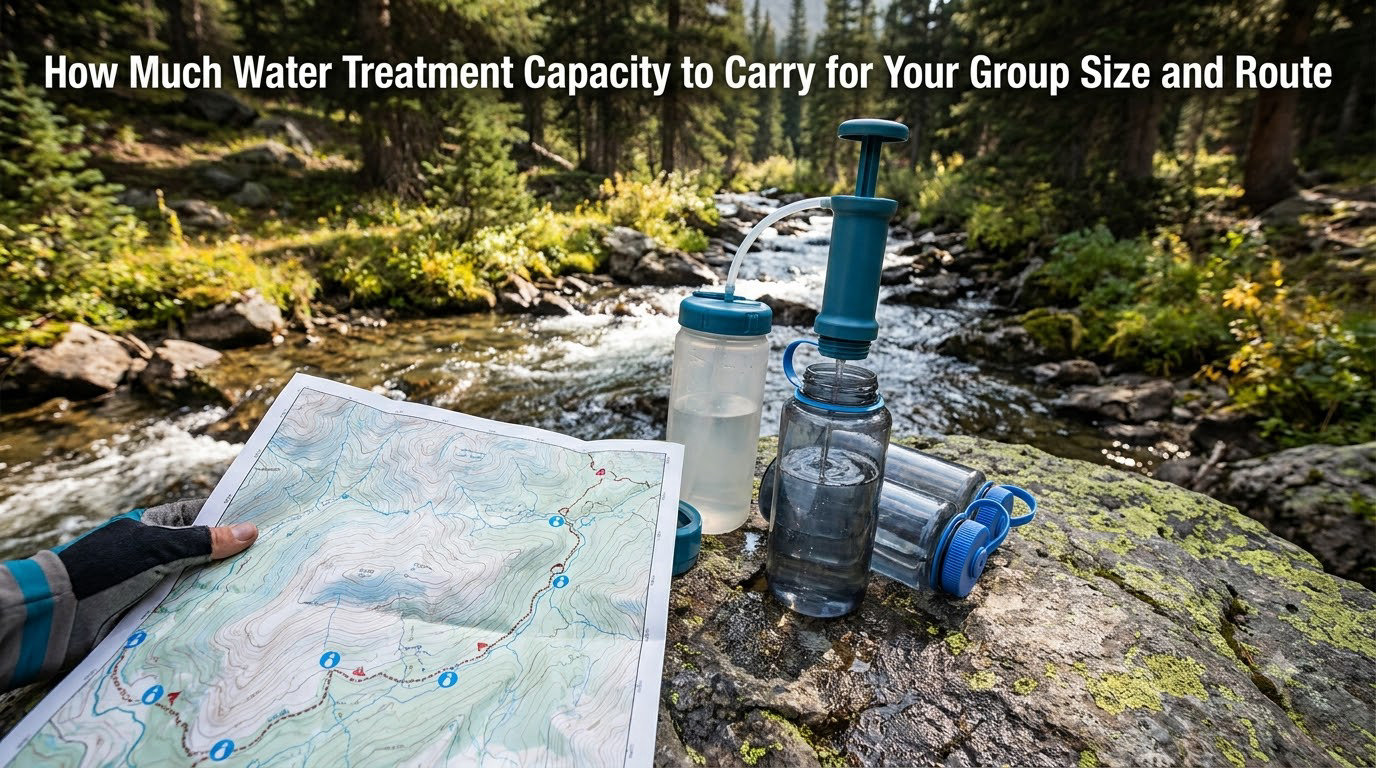
Figuring out how much water treatment capacity to carry for your group size and route comes down to one core formula: multiply your group size by the hours you will be hiking by 0.5 liters per person per hour, then add adjustments for elevation, temperature, and cooking needs. That total tells you how much treated water your group needs each day. From there, you match that daily demand to the right treatment method and carrying capacity so nobody runs dry between water sources.
Water treatment capacity refers to how much water your filtration or purification system can process in a given day to keep your entire group hydrated, fed, and clean. It is not just about how many liters you stuff into your pack at the trailhead. It is about the rate at which you can turn stream, lake, or spring water into safe drinking water at camp and on the trail.
Get this calculation wrong and you face two bad outcomes. Carry too little treatment capacity and your group runs out of safe water on a hot, dry stretch with the nearest source miles away. Carry too much and you lug unnecessary weight that slows everyone down and turns a fun trip into a slog.
This guide breaks down the exact formula, worked examples for groups from solo to eight-plus people, route-specific adjustments, and how to match your treatment method to your group’s daily needs. Everything here is based on established backcountry guidelines and real hiker experience from 2026.
Table of Contents
Understanding Your Group’s Daily Water Needs
Your group’s daily water need starts with a simple baseline that outdoor educators and university extension programs agree on: plan for 0.5 liters of water per person per hour of activity. This covers drinking while moving on the trail.
But that baseline only tells part of the story. You also need water for cooking meals, cleaning dishes, basic hygiene, and rehydrating after a long day. Most backpackers add another 1 to 2 liters per person per day for cooking and camp use. That means a full daily budget for an active hiker runs 3 to 4 liters in moderate conditions.
Here is where treatment capacity differs from carrying capacity. Carrying capacity is the volume of containers you bring: bladders, bottles, and reservoirs. Treatment capacity is the speed and volume at which your filter, purifier, or chemical system can process raw water into safe water. A group of four might only carry 2 liters each at any given moment but need to treat 16 liters total per day.
If your route passes reliable water sources every few miles, you can treat small batches frequently and carry less. If sources are sparse, you need either more carrying capacity or a faster treatment method to load up big at each stop.
Several factors push your baseline water needs higher than 0.5 liters per hour. Hot weather above 80 degrees Fahrenheit can increase demand by 50 percent or more. High altitude above 8,000 feet accelerates dehydration because the air is drier and you breathe faster. Strenuous terrain with heavy packs makes you sweat more, even in cool weather.
Cold weather creates a deceptive situation. You may not feel thirsty, but your body still loses moisture through respiration and increased urination at altitude. Winter backpackers should plan for the same 0.5 liters per hour even when they do not feel thirsty.
One forum hiker shared a cautionary tale: “I was on a 3-day hike and took 3 liters each day, but the temperature was much hotter than expected. I ran out by midafternoon on day two.” That experience underscores why you should always build a buffer into your calculation rather than planning for the absolute minimum.
The Water Treatment Capacity Calculation Formula
Use this five-step formula to calculate exactly how much water treatment capacity your group needs for any trip. Work through each step in order and write down the running total.
Step 1: Calculate Base Drinking Water
Multiply your group size by hours of hiking by 0.5 liters per person per hour. For example, 4 people hiking 7 hours equals 4 times 7 times 0.5, which gives you 14 liters of drinking water for the day.
Step 2: Add Cooking and Camp Water
Add 1.5 liters per person for cooking meals, cleaning, and hygiene. For a group of 4, that is 6 additional liters. Your running total is now 20 liters for the day.
Step 3: Apply Elevation Adjustment
Add 1 liter per person for every 1,000 feet of elevation gain on your route. If your group of 4 climbs 2,000 feet, add 8 liters. This brings your daily total to 28 liters.
Step 4: Apply Temperature Adjustment
In temperatures above 80 degrees Fahrenheit, multiply your base drinking water from Step 1 by 1.5. In temperatures above 90 degrees, multiply by 2. For our group of 4 hiking in 85-degree heat, the 14-liter drinking total becomes 21 liters. Recalculate: 21 drinking plus 6 cooking plus 8 elevation equals 35 liters for the day.
Step 5: Add Safety Buffer
Add 20 percent to your final total as a safety margin for delays, spills, or unexpectedly hot conditions. For 35 liters, add 7 liters, giving you a total treatment capacity target of 42 liters for that group on that day.
That 42-liter figure is your daily treatment capacity target. Your treatment system needs to be able to process that volume, or you need to plan multiple treatment sessions throughout the day at water sources along your route.
Here is a quick reference for base drinking water needs (before adjustments) by group size and hiking duration:
1 person, 4 hours: 2 liters
2 people, 6 hours: 6 liters
4 people, 7 hours: 14 liters
6 people, 8 hours: 24 liters
8 people, 8 hours: 32 liters
The popular alternative rule of thumb is 1 liter of water per 5 miles of hiking. This works well for day hikes on moderate terrain in comfortable temperatures. For multi-day trips, variable terrain, or large groups, the per-hour formula gives you more precise numbers because it accounts for time on trail rather than just distance covered.
Remember that these formulas assume you have access to water sources along the way. If your route has long dry stretches of 10 or more miles between sources, you need enough carrying capacity to hold the full volume for that section, not just enough to treat at each stop.
Group Size Considerations
Your group size drives both the total volume of water you need to treat each day and the type of treatment system that makes sense. What works for a solo hiker will frustrate a group of eight waiting in line at a slow filter.
Solo Hikers (1 Person)
A solo hiker typically needs 3 to 4 liters per day in moderate conditions. A single squeeze filter or chemical tablets can easily handle this volume. You only need to carry 1 to 2 liters at a time if water sources are frequent, which keeps your pack light. Treatment capacity is rarely a bottleneck for one person.
Couples and Small Groups (2 to 3 People)
Two to three people need 6 to 12 liters per day depending on conditions. A single squeeze filter still works but requires multiple sessions. A small gravity filter system shines here because you can hang it at camp and treat 4 liters at once while setting up tents or cooking. This is the sweet spot for gravity systems.
Families and Medium Groups (4 to 6 People)
Four to six people need 12 to 24 liters per day. At this size, pump filters become slow and frustrating. One person pumping for 30 minutes to produce 4 liters while five others wait is a recipe for campsite tension. A 4-liter or 8-liter gravity system can process enough water in two to three sessions to keep everyone happy.
For groups this size, consider carrying two treatment systems for redundancy. If one filter clogs or breaks, the entire group is affected. Many experienced group leaders carry a primary gravity filter plus chemical tablets as backup.
Large Groups (8+ People)
Large groups need 24 to 40-plus liters per day. This is where treatment capacity planning gets serious. A single gravity filter will need four to six sessions to meet demand. Most large groups run two gravity systems in parallel to cut treatment time in half. Others pre-assign water duty to specific people who treat water while the rest of the group sets up camp.
One backcountry forum user noted that their group of ten carried two 4-liter gravity filters and still spent over an hour each evening treating water for dinner and breakfast. Planning for this time commitment prevents the group from feeling rushed at camp.
Large groups also face a higher statistical risk of equipment failure simply because more people are handling the gear. Always carry backup treatment for any group larger than four. Chemical tablets are lightweight, inexpensive, and take up almost no pack space.
Route Factors That Change Everything
Your route characteristics can shift your water treatment capacity needs by 50 percent or more. The same group of four might need 20 liters on one trail and 35 liters on another. Understanding these factors helps you plan accurately rather than guess.
Distance Between Water Sources
This is the single most important route factor. Map out every reliable water source on your route before the trip. Note the distance between each one. If sources are spaced every 3 to 5 miles on a forested trail with a stream, you can carry 1 to 2 liters per person and treat frequently. If the next source is 12 miles away across an exposed ridge, you need to carry the full volume for that entire section.
Always verify water source reliability close to your trip date. Springs and seasonal creeks dry up, especially in late summer. A source marked on a map from spring may be bone dry by August. Check recent trip reports or call the local ranger station.
Elevation and Altitude
Higher altitude means drier air, increased respiration, and faster dehydration. Above 8,000 feet, your body loses moisture more quickly even without heavy sweating. Plan for the 1-liter-per-1,000-feet adjustment in your formula. Above 10,000 feet, consider adding an additional 0.5 liters per person per hour to your baseline.
High-altitude routes also tend to have fewer reliable water sources above treeline. Plan to fill up at the last source before a high exposed section and carry enough for the entire push.
Temperature and Weather
Hot weather is the most common reason hikers run out of water. Above 80 degrees Fahrenheit, increase your base calculation by 50 percent. Above 90 degrees, double it. Desert routes require the most conservative planning because water sources are sparse and heat is extreme.
One hiker on a desert forum shared that they planned for 4 liters on a 10-mile desert hike in spring but needed 6 because an unexpected heat wave pushed temperatures into the 90s. Always check the forecast and build in a heat buffer.
Cold weather does not eliminate hydration needs. Winter hikers lose significant moisture through breathing in cold, dry air. Plan for the same baseline 0.5 liters per hour, and remember that treating water in freezing conditions takes longer because sources may be frozen or your filter may ice up.
Route Type Comparisons
Different route types create different water planning challenges. Here is how common route types compare:
Forested mountain trails typically have frequent stream crossings and reliable springs. Carry 1 to 2 liters per person and treat at each source. Treatment capacity needs are low because you treat small amounts frequently.
Desert routes have sparse, unreliable water sources. Carry 4 to 6 liters per person and plan long dry sections carefully. Treatment capacity needs are high at each stop because you are loading up for many miles.
Alpine above-treeline routes have limited sources above treeline. Fill up at the last source before the climb and carry enough for the entire exposed section. Treatment capacity needs are moderate, focused on big sessions before and after exposed sections.
Coastal trails may have no fresh water for long stretches. Some routes require packing all water in. Plan treatment capacity only if you know there are reliable streams or lakes along the way.
Treatment Methods and Their Daily Capacity
The treatment method you choose directly affects how much water you can produce per day and how you plan your carrying strategy. Each method has a practical throughput limit that determines whether it can keep up with your group’s needs.
Gravity Filters
Gravity filters are the workhorses of group water treatment. A typical 4-liter gravity system processes 1.5 to 2 liters per minute, meaning a full 4-liter batch takes 2 to 3 minutes of hands-off filtering. You set it up and walk away. For a group of four needing 20 liters per day, that is five batches totaling about 15 minutes of setup and filtering time spread across the day. This makes gravity systems ideal for groups of three or more.
Pump Filters
Pump filters produce roughly 1 liter per minute of active pumping. For a solo hiker or pair, this works fine. For a group of six needing 24 liters, someone will be pumping for 24 minutes of manual labor. Pumps are better suited for solo hikers, pairs, or as a backup for larger groups.
Squeeze Filters
Squeeze filters attached to soft flasks process about 0.5 to 1 liter per minute depending on the user’s grip strength and filter condition. They are lightweight and versatile for solo hikers and pairs. For groups larger than three, squeeze filters become tedious because each batch is small and requires active effort.
Chemical Treatment
Chlorine dioxide tablets treat water in 30 minutes for most bacteria and viruses, and 4 hours for cryptosporidium. The throughput is limited only by how many containers you have. Chemical treatment is excellent as a backup or for small groups but the wait time makes it impractical as a primary method for groups needing 20-plus liters quickly at camp.
UV Purification
UV pens like SteriPEN treat 1 liter in about 90 seconds. They are fast and effective against viruses but require clear water, batteries, and careful technique. For groups, UV works for treating bottles one at a time but cannot process large batches. Pre-filtering cloudy water adds time.
Boiling
Boiling is 100 percent effective but fuel-intensive. Bringing water to a rolling boil for 1 minute (3 minutes above 6,500 feet) treats water but uses significant stove fuel. Boiling makes sense for cooking water but is impractical as your sole treatment method for a group’s drinking needs.
Match your method to your group size: solo and pairs do well with squeeze or pump filters. Groups of three to six benefit most from gravity systems. Large groups should run parallel gravity filters. Everyone should carry chemical tablets as backup regardless of primary method.
FAQs
How much water should I bring for a 4 hour hike?
Plan for 2 liters per person for a 4-hour hike in moderate conditions, based on the 0.5 liters per hour per person guideline. In hot weather above 80 degrees, increase that to 3 liters. Add another 1 liter per person for every 1,000 feet of elevation gain on your route.
Is 2 liters enough for a 10 mile hike?
For a 10-mile hike, 2 liters is the minimum for moderate conditions at a relaxed pace. The general rule is 1 liter per 5 miles, which gives you 2 liters. However, in hot weather, at high altitude, or on strenuous terrain, you should increase that to 3 to 4 liters per person.
How do I calculate water needs for group backpacking?
Multiply group size by hours hiking by 0.5 liters per person per hour for drinking water. Add 1.5 liters per person for cooking and camp use. Add 1 liter per person per 1,000 feet of elevation gain. Add a 20 percent safety buffer to the total. This gives you your daily water treatment capacity target for the group.
Is it okay to only carry 2 liters of water if backpacking along a water source?
Yes, 2 liters is enough to carry at any one time if your route has frequent, reliable water sources. You will treat small batches at each source along the way. The key is having a treatment system that can process water quickly at each stop. Always verify source reliability before counting on this strategy.
What water treatment method is best for a large group?
Gravity filters are the best primary treatment method for groups of four or more. A 4-liter gravity system can process water hands-free while the group sets up camp. For groups of eight or more, run two gravity filters in parallel. Always carry chemical tablets as a lightweight backup regardless of group size.
Putting It All Together
Planning how much water treatment capacity to carry for your group size and route comes down to running the formula, adjusting for conditions, and matching your treatment method to the demand. Start with 0.5 liters per person per hour, add cooking and camp water, factor in elevation and temperature, and add a 20 percent safety buffer. Then choose a treatment system that can deliver that volume without making your group wait.
The hikers who struggle most are the ones who treat water planning as an afterthought. They grab a filter they have used on solo day hikes and assume it will scale for a group of six on a multi-day trek. It will not. Take ten minutes before your trip to run the numbers for your specific group and route.
Write your daily treatment target on your trip plan. Pack a backup method. Verify water source conditions close to departure. These three habits will keep your group hydrated, healthy, and moving comfortably on any trail you choose in 2026 and beyond.