
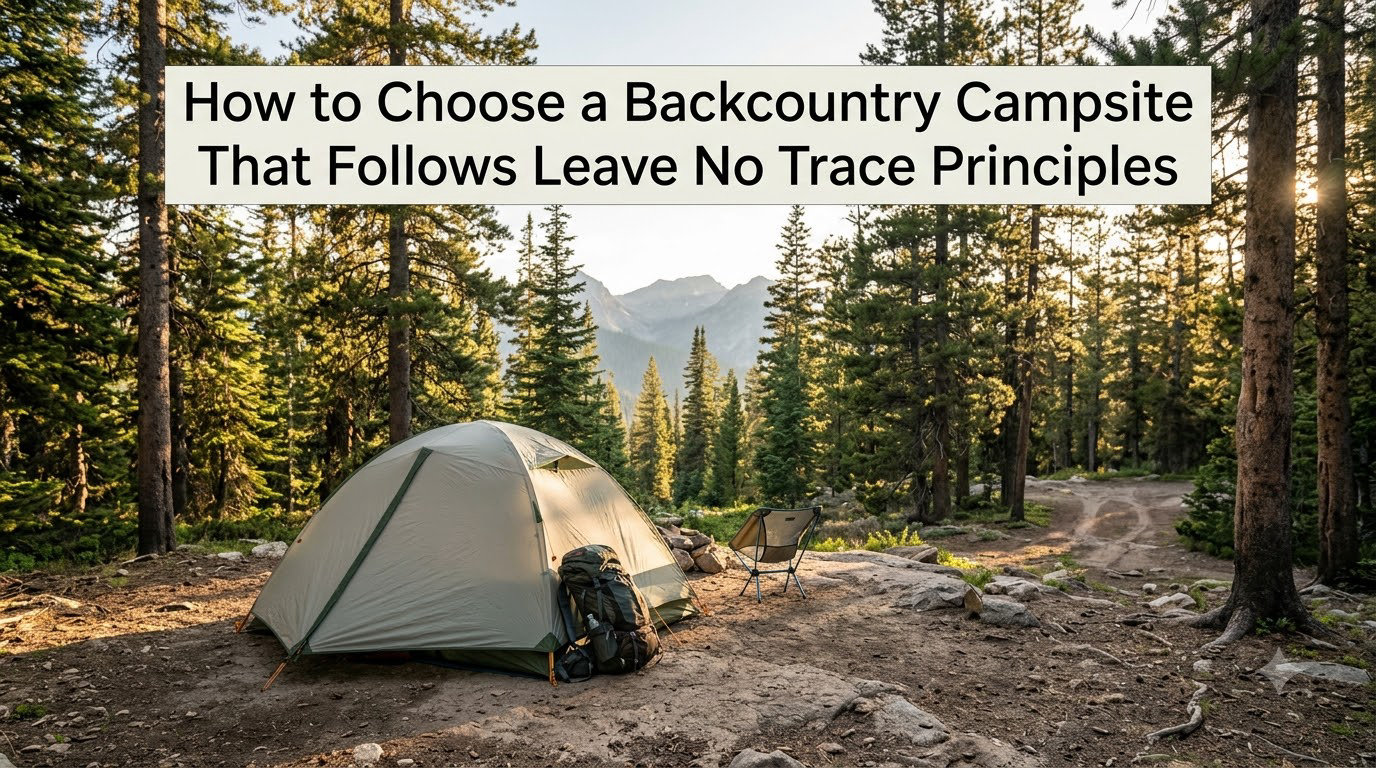
The backcountry offers some of the most rewarding camping experiences you can find, but every site you choose has the potential to leave a lasting mark. Learning how to choose a backcountry campsite that follows Leave No Trace principles is one of the most important skills any wilderness traveler can develop.
I have spent years backpacking through national forests, designated wilderness areas, and remote backcountry zones. Along the way, I have seen how poor campsite selection damages fragile ecosystems firsthand. Vegetation gets trampled into bare dirt. Soil erodes downhill. Wildlife loses access to the water sources they depend on for survival.
The good news is that nearly all of this damage is preventable. The Leave No Trace Center for Outdoor Ethics developed seven core principles to help people enjoy the outdoors responsibly. The second principle, Travel and Camp on Durable Surfaces, is the one that most directly governs where you pitch your tent.
When you understand this principle, the way you evaluate a potential campsite shifts completely. You stop looking for just any flat spot and start considering surface durability, water source distance, existing site condition, and whether your tent footprint will crush fragile vegetation.
This guide covers everything you need to know about backcountry campsite selection for 2026. I will walk you through how to identify durable surfaces, explain the 200-foot rule from water, show you how to prevent site creep, and share specific guidance for different environments, from alpine zones and deserts to river corridors.
Whether you are planning your first overnight backpacking trip or you have logged hundreds of miles on remote trails, these Leave No Trace principles will help you camp responsibly and protect wild places for the people who come after you.
The core philosophy comes down to a phrase that the National Park Service and Leave No Trace both repeat: good campsites are found, not made. Here is what that actually means in practice.
Table of Contents
Understanding the 7 Leave No Trace Principles
The seven Leave No Trace principles form a complete framework for minimizing your impact in the outdoors. They were developed by the Leave No Trace Center for Outdoor Ethics and are used by land management agencies across the United States, including the National Park Service and the U.S. Forest Service.
Here are all seven principles:
Plan Ahead and Prepare
Travel and Camp on Durable Surfaces
Dispose of Waste Properly
Leave What You Find
Minimize Campfire Impacts
Respect Wildlife
Be Considerate of Other Visitors
Principle 2, Travel and Camp on Durable Surfaces, is the one this guide focuses on most heavily. It directly addresses where you walk, where you pitch your tent, and how you move around camp. The decisions you make under this principle determine whether your campsite selection protects or damages the land.
But the principles do not work in isolation. Principle 1 (planning) determines whether you even know the local regulations before choosing a site. Principle 5 (campfire impacts) ties directly into where and whether you build a fire at camp. Principle 6 (respecting wildlife) connects to how far you camp from water sources.
Understanding all seven gives you the full picture of responsible backcountry camping. But if you want to master campsite selection specifically, Principle 2 is where you spend most of your attention.
What Are Durable Surfaces and Why They Matter
Durable surfaces are ground types that can withstand repeated foot traffic and camping without suffering lasting damage. The Leave No Trace Center for Outdoor Ethics defines them as rock, gravel, sand, compacted soil, dry grasses, and snow.
When you camp on these surfaces, your tent and your feet do minimal harm. The ground can absorb the impact of a single night or a short stay without losing its natural character. That is the entire goal: choosing a surface that bounces back after you leave.
Fragile surfaces are the opposite. These include living soil (also called cryptobiotic crust), desert pavement, fragile alpine plants, wet meadows, riparian vegetation, and freshly germinating seedlings. Walking or camping on these surfaces can cause damage that takes decades to heal. In some desert environments, cryptobiotic crust can take 50 to 250 years to recover from a single boot print.
Surface durability is not the same everywhere. A surface that is tough in one environment might be delicate in another. Dry grass is durable, but the same type of grass becomes fragile when wet or during spring growth. Snow is highly durable when deep enough, but patchy or early-season snow offers no protection to the plants underneath.
The key is learning to read the ground beneath your feet. Before you pitch your tent, ask yourself one question: will this spot look the same tomorrow as it does today? If the answer is no, find a different spot.
Durable vs. Fragile Surfaces at a Glance
| Durable Surfaces (Camp Here) | Fragile Surfaces (Avoid) |
|---|---|
| Rock and bare bedrock | Living soil / cryptobiotic crust |
| Gravel and decomposed granite | Desert pavement with dark varnish |
| Sand and dry river bars | Alpine tundra vegetation |
| Compacted dirt on established sites | Wet meadows and marshy ground |
| Dry grasses (dormant season) | Riparian vegetation near streams |
| Deep snow (winter camping) | Spring wildflowers and new seedlings |
| Pine duff in established areas | Moss-covered forest floor |
Memorize this table before your next trip. When you arrive at a potential site, compare what you see to the left column. If the ground looks more like the right column, keep walking.
The 200-Foot Rule: How Far Should You Camp From Water?
The 200-foot rule is one of the most important Leave No Trace guidelines for backcountry campsite selection. It states that you should camp at least 200 feet, roughly 70 adult paces, from any lake, stream, river, or seasonal water source.
I can tell you from experience that 200 feet feels farther than most people think. Count it out: seventy full strides from the water’s edge. That is about two-thirds the length of a football field. Many campers set up too close because they underestimate the distance or want easy water access at night.
The reason for the 200-foot rule comes down to wildlife and water quality. Animals depend on water sources, especially in arid environments. When campsites crowd the shoreline, wildlife avoids those areas entirely, sometimes abandoning critical drinking and feeding zones altogether.
Camping too close also increases the risk of soap, food particles, and human waste contaminating the water supply. Even biodegradable soap disrupts aquatic ecosystems when it reaches streams and lakes before breaking down.
Riparian areas, the vegetated zones along rivers, streams, and lakes, are also among the most ecologically sensitive habitats in the backcountry. They support the highest diversity of plants and animals and are the most vulnerable to trampling and erosion.
There are exceptions to the rule. Some designated backcountry campsites sit closer than 200 feet to water because they were established before current guidelines existed. If a site is designated and maintained by a land management agency, follow the local rules. In river corridors where canyon walls prevent moving 200 feet back, camp on durable surfaces like sandbars or bare rock within the constrained corridor.
When in doubt, walk those extra steps. The wildlife that depends on that water source has no other options.
How to Choose a Backcountry Campsite: Step by Step
Choosing a backcountry campsite that follows Leave No Trace principles comes down to a sequence of decisions. You evaluate regulations, surface durability, water distance, hazards, and existing site condition, in that order.
Step 1: Research Before You Go
Campsite selection starts at home, not on the trail. Before your trip, research the specific regulations for the area you plan to visit. Many wilderness areas require permits, restrict camping to designated sites, or prohibit campfires entirely.
Check the website of the managing agency, whether that is the National Park Service, U.S. Forest Service, Bureau of Land Management, or state parks department. Call the local ranger station for current conditions and any seasonal restrictions. Some areas close campsites during wildlife mating or nesting seasons.
Knowing the rules before you arrive means you are not making rushed decisions at the end of a long hiking day. It also prevents you from accidentally camping in a prohibited zone or building a fire during a burn ban.
Step 2: Use Established Sites When Available
In popular backcountry areas, always use existing established campsites. These are sites that have already been impacted. The vegetation is gone, the ground is compacted, and the damage is done. Concentrating your impact on an already-modified site prevents new areas from being damaged.
Look for sites with bare compacted soil, a cleared tent area, and sometimes a simple rock fire ring where fires are permitted. These sites are often marked on trail maps or noted in guidebooks. If you find one, use it rather than creating a new site nearby.
The principle here is concentration in high-use areas. By using the same impacted sites, you keep the total footprint of human camping contained to a small number of locations.
Step 3: Evaluate the Ground Surface
Before pitching your tent, examine the ground carefully. Is it rock, gravel, sand, or compacted dirt? These are your durable surfaces. Is it covered in fragile alpine flowers, soft moss, or crusty desert soil? Move on, because those surfaces cannot handle your tent.
Check for level ground. You do not need a perfectly flat site, but you want enough of a level area to sleep comfortably without rolling downhill. A slight slope is fine if your head is positioned uphill.
Look at what is underneath your tent footprint. Pine needles and dry leaves (called duff) provide a natural cushion and are acceptable in moderation on established sites. But if you are on a pristine site, avoid clearing away natural debris to create a pad. That alters the site and leaves a visible scar.
Step 4: Measure Your Distance From Water
Once you have a candidate site, pace off the distance to the nearest water source. Walk 70 full strides away from the shoreline. If you end up at 200 feet or more, you are in good shape.
While you are at it, check that you are also 200 feet from the trail. Camping right next to a trail impacts other hikers’ wilderness experience and widens the trail corridor through vegetation trampling. Other backpackers did not hike miles into the wilderness to walk through your camp.
Step 5: Scan for Hazards
Look up, look down, and look around. Dead trees, especially tall snags with hanging branches (sometimes called widowmakers), can fall without warning. Do not camp under them, especially in windy conditions or during stormy weather.
Check for signs of pooling water or dry washes that could flash flood. Avoid camping in the bottom of a drainage or a low-lying depression, even if it looks bone dry at the moment. A storm miles away can send water rushing through that same spot in minutes.
Check the immediate area for ant hills, yellow jacket nests, and animal dens. A perfect-looking site becomes miserable if you discover a wasp nest three feet from your tent at dusk.
Step 6: Consider Sun, Wind, and Shade
Finally, think about your comfort and the elements. A site with morning shade keeps your tent cooler in summer but means waking up to dew that lasts longer on your gear. An eastern-facing slope catches early sun, which helps dry things out but heats up fast by mid-morning.
Wind exposure matters too. A completely exposed ridge offers great views but can mean a cold, noisy night with your tent fabric snapping in the breeze. A site tucked behind natural windbreaks like boulders, dense tree clusters, or terrain features is more comfortable and reduces the risk of tent damage.
High-Use Areas vs. Undisturbed Areas: Different Strategies
The Leave No Trace approach to campsite selection changes depending on how popular the area is. This is called the concentration vs. dispersal strategy, and it is one of the most misunderstood concepts in backcountry camping.
In high-use areas (popular trails, designated wilderness zones near trailheads, well-known backcountry destinations), you should concentrate your impact. Use established campsites exclusively. Do not create new sites. Do not expand existing ones. The goal is to keep all camping damage confined to sites that are already modified.
In undisturbed or pristine areas (remote zones with few visitors, off-trail locations, wilderness areas with low traffic), the strategy flips entirely. You should disperse your impact to leave no trace at all. Spread your tents apart so no single spot gets concentrated wear. Move around camp on different routes so you do not create visible paths. Avoid repeating the same footsteps through the same patch of ground.
The logic is simple. In a high-use area, a single new campsite adds to hundreds of existing impacts, and the land cannot recover from the cumulative pressure. In a pristine area, spreading out means each individual spot receives so little impact that the vegetation and soil recover fully before anyone returns.
Concentration vs. Dispersal: Side by Side
| Strategy Element | High-Use Areas (Concentrate) | Undisturbed Areas (Disperse) |
|---|---|---|
| Site selection | Use existing established sites | Find pristine durable surfaces |
| Tent spacing | Cluster tents together | Spread tents far apart |
| Walking routes | Stick to established paths | Vary your route each time |
| Duration | Stay on existing impacted ground | Move camp daily if staying multiple days |
| Fire rings | Use existing rings if fires are allowed | Do not build fire rings |
| Departure | Leave site clean and obvious | Naturalize the site completely |
Getting this distinction right is what separates responsible backcountry campers from those who unintentionally damage the land. When you understand whether you are in a high-use or pristine area, the correct strategy becomes obvious.
Preventing Site Creep: A Hidden Problem
Site creep is the gradual expansion of a campsite’s footprint over time. It happens when campers pitch their tents slightly outside the existing bare-ground area, cook a few steps away from the main pad, or store gear on the surrounding vegetation. Over weeks and seasons, what started as a compact 8-by-8-foot site grows into a 20-by-20-foot barren patch of dead dirt.
I have watched this happen at backcountry sites I visit regularly year after year. Each season, the bare ground spreads a little wider as more campers push the edges. Vegetation that once bordered the site gets trampled and dies off. The soil compacts and erodes. Eventually, the site looks like a small dirt parking lot carved out of the forest.
Preventing site creep requires conscious effort from every camper. When you arrive at an established site, keep all your activity within the already-impacted zone. Pitch your tent on the bare pad, even if it means a slightly less comfortable spot. Do your cooking, gear sorting, and pack organization on the bare ground or on rock surfaces nearby.
Vary your walking routes within camp. The Leave No Trace Center specifically advises against creating connecting trails between parts of your camp, meaning the tent area, the cooking area, and the food storage area. Walk on slightly different paths each time so no single track gets worn into the ground.
If the existing site is too small for your group size, do not expand it. Instead, find a second established site nearby or move to a different area entirely. Expanding a site, even by a few feet, contributes to the slow death of the surrounding vegetation and soil.
Keep your footprint tight. Every square foot of bare ground you preserve matters more than you might think.
Special Environments: Deserts, Alpine Zones, and River Corridors
Different environments call for different campsite selection strategies. The durable surfaces and hazards change dramatically depending on where you are camping.
Desert Camping
Desert environments present some of the most fragile surfaces in the world. The most important thing to avoid is cryptobiotic crust, also called living soil or biological soil crust. This dark, bumpy crust is a living community of cyanobacteria, lichens, and mosses that stabilizes desert soil and prevents erosion. It can take over a century to form, and a single boot print can destroy it.
In the desert, camp on slickrock (bare rock surfaces), sand, or gravel washes. Stay on previously disturbed ground whenever possible. Never camp on or walk through areas with dark, crusty soil. If you are unsure whether something is living crust, treat it as fragile and walk around it.
Desert pavement, the naturally arranged mosaic of small rocks that covers many desert surfaces, is also easily damaged. Once those rocks are displaced by foot traffic or tent stakes, the surface does not reform on any human timescale.
Alpine and High-Elevation Zones
Above treeline, vegetation grows incredibly slowly due to short growing seasons and harsh conditions. Alpine plants that take an entire summer to grow a single inch can be destroyed by one tent footprint, and recovery may take decades.
In alpine zones, camp on rock, bare soil, or snow. Avoid vegetated areas entirely, especially delicate cushion plants, heather communities, and sedge tussocks. If you must camp near vegetation, choose the most durable spots available and keep your group as compact as possible. The higher the elevation, the more carefully you need to choose.
River Corridors
River canyons present a unique challenge because the canyon walls often prevent camping 200 feet from the water. In deep, narrow canyons, you may have no choice but to camp closer to the river than the standard guidelines suggest.
In these situations, the Leave No Trace guidance is to camp on durable surfaces within the corridor. Sandbars, bare rock benches, and existing established sites are your best options. Avoid trampling riparian vegetation along the banks. Those green strips are critical wildlife habitat and natural erosion buffers.
If you are on a permitted river trip, follow the specific guidance from the managing agency. Many river corridors have designated campsites that were selected to account for the physical constraints of the canyon walls while minimizing ecological damage.
Minimizing Campfire and Cooking Impacts at Your Campsite
Where you cook and whether you build a fire both affect your campsite’s overall footprint. Leave No Trace Principle 5, Minimize Campfire Impacts, ties directly into site selection.
If fires are permitted and you choose to have one, use an existing fire ring. Never build a new ring or create a second ring next to an existing one. Multiple fire rings are one of the most common signs of site creep and represent unnecessary, lasting impact on the landscape.
Better yet, use a lightweight camp stove for cooking. Stoves leave no trace, work in any weather, and eliminate the need for firewood gathering. Gathering wood strips the area of dead and downed material that would otherwise decompose and feed the soil. In high-use areas, firewood is often completely depleted within a mile of popular campsites.
If you do build a fire, keep it small. Use only sticks you can break by hand, nothing thicker than your wrist. Burn the wood down to fine white ash. When you leave, scatter the cold ashes and dismantle any rocks you moved to construct the fire ring. If you created a ring in a pristine area (which you should avoid in the first place), erase it completely.
For cooking, use your stove on the most durable surface available, such as a flat rock or the established bare-ground pad. Clean up thoroughly. Strain dishwater and scatter it broadly at least 200 feet from water sources. Pack out all food scraps, including micro-trash like rice grains, noodle bits, and dropped seasoning.
Breaking Down Camp: How to Naturalize Your Site
Naturalizing your campsite means restoring it to look like you were never there. This step matters most in pristine or undisturbed areas, but it is good practice at every campsite you use.
When you break camp, fluff up any flattened grass or pine duff with your hands or a stick. Scatter leaves, twigs, and natural debris over the tent area to restore the ground’s natural appearance. If you moved rocks to secure your tent or create a cooking surface, put them back where you found them.
Fill in any holes you dug, including cat-hole toilet areas. Naturalize the surface so it blends with the surrounding ground. Remove all traces of your fire, meaning scatter cold ashes, replace displaced soil, and return rocks to their original positions.
Pack out all trash, including food scraps, wrappers, and any micro-trash. Check the area carefully, because it is easy to miss small items like twist ties, fruit stickers, and dropped food bits. Do a final sweep of your campsite from different angles before you put on your pack and leave.
The goal is simple. The next person who walks through should not be able to tell anyone camped there. In high-use areas with established sites, this means leaving the site cleaner than you found it. In pristine areas, it means leaving absolutely no trace at all.
I make it a habit to turn around and look back at my campsite from 50 feet down the trail. If anything looks disturbed or out of place, I go back and fix it. It takes two minutes and it works every time.
Quick Campsite Evaluation Checklist
Use this checklist every time you select a backcountry campsite. Print it, screenshot it, or memorize it before your next trip.
Before the Trip:
Check local regulations and permit requirements for your destination
Identify designated campsites or camping zones on your map
Check current conditions with the local ranger station
On the Ground:
Camp at least 200 feet (70 adult paces) from water sources
Camp at least 200 feet from the trail
Choose durable surfaces: rock, gravel, sand, compacted soil, dry grass, or snow
Use existing established sites in popular areas
Avoid fragile surfaces: living soil, desert pavement, wet meadows, alpine plants
Look up for hazards: dead trees, hanging branches, loose rocks on slopes above
Look down for drainage: avoid depressions, dry washes, and low spots
In Camp:
Keep all activity within the established footprint
Vary your walking routes to prevent trail formation
Use a camp stove instead of building a fire when possible
Store food properly to protect wildlife (bear canister or hang)
Keep a clean camp and pack out everything you brought in
Breaking Camp:
Naturalize the site: scatter debris, replace moved rocks, fluff vegetation
Pack out all trash and food scraps, including micro-trash
Dismantle any fire rings you created and scatter cold ashes
Do a final visual sweep from multiple angles
Leave the site looking completely undisturbed
FAQs
What is the 200 rule for camping?
The 200-foot rule states that you should camp at least 200 feet, approximately 70 adult paces, from any water source including lakes, streams, rivers, and springs. This distance protects wildlife access to water, prevents contamination of water supplies from camp activities, and avoids damaging sensitive riparian vegetation along shorelines.
How to choose a backcountry campsite?
Choose a backcountry campsite by following six steps: research local regulations before your trip, use established sites in popular areas, evaluate the ground for durable surfaces like rock or compacted soil, measure at least 200 feet from water and trails, scan for hazards like dead trees and flood zones, and consider sun, wind, and shade for comfort. The guiding principle is that good campsites are found, not made.
What are durable surfaces for camping?
Durable surfaces are ground types that can withstand camping without lasting damage. According to Leave No Trace, these include rock, gravel, sand, compacted soil, dry grasses, and snow. Fragile surfaces to avoid include living soil (cryptobiotic crust), desert pavement, wet meadows, riparian vegetation, and alpine plants, which can take decades or even centuries to recover from trampling.
What is Principle 5 of Leave No Trace?
Principle 5 is Minimize Campfire Impacts. It encourages using lightweight camp stoves for cooking, using existing fire rings when fires are permitted, keeping fires small, using only small sticks that can be broken by hand, burning wood completely to ash, and removing all traces of the fire when breaking camp. In many backcountry areas, campfires are prohibited entirely due to fire danger and resource damage.
What does FF mean in camping?
In backcountry camping discussions, FF is an informal abbreviation that varies by context and region. It can refer to first flush (the first significant rain after a dry period that affects water quality), free fire (areas where campfires are allowed without special permit), or front-country facilities depending on the source. There is no single universally accepted meaning in Leave No Trace literature.
How far should you camp from water sources?
You should camp at least 200 feet from any water source, which equals about 70 adult steps or roughly two-thirds the length of a football field. This distance protects wildlife access to water, prevents contamination of water from camp activities, and avoids damage to sensitive shoreline vegetation called riparian areas.
Conclusion
Learning how to choose a backcountry campsite that follows Leave No Trace principles is not about memorizing rules. It is about developing a mindset of care for the places you visit. Every surface you step on, every spot you pitch your tent, and every trace you leave behind or fail to leave behind adds up across thousands of visitors each year.
The core idea is simple: good campsites are found, not made. Camp on durable surfaces, stay 200 feet from water, use established sites in popular areas, disperse your impact in pristine zones, and naturalize your camp when you leave. If you do these things consistently, the wilderness will still be wild when the next person arrives.