
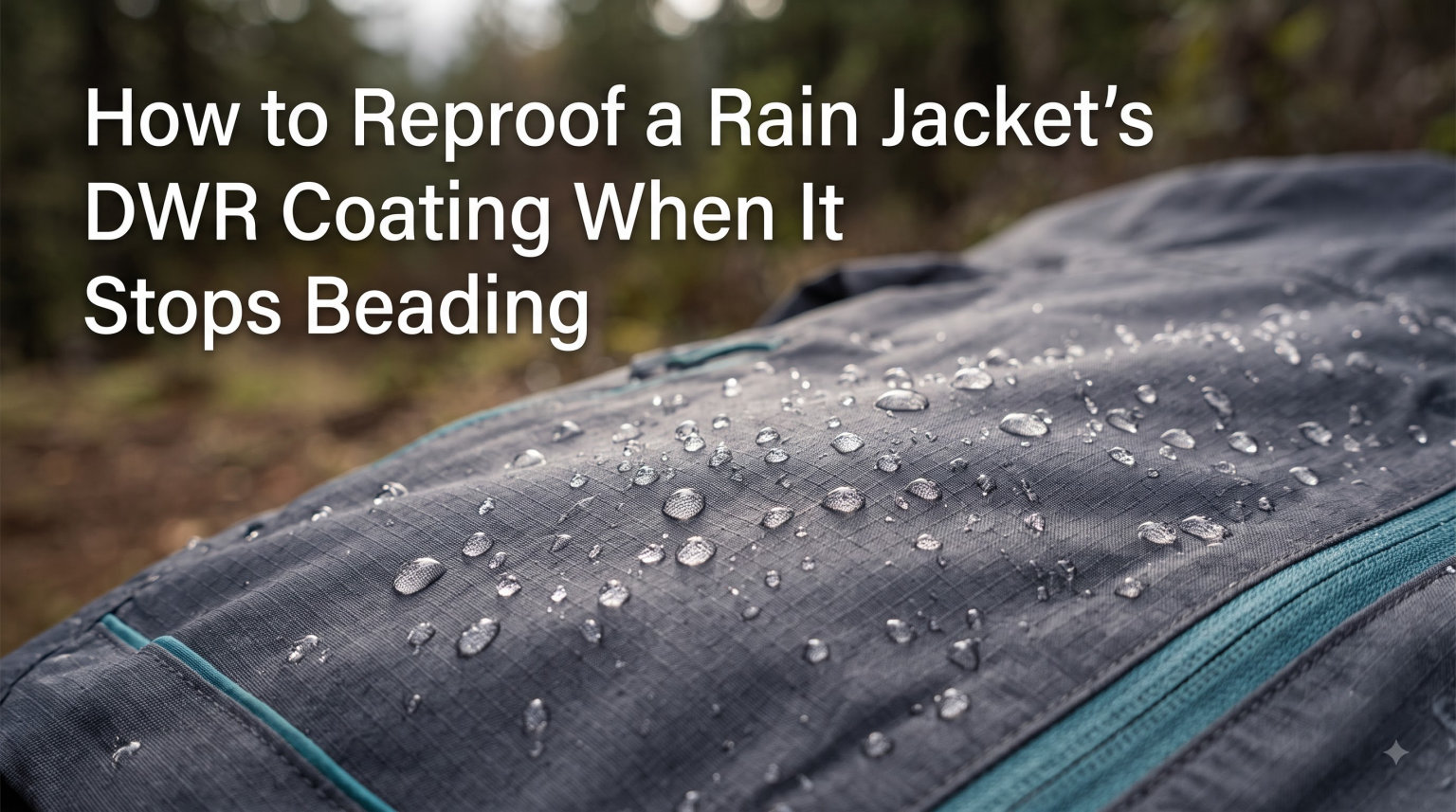
I was three hours into a wet hike last fall when I realized my jacket had gone from “rain-shedding” to “personal sponge.” The water was no longer beading on the surface. It was soaking in, leaving me clammy and cold.
If that sounds familiar, your problem is almost certainly the DWR coating on the outer fabric, not the waterproof membrane underneath. The good news: you can usually fix this at home in an afternoon. This guide walks through exactly how to reproof a rain jacket DWR coating when it stops beading, based on what I have learned from outdoor gear specialists and my own trial-and-error over dozens of jackets.
Table of Contents
What Is DWR and Why Does It Matter
DWR stands for Durable Water Repellent, a factory-applied coating on the outermost fabric of your rain jacket. It is what makes water bead up and roll off instead of soaking into the material.
Your jacket actually has two layers of water protection. The waterproof membrane (like Gore-Tex or eVent) blocks water from passing through to your skin. The DWR stops the outer fabric from absorbing water in the first place. When the outer fabric gets saturated, a condition called “wet out,” your jacket feels heavy, cold, and clammy even though the membrane is still working.
Because wet-out destroys breathability, almost every rain jacket you own depends on DWR. Lose the DWR and the jacket still keeps water out, but it stops letting sweat escape. That is the problem you are trying to solve.
How DWR Coating Works (The Simple Science)
DWR works by increasing the contact angle of water droplets on the fabric surface. Higher contact angle means the water forms tight beads instead of spreading flat.
Think of it as a microscopic bed of tiny spikes. Water droplets have high surface tension, so they sit on top of those spikes rather than sliding into the spaces between fibers. The droplet stays round, then gravity or a slight breeze rolls it off the jacket.
Most modern DWR treatments are made from fluorocarbon, silicone, or hydrocarbon polymers. Each polymer type has trade-offs in durability, environmental impact, and feel. The key takeaway: DWR is a thin polymer coating, not a sealant, and it wears off with use.
Why Your DWR Stops Beading Water
DWR fails for four main reasons, and most jackets experience a combination of them. The first is dirt and body oil. Skin oils, sunscreen, campfire smoke, and regular grime clog the DWR’s microscopic structure and stop water from beading.
The second is abrasion. Backpack straps, seat belts, and rubbing against rocks or Velcro gradually scrape the DWR off high-wear areas like shoulders and hips. The third is detergent residue. Regular laundry detergent leaves a hydrophilic film that attracts water and cancels out DWR.
The fourth is heat damage in a hot dryer cycle. Excessive heat can actually cook the DWR off the fabric. The interesting twist: a controlled amount of heat reactivates DWR. I will explain that next.
How to Test If Your DWR Still Works
The water spray test takes 30 seconds and tells you everything you need to know. Lightly spray your jacket with clean water from a spray bottle or hold it under a running faucet for a few seconds.
If water beads up and runs off the surface, your DWR is still functional. If the fabric darkens as it absorbs water and the water stays flat on the surface, your DWR has failed or worn off. You will often see this happen first on the shoulders and upper back, where backpack straps cause the most abrasion.
Another quick test is the “wet out” check. Wear the jacket in moderate rain for 10 minutes. If the outer fabric feels heavy and waterlogged but your skin stays dry, the membrane is fine and the DWR is the issue. If water reaches your skin, the membrane may be compromised and reproofing may not solve the problem.
Step 1: Clean Your Jacket Before Anything Else
Cleaning is the single most important step before you try to revive or reapply DWR. I have skipped this step more times than I care to admit, and the result is always the same. The DWR treatment does not bond properly to a dirty jacket.
Use a technical fabric wash like Nikwax Tech Wash or Granger’s Performance Wash. These are pH-neutral and free of the additives that destroy DWR. Standard household detergent contains surfactants and fragrances that leave a water-attracting film on the fabric.
Wash the jacket on a gentle cycle in warm water (around 105 degrees F). For a front-loading washer, just toss the jacket in. For a top-loader with an agitator, I prefer to hand wash in a bathtub to avoid stress on the seams. Zip all zippers, close all Velcro, and empty the pockets. Rinse the jacket twice to make sure no residue remains.
Do not skip the rinse. Leftover detergent is one of the most common reasons DWR treatments fail to revive properly.
Step 2: Revive DWR with Heat (The Free Fix)
If your jacket still has factory DWR on it, heat reactivation can restore it without buying any products. This works because the polymer chains in DWR loosen when warm and reset into a more uniform structure when they cool.
The easiest method is the tumble dryer. Place the clean jacket in a dryer on medium heat (not high) for 20 to 30 minutes. A clean tennis ball or two dryer balls helps prevent clumping. Take the jacket out while it is still slightly warm.
You can also use a regular iron. Set the iron to low heat with no steam. Place a thin cotton cloth over the jacket and iron briefly across the surface. The cloth stops the iron from melting the fabric. This method is trickier on large jackets, and I usually save it for touch-ups.
After either heat method, do the water spray test again. If water now beads, you have just revived your DWR for free. If it still soaks in, the factory DWR is too worn down and you need Step 3.
Step 3: When to Apply New DWR Treatment
If cleaning and heat did not bring beading back, your jacket needs new DWR applied. This is normal for any jacket over two years old, or new jackets that have been heavily used.
The decision tree is simple. Did water bead after cleaning and heat? If yes, you are done. If no, you need to apply fresh DWR. The two main options are spray-on and wash-in treatments, and which one you choose depends on the jacket.
Use a spray-on treatment if your jacket has a waterproof membrane but only the outer fabric is wetting out, or if you want to target high-wear areas like shoulders and elbows. Use a wash-in treatment for full re-coverage, especially on older jackets or those without a separate membrane layer.
Spray-On vs Wash-In DWR Products Compared
Spray-on DWR treatments (like Nikwax TX.Direct Spray-On, Granger’s Repel, or Revivex) give you control over where you apply the product. You can focus on shoulders, chest, and other high-wear zones without changing the breathability of inner liners.
The drawback is uneven application. It takes practice to get full, even coverage, and you usually need two light coats rather than one heavy one. Spray-ons also require a heat-setting step after application to bond the polymer to the fabric.
Wash-in DWR treatments (like Nikwax TX.Direct Wash-In) are easier to apply evenly. You just replace your regular detergent with the DWR product during the wash cycle. The drawback is that the treatment also coats the inner lining of the jacket, which can slightly reduce breathability and wicking performance against the skin.
For most situations, I default to spray-on. The targeted application preserves the inner lining’s moisture-wicking properties, which matters more than the convenience of wash-in.
How to Apply Spray-On DWR (Step by Step)
Lay the clean, still-damp jacket flat on a protected surface. Hang it outdoors or in a ventilated area. Hold the spray bottle 6 inches from the fabric and apply a thin, even coat across the entire outer surface.
Wipe off any drips or pools with a clean cloth. Let the jacket dry for a few minutes, then apply a second light coat. Pay extra attention to high-wear zones like shoulders and cuffs.
Once the second coat is dry, set the DWR with heat. Tumble dry on medium heat for 20 to 30 minutes, or use the iron method I described earlier. The heat bonds the DWR polymer to the fabric fibers. Without this step, the DWR will wash out within a few cycles.
How to Apply Wash-In DWR (Step by Step)
Clean the jacket first using tech wash, then run a second wash cycle with the wash-in DWR product. Follow the specific product instructions for the correct amount.
Most instructions call for adding the DWR to the detergent drawer before starting the cycle. Use warm water and a gentle cycle. Rinse thoroughly afterward.
Tumble dry on medium heat to activate the DWR. As with spray-on, the heat step is not optional. Skipping it is the most common reason wash-in DWR treatments fail to perform.
When to Replace Your Jacket Instead of Reproofing
Reproofing only fixes the DWR coating, not the waterproof membrane. If your jacket is leaking water through to your skin, reproofing will not help. At that point, you are looking at delaminated seams, a damaged membrane, or worn-out factory tape.
Other signs it is time to replace: the face fabric is pilling or delaminating, the seams are peeling, the zippers are no longer water-resistant, or the inner lining is falling apart. A fresh bottle of DWR will not fix any of these problems.
For a high-quality Gore-Tex or similar jacket, reproofing every 18 to 24 months will keep the DWR performing well for 10 years or more. A budget jacket with a thin coating may be cheaper to replace than reproof, especially once the membrane is compromised.
Maintenance Tips to Extend DWR Life
The best way to avoid reproofing is to slow down DWR wear in the first place. I have gotten 3+ years between reproofings on my daily-use jacket by following these habits.
Wash the jacket with tech wash, never regular detergent, every 5 to 10 wear cycles or whenever it gets visibly dirty. Skip the dryer entirely except for the heat-activation step after a reproofing. Hang dry in a shaded, ventilated area instead.
Avoid fabric softener, dryer sheets, and bleach at all costs. These coat the fabric with hydrophilic chemicals that permanently destroy DWR. Reapply a quick heat cycle every few months even if the jacket is not due for a full reproofing. The 20 minutes in a warm dryer will reactivate the DWR and extend its life by months.
Finally, store the jacket hanging, not crumpled in a ball. Compression-set wrinkles can damage the membrane over time, especially in a humid closet.
Frequently Asked Questions
How to reactivate DWR coating?
Wash the jacket with a technical fabric cleaner, then tumble dry on medium heat for 20 minutes. The heat reactivates the polymer chains in the existing DWR and restores water beading without any new product.
What are the drawbacks of DWR coating?
DWR wears off with use, requires regular reproofing, and traditional fluorocarbon-based DWR treatments raise environmental concerns. Newer PFC-free DWRs are less durable and need more frequent reapplication.
Can you reapply DWR coating?
Yes. After cleaning and confirming heat reactivation does not work, apply a spray-on or wash-in DWR treatment like Nikwax TX.Direct, Granger’s Repel, or Revivex. Always set the new DWR with medium heat to bond it to the fabric.
How to restore waterproof coating?
First clean the jacket with tech wash, then attempt heat reactivation in a medium-heat dryer. If water still soaks through, apply a fresh DWR treatment. The waterproof membrane itself cannot be restored at home; only the outer DWR can be reapplied.
Final Thoughts
Learning how to reproof a rain jacket DWR coating when it stops beading can save you real money over the life of a jacket. The core formula is simple. Clean, heat, then reapply only if needed.
Most jackets just need a wash and 20 minutes in a medium-heat dryer to bounce back. Save the spray-on or wash-in treatment for jackets whose DWR is truly worn out. With a single bottle of DWR and an afternoon of work, you can keep a quality rain jacket performing for a decade or more.