
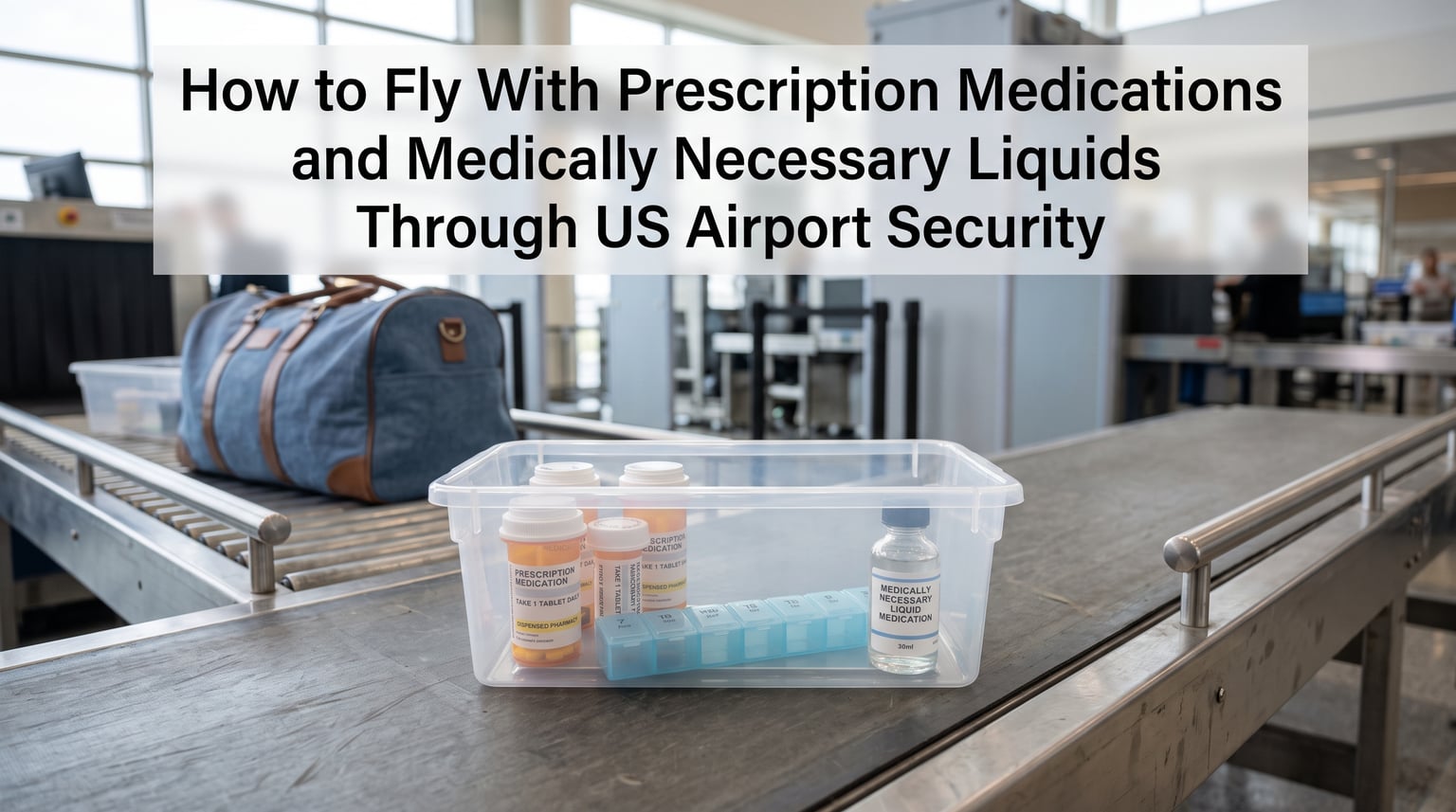
If you have ever stood in the TSA security line wondering whether your prescription liquids will get confiscated, you are not alone. Thousands of travelers every day need to fly with prescription medications and medically necessary liquids through US airport security, and the rules can feel confusing at first glance.
The good news is that TSA has built clear exemptions into its policies specifically for medically necessary items. You can bring liquid medications, gels, and aerosols in amounts exceeding the standard 3.4-ounce limit, provided you follow the right steps at the checkpoint.
In this guide, we walk you through every detail of how to fly with prescription medications and medically necessary liquids through US airport security. You will learn how to declare your medications, what documentation to carry, whether original containers matter, and what to do if a TSA officer pulls you aside.
Our team has combed through official TSA guidelines, talked to frequent travelers on forums like Reddit’s r/TravelHacks and r/tsa, and compiled real traveler experiences to give you a resource that goes beyond what a single government page can offer. By the end, you will feel confident walking through security with your medication, no matter what form it takes.
Table of Contents
TSA Medication Rules: The Complete Overview
TSA allows you to bring all forms of medication, including pills, liquids, gels, and aerosols, through airport security in both carry-on and checked baggage. You are not limited to 3.4 ounces for medically necessary liquids, but you must tell a TSA officer about them before screening begins.
This is the single most important rule to remember. The standard 3-1-1 liquids rule that restricts passengers to containers of 3.4 ounces (100 ml) inside a single quart-sized bag does not apply to medications you need for your health. TSA treats these items under a separate, more accommodating set of guidelines.
Solid medications, such as pills and capsules, can travel in any quantity in your carry-on bag without declaration. You do not need to place them in a separate bin or tell an officer about them. Liquid and gel medications in containers larger than 3.4 ounces, however, require a few extra steps.
Travelers frequently ask whether over-the-counter medications receive the same treatment as prescriptions. The answer is yes. TSA does not distinguish between prescription and non-prescription medications when applying the medically necessary liquids exemption. If you need cough syrup, liquid pain reliever, or children’s medicine in a quantity above 3.4 ounces, you can bring it through under the same rules.
The 3.4 Ounce Rule Exception for Medically Necessary Liquids
The 3.4-ounce rule exception allows you to carry medically necessary liquids, gels, and aerosols in reasonable quantities for your trip, regardless of the standard liquid limits. You must declare these items to TSA officers at the checkpoint.
This exception covers a wide range of items. Common medically necessary liquids that travelers bring through security include insulin, liquid antibiotics, cough syrup, liquid pain relievers, eye drops, contact lens solution, and topical treatments in gel or liquid form. If a medical professional has recommended or prescribed it, it qualifies.
The key phrase TSA uses is “reasonable quantities for your trip.” This means you should bring enough medication to last the duration of your travel, plus a small buffer for delays. Bringing a six-month supply for a weekend trip may raise questions, while a two-week supply for a ten-day vacation is completely reasonable.
Many travelers worry that declaring these liquids will slow them down. In practice, forum users on Reddit consistently report that the declaration process adds only a minute or two at most. One traveler on r/TravelHacks noted that they declared a large bottle of prescription cough syrup and were waved through after a quick visual inspection.
It is worth noting that gel-filled cooling packs used to keep medications like insulin at the right temperature also qualify for this exception. TSA allows frozen or partially frozen gel packs when they are needed to maintain medication temperature, but you should declare them alongside your medication.
How to Declare Medically Necessary Liquids at TSA
Declaring medically necessary liquids at TSA is a simple process that involves telling an officer about your items before they go through the X-ray machine and placing them in a separate bin. Here is the step-by-step process we recommend based on official TSA guidance and real traveler experiences.
Step 1: Keep medications accessible. Pack your liquid medications near the top of your carry-on bag or in an easily reachable compartment. You will need to remove them quickly at the checkpoint. A dedicated medication pouch works well for this purpose.
Step 2: Tell the TSA officer before screening. As you approach the X-ray conveyor belt, inform the nearest TSA officer that you have medically necessary liquids to declare. You do not need to make a big announcement. A simple statement like “I have liquid medications to declare” is all it takes.
Step 3: Place liquids in a separate bin. Remove your liquid medications from your bag and place them in their own bin for X-ray screening. Keep them separate from your quart-sized toiletry bag if you also have standard liquids. This helps the officer identify them quickly.
Step 4: Present documentation if asked. Most of the time, TSA officers will not request documentation for standard medications. However, having your prescription label, a doctor’s note, or a pharmacy printout ready can smooth the process if questions arise. Controlled substances and injectable medications are more likely to prompt a documentation check.
Step 5: Complete any additional screening. Sometimes TSA needs to perform additional screening on liquid medications, such as a vapor analysis test using a small swab. This is routine and takes only a few seconds. The officer will explain what they are doing and why.
Travelers who follow these steps report smooth, stress-free experiences at checkpoints. The most common mistake people make is failing to declare their medications, which can actually cause more delays and additional screening than being upfront about what you are carrying.
Do Pills Have to Be in Prescription Bottles for TSA?
No, pills do not have to be in original prescription bottles for TSA screening. You are allowed to carry solid medications in pill organizers, plastic bags, or any container you choose. TSA does not require prescription labels on solid pill-form medications.
This is one of the most frequently asked questions on travel forums, and the answer surprises many people. TSA officers screen all medications for security threats, but they do not verify prescriptions for standard solid pills. You can safely use a weekly pill organizer or a simple Ziploc bag for your vitamins, supplements, and prescription tablets.
However, there is an important caveat. While TSA does not require original containers, keeping your medications in their original labeled bottles is strongly recommended for several practical reasons. First, it helps you prove the medication belongs to you if questions arise. Second, original containers provide critical information about dosage and prescribing doctor if you need medical assistance while traveling.
For international travel, original containers become much more important. Customs officials in foreign countries may ask to see proof that your medications are legitimately prescribed. Some countries have strict regulations about certain medications, and unlabeled pills can create serious problems at border control.
Our practical recommendation is to use a pill organizer for convenience during your trip but carry the original labeled bottles in your luggage as backup. This gives you easy access during travel while maintaining documentation if you need it. Many experienced travelers keep their most critical medications in original containers and use organizers for daily vitamins and supplements.
If you are traveling with controlled substances, the original container recommendation becomes closer to a requirement. See our section below on controlled substances for specific guidance.
Carry-On vs Checked Baggage for Medications
Always pack essential medications in your carry-on bag, never in checked luggage. TSA and medical professionals strongly recommend this because checked bags can be delayed, lost, or exposed to extreme temperatures that may damage sensitive medications.
When your medication is in your carry-on, you maintain control over it at all times. If your checked bag gets rerouted or delayed, you could be stuck without critical medication for days. Travel insurance may reimburse the cost of replacement prescriptions, but that process takes time and may not be possible in a foreign country.
Temperature is another major concern. The cargo hold of an aircraft can experience temperature extremes during ground delays. Insulin and other temperature-sensitive medications can degrade or lose effectiveness if exposed to freezing or excessive heat. Carry-on storage keeps your medication in the climate-controlled passenger cabin.
TSA does technically allow medications in checked baggage, and solid pills in checked bags do not require declaration. But for anything you need on a regular schedule or would be in serious trouble without, carry-on is the only smart choice.
A good strategy is to carry enough medication in your carry-on for your entire trip, plus a few extra days as a buffer. If you must distribute some across bags, split your supply and keep at least a week’s worth in your carry-on. Never put one hundred percent of a critical medication in checked luggage.
Flying with Insulin, Syringes, and Medical Devices
You can fly with insulin, syringes, and medical devices in your carry-on bag, and TSA has specific procedures to accommodate these items. Insulin and other injectable medications are exempt from the 3.4-ounce liquid limit, and syringes are allowed when accompanied by the corresponding medication.
Insulin should always travel in your carry-on. The cargo hold temperature in checked baggage can freeze insulin, which destroys its effectiveness. Carry your insulin in an insulated pouch with gel cooling packs, and declare these items at the checkpoint.
If you wear an insulin pump or continuous glucose monitor, you do not need to remove it for screening. TSA allows you to go through advanced imaging technology, commonly called the body scanner, while wearing your device. If the device triggers an alarm during screening, a TSA officer will perform a gentle pat-down of the area and may swab the device for explosive trace detection.
Some travelers with insulin pumps prefer to request a pat-down instead of going through the body scanner. TSA accommodates this request, and you can simply tell the officer that you would like an alternative screening method. This is a personal choice and TSA is required to provide it.
EpiPens and similar auto-injectors are treated the same way as other medically necessary items. Keep them in their original packaging if possible and declare them. Inhalers follow the same rules and do not count against your liquid allowance.
For syringes and needles, bring documentation showing they are prescribed for your medical condition. A pharmacy label on the medication box, a prescription printout, or a doctor’s note all work well. While TSA does not always ask for this documentation, having it prevents complications if questions arise.
Traveling with Controlled Substances on a Plane
You can fly with controlled substance prescriptions, but you should take extra precautions. Keep controlled medications in their original pharmacy-labeled containers and carry a copy of your prescription to avoid complications at security.
Controlled substances include medications like certain pain relievers, anxiety medications, ADHD treatments, and sleep aids that are classified under federal scheduling. While TSA’s primary mission is transportation security rather than drug enforcement, officers can and do refer suspicious situations to law enforcement.
Original containers with intact pharmacy labels serve as proof that your controlled medications are legitimately prescribed. The label should show your name, the prescribing doctor, the medication name, and the prescription number. This documentation is particularly important if you are carrying a large supply for an extended trip.
For international travel with controlled substances, the stakes are higher. Some countries have strict laws about bringing controlled medications across their borders, and certain medications that are legal in the United States are restricted or prohibited elsewhere. Research your destination’s regulations before you travel, and carry a letter from your doctor explaining your medical need.
Forum travelers on Reddit consistently advise keeping controlled substances in carry-on luggage only. If your checked bag is lost or searched, you want to have your documentation and your medication with you at all times.
Do Airport X-Rays Affect Medications?
No, airport X-ray machines do not damage medications. The FDA has confirmed that the radiation levels used in airport security screening equipment are far too low to affect the chemical composition or effectiveness of prescription and over-the-counter medications.
This is a common concern among travelers, and it comes up frequently in travel forums. People worry that sending their expensive prescription medications through the X-ray scanner could somehow reduce their potency. The science is reassuring on this point.
TSA’s X-ray equipment operates at radiation levels designed to penetrate baggage and detect security threats without harming the contents. Drug manufacturers also test their products for stability under various conditions, and the minimal radiation from an airport scanner is negligible compared to normal environmental exposure.
If you still feel uncomfortable sending certain medications through the X-ray machine, you have the right to request a visual inspection instead. Tell the TSA officer that you would like your medication visually inspected rather than X-rayed, and they will accommodate the request. This process may take a few extra minutes and could involve opening containers for the officer to inspect.
In practice, most travelers simply send their medications through the X-ray with the rest of their belongings. The visual inspection option is available as a backup but is rarely necessary.
International Travel with Prescription Medications
International travel with prescription medications requires additional planning beyond TSA rules. Each country has its own customs regulations, and some medications that are perfectly legal in the United States are restricted or banned in other parts of the world.
Before an international trip, research your destination country’s medication regulations through their embassy website or official customs authority. Pay special attention to controlled substances, as rules vary dramatically between countries. Japan, for example, has strict limits on certain stimulant medications, and some Middle Eastern countries prohibit specific compounds entirely.
Keep all prescription medications in their original labeled containers when traveling internationally. This is not just good practice, it is often a legal requirement at border crossings. A pharmacy label with your name, the medication name, and dosage information provides immediate proof that the medication is legitimately prescribed to you.
Carry a letter from your doctor for any controlled substances or unusual medications. The letter should be on official letterhead, list your medical conditions, and specify the medications you are carrying with their generic names. If traveling to a non-English-speaking country, consider having the letter translated.
If you are connecting through Canada, CATSA (Canadian Air Transport Security Authority) follows similar rules to TSA for medications. Liquid medications in amounts over 100 ml are permitted when declared, and you should present them separately at the checkpoint. The declaration process is nearly identical to TSA procedures.
Always pack extra medication for international trips. Flight delays, missed connections, and extended stays happen. A good rule is to carry enough medication for your planned trip duration plus an additional week. If you are going to be gone for a long time, talk to your doctor and insurance provider about getting an extended supply before you leave.
TSA Cares Program: Getting Extra Help at the Airport
TSA Cares is a helpline that provides assistance to travelers with disabilities, medical conditions, and other special circumstances. You can call them before your flight to request a Passenger Support Specialist who will meet you at the airport and guide you through the security screening process.
This free service is available to anyone who needs additional help at the checkpoint, including travelers with medical devices, mobility aids, cognitive conditions, or anxiety about flying. A Passenger Support Specialist is a specially trained TSA officer who understands accommodations and can answer questions before and during screening.
To use TSA Cares, call their helpline at 1-855-787-2227 at least 72 hours before your scheduled flight. This advance notice allows TSA to coordinate a specialist for your departure airport. When you call, explain your situation and what kind of assistance you need, whether that is help with medication declaration, insulin pump screening, or general checkpoint navigation.
The TSA Cares program also provides information about what to expect at the checkpoint, which can reduce anxiety if you are traveling with medical equipment for the first time. Many travelers with complex medical needs find that a pre-trip call to TSA Cares makes their entire security experience smoother and less stressful.
Managing Medication Schedules Across Time Zones
Time zone changes can disrupt your medication schedule, so plan your dosage timing before you travel. The goal is to maintain consistent intervals between doses without dangerous gaps or overlaps as you cross into different time zones.
For short trips across one or two time zones, many travelers simply adjust gradually over the first day or two. A two-hour shift means taking your medication two hours earlier or later than usual, which is generally safe for most medications.
For longer flights with significant time changes, talk to your doctor or pharmacist about the best adjustment strategy. Some medications, particularly those with narrow therapeutic windows like certain blood thinners and anti-seizure drugs, require careful timing that your healthcare provider should oversee.
Set alarms on your phone using your home time zone for the first few days of travel. This helps you maintain your original schedule until you adjust. Once you are settled into your destination’s time zone, switch your alarms accordingly.
Carry a written medication schedule in your travel documents. If your phone dies or you lose access to your medication reminder app, a physical copy ensures you stay on track. Include the medication name, dosage, and time for each scheduled dose.
Your Medication Travel Checklist
Use this checklist before your next flight to make sure you have everything covered for TSA security screening and safe medication travel.
Before You Leave Home:
Pack all essential medications in your carry-on bag, never in checked luggage.
Carry enough medication for your trip duration plus at least seven extra days.
Keep prescription medications in original labeled containers whenever possible.
Prepare a medication list with names, dosages, and prescribing doctor information.
Get a doctor’s letter for controlled substances and international travel.
Research your destination’s medication regulations if traveling internationally.
Call TSA Cares at 1-855-787-2227 at least 72 hours before your flight if you need special assistance.
At the Security Checkpoint:
Keep liquid medications easily accessible in your carry-on.
Tell the TSA officer you have medically necessary liquids to declare before screening.
Place liquid medications in a separate bin for X-ray screening.
Present prescription documentation if requested.
Keep gel cooling packs with your temperature-sensitive medications.
Request a visual inspection instead of X-ray if you prefer, though it is rarely necessary.
During Your Trip:
Set medication alarms adjusted for your new time zone.
Store medications at appropriate temperatures using insulated pouches if needed.
Keep your medication list and emergency contact information with you.
Know the location of pharmacies at your destination for refills if necessary.
What to Do If TSA Stops You for Additional Screening
If TSA stops you for additional medication screening, stay calm and cooperate fully. Additional screening for medically necessary liquids is routine and does not mean you have done anything wrong. The process usually takes only a few minutes.
A TSA officer may need to perform a swab test on your liquid medication container. This test checks for explosive residue and is completely harmless to your medication. The officer will hold a small cloth against the container and place it in a detection device. Your medication is not opened or altered during this process.
Sometimes a TSA officer will ask questions about your medication, such as what it is for or who prescribed it. Answer honestly and briefly. If you have documentation, present it. You are not required to disclose detailed medical information, but providing the name of the medication and confirming it is prescribed to you is usually sufficient.
In rare cases, TSA may need to consult with a supervisor or perform a more detailed inspection. This can happen with unusual liquid medications, large quantities, or items that trigger the X-ray machine’s alert system. If this happens, remain patient and follow the officer’s instructions. You can request a private screening area if the inspection involves sensitive personal items.
If you feel your rights are being violated during the screening process, you can ask to speak with a TSA supervisor. You also have the option to file a complaint with the TSA Contact Center after your travel is complete. However, the vast majority of medication screenings proceed without incident when travelers declare their items properly and carry basic documentation.
Forum travelers on Reddit consistently report that declaring medications proactively and having documentation ready makes the entire process painless. One traveler noted that their insulin supplies triggered an additional swab test but the officer was professional, quick, and respectful throughout.
FAQs
Is it okay to have a Ziploc bag of medicine and pills when flying?
Yes, you can carry pills in a Ziploc bag when flying. TSA does not require solid medications to be in original prescription bottles, so pill organizers and plastic bags are perfectly acceptable for security screening. However, keeping original labeled bottles in your luggage as backup is recommended, especially for international travel.
How to declare medically necessary liquids TSA?
Tell a TSA officer that you have medically necessary liquids before screening begins, then place the liquids in a separate bin for X-ray inspection. Remove the items from your carry-on bag so they are visible and easy to inspect. Present prescription labels or a doctor’s note if the officer asks for documentation. The entire process typically adds only a minute or two to your screening time.
Do pills have to be in prescription bottles for TSA?
No, pills do not need to be in prescription bottles for TSA. You can use pill organizers, plastic bags, or any container for solid medications without declaring them. Original labeled bottles are recommended for practical reasons like proving ownership and traveling internationally, but they are not a TSA requirement for domestic flights.
Can I mix pills in the same container when flying?
Yes, you can mix different pills in the same container when flying. TSA allows pills in any arrangement, including combined in pill organizers with multiple compartments. For safety and organization, many travelers prefer to keep prescription medications separated by type, but TSA does not require pills to be individually sorted or labeled for domestic flights.
Fly with Confidence: Your Medications and TSA
Flying with prescription medications and medically necessary liquids through US airport security is straightforward once you know the rules. The key steps are packing medications in your carry-on, declaring liquid medications before screening, and carrying documentation for controlled substances and international travel.
TSA has designed its policies to accommodate medical needs, not to create obstacles. The 3.4-ounce rule does not apply to your medications, pill organizers are welcome, and additional screening for liquids is quick and routine. Understanding how to fly with prescription medications and medically necessary liquids through US airport security gives you the confidence to travel without anxiety about your health needs at the checkpoint.
Remember that TSA Cares is available if you need extra help, and your doctor’s office is the best resource for medication scheduling across time zones. With a little preparation and the right documentation, your medication will move through security as smoothly as you do.