
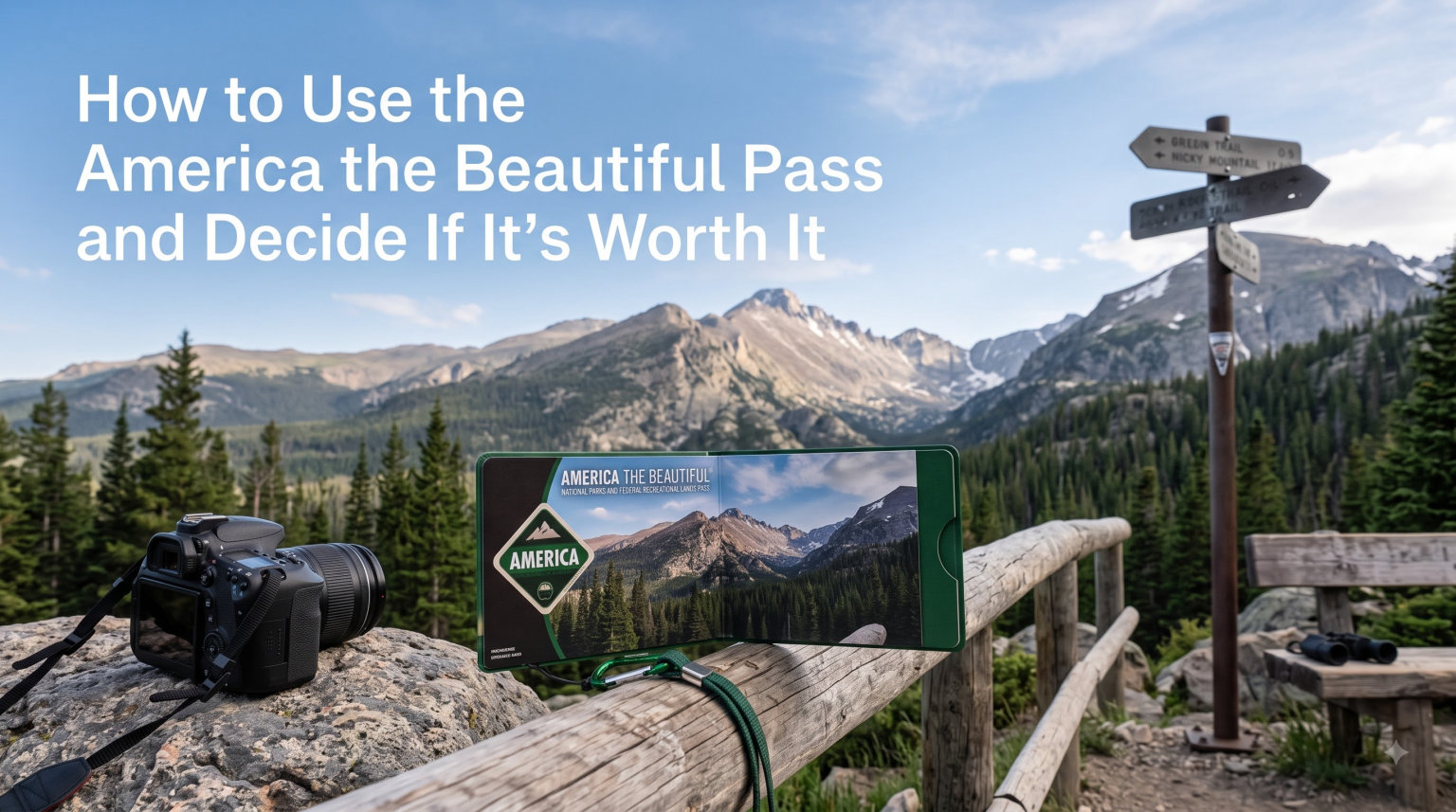
If you’ve ever stood at a national park entrance wondering whether to pay the per-vehicle fee or shell out for an annual pass, this guide is for you. The America the Beautiful Pass is the single best deal in US outdoor recreation, but only if your travel plans actually match what it covers.
I’ve used this pass on three cross-country road trips over the last few years, and I’ll walk you through exactly what it does, what it doesn’t do, who should buy one, and how to decide if it’s worth it for your situation. By the end, you’ll know whether this pass will save you money or whether you’re better off paying entry fees one park at a time.
Here’s the short version: the America the Beautiful Pass covers entrance and standard amenity fees at more than 2,000 federal recreation sites for one year from purchase. For most travelers planning to visit two or more national parks in a 12-month window, the pass pays for itself. For everyone else, the math gets a little more interesting.
Table of Contents
What Is the America the Beautiful Pass?
The America the Beautiful Pass, officially called the National Parks and Federal Recreational Lands Pass, is an annual entrance pass sold by the US Geological Survey (USGS). It replaced the old “National Parks Pass” and several other interagency passes when it launched in 2026.
The pass is administered jointly by five federal agencies: the National Park Service, US Fish and Wildlife Service, US Forest Service, Bureau of Land Management, and Bureau of Reclamation. Because these five agencies share fee revenue and recognition, your single pass works at sites run by any of them.
Think of it as a unified admission ticket to America’s federal backyard. When you pull up to a national park gate, a wildlife refuge, or a national forest recreation area that charges an entrance fee, you show your pass along with a photo ID and you’re in. No fumbling with cash, no surprises.
The pass is non-transferable. That detail matters more than you might think, and I’ll come back to it later.
The Five Federal Agencies Behind the Pass
The National Park Service manages 63 major national parks (think Yellowstone, Yosemite, Grand Canyon) plus hundreds of national monuments, seashores, and historic sites.
US Fish and Wildlife Service runs national wildlife refuges, where you might paddle a kayak through wetlands or photograph migratory birds.
US Forest Service oversees 154 national forests and 20 grasslands, covering 193 million acres of land. Some of these charge day-use fees at developed recreation areas.
The Bureau of Land Management manages 245 million acres, primarily in the West, and runs many recreation sites with fee requirements.
The Bureau of Reclamation operates facilities around major reservoirs and dams in the Western US.
America the Beautiful Pass Types and Current Pricing
There are actually several pass options under the America the Beautiful umbrella, and the one you choose depends on your residency status, age, and military service. Here’s what each one costs and who qualifies.
Annual Pass ($80 for US Residents)
This is the workhorse option. At $80, the annual pass is available to US citizens, permanent residents, and anyone else considered a US resident for tax purposes. It covers an entire vehicle (or up to four adults at per-person sites) for 12 months from the month of purchase.
Annual Pass ($250 for Non-Residents)
Starting in 2026, the non-resident annual pass jumped from $80 to $250. This change, announced in late 2026, targets international visitors who previously paid the same rate as US residents despite not contributing to the federal tax base that supports park maintenance.
If you’re visiting from outside the US and plan to see multiple parks, the math is still attractive compared to paying $30 to $35 per vehicle at major parks. But it’s a significant bump from what non-residents used to pay.
Senior Pass ($20 Annual or $80 Lifetime)
US citizens or permanent residents aged 62 or older qualify for the Senior Pass. The lifetime version, available for $80 (or $20 for US military veterans and Gold Star families), is one of the best bargains in federal recreation. Once you have the lifetime pass, it’s yours forever.
Access Pass (Free for Disability)
US citizens or permanent residents with a permanent disability can get the Access Pass at no cost. It provides the same benefits as the annual pass and is accepted at all federal recreation sites that charge entrance or standard amenity fees.
Military Pass (Free for Current Military and Veterans)
Current US military members and veterans, plus dependents of current military, can obtain a free Military Pass (sometimes called the Annual Military Pass or the Veterans Lifetime Pass). The veterans version became free in 2026 and remains valid for the passholder’s lifetime.
Volunteer Pass ($80 Annual)
If you log 250 volunteer hours with a federal agency, you can earn a Volunteer Pass valid for 12 months from the date of issue. This is one of the least-known pass types.
Here’s a quick comparison of the main pass types:
| Pass Type | Price | Eligibility | Validity |
|---|---|---|---|
| Annual Pass (US Resident) | $80 | US citizens and permanent residents | 12 months |
| Annual Pass (Non-Resident) | $250 | International visitors | 12 months |
| Senior Annual Pass | $20 | Age 62+, US citizens/residents | 12 months |
| Senior Lifetime Pass | $80 | Age 62+, US citizens/residents | Lifetime |
| Access Pass | Free | Permanent disability, US citizens/residents | Lifetime |
| Military Pass | Free | Current military, veterans, dependents | Annual or Lifetime |
What the Pass Covers (and What It Doesn’t)
The America the Beautiful Pass covers entrance fees and standard amenity fees at federal recreation sites. It does not cover everything you’ll spend money on at a national park, and this is where many first-time buyers get confused.
What the Pass Covers
The pass covers the basic entry fee at more than 2,000 federal recreation sites. If a site charges a per-vehicle entrance fee (typically $20 to $35), the pass gets your whole car in. If it charges a per-person fee (typically $10 to $15), the pass covers up to four adults.
At sites that charge standard amenity fees for things like swimming beaches, boat launches, or picnic areas, the pass covers those too.
What the Pass Does NOT Cover
This is the part you really want to read. The pass does not cover:
State parks. State parks are run by individual states, not the federal government, so the America the Beautiful Pass does not apply. If you’re planning a state park road trip, you’ll need separate state park passes or daily fees.
Camping fees. Developed campground fees, even at national parks, are separate from entrance fees. The pass does not waive camping charges, though it may get you a discount at some sites.
Concessionaire-operated activities. Guided tours, shuttle buses run by private companies, equipment rentals, and similar activities operated by concessionaires are not covered.
Special recreation permit fees. If you’re applying for a special use permit, the pass does not apply.
Parking within parks. Many national parks charge separate parking fees, and the pass does not always cover these. Always check the specific park’s fee page before you go.
Lodging. Inside-park lodges, cabins, and other accommodations are not covered.
The $100 Non-Resident Surcharge at 11 Parks
One of the most confusing elements of the pass for international travelers is the mandatory $100 surcharge at 11 specific parks. These parks include Yellowstone, Grand Canyon, Yosemite, Acadia, Mount Rainier, Olympic, Rocky Mountain, Glacier, Sequoia & Kings Canyon, Joshua Tree, and Shenandoah.
Even with the non-resident annual pass, visitors from outside the US must pay this surcharge once per park, per visit. So if you’re a German tourist visiting Yellowstone, you still pay $100 on top of the pass for that single park visit. The fee funds park infrastructure improvements.
How to Buy and Activate Your Pass
Buying the pass is straightforward, and you have three main options: in person, online, or through the official USGS store. Here’s how each method works.
Buying In Person at a Park
The most common way to get the pass is at a national park entrance station. Simply pull up to the gate, tell the ranger you’d like an annual pass, pay the fee, and they’ll hand you the pass on the spot. You can use it immediately for that same park.
This is what I did on my first trip. I rolled up to a national forest ranger station on a Monday morning, paid $80 cash, and walked out with a pass that I used at six more sites that year.
Buying Online Through the USGS Store
The USGS operates the official online store at usgs.gov. You can order the annual pass, senior pass, and access pass through this site. The physical pass is mailed to you, which typically takes two to three weeks.
This is the most reliable option for non-US residents, since some international mail forwarding can complicate things.
Buying Through Recreation.gov
Recreation.gov sells digital versions of the America the Beautiful Pass for US residents. You can print a temporary pass immediately and receive the physical pass by mail later. Digital passes are accepted at most federal recreation sites, though a few older entry stations may still require the physical card.
Where You Can Also Buy the Pass
The pass is sold at more than 1,000 federal recreation sites across the country, including many national park visitor centers, national forest offices, and BLM field offices. Some REI stores also sell them, though selection varies by location.
The pass activates the moment you buy it. If you buy in person, your 12-month clock starts that day. If you buy online, the pass is typically valid for 12 months from the date the USGS mails it, though you can request a specific activation date.
How to Use the Pass at National Parks
Using the pass is simple once you understand the rules. Here’s the process step by step.
Step 1: Keep the Pass With You
The pass must be in your possession when you enter a site that charges an entrance fee. Most visitors keep it in their glove compartment or center console for easy access.
Many experienced travelers also keep a photo of the pass on their phone as a backup in case the physical card is lost or stolen.
Step 2: Show the Pass Plus Photo ID
At the entrance station, present your pass along with a valid photo ID (driver’s license, passport, or similar). The ranger will verify that the pass matches your ID, since the pass is non-transferable.
Step 3: Confirm Whether You Need a Reservation
This is where many visitors get tripped up. Starting in 2026, more than a dozen national parks require timed entry reservations during peak season, even for pass holders. The pass covers your entrance fee, but it does not replace reservation requirements.
Parks that currently require timed entry include Yosemite, Arches, Glacier, Rocky Mountain, Acadia, Haleakalā, and several others. Reservations open on Recreation.gov, typically 1-3 months in advance, and some are released in rolling windows.
If you show up without a reservation during peak season, you’ll be turned away regardless of whether you have a pass.
Step 4: Understand Per-Vehicle vs Per-Person Sites
Most national parks charge per-vehicle fees, and your pass covers everyone in your car. Some smaller sites charge per-person fees (typically $10-$15 per adult), and the pass covers up to four adults at those sites.
If you have more than four adults in your group, you’ll need to pay the per-person fee for additional people. Children under 16 are usually free.
Is the America the Beautiful Pass Worth It?
This is the question everyone asks, and the honest answer is “it depends on your plans.” Let me walk you through the math so you can decide for yourself.
The Break-Even Calculation
Let’s do the math for a US resident. At $80 for the annual pass, you break even when your entrance fees would have exceeded $80.
A typical national park entrance fee is $30 per vehicle. So if you visit three parks charging $30 each, you’ve paid $90 in fees, which already exceeds the pass price. After three parks, the pass saves you money on every additional visit.
If you’re visiting parks that charge $35 (like Yellowstone or Yosemite), you break even after just over two visits.
For non-residents at $250, the math looks different. You’d need to visit parks totaling more than $250 in entrance fees to break even, which usually means 4-5 major parks, depending on which ones.
When the Pass Is Definitely Worth It
The pass is clearly worth it if you’re planning:
A multi-park road trip. If you’re doing a Southwest road trip that hits Zion, Bryce, Grand Canyon, and Arches, you’ll spend more than $120 on entrance fees alone. The pass saves you $40 and lets you add more parks without extra cost.
A return visit within 12 months. If you visit one park this fall and plan to revisit in spring, the pass covers both visits.
Multiple family members. Per-vehicle fees cover everyone in your car, so the savings scale up with each passenger. A family of four visiting three parks pays $120 in fees versus $80 for the pass.
Multiple short trips. Even if you only visit one park per weekend, four park visits in a year means you’ve broken even.
When the Pass Might Not Be Worth It
The pass might not make sense if you’re:
Visiting just one park. If your only park visit for the year is a single trip to one location, you’re better off paying the entrance fee.
Sticking to free parks. Many national parks don’t charge entrance fees at all (like Great Smoky Mountains, which is free year-round). If you only visit free parks, the pass doesn’t save you anything.
Visiting only state parks. State parks require separate passes, so the federal pass won’t help.
A non-resident on a short trip. If you’re visiting from abroad and only plan to see 1-2 parks, the $250 non-resident pass plus the $100 surcharge at major parks might cost more than just paying entry fees directly.
Who Benefits Most From the Pass
Based on forum discussions and my own conversations with other travelers, certain types of visitors get the most value from the pass.
RV travelers absolutely benefit. If you’re driving an RV across the country for months at a time, you’ll likely hit dozens of fee-charging sites. The pass pays for itself within the first week or two of travel.
Photographers and outdoor enthusiasts who make frequent trips to public lands benefit significantly. Many BLM and Forest Service sites charge modest day-use fees that add up quickly.
Families on summer road trips benefit because per-vehicle fees cover everyone in the car. A family of five visiting four parks in summer has saved at least $40 over paying individual fees.
Retirees with the lifetime senior pass get the best long-term value. At $80, the lifetime pass pays for itself in three park visits and then continues to provide value for decades.
International travelers on extended visits benefit from the non-resident pass, especially if they’re planning a multi-park itinerary spanning several weeks or months.
Tips for Maximizing Your Pass Value
Once you have the pass, a few strategies can help you squeeze even more value from it.
Plan a Multi-Park Road Trip
The most obvious way to maximize value is to plan a trip that hits several fee-charging parks. The Southwest, the Rocky Mountains, and California each offer clusters of major parks within driving distance.
Don’t Forget About Lesser-Known Sites
The pass isn’t just for headline national parks. It works at national monuments, wildlife refuges, recreation areas, and historic sites that many travelers overlook. Sites like Joshua Tree (technically a national park), Great Basin National Park, and Black Canyon of the Gunnison charge modest fees that the pass covers.
Use It for Local Recreation Areas
Many national forest campgrounds and BLM sites charge day-use fees. The pass covers these too, so even local weekend trips add up.
Pair It With the NPS App
The official NPS app includes an interactive map of all federal recreation sites, fee information, and timed entry reservation links. Pairing the app with your pass makes trip planning much easier.
Time Your Purchase Strategically
If you know you’ll be doing most of your travel in summer, buy the pass in early spring. The 12-month clock starts at purchase, so buying in April gives you coverage through the following April, covering two summer seasons.
Take Advantage of Free Entrance Days (When You Don’t Use the Pass)
The NPS designates several free entrance days each year, including Martin Luther King Jr. Day, the first day of National Park Week, Juneteenth, and Veterans Day. If your visit falls on these days, you don’t need the pass for that visit. Save the pass for paid days.
Common Misconceptions and Mistakes to Avoid
Let me clear up some confusion I’ve seen in forums and online discussions.
“The Pass Covers State Parks”
This is wrong. State parks are managed by state governments and require separate passes or fees. If you’re planning a state park-heavy trip, the federal pass won’t help.
“I Can Share My Pass With Family”
The pass is non-transferable, but it can be used by anyone in the vehicle when the passholder is present. So your spouse can use the pass if they’re with you, but you can’t hand it to a friend to use while you’re elsewhere.
“The Pass Replaces Timed Entry Reservations”
Wrong. The pass covers entrance fees, but timed entry reservation systems are separate. You’ll still need to reserve entry at parks that require it.
“I’ll Just Leave the Pass in My Car”
You can leave the physical pass in your vehicle, but many travelers worry about theft. The pass is non-replaceable if lost (you’d need to buy a new one), so keeping a photo backup on your phone is a smart practice.
“The Pass Includes Camping”
It does not. Camping fees at federal recreation sites are separate from entrance fees, and the pass does not waive them.
“International Visitors Pay the Same as US Residents”
Since 2026, non-residents pay $250 for the annual pass, which is more than three times the US resident price.
FAQs
Is it worth getting an America the Beautiful Pass?
The pass is worth it if you plan to visit three or more federal recreation sites charging entrance fees within 12 months. At $80 for US residents, the pass pays for itself after two to three typical national park visits ($30 per vehicle on average). For non-residents at $250, you need four to five major park visits to break even, depending on which parks you visit.
What does an America the Beautiful Pass get you?
The pass grants unlimited entry for 12 months to more than 2,000 federal recreation sites, including all national parks, national monuments, wildlife refuges, and national forests that charge entrance or standard amenity fees. It covers per-vehicle fees for everyone in your car or up to four adults at per-person sites.
Can I use my wife’s America the Beautiful Pass?
Only if she is in the vehicle with you. The pass is non-transferable and must be presented along with the passholder’s photo ID. However, anyone in the vehicle can use the pass when the passholder is present, so spouses and family members riding together can share the benefit.
Is America the Beautiful Pass good for the whole car?
Yes. At parks and sites that charge per-vehicle entrance fees, the pass covers your entire vehicle, regardless of how many passengers are inside. At sites that charge per-person fees, the pass covers up to four adults.
Where can I buy the America the Beautiful Pass?
You can buy the pass in person at any federal recreation site that charges entrance fees, including national park entrance stations, visitor centers, and national forest offices. Online purchases are available through the USGS store at usgs.gov, and digital versions are sold through Recreation.gov.
Does the America the Beautiful Pass cover state parks?
No. State parks are managed by individual state governments, not federal agencies, so the America the Beautiful Pass does not apply. You’ll need separate state park passes or pay daily fees at state parks.
Final Thoughts on the America the Beautiful Pass
The America the Beautiful Pass is one of the best deals in outdoor recreation, period. For US residents at $80, it’s hard to argue against buying one if you’re planning even two or three national park visits in a year. For non-residents at $250, the math still works for multi-park itineraries, especially longer road trips.
If you’re planning a 2026 road trip with multiple national parks or federal recreation sites on your list, grab the pass. Buy it at your first park entrance, keep it in your car, and let it pay for itself over the next 12 months. If you’re sticking to one or two parks or only visiting state parks, save your money and pay entry fees directly.
Either way, understanding how to use the America the Beautiful Pass makes every federal recreation site visit a little easier. And that means more time enjoying the outdoors and less time fumbling with cash at the entrance station.