
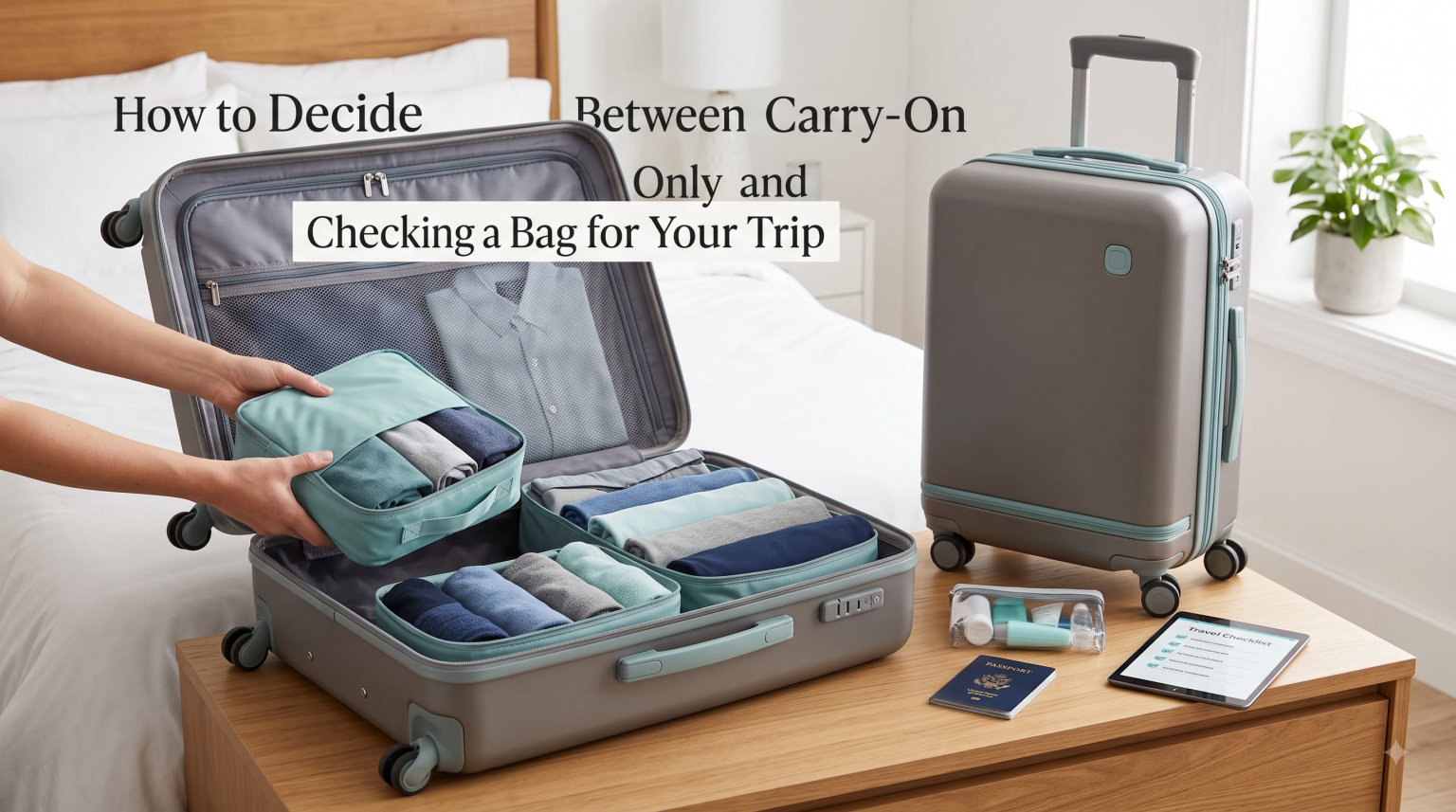
I have been the person standing at the check-in counter watching the scale tick over to 8.2 kg and realizing my “small” backpack was about to cost me extra. I have also been the person breezing through arrivals with a backpack on my shoulders, skipping the baggage carousel entirely. Both trips taught me something useful about the carry-on vs checked bag question.
This guide is built from those trips, plus dozens of conversations with Indonesian travelers heading to Bali, Tokyo, Seoul, and beyond. You will get a clear way to decide between carry-on only and checking a bag for your next trip, with sizes, weights, fees, and rules that actually match what airlines in Southeast Asia enforce in 2026.
By the end, you will know exactly when carry-on only makes sense, when a checked bag saves you money and stress, and how to make the call in under a minute for any trip on your calendar.
Table of Contents
What Is a Carry-On Bag and What Is a Checked Bag
The carry-on vs checked bag confusion almost always starts with the words themselves. They sound similar. They go on the same flight. But once you board, they end up in completely different places.
Carry-On Bag Definition and Where It Goes
A carry-on bag (also called hand luggage, cabin baggage, or in Indonesian, bagasi kabin) is a piece of luggage you keep with you in the passenger cabin. It travels in the overhead compartment above your seat or, if it is small enough, under the seat in front of you.
You take it through the security checkpoint yourself. You lift it into the bin yourself. You bring it down when you land. The airline does not touch it between the gate and your destination.
Most airlines treat carry-on as one main bag plus one smaller “personal item” such as a laptop bag, a small backpack, or a handbag.
Checked Bag Definition and Where It Goes
A checked bag (also called checked baggage, hold luggage, or in Indonesian, bagasi tercatat) is luggage you hand over to the airline at the check-in counter. The airline tags it, puts it on a conveyor belt, and stores it in the cargo hold underneath the passenger cabin.
You do not see it again until you reach baggage claim at your destination. Ground crews handle it. Conveyor belts and sorting systems move it. A baggage tag on your boarding pass ties it to your name.
The key difference is control. With a carry-on, you control your bag every minute. With a checked bag, the airline controls it for most of the journey.
Size and Weight Limits: Indonesian Airline Rules
Numbers matter more than opinions in the carry-on vs checked bag debate. If your bag does not fit the frame at the gate, it gets checked, sometimes for a fee higher than if you had paid in advance.
Carry-On Size and Weight Standards
Across most major Indonesian carriers, the carry-on standard hovers around 56 x 36 x 23 cm with a maximum weight of 7 kg. Garuda Indonesia, Batik Air, and Citilink all publish very similar numbers. AirAsia Indonesia uses the same 7 kg ceiling but allows a slightly smaller linear dimension.
International flights on the same carriers usually allow the same dimensions, though some long-haul Garuda business class tickets raise the weight limit to 10 kg.
The personal item limit is looser. A laptop bag, a small daypack, or a handbag under about 40 x 30 x 10 cm is almost always accepted, as long as it fits under the seat in front of you.
Checked Bag Allowance for Major Airlines
Checked bags follow a different rule. Size and weight both matter, and they trigger fees fast if you go over.
Here is how the major Indonesian airlines set their checked baggage allowance:
Garuda Indonesia economy: 23 kg free on most domestic routes, 30 kg on international routes in standard economy.
Batik Air economy: 20 kg free on domestic routes, often 30 kg on regional international flights.
Lion Air economy: 20 kg free domestic, weight and size depend on fare class.
AirAsia Indonesia: No free checked bag on most fares; you buy 20 kg or 32 kg bundles at booking or after.
Citilink: 20 kg free on most domestic economy fares.
Linear dimensions for checked bags typically cap at 158 cm (length plus width plus height combined). Heavier bags are allowed on most airlines up to 32 kg, but anything over 32 kg gets refused at the counter and must be shipped as cargo.
Benefits of Flying With Carry-On Only
When I started traveling with just a backpack, I did not expect the savings to be mostly about time, not money. Here is what carry-on only actually buys you.
You skip the baggage carousel. After a long flight, that 15 to 40 minute wait at baggage claim disappears. For short connections, that alone can be the difference between making your flight and missing it.
You avoid checked bag fees. Budget carriers in Southeast Asia charge extra for checked bags, often more than the seat itself. Carrying on saves money on every flight that does not include a free checked allowance.
You keep valuables with you. Passports, laptops, medication, jewelry, and fragile items stay in your sight. They do not get lost, mishandled, or opened by curious hands.
You move faster through the airport. No counter line for bag drop. No waiting at the carousel. No dragging a heavy suitcase through a crowded terminal.
You avoid the risk of lost luggage. Airline industry data shows roughly 6 to 8 bags per 1,000 passengers get mishandled. Carry-on bags, by definition, cannot be lost in transit.
You can change plans more easily. A short delay, a missed connection, a switch to a different flight at the last minute. All easier when your bag is on your back.
Drawbacks of Carry-On Only Travel
Carry-on only is not always the right answer. The limitations show up quickly on longer trips.
You have strict weight and size limits. The 7 kg ceiling on most Indonesian carriers is tight. If you try to pack for two weeks, you will feel every gram.
Liquid restrictions limit what you can bring. Anything liquid, gel, or cream must be 100 ml or less and fit in a single 1 liter clear bag. Full-size toiletries have to go in a checked bag or stay home.
You may be forced to gate-check. On full flights, gate agents often ask passengers to check their carry-on bags for free. You lose time at the gate and risk damage from the last-minute handling.
Overweight bags get flagged. Indonesian ground crews are strict about carry-on weight, especially Batik Air. If your bag is over 7 kg at check-in, you will be asked to repack or pay an overweight fee on the spot.
You carry everything through the airport. No carts, no porters, no wheels on the escalator. For travelers with back, knee, or mobility issues, that is a real cost.
You have less room for souvenirs and shopping. A weekend in Bangkok or a week in Tokyo adds up. Carry-on only works best if you are disciplined about what you buy.
Benefits of Checking a Bag
There is a reason seasoned long-haul travelers still check bags. The extra space changes the whole trip.
You can pack more without stress. Two weeks of clothes, two pairs of shoes, gifts for family back home, and full-size toiletries. None of it has to fit inside a 7 kg box.
You move freely through the airport. Once you drop your bag at the counter, you only have a small personal item to manage. The long walk to the gate feels lighter.
You can bring items that are not allowed in cabin. Sharp objects, large batteries, full-size liquids, even some sporting gear all have to go in checked luggage.
You avoid gate-checking surprises. Your bag is tagged at the counter, not pulled from your hand at the gate. You board faster and walk off the plane knowing your suitcase is already in the system.
You can split duties. One traveler handles the carry-on essentials, the other manages the checked suitcase. For families and business trips, this division saves effort.
You protect fragile items better. Counter agents tend to load checked bags more carefully than bags thrown into a cargo hold at the last minute. A well-packed suitcase with bubble wrap around glassware or ceramics often arrives in better shape than expected.
Drawbacks of Checking a Bag
Even with all those benefits, checked bags come with real costs and risks.
Fees add up quickly. Budget carriers like AirAsia and Lion Air charge per kilogram for checked bags. A 20 kg bag can cost as much as a low-cost ticket on a short regional flight.
You wait at the carousel. Baggage claim can add 15 to 45 minutes to your arrival time, longer if multiple wide-body flights land at once.
You risk lost or delayed bags. Mishandled baggage rates jump on connecting flights and on routes with tight transfers. Airlines worldwide lose millions of bags every year.
You risk damage. Conveyor belts, rough handling, and overstuffed cargo holds lead to cracked wheels, broken zippers, and torn fabric. Airline liability for damage is limited and slow to pay out.
You lose immediate access to essentials. If your bag is delayed or lost, you have no change of clothes, no medication, no chargers. That risk matters more on short trips where one missing item can derail the day.
You face stricter liquid rules in reverse. You cannot bring liquids over 100 ml in your carry-on, but you can in checked bags. However, that means you cannot use your shampoo, lotion, or toothpaste during the flight or right after landing.
When to Choose Carry-On Only
Carry-on only works best when your trip is short, your gear is light, and your schedule is tight. If the conditions below match your trip, leave the big suitcase at home.
You are traveling for 1 to 5 days. Anything shorter than a week fits in a 30 to 40 liter backpack with careful packing.
You fly budget carriers on regional routes. AirAsia, Lion Air, and Citilink all charge for checked bags. Saving that fee on a short hop pays for a meal at your destination.
You have a tight connection or short layover. Carry-on only removes the risk of your bag missing the connection and lets you sprint to the next gate if needed.
You carry valuables or work gear. Laptops, cameras, medication, business samples, or important documents stay in your sight the entire time.
You stay in one place and do not move around much. A beach resort, a city hotel, a family home. If you are not hopping between cities, you do not need to roll a big bag.
You travel light by habit or philosophy. If you already know how to pack a capsule wardrobe and wash clothes in the sink, carry-on only is easy.
You use a personal item plus a backpack. Most airlines allow this combination for free. You can fit a week’s worth of clothing in a 25 liter daypack if you roll everything tight.
When to Check a Bag Instead
There are clear situations where checking a bag is the smarter call, even if it costs more.
You are traveling for 6 days or more. The math breaks down around day six. You either wear the same clothes repeatedly or you check a bag.
You are flying long-haul. International flights to Europe, the Middle States, or South America often include free checked bags on full-service carriers. Use the allowance.
You are bringing back items. A trip to Korea for cosmetics, a Tokyo run for electronics, or a Bangkok shopping trip all need the extra space on the way home.
You travel with family and need to share items. Kids’ clothes, shared snacks, gifts, and shared toiletries. A single checked bag handles what would otherwise be five carry-ons.
You carry specialized gear. Ski boots, dive gear, musical instruments, professional camera kits, sports equipment. These often cannot fly in the cabin and need checked baggage.
You have medical or mobility needs. Extra medication, mobility aids, or bulky medical equipment can require a checked bag for backup and overflow.
You want to relax at the airport. Sometimes paying for a checked bag is worth not having to think about weight, liquids, or gate checks.
You are moving or relocating. Temporary moves, study abroad, long work assignments, or relocations almost always require a checked bag or two.
How to Avoid Having Your Carry-On Checked at the Gate
Gate-checking happens when flights are full or bags are too big. You can lower the chance it happens to you.
Pick a bag that matches the airline’s published dimensions. Do not buy a “carry-on” that is one centimeter over. Gate agents measure, and they will pull it.
Weigh your bag at home. A small luggage scale costs less than an overweight fee. Stay under 7 kg on Indonesian carriers and you will almost never get flagged.
Board early if your airline offers it. Overhead bins fill up fast. Early boarders get bin space. Late boarders get gate checks.
Use a soft-sided bag if you can. Soft bags can be squeezed into tight bins. Hard shells cannot. A backpack is even better, since it counts as your personal item on most airlines.
Wear your bulkiest items. Jackets, boots, hats, and sweaters take up the most space. Wear them through security and onto the plane.
Pay for priority boarding. On low-cost carriers, priority boarding usually includes overhead bin access. That alone keeps your bag with you.
Pack liquids in 100 ml containers in a 1 liter clear zip bag. Security will pull your bag if you break this rule, and that delay can push you into a gate-check situation later.
Lost Baggage: How to Reduce the Risk
Even the best travelers lose bags sometimes. You cannot remove the risk, but you can shrink it.
Fly direct whenever possible. Most lost bags happen during connections. A nonstop flight is the single biggest protection against lost luggage.
Put a tracker inside your bag. An AirTag or similar Bluetooth tracker hides in your suitcase. You can see your bag’s location in real time and prove it to the airline if it goes missing.
Take a photo of your bag before you check it. Airline counters see hundreds of black suitcases a day. A photo with a colored ribbon, strap, or sticker makes your bag easier to find and harder to grab by mistake.
Keep essentials in your carry-on. Change of clothes, medication, phone charger, basic toiletries. If your checked bag is delayed for 24 hours, you can still function.
Tag your bag inside and out. A luggage tag on the outside helps the airline return it. A paper with your name and phone number inside helps if the outside tag rips off.
Arrive at baggage claim quickly. The longer you wait, the more chances for someone else to grab your bag by mistake or for it to be pulled aside by security.
File a report immediately if your bag is missing. Most airlines require a lost baggage report within 24 hours. The sooner you file, the better your chance of recovery.
A Quick Decision Checklist
Use this 30-second checklist before you book or pack. If you answer yes to most of these, go carry-on only. If you answer no, check a bag.
Is your trip 5 days or shorter?
Are you flying a budget carrier?
Do you have a tight connection or layover?
Can you fit your needs in 7 kg?
Do you want to skip the baggage carousel?
Are you carrying valuables, work gear, or medication?
If most answers are yes, carry-on only is your best choice. If most are no, or if you have a 10-day beach vacation with a family of four, check a bag and save yourself the headache.
FAQs
When should I check a bag versus carry-on?
Check a bag for trips longer than 5 days, flights with free checked allowance, family travel, shopping-heavy destinations, or when you carry specialized gear. Choose carry-on for short trips, budget carriers, tight connections, or trips with valuables.
Can I take a carry-on instead of a checked bag?
Yes, you can take a carry-on instead of a checked bag on almost every flight. Just make sure your bag meets the airline size and weight limits (usually 56 x 36 x 23 cm and 7 kg on Indonesian carriers) and fits in the overhead bin or under the seat.
How do I avoid having my carry-on checked at the gate?
Pick a bag that matches the airline’s published dimensions, weigh it at home to stay under 7 kg, board early or pay for priority, use a soft-sided bag or backpack, and wear your bulkiest clothing. Liquids must be in 100 ml containers inside a 1 liter clear zip bag.
What happens if my carry-on bag weighs more than 7 kg?
On most Indonesian airlines like Garuda, Batik Air, and Citilink, an overweight carry-on gets flagged at check-in. You will be asked to repack into a smaller bag, pay an overweight fee on the spot, or surrender the bag to be checked at the counter. Some carriers charge per kilogram over the limit.
What is the difference between carry-on and personal item?
A carry-on is your main bag that goes in the overhead bin and must meet the airline’s size and weight limits (typically 56 x 36 x 23 cm and 7 kg). A personal item is a smaller bag like a laptop bag, handbag, or small backpack that fits under the seat in front of you. Most airlines let you bring one of each for free.
Is it cheaper to carry on or check a bag?
Carry-on is usually cheaper on budget carriers that charge per kilogram for checked bags. AirAsia, Lion Air, and Citilink can charge significant fees for a 20 kg checked bag. On full-service carriers like Garuda Indonesia, a free checked bag is often included, so checking costs nothing extra.
The Final Word on Carry-On vs Checked Bag
The carry-on vs checked bag decision is not about which is better in general. It is about which is better for this trip, this airline, this length of stay, and this set of bags.
Use the checklist above the next time you open a travel booking page. If your trip is short, your bags are light, and your schedule is tight, carry-on only will save you time and money. If your trip is long, your bags are heavy, or your airline includes a free checked allowance, save yourself the stress and check a bag.
Either way, weigh your bag before you leave home, know the airline’s exact size limits, and pack a small essentials kit you can carry even if everything else goes wrong. That is the difference between a smooth trip and a stressful one in 2026.