
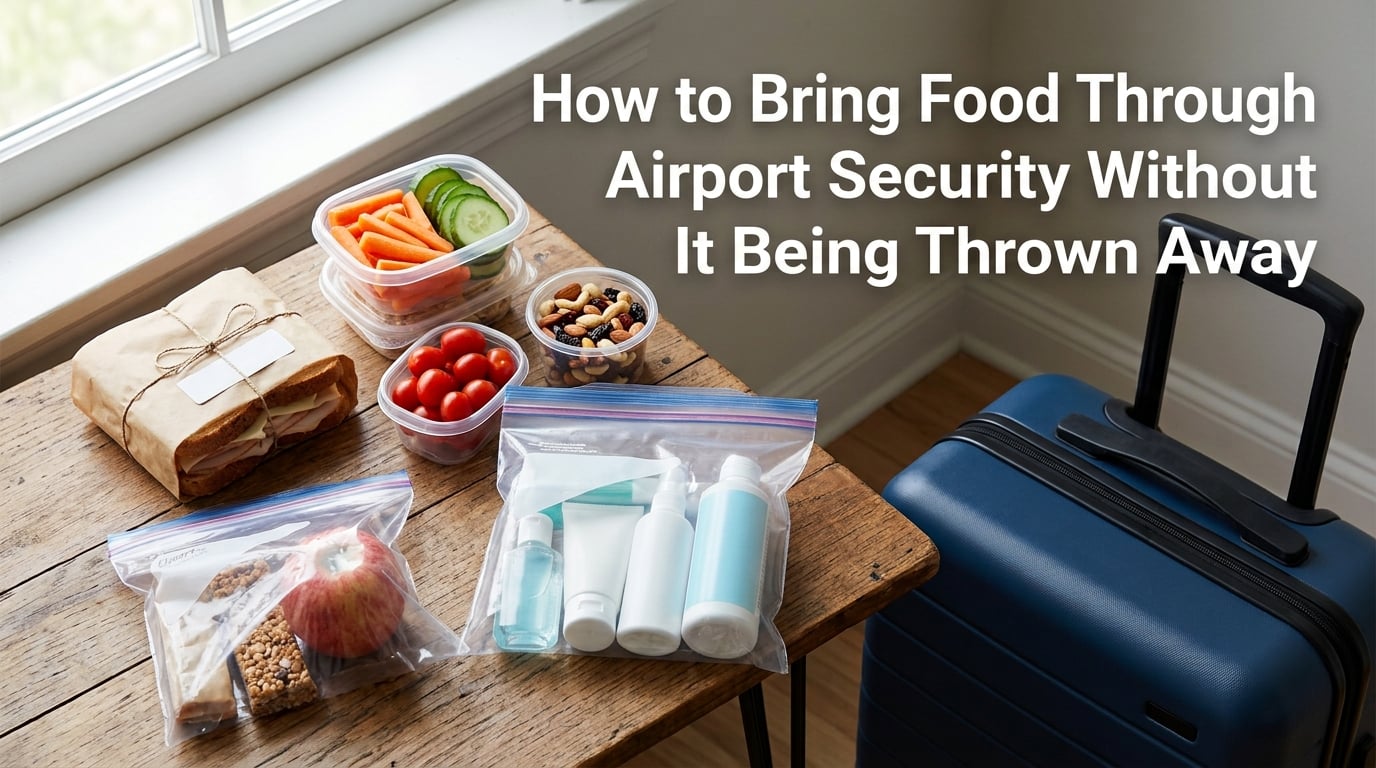
Yes, you can bring food through airport security. The TSA allows most solid food items in both your carry-on and checked bags. The one rule that trips people up: any liquid, gel, or spreadable food item larger than 3.4 ounces (100 milliliters) must go in your checked bag or it will get confiscated.
If you have ever watched a TSA officer toss your carefully packed yogurt or full jar of peanut butter into the trash, you know how frustrating it can be. Our team has spent months researching TSA guidelines, reading through hundreds of forum posts from real travelers, and comparing the official rules against what actually happens at the checkpoint.
This guide covers everything you need to know about how to bring food through airport security without it being thrown away. We break down the 3-1-1 rule, list exactly which foods pass and which fail, cover baby food and breast milk exceptions, and share practical packing tips from frequent flyers who do this every week.
Table of Contents
What Foods Can You Bring Through Airport Security?
The short answer: solid foods are almost always allowed. If a food item holds its shape at room temperature and is not a liquid, gel, or spread, it can go through the X-ray machine in your carry-on bag without any problems.
The TSA does not restrict the quantity of solid food you carry. You can bring an entire sandwich platter, a bag of apples, or a box of pastries if you want. The key distinction is whether the food is solid or liquid, not whether it is allowed at all.
One important note: TSA officers have the final say at the checkpoint. Even if a food item technically qualifies as solid, an officer can ask to inspect it further or request that you place it in your checked bag. This is rare for genuinely solid foods but worth knowing.
Sandwiches, Wraps, and Burritos
Sandwiches and wraps are some of the easiest foods to bring through security. I have personally carried turkey sandwiches, breakfast wraps, and bean burritos through TSA dozens of times without a single issue.
Reddit travelers on r/TravelHacks confirm this experience. Wraps, burritos, and sandwiches pass through routinely because they are solid items that do not trigger liquid restrictions. The only thing to watch for is heavy sauces or dressings inside your sandwich.
A small amount of mustard or mayo on a sandwich will not cause a problem. But if your wrap is swimming in sauce, an officer might ask to take a closer look. Keep condiments reasonable and you will be fine.
Snacks: Chips, Crackers, Granola Bars, and Trail Mix
Dry snacks are the safest category of food for air travel. Chips, crackers, pretzels, granola bars, protein bars, cookies, nuts, dried fruit, and trail mix all pass through TSA without any questions.
These items do not fall under the 3-1-1 liquid rule because they are completely solid. You can pack as many as your bag holds. I usually travel with a mix of granola bars, mixed nuts, and crackers for long flights.
One tip from frequent flyers: keep snacks in their original sealed packaging when possible. Sealed packages look cleaner on the X-ray screen and reduce the chance of an officer wanting to open your bag.
Fresh Fruits and Vegetables
Fresh fruits and vegetables are allowed through TSA security for domestic flights within the United States. Apples, bananas, oranges, grapes, carrots, celery, and baby tomatoes all pass without issue.
The main thing to remember is that fruit with high water content can look suspicious on the X-ray machine. Watermelons, whole coconuts, and large containers of cut fruit sometimes get a second look from officers.
If you are flying internationally, fresh fruits and vegetables are often restricted by customs at your destination. We cover international rules in detail later in this guide.
Baked Goods and Solid Sweets
Baked goods are fully allowed in carry-on bags. Cakes, pies, cookies, brownies, muffins, bread, pastries, and candy all pass through security without problems.
The only catch is if your baked item contains a large amount of filling or frosting that could be classified as a gel. A standard birthday cake is fine, but a cake overflowing with liquid filling might raise questions.
Holiday travelers regularly bring entire pies through security during Thanksgiving and Christmas. TSA even posts reminders about pie rules on their social channels during the holidays because it comes up so often.
Cooked Foods, Fast Food, and Takeout
You can absolutely bring cooked food and fast food through airport security. Chick-fil-A, McDonald’s, Chipotle bowls, pizza slices, leftover Chinese food, and homemade meals are all allowed as long as they are solid.
The practical issue is temperature and smell. A hot pizza box takes up space and the smell can bother other passengers. Most experienced travelers recommend eating hot takeout food before boarding rather than carrying it onto a packed plane.
If you do bring takeout through security, make sure it does not contain a large cup of sauce or dressing on the side. That side sauce counts as a liquid and must be 3.4 ounces or less.
Cheese and Solid Dairy
Hard cheeses like cheddar, parmesan, and Swiss pass through TSA without any questions. Solid cheese blocks are treated like any other solid food item.
Soft cheeses are where things get tricky. Cream cheese, brie, ricotta, and other spreadable cheeses fall under the liquid and gel category. A small container under 3.4 ounces can go in your quart-sized bag, but anything larger needs to go in your checked bag.
The 3-1-1 Rule for Liquid and Gel Foods
The 3-1-1 rule is the single most important rule to understand when you want to bring food through airport security. It determines exactly what liquid and gel foods can travel in your carry-on bag.
Here is what each number means. The first “3” refers to the 3.4-ounce (100 milliliter) maximum container size. The first “1” means all your liquid containers must fit in one quart-sized clear plastic bag. The final “1” means each passenger gets one quart-sized bag.
This rule applies to all liquids, gels, aerosols, creams, and pastes. That includes food items you might not immediately think of as liquids.
Foods That Count as Liquids or Gels
Many foods that seem solid actually fall under the liquid and gel restriction. The TSA classifies these food items as liquids:
Peanut butter, Nutella, and other nut butters are considered spreads and must follow the 3.4-ounce rule. A full jar of peanut butter will be confiscated if it is in your carry-on.
Jams, jellies, and preserves also count as gels. The same goes for honey, maple syrup, and chocolate spreads. Even though these feel thick, TSA treats them as liquids because they are spreadable and pourable.
Yogurt, pudding, jello, and applesauce are all classified as gels. A standard 6-ounce yogurt cup exceeds the 3.4-ounce limit and will not make it through security in your carry-on.
Soups, broths, and sauces are liquids. That cup of soup from the deli or the gravy you wanted to bring home for Thanksgiving will not pass unless it is frozen solid.
Salad dressings, dips, hummus, salsa, and queso all count as liquids or gels. A side of ranch dressing for your sandwich needs to be under 3.4 ounces and in your quart-sized bag.
Creamy or liquid-filled candies can also be restricted. A standard chocolate bar is fine, but a large tube of liquid candy or a jar of marshmallow fluff will trigger the liquid rule.
How to Pack Liquid Foods in Your Carry-On
If you want to bring a small amount of a liquid or gel food in your carry-on, it must meet three conditions. The container must hold 3.4 ounces or less. It must fit inside your one quart-sized clear plastic zip-top bag. And it must come out of your bag for separate screening at the checkpoint.
Travel-sized peanut butter, small jam jars, and miniature yogurt cups (if you can find one under 3.4 ounces) all work within this rule. The quart bag must seal completely and all items must fit inside without stuffing it to bursting.
I pack small packets of honey, single-serve cream cheese, and mini hot sauce bottles this way when I travel. They take up very little space and never cause issues.
When to Move Food to Your Checked Bag
If you have liquid or gel food items larger than 3.4 ounces that you absolutely must bring, your checked bag is the solution. There are no size restrictions on liquids in checked baggage.
A full jar of homemade jam, a bottle of maple syrup from your vacation, a large container of salsa, or a tub of Nutella can all travel in your checked luggage. Just wrap them carefully to prevent leaks and breakage.
The trade-off is that checked bags can be delayed or lost. Do not pack anything irreplaceable or temperature-sensitive in a checked bag if you can help it.
Foods That Will Get Confiscated at Airport Security
Every day, TSA officers confiscate thousands of food items from carry-on bags at checkpoints across the country. Almost all of these confiscations involve liquid or gel foods that exceed the 3.4-ounce limit.
Understanding which foods get flagged helps you avoid the disappointment of watching your food get thrown away. Here are the most commonly confiscated food items.
Large Yogurt, Pudding, and Jello Cups
Standard yogurt cups are typically 5 to 7 ounces, which puts them over the 3.4-ounce limit. TSA officers see these constantly and will pull them from your bag every time.
Pudding cups and jello cups face the same restriction. If you want yogurt for your flight, either buy a travel-sized option under 3.4 ounces or purchase it from an airport shop past security.
Full-Size Jars of Spreads and Butters
Peanut butter jars, Nutella containers, jam jars, and almond butter tubs are some of the most commonly confiscated items. People often do not realize that these thick, spreadable foods count as liquids.
The rule is consistent: if you can spread it or pour it, TSA treats it as a liquid. A 16-ounce jar of peanut butter has no place in a carry-on bag unless you want to surrender it at the checkpoint.
Soups, Sauces, and Gravies
That bowl of soup you grabbed on the way to the airport will not survive security. Liquid soups, pasta sauces, gravy containers, and broth-based foods all exceed the liquid limit.
Frozen soups are an exception. If your soup is frozen completely solid, TSA treats it as a solid item. Once it thaws and becomes liquid, the rule kicks back in. This is a narrow window that rarely works in practice.
Creamy Dips and Large Condiment Containers
Hummus, queso, spinach dip, large bottles of hot sauce, and full-size dressing bottles all get flagged. A small side of dip under 3.4 ounces in your quart bag is acceptable, but a full tub is not.
I once watched a traveler lose an entire container of homemade guacamole at security. It was a painful reminder that creamy, spreadable foods fall firmly in the liquid category regardless of how thick they are.
Beverages and Liquid Drinks Over 3.4 Ounces
Coffee, smoothies, juice, soda, and water bottles brought from home will be confiscated if they contain more than 3.4 ounces. This is the most common confiscation at airport security.
The simple workaround: buy your drinks at airport shops past the security checkpoint. Anything purchased inside the secure area can be carried onto the plane.
Special Exceptions: Baby Food, Breast Milk, and Medical Needs
TSA makes important exceptions for travelers with infants and for people with medical needs. These exceptions allow larger quantities of liquid foods that would normally be confiscated.
Understanding these rules is essential for parents and anyone traveling with medically necessary liquid foods.
Breast Milk and Formula
Breast milk is allowed in carry-on bags in quantities greater than 3.4 ounces. You do not need to be traveling with your child to bring breast milk through security.
Formula and breast milk are exempt from the standard liquid restrictions. TSA requires you to inform the officer about these items before screening begins and to remove them from your bag for separate inspection.
These items may be subject to additional screening, including X-ray examination, explosive trace detection, or a visual inspection. You can request that breast milk not be X-rayed and officers will use alternative screening methods.
Baby Food for Infants
Baby food in quantities greater than 3.4 ounces is allowed when you are traveling with an infant. This includes jarred baby food, baby food pouches, and toddler snacks that might otherwise be restricted.
Cooled or gel-based baby food products are treated as medically necessary liquids. The key is that you must be traveling with a child for these larger quantities to be permitted.
I have traveled with jars of baby food for my toddler and found that simply pulling them out and telling the officer made the process quick and stress-free. Officers see this every day and know the rules.
Ice Packs and Cooling Needs
You can bring ice packs through security to keep breast milk, baby food, or medically necessary items cold. Gel ice packs and frozen water bottles are allowed if they are frozen solid at the time of screening.
If your ice pack has partially melted and has any liquid at the bottom, TSA may treat it as a liquid and require it to meet the 3.4-ounce rule. Keep ice packs fully frozen until you reach the checkpoint.
Regular ice (not gel packs) is also permitted as long as it remains frozen. The moment any liquid accumulates, the restriction applies.
How to Declare These Items
You do not need to fill out any special paperwork to bring breast milk, baby food, or medically necessary liquids through security. Simply inform the TSA officer at the beginning of the screening process.
Remove these items from your bag and place them in a separate bin. Tell the officer what they are and why you are carrying them. Being upfront and organized keeps the process moving smoothly.
TSA has a dedicated helpline (TSACares) that provides assistance to travelers with disabilities, medical conditions, and families traveling with children. You can call them 72 hours before your flight for personalized guidance.
Bringing Food Through Airport Security on International Flights
International travel adds an extra layer of food restrictions that domestic travelers do not face. The issue is not just getting through TSA at departure but also clearing customs and agriculture checks at your destination.
TSA versus Customs: Two Different Checks
TSA checks happen at security before you board your flight. Their rules are about safety on the aircraft. The 3.4-ounce liquid rule applies regardless of whether you are flying domestically or internationally.
Customs and agriculture checks happen when you arrive at your destination country. These are completely separate from TSA and have their own rules about what food can enter the country. A food item that passes TSA perfectly can still be confiscated by customs agents.
This catches many travelers off guard. You clear security with your snacks, eat some on the plane, and then arrive only to have customs take your remaining food.
Countries With Strict Food Restrictions
Many countries strictly prohibit fresh fruits, vegetables, meats, and dairy products from entering. Australia, New Zealand, Japan, and the European Union are known for aggressive agriculture inspections.
The United States also restricts many food items entering from other countries. Customs and Border Protection agents at US airports routinely confiscate fruits, vegetables, meats, and seeds from arriving international passengers.
When flying internationally, stick to commercially packaged, shelf-stable snacks. Sealed bags of chips, crackers, candy, and granola bars are almost universally accepted. Fresh foods and homemade items are the most likely to be confiscated.
Can You Take Homemade Food Through Airport Security Internationally?
Homemade solid foods like sandwiches and wraps will pass TSA security without problems for international flights, just as they do for domestic travel. The TSA checkpoint does not distinguish between domestic and international departures.
However, homemade foods are much more likely to be confiscated by customs at your destination. Homemade items lack commercial packaging and ingredient labels, making it harder for agents to verify what they contain.
For international travel, our recommendation is to pack commercially sealed snacks for the journey and plan to eat homemade foods before you land. This avoids the risk of losing food to customs restrictions.
Tips for Smooth Food Screening From Real Travelers
Knowing the rules is half the battle. The other half is organizing your food so the screening process goes quickly and smoothly. These tips come from frequent flyers, forum discussions, and our own travel experience.
Organize Food for X-Ray Screening
TSA officers see thousands of bags daily. Dense food items, unusual shapes, and layered packaging can look suspicious on the X-ray machine, triggering a manual bag check.
Pack food items in a single layer when possible rather than stacking them. Spread items across your bag so their shapes are clear on the screen. This reduces the chance of an officer needing to open your bag.
Consider using a dedicated snack bag or pouch. When your food is grouped together and easy to access, you can quickly pull items out if an officer asks.
Ziploc Bags Versus Aluminum Foil
Clear zip-top bags are ideal for packing food through TSA. They are transparent, which means officers can see what is inside without opening anything. They also do not block X-ray imaging.
Aluminum foil is more problematic. Foil blocks X-rays and creates opaque areas on the screening image. Wrapping a sandwich tightly in foil may prompt an officer to open your bag for a closer look.
If you use foil, keep it to a single loose layer. Better yet, use wax paper, parchment paper, or clear containers that do not interfere with screening. Reddit users on r/YouShouldKnow frequently recommend clear containers for this exact reason.
Handling TSA Officer Questions About Your Food
If a TSA officer pulls your bag for inspection, stay calm and cooperative. They may ask what food is inside or request to open containers. This is a normal part of the process and rarely means you have done something wrong.
Answer their questions directly and let them examine anything they ask to see. If an item does not meet the rules, they will ask you to either put it in a checked bag, mail it home, or surrender it. Arguing will not change the outcome.
In some airports, TSA offers the option to exit the security line briefly to rearrange items into a checked bag. This is not guaranteed, but it is worth asking about if you are about to lose a valuable food item.
Odor and Etiquette Considerations
TSA will let most strong-smelling solid foods through security, but your fellow passengers may not appreciate them on a confined plane. Foods with powerful odors like boiled eggs, fish, curries, and pungent cheeses can make an entire row uncomfortable.
No competitor currently covers this topic, but forum posts reveal it is a real concern. Many travelers recommend eating strongly scented foods in the airport terminal before boarding rather than on the aircraft itself.
If you must bring aromatic foods on the plane, choose a seat near a window where air circulation is slightly better. Eat quickly, dispose of packaging immediately, and consider bringing a mild alternative for other passengers nearby.
A Quick Packing Checklist
Before you head to the airport, run through this checklist. These steps will help you bring food through airport security without delays or confiscations.
Pack solid foods freely in your carry-on. Sandwiches, wraps, snacks, fruit, baked goods, and dry items need no special handling.
Put any liquid or gel foods under 3.4 ounces in your quart-sized clear bag. Remove this bag at the checkpoint for separate screening.
Move larger liquid and gel foods to your checked bag, or leave them behind. Do not try to sneak them through.
Pull out baby food, breast milk, and medically necessary liquids and inform the officer before screening begins.
Use clear containers and avoid heavy foil wrapping to reduce the chance of a manual bag check.
FAQs
Will TSA throw my food away?
TSA will only confiscate food that violates their rules, typically liquid or gel items over 3.4 ounces. Solid foods like sandwiches, snacks, fruits, and baked goods will not be thrown away. If you have a prohibited item, you can usually choose to put it in a checked bag, mail it home, or surrender it.
Can I bring Chick-fil-A through TSA?
Yes, you can bring Chick-fil-A through TSA as long as the food items are solid. Chicken sandwiches, nuggets, and waffle fries pass through security without problems. Just make sure any dipping sauces are under 3.4 ounces and placed in your quart-sized liquid bag.
Can I bring food in a Ziploc bag through TSA?
Yes, food in Ziploc bags is absolutely fine and actually recommended. Clear zip-top bags let TSA officers see your food easily and do not block X-ray imaging. They are one of the best ways to pack food for airport security.
Can I bring food wrapped in aluminum foil through TSA?
Yes, foil-wrapped food is allowed, but it can trigger additional screening. Aluminum foil blocks X-rays, which may prompt a TSA officer to open your bag for a manual inspection. Using clear containers or wax paper instead reduces this risk.
What snacks are not TSA approved?
Snacks that are liquid or gel over 3.4 ounces are not allowed in carry-on bags. This includes yogurt cups, pudding, jello, large jars of peanut butter, Nutella, hummus, salsa, soups, and full-size bottles of sauce or dressing. Dry snacks like chips, crackers, granola bars, and nuts are always fine.
Conclusion: Bring Food Through Airport Security With Confidence
Bringing food through airport security is straightforward once you understand the core rule. Solid foods go in your carry-on freely, and liquid or gel foods must be 3.4 ounces or less in a quart-sized bag.
The fear of having your food thrown away comes from not knowing where the line is. Now you know: if you can spread it, pour it, or spoon it as a gel, it falls under the liquid restriction. Everything else passes through without a second thought.
Plan ahead, pack smart with clear containers, declare baby food and medical liquids, and be prepared for international customs checks. When you know how to bring food through airport security the right way, you will arrive at your destination with your snacks intact and your hunger satisfied.