
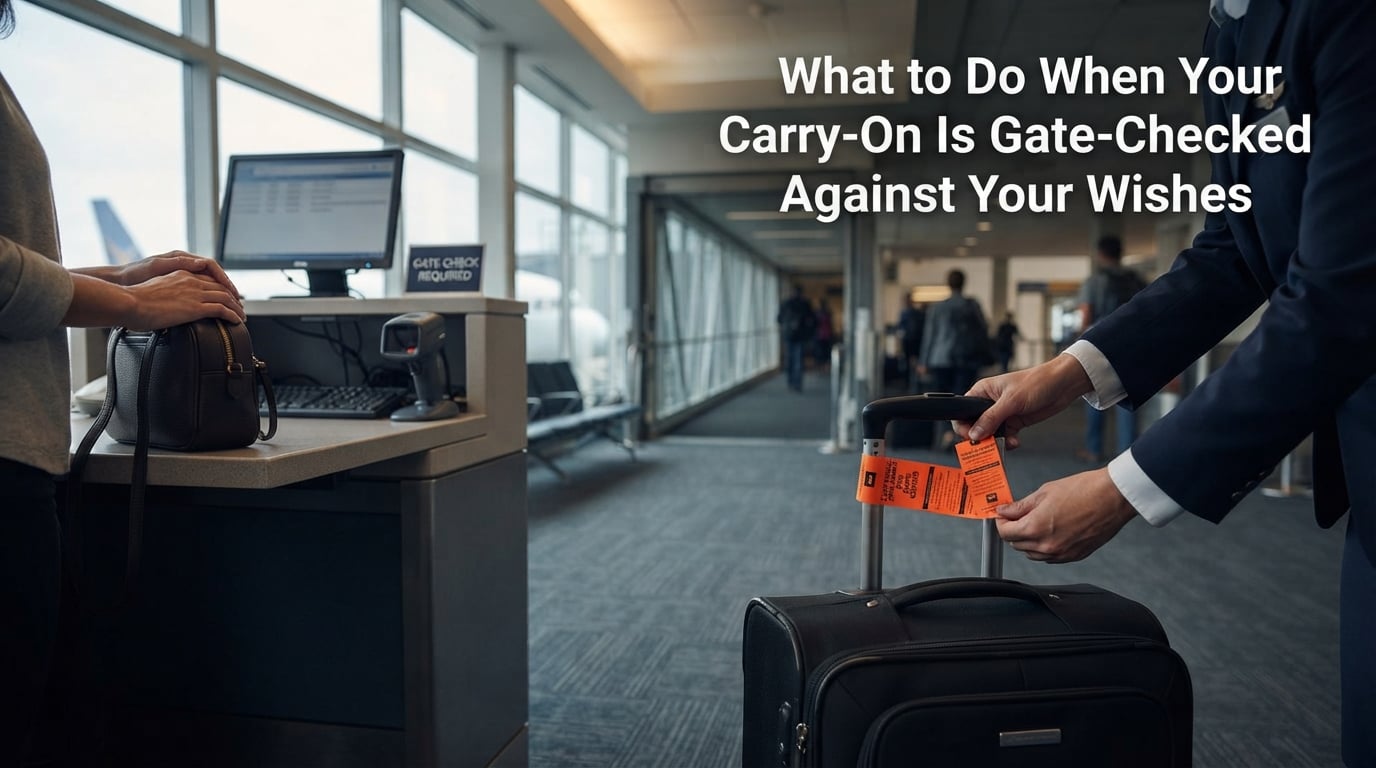
You’re standing at the jet bridge, your perfectly-sized carry-on in hand, and a gate agent tags it before you can blink. That helpless feeling when your carry-on is gate-checked against your wishes is something almost every frequent flyer has experienced at least once. I’ve been there, watching my bag disappear into the cargo hold while I wondered whether my laptop, medication, or birthday present would arrive in one piece. This guide covers exactly what to do in that moment, what to expect when you land, how to recover if your bag gets lost or damaged, and how to keep it from happening again on your next flight.
Table of Contents
What Does It Mean When Your Carry-On Is Gate-Checked
Gate checking is when airline staff take your carry-on bag at the boarding gate and place it in the aircraft’s cargo hold rather than letting you bring it into the cabin. The gate agent puts a special tag on your bag, often a bright orange or pink “valet tag,” and hands it to a ramp agent who loads it with the rest of the checked luggage. You still board the plane as usual, but your bag travels separately below, accessible only to the flight crew and ground handlers.
This happens most often when overhead bins are filling up faster than expected. Gate agents are usually instructed to start gate-checking bags once bins pass a certain threshold, even from passengers whose bags meet every size requirement. I’ve personally watched zone 5 passengers on a fully booked 737 have their bags taken before anyone in zones 3 and 4 even had a chance to board. Regional jets are the worst offenders because their overhead bins are noticeably smaller than on mainline aircraft, and many airlines now run smaller regional jets on routes that used to use 737s or A320s. The result: even passengers who board in group 2 can find themselves scrambling for space.
The good news: gate checking is almost always free. Airlines don’t charge you an extra fee when they gate-check a bag, even if you already paid for a checked bag as part of your fare. Some airlines even offer a small frequent flyer credit or bonus miles as a soft apology when this happens on a sold-out flight. The bad news: your bag spends time in the cargo hold, separated from any essentials you left inside, and travel between bins and baggage claim adds wear on the bag itself.
What to Do the Moment You’re Asked to Gate-Check
Step 1: Don’t argue, but do ask. Gate agents hear complaints about gate-checking dozens of times per flight. A polite question like “Is the overhead bin really full, or is this a guess?” sometimes buys you a few extra minutes if the flight still has zones left to board. I’ve had success with this on smaller flights where the agent relented once they saw more bins open up. Keep your tone friendly, your body language relaxed, and your question short. A gate agent under pressure will not negotiate with a frustrated passenger.
Step 2: Ask for the tag to be placed on the side of the bag, not the handle. This sounds small, but if the tag wraps around your handle, it can jam the telescoping mechanism and leave your bag partially open when you arrive at baggage claim. Most agents will happily comply without explanation, and it also makes the bag easier to spot on the carousel because the tag doesn’t get covered by other bags stacked on top.
Step 3: Pull out anything essential before you hand the bag over. This is the single most important step. Move your medications, chargers, laptop, valuables, and anything you can’t afford to lose into your personal item right there at the gate. Don’t assume you’ll remember later. Once the bag goes down the ramp, you won’t see it again until landing. If you don’t have room in your personal item, slip items into a duty-free plastic bag from a shop nearby and carry it as a third item. Most airlines will allow it.
Step 4: Take a quick photo of the bag tag. The tag number on your gate-check slip is what you’ll need if the bag gets lost, delayed, or damaged. Photographing it takes five seconds and saves hours on the phone with customer service later. Our team has seen travelers wait 45 minutes on hold just to recite a tag number they didn’t save. Photograph the front and back of the tag, and keep the photo in a dedicated album so it doesn’t get lost in your camera roll.
Step 5: Politely ask where pickup will be. Some flights bring bags up at the jet bridge, others send them to baggage claim. Knowing this in advance lets you plan your deplaning and your connections. Also confirm whether your bag will be transferred to your next flight or if you’ll need to recheck it yourself. We covered this in detail in the next section.
Where You Pick Up a Gate-Checked Bag After Landing
The pickup location for a gate-checked bag depends on the aircraft type and the airline. On regional jets operated by smaller carriers, your bag usually comes back to you at the jet bridge. After deplaning, you’ll see it sitting on a cart just outside the aircraft door, and you grab it and walk into the terminal. This is the fastest scenario and takes about 30 seconds.
On mainline aircraft and larger regional jets, gate-checked bags go to the regular baggage claim. You’ll need to check the monitors for your flight number and find the assigned carousel. Most airlines now also send a notification to your phone when the bag is loaded onto the carousel, but the airline app has to be enabled to receive these alerts. The bag typically arrives 10 to 20 minutes after you reach the carousel, though delays of 30 minutes are common on flights from smaller airports with limited ground staff.
For connecting flights, this is where things get tricky. If your gate-checked bag was never formally checked at the origin (because gate-checking skips the usual tag-and-sticker process at the check-in counter), there’s a small chance it doesn’t get transferred to your next flight automatically. Baggage handlers usually catch this, but on tight connections under 45 minutes, I always recommend checking the bag at the ticket counter in your connecting city rather than relying on the system to route it correctly. One of our team members missed a connection in Chicago because her gate-checked bag was sent to the wrong carousel and her next flight left without her. The airline later reimbursed her hotel and rebooked her, but only after she filed a formal complaint and waited 11 days.
What to Do If Your Gate-Checked Bag Is Lost or Damaged
Most gate-checked bags arrive safely, but when they don’t, you have rights. Domestic U.S. flights fall under Department of Transportation rules, which cap airline liability at roughly $4,700 per passenger for lost, damaged, or delayed bags on domestic itineraries. For international flights, the Montreal Convention applies and the cap is higher.
File a claim immediately at the airline’s baggage service desk, which is located near baggage claim in every major airport. Don’t leave the airport without filing. Get a written claim number, the agent’s name, and a contact phone number. Photograph the damage before you leave the airport if your bag arrives torn or broken. Airlines are far more responsive to claims filed at the desk than claims filed days later by phone or email.
If the bag is delayed and you need essentials, most airlines will reimburse reasonable purchases like a change of clothes, basic toiletries, and medications. Keep all receipts and submit them with the claim. If your bag is lost entirely, the airline is required to compensate you for the bag’s value and the contents, though they may depreciate items based on age. Having a Bluetooth tracker in your bag helps prove that the bag was actually delivered to the wrong airport or stuck on the wrong carousel, which speeds up the entire process.
How to Protect Your Essentials When Gate-Checked
Your personal item is your lifeline once your carry-on is gate-checked. The smartest travelers pre-pack this bag with the assumption that the carry-on will be taken. I keep my wallet, phone charger, headphones, a change of underwear, my prescription medications, a snack, a refillable water bottle, and a paperback book in my personal item at all times. If the carry-on gets taken, I’m still functional for the flight and the next morning.
Valuables and electronics should never go in a gate-checked bag. Laptops, tablets, jewelry, cameras, and irreplaceable items like legal documents or family heirlooms belong in your personal item, even if it means stuffing coat pockets. Airlines explicitly exclude most of these items from liability if they’re in a checked bag, so insurance won’t help you. I’ve personally watched a traveler weep at the baggage claim after her grandmother’s wedding ring was lost from a checked bag, and the airline’s response was a polite apology and a claim form.
Consider a small Bluetooth tracker if you fly frequently. A tracker tucked into your carry-on lets you see exactly where your bag is at every step, from cargo hold to carousel. I’ve personally used one to prove that a “lost” bag was actually on a different carousel in the same airport, saving me 90 minutes of conversation with the baggage service desk. The peace of mind alone is worth the small upfront cost, and the same tracker works for international connections where real-time tracking is otherwise hard to find.
How to Avoid a Forced Gate Check on Future Flights
Tip 1: Board early. The single biggest factor in whether your carry-on stays with you is your boarding group. First class, business class, premium economy, and elite status passengers board first and get first pick of the overhead bins. If you don’t have status, paying for early boarding or selecting a seat in the front of the cabin can buy you access to the early boarding group. I spent an extra $35 on early boarding for a 7am flight last month and kept my bag with no questions asked.
Tip 2: Choose an aisle or window seat toward the front of the economy cabin. Passengers in the middle of the cabin often board last because of how groups are split, and the rear bins fill up first. Sitting near the front gives you a real advantage on full flights. Exit row seats, when available, also let you board with the first group of economy passengers and give you extra legroom as a bonus.
Tip 3: Use a bag that fits the most restrictive airline size limits. Most U.S. domestic carriers have settled on 22″ x 14″ x 9″ as the standard, but some regional jets enforce smaller dimensions. Hard-shell bags with external dimensions that exactly match the spec give you the best chance of keeping your bag on board. Soft-sided bags can sometimes be squeezed into a remaining bin slot when a hard-shell wouldn’t fit. Measure your bag with the wheels included, since some airlines include wheels in the size limit and others don’t.
Tip 4: Avoid basic economy if you can’t live without your carry-on. Basic economy passengers usually board last and have no carry-on included in their fare on airlines like American and United. Several airlines explicitly market basic economy as a “gate-checked” experience, so unless you can survive without your bag for the flight, pay the difference for a main cabin fare. The savings on basic economy rarely make up for the inconvenience of a forced gate check plus a longer boarding process.
Tip 5: Watch the gate area before boarding. If you see gate agents already pulling bags at the gate before your group has even been called, that’s a signal overhead bins are running tight. Use this time to slim down your carry-on and move anything non-essential to your personal item. Even checking the bag voluntarily at the counter at that point can save you the stress of a forced gate check, and it usually means the bag arrives at baggage claim faster because it was tagged earlier in the process.
Tip 6: Hold off on hot drinks and snacks before boarding. Travelers with free hands and a small personal item move through the boarding lane faster and are less likely to get stopped for bag size checks. This is a small thing, but on busy flights the agent’s attention is limited and they move quickly through the line.
Frequently Asked Questions
What happens if your carry-on is gate checked?
Your carry-on is taken at the boarding gate, tagged with a special receipt, and placed in the aircraft’s cargo hold. You board the plane without it and pick it up either at the jet bridge or at baggage claim after landing, depending on the airline and aircraft type.
Can I refuse to check a carry-on?
You can ask politely, but the gate agent has final authority. If the agent says overhead bins are full, refusing usually means you don’t board the flight. Sometimes waiting a few extra minutes lets you keep your bag if bins open up.
Is gate checking free?
Yes, gate checking is almost always free. Airlines do not charge an extra fee when they take your carry-on at the gate, even if you would otherwise pay for a checked bag.
Where do you pick up gate checked bags?
On regional jets, gate-checked bags are usually returned at the jet bridge right after deplaning. On larger aircraft, they go to the regular baggage claim carousel. Check the flight information monitors for the assigned carousel number.
What should I put in my personal item if gate check is likely?
Keep medications, phone chargers, headphones, a change of clothes, snacks, water, and any valuables or electronics in your personal item. Treat your personal item as your backup carry-on in case the larger bag is taken at the gate.
Does gate checking increase the risk of lost or damaged luggage?
No. Gate-checked bags are treated the same as bags checked at the ticket counter. They travel in the same cargo hold and go through the same handling process, so the risk of loss or damage is essentially the same.
Bottom Line
Getting your carry-on gate-checked against your wishes is frustrating, but it doesn’t have to ruin your trip. The moment you’re asked, slide your essentials into your personal item, photograph the tag, ask politely where you’ll pick up the bag, and keep your phone ready to file a claim if anything goes wrong. Once you land, follow the jet bridge or baggage claim based on the aircraft type, and double-check your connection if you have a tight transfer. For future trips, board early, choose a bag that fits even the smallest regional jet bins, and avoid basic economy when your bag matters. With the right preparation, a forced gate check becomes a minor inconvenience rather than a travel disaster.