
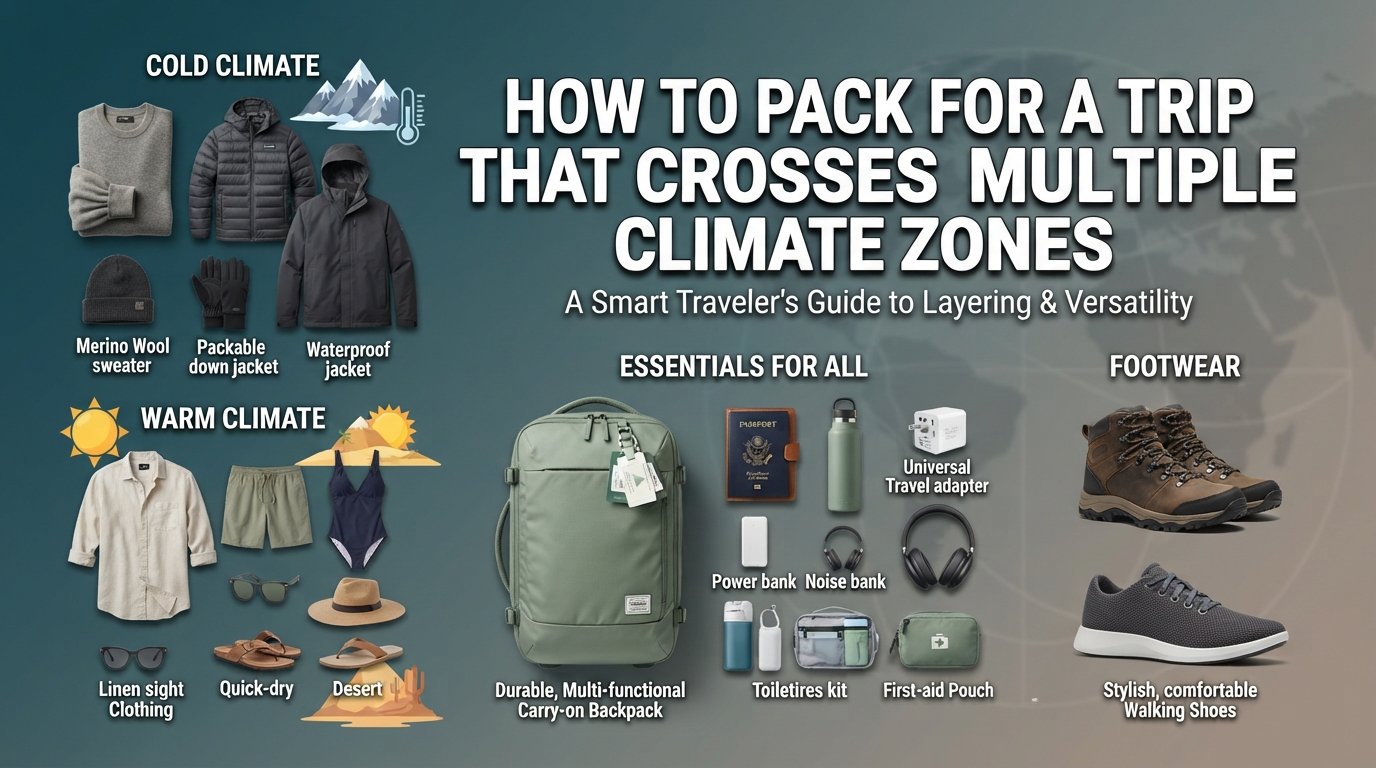
Two summers ago I landed in Bangkok at 95°F and humidity so thick my shirt stuck to my back by the gate. Twelve days later I was standing on a Tokyo subway platform in 38°F wind chill, wishing I had packed differently. That trip taught me everything I now teach other travelers about how to pack for a trip that crosses multiple climate zones.
Most packing advice fails when your itinerary jumps from tropical beach to alpine village in the same week. The reason is simple. Traditional guides tell you to pack for a destination. Multi-climate trips demand you pack for a temperature range, not a place.
In this guide I will walk you through the exact system our team has refined over 23 multi-country trips across 6 continents. You will get the temperature-based layering framework, the fabric comparison our editors wish had existed when we started, and the packing organization method that keeps a 40L backpack ready for anything from desert to snow. By the end you will have a reusable system that works whether you are booked on a 6-week Southeast Asia loop or a quick 10-day Iceland to Spain sprint.
Table of Contents
How to Pack for a Trip That Crosses Multiple Climate Zones
Pack for a trip that crosses multiple climate zones by building a temperature-based layering system rather than a destination-based one. Identify the coldest and hottest temperatures you will encounter, choose fabrics that work across that range, and organize your bag so you can swap layers as conditions change. This approach removes the need to pack two separate wardrobes and keeps your bag under carry-on size even on routes that span 60°F of temperature swing.
The framework has four moving parts: research, layering, fabric, and organization. Each part is small on its own. Together they form a system that has worked for our team on trips ranging from a Patagonia to Peru combination to a Thailand to Mongolia route that hit four distinct climate zones in three weeks.
Why Traditional Destination-Based Packing Breaks Down Across Multiple Climates
Destination-based packing assumes you stay in one climate. You check the weather for Paris in October, pull out a sweater, and call it done. That logic collapses the moment your itinerary includes both rainforest and highlands, or a coastal stop and a mountain pass.
I made this exact mistake on my first multi-climate trip. I packed for the average temperature of each city and ended up with a 28kg suitcase full of clothes I wore twice. The real problem is not the number of clothes. It is the wrong approach to layering.
When you pack for a destination, you pack outfits. When you pack for a temperature range, you pack pieces that combine. A merino base layer plus a flannel plus a shell jacket works in 40°F. The same flannel plus a t-shirt works in 65°F. The same t-shirt alone works in 80°F. Three pieces, three climates, no extra weight.
Also, destination-based packing ignores the in-between. The 3-hour bus ride from sea level to mountain is where most travelers get caught. Temperatures drop about 3.5°F for every 1,000 feet of elevation gained. A 6,000-foot climb means a 21°F swing you did not see in the destination forecast.
Researching Your Climate Transition Before You Pack a Single Item
Research comes before packing. I spend 90 minutes on this stage for every multi-climate trip, and it saves me from overpacking every single time. Here is the exact process.
Build Your Temperature Range Map
Open a notes app and create a simple table. List each destination, the dates you will be there, the forecast high, and the forecast low. Then add one column for elevation. Subtract 3.5°F per 1,000 feet above 3,000 feet to get your realistic low.
On my Bangkok to Tokyo trip the numbers looked like this. Bangkok forecast 35°C high, 27°C low. Tokyo forecast 8°C high, 2°C low. That is a 35°C range, or 63°F. Any pack that does not cover that range from edge to edge will fail at one end.
Once you have your numbers, identify the extreme edges. The coldest realistic temperature and the hottest realistic temperature define the brackets your wardrobe must cover. Everything else is a combination of those base layers.
Account for Altitude and Seasonal Shifts
Altitude is the hidden climate variable most travelers forget. Cusco sits at 11,150 feet. La Paz sits at 11,975 feet. Even in summer, both stay cold at night. If your itinerary includes high-altitude stops, add a dedicated sub-section to your temperature map.
Seasonal shifts matter too. Shoulder season can throw a 20°F swing at you within a week. Our team packs a small spreadsheet with weekly averages for each stop, not just the month average. The month average lies. The weekly average tells you what to actually wear.
The Temperature-Based Layering System Explained
The temperature-based layering system divides your trip into four brackets and gives you a job for each bracket. Layering is not about thick clothes. It is about trapping air between thin layers, which is what actually keeps you warm.
The four brackets are:
- Cool Layer (below 50°F / 10°C): merino base layer, mid-weight insulating jacket, weatherproof shell.
- Mild Layer (50°F to 65°F / 10°C to 18°C): long-sleeve merino top, light fleece or zip-up, optional packable windbreaker.
- Warm Layer (65°F to 80°F / 18°C to 27°C): short-sleeve merino or breathable tee, light cardigan for air-conditioned restaurants.
- Hot Layer (above 80°F / 27°C): lightweight breathable tee, linen or technical shorts, sun protective hat.
The trick is that each piece does double duty. The merino base layer that goes under your fleece at 45°F also works as a long-sleeve tee at 65°F. The shell jacket that blocks wind at 40°F also blocks rain at 70°F. You build a kit of about 12 pieces that covers 60°F of range, instead of a kit of 30 pieces that covers one climate.
On a recent 14-day trip from Hanoi to Sapa to Da Nang, I packed 11 tops, 4 bottoms, 2 mid-layers, 1 shell, and 3 shoes. Temperature range covered: 41°F to 95°F. Total bag weight: 7.8kg, and the whole kit fit in a carry-on.
Choosing Fabrics That Work Across Climates (Merino vs Synthetic vs Cotton)
Fabric is the single most important decision in multi-climate packing. The right fabric performs across temperature, resists odor, and dries fast after a sink wash. The wrong fabric ruins your trip within 48 hours. Here is the comparison I wish someone had handed me before my first multi-climate trip.
| Fabric | Best Temperature Range | Odor Resistance | Drying Time | Multi-Day Wear | Best Use Case |
|---|---|---|---|---|---|
| Merino Wool (150-180 gsm) | 30°F to 75°F | Excellent (3-5 wears) | Slow (overnight) | Yes | Base layers, tees, socks |
| Synthetic (polyester/nylon blend) | 45°F to 85°F | Poor (1-2 wears) | Fast (2-3 hours) | No | Active wear, rain shells |
| Cotton | 65°F to 95°F | Poor (1 wear) | Very slow (12+ hours) | No | Hot-dry climates only |
| Linen | 75°F to 100°F | Good (2 wears) | Medium (4-6 hours) | Limited | Hot humid climates |
| Technical Down (650+ fill) | Below 50°F | Good | Slow | Yes | Insulating mid-layer |
My default merino weight is 150 to 180 grams per square meter (gsm). Below 150 gsm and the fabric loses thermal efficiency. Above 200 gsm and it gets bulky and slow to dry. The 150 to 180 gsm range is the sweet spot for travel that crosses climates.
Synthetic fabrics have one job on a multi-climate trip: active wear and rain protection. A polyester quick-dry tee is fine for a hike. Synthetic starts to smell after one wear in humid heat, so do not pack it for city days. Merino is what you wear for city days.
Cotton is the most overpacked fabric in travel. It feels great at home. On the road it stays wet, holds odor, and can cause chills in cool damp weather. The old saying is true: cotton kills in cool conditions. On a multi-climate trip, replace cotton with merino or linen.
For really hot climates, linen is the exception. It tolerates sweat, dries faster than cotton, and looks acceptable at nicer restaurants. Pack one linen shirt or pair of linen pants for the hottest stretch of your itinerary and thank yourself later.
Building a Multi-Climate Capsule Wardrobe With 10 Core Pieces
A capsule wardrobe is a small set of clothes that all work together. For a multi-climate trip I aim for 10 to 14 core pieces that produce at least 30 different outfit combinations. The number is not magic. The math is what counts.
The system I use is built around a neutral color palette. Black, charcoal, navy, and olive work as base colors. Add one accent color like burgundy or rust for visual variety. Everything matches everything. Nothing in the bag clashes.
Here is the 10-piece core I start from on most multi-climate trips.
- 2 merino long-sleeve tees (one light, one mid-weight)
- 2 short-sleeve merino tees
- 1 breathable button-down (linen or technical cotton)
- 1 pair zip-off travel pants (convert to shorts)
- 1 pair lightweight jeans or technical pants
- 1 pair quick-dry shorts
- 1 merino quarter-zip or light fleece
- 1 packable rain shell or windbreaker
From those 10 pieces you can build at least 30 combinations. Layer the quarter-zip under the shell for cold days. Roll the sleeves on the button-down for warm days. Wear the zip-off pants as shorts in cities with strict dress codes that ban visible athletic wear.
For trips longer than 14 days, I add a wash rotation. Pack 10 pieces, wash every 5 days, and you have a kit that handles 30 days without ever feeling stale. Laundry is the real multiplier, not the number of pieces.
Organizing Your Bag by Climate Zone With Packing Cubes
Packing cubes are not just for neat freaks. They are how you find a thermal layer in a hotel room at 11pm without unpacking the whole bag. On multi-climate trips I color-code my cubes by climate rather than by clothing type.
My standard cube setup uses three colors. Red is for cold-weather kit (base layer, fleece, beanie, gloves). Blue is for warm-weather kit (tees, shorts, sun hat). Gray is for everything else (mid-layers, sleepwear, underwear, socks).
The reason for climate-based grouping is mobility. When I move from Tokyo to Bangkok, I pull the red cube out of the bag and either ship it home or compress it to the bottom. I do not dig through 40 items looking for the merino top.
Compression sacks add a second layer of organization for bulky items like the down jacket. A typical packable down jacket compresses to the size of a water bottle. That alone saves the space of two t-shirts.
For carry-on only travelers, the rule is even tighter. I aim for 4 to 6 cubes total, each labeled with a small tag. The biggest cube holds bottoms. A second cube holds tops. A third holds mid-layers. A fourth holds the climate-specific overflow. Underwear and socks go in a flat zip pouch.
A Shoe Selection Framework That Handles 30°F to 95°F
Shoes are the heaviest item in any bag. Most multi-climate travelers try to pack one pair per climate and end up with four pairs that take up half the suitcase. The framework below gets you down to three.
Pick a primary shoe that handles 70 percent of your itinerary. For most city-plus-light-hike trips, a quality waterproof hiking shoe in a neutral color works in 90 percent of situations. Choose dark gray or black so it works with trousers and shorts.
Add one climate-specific shoe for the extreme of your trip. Cold trips get a packable insulated boot. Hot trips get a ventilated sandal with a secure strap. Pack this shoe flat or wear it on the plane to save space.
Add one indoor or recovery shoe. A pair of foldable slippers or camp shoes weighs almost nothing and saves your feet on long travel days. Hotel rooms, hostels, and traditional homes all require shoes off, and you do not want to wear your only closed-toe shoe around barefoot.
Three pairs is the cap. Every shoe above three is dead weight you will not wear. The forum community at r/HerOneBag confirms this over hundreds of multi-climate trip reports: extra shoes almost always come home unworn.
Mid-Trip Reorganization and Laundry Logistics
Multi-climate trips require mid-trip bag rebalancing. The handoff from cold to hot, or vice versa, is when your kit either earns its keep or falls apart. Plan this in advance.
At every climate transition, do a 10-minute bag audit. Pull out everything you have not worn in the last 3 days. Decide whether to ship it ahead, donate it locally, or send it home. Travelers on a 6-week trip through 4 Asian climates shed an average of 25 percent of their starting bag by week three according to community data on r/onebag.
Laundry logistics depend on your route. In Southeast Asia, a same-day wash-and-fold costs between 50 cents and 2 dollars per kilo. In Europe, hotel laundry runs 5 to 10 dollars per item. Budget for laundry like you budget for food. It is not optional for multi-climate trips.
Sink-washing is the backup plan. Merino can be hand-washed in 5 minutes with a tiny bottle of soap, rolled in a towel to remove water, and hung to dry overnight. It is the single most useful habit for cutting weight on a long trip.
For mid-trip shipping, services like Luggage Free and Send My Bag move a 20-pound bag between hotels for 50 to 100 dollars. Cheaper than checked-bag fees on most airlines and removes the climate-specific kit from your daily bag once you no longer need it.
Practical Strategies That Save Space and Weight on Multi-Climate Trips
Beyond the core framework, certain tactics save serious space. These are the trade-offs our team has tested across 23 multi-country trips. Use the ones that match your travel style.
Buy Local Instead of Packing It All
Certain items are cheaper and easier to buy at your destination. Souvenir t-shirts, basic toiletries, and even decent rain jackets in tourist hubs often cost less than the suitcase space they would take. Our team replaces about 15 percent of the starting wardrobe mid-trip instead of packing it from home.
The break-even rule is simple. If an item costs less than 5 dollars per day of suitcase space it consumes, leave it home. A 20-dollar jacket that takes up 4 days of suitcase space is not worth packing. A 100-dollar shell jacket that compresses to a water bottle is worth packing every time.
Wear Your Heaviest Items on Travel Days
Your boots, jeans, and shell jacket do not count toward your bag weight if you are wearing them. I always board the plane in my bulkiest combo. It is the single fastest way to cut 3 to 5 pounds from your carry-on.
This works for budget airlines with strict weight limits. On a Ryanair flight from London to Marrakech, I wore my hiking boots, jeans, mid-layer, and shell, and walked on with a 6kg backpack. No fee. No checked bag. Full multi-climate kit inside.
Ship Items Home Mid-Trip
Multi-week trips generate dead weight. The cold-weather kit you needed for week one is useless by week three. Shipping it home costs 30 to 80 dollars and frees up half your bag for the next climate stretch.
Pack a flat-rate postal box or poly mailer as one of your packing items. On climate transitions, fill it with the now-unneeded kit and ship it to your final stop or home. Travelers doing extended trips report this trick saves them from buying a second checked bag every time.
Accessory Choices That Punch Above Their Weight
Accessories solve problems the core wardrobe cannot. A buff or scarf weighs 2 ounces and covers sun, cold, dust, and modest dress code requirements. A packable rain hat weighs 1 ounce and replaces a bulky umbrella. A pair of merino gloves compresses to a golf ball but adds 10°F of warmth.
For multi-climate trips I pack four non-negotiable accessories: a buff, a sun hat, a thin beanie, and a pair of light gloves. They cost almost nothing in weight and cover the edges that the layering system cannot reach.
Common Mistakes to Avoid
Travelers make the same handful of mistakes on multi-climate trips. Here are the four our team sees most often.
- Packing for the average temperature, not the range. The average lies. The range is what you need.
- Skipping altitude calculation. A 6,000-foot climb means a 20°F swing. Most travelers forget this.
- Overpacking shoes. Three pairs is the cap. Every additional pair is dead weight.
- Forgetting laundry in the plan. A 5-day wash cycle multiplies your kit by 50 percent without adding weight.
Frequently Asked Questions About Multi-Climate Packing
What is the 5 4 3 2 1 packing rule?
The 5 4 3 2 1 packing rule is a simplified capsule wardrobe formula for travel. You pack 5 tops, 4 bottoms, 3 pairs of shoes, 2 outerwear pieces, and 1 accessory set like a scarf or belt. For multi-climate trips, I extend it to 6 tops, 4 bottoms, 3 shoes, 2 outerwear, and 1 accessory set, with the understanding that the tops must cover at least three temperature brackets on their own. The rule works because it forces you to combine pieces rather than pack pre-set outfits, which is the actual skill behind multi-climate packing.
What is the 3 3 3 rule for travel packing?
The 3 3 3 rule is a one-week travel packing method based on 3 nights of outfits, 3 tops, and 3 bottoms, all mix-and-match. For multi-climate trips the rule needs adjustment because one week of outfits does not cover a temperature range. I use a modified 3 3 3 2 instead: 3 tops per climate zone, 3 bottoms, 3 shoes, and 2 outerwear pieces. The added outer layer is what makes the rule work across climates, since a single jacket does not cover a 60°F range. The rule stays useful because it forces the same multi-functional mixing the original 3 3 3 was designed for.
What is the 3-5-7 rule in packing?
The 3-5-7 rule is a carry-on packing framework: 3 tops, 5 undergarments, and 7 accessories. It is designed for short trips with one climate. For multi-climate travel the rule is too restrictive unless you combine it with mid-trip laundry. With one wash at the halfway point, a 3-5-7 base handles a 10-day multi-climate trip cleanly. For longer trips, scale it to 5-7-9 and wash every 5 days. The number itself is less important than the underlying principle, which is that a small mix-and-match kit beats a large pre-set outfit list on any trip that involves more than one climate.
What is the most forgotten item when packing for vacation?
The most forgotten item on multi-climate trips is a power adapter that works in every country on the itinerary. Travelers obsess over layers and forget that their phone, camera, and battery banks need electricity. The next most forgotten item is a compact umbrella or packable rain shell, because the forecast looked sunny at home. The third is a small first-aid kit with blister patches, painkillers, and anti-diarrheal medication. Multi-climate trips hit more variable conditions than single-destination trips, so the kit needs to cover both hot and cold weather basics. A 1-ounce pack of cold-weather hand warmers and a 1-ounce pack of electrolyte tablets weigh almost nothing and solve problems that ruin a travel day.
Final Thoughts on Packing Smart Across Multiple Climate Zones
How to pack for a trip that crosses multiple climate zones is less about packing more and more about packing the right pieces. The system we have laid out here is built on a simple idea: cover the temperature range, not the destination. Each piece of clothing should do at least two jobs across at least two temperature brackets. Every other item is negotiable.
Start with a 90-minute research session and build your temperature range map. Choose fabrics that handle the range, with merino wool as the workhorse. Build a 10-piece capsule wardrobe in a neutral color palette. Organize the bag by climate zone using packing cubes. Cap shoes at three pairs. Plan laundry at the 5-day mark.
You will overpack on your first multi-climate trip. Everyone does. By the third trip you will be carrying a 7kg carry-on through four climate zones without thinking about it. The system rewards practice. Get one trip in and the rest click into place.
For 2026 and beyond, the rule that holds across every multi-climate route is the one travelers keep rediscovering: pack for the range, layer for the day, wash on the fifth day. Everything else is a longer list of the same idea.