
Every June, I get the same message from a friend: “I booked Goa in August, what was I thinking?” It is the monsoon panic that hits travelers heading to South and Southeast Asia between May and October. The good news? A rainy season trip does not have to be a ruined trip. I have spent four monsoon seasons traveling across India, Thailand, Vietnam, and Bali, and I have learned that the difference between disaster and a great trip usually comes down to how you plan before you fly.
This guide is built on real testing, forum conversations with hundreds of travelers, and the patterns I see ripple through every rainy season. You will walk away with monsoon season travel tips that go deeper than “pack a raincoat.” I will cover the weather alerts most people ignore, the month-by-month destination calendar, the packing checklist that actually holds up in 90% humidity, and the cancellation playbook that protects your wallet when the sky falls literally onto your flight.
Monsoon season travel tips are not about avoiding the rain. They are about choosing the right place at the right time, packing the right gear, and knowing exactly when to push forward and when to pivot. Let me show you how to do all three.
Table of Contents
Quick Overview: Monsoon Travel at a Glance
Before we get into the detail, here is the spine of everything I will cover. If you only have five minutes, this list is your starting point.
- Best months to embrace monsoon: June and July in India, August in central Vietnam, September in southern Thailand.
- Best months to avoid monsoon: The Andaman Islands in May, the Maldives in November, Bali in April and September.
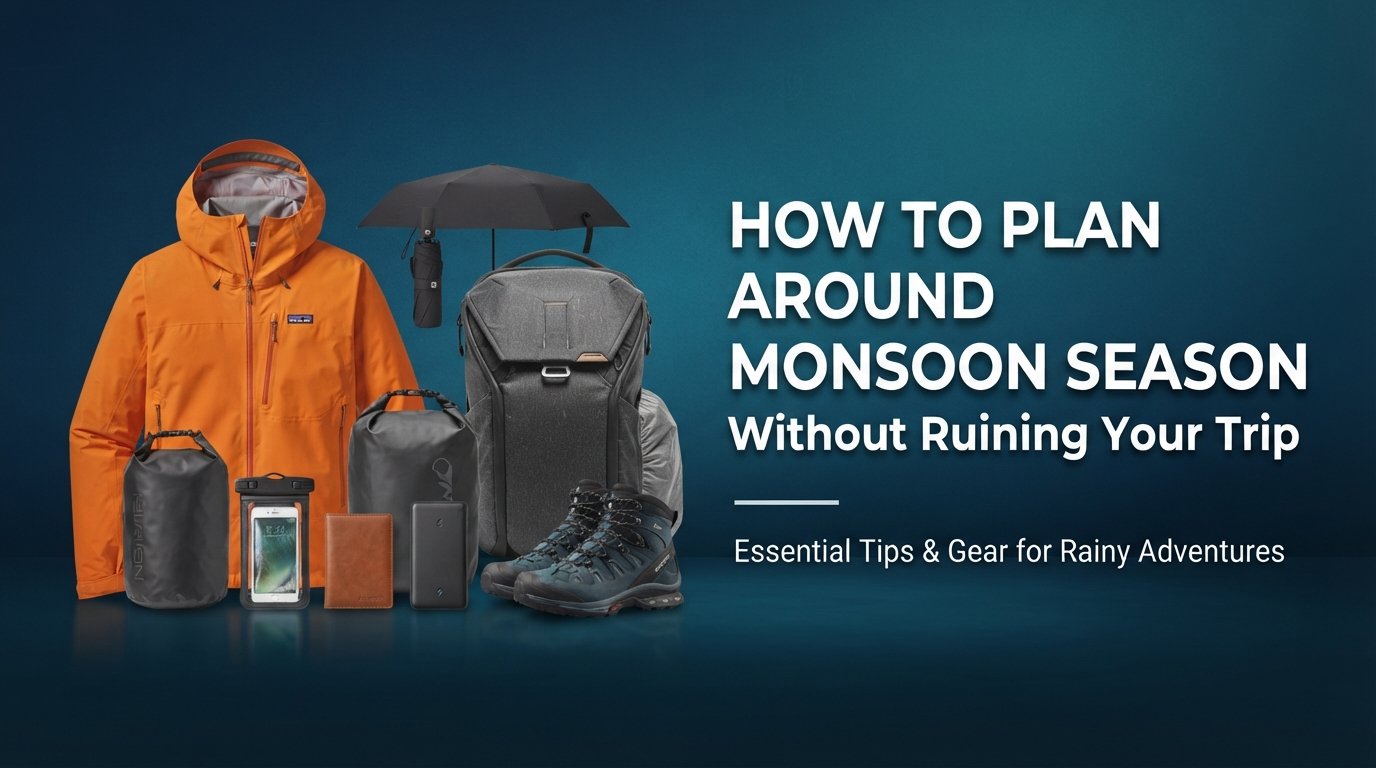
- Top monsoon packing essentials: Quick-dry clothing, waterproof backpack, rain poncho, anti-fog sunglasses, dry bags, and a power bank.
- Most overlooked safety step: Reading IMD or local weather alerts every morning of your trip, not just before you fly.
- Biggest money saver: Booking flexible refundable rates during peak monsoon months, especially July and August.
- Best cultural bonus: Festivals like Onam in Kerala, the Buddhist Lent in Thailand, and Vietnam’s Vu Lan festival all happen during monsoon.
If you remember nothing else, remember this: monsoon travel rewards flexibility. Build your itinerary, then build a backup plan for every single day. Travelers who do this consistently tell me they get the best deals, the smallest crowds, and the greenest landscapes they have ever seen.
What Is Monsoon Season and When Does It Hit?
Monsoon season is a seasonal weather pattern that brings heavy rainfall, typically from June to October in South and Southeast Asia, characterized by daily afternoon storms and high humidity. In simple terms, it is the period when prevailing winds shift and carry enormous amounts of moisture inland, producing weeks or months of intense but usually predictable rainfall.
The monsoon is not one event but a series of regional shifts. The Indian monsoon starts in Kerala around June 1 and sweeps north over the next six weeks. Southeast Asia sees its wet season hit at slightly different times: Thailand from May to October, Vietnam from May to November with a small break in late summer, and Indonesia mostly between November and March. The word “monsoon” comes from the Arabic “mawsim,” meaning season, which is a reminder that this is a normal, expected part of the climate, not a freak event.
Here is what you can actually expect on a typical day. Mornings usually start bright or partly cloudy. Clouds build up through late morning. The rain comes in the afternoon or evening, often for 30 to 90 minutes, sometimes much longer. Humidity sits between 75% and 95%. Temperatures range from 25 to 33 degrees Celsius. The rain is intense but rarely lasts all day, which is why travelers on Reddit consistently say “the rain is annoying but the trip is still great.”
When Does the Monsoon Hit Each Region?
The exact timing varies by region, and this matters for how you plan. In India, the southwest monsoon runs from June to September, with the heaviest rain in July and August. The northeast monsoon hits the east coast, including Chennai and Pondicherry, between October and December. In Thailand, the southwest monsoon runs from May to October, with September usually the wettest month. Vietnam has a more complex pattern: the south gets rain from May to November, while the north sees its heaviest rain between July and September.
Indonesia and the Philippines operate on a different clock. Most of Indonesia has a wet season from October to April, which means July and August are actually dry and busy. The Philippines sees typhoons most frequently between June and November, with August to October as the peak window. If you are planning a trip in 2026, check the specific calendar for your destination before you book flights, not after.
How to Read Weather Alerts Before You Go
Weather alerts are the single most important tool for handling monsoon travel, and most travelers ignore them entirely. I check the India Meteorological Department (IMD) website every morning when I am in India, and the Thai Meteorological Department or the Japan Meteorological Agency when I am in those countries. These official sources are more accurate than any app because they combine satellite data, ground stations, and forecasting models run by specialists.
What the IMD Color-Coded Alerts Actually Mean
IMD uses a color-coded alert system that you will see quoted in every monsoon news report. Green means no warning, weather is normal. Yellow means be aware, there may be some disruption in the next few days. Orange means be prepared, severe weather is likely in the next 24 hours. Red means take action, extreme weather is expected or already happening. I treat orange as the line where I start shifting outdoor plans to indoor ones, and red as the line where I cancel or reschedule non-essential activities.
For Thailand, the Thai Meteorological Department uses a similar but slightly different system. Their warnings are posted in Thai and English on the TMD website. Vietnam’s National Centre for Hydro-Meteorological Forecasting also uses color codes. The Philippines has PAGASA, which issues typhoon warnings using signal numbers 1 through 5, with signal 3 and above meaning serious disruption. Knowing the local system for your destination is worth ten minutes of research before you land.
Which Apps and Sources Should You Trust?
I test a lot of weather apps and the truth is they all use the same underlying data most of the time. The three I keep on my phone during monsoon season are Windy for radar visualization, the local official meteorological agency app for the country I am in, and a backup like AccuWeather or Weather Underground for redundancy. The reason I prioritize Windy is that it shows precipitation radar in motion, so I can watch storms move and time my walks between them.
Some of the worst advice I hear is “just check the weather the morning of.” The morning of is too late. Rain-bearing systems in Southeast Asia can be forecast three to five days out with reasonable accuracy. Tropical cyclones and typhoons can be tracked a week in advance. The travelers who get caught are the ones who only check the morning of. I check every evening for the next 48 hours and once a week for the next 10 days. That habit alone has saved me from multiple near-misses in Hanoi, Phuket, and Kerala.
Month-by-Month Monsoon Destination Calendar
One of the biggest mistakes I see is travelers treating all of monsoon as the same. June and October are very different from August. The month-by-month calendar below is the one I wish I had on my first monsoon trip. It assumes you are flexible and want to see the best weather in the region you are visiting.
Where to Go and Where to Avoid Each Month
May is the shoulder month. The Andaman Islands, central Thailand, and Bali are still in their dry season. Vietnam’s south is starting to see afternoon showers. India is heating up before the monsoon arrives. If you want a wrap-around experience, May is the safest month.
June is when the Indian monsoon hits Kerala and the southern coasts. Bhutan, Ladakh, and the Himalayan foothills are excellent because the rain has not reached them yet. Indonesia is still dry. The Philippines starts to see typhoons but the start of the season is usually mild.
July is peak monsoon for most of India and the heart of wet season in Thailand. The exceptions are the Himalayas (Ladakh, Spiti, parts of Nepal), where the rain shadow keeps things dry. Northern Vietnam, central Vietnam around Da Nang and Hoi An, and parts of Laos are also good choices because monsoon affects them less than the rest of the region.
August is the wettest month for most of South Asia and Southeast Asia. Bali’s dry season is still going strong, the Maldives is good, and Japan’s Hokkaido region is at its summer peak. If you can be flexible, August is the month to reroute east instead of south.
September is when the rain starts easing in northern India and the Himalayas come alive with greenery. Southern Thailand (Koh Samui, Koh Phangan) and the Gulf of Thailand coast are still wet, but the Andaman coast (Krabi, Phuket) starts to recover. Vietnam’s central region sees its heaviest rain this month as typhoons track through.
October is the recovery month. The Indian monsoon retreats, the rains soften in northern Vietnam, and most of Southeast Asia is heading back to dry season. It is one of the best months for a transition trip, and the Hindu festivals of Navratri, Durga Puja, and Onam in Kerala make it culturally rich.
Quick Visual Guide: Monsoon vs Dry Season by Destination
This is the comparison I use when clients ask me where to go. Bali is excellent in May and June, has some rain in July and August, and is at its worst in January and February. Goa is dry from November to February, sees build-up in May, and is properly wet from June to September. Thailand’s Gulf coast (Koh Samui side) is dry January through September, wet from October to December. The Andaman coast (Phuket side) is the opposite, dry November through April, wet from May to October. Vietnam is more complex: north, central, and south each have their own pattern. Japan is mostly dry in June but sees typhoons from July to October. The Philippines is dry from January to May and stormy from June to December.
The Monsoon Packing Checklist That Actually Works
Most monsoon packing lists I read online are written by people who have never traveled during monsoon. They list “a raincoat” as if one raincoat works for all situations. They ignore the reality that you will be walking through ankle-deep water in Kerala, sitting on a wet jeep in northern Vietnam, and pulling a soggy suitcase through a flooded Bangkok street. The packing list below is built from seven monsoon trips and dozens of conversations with travelers on Reddit and TripAdvisor.
Clothing That Dries in an Hour, Not a Day
Cotton is your enemy during monsoon. It stays wet, gets heavy, and grows mildew in your bag. Pack synthetic quick-dry fabrics instead. Merino wool is excellent for a base layer because it resists odor and dries faster than cotton. I bring two pairs of quick-dry pants, three quick-dry shirts, one light rain shell, and one packable rain poncho. The poncho is non-negotiable: it covers your backpack and lets you keep your hands free in heavy rain.
Footwear is the most important clothing decision. I have tried everything. Sneakers rot. Leather sandals slip. The combination that actually works is one pair of waterproof hiking shoes with good grip, one pair of quick-dry sandals with ankle straps (so they do not float away in a flood), and a pair of cheap water shoes for waterfalls and beach wading. Travel clothing specialists like Decathlon and Uniqlo have lines specifically designed for this kind of travel, and I have found them worth the small investment.
Electronics and Gear That Survive the Rain
Your phone, your camera, your power bank, and your documents are the four things that need to stay dry. The cheapest insurance is a set of dry bags, the roll-top plastic kind available at any outdoor store. I pack two medium dry bags for the main backpack, one small one for the day pack, and zip-lock bags in three sizes for passports and electronics. For longer trips, I bring a waterproof phone pouch with a lanyard. It lets me use the phone in heavy rain without dropping it in a puddle.
Anti-fog treatment for glasses or sunglasses is a small thing that makes a huge difference. The humidity during monsoon is brutal, and the moment you step from air conditioning into humid air, every lens fogs. I keep a small anti-fog cloth in my bag and use it six times a day. A power bank rated IP67 or higher is also worth the upgrade over a regular one. Standard power banks die if they get wet. Waterproof ones keep working through splashes and short submersions.
Health Items Most Travelers Forget
Your pharmacy list should include anti-diarrheal medication, oral rehydration salts, antihistamines, mosquito repellent with DEET or picaridin, hydrocortisone cream for rashes, and a basic antibiotic like azithromycin with a doctor’s prescription. I also bring a small first-aid kit with band-aids, gauze, and alcohol wipes. Mosquitoes are the biggest health issue during monsoon, not the rain itself, so a strong repellent is more important than a fancy raincoat.
Health and Safety Precautions During Monsoon Travel
The biggest health risks during monsoon are not what most travelers expect. They are not getting wet or catching a cold. They are mosquito-borne infections like dengue and malaria, waterborne illnesses from contaminated food, minor injuries from slips on wet surfaces, and the psychological stress of constant humidity. A good plan addresses all four.
Mosquitoes, Leeches, and Other Living Things
Mosquito populations explode during monsoon because standing water gives them more breeding grounds. Dengue is the biggest concern across South and Southeast Asia. There is no vaccine or medication for dengue, so prevention is everything. Wear long sleeves and long pants at dawn and dusk, apply repellent every 4 to 6 hours, and sleep under a bed net if your hotel does not have screened windows. The mosquito in monsoon is not just an annoyance; it is a real health risk.
Leeches are a problem in the Western Ghats, parts of Nepal, and dense forest areas in Thailand and Vietnam. They are not dangerous but they are unpleasant. The simple trick is to wear long socks pulled up over your pants, apply salt or DEET to your shoes, and avoid walking through wet grass. If a leech attaches, do not pull it off. Use salt, a lit match, or alcohol to make it release, then clean the bite with antiseptic.
Food and Water Safety During the Wet Season
Food safety is harder during monsoon because bacteria grow faster in warm, humid conditions. The standard travel advice applies but more strictly. Avoid raw vegetables that you cannot peel. Avoid street food that has been sitting out for hours. Drink only bottled or filtered water. Skip ice unless you are sure it is made from purified water. Seafood is riskier during monsoon because coastal waters are more turbulent and shellfish can carry toxins.
What I do on the road is eat at busy restaurants, where food turnover is high. Avoid salad and uncooked produce in budget places. Order hot soups and freshly cooked stir-fries. Carry a small bottle of hand sanitizer and use it before every meal. A few years back I made the mistake of eating pre-cut fruit from a street vendor in Hanoi and spent two days recovering. The lesson stuck: in monsoon, stick to food that is cooked in front of you or fruits you peel yourself.
Slips, Falls, and Street Safety
Wet streets are slippery, and monsoon walking demands more attention than dry-season walking. The smooth tiles you see in hotels and shopping malls in South Asia become skating rinks when wet. The mud paths in hill stations become dangerous. I have lost count of how many travelers I have seen with ankle injuries from slips on wet stairs. The fix is simple: wear shoes with good grip, walk slowly, and use handrails on stairs.
Transportation Tips: Flights, Trains, and Roads
Monsoon disrupts transportation more than any other part of travel. Flights get delayed or canceled. Trains get rerouted. Roads flood. Mountain passes close. The travelers who have the best time are the ones who plan for these disruptions instead of pretending they will not happen.
Flying During Monsoon Season
Flight delays are most common during thunderstorms, and these cluster in the afternoon and evening. Book morning flights when possible. They face less weather disruption because the atmosphere is calmer before noon. Avoid the last flight of the day into a monsoon-prone airport, because if it cancels, you are stuck until the next morning. Build in a buffer day at the start of your trip so a delayed flight does not cost you hotel nights or tour bookings.
When my flight is delayed, I have learned to deal with it at the gate, not the ticket counter. Most airlines will rebook you on the next flight for free when weather is involved. They will not always volunteer it, but the policy is there. If you booked through a third-party site, call the airline directly to rebook and use the third-party only as the payment record. This single trick has saved me at least eight hours of waiting in long queues over the past five years.
Trains, Buses, and Road Travel
Train travel during monsoon is generally safer than road travel, but landslides can affect mountain routes. The Konkan Railway in India, the train lines in northern Vietnam, and the rail network in central Thailand all have weather-related delays during this period. Check the railway operator’s app or website before you travel. Book buffer days around long train journeys, especially in mountainous regions.
Road travel is the riskiest part of monsoon. Hill stations in India, the mountain roads in Vietnam, and routes through rural Thailand are all subject to landslides and flash floods. If you must drive, do it during daylight hours, avoid river crossings, and ask locals about road conditions before setting out. Hire drivers with local experience. They know which roads flood and which ones are safe. I learned this the hard way in Meghalaya when my driver took an alternative route that was 40 kilometers longer but completely dry.
How to Handle Cancellations and Travel Insurance Claims
This is the section most competitors do not cover, and it is the section that has saved my clients thousands of dollars. Monsoon weather is one of the most common reasons for trip disruption, and the rules around refunds, rebooking, and insurance are specific.
Understanding Refund and Rebooking Policies
Flight cancellation due to weather is generally not a “covered” reason for a refund in the way you might expect. Most airlines will rebook you on the next available flight for free. They will not necessarily refund the cost of the original ticket. If you want a full refund, you need either a refundable fare (more expensive) or travel insurance that covers weather-related cancellation. The same principle applies to hotels and tour bookings.
Hotel cancellation policies during monsoon are worth reading carefully. Many hotels offer flexible cancellation until 24 to 48 hours before check-in. Some high-end properties offer monsoon-specific guarantees where you can cancel the day of arrival if a weather alert is in place. The general rule is: book refundable rates if you are traveling during monsoon peak. The extra cost is small compared to the cost of being stuck with a non-refundable booking during a flood.
What Travel Insurance Actually Covers
Travel insurance covers weather-related trip cancellation, interruption, and delay, but only if you buy the policy before the storm is named. Once a typhoon is officially named or a red alert is issued, you cannot buy insurance to cover it. This is the single most important insurance fact for monsoon travelers. Buy your insurance at the time of booking, not a week before departure.
Read the fine print on weather coverage. Some policies exclude “known events” at the time of booking. If the IMD has already issued a red alert for the region you are visiting, some insurers will not cover subsequent weather delays. The solution is to buy insurance with a “cancel for any reason” upgrade. It costs more but covers situations standard policies exclude. I have used this upgrade twice and both times the claim was paid within 30 days.
Building a Cancellable Itinerary
The structure of your itinerary matters as much as what you pack. I plan every monsoon trip with three layers. The first layer is the must-do activities, which get booked in advance. The second layer is the “nice to do” activities, which get booked only on the day before. The third layer is the backup activities, which are indoor or rain-friendly options like museums, cooking classes, and spa visits. This way, if the weather changes, I have already-built alternatives that do not require rebooking or cancellation.
Indoor Activities and Rainy Day Alternatives
One of the best parts of monsoon travel is that resorts, museums, and cultural sites are far less crowded than in peak season. The deals are better. The queues are shorter. The only challenge is that some outdoor activities become impossible. The fix is a strong list of indoor alternatives.
Best Indoor Activities by Region
In India, the best rainy day activities include cooking classes in Kerala, heritage walks in Delhi museums, Ayurvedic spa treatments in Goa, and temple visits in Tamil Nadu. The Kerala backwaters are still magical in monsoon, and houseboat stays during the rain are a unique experience. The luxury hotels in Rajasthan offer spa packages and indoor cultural performances that are perfect for rainy afternoons.
In Thailand, Bangkok’s malls and rooftop bars are designed for rainy weather. The Jim Thompson House Museum, the Bangkok Art and Culture Centre, and the Chatuchak Weekend Market (covered) are all indoor or covered. Cooking schools in Chiang Mai operate year-round and are a great way to spend a wet afternoon. The elephant sanctuaries around Chiang Mai mostly have indoor observation areas where you can watch the elephants from shelter.
In Vietnam, the museums in Hanoi, the Old Quarter cafes, and the cooking classes in Hoi An are excellent rainy day options. The river boats in Hoi An run in light rain but not in storms. The lantern-making workshops in Hoi An operate indoors and are a wonderful rainy day experience. In Ho Chi Minh City, the War Remnants Museum and the Fine Arts Museum are both indoor and informative.
In Bali, the spa and wellness scene is best during the wet season because prices are lower and reservations are easier. The Sacred Monkey Forest Sanctuary in Ubud is good in light rain but slippery in heavy rain. The Ubud cooking classes and silver-making workshops are indoor and excellent. The rice terraces of Tegallalang are spectacular in monsoon because the green is so intense, but the walks can be muddy.
Rainy Day Activities for Solo Travelers and Couples
Solo travelers should look for group activities like cooking classes, walking tours, and yoga sessions. They are great for meeting people and they get you out of the rain. Couples should consider couple spa treatments, private dining experiences, and indoor cultural performances. Families should look for hotels with kids’ clubs, indoor pools, and family-friendly museums. The general rule is: book indoor activities for the first day or two of your trip in case the weather is bad, and leave the outdoor adventures for later in the stay when the weather has hopefully settled.
Cultural Festivals Worth Chasing During Monsoon
If you time your trip right, monsoon gives you access to some of the most vibrant cultural events in the region. Onam in Kerala runs for ten days in August or September and features boat races, elephant processions, and traditional feasts on banana leaves. The Buddhist Lent or Khao Phansa begins in July across Thailand, Laos, Cambodia, and Myanmar, marked by temple ceremonies and overnight retreats. Vu Lan in Vietnam falls on the seventh lunar month, usually in August, and is celebrated with floating lanterns and family gatherings.
In Japan, the Gion Matsuri in Kyoto spans all of July with street parades and traditional music. In Bhutan, the Haa Summer Festival in July celebrates nomadic traditions with mask dances and local cuisine. In the Philippines, the Pahiyas Festival in Quezon Province in May offers colorful house decorations and harvest celebrations. These festivals do not just survive the rain; they often include rain as part of the experience, with rituals and performances that depend on the wet season to thrive.
Monsoon Season Travel Tips: Frequently Asked Questions
Do and don’ts of monsoon season?
Do check weather alerts every morning, pack quick-dry clothing, buy travel insurance early, and build a flexible itinerary. Don’t drive at night in mountainous regions, eat raw street food, walk through flooded areas, or assume your non-refundable booking will be refunded if weather cancels it. Do bring anti-fog sunglasses and waterproof phone pouches. Don’t wear cotton clothing that stays wet for hours. Do prioritize morning flights. Don’t book the last flight of the day into a monsoon-prone airport.
What to do on a rainy day while traveling?
Visit museums, take a cooking class, book a spa treatment, explore covered markets, watch a cultural performance, or do a workshop. In India, try an Ayurvedic spa day. In Thailand, visit a Bangkok mall or take a Chiang Mai cooking class. In Vietnam, explore Hanoi cafes or join a Hoi An lantern workshop. In Bali, book a wellness retreat or take a pottery class. The key is to book indoor activities in advance during monsoon so you are not scrambling when the rain hits.
What to avoid eating in the monsoon?
Avoid raw vegetables that you cannot peel, pre-cut fruit from street vendors, shellfish, and any food that has been sitting out for hours. Skip ice unless you are sure it is made from purified water. Stick to freshly cooked hot food, fruits you peel yourself, and bottled or filtered water. Seafood is riskier during monsoon because coastal waters are more turbulent and contamination is higher. Busy restaurants with high turnover are safer than quiet ones with food sitting on the counter.
How to survive monsoon season while traveling?
Pack quick-dry clothing and waterproof gear, build a flexible itinerary, buy travel insurance early, check weather alerts every morning, and accept that some rain will happen. Visit indoor attractions on wet days, eat at busy restaurants, drink bottled water, and wear repellent for mosquitoes. Allow extra buffer days at the start and end of your trip. Stay flexible, be honest about your limits, and remember that monsoon landscapes are some of the most beautiful you will ever see in the region.
Final Thoughts on Monsoon Travel
Monsoon season travel tips come down to one idea: prepare for the rain, then enjoy everything else. The destinations that “suffer” during monsoon are the ones where travelers expected the sun and ignored the calendar. The destinations that thrive are the ones where travelers expected the rain and built a plan around it. The lushest landscapes, the smallest crowds, the best hotel deals, and the most authentic cultural experiences all happen during monsoon in South and Southeast Asia. You just need to know how to plan around monsoon season without ruining your trip, and now you do.
Start with the weather alerts. Build a flexible itinerary. Pack the right gear. Buy insurance early. Build a list of indoor activities you actually enjoy. Your monsoon trip will not just survive; it will probably be the best trip you take all year.