
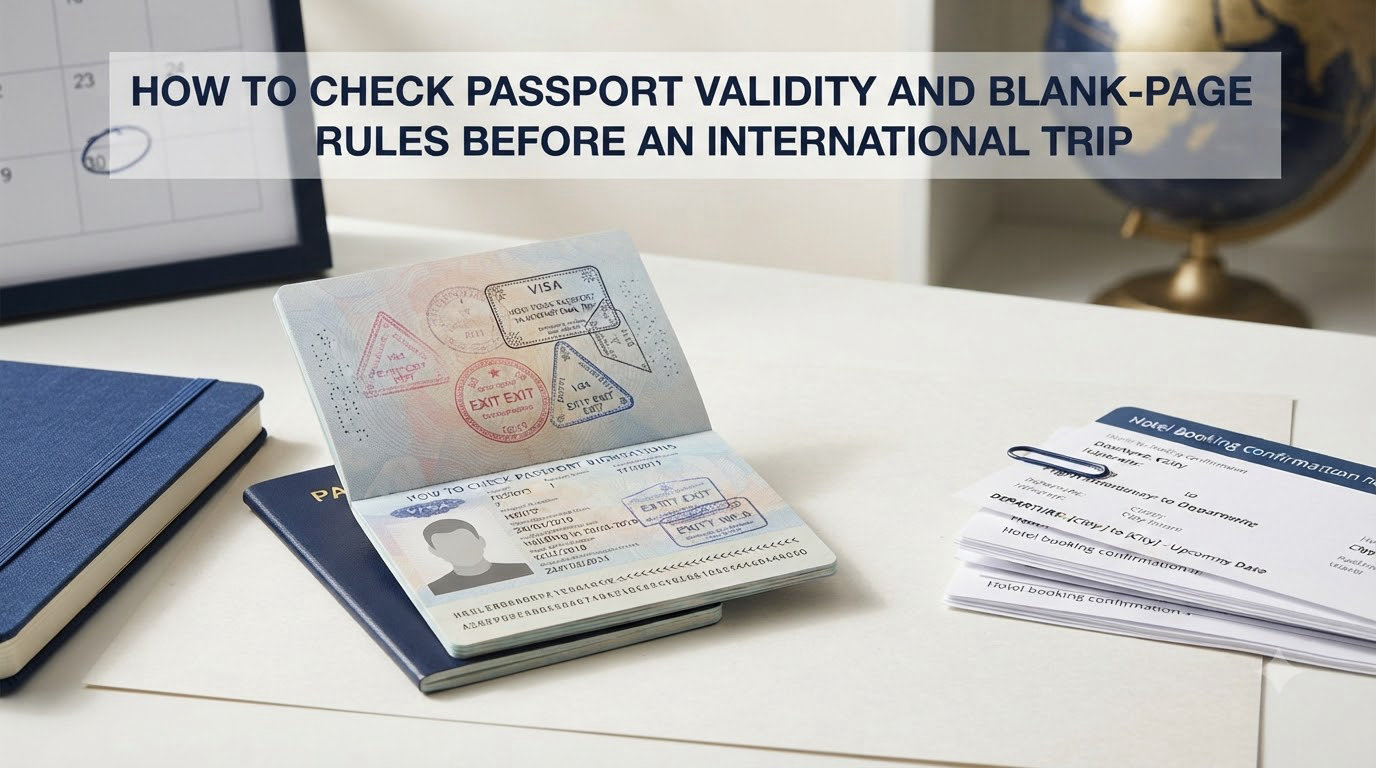
Picture this: you arrive at the airport excited for your long-planned international trip, only to be turned away at the check-in counter because your passport does not meet entry requirements. It happens more often than most travelers realize. Airlines are fined heavily for boarding passengers who lack valid documents, so gate agents enforce the rules strictly. Knowing how to check passport validity and blank-page rules before an international trip can save you thousands of dollars and a ruined vacation.
Most people glance at their passport expiration date and assume they are good to go. That assumption is dangerous because many countries require your passport to stay valid for three to six months beyond your planned return date. Others demand a specific number of completely blank pages for immigration stamps and visas. Failing either check can end your trip before it starts, and travel insurance rarely covers document oversights.
In this guide, I will walk you through every step of verifying your passport is ready for international travel. We will cover the six-month validity rule, blank-page requirements by country, what counts as a usable page, renewal options when you run low, and what to do if you travel frequently enough to fill a passport fast. By the end, you will have a clear checklist you can run through before booking any overseas flight.
Everything here is based on official State Department guidance, current immigration requirements, and real traveler experiences shared in forums like Reddit and TripAdvisor. I have organized it to be practical, so you can scan it in a few minutes or read it in full if you want complete confidence before your next border crossing.
Table of Contents
How to Check Passport Validity and Blank-Page Rules: The Quick Checklist
Run through these five checks before you book any international flight. If any item fails, address it immediately because processing times can stretch for weeks or months.
Check the expiration date: Open your passport to the photo page and read the date listed. Many countries require at least six months of validity beyond your return date.
Count completely blank pages: Flip through every page and count the ones with zero stamps, marks, or writing. Most destinations need at least one, some need two or more.
Look for damage: Water damage, torn pages, or a peeling photo page can render your passport invalid at the border.
Confirm you have a passport book, not just a card: The U.S. passport card does not work for international air travel. You need the book for flights.
Verify your destination’s specific requirements: Entry rules vary by country, so check the exact validity and page minimums for where you are going.
If you pass all five checks, your passport is likely ready. Read on for the details behind each step so you understand why these rules exist and how to handle edge cases.
What Passport Validity Actually Means
Passport validity is simply whether your passport is still accepted for international travel. It is determined by your expiration date and whether that date gives you enough cushion beyond your trip. An unexpired passport is not automatically a valid passport for every destination.
Validity also depends on physical condition and the type of document you carry. A damaged book or a passport card instead of a book can cause problems even when the date is fine. Let me break down the two most important validity concepts.
The 6-Month Validity Rule Explained
The six-month rule means your passport must remain valid for at least six months after your planned date of departure from your destination. This is not a suggestion from airlines. It is a legal requirement enforced by the destination country’s immigration authority.
Countries enforce this rule because they want a safety margin. If you are forced to stay longer than expected due to illness, a missed flight, or an emergency, your passport should still be valid long enough for you to leave legally. Without that buffer, you could overstay and face fines, detention, or future travel bans.
The Schengen Area, which includes most of Europe, enforces this strictly. So does China, Thailand, and much of Southeast Asia. Some countries require only three months beyond your stay, including the United Kingdom. A few, like Canada and Mexico for U.S. citizens, only need the passport to be valid for the duration of your visit. Always confirm the specific rule for your destination.
The International Civil Aviation Organization recommends the six-month rule, which is why so many countries adopted it. When in doubt, assume six months is the minimum.
How to Find and Read Your Expiration Date
Your passport expiration date is printed on the photo page inside the front cover. For U.S. passports, look for the line labeled “Date of Expiration” near your personal details. The format is day, month, year, which trips up many travelers accustomed to the American month-first format.
Once you find the date, calculate forward. Add six months to your planned return date and confirm your passport expires after that. If you have multiple destinations, use the date you leave the country with the strictest rule. For example, if you visit both the UK and France on one trip, France’s Schengen six-month rule applies and is the one you must satisfy.
Adult U.S. passports issued to travelers age 16 and older are valid for ten years. Passports issued to children under 16 are valid for only five years. If you renewed recently, double-check because your old expiration date may still be stuck in your memory.
Understanding Passport Pages: Visa Pages vs Endorsement Pages
Not every page in your passport is treated the same way by immigration officers. Understanding the difference between visa pages and endorsement pages prevents a common mistake that catches travelers off guard. Many people count endorsement pages as blank, only to be told at the border that they do not qualify.
What Counts as a Blank Page
A blank page is a visa page with absolutely nothing on it: no entry stamps, no exit stamps, no visas, no amendments, no notes from any immigration authority. Even a single stamp in a corner disqualifies the page for many countries.
Some immigration officers are flexible and will stamp on partially used pages if space allows. Others follow the letter of the law and require a fully blank sheet. You cannot predict which officer you will get, so treat any page with a mark as used.
This is where travelers get confused. A page with one small entry stamp still has visible white space. It looks usable. But for countries that require a blank page, that page does not count. Flip through your passport and only tally pages that are completely clean from edge to edge.
Endorsement Pages vs Visa Pages
U.S. passports contain two types of pages. Visa pages are the numbered pages where immigration stamps and visas go. Endorsement pages, usually near the back and marked “Amendments and Endorsements,” are for official changes like name updates, not for travel stamps.
Endorsement pages do not count as blank pages for entry requirements. This is the single biggest source of confusion I see in travel forums. People count every empty-looking page, including endorsement pages, and arrive at the airport thinking they have enough. The airline checks only visa pages and denies boarding.
To avoid this mistake, only count the numbered visa pages that are completely clean. Ignore the amendments section entirely when tallying your blank pages. When I checked my own passport before a trip to South Africa, I initially counted 4 pages but only 2 were actual visa pages, and South Africa requires 2 minimum. That close call is exactly why this distinction matters.
U.S. Passport Book Sizes and Page Counts
The standard U.S. passport book contains 28 pages, of which 17 are visa pages. The large book, which you can request at no extra cost when applying, contains 52 pages with 43 visa pages. Frequent travelers should always opt for the large book.
You cannot add pages to an existing U.S. passport anymore. The State Department discontinued the page-insert service in 2016. If you run out of pages, your only option is to renew, which means you lose any remaining validity on your current passport.
This is why frequent travelers burn through passports quickly. Each entry and exit uses page space. A round trip can consume one to two pages depending on the country. Visit five countries on one trip, and you might use eight or more pages.
Blank Page Requirements for International Travel
Blank page requirements exist because immigration authorities need physical space to stamp your entry and exit. Visas, whether physical stickers or ink stamps, also take up a full page or more. Without enough room, the officer literally has nowhere to process you.
According to data compiled from 199 countries, 152 require at least one blank page, 43 require two or three pages, and only 4 have no specified page requirement. That means the vast majority of destinations will check your page count before letting you in.
Why Countries Need Blank Pages
Every time you cross a border, the immigration officer stamps your passport. An entry stamp records when you arrived, and an exit stamp records when you left. Some countries place both on the same page, while others use separate pages.
Countries that issue visa-on-arrival or e-visa printouts need space to attach the document. A visa sticker is roughly the size of a full page, so one visa consumes an entire sheet. If you need both a visa and room for entry and exit stamps, you can easily need two or three pages for a single destination.
South Africa is famously strict. It requires two completely blank facing pages, meaning the two pages must be side by side when you open the book. A blank page followed by a stamped page does not satisfy this rule. Other strict enforcers include China, India, Brazil, and many African nations.
Country-Specific Blank Page Requirements
Below is a reference table covering popular destinations and their typical blank-page and validity requirements. Always double-check with your destination’s embassy or official travel authority before your trip, as rules change.
| Destination | Blank Pages Required | Validity Beyond Stay |
|---|---|---|
| Schengen Area (most of Europe) | 1 to 2 pages | 6 months |
| United Kingdom | 1 page | 3 months |
| South Africa | 2 facing pages | 6 months |
| China | 2 pages | 6 months |
| India | 2 pages | 6 months |
| Brazil | 2 pages | 6 months |
| Thailand | 1 page | 6 months |
| Japan | 1 page | 3 months |
| Australia | 1 page | Duration of stay |
| Canada (for U.S. citizens) | 1 page | Duration of stay |
| Mexico (for U.S. citizens) | 1 page | Duration of stay |
| Egypt | 1 page plus visa space | 6 months |
| Indonesia (Bali) | 1 page | 6 months |
Note that requirements can shift based on visa type. A country may require one page for visa-free entry but two or three if you need a visa-on-arrival. When applying for a visa in advance, the embassy often specifies exactly how many pages you need.
Step-by-Step Passport Validity Checklist Before You Book
Follow these steps in order before you pay for any international flight or hotel. Taking ten minutes now can prevent a costly mistake later.
Write down your return date. Find your exact planned departure date from your destination. This is the anchor for all validity calculations.
Add six months to that date. Mark this date on your calendar. Your passport must expire after this date for most destinations.
Check your passport expiration. Compare the date on your photo page to your calculated date. If it expires before the six-month mark, you need to renew.
Count completely blank visa pages. Only count numbered pages with zero marks of any kind. Write the number down.
Check your destination’s page minimum. Look up the requirement using the table above or the destination’s official immigration website.
Compare your page count to the requirement. If you have fewer pages than required, renew your passport before booking.
Inspect for physical damage. Look for water stains, torn pages, a damaged chip, or a peeling photo. Any of these can cause rejection.
Confirm you have the book, not just the card. The passport card is only valid for land and sea entry from Canada, Mexico, and the Caribbean. Air travel requires the book.
Make digital and physical copies. Photograph your passport and store it securely online. Carry a printed copy separately from the original.
Recheck one week before departure. Rules occasionally change, and you want to catch any updates before you reach the airport.
If everything passes, you are ready. If anything fails, move to the renewal section below and start the process immediately.
What to Do When Your Passport Runs Out of Blank Pages
Running out of pages is one of the most frustrating situations for frequent travelers. Your passport may still be valid for years, but without blank pages, you cannot enter most countries. Here is how to handle it.
Can You Add Pages to a U.S. Passport?
No, you cannot. The State Department stopped offering extra page inserts in 2016. Before that, travelers could request additional visa pages to be stitched into their existing book. That service is gone permanently.
This change caught many frequent travelers off guard. I have read dozens of forum posts from people who discovered at the airport that their five-year-old passport was full and they had no way to add pages. The only solution now is to renew the entire passport, even if it still has years of validity remaining.
When you renew for this reason, request the large 52-page book. It gives you 43 visa pages instead of 17, which roughly doubles your travel capacity before you need to renew again.
Passport Renewal Options and Processing Times
U.S. citizens have several renewal paths depending on how quickly they need the new passport. Standard processing takes several weeks, so plan ahead.
Online renewal: Eligible adults can renew online through the State Department’s portal if their most recent passport was issued within the last 15 years and they were 16 or older at the time. This is the easiest option for routine renewals.
Mail renewal (Form DS-82): If you do not qualify for online renewal, mail in the DS-82 form with your old passport, a new photo, and the fee. Processing takes several weeks for routine service.
In-person appointment: If you need it faster or do not qualify for mail renewal, schedule an appointment at a passport agency or acceptance facility. Expedited service is available for an additional fee and cuts the wait time significantly.
Emergency renewal: If you are traveling within 14 days, you can make an appointment at a passport agency for urgent service. Bring proof of travel like a flight itinerary. This is the fastest route and sometimes produces a passport within 24 to 48 hours.
Always check current processing times on the State Department website before you apply. Times fluctuate based on demand and season. Summer and holiday periods tend to have longer waits.
Second Passport Option for Frequent Travelers
If you travel internationally several times a year, a single passport may not have enough pages. The solution many people do not know about is a second valid passport. The State Department allows qualified U.S. citizens to hold two valid passports simultaneously.
A second passport is issued for a limited validity of four years rather than the standard ten. You typically qualify if you travel so frequently that you need one passport for travel while the other is at an embassy obtaining a visa. People who visit countries that conflict politically, such as needing stamps from both Israel and certain Middle Eastern nations, also qualify.
To apply, submit Form DS-82 along with a letter explaining your need for a second passport. You must include proof like upcoming travel itineraries, visa applications in progress, or business travel documentation. The process is straightforward once you have your justification ready.
This option is underused because most travelers do not know it exists. I have seen frequent flyers renew their passport three times in five years because they kept running out of pages, when a second passport would have solved the problem. If you take more than four or five international trips annually, look into it.
Upcoming Entry Requirements: ETA and ETIAS
Several countries are rolling out electronic travel authorization systems that add a new step to international travel. These do not replace your passport, but you must complete them before departure or you will be denied boarding.
The United Kingdom introduced its Electronic Travel Authorization (ETA) for visa-exempt visitors. If you are traveling to the UK, check whether your nationality requires an ETA and apply online before your trip. The process is quick but mandatory.
The European Union is launching ETIAS, its own travel authorization system, expected in 2027. It will apply to visa-exempt travelers visiting the Schengen Area. You will complete an online application and receive approval before travel. It is similar to the U.S. ESTA system that has been in place for years.
Australia already requires an ETA or eVisitor for most short-term visitors. The U.S. requires an ESTA for visitors from visa waiver countries. None of these replace your passport, but each adds a requirement you must satisfy in addition to validity and blank pages. Build these checks into your pre-trip routine.
Passport Planning Tips Every Traveler Should Know
These practical tips come from official guidance and real traveler experiences shared across travel forums. They address the most common pitfalls I have seen trip after trip.
Request the large book when you apply or renew. The 52-page book costs the same as the 28-page book but gives you far more visa pages. There is no downside to choosing it.
Keep a digital backup. Take clear photos of your passport photo page and store them in a secure cloud service. If your passport is lost or stolen abroad, this speeds up replacement at an embassy.
Carry a printed copy separate from the original. Keep one copy in your luggage and one in your carry-on. If one is lost, you still have documentation.
Renew early, not late. Start the renewal process when your passport hits the nine-month validity mark. This gives you a comfortable buffer for the six-month rule at most destinations.
Ask immigration officers to conserve pages. When possible, politely ask the officer to stamp on a partially used page if space allows. Many will accommodate the request, which extends your passport’s usable life.
Check requirements for every country on a multi-stop trip. The strictest country’s rules apply. If one destination requires two facing pages, make sure you have that before you leave home.
Protect your passport from damage. Use a cover, keep it away from water, and do not let it bend. Water damage is a leading cause of passports being rejected at borders.
Do not assume renewal is fast. Processing times spike during peak travel seasons. Apply at least two months before your trip for routine service to avoid stress.
Travelers on Reddit frequently share stories of being denied boarding for reasons that seem minor. One user reported arriving for a South Africa trip with one blank page instead of the required two facing pages. They were not allowed to board and lost the entire trip. Another traveler had a passport damaged by a leaky water bottle in their bag, and the frayed pages led to questioning at customs. These situations are preventable with a few minutes of preparation.
FAQs
How to check passport validity before travel?
Open your passport to the photo page and read the expiration date. Add six months to your planned return date and confirm your passport expires after that. Then count your completely blank visa pages and compare the number to your destination’s requirement. Most countries need at least one blank page, and some need two or more.
Which countries require blank pages for passport?
Approximately 152 of 199 countries require at least one blank visa page. Strict enforcers include South Africa (2 facing pages), China (2 pages), India (2 pages), Brazil (2 pages), and the Schengen Area (1 to 2 pages). Countries like Egypt, Indonesia, Kenya, and Jamaica also require one or more blank pages.
Do you need blank pages in a passport to travel?
Yes, for most international destinations. Immigration officers need physical space to stamp your entry and exit. Without at least one completely blank visa page, many countries will deny you entry. Only a handful of destinations have no specified page requirement.
What happens if your passport runs out of blank pages?
You cannot enter most countries. Since 2016, the U.S. no longer allows you to add pages to an existing passport, so your only option is to renew the entire book even if it has years of validity left. Request the large 52-page book when you renew to delay the problem.
What counts as a blank page in a passport?
A blank page is a numbered visa page with zero stamps, marks, visas, or writing of any kind. Endorsement and amendment pages near the back do not count. Even a single small stamp disqualifies a page for countries that require a fully blank sheet.
Why do I need blank pages in my passport?
Immigration authorities need space to stamp your entry and exit, and visas take up a full page or more. Countries require blank pages to guarantee they can process you properly when you arrive and when you leave.
What if I run out of blank pages on my passport?
You must renew your passport before your next international trip. The page-insert service was discontinued in 2016, so renewal is the only option. If you travel frequently, apply for a second valid passport or always request the 52-page large book to maximize your page count.
Conclusion
Checking your passport before an international trip takes ten minutes and can save your entire vacation. Confirm your expiration date clears the six-month rule, count only completely blank numbered visa pages, verify your destination’s specific requirements, and inspect for physical damage. If anything falls short, start the renewal process immediately and request the large 52-page book.
Now that you know how to check passport validity and blank-page rules before an international trip, make this checklist part of your routine before booking any overseas flight. A few minutes of preparation beats being turned away at the gate. Safe travels.