
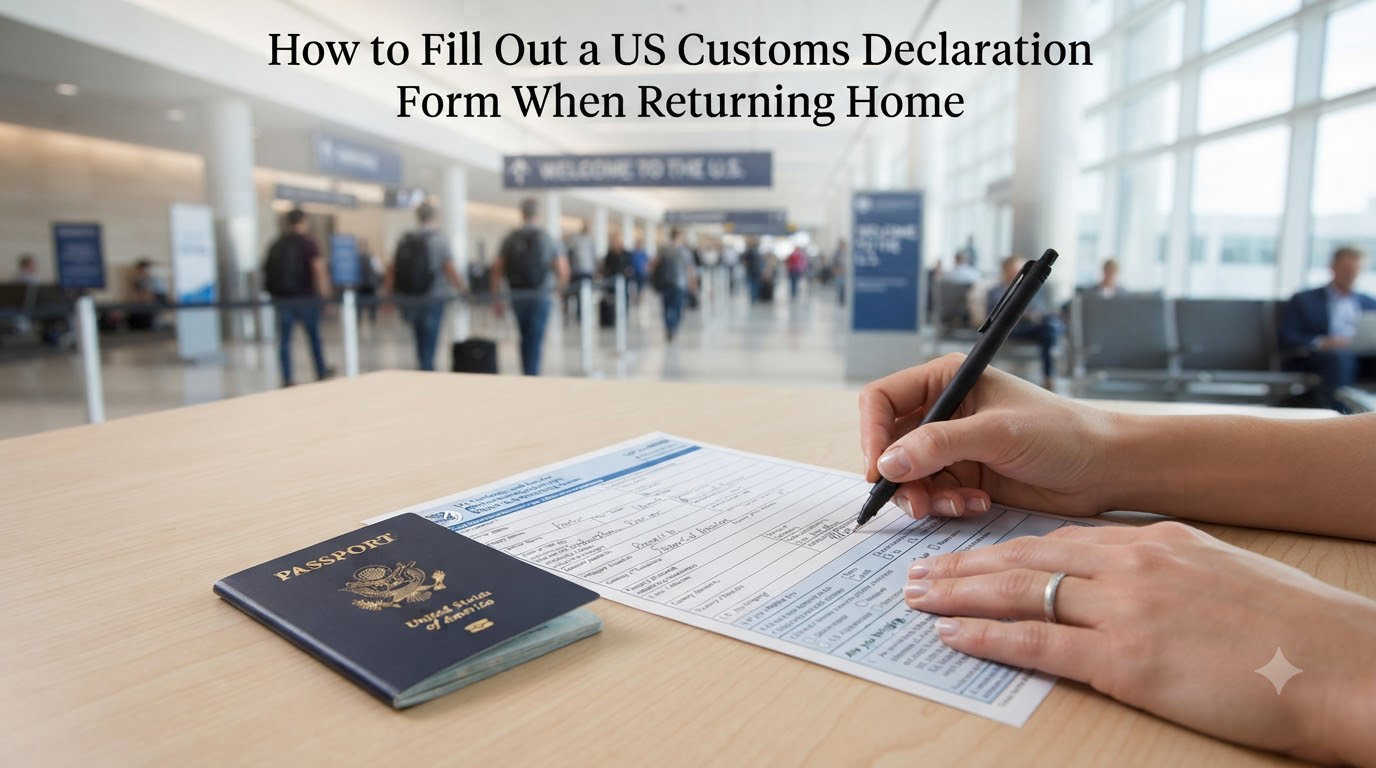
Walking off a long international flight and facing a US customs declaration form can feel stressful, especially after hours of travel. I have filled out this form more times than I can count, and I have seen fellow passengers freeze at the sight of those small checkboxes. The good news is that the process is far simpler than it looks once you understand what each section asks.
This guide walks you through every part of the US customs declaration form so you can complete it quickly and confidently. You will learn what Form 6059B is, who needs to fill it out, how to handle each of the 15 sections, and how duty-free allowances work. I will also cover common mistakes, the $10,000 currency rule, and what actually happens when you reach the customs checkpoint.
Whether you are a returning US resident or a first-time visitor, this walkthrough will help you avoid delays and surprises. The key rule to remember throughout is simple: honesty always makes the process smoother.
Table of Contents
What Is the CBP Declaration Form 6059B?
The CBP Declaration Form 6059B is the official document US Customs and Border Protection uses to collect basic information about who you are and what you are bringing into the United States. Every traveler arriving by air or sea encounters this form or its electronic equivalent. It is a single-page document with 15 numbered sections that you complete before reaching the customs officer.
The form exists to help CBP assess whether you owe duty taxes on purchased goods and to screen for prohibited items like certain foods, plants, and animal products. You will usually receive it from your airline during the flight, or you can download the fillable PDF version from the CBP website ahead of time.
Many travelers ask whether they can complete the declaration online rather than on paper. The answer depends on your entry method. If you use a Global Entry kiosk, an Automated Passport Control kiosk, or the Mobile Passport Control app, the declaration questions are built into the digital process and no paper form is needed. Travelers going through the standard line still receive and complete the paper form.
Who Needs to Fill Out a Customs Declaration?
Every individual arriving in the United States must complete a customs declaration, including US citizens, lawful permanent residents, and foreign visitors. There are no exceptions based on nationality or how long you were abroad. Even if you bought nothing and are carrying only personal items, you still go through the declaration process.
One Form Per Family: The Rule That Confuses Everyone
Here is where many travelers get tripped up. US customs follows a one-form-per-family rule, meaning a single declaration covers all family members living in one household who are returning together. Each traveling family member does not need a separate form.
CBP defines a family as members of a household residing in one home. This includes spouses, unmarried minor children, and unmarried parents traveling with their minor children. Adult children traveling with their parents, friends sharing a trip, or unmarried partners living in separate homes each need their own form.
If you are traveling with a roommate or an adult friend, you each fill out a separate declaration. If you are a family of four returning from vacation together, only one parent completes the form and lists the combined value of goods for the entire family.
Returning Residents Versus Visitors
The form asks whether you are a US resident or a visitor, and this distinction matters because the duty-free allowances differ significantly. US residents enjoy a personal exemption of $800 worth of goods. Visitors (non-residents) typically receive a $100 duty-free allowance for personal items. I cover the exact calculations in the duty-free section below.
How to Fill Out a US Customs Declaration Form: Step by Step
Filling out the US customs declaration form comes down to completing 15 numbered boxes in order. I will walk you through each one so you know exactly what to write. Have your passport handy, since several fields require details printed inside it.
Box 1. Family Name: Print your last (family) name exactly as it appears in your passport. Use capital letters and write clearly so the officer can read it without asking.
Box 2. First (Given) Name: Enter your first given name as shown in your passport. If you have multiple given names, include the first one at minimum.
Box 3. Date of Birth: Write your birth date in the requested format, typically month, day, and year. Double-check the format requested, since mixing up day and month is a common error.
Box 4. Number of Family Members Traveling With You: Count only family members covered by this one form. If you are traveling alone or are the sole household member, write the appropriate number reflecting your group. Do not count friends or non-household companions.
Box 5a. Present Address: Write your complete home address including street, city, state, and zip code. Use the address where you actually reside, not a temporary or business address.
Box 5b. Passport Number: Copy your passport number exactly as printed. One wrong digit can cause delays while the officer verifies your identity.
Box 6. Country of Residence: Write the country where you currently live. For US residents, this is the United States regardless of citizenship status.
Box 7. Countries Visited on This Trip: List every country you visited before arriving in the United States on this trip. Include layover countries if you left the airport. The CBP officer uses this to assess agricultural risk based on where you traveled.
Box 8. Primary Purpose of This Trip: The form typically asks whether your trip is for business or personal reasons. Check the box that matches the main purpose of your travel. If your trip was mostly tourism with one business meeting, personal is usually the right choice.
Box 9a. Arriving by Air or Sea: Check the box that matches your mode of arrival. This helps route your form through the correct processing system.
Box 9b. Airline or Vessel Name/Flight Number: Write the name of your airline or cruise line and your flight or voyage number. You can find this on your boarding pass.
Box 10. Commercial Merchandise: This question asks whether you are carrying commercial merchandise, meaning goods purchased for resale or business use rather than personal use. If you are bringing back items to sell, check yes. Personal gifts and souvenirs do not count as commercial merchandise.
Box 11. Total Value of All Goods: Add up the total value of everything you purchased abroad and are bringing back, for all family members on this form. Use US dollars and round to the nearest dollar. I explain how this number interacts with your duty-free allowance in the next section.
Box 12. The Declaration Questions (Foods, Animals, Soil): This cluster of yes-or-no questions asks whether you are carrying specific restricted items. Check yes if you have any of the listed items, even if you believe they are allowed. Declaring an item does not mean it will be confiscated; it simply lets the officer inspect it. I break down each declaration question in detail later in this guide.
Box 13. Have You or Any Family Member Been in Close Proximity to Livestock: Check yes if you visited a farm, ranch, or had close contact with farm animals during your trip. This helps CBP screen for animal-borne diseases. Checking yes may result in a brief additional question, not a denial of entry.
Box 14. Currency and Monetary Instruments Over $10,000: Check yes if you are carrying more than $10,000 in combined currency, coins, or monetary instruments such as traveler’s checks or negotiable instruments. I cover the full rules in the currency reporting section.
Box 15. Resident or Visitor and Signature: Check the box indicating whether you are a US resident or a visitor, which determines your duty-free allowance. Then sign and date the form. Your signature confirms that everything you wrote is accurate and complete.
Duty-Free Allowances: What You Can Bring Back
The duty-free allowance is the total value of goods you can bring into the United States without paying import taxes. The amount depends on your status as a resident or a visitor and how frequently you travel.
US residents returning from most countries can bring back up to $800 worth of goods duty-free. This personal exemption applies once every 30 days. Anything above $800 may be subject to a flat 3 percent duty on the next $1,000 worth of goods, followed by the rate that applies to each item after that.
Visitors (non-residents) entering the United States generally receive a $100 duty-free allowance for personal items they intend to take home. Gifts and personal effects valued under $100 enter without duty. Amounts above $100 may be subject to duty.
The $800 resident allowance applies to goods you acquired abroad for personal or household use, or as gifts. It does not cover items intended for resale, which fall under commercial merchandise rules in Box 10. Keep your receipts organized so you can prove the value of each purchase if asked.
If you travel abroad more than once every 30 days, the $800 exemption still applies, but you can only claim it once within that window. Frequent international travelers should track their trip dates to avoid unexpected duty charges.
One important note: certain items like alcohol and tobacco have separate quantity limits regardless of total value. Residents 21 and older can generally bring back one liter of alcohol duty-free, and visitors face their own limits. Check current CBP limits before your trip, since these can change.
Currency Reporting: The $10,000 Rule
Anyone bringing more than $10,000 in currency or monetary instruments into the United States must report it to CBP. This rule applies to all travelers regardless of citizenship, and it covers cash, coins, traveler’s checks, money orders, and negotiable instruments. The threshold is a combined total, so $6,000 in cash plus $5,000 in traveler’s checks means you must report.
If you are carrying over $10,000, check yes on Box 14 of the customs form. You will also need to complete FinCEN Form 105, the Report of International Transportation of Currency or Monetary Instruments. CBP officers can provide this form at the checkpoint.
Reporting the money is not illegal and does not mean it will be seized. Failing to report, however, is a serious violation that can result in confiscation of the entire amount and potential legal penalties. Always report honestly if you are carrying a large sum, even if the source is legitimate.
Family members cannot split the amount to avoid the threshold. If a household is collectively carrying $10,000 or more, it must be reported on the combined form.
Declaration Questions Explained: What Counts
Box 12 of the customs form contains several yes-or-no questions about restricted items, and these are the questions that cause the most anxiety. I want to reassure you: checking yes does not automatically mean your items will be taken. It simply triggers an inspection so the officer can determine whether the specific item is permitted.
Fruits, vegetables, plants, and seeds: Check yes if you have any fresh produce, dried fruits, live plants, cut flowers, or seeds. Many agricultural products are allowed with inspection, but some are strictly prohibited depending on the country of origin. When in doubt, declare it.
Meat and animal products: Check yes if you are carrying meat, cheese, dairy, eggs, or products made from animal materials. Rules vary by country due to animal disease concerns. Cooked and commercially packaged items are often permitted, while raw meats frequently are not.
Livestock, birds, and snails: This question covers live animals and related products. Most travelers do not carry these, but if you do, declare them so CBP can assess whether they meet import requirements.
Disease agents, cell cultures, and snails: This applies primarily to researchers and scientists. If you are transporting biological materials, check yes and be prepared to show documentation.
Soil or been on a farm: Check yes if you visited a farm, ranch, or area with livestock, or if your shoes and gear have soil on them. CBP may ask to disinfect your footwear. This is a routine agricultural safeguard.
The single best approach is honesty. Declaring an item that turns out to be prohibited means the officer confiscates it, but you face no penalty for declaring it. Failing to declare a prohibited item, even by accident, can result in fines starting at $300 and escalating from there.
Global Entry and Automated Kiosk Alternatives
If you want to skip the paper form entirely, several electronic options streamline the customs process. These programs replace the paper Form 6059B with digital questions asked at a kiosk or through an app.
Global Entry Kiosks
Global Entry is a trusted-traveler program that gives pre-approved, low-risk travelers access to expedited kiosks at major US airports. At a Global Entry kiosk, you scan your passport or US permanent resident card, verify your identity through facial biometric comparison, and answer the declaration questions on screen. The kiosk prints a receipt, and you hand it to the CBP officer on your way out.
Global Entry members must still answer all the same declaration questions about food, currency, and purchased goods. The difference is speed. The entire kiosk interaction typically takes under two minutes, and you never handle a paper form.
Automated Passport Control (APC) Kiosks
APC kiosks are available to a broader range of travelers, including those without Global Entry membership. You answer customs and passport questions on a touch screen, receive a printed receipt, and present it to the CBP officer. APC does not require advance enrollment or an application fee.
Mobile Passport Control App
The free Mobile Passport Control app, offered by CBP, lets you submit your passport information and customs declaration from your smartphone before you reach the officer. After completing the app, you show the digital receipt at a dedicated line. The app is available to US citizens and Canadian visitors at participating airports.
All three electronic options ask the exact same declaration questions as the paper form. The information you provide is identical, only the delivery method changes.
Common Mistakes to Avoid on Your Customs Form
After watching travelers go through this process, I have noticed a pattern of avoidable errors. Here are the most common mistakes and how to prevent them:
Underestimating the value of your purchases. Some travelers round down or forget items to stay under the $800 limit. Add every purchase accurately. If you cannot remember an exact price, give your best honest estimate, which officers generally accept.
Not declaring food items. This is the single most common reason travelers get flagged for secondary inspection. Even a snack in your bag counts. Declare it and let the officer decide whether it is allowed.
Forgetting the family-form rule. Travelers who are not actually part of the same household sometimes try to combine onto one form. If you do not share a residence, you need separate declarations.
Leaving boxes blank. Every section of the form should have an answer. If a question does not apply, check no or write zero rather than leaving it empty. Blank boxes prompt questions and slow you down.
Guessing at your passport number. Take ten seconds to open your passport and copy the number exactly. A transposed digit can trigger a manual verification.
Panic about checking yes. Many travelers fear that checking yes on a declaration question will cause problems. In reality, honest declarations are the fastest path through customs. Officers appreciate transparency and routinely wave through travelers who declared minor items that turn out to be permitted.
What Happens at the Customs Checkpoint
Once you hand in your form (or kiosk receipt), the customs process begins. Understanding what to expect can ease the anxiety that many first-time travelers describe in travel forums.
Primary Inspection
Primary inspection is the standard checkpoint every traveler passes through. The CBP officer reviews your declaration form, passport, and asks a few questions about your trip. Common questions include where you went, what you purchased, and whether you are carrying any food. Most travelers clear primary inspection in under a minute and are on their way.
Answer clearly and honestly. If the officer asks to see your receipts, hand them over. A short, direct conversation is all that happens for the vast majority of travelers.
Secondary Inspection
Secondary inspection is a more detailed check that happens when the officer wants to verify something on your form. You might be sent to secondary if you declared food, if your goods value is high, or if a random check is selected. It is not a punishment or a sign you did something wrong.
During secondary inspection, an officer may look through your luggage, ask follow-up questions, or examine specific items. They might check whether a declared food product is permitted or verify the value of purchases against your receipts. The process typically takes 10 to 20 minutes.
Stay calm and cooperative. Officers conduct secondary inspections routinely, and being helpful moves the process along faster. If an item is prohibited, the officer confiscates it and documents the interaction. If everything checks out, you proceed to the exit.
Electronic Device Inspections
CBP officers have the authority to inspect electronic devices at the border, including phones, laptops, and tablets. This applies to all travelers, citizens and non-citizens alike. Device inspections are relatively rare for ordinary tourists but more common for travelers who raise concerns.
If your device is selected for inspection, the officer may ask you to power it on and may review its contents. To prepare, back up your data before traveling and consider using password protection. US citizens are not required to unlock devices, though refusal may lead to longer delays. Non-citizens should be aware that refusal can affect their admissibility.
Frequently Asked Questions
How do I fill out a customs declaration?
Fill out all 15 sections of CBP Form 6059B with your personal details, passport information, countries visited, and answers to the declaration questions about food, currency, and purchased goods. Sign and date the form, then hand it to the CBP officer at the checkpoint.
What forms do I need to fill out when returning to the USA?
Most travelers complete CBP Declaration Form 6059B, either on paper or through an electronic kiosk. If you use Global Entry, an Automated Passport Control kiosk, or the Mobile Passport Control app, the declaration questions are built into the digital process and no paper form is needed.
What are common mistakes on customs forms?
The most common mistakes include underestimating purchase values, failing to declare food items, leaving boxes blank, misusing the one-form-per-family rule, and copying passport numbers incorrectly. Honest, complete answers prevent most issues.
Can I fill out my customs declaration online?
Yes. If you use a Global Entry kiosk, Automated Passport Control kiosk, or the free Mobile Passport Control app, you answer the declaration questions electronically instead of filling out a paper form. Travelers using the standard line still complete the paper version.
Final Thoughts on Filling Out Your Customs Declaration
Knowing how to fill out a US customs declaration form removes the guesswork from re-entering the country after international travel. The form has 15 straightforward sections, and once you understand what each one asks, the process takes only a few minutes.
Remember the key numbers: $800 duty-free for residents, $100 for visitors, and $10,000 for currency reporting. Keep your receipts, declare food honestly, and use the one-form-per-family rule correctly. If you travel frequently, consider enrolling in Global Entry or using the Mobile Passport Control app to skip the paper form entirely.
Most importantly, honesty is the fastest path through customs. Officers deal with thousands of travelers every day, and a transparent, complete declaration gets you through the checkpoint with minimal fuss. Safe travels, and welcome home.