
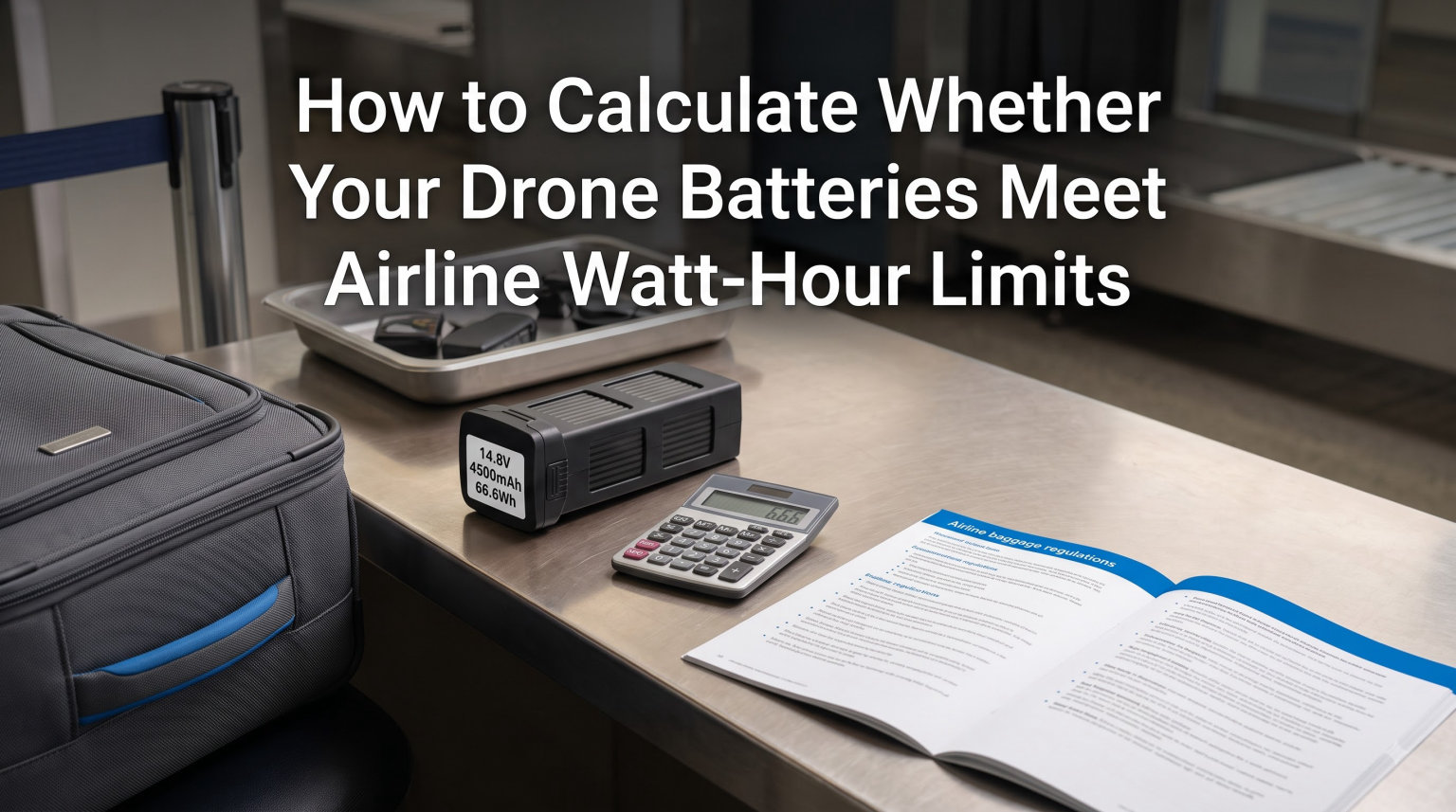
I learned this lesson the hard way on a flight from Jakarta to Bali. My DJI Mavic Air 2 was packed, my drone case was ready, and I confidently walked through security. Twenty minutes later, I was watching a TSA-equivalent officer hold up my battery pack and ask, “How many watt hours is this?” I did not have a clear answer. They let me through that time, but I never flew again without knowing the exact number on every battery in my bag.
This guide is the resource I wish I had back then. I will walk you through the exact formula to calculate a drone battery’s watt-hour rating, show you real examples using popular DJI batteries, and break down the FAA, IATA, and most major airline rules so you know exactly what is allowed, what needs approval, and what will get confiscated at the gate. Whether you fly domestic or international with a lithium polymer battery, this is the calculation you need to master.
Table of Contents
What Is a Watt-Hour and Why Do Airlines Use It?
A watt-hour (Wh) is a unit of energy that tells you how much power a battery can deliver over one hour. Airlines care about watt-hours because lithium-ion and lithium polymer (LiPo) batteries can experience thermal runaway, a chain reaction where one cell overheats and triggers the cells next to it, which can cause fires or explosions in the cabin or cargo hold. Higher watt-hour ratings mean more stored energy, which means more risk if something goes wrong.
Think of watt-hours like the size of a gas tank. A small battery (under 100 Wh) is a sip of fuel. A mid-sized battery (100-160 Wh) is a full tank. A battery over 160 Wh is a fuel tanker, and airlines will not let you bring one on board. By capping watt-hour ratings, regulators limit the total energy that can go wrong in a single incident, which keeps passengers safer.
The Three Energy Categories Airlines Care About
0 to 100 Wh: Low energy, no airline approval needed for most carriers
100 Wh to 160 Wh: Medium energy, requires advance airline approval and is usually limited to two spare batteries per passenger
Over 160 Wh: High energy, prohibited on passenger aircraft entirely
Every LiPo battery you own falls into one of these three buckets. Your job is to figure out which one before you get to the airport.
The Watt-Hour Calculation Formula for Drone Batteries
The watt-hour formula is straightforward: multiply voltage (V) by amp hours (Ah). That gives you the energy capacity in watt-hours. Here is the core equation you need to memorize.
Wh = Voltage (V) x Amp Hours (Ah)
Most drone batteries list their voltage and capacity on the label. If you see a capacity listed in milliamp hours (mAh), you need to convert it first by dividing by 1000. Then multiply by the voltage.
Wh = (mAh / 1000) x Voltage (V)
LiPo Shortcut: Calculate Wh Using Cell Count
Drone batteries are usually labeled with a cell count like 3S, 4S, or 6S. Each lithium-polymer cell has a nominal voltage of 3.7V. So you can use this shortcut.
Wh = Cell Count x 3.7V x Amp Hours (Ah)
A 3S 2200mAh battery, for example, is 3 x 3.7 x 2.2 = 24.42 Wh. This shortcut is useful when you only know the cell count and capacity, not the exact voltage printed on the label.
Step-by-Step Calculation Examples Using Real Drone Batteries
Let me run the formula with batteries you probably own or have considered buying. I pulled these specs directly from manufacturer listings so the numbers are accurate.
Example 1: DJI Mavic Air 2 Battery
The label reads 11.55V, 3500 mAh. Convert mAh to Ah: 3500 / 1000 = 3.5 Ah. Multiply by voltage: 11.55 x 3.5 = 40.43 Wh. This is well under 100 Wh, so it flies without any airline approval.
Example 2: DJI Phantom 4 Pro Battery
The label reads 15.2V, 5870 mAh. Divide by 1000: 5.87 Ah. Multiply: 15.2 x 5.87 = 89.22 Wh. Still under 100 Wh, so this one is also fine to carry on without permission.
Example 3: DJI FPV Battery
The label reads 22.2V, 2000 mAh. Convert: 22.2V x 2.0 Ah = 44.4 Wh. As one Reddit user on r/dji confirmed, these batteries slot in comfortably under the 100 Wh line. No approval needed.
Example 4: DJI Inspire 1 Battery (TB47)
The label reads 22.2V, 4500 mAh. Calculation: 22.2 x 4.5 = 99.9 Wh. Just under the limit. The larger TB48 battery on the same drone reads 22.8V, 5700 mAh, which equals 129.96 Wh. That one crosses into the approval-required zone, and as a mavicpilots forum user noted, you cannot carry it without written permission from the airline in advance.
Example 5: A 6S 5000 mAh FPV LiPo
Using the cell-count shortcut: 6 x 3.7 x 5.0 = 111 Wh. Anything over 100 Wh means you need airline approval and a LiPo safe bag for the flight.
FAA and IATA Drone Battery Airline Regulations for 2026
The FAA, the U.S. agency that governs civil aviation, and IATA, the International Air Transport Association, both treat lithium batteries as hazardous materials. The rules below apply to U.S. domestic flights and most international carriers. Always confirm with your specific airline before you fly, but these are the baseline standards you must meet.
Summary of the rules:
Batteries must be in carry-on baggage, not checked bags, when they are spares
Installed batteries (one inside the drone) are allowed in both carry-on and checked bags under most rules
Terminals must be protected from short circuit, usually with tape or a battery case
Batteries over 160 Wh are prohibited on passenger aircraft
Batteries 100-160 Wh require airline approval, typically capped at two spare batteries per passenger
Under 100 Wh: No Airline Approval Required
Drone batteries under 100 Wh are the easiest category. You can carry them on board, you do not need airline approval, and most carriers place no limit on the number of spares you can bring, beyond what fits in your bag. The DJI Mavic series, Mini series, Air series, Phantom 4 series, and FPV batteries all fall into this zone. So do most consumer and prosumer LiPo packs under 5000 mAh at lower cell counts.
You still need to keep them in your carry-on, not your checked bag, and you should protect the terminals. But the 100 Wh ceiling is the threshold where you stop sweating paperwork.
100 Wh to 160 Wh: Airline Approval and Quantity Limits
This is the trickiest category because rules vary by airline, but the FAA and IATA rules are consistent. Batteries between 100 Wh and 160 Wh are allowed on board, but only with airline approval and usually capped at two spare batteries per passenger.
“Approval” usually means you need to contact the airline at least 72 hours before departure, submit a request, and receive written confirmation, often via email. Some carriers publish a form on their website. Others handle it on the phone. None of them grant approval at the gate, so do this before you leave for the airport.
Examples of batteries in this range: the DJI Inspire 2 standard battery (130 Wh), some DJI Matrice batteries, and larger 6S FPV LiPos over 5000 mAh. If your battery is anywhere near 100 Wh, check the exact number on the label and prepare the approval email before you pack.
Over 160 Wh: Prohibited on All Commercial Flights
Batteries above 160 Wh are not allowed on passenger aircraft, period. This applies to checked bags, carry-on bags, and the cabin. The only way to transport them is by ground cargo under full hazardous materials shipping regulations, which is expensive and slow. For most drone pilots, this is a hard limit.
Why is the limit 160 Wh? At that capacity, the stored energy is enough to sustain a serious thermal runaway event that could overwhelm a cabin’s fire suppression system. Regulators consider it an unacceptable risk. If your battery exceeds 160 Wh, leave it home or ship it separately.
Carry-On vs Checked Baggage Rules for Drone Batteries
The split between carry-on and checked baggage is one of the most misunderstood parts of drone battery travel rules. Here is the clean version.
Spare batteries: Must be in your carry-on bag. Never in checked baggage
Batteries installed in your drone: Typically allowed in both carry-on and checked bags, but carry-on is still preferred
Power banks: Treated as spare lithium batteries, so they go in your carry-on only
Damaged or recalled batteries: Forbidden on all aircraft, both carry-on and checked
The reason for the carry-on rule is visibility. If a battery starts to smoke or overheat, cabin crew can see it and respond. In the cargo hold, a thermal runaway event can go undetected until it’s too late. Your spare batteries stay with you at your seat or in the overhead bin.
Spare Battery Restrictions and the 100 Wh Threshold
“Spare” means any battery not currently inside a device. If you have a drone with one battery installed in the aircraft and three extras in your bag, those three are spares. The installed battery is fine in either bag. The spares must be in your carry-on.
For under 100 Wh batteries, the number of spares is generally unlimited, but practical limits apply. Most travelers carry 3 to 6 spares without issue. For 100-160 Wh batteries, the FAA caps you at two spares per passenger, and the airline has to say yes in advance. If you need more than two, you may need to fly on two segments with different battery sets, or borrow batteries at your destination.
Common Drone Battery Watt-Hour Ratings Quick Reference
This quick reference table covers the most popular consumer and prosumer drone batteries. Use it to check your battery at a glance, but always verify the exact number on the label printed by the manufacturer.
| Drone / Battery | Voltage | Capacity | Watt-Hours | Category |
|---|---|---|---|---|
| DJI Mavic Mini | 7.2V | 1100 mAh | 7.92 Wh | Under 100 Wh |
| DJI Mini 2 / Mini 3 | 7.7V | 2250 mAh | 17.32 Wh | Under 100 Wh |
| DJI Mavic Air 2 | 11.55V | 3500 mAh | 40.43 Wh | Under 100 Wh |
| DJI Air 2S | 11.55V | 3500 mAh | 40.43 Wh | Under 100 Wh |
| DJI Mavic 3 | 15.4V | 5000 mAh | 77 Wh | Under 100 Wh |
| DJI Phantom 4 Pro | 15.2V | 5870 mAh | 89.22 Wh | Under 100 Wh |
| DJI FPV | 22.2V | 2000 mAh | 44.4 Wh | Under 100 Wh |
| DJI Inspire 1 (TB47) | 22.2V | 4500 mAh | 99.9 Wh | Under 100 Wh (just) |
| DJI Inspire 1 (TB48) | 22.8V | 5700 mAh | 129.96 Wh | 100-160 Wh, approval required |
| DJI Inspire 2 | 22.8V | 5700 mAh | 129.96 Wh | 100-160 Wh, approval required |
| DJI Matrice 300 TB60 | 52.8V | 2745 mAh | 144.94 Wh | 100-160 Wh, approval required |
| Generic 6S 5000 mAh FPV | 22.2V | 5000 mAh | 111 Wh | 100-160 Wh, approval required |
How to Prepare Drone Batteries for Air Travel
Knowing the watt-hour rating is only half the job. Your batteries also need to be physically prepared for travel so they cannot short circuit, ignite, or get flagged by security. Here is the packing checklist I follow before every flight.
Discharge to storage charge level (40-50%). A full battery is more energetic and more prone to thermal runaway than a partly drained one. Most smart chargers have a “storage” mode that discharges or charges to this range automatically.
Cover the terminals. Use a small piece of electrical tape, a battery cap, or a dedicated LiPo safe bag to ensure the metal contacts cannot touch anything conductive during the flight.
Place each battery in a LiPo safe bag or individual case. A LiPo safe bag is a fireproof sleeve that contains a battery if it ignites. Costs about 10 to 25 dollars and is required by some airlines for the 100-160 Wh category.
Label each battery clearly. Use a permanent marker or printed label to show the Wh rating on the outside of the LiPo bag. Airport security will thank you.
Keep batteries in your carry-on, not your checked bag. This is non-negotiable for spares.
Carry your airline approval email for 100-160 Wh batteries. Have it printed or saved on your phone, ready to show if asked.
What to Do If TSA or Airline Staff Don’t Know the Rules
This is a real pain point for drone travelers. I have seen agents insist that drone batteries must go in checked bags, or that all batteries over 100 Wh are banned. They are sometimes wrong. The fix is to stay calm, point to the FAA PackSafe page on your phone, and reference the relevant watt-hour limit. Print a copy of the FAA’s chart and keep it in your camera bag. If the agent still refuses, ask for a supervisor. In a worst case, you may have to leave the batteries behind, but in my experience, courteous persistence resolves it.
International Airline Variations and What to Watch For
Non-U.S. carriers sometimes have stricter rules than the FAA baseline. British Airways, Qantas, and Air Canada, for example, may require you to discharge batteries to a specific state of charge and carry them only in specific battery bags. Some Asian carriers limit the number of total spares regardless of watt-hour class. Before you book an international flight, visit the airline’s special baggage page and email customer service to confirm.
For the 100-160 Wh range, I always request written approval in advance. Some carriers take 48 hours, others take a week. Build that into your packing timeline. If you cannot get approval, do not bring the high-capacity batteries. Borrow at the destination or rent a drone locally instead.
FAQs: Drone Battery and Airline Watt-Hour Limits
What is the watt hour limit for airline batteries?
Most airlines follow the FAA and IATA rules. Batteries up to 100 Wh are allowed in carry-on bags with no approval needed. Batteries between 100 Wh and 160 Wh need advance airline approval and are usually capped at two spare batteries per passenger. Anything over 160 Wh is banned on passenger aircraft.
How do I calculate the watt hours of a drone battery?
Multiply the voltage (V) by the amp hours (Ah) on the battery label. If the capacity is listed in milliamp hours (mAh), divide by 1000 first to convert to Ah, then multiply by voltage. The formula is Wh = V x Ah. For LiPo batteries, you can also use Wh = cell count x 3.7V x Ah.
Can I carry drone batteries on a plane?
Yes. Spare drone batteries must be in your carry-on bag, never checked. Batteries installed in a working drone are typically allowed in both carry-on and checked bags. Most consumer drones use batteries under 100 Wh, which need no approval. Larger batteries between 100 Wh and 160 Wh require advance written permission from the airline.
How many drone batteries can I bring on a plane?
For batteries under 100 Wh, there is no formal limit set by the FAA, though most travelers carry 3 to 6 spares. For batteries between 100 Wh and 160 Wh, the FAA caps you at two spare batteries per passenger, and the airline must approve it in writing. For batteries over 160 Wh, the FAA allows zero on passenger aircraft.
Should I discharge my drone batteries before flying?
Yes. Discharge each battery to about 40-50% storage charge before flying. This reduces the energy available for a thermal runaway event and is a recommended safety practice by IATA and most drone manufacturers. Most smart chargers have a built-in storage mode that does this automatically.
What happens if my drone battery is over 160 Wh?
It cannot be brought on a passenger aircraft, either in carry-on or checked baggage. You will need to ship it via a ground carrier licensed to handle hazardous materials, which is expensive and slow. For most drone pilots, the practical answer is to leave over-160 Wh batteries at home and rent or borrow at your destination.
Final Thoughts: Master the Formula, Master the Flight
Learning how to calculate your drone battery watt hour limit for airline travel is the difference between a stress-free trip and a ruined shoot at the security checkpoint. Remember the formula: Wh = V x Ah. Memorize the three thresholds: under 100 Wh is free, 100-160 Wh needs approval, and over 160 Wh is banned. Discharge to 40-50% before you fly, carry your batteries in a LiPo safe bag in your carry-on, and you will glide through every gate. I have not had a battery confiscated since I started running these numbers the night before every flight. You will not either.