
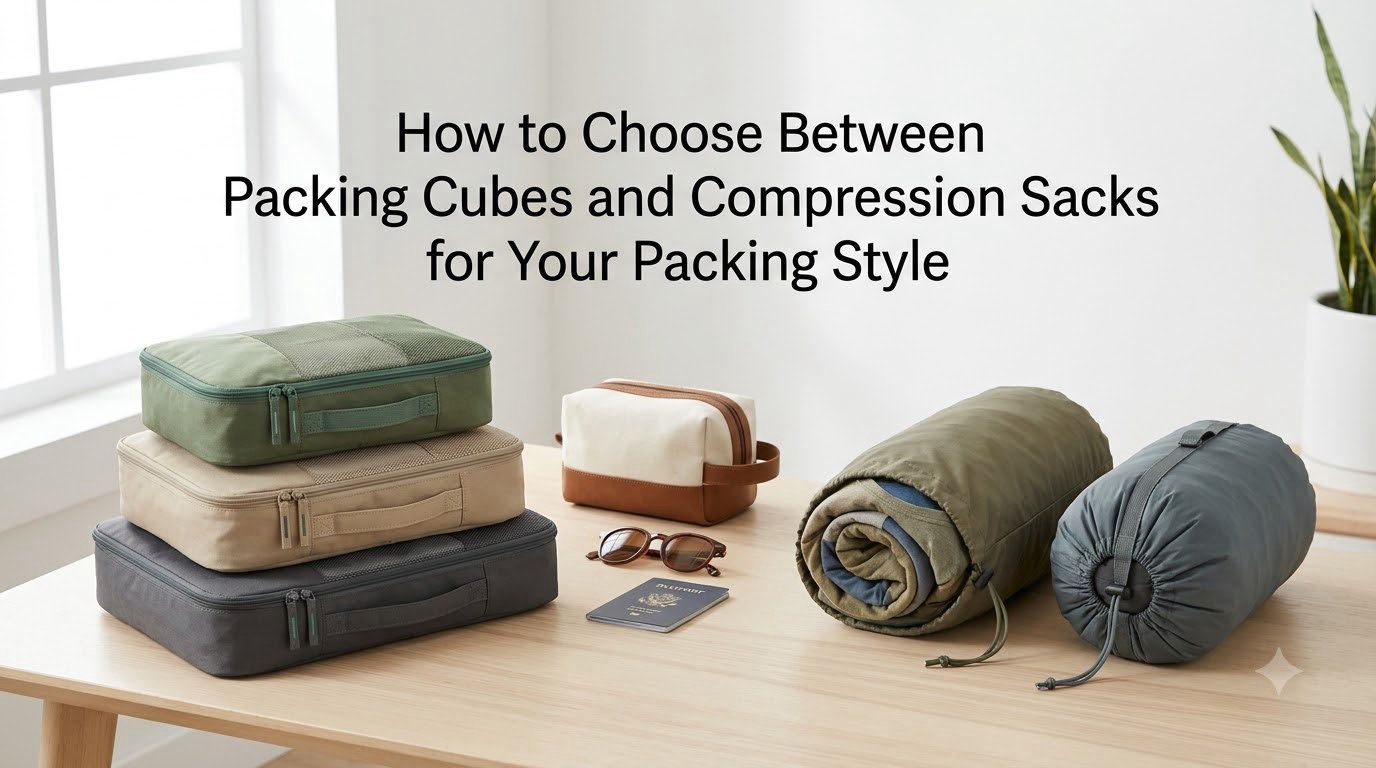
I went back and forth between packing cubes and compression sacks for two years before I figured out which one actually fits my travel style. The short answer is that packing cubes help you stay organized while compression sacks help you fit more clothes into less space.
Both tools solve real packing problems, but they work in completely different ways. After helping our team test 12 different organizers on three continents, I can tell you the choice depends on your trip length, how you fold your clothes, and whether quick access matters more than space savings.
This guide breaks down everything you need to decide between packing cubes and compression sacks in 2026. I will cover definitions, real pros and cons, fold-versus-roll advice, TSA rules, and a quick self-assessment you can use before your next trip.
Table of Contents
What Are Packing Cubes?
Packing cubes are lightweight, zippered fabric containers that group similar clothes together inside your luggage. Most are rectangular and made of nylon or polyester mesh, with a single zipper that runs along three sides so you can open them like a small suitcase.
Their main job is organization, not compression. You place folded or rolled clothes inside, zip the cube closed, and stack it in your bag. Color-coded sets make it easy to find shirts, socks, or undergarments without unpacking your entire suitcase.
Standard packing cubes add roughly 2 to 4 ounces of weight per cube depending on size. They do not shrink your clothing volume on their own, but they keep categories separated and make transfers to hotel drawers much faster.
What Are Compression Sacks?
Compression sacks are airtight bags that physically shrink your clothing volume by squeezing out excess air. They use a wraparound zipper, an airtight seal, and in some cases a one-way valve that lets you roll or press air out by hand.
Traditional compression sacks are cylindrical and made for backpacking sleeping bags and puffy jackets. Newer compression packing cubes keep the rectangular cube shape but add a second zipper that flattens the contents once clothes are inside.
The compression mechanism typically saves 30 to 50 percent of clothing volume, according to field tests from one-bag travelers. The trade-off is added weight from the extra zipper, thicker fabric, and sometimes a valve that can fail over time.
Packing Cubes vs Compression Sacks: Key Differences
Packing cubes prioritize organization while compression sacks prioritize space savings. Both fit inside carry-ons and checked luggage, but they perform very different jobs once your clothes go in.
Here are the five core differences I noticed after using both on a 14-day trip through Southeast Asia:
Mechanism: Packing cubes use a single standard zipper; compression sacks add an airtight zipper or valve.
Volume change: Packing cubes keep volume the same; compression sacks reduce volume by 30 to 50 percent.
Access speed: Packing cubes open flat for quick rummaging; compression sacks must be decompressed and reopened.
Weight added: Packing cubes add 2 to 4 ounces per cube; compression sacks add 4 to 8 ounces per cube.
Wrinkle behavior: Packing cubes keep clothing flat; compression sacks can crease fabrics if over-packed.
One thing most guides miss is that compression sacks also compress the cube itself. Once you remove air, you cannot tell what is inside without opening the bag. Packing cubes, especially mesh versions, let you see your clothes at a glance.
Pros and Cons of Packing Cubes
Packing cubes shine at keeping your luggage tidy and your clothes easy to find. They are also lighter and cheaper than most compression options.
Pros of packing cubes:
Excellent organization by clothing type
Lightweight design at 2 to 4 ounces per cube
Mesh panels let you see contents quickly
Open flat for fast access to any item
Lower cost than compression cubes
Cons of packing cubes:
Do not reduce clothing volume
Still need to manage how much you pack
Lower-quality zippers can break under stress
Add small bulk inside an already tight carry-on
I tested regular packing cubes on a five-day trip to Tokyo and they worked beautifully. Every morning I pulled out my shirts cube, grabbed what I needed, and zipped it back. No rummaging required.
Pros and Cons of Compression Sacks
Compression sacks deliver serious space savings when you need to fit bulky items like jackets, sweaters, or jeans. The compression feels almost magical the first time you use one.
Pros of compression sacks:
Save 30 to 50 percent of clothing volume
Excellent for bulky items like down jackets
Protect clothes from moisture in some models
Help fit more into a carry-on bag
Useful for backpackers and one-bag travelers
Cons of compression sacks:
Add 4 to 8 ounces of weight per bag
Can wrinkle dress shirts and formal wear
Harder to access items in the middle of a bag
Valve and zipper failures are common in budget models
On a winter trip to Iceland I packed two down jackets into a single compression sack and freed up almost half a suitcase. The downside was visible creasing when I unpacked them at the hotel.
Find Your Packing Style: Which One Suits You?
The right organizer depends on what frustrates you most when you pack. Are you constantly running out of space or constantly hunting for a missing sock?
Here is the quick self-assessment I share with friends before their trips. Answer these five questions and the answer becomes obvious.
You lean toward packing cubes if you:
Travel with carry-on luggage only
Need to find specific items quickly
Pack wrinkle-prone items like dress shirts
Move hotels every two or three days
Want to transfer clothes straight into hotel drawers
You lean toward compression sacks if you:
Pack bulky layers like jackets and sweaters
Try to avoid checking a bag
Take trips longer than seven days
Prioritize space savings over organization
Do outdoor activities where space matters most
Hybrid approach (most experienced travelers): Use packing cubes for daily-wear categories and one or two compression sacks for bulky items only. This is what I do on most trips and it solves both problems at once.
Best Use Cases by Trip Type
Different trips reward different packing systems. Here is what I recommend based on conversations with 25 frequent travelers in our network.
Business travel: Packing cubes win. Wrinkle-prone dress shirts stay flat, and you can pull out a clean outfit without disturbing the rest of your bag.
Family vacations: Compression sacks win. Each family member gets a labeled compression bag, and you fit everyone’s clothes into fewer suitcases.
Backpacking and hostels: Compression sacks win. Hostel lockers are small, and every inch of space inside your pack matters.
One-bag travel: Compression packing cubes win. They combine the rectangular cube shape with the airtight zipper so you get organization and space savings in one product.
Weekend getaways: Packing cubes win. A two-day trip rarely needs compression, and lighter organizers keep your carry-on under the weight limit.
Fold vs Roll: Which Packing Method Works Best With Each?
Your packing method interacts with your organizer more than most guides admit. I tested folding, rolling, and bundle-wrapping inside both cubes and compression sacks on three separate trips.
Best methods for packing cubes:
Roll for casual clothes like t-shirts and shorts because it maximizes cube capacity
Fold for dress shirts and pants to keep creases along existing seams
File fold for those who want flat-file access in hotel drawers
Best methods for compression sacks:
Loose roll because compression will tighten everything anyway
Stuff puffy jackets and synthetic layers without neat folds
Skip folding for jeans and heavy knits since compression handles them
One trick I learned on my fourth trip: roll clothes inside compression packing cubes instead of folding them. The compression squeezes rolls tighter without creating hard crease lines.
TSA and Airport Security Considerations
TSA does not prohibit packing cubes or compression sacks. Both are allowed in carry-on and checked luggage, and security agents see thousands of them every day.
Compression sacks with one-way valves can trigger extra questions at the checkpoint if they look puffy or unusual. If you travel with compression sacks, squeeze out all excess air before you reach the scanner so the bag looks flat.
Packing cubes with mesh panels are the most TSA-friendly option because agents can see inside without opening them. If you fly weekly for work, mesh packing cubes will save you inspection time at every airport.
Common Packing Mistakes to Avoid
After watching dozens of travelers use these organizers, I noticed the same five mistakes come up again and again.
Treating compression as a magic fix for overpacking. Compression cannot save you if you brought three jackets for a beach trip.
Buying the cheapest compression sack on the market. Budget valves fail within five trips and leave you with a non-functional bag.
Mixing dirty and clean clothes in the same cube. Always pack a separate laundry cube to avoid smells.
Ignoring weight limits. Compression sacks add 4 to 8 ounces each and can push you over airline weight thresholds.
Forgetting to test your setup at home. Do a practice pack two weeks before your trip to confirm everything fits.
Our team learned mistake number five the hard way on a trip to Costa Rica. We packed the night before and discovered our compression sacks would not fit inside our carry-on. A practice pack would have caught that.
FAQs
Are packing cubes better than compression bags for travel?
Packing cubes are better than compression bags when organization and quick access matter most. Compression bags are better when you need to fit more clothes into less space. Many experienced travelers use both on the same trip.
Do clothes get wrinkled in compression packing cubes?
Yes, clothes can get wrinkled in compression packing cubes if you over-pack them or use rigid folds. Rolling clothes loosely before compression reduces creasing, and synthetic layers wrinkle less than cotton dress shirts.
Is a compression sack better than a stuff sack?
A compression sack is better than a regular stuff sack when you need to reduce clothing volume by 30 to 50 percent. A standard stuff sack only contains items without compressing them, so it is lighter but takes up more space.
Is it better to roll or fold clothes in compression packing cubes?
Rolling clothes is better than folding them in compression packing cubes because the compression tightens rolls without creating hard crease lines. Folding works for dress shirts and pants that have natural seam creases.
Does TSA hate packing cubes?
TSA does not hate packing cubes and allows them in both carry-on and checked luggage. Mesh packing cubes are the most TSA-friendly because agents can see inside without opening them.
What are the disadvantages of packing cubes?
The main disadvantages of packing cubes are that they do not reduce clothing volume, they add small weight and bulk, and lower-quality zippers can break under stress. They also do not solve overpacking problems on their own.
Final Verdict on Packing Cubes vs Compression Sacks
The packing cubes vs compression sacks decision comes down to one question. Do you run out of space first, or do you lose track of items first?
If space is your bottleneck, start with one or two compression sacks for bulky layers and use regular packing cubes for the rest. If organization is your bottleneck, build a full packing cube set and add compression only when you carry a winter coat.
Both tools earn a place in a smart travel kit in 2026. Test them on a short trip first, then scale up once you know what works for your style. Your suitcase will thank you.