
I have stood in a hotel room in Tokyo holding a dead hair dryer and a useless brick of a converter, watching my phone battery drop another percent, and thinking: “Why did nobody explain this in plain English years ago?” That little disaster is exactly why I wrote this guide for 2026.
Picking the right power adapter and knowing if you need a voltage converter is one of those travel skills nobody teaches you until something goes wrong. The wrong combination can quietly fry a charger, blow a fuse in your hotel room, or ruin a device you cannot easily replace abroad.
In this guide, I will walk you through the exact decision I wish I had before my trip, so you can avoid the same guesswork. You will learn the difference between an adapter and a converter, how to check whether your device is dual voltage, how to size a converter by wattage, and how to pack the right gear for any destination in 2026.
Table of Contents
What Is a Power Adapter and What Does It Actually Do?
A power adapter is a simple plastic shell that lets your device’s plug physically fit into a foreign wall outlet, and it does absolutely nothing to change the electricity flowing through it.
Different countries use different plug shapes. The United States uses Type A and Type B flat prongs. The United Kingdom uses chunky Type G rectangular pins. Most of Europe uses Type C and Type F round prongs. Australia uses angled Type I plugs. An adapter bridges that physical gap between your plug and the wall socket so electricity can flow at all.
Think of an adapter as a translator for the shape of the plug, not for the electricity itself. If your home country runs on 110V and you travel somewhere with 220V, an adapter alone will not save your device. It will let the plug enter the outlet, but the higher voltage can fry the circuit board in seconds. That is the point most travelers miss, and it is also the point that creates the most expensive mistakes.
Adapters also vary widely in quality. A cheap no-name adapter may fit loosely, wobble in the socket, or lack basic insulation. A well-built universal adapter fits firmly, often includes USB ports for charging phones and tablets, and may have surge protection built in. The few extra dollars usually pay for themselves in safety and convenience.
What Is a Voltage Converter and Why Would You Ever Need One?
A voltage converter is an electronic device that takes the incoming electricity from the wall and changes it to a different voltage so your single-voltage appliance can run safely.
Most of the world runs on either 110 to 120 volts (the Americas, Japan, parts of the Caribbean) or 220 to 240 volts (Europe, Asia, Africa, Australia). A step-down converter takes 220V and outputs 110V. A step-up converter does the opposite. The converter does the actual electrical translation that an adapter cannot do.
You only need a converter for single-voltage devices, which are usually older or high-heat appliances. Hair dryers, curling irons, electric razors, clothes irons, and some coffee makers fall into this category. Modern laptops, phone chargers, tablet chargers, and camera batteries almost never need one, because they are already dual voltage.
Converters are designed for short-term use, typically under an hour at a time. Running a converter for hours on end can cause overheating. For extended use, especially with sensitive electronics, a step-up or step-down transformer is the better tool, although it is heavier, larger, and more expensive.
Adapter vs Converter: The Key Difference You Must Understand
An adapter changes the shape of the plug, and a converter changes the voltage of the electricity, and using the wrong one either wastes space in your suitcase or destroys your device.
Here is the rule I follow: if your appliance can only run on 110 to 130 volts, you need a converter. If your device is labeled 100 to 240V (also called dual voltage), you only need an adapter. Getting this backwards is the single most common mistake international travelers make, and it is exactly why forum threads are full of stories about fried hair dryers and dead curling irons.
To make the decision clearer, here is a side-by-side comparison of the two.
Adapter: Changes plug shape only, weighs almost nothing, costs a few dollars, works for dual voltage devices.
Voltage converter: Changes actual voltage, weighs one to five pounds, costs more, and is only required for single voltage heating devices.
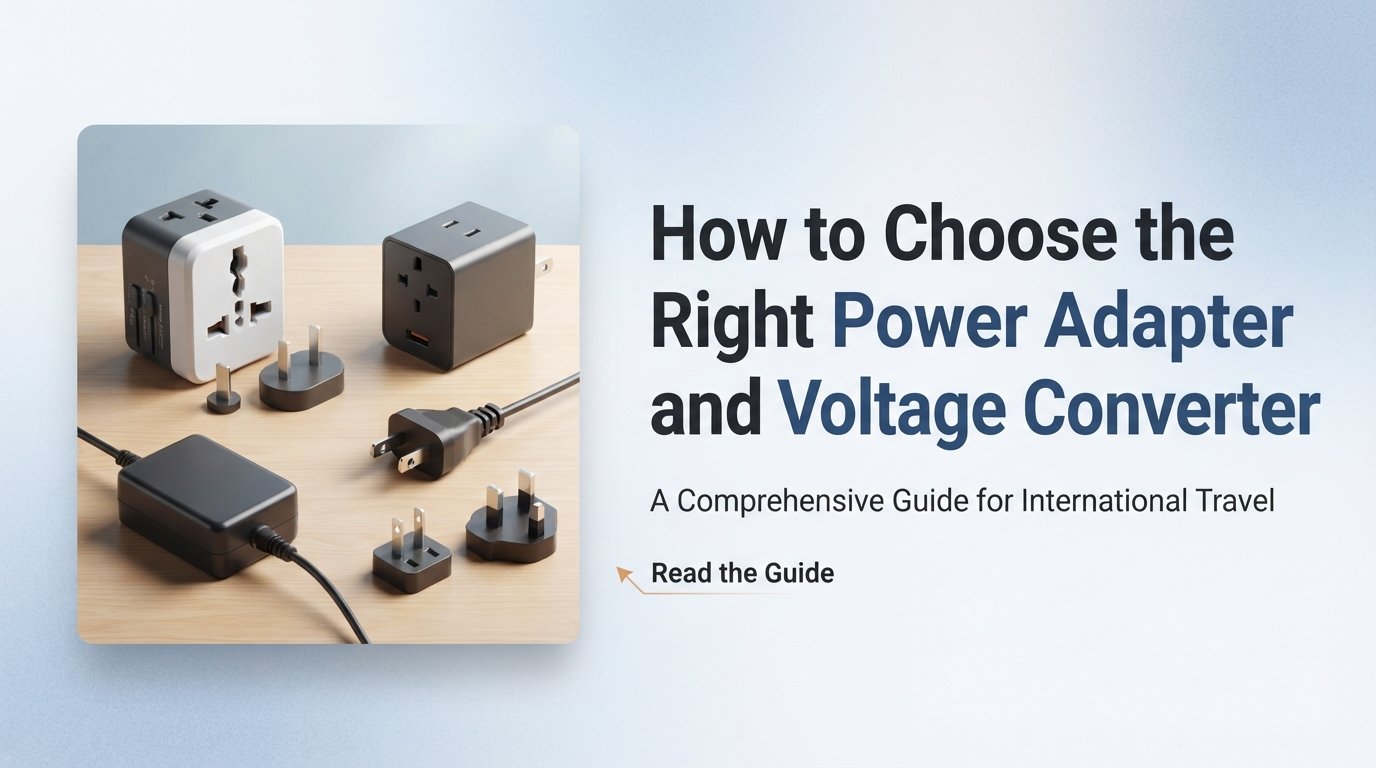
Universal travel adapter: Combines multiple plug shapes in one unit, often includes USB ports, ideal for phones and laptops.
The fastest test is to flip your device over and look at the small print on the label or charger brick. If you see something like “Input: 100 to 240V” or “50 to 60Hz,” you only need an adapter. If you only see a single number like “120V” or “240V,” you need a converter too.
The mistake I see most often is packing a heavy converter for a trip where it will never be used. Most modern electronics do not need one. Converters are only for specific single-voltage appliances, and on most trips you can avoid them entirely by leaving those appliances at home or buying a dual voltage replacement.
How to Check If Your Device Is Dual Voltage
You can check if your device is dual voltage by reading the input label on the charger brick, power cord, or the back of the appliance itself.
Here is the step-by-step method I use whenever I am packing for a new country.
Step 1: Locate the label. Flip the charger or device over and find the small printed text. On Apple chargers, it is on the side of the USB power brick. On laptops, it is usually on the bottom of the machine. On hair tools, it is printed directly on the handle or near the cord.
Step 2: Read the input line. Look for the word “Input” followed by a voltage range. A dual voltage device will say something like “Input: 100 to 240V, 50 to 60Hz.” A single voltage device will say “Input: 120V, 60Hz” or “Input: 220 to 240V, 50Hz.”
Step 3: Decide what to pack. If the input range covers both your home voltage and your destination voltage, grab an adapter and skip the converter. If the input is locked to a single voltage, you need both an adapter and a converter sized to the wattage of the device.
Step 4: When in doubt, check the manual. Some manufacturers bury the dual voltage info in the spec sheet. A quick search for your model number plus “dual voltage” almost always gives you a clean answer from the manufacturer page or a forum.
Step 5: Watch for hidden switches. Some older appliances, especially hair clippers and shavers, have a tiny switch on the body to flip between 110V and 220V modes. If your device has this, switch it before plugging in abroad or you risk damaging the motor.
Real-world examples help here. Every Apple iPhone charger I have tested since the iPhone 5 has been dual voltage. MacBook chargers are dual voltage. Nintendo Switch consoles are dual voltage. Most DSLR battery chargers are dual voltage. A 2010 Conair hair dryer is almost always single voltage, which is why it died in my Tokyo hotel room in under two minutes.
Device-Specific Guidance: Phones, Laptops, and Hair Dryers
Most modern phones and laptops are dual voltage and only need a travel adapter, while hair dryers and other heating tools are typically single voltage and require a voltage converter.
This is the practical breakdown I share with friends before they travel abroad.
Phones and tablets. Any iPhone, iPad, Samsung Galaxy, Google Pixel, or other modern smartphone charger is dual voltage. You only need a plug adapter, or a universal adapter with built-in USB ports so you can leave the bulky charging bricks at home.
Laptops. Apple, Dell, Lenovo, HP, and Asus laptops all ship with dual voltage chargers. A travel adapter is enough. If your laptop uses USB-C charging, you can carry a single 65W GaN charger with interchangeable plug heads for nearly every country.
Hair dryers, curling irons, flat irons. These are almost always single voltage and they pull a lot of wattage. A travel-sized dual voltage hair dryer is the easiest solution. If you must bring your own, pack a step-down converter rated for at least 50% more wattage than the dryer’s label.
Electric razors and toothbrushes. Most premium brands like Philips Norelco and Braun are dual voltage, but budget brands often are not. Always check the label before you assume.
Game consoles, e-readers, cameras. Modern Nintendo Switch, Kindle, and mirrorless camera chargers are dual voltage. Older devices or specialty chargers can vary, so check the label.
Medical devices. CPAP machines, blood pressure monitors, and electric blankets sometimes run on a single voltage. Some CPAP power supplies are dual voltage, others are not. Always verify with your device manufacturer before international travel.
The fastest rule of thumb is that anything with a USB charger brick these days is dual voltage. Anything that generates heat or has a mechanical motor is more likely to be single voltage and may require a converter when used outside its original region.
Understanding Wattage Requirements for Voltage Converters
You size a voltage converter by matching or exceeding the wattage of the device you plan to run through it, and going at least 25 to 50% higher to handle startup surges.
Wattage tells you how much power a device consumes, and a converter has a maximum wattage it can safely deliver. If the device tries to pull more than the converter can give, the converter overheats, shuts off, or burns out. Worse, an undersized converter can damage the device plugged into it.
You can calculate wattage using the formula:
Watts = Volts x Amps
This information is on the same label where you checked the voltage. If a hair dryer is labeled “220V, 5A,” the wattage is 220 x 5, which equals 1100W. To run it safely on 110V through a step-down converter, you need a converter rated for at least 1500W to handle the startup spike.
A quick reference for common single-voltage travel devices:
Hair dryer: 1000 to 1875W
Curling iron or flat iron: 75 to 200W
Electric kettle: 1000 to 1500W
Clothing iron: 1000 to 1200W
Heated blanket: 50 to 200W
Electric shaver: 10 to 50W
For anything over 1500W, you usually want a heavy-duty step-down transformer instead of a small travel converter. Converters are designed for short-term use on heating devices, not for running them for hours at a time. If you plan to dry your hair every morning of a two-week trip, a transformer is the safer choice despite the extra weight.
Also remember that some appliances pull two to three times their rated wattage at startup. A hair dryer rated at 1500W may briefly draw 3000W when you turn it on. That is why oversizing the converter by 25 to 50% is the standard recommendation from experienced travelers.
Grounded vs Non-Grounded Adapters: Which Type Do You Need?
Grounded adapters have a third pin that connects to the ground wire in the electrical system, and you need one whenever your device’s plug has three prongs instead of two.
Two-prong plugs are called non-grounded. They work with simple appliances like phone chargers and small electronics. Three-prong plugs are grounded, and the third pin is a safety feature that directs stray electrical current away from you in case of a fault.
Devices that typically use three-prong plugs include desktop computers, kitchen appliances, power tools, and high-end electronics. If your device has a three-prong plug, you must use a grounded adapter, often called a Type B adapter in North America or a Schuko-compatible adapter in Europe.
A simple two-prong adapter will physically accept a three-prong plug only if you remove the grounding pin, which I do not recommend. You lose the safety feature that prevents electrical shocks. The safer option is to buy a grounded universal adapter that accepts both two-prong and three-prong plugs.
Travelers to older European buildings also encounter ungrounded outlets in some countries. A grounded plug will not fit a non-grounded European outlet without an adapter or a so-called “Europlug” workaround. Modern universal adapters handle both situations automatically with retractable ground pins.
Common Travel Destinations and Their Voltages
Most countries outside North America and Japan use 220 to 240V, which means travelers from the United States need both a plug adapter and a converter for single voltage devices.
This quick reference covers the most popular destinations. I update this list every year to keep the voltages accurate, and it is current as of 2026.
United States, Canada, Mexico: 110 to 120V, plug types A and B.
United Kingdom, Ireland, Malaysia, Singapore, Hong Kong: 230V, plug types G and M.
France, Germany, Italy, Spain, Netherlands, Greece: 230V, plug types C and F, with Type E in France and Belgium.
Japan, Taiwan: 100 to 110V in Japan, 110V in Taiwan, plug types A and B.
Australia, New Zealand, China, Argentina: 220 to 240V, plug types I and, in China, types A, C, and I.
Thailand, Vietnam, Indonesia: 220 to 230V, plug types A, B, and C.
India, South Africa, Kenya: 220 to 240V, plug types C, D, M, and N depending on region.
Brazil, Chile, Peru: 127 to 220V depending on region, plug types C and N.
The big takeaway is this: if you are flying from the United States to almost anywhere in Europe, Asia, Africa, or Oceania, expect 220 to 240V and bring an adapter for each plug style you encounter. If you are flying to Japan, the plug shape is often the same as the US, so you may not need an adapter at all, only awareness that Japanese outlets run on 100V instead of 120V.
Some countries, including Brazil and Peru, use multiple voltages within the same country. In those cases, your hotel or guesthouse staff can usually tell you which voltage the specific outlet delivers. When in doubt, test with a low-wattage dual voltage device before plugging in anything expensive.
Converter vs Transformer: Are They the Same Thing?
A converter is for short-term use on simple heating devices, and a transformer is for continuous use on sensitive electronics, and the distinction matters when you are choosing what to buy.
Voltage converters are lightweight, inexpensive, and designed for devices that run for a few minutes at a time, such as a hair dryer or curling iron. They are not accurate enough for laptops, medical devices, or anything with a microprocessor.
Voltage transformers are heavier, more expensive, and produce a stable, clean sine wave that sensitive electronics need. If you plan to run a high-end audio device, a CPAP machine, or a kitchen mixer for extended periods, a transformer is the right tool.
For most travelers, a converter is plenty. But if you are relocating abroad with expensive electronics or medical equipment, a transformer is worth the extra weight and cost. Some transformers also offer both step-up and step-down functionality, which is helpful if you move between regions regularly.
How to Choose the Right Adapter and Converter: A Practical Buying Guide
Choose a universal adapter with USB-C and USB-A ports for daily electronics, and only buy a converter if you are bringing single-voltage heating devices.
After dozens of trips, here is the packing framework I now use, and I share it with anyone who asks.
Step 1: Audit your electronics before you pack. Lay out every charger and device. Flip each one over and note whether it is dual voltage. Set aside anything that is single voltage for converter math. Many travelers find that 90 percent of their gear is dual voltage and does not need a converter at all.
Step 2: Pick one universal adapter per traveler. A good universal adapter covers US, UK, EU, and Australian plugs, has at least two USB-A ports, and includes a USB-C PD port for laptop charging. Brands like Epicka, Tessan, and Mifola are popular choices among frequent travelers. Avoid the cheapest no-name adapters because they often lack surge protection and have loose-fitting prongs that can fall out of the wall.
Step 3: Match your converter to the highest-wattage single-voltage device. If your hair dryer pulls 1875W and your curling iron pulls 150W, buy a converter rated for at least 2000W so both can run, even if not at the same time. Adding 25 to 50 percent headroom is the safest approach.
Step 4: Skip the converter entirely if you can. Many hotels and Airbnbs now provide hair dryers. Dual voltage travel hair dryers exist for under thirty dollars and weigh almost nothing. The cheapest way to solve a converter problem is to avoid needing one.
Step 5: Add surge protection for expensive devices. A small universal adapter with built-in surge protection is worth the few extra dollars when you plug in a laptop or camera battery. Power grids in older buildings can be inconsistent, especially in developing regions, and a sudden surge can destroy sensitive electronics in a heartbeat.
Step 6: Consider USB-C charging seriously. A single 65W or 100W USB-C GaN charger with interchangeable international plugs can replace almost every laptop, phone, and tablet charger in your bag. That means fewer adapters to carry and one less thing to forget on the way home.
Here is a short packing checklist for international travel:
1. One universal adapter with USB-A and USB-C ports per person.
2. A step-down converter only if you are bringing a single-voltage heating device.
3. A short extension cord if your hotel room has only one outlet near the bed.
4. Spare USB-C and Lightning cables for charging multiple devices at once.
5. A small surge protector power strip if you are traveling with several electronics.
6. A dual voltage travel hair dryer if your accommodation does not provide one.
7. A label of every device’s input voltage, photocopied or photographed, in case you forget during your trip.
Modern USB-C charging has simplified all of this. Many travelers now carry a single 65W or 100W GaN charger with interchangeable international plugs, which can run a laptop, phone, and tablet from one brick. If you have switched to USB-C, the only adapter you need is for the plug shape at the wall.
Frequently Asked Questions About Power Adapters and Voltage Converters
How do I know if I need a converter or adapter?
You need an adapter whenever the wall outlet shape does not match your plug. You need a voltage converter only when your device is single voltage, meaning the label lists one voltage like 120V or 240V. If the label lists a range such as 100 to 240V, your device is dual voltage and only needs an adapter.
Do I need a voltage converter if I have an adapter?
Not always. An adapter only changes the plug shape, not the electricity. If your device is dual voltage, the adapter is enough. If your device is single voltage, the adapter alone will let the plug fit, but the wrong voltage can damage or destroy the device within seconds.
How to choose the right voltage converter?
Choose a voltage converter rated for at least 25 to 50 percent more wattage than the device you plan to run. Find the device wattage on its label using the formula Watts = Volts x Amps. For heating devices like hair dryers, plan for short-term use only and consider a heavy-duty transformer instead for longer sessions.
How do I figure out what power adapter I need?
Identify the plug types used at your destination, then pick a universal adapter that covers them. Most adapters today include US, UK, EU, and Australian plug types in one unit. Look for USB-A and USB-C ports so you can charge phones and laptops without separate bricks.
What happens if I plug a 110V device into 220V?
The device can overheat, short-circuit, or fail permanently within seconds. Many devices spark, blow fuses, or even catch fire. This is exactly why single-voltage appliances require a voltage converter when used abroad, and why dual voltage labeling exists to protect you.
Do I need a voltage converter for my phone or laptop?
No, not in almost any modern case. iPhones, Android phones, MacBooks, Windows laptops, tablets, and e-readers are dual voltage. Their chargers accept 100 to 240V automatically. You only need a plug adapter to fit the wall outlet shape at your destination.
Final Thoughts
Choosing the right power adapter and knowing if you need a voltage converter comes down to one habit: read the label on every device before you pack.
Once you understand that an adapter handles plug shape and a converter handles voltage, the rest of the puzzle falls into place. Most travelers in 2026 only need a good universal adapter with USB ports and a single step-down converter if they refuse to leave their single-voltage hair dryer at home.
If you want a fast action plan, here it is: check each device label tonight, build a list of dual voltage versus single voltage, and pack one universal adapter per traveler. You will save space, save weight, and never again stare at a dead hair dryer wondering what went wrong.