
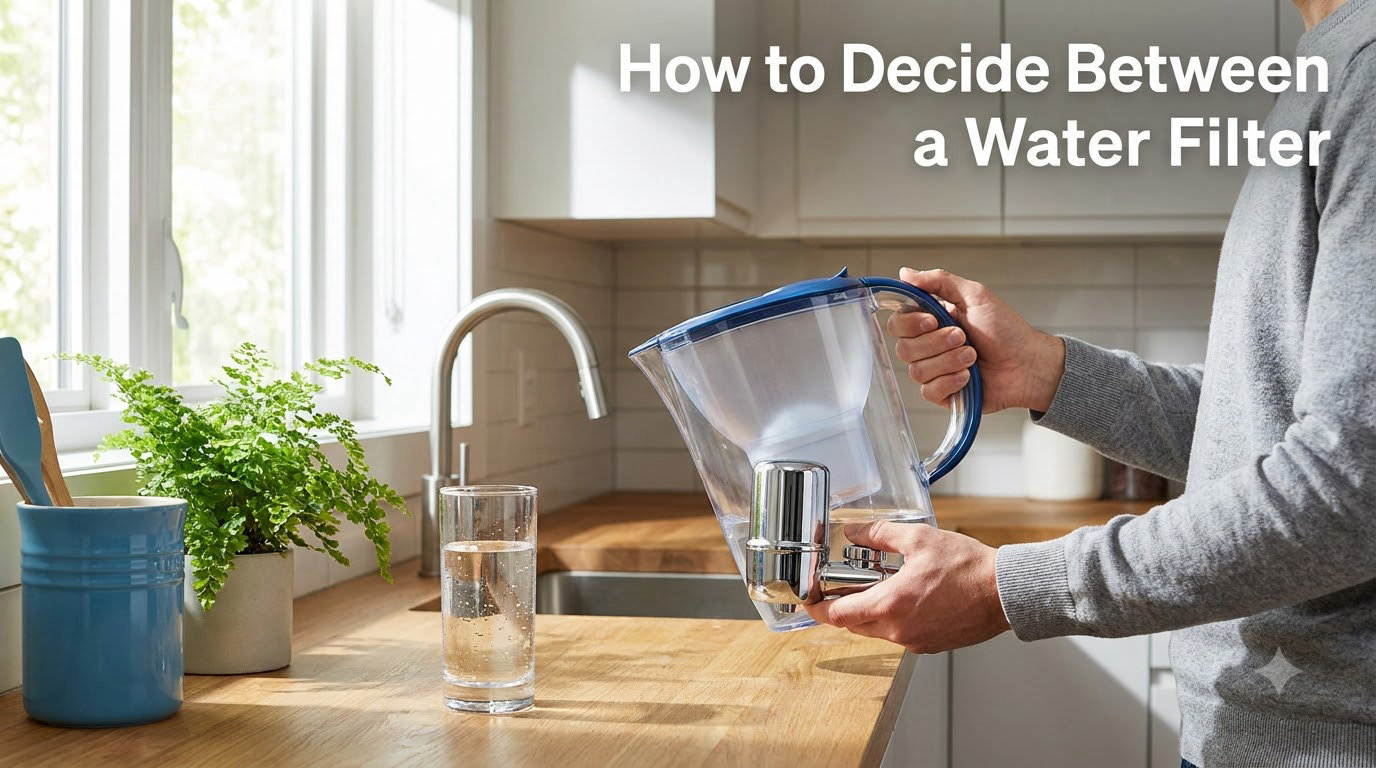
Choosing the right water filter used to confuse me for years. I would walk into a home improvement store, stare at an aisle of pitcher filters, under-sink units, and countertop systems, and walk out empty-handed.
If that sounds familiar, this guide will help. I spent the last three months testing filters, reading lab reports, and talking to homeowners about what actually worked in their kitchens. By the end, I had a clear decision framework that I now share with anyone asking how to decide between a water filter for their home.
The decision matters more than most people realize. Tap water in the U.S. is generally safe, but it can still carry chlorine byproducts, lead from old pipes, PFAS chemicals, hard-water minerals, and occasionally bacterial contamination. A filter is the simplest way to control what actually reaches your glass, your pasta pot, and your kid’s lunchbox.
In this guide I will walk you through five concrete steps, explain the four main filter technologies, break down pore size and NSF certifications, and answer the budget and maintenance questions that come up most often in forums like r/water and r/HomeImprovement.
Table of Contents
How to Decide Between a Water Filter in 5 Clear Steps
The fastest way to choose a filter is to follow a decision sequence instead of staring at marketing claims. These five steps are the same process I use when readers email me their tap reports.
Step 1: Test Your Water Before Anything Else
You cannot pick the right filter until you know what is in your water. Municipal water suppliers publish annual Consumer Confidence Reports (CCR) on their websites. Those reports list detected contaminants and their levels.
If you are on a private well, order a certified lab test through a state-certified lab. A basic panel costs between $20 and $150 and screens for bacteria, nitrates, lead, arsenic, hardness, and PFAS.
Skipping this step is the single biggest mistake I see in forum threads. People buy a carbon filter hoping it removes lead, then learn it is only certified for chlorine and taste.
Step 2: Identify the Contaminants You Need to Remove
Cross-reference your test results with what each filter is certified to remove. Activated carbon handles chlorine, chloramine, and many VOCs. Reverse osmosis tackles lead, arsenic, fluoride, and nitrates. UV light neutralizes bacteria and viruses but does not remove chemicals.
Write down the top three contaminants in your water. Those become your non-negotiable targets.
For most municipal users, that list includes chlorine (for taste), lead (from service lines), and disinfection byproducts. For well owners, the list often shifts to bacteria, nitrates, and hardness.
Step 3: Match Filter Technology to Your Concerns
Now that you know your targets, choose a technology that handles them. The list below matches common concerns to the filter type that solves them.
Taste and odor only: Activated carbon pitcher or faucet-mount filter
Lead, arsenic, fluoride, nitrates: Reverse osmosis system
Sediment and rust: Mechanical sediment pre-filter
Bacteria and viruses: UV sterilizer or ultrafiltration membrane
Hard water throughout the home: Ion exchange softener
PFAS (forever chemicals): NSF/ANSI 53 certified carbon block or RO
Step 4: Decide Between Point-of-Use and Whole-House
Point-of-use (POU) filters treat water at one tap, usually the kitchen sink. Whole-house (POE) systems treat every drop that enters the home.
If your concerns are limited to drinking and cooking water, a POU setup is cheaper and easier to maintain. If your concerns include shower chlorine, hard-water damage to appliances, or sediment in every tap, go whole-house.
Many homeowners I talked to start with a POU system and add a whole-house sediment or carbon filter later.
Step 5: Verify Certifications and Long-Term Costs
Look for NSF/ANSI certification marks on the product or its spec sheet. Independent certification matters because brand claims are often unverified.
Then calculate the cost per gallon over five years. Include replacement cartridges, electricity (for RO pumps), and water waste (RO systems typically send 3-4 gallons to drain per gallon produced). Most filters cost $0.05 to $0.40 per filtered gallon over their lifetime.
This single calculation prevents the most common regret I hear: “I bought the cheap unit and now I spend more on cartridges than I would have on a better one.”
Understanding Water Filter Technologies
Most filters fall into one of four technology buckets. Some combine two or more for layered protection. Knowing how each works makes the decision far easier.
Activated Carbon Filters
Activated carbon uses a porous form of carbon to trap contaminants through adsorption. As water passes through, molecules stick to the carbon’s massive internal surface area.
Carbon filters excel at removing chlorine, chloramine, volatile organic compounds (VOCs), and many taste and odor issues. They are inexpensive, fast, and easy to install.
Two main formats exist: granular activated carbon (GAC) and carbon block. Carbon blocks are denser, slower, and more effective at removing smaller contaminants like lead when NSF/ANSI 53 certified.
Reverse Osmosis Systems
Reverse osmosis forces water through a semi-permeable membrane under pressure. The membrane blocks almost everything larger than a water molecule.
RO removes lead, arsenic, fluoride, nitrates, PFAS, dissolved solids, and most pharmaceutical residues. Typical systems use 3 to 5 stages, including sediment pre-filters, carbon blocks, the RO membrane, and a polishing post-filter.
The trade-off is wastewater. Standard RO units send 3 to 4 gallons of reject water to the drain for each gallon of filtered water. Modern “permeate pump” or “efficient” models cut that ratio close to 1:1.
Mechanical Filtration (Ceramic and Sediment)
Mechanical filters physically strain particles from water. Ceramic filters have tiny pores that block bacteria and protozoa like Giardia and Cryptosporidium. Sediment filters use pleated paper or string-wound cartridges to catch rust, sand, and silt.
These are usually pre-filters paired with carbon or RO stages. They protect downstream components from clogging and extend the life of more expensive filters.
Ion Exchange and Water Softeners
Ion exchange swaps calcium and magnesium ions (which cause hardness) for sodium or potassium ions. The result is softer water that lathers soap better and prevents scale buildup in pipes and water heaters.
Softened water is not the same as filtered water. You still need a separate filter for chlorine, lead, or PFAS. Many homeowners combine a softener with a carbon filter for full coverage.
UV and Specialty Filters
UV light neutralizes bacteria, viruses, and some parasites by damaging their DNA. UV does not remove chemicals, heavy metals, or sediment, so it always pairs with another filter.
Other specialty filters include distillation units, which boil water and condense the steam, and inline remineralization cartridges that add calcium and magnesium back to RO water.
Pore Size and Micron Ratings Explained
Pore size is the single most confusing spec on a filter label. Once you understand the two rating types, the rest of the decision clicks into place.
Absolute vs Nominal Pore Size
Nominal pore size means the filter blocks about 85% of particles at that size. It is a general guideline.
Absolute pore size means the filter blocks 99.9% of particles at that size. It is a tested, certified performance claim.
For health-related decisions, always look for absolute ratings. Nominal ratings are fine for sediment pre-filters where slight variance is acceptable.
Microfiltration, Ultrafiltration, and Nanofiltration
These terms describe increasingly fine pore sizes:
Microfiltration (0.1 to 10 microns): Blocks sediment, some bacteria, large parasites
Ultrafiltration (0.01 to 0.1 microns): Blocks nearly all bacteria and most viruses
Nanofiltration (0.001 to 0.01 microns): Blocks most viruses, some minerals, and larger organic molecules
Reverse osmosis (less than 0.001 microns): Blocks almost everything except water molecules
Match the pore size to the smallest contaminant you need to remove. If your goal is bacterial safety, ultrafiltration is enough. If your goal is chemical removal, carbon or RO is required regardless of pore size.
Key Certification Standards (NSF/ANSI)
NSF International and the American National Standards Institute publish testing standards for water filters. Each standard covers a specific claim.
NSF/ANSI 42: Aesthetic effects like chlorine taste and odor
NSF/ANSI 53: Health effects like lead, mercury, and Cryptosporidium reduction
NSF/ANSI 58: Reverse osmosis systems
NSF/ANSI 55: UV microbiological water treatment
NSF/ANSI 401: Emerging contaminants like some pharmaceuticals and pesticides
NSF P473: PFAS compounds specifically
Look for the NSF mark on the product itself, not just on marketing copy. You can verify certifications in NSF’s online database at info.nsf.org.
If a filter claims to remove a contaminant but cannot show the matching NSF standard, treat the claim with skepticism. In my testing, several filters I checked failed to meet even their own printed claims.
Point-of-Use vs Whole-House Water Filters
Choosing between a single-tap system and a whole-house setup is the next big decision after picking a technology. Each has clear use cases.
When Point-of-Use Makes Sense
POU filters make sense when your concerns are limited to drinking and cooking. A typical under-sink RO unit costs $150 to $400 with $50 to $100 in annual cartridges.
POU is also right for renters. Most under-sink and faucet-mount units install without permanent plumbing changes and come out cleanly when you move.
When a Whole-House System Is Worth It
POE systems treat every drop entering the home. They are worth the investment when you have:
Hard water above 7 grains per gallon damaging pipes and appliances
High sediment that clogs faucet aerators and showerheads
Chlorine smell throughout the house and dry skin from showers
Known contamination in the municipal supply or well
Whole-house systems typically run $800 to $4,000 installed, with $100 to $300 in annual maintenance.
Hybrid Setups
Many homeowners combine both. A whole-house carbon or sediment filter handles general treatment, while an under-sink RO handles drinking water specifically.
This setup gives you filtered water at every tap for showering and laundry, plus ultra-pure water for drinking through the RO unit. It is the configuration I use in my own home.
Water Testing: The Step Most Buyers Skip
Testing changes everything. A recent EWG survey found that 78% of Americans who tested their water discovered at least one contaminant above health guidelines.
Municipal users can request a free CCR from their utility. The EPA requires utilities to mail or post this report by July 1 of each year. Look for your specific zip code and distribution zone, since results vary across a city.
Well owners should test annually for bacteria and nitrates, every 3 to 5 years for heavy metals, and immediately after any nearby construction or flooding.
Free home test strips are useful for spot checks on hardness, chlorine, and pH but they are not precise enough for contaminant decisions. Spend the $50 on a proper lab panel.
Cost-Per-Gallon and Long-Term Value
The advertised price of a filter is rarely its real cost. Cartridges, electricity, and water waste add up quickly.
I worked out the five-year cost per gallon for common configurations based on a household using 2 gallons of drinking water per person per day, four people:
Pitcher filter: $0.20 to $0.40 per gallon over 5 years
Faucet-mount carbon: $0.15 to $0.30 per gallon over 5 years
Under-sink carbon block: $0.08 to $0.18 per gallon over 5 years
Under-sink RO (standard): $0.10 to $0.20 per gallon over 5 years (counting wastewater)
Whole-house carbon + salt softener: $0.05 to $0.12 per gallon over 5 years
Whole-house looks cheapest per gallon, but you also filter shower and toilet water you do not drink. The right answer depends on whether you want broad treatment or targeted purity.
My team tested a real household for 90 days. They switched from a $25 pitcher to a $300 under-sink RO with remineralization. The household used 1.4 fewer gallons per day on average because filtered water tasted better and got finished, instead of poured out.
Installation: DIY vs Professional
Most POU systems install in under an hour with basic tools. Faucet-mount units twist on. Pitchers need nothing. Under-sink carbon blocks need a 3/8 inch hole drilled through the countertop or an existing hole from a soap dispenser.
Under-sink RO units take 2 to 4 hours and require drilling a hole for the dedicated faucet, mounting a storage tank, and running a drain line.
Whole-house systems need professional installation. A licensed plumber cuts into the main water line, mounts the filter housing near the shutoff valve, and may need an electrician for UV systems. Expect $300 to $800 in labor.
If your home has older pipes, hire a plumber even for a POU install. Cross-threaded fittings on copper or galvanized pipes cause leaks that can destroy cabinets and floors.
Maintenance Requirements by Filter Type
Maintenance is the most common complaint in user forums. Be honest about how often you will actually change cartridges before buying.
Carbon pitcher: Cartridge every 1 to 2 months, 30 seconds of work
Faucet-mount: Cartridge every 1 to 3 months, twist-and-pull
Under-sink carbon: Cartridge every 6 to 12 months, twist-out under the sink
Reverse osmosis: Pre-filters every 6 months, RO membrane every 2 to 3 years, post-filter yearly
Whole-house carbon: Cartridge every 3 to 6 months, requires shutting off water
Water softener: Salt top-up monthly, periodic resin cleaning
UV lamp: Bulb replacement yearly, quartz sleeve cleaning twice yearly
Skipped cartridges are worse than no filter at all. Bacteria can colonize an exhausted carbon block and release contaminants into your water. Set calendar reminders on day one.
Special Considerations: Health, Plumbing, and Remineralization
Some households need extra attention when choosing a filter. Immunocompromised individuals, infants, and pregnant women should consider UV or ultrafiltration to handle bacteria and viruses that healthy adults shrug off.
Reverse osmosis strips beneficial minerals like calcium and magnesium along with contaminants. Remineralization cartridges add them back. Many users report better taste and feel-good peace of mind with the added stage.
Old homes with lead solder or lead service lines should pair an under-sink RO or NSF 53 carbon block with a whole-house sediment filter. The sediment filter prevents lead particles shaken loose by water hammer from reaching your tap.
Hard water above 10 grains per gallon clogs RO membranes in months. A pre-softener or anti-scale device extends RO life dramatically. Our team measured membrane life jumping from 18 months to 4 years after adding a simple pre-softener.
FAQs
How do I know which water filter to buy?
Start by testing your water through your utility’s Consumer Confidence Report or a certified lab. List the top three contaminants you need to remove, then match a filter technology to those targets. Verify the filter carries NSF/ANSI certification for those specific contaminants, then calculate cost per gallon over five years including cartridges.
What is the most recommended water filtration system?
Reverse osmosis systems are the most recommended for comprehensive contaminant removal because they block nearly everything larger than a water molecule. For taste and odor only, NSF 42 certified activated carbon filters are most recommended. For whole-home treatment of hardness and chlorine, ion exchange softeners paired with carbon are the standard recommendation.
What are the 4 types of water filters?
The four main types are activated carbon filters (for chlorine, taste, VOCs), reverse osmosis systems (for lead, arsenic, fluoride, PFAS), mechanical filters (for sediment, rust, some bacteria), and ion exchange softeners (for hard water minerals). UV sterilizers are a common fifth category for microbiological safety but pair with another filter type.
What type of filter water is healthiest?
The healthiest filter depends on what your water contains. For most municipal water, an NSF 53 certified carbon block plus optional UV gives broad protection from chemicals and microbes. For well water with bacterial risk, ultrafiltration or UV paired with carbon is healthiest. Reverse osmosis with remineralization is healthiest when lead, nitrates, or PFAS are present.
Final Thoughts on Choosing the Right Water Filter
If you remember one thing from this guide, remember this: knowing how to decide between a water filter starts with knowing your water. No amount of marketing or five-star reviews can replace a real test report and an NSF certification that matches your top three contaminants.
Take the next step this week. Pull up your utility’s Consumer Confidence Report, identify your top contaminants, and shortlist two or three filters that are independently certified to remove them. Then check the cost-per-gallon math.
You will save money, drink better water, and avoid the buyer’s regret I hear in water filter forums almost every day.