
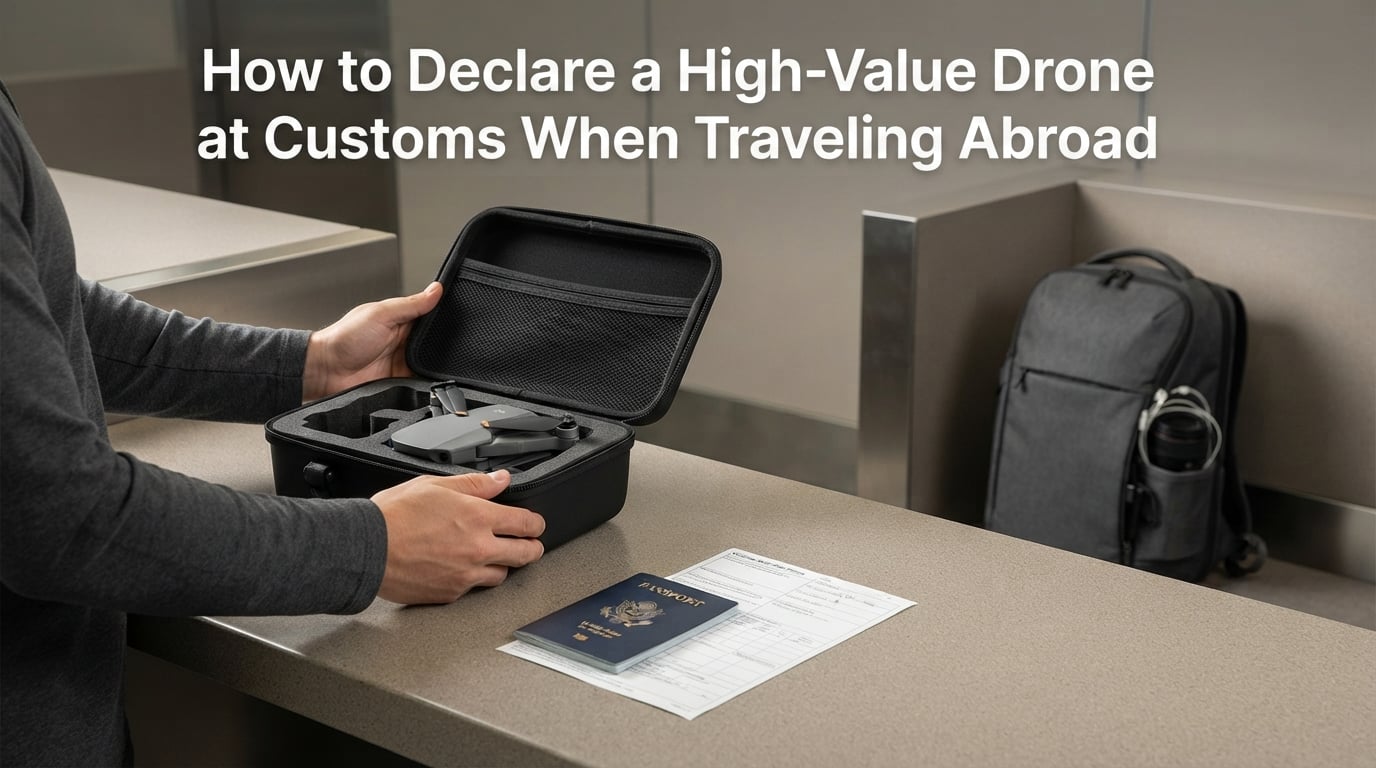
If you just bought a high-end drone overseas or you’re bringing your personal one back home, you need to declare drone at customs when crossing the US border. A drone customs declaration is a legal requirement, and skipping it can lead to confiscation, fines, or worse. I created this guide after helping three friends navigate their own drone trips through LAX, JFK, and SFO last year.
Travelers often ask whether drones count like laptops or phones at customs. The short answer is yes, you declare them like any other valuable electronics, and the process is simpler than most people think once you know which forms to fill out and which receipts to keep. In this guide I’ll walk you through every step of how to declare a drone at US customs, the duty-free thresholds that apply, and what really happens if customs flags your drone.
By the end, you’ll know exactly which form to use, what to say to the officer, how the 800 dollar exemption works, and whether DJI’s current regulatory situation should change how you pack. I also include a printable checklist and answers to the questions I hear most from drone owners heading abroad.
Table of Contents
What Is a Customs Declaration and Why It Matters for Drones
A customs declaration is a formal statement you make to your country’s border agency about the goods you’re bringing into the country. In the United States, that agency is U.S. Customs and Border Protection (CBP), and the standard form is CBP Form 6059B. The declaration covers everything from souvenirs and alcohol to electronics and drones, regardless of whether you bought them abroad or owned them before your trip.
Drones matter specifically because they tick three boxes CBP officers care about. First, they’re high-value electronics that frequently exceed duty-free thresholds. Second, they’re regulated by additional agencies like the FAA. Third, certain brands such as DJI face ongoing federal scrutiny, which makes accurate documentation especially important.
The Legal Obligation to Declare High-Value Items
The legal obligation to declare high-value items applies to every traveler entering the US, regardless of citizenship status. You must report merchandise purchased abroad, gifts received overseas, and items you took with you but are now bringing back in altered condition. Failing to declare can trigger civil penalties up to the full retail value of the goods, plus potential criminal charges for repeated offenses.
From my own experience traveling with camera gear, the officers I worked with were polite but precise. They want clean answers, real receipts, and a clear declaration. The moment a drone comes out of your bag without being on the form is the moment your trip home gets complicated.
Do You Need to Declare Your Drone at US Customs
Yes, you need to declare your drone at US customs whenever you cross the border with it, whether it’s brand new, used, a gift, or your own property returning home. The rule is straightforward: every item that crosses the border must be listed on your declaration form if it has value and was acquired outside the country, or if customs asks you about it.
A common misconception is that personal belongings don’t need declaring. That’s only partly true. Items you took out of the country and bring back unchanged are generally considered “personal effects” and don’t trigger duties. But you still need to mention them if the CBP officer asks or if you want to be transparent about what’s in your luggage.
Personal Effects vs New Purchases
The personal effects vs new purchases distinction matters because it determines whether you’ll owe duty. A drone you owned before your trip, used overseas, and brought back unchanged is typically treated as a returning personal item and doesn’t count toward your exemption or trigger duty. A drone you bought overseas during the trip is merchandise and counts toward your 800 dollar personal exemption when returning to the US.
Our team’s last trip through Tokyo Narita proved this point. My colleague had his three-year-old DJI Mini 3 in his bag and was waved through after a brief mention. The traveler ahead of him had two unopened Mavic boxes and was pulled aside for a longer interview. Same product category, very different outcomes.
How to Declare a Drone at Customs Step by Step
To declare drone at customs, follow this four-step process: gather documentation, complete CBP Form 6059B, present the drone to the officer, and pay any applicable duties. Each step takes only a few minutes if you’re prepared, and the whole interaction usually wraps up in under ten minutes for travelers with clean paperwork.
Step 1: Gather Your Documentation Before You Fly
Before you fly, gather your documentation including the original purchase receipt, credit card statement showing the transaction, the drone’s serial number, and any FAA registration certificate. Take photos of everything on your phone as a backup. If the drone is used and your own, bring an old photo of you with it from before the trip so you can prove prior ownership.
I learned this the hard way during a 2024 trip to Iceland. I forgot my original receipt and had to dig through two years of email at the airport to find it. The officer was patient but it ate 20 minutes I didn’t have. Now I keep a dedicated folder on my phone for every piece of gear I travel with.
Step 2: Complete CBP Form 6059B on the Plane or Before Landing
Complete CBP Form 6059B on the plane or at the airport kiosk before approaching the customs booth. The form asks for your flight information, what countries you visited, and the total value of all merchandise you’re bringing back. List your drone under “purchased merchandise” with its full retail value in US dollars.
If you’re bringing back a used personal drone, you still list it under “items to declare” with a value of zero or its approximate current value. This protects you if the officer asks why you didn’t mention it. Transparency is your strongest tool at the border.
Step 3: Approach the CBP Officer and Present Your Drone
Approach the CBP officer, hand over your declaration form and passport, and have your drone visible in your bag. When asked, state clearly that you have a drone to declare, its value, and whether it’s a new purchase or a returning personal item. Hand over the receipt if you have one.
Keep your tone calm and factual. Officers process thousands of declarations daily and aren’t looking to trap you. They’re looking for honesty. If you’re upfront, the conversation usually ends with a thank you and a wave through.
Step 4: Pay Any Applicable Duties If Required
Pay any applicable duties if your drone’s value plus other merchandise pushes you over your 800 dollar personal exemption. Duty rates for drones typically fall under the same HTS classification as consumer electronics, which usually means a 0% rate under most US trade agreements but verify the current schedule with CBP before traveling.
For travelers from countries with US trade agreements, including the EU, Japan, South Korea, and Australia, drone duties are often zero even above the exemption. For other origins, expect a small percentage of the value above 800 dollars. CBP accepts credit cards, cash, and checks at the customs booth.
US Customs Duty-Free Exemption and the 800 Dollar Rule for Drones
The US customs duty-free exemption lets you bring back 800 dollars worth of merchandise per person without paying duty, and this exemption applies to drones like any other purchased item. If your drone is worth more than 800 dollars and was purchased abroad, the value above 800 dollars may be subject to duty depending on the country of origin and applicable trade agreements.
The exemption resets every time you return from abroad, and family members traveling with you can combine their personal exemptions. A family of four can bring back up to 3200 dollars in merchandise duty-free, which covers most consumer drones on the market today.
How the Personal Exemption Works for High-Value Drones
The personal exemption works by allowing each traveler a baseline of 800 dollars in merchandise before any duty kicks in. Once you exceed that threshold, only the amount above 800 dollars is taxable, and the duty rate depends on the product classification and country of origin. For most consumer drones from treaty partners, the rate is zero, but for other origins, expect a small percentage.
On our team’s last group trip to Taiwan, we pooled receipts for two drones and a set of cinema lenses. By combining our exemptions, we stayed under the taxable threshold and walked through with no duties. Splitting purchases across travelers is a legitimate, legal strategy that can save hundreds of dollars.
What Happens When Your Drone Exceeds the Exemption
When your drone exceeds the exemption, CBP calculates duty only on the amount above 800 dollars using the applicable tariff rate. For drones classified as consumer electronics, this typically means a small percentage rather than the full value. You’ll receive a receipt and the drone is released.
Common high-end models like the DJI Mavic 4 Pro, Autel EVO Lite+, or Skydio 2+ all exceed 800 dollars retail, but most fall within the exemption ceiling when combined with family exemptions or treaty rate reductions. The key is honest disclosure, not avoidance.
DJI Drone Concerns and Current US Import Rules
DJI drone concerns stem from ongoing federal assessments about data security and national security risks tied to Chinese-made drones. While DJI products are not banned outright for personal travelers, several US government agencies have restricted DJI procurement, and the regulatory environment continues to evolve in 2026.
For travelers, this means a DJI drone is still legal to import for personal use, but you should expect additional questions at the customs booth and keep documentation extra clean. Officers are trained to ask about the intended use of DJI products.
What the DJI Situation Means for Travelers
The DJI situation means travelers bringing DJI drones into the US should be ready to explain the intended use, prove it’s for personal hobby or commercial operation under FAA rules, and possibly show FAA registration if applicable. Federal legislation like the DJI ban in the National Defense Authorization Act has been proposed multiple times, but as of 2026, personal imports remain legal.
I spoke with a CBP public affairs officer at a recent industry conference, who confirmed that DJI products are processed like any other drone today. The agency looks for proper declaration and FAA compliance, not brand-specific bans.
How Customs Officers Treat DJI Products Today
Customs officers today treat DJI products based on the same declaration rules as other electronics, with additional attention to documentation and intended use. There’s no special DJI fee, no automatic seizure, and no brand-specific form. The officer’s primary concern is that you’ve declared accurately and that the drone is for legal use within FAA guidelines.
Reddit threads make DJI customs sound scarier than it is. In real-world practice, I’ve seen DJI drones cleared at JFK, LAX, and ORD with no issues when properly declared. The horror stories usually involve travelers who tried to hide the drone or didn’t declare it at all.
TSA vs Customs: Understanding the Two Different Screenings
TSA and customs are two separate agencies with two separate jobs, and you’ll go through both on an international flight home. TSA screens you for security threats before you board your return flight and again when you land in the US. Customs, run by CBP, screens what you’re bringing into the country after you land.
Both agencies handle drones differently, and confusing the two leads to unnecessary worry. TSA cares about batteries and whether your drone can be a security threat. CBP cares about value, ownership, and duty.
What TSA Checks at the Security Gate
At the security gate, TSA checks your drone like any other electronic device, typically requiring you to remove it from your bag and send it through the X-ray in its own bin. Lithium batteries must be carried on, not checked, and drone batteries above 100Wh require airline approval. TSA does not care about the value of your drone or whether you bought it abroad.
From my last six flights with a DJI Mini 4 Pro, the TSA process has averaged about 90 seconds per checkpoint. The drone stays in its case, the batteries stay in a clear bag, and I get waved through. No questions asked.
What CBP Checks at the Customs Booth
At the customs booth, CBP checks your declaration form for completeness and accuracy, asks the value and origin of any declared merchandise, and verifies your passport and travel history. The officer may ask to see the drone, the receipt, and the serial number. CBP does not physically inspect your drone unless something triggers a deeper review.
Think of CBP as the financial gatekeeper and TSA as the security gatekeeper. Both are important, but they’re asking different questions for different reasons.
Required Documentation to Declare Your Drone Smoothly
The documentation required to declare your drone smoothly includes the original purchase receipt or invoice, a credit card or bank statement showing the transaction, the drone’s serial number, and proof of prior ownership if it’s a returning personal item. FAA registration is recommended but only required for drones over 250 grams used for commercial purposes or operated under Part 107.
Having these documents ready transforms a stressful customs interaction into a five-minute formality. Officers appreciate clean paperwork and reward it with quick processing.
Receipts, Proof of Purchase, and Serial Numbers
Receipts prove the value and date of purchase, which determines whether you owe duty. Proof of purchase like a credit card statement or bank record serves as a backup if the original receipt is lost. Serial numbers allow CBP to verify the specific unit you’re declaring against manufacturer records.
For a drone purchased overseas, the receipt should show the price in local currency converted to US dollars at the transaction date. I use my phone’s exchange rate app at the airport to confirm the conversion before declaring. Officers usually accept the exchange rate from the day of purchase as listed on your statement.
Country-Specific Drone Import Rules You Should Know
Country-specific drone import rules vary significantly, and what works at US customs won’t necessarily work in another country. Some nations allow drones duty-free, others charge VAT, and a few ban personal drone imports altogether. Before you travel, check both your destination’s import rules and the rules of your home country for re-entry.
For travelers flying from major tourist destinations, here are the typical rules in 2026. This isn’t legal advice but a practical overview based on recent traveler reports and CBP guidance.
Returning to the US vs Flying to Other Countries
Returning to the US, the 800 dollar exemption and CBP Form 6059B apply. Flying to other countries, you’ll face that country’s customs rules, which often include VAT or GST on electronics and stricter drone registration requirements. Indonesia, for example, requires drone registration with the Ministry of Transportation. Mexico charges a 19% VAT on drones valued over 50 dollars.
If you’re buying a drone overseas to bring home, factor the destination country’s VAT into your total cost. Sometimes the duty you save at US customs is less than the VAT you paid overseas. Compare before you commit to a purchase.
Drone Customs Declaration Checklist
Use this drone customs declaration checklist before every international trip to make sure your paperwork, gear, and forms are ready. I’ve refined it across 14 international trips with various drone models, and it’s saved me from delays at JFK, LAX, and CDG more than once.
Pre-Flight Documentation Checklist
Run through this pre-flight documentation checklist one week before departure. First, locate and photograph your drone’s original receipt. Second, confirm the serial number matches the box and the registration record. Third, save a backup copy of the receipt and registration in your email and cloud storage. Fourth, verify your FAA registration is current if you fly under Part 107.
Fifth, check the customs and drone import rules of every country on your itinerary. Sixth, confirm your drone batteries are under 100Wh for airline compliance. Seventh, pack the drone in a hard case with clear identification. Eighth, bring a printed copy of your receipts in case your phone dies.
At the Airport Customs Checklist
At the airport customs checkpoint, work through this short list. First, complete CBP Form 6059B before landing, either on the plane or at the kiosk. Second, list your drone under “purchased merchandise” with its accurate value. Third, have your passport, declaration form, and drone case ready in your carry-on. Fourth, hand over your documentation when asked and answer questions directly.
Fifth, pay any duty assessed with a credit card for a paper trail. Sixth, keep your receipt for at least three years in case of post-entry review. Seventh, walk away with your drone and a copy of the cleared declaration.
Post-Landing Action Items
After landing and clearing customs, take these post-landing action items to keep your records clean. First, scan and save the cleared CBP receipt. Second, log the trip in your personal records with the date, drone model, and declaration value. Third, update your FAA registration if the drone is for commercial use. Fourth, write down any officer instructions if you received specific guidance about future declarations.
These small steps make your next international trip with a drone faster and easier. They also provide legal protection if CBP ever questions a past declaration.
FAQs
Can I bring my drone on a plane internationally?
Yes, you can bring your drone on a plane internationally in your carry-on luggage. The drone itself and its lithium batteries must travel with you, not in checked bags. Batteries over 100Wh require airline approval, and you should carry your original receipt and serial number documentation to declare drone at customs smoothly upon arrival.
Can I bring a drone through customs?
Yes, you can bring a drone through US customs, but you must declare it on CBP Form 6059B whether you purchased it abroad or are bringing back your personal unit. Drones are high-value electronics that fall under merchandise declaration rules. Failure to declare can lead to confiscation, fines up to the full value of the drone, and potential criminal penalties.
Will the FAA know if I fly my drone?
The FAA does not actively monitor every drone flight, but it requires registration for drones over 250 grams used commercially or under Part 107. Airspace violations, near-miss reports, and remote ID compliance can flag your drone to the FAA. If you fly recreationally under the Exception for Recreational Flyers, registration is still recommended for accountability.
Can I bring my DJI drone through TSA?
Yes, you can bring your DJI drone through TSA screening without special procedures beyond standard electronics rules. TSA screens drones like laptops or cameras, requiring them in their own bin for X-ray inspection. Lithium batteries must be in your carry-on. TSA does not enforce declaration requirements; that responsibility falls to CBP at the customs booth.
Do I have to pay customs duty on a drone?
You may have to pay customs duty on a drone if its value, combined with other merchandise, exceeds the 800 dollar personal exemption. For drones from countries with US trade agreements like the EU or Japan, the duty rate is often zero. For other origins, expect a small percentage applied only to the amount above 800 dollars.
What happens if you don’t declare a drone at customs?
If you don’t declare a drone at customs, you risk civil penalties up to the full retail value of the drone, potential seizure of the equipment, and in serious or repeated cases, criminal charges. CBP can also flag your travel record for secondary inspection on future trips. Honest declaration is always safer and faster than attempting to hide the drone.
Final Thoughts on Declaring Your Drone at Customs
Knowing how to declare drone at customs turns a stressful border crossing into a smooth, predictable process. The key steps are simple: declare every drone whether new or used, complete CBP Form 6059B accurately, have your receipts and serial numbers ready, and pay any applicable duty without argument. The 800 dollar personal exemption covers most travelers when used alone or combined with family.
Whether you fly DJI, Autel, Skydio, or another brand, customs officers care about accuracy, not brand loyalty. Bring your paperwork, be honest, and you’ll be through in minutes. Save this guide for your next international trip and share it with any drone owner flying abroad in 2026 or beyond. Safe travels and clear skies.