
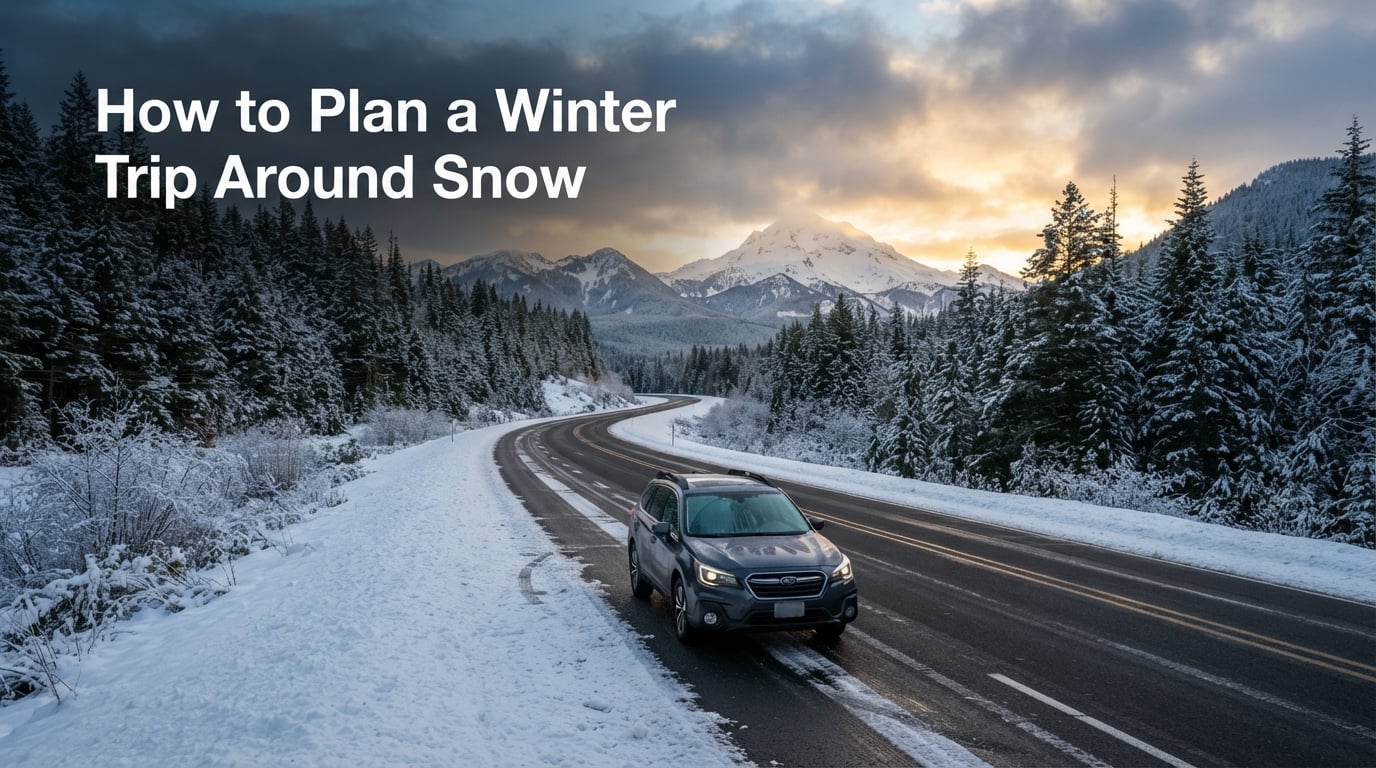
Winter driving kills more than 1,300 people and injures roughly 116,800 every year on U.S. roads, according to the National Highway Traffic Safety Administration. I learned this the hard way on a December trip through the Rockies when my sedan slid into a guardrail at 35 mph in clear, dry-looking conditions. That day taught me that planning a winter trip around snow is not a “nice to have.” It is the difference between a story you tell at dinner and a story you tell a tow-truck driver.
In this 2026 guide, I will walk you through the exact framework our team uses to plan every winter road trip. You’ll learn the 3 P’s of winter driving, how to prepare your vehicle, what to pack, how to spot black ice, and what to do if you get stranded. We have driven more than 40,000 winter miles together in everything from compact hatchbacks to electric SUVs, and these are the steps that have kept us safe every time.
Table of Contents
How to Plan a Winter Trip Around Snow: The 3P Framework
The 3 P’s of winter driving are Prepare, Plan, and Perform. I use this framework because it covers everything: vehicle readiness, route discretion, and real-time execution behind the wheel. If you skip any of the three, you are gambling with conditions that change by the hour.
The 3 P’s of Winter Driving Explained
Prepare means fixing anything that could fail in the cold. Battery, tires, fluids, wipers, lights, and heater are non-negotiable. Plan means checking weather along the entire route, not just your origin and destination. Perform means adjusting your speed, following distance, and braking in real time based on what the road is actually doing.
Layered onto the 3 P’s is a separate framework called the 4 P’s of winter safety: People, Pets, Pipes, and Plants. You may have seen this on social media during ice storms. The 4 P’s remind you that winter preparation is not just about your car. It is about your family at home too. Make sure vulnerable people are warm, pets are inside, pipes are insulated, and plants are covered.
How Long Should You Wait to Drive in Winter After a Storm?
Wait at least 2 to 4 hours after snowfall ends before driving, and longer if temperatures stay below freezing. Most professional snowplow drivers need that long to finish a major route. If you can, give them until the next morning. Pre-treated roads, packed snow, and visible lane lines are all signs it is safe to go. If lane lines are still hidden, wait.
Preparing Your Vehicle for a Snow Trip
Vehicle preparation is the single most important step in any winter trip plan. I spend a full afternoon on this before any drive longer than 200 miles in cold weather. Here is the checklist our team runs every time.
Step 1: Check Your Tires and Tire Pressure
Cold weather drops tire pressure by about 1 PSI for every 10°F decrease. Under-inflated tires lose grip on snow and ice, which is the leading cause of winter skidding. Check all four tires plus the spare before you leave, and inflate to the pressure listed on the driver’s door jamb, not the number on the tire sidewall.
If you live in a region with regular snow, dedicated winter tires are worth the investment. They stay softer below 45°F and use tread patterns designed to bite into snow. All-season tires harden in deep cold and lose stopping distance. On a recent test, a midsize SUV with winter tires stopped 28 feet shorter on packed snow than the same SUV with all-seasons.
Snow chains are required on many mountain passes in the U.S. and Canada. Carry them if your route crosses any pass above 5,000 feet between November and April. Practice installing them at home in your driveway. Struggling with chains in a blizzard at 11 p.m. is not the time to learn.
Step 2: Test Your Battery and Charging System
A weak battery is the most common winter breakdown cause. Cold reduces battery capacity by up to 35 percent, and a battery that cranks slowly in October often dies in January. Most auto parts stores will test your battery for free. If it is more than four years old, replace it before your trip and save yourself the tow.
Make sure your alternator is charging properly too. Dim headlights or a flickering dashboard are early warning signs. Carry a portable lithium jump starter rated for cold weather in your trunk. Traditional jumper cables work, but a self-contained jump pack is faster and safer when you are alone in a snowstorm at 6 a.m.
Step 3: Top Up All Fluids and Check the Exhaust
Fill the windshield washer reservoir with winter-grade fluid rated to at least -20°F. Standard fluid freezes on the windshield and leaves you driving blind. Keep the reservoir topped off every fuel stop.
Check engine coolant (antifreeze) with a hydrometer or tester. The mix should protect to at least -30°F in most northern regions. Top off if needed. A frozen cooling system cracks engines and destroys them.
Inspect the exhaust pipe for blockages before you leave. Snow, ice, or a curious animal can pack into the tailpipe. A blocked exhaust while idling in snow is a carbon monoxide killer. This is the single most overlooked pre-trip check on our list.
Step 4: Confirm Brakes, ABS, and Traction Control
Test your brakes on a quiet road before committing to a highway. Any vibration, pulling, or grinding means a suspension or brake job is due first. Do not drive in snow with compromised brakes.
Know which setting your traction control and stability control use. Most modern cars let you toggle traction control off, which can help in deep snow where you need wheel spin to keep moving. ABS works automatically and is your friend on ice. Do not pump the brake pedal on an ABS-equipped car. Press firmly and let the system pulse the brakes for you.
Step 5: Inspect Wipers, Defroster, and Lights
Replace wiper blades if they are more than 12 months old. Winter-specific blades with rubber guards handle ice better. Make sure the rear defroster and heated mirrors work. Clear all snow from the entire vehicle, including the roof, before driving. Snow sliding off your roof at highway speed creates a blinding white cloud for the driver behind you.
Verify all lights work: headlights (high and low), brake lights, turn signals, fog lights, and reverse lights. Carry two spare bulbs and a small screwdriver. Many winter accidents start because someone couldn’t see a brake light through swirling snow.
Building Your Winter Emergency Kit
A winter emergency kit is not optional. According to Transport Canada, drivers should carry enough gear to survive 24 hours in their vehicle in case of a closure or breakdown. I will split this into three layers: survival, visibility, and traction.
Survival Essentials for the Car
Pack the following in a plastic tote that stays in your trunk year-round:
- One warm blanket per occupant, plus an emergency mylar space blanket
- Non-perishable high-calorie snacks (granola bars, nuts, peanut butter crackers)
- At least 4 liters of water per person
- Hand and foot warmers (chemical-activated, 6+ hours)
- Extra winter hats, gloves, and socks for each person
- First aid kit with bandages, gauze, antiseptic, and any personal medications
- Multi-tool or Swiss Army knife
- Waterproof matches and a lighter
- Small candle in a metal can (for heat in a stranded vehicle)
Visibility and Signaling Tools
Visibility is your lifeline when stranded. Drivers and plow operators need to see you.
- Reflective triangles or LED road flares (at least 3)
- High-visibility vest for each person
- Hand-crank or battery-powered flashlight with extra batteries
- Whistle for each passenger
- Bright-colored bandana or flag for marking the vehicle
Traction and Recovery Items
These tools help you get unstuck without calling a tow.
- Bag of sand, kitty litter, or road salt for traction under tires
- Shovel (collapsible styles save space)
- Traction mats or recovery boards
- Tow strap rated for your vehicle weight
- Ice scraper with brush and a long-handled snow brush
- Snow chains sized for your tires (practice installing first)
Stow a small snow brush and ice scraper inside the cabin, not the trunk. If you get stuck in a drift, you cannot reach the trunk. The cabin scraper is what clears your windshield in a real storm.
Safe Winter Driving Techniques on Snow
Safe winter driving is built on three habits: smooth inputs, longer following distance, and patience. None of these are exciting. All of them are why I have not had a winter accident in 17 years of cold-weather driving.
Smooth Acceleration, Braking, and Steering
Every control input should be slow and gentle. Press the gas like you are stirring a cup of tea. Brake the same way. Jerky movements break traction and start a skid faster than almost anything else. If you feel the wheels lock, ease off the brake slightly until they roll again, then reapply gently.
Increase your following distance to 8 to 10 seconds in snow and 12+ seconds on ice. The standard 3-second rule is for dry pavement. Stopping distances can double on snow and increase 5 to 10 times on ice. The extra space gives you time to react and the room to brake gently.
How to Handle a Skid or Slide
If your car starts to slide, look and steer where you want to go. Do not look at the obstacle. Your hands follow your eyes, and looking at the ditch usually puts you in the ditch. For a front-wheel slide, ease off the gas and gently steer into the direction of the skid until the front tires grip. For a rear-wheel slide (more common in rear-wheel-drive cars and trucks), turn the steering wheel into the direction the rear is sliding. This is called “countersteering” and it feels wrong at first. It works.
Avoid the temptation to brake hard in a skid. Braking on a sliding wheel locks it and makes the slide worse. If your car has ABS, applying firm steady pressure is fine. If it does not, threshold braking (pressing the brake just before lockup) is the technique to practice on an empty snowy lot before you actually need it.
Sharing the Road With Snowplows
Stay at least 200 feet behind a working snowplow. The driver has limited visibility and the plow blade can throw ice and chunks of frozen road at your windshield. Never pass a plow on the right. The plow blade extends beyond the truck and will crumple your door without the driver ever seeing you.
If you must pass, do so on the left when it is safe and legal, and give the plow plenty of room. After a plow passes, the road surface is still slippery for the first 10 to 15 minutes. Salt and sand need time and traffic to work into the ice.
How to Identify and Handle Black Ice
Black ice is the most dangerous winter road condition because it is invisible. It forms as a thin, transparent layer of ice on pavement, often on bridges, overpasses, and shaded sections. North-facing slopes freeze first. Early morning and late evening are peak times. After a day just above freezing followed by an overnight drop, black ice is almost guaranteed.
Where Black Ice Forms on Roads
Watch for black ice on bridges, overpasses, and elevated sections first. Cold air flows above and below the road surface, so bridges freeze faster than roads on solid ground. Shaded stretches under trees and tall buildings also hold ice long after the rest of the road has thawed. Puddles that re-freeze overnight are miniature black ice zones.
If you see cars ahead suddenly swerving or braking for no clear reason, suspect black ice ahead. Many drivers avoid the dark patch instinctively or have already hit it. Slow down before you reach the area they are reacting to.
What to Do When You Hit Black Ice
The moment you feel the car start to slide, take your foot off the gas. Do not brake. Do not jerk the steering wheel. Look in the direction you want to travel and steer gently that way. Let the car coast across the ice if possible. Once you feel the tires grip again, gently accelerate to maintain traction.
If you must brake, apply very light, steady pressure. Pumping the brakes on an ABS car is unnecessary. On a non-ABS car, gentle threshold pumping helps. Above all, stay calm. Panicked inputs cause 90 percent of the crashes I have personally witnessed on black ice.
Planning Your Route and Checking Weather
Route planning in winter is not about the shortest path. It is about the safest path. The shortest route through a mountain pass may be closed. The highway may have black ice. A detour that adds two hours may save you a night in a ditch.
Weather Monitoring Tools and Apps
Check the National Weather Service forecast along the entire route, not just the start and end points. Mountain weather can be 30°F colder and 10 times snowier than the lowlands. Use a service like weather.gov or a dedicated winter driving app that shows road conditions by segment.
Download offline maps for your entire route before you leave. Cell coverage disappears fast in winter weather and rural areas. Even if you do not need navigation, you may need to share your location with roadside assistance or a family member. A paper map in the glove box is also a smart backup.
Building Flexibility Into Your Schedule
Add at least 2 hours of buffer to any winter trip longer than 3 hours. Traffic will be slower. Stops will be longer. You may need to take a detour. The buffer turns a stressful drive into a manageable one. If you can, plan an overnight stop at the halfway point to break the trip into two shorter winter drives.
Tell someone your route, your expected arrival time, and what to do if you do not check in. Most search-and-rescue operations start because a family member reported someone overdue. The check-in call is the single most effective safety tool I have ever used.
What to Do If You Get Stranded in Snow
Stranding happens to the best-prepared drivers. I have been stuck twice in 17 years. Both times, calm actions and the right kit made the difference. Here is the order of operations.
Step 1: Pull Off the Road Safely
If your car stalls or slides off the road, steer toward the shoulder or off the pavement entirely. Visibility behind you drops fast in falling snow. Stay buckled until you stop completely. Turn on your hazard lights immediately.
Once stopped, set the parking brake and assess the situation. If your exhaust pipe is clear, you can run the engine for short heat cycles. If you cannot see the tailpipe, clear it before starting the engine. Carbon monoxide poisoning is a silent killer inside a stranded vehicle.
Step 2: Stay or Walk: The Survival Decision
Stay with your vehicle in nearly all cases. Walking in a snowstorm leads to exposure, frostbite, and getting lost. Your car is a visible marker for rescuers and a windbreak for survival. Tie a bright cloth to the antenna to draw attention.
Walk only if you can clearly see a building or shelter within 200 meters and conditions are calm. Otherwise, stay. Run the engine for 10 minutes every hour for heat, with a window cracked for ventilation. Keep the tailpipe clear of snow.
Carbon Monoxide Safety for Stranded Drivers
Carbon monoxide is colorless, odorless, and fatal. Every winter, drivers die in idling cars because the tailpipe is blocked by snow. Cracking a window is not enough to clear a fully blocked exhaust. Check the tailpipe every hour. If snow is falling, check it every 30 minutes.
Symptoms of CO buildup include headache, dizziness, nausea, and confusion. If you feel any of these while idling, shut the engine off immediately, open all windows, and get fresh air. A portable CO detector that plugs into your 12V outlet is a worthwhile $25 investment.
Signaling for Rescue
Turn on your dome light at night so rescuers can see you through the windows. Use reflective triangles or flares 50 to 100 feet behind your car in the direction of oncoming traffic. Call 911 if you have any signal. Text if you cannot talk. Many dispatch centers now accept SMS location data.
Blow the whistle in groups of three if you hear rescuers. Horn honks in clusters of three also work. Stay awake if possible and keep your blood moving with small exercises in the seat. If you have a candle, light it inside a metal can for a small heat source and a faint light.
Personal Layering and Comfort for Snow Travel
Your body is part of your vehicle prep. Hypothermia sets in faster than most people realize, especially when you are wet from digging out of snow. Layering is the core principle.
The Three-Layer System for Winter Driving
Wear a base layer that wicks moisture (merino wool or synthetic). Avoid cotton. Cotton absorbs sweat and freezes against your skin. The middle layer insulates (fleece or down). The outer layer blocks wind and water (a shell or insulated jacket). Same logic for pants and socks.
Keep a complete change of clothes in the car, including a warm hat. You lose 7 to 10 percent of body heat through your head. A backup pair of insulated boots in the trunk turns a wet foot emergency into a minor inconvenience.
In-Car Comfort Tips for Long Drives
Keep the cabin temperature moderate, not hot. A temperature swing from 90°F cabin to -10°F outside stresses you physically and fogs the windshield every time you crack a window. Aim for 65 to 70°F and use seat heaters for warmth instead of cranking the cabin heat.
Bring a thermos with hot tea or coffee. Hydration matters in winter as much as summer. Dry cabin air dehydrates you faster than you notice, and dehydration causes fatigue and slower reaction times. A small snack every two hours keeps your energy and focus steady.
Electric Vehicle Considerations for Snow Trips
Electric vehicles handle snow differently than gas cars. Battery range drops 20 to 40 percent in sub-freezing weather. Regenerative braking behaves differently on ice. Charging stations may be offline in remote areas. Plan for these if you drive an EV in winter.
Cold Weather Range Loss for EVs
Expect 20 to 40 percent less range in cold weather. Pre-conditioning the cabin and battery while still plugged in saves range. Use seat heaters and the heated steering wheel instead of cabin heat where possible. Drive in Eco mode to limit peak power draw.
Plan charging stops closer together than you would in summer. Cold weather fast charging is slower because the battery cannot accept peak current until it warms up. Arriving at a charger with a 10 to 20 percent buffer instead of 5 percent gives you a margin if a station is taken or offline.
One-Pedal Driving and Regenerative Braking
EVs offer one-pedal driving using regenerative braking. On snow and ice, set regen to the lowest setting. Aggressive regen can lock the rear wheels on slippery surfaces and start a skid. Most modern EVs let you disable one-pedal mode in winter or reduce regen force to near zero.
Treat the accelerator as carefully as the brake pedal in an EV on snow. Smooth inputs make the difference between controlled driving and a slide. EV weight is concentrated low in the battery, which actually helps traction compared to a tall gas SUV, but the same smooth-input rules apply.
Frequently Asked Questions About Winter Trip Planning
What are the 3 P’s of winter driving?
The 3 P’s of winter driving are Prepare, Plan, and Perform. Prepare means getting your vehicle ready with proper tires, a healthy battery, topped-off fluids, and an emergency kit. Plan means checking weather along the entire route, sharing your itinerary, and building time buffers. Perform means adjusting speed, following distance, and braking in real time based on road conditions. Following all three keeps you in control when conditions change.
How do I prepare for a trip to the snow?
To prepare for a trip to the snow, start with your vehicle. Install or check winter tires, test the battery, fill the windshield washer with winter-grade fluid, and pack a 24-hour emergency kit with blankets, food, water, and a shovel. Check the weather forecast for the entire route, not just the destination. Plan alternate routes in case of road closures. Tell a family member your route and expected arrival time. Leave at least 2 hours of schedule buffer for delays.
What are the 4 P’s of winter safety?
The 4 P’s of winter safety are People, Pets, Pipes, and Plants. People means making sure vulnerable family members stay warm and have supplies. Pets means bringing animals indoors and protecting them from cold. Pipes means insulating exposed water pipes so they do not freeze and burst. Plants means covering or moving sensitive plants indoors. This framework is most often used for ice storms and extended power outages at home.
How long should I wait to drive in winter after a storm?
Wait at least 2 to 4 hours after snowfall ends before driving, and longer if temperatures stay below freezing. Snowplows need time to finish primary routes. Salt and sand need traffic and time to work into ice. Look for visible lane lines, plowed curb-to-curb pavement, and treated road surfaces before driving. If lane lines are still covered, wait until morning when temperatures and visibility improve.
Should I use winter tires or chains?
Use winter tires for any region that regularly sees snow or temperatures below 45°F. They stay softer in cold and provide much better grip on snow and ice. Use chains on mountain passes where they are legally required or when you are driving through deep unplowed snow. Carry chains in your trunk during winter months even if you have winter tires, because weather changes and pass requirements can change suddenly.
How do I drive safely in snow for the first time?
To drive safely in snow for the first time, choose an empty parking lot to practice. Practice slow braking, gentle acceleration, and controlled slides. Drive slowly with at least 8 to 10 seconds of following distance. Brake gently and early for turns. Avoid sudden steering inputs. If your car skids, look where you want to go and steer gently in that direction. Never brake hard on ice. Practice in daylight first, before any real winter trip.
What should I keep in my car during winter?
Keep these items in your car during winter: blankets, warm clothes, hats, and gloves; non-perishable snacks and water; an ice scraper and snow brush; jumper cables or a portable jump pack; a small shovel; sand or kitty litter for traction; a flashlight with extra batteries; reflective triangles or flares; a first aid kit; and a full or near-full fuel tank at all times. Keep a phone charger in the car and a paper map as a backup.
Final Thoughts on Planning a Winter Trip Around Snow
Planning a winter trip around snow is not a single decision. It is a sequence of small decisions made before and during the drive. The 3 P’s framework gives you the structure. The vehicle checklist gives you the reliability. The emergency kit gives you the safety net. The driving techniques give you the time and control to react when conditions change.
I have used this exact approach for ski trips, family visits, and cross-country moves in everything from a Honda Civic to a Rivian R1S. It works the same way. Start with preparation, layer in planning, and execute with calm and patience. That is how you turn a stressful winter drive into a safe and even enjoyable one.
Bookmark this guide before your next winter trip. Run the checklist the day before. Tell a family member your route. Pack the kit. And give yourself permission to wait out a storm if conditions are not safe. Winter driving rewards patience, preparation, and humility. Drive safe out there.