
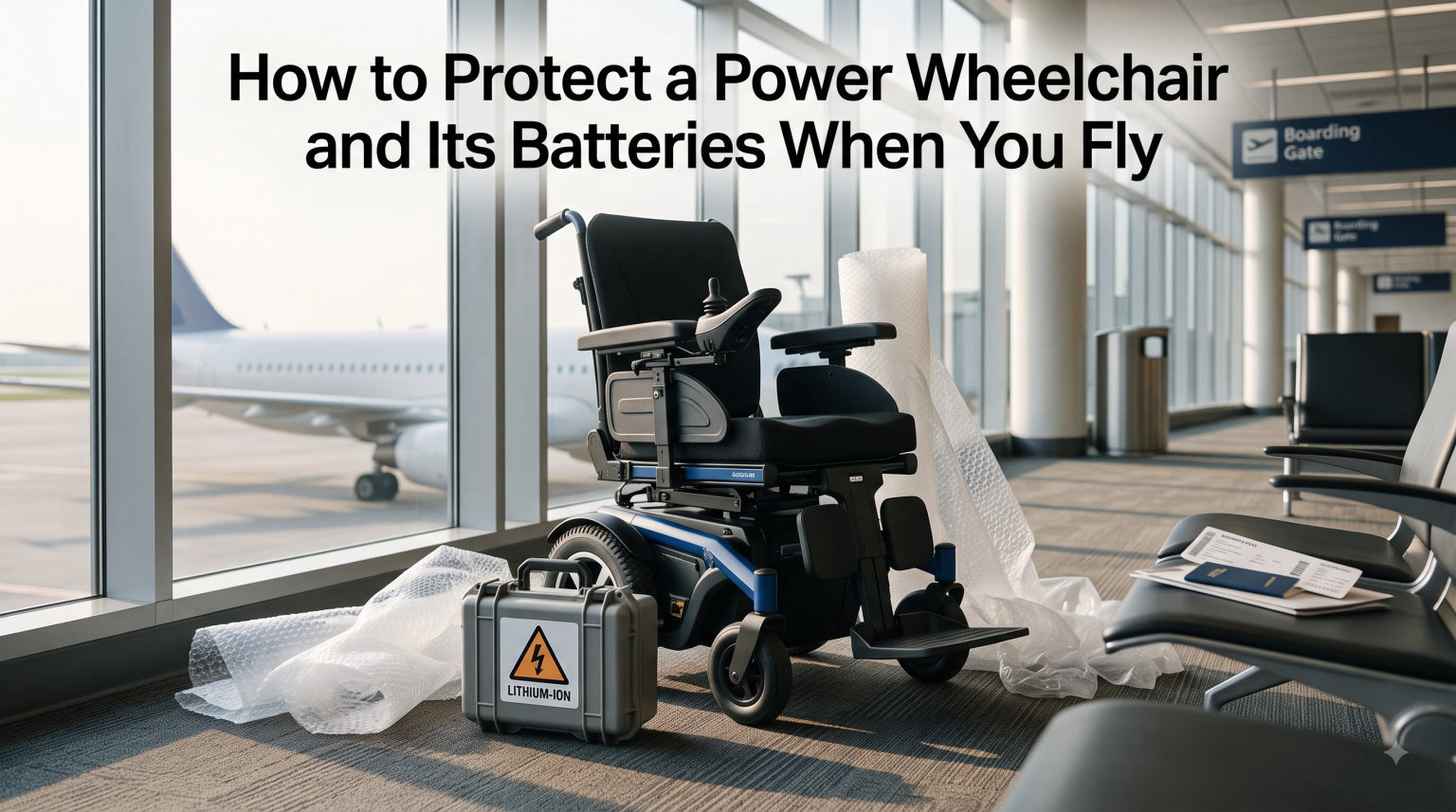
Flying with a power wheelchair can feel like a gamble. According to data from the Air Travel Consumer Report, roughly 1 in 80 wheelchairs (a 1.26% mishandling rate) is damaged or lost on every flight cycle, and surveys show that 57.89% of power chair users have experienced problems or damage during air travel. Those numbers are sobering, but they do not mean you have to stop flying.
In this guide, I will walk you through exactly how to protect a power wheelchair when flying, from understanding battery regulations to documenting your chair’s condition before you ever reach the gate. Whether you are taking your first trip with a motorized chair or you are a seasoned traveler looking for better strategies, these steps will help you reduce the risk of damage and travel with more confidence.
You will learn the FAA and TSA rules for wheelchair batteries, how to prepare your chair for the cargo hold, how to notify airlines correctly, and what to do if your wheelchair comes back damaged. I have pulled together the latest regulatory requirements, real traveler experiences, and practical tips that most guides leave out.
Table of Contents
The Real Risk: How Often Wheelchairs Are Damaged on Flights
Wheelchair damage during air travel happens far more often than airlines advertise. The Department of Transportation’s Air Travel Consumer Report tracks wheelchair mishandling, and the numbers tell a clear story about where risks concentrate.
The overall mishandling rate for wheelchairs sits at approximately 1.26%, meaning about 1 in 80 wheelchairs is damaged, delayed, or lost per flight. That might sound low at first glance, but when you fly round-trip multiple times a year, the cumulative risk adds up quickly. A traveler taking four round trips faces a much higher lifetime probability of experiencing damage.
More concerning is what travelers themselves report. Community surveys from wheelchair user forums and advocacy groups show that 57.89% of power chair users have experienced some form of problem or damage when flying. This includes scratched frames, broken joysticks, bent footrests, disconnected wiring, and in some cases, complete loss of the chair.
Most damage occurs during two specific moments: loading the wheelchair into the cargo hold and unloading it at the destination. The narrow cargo bay openings, tight turn angles, and conveyor belt transfers put stress on parts that are not designed to be lifted or dragged. Gate-checking your chair reduces the risk of loss but does not eliminate the risk of damage during these transfer points.
The good news is that preparation dramatically reduces your risk. Travelers who label their chairs, attach handling instructions, and document condition before every flight report significantly fewer damage incidents. The steps in this guide are built around those high-impact actions.
Battery Regulations You Must Know Before Flying
Battery regulations are the single most important thing to understand before you fly with a power wheelchair. Get this wrong, and your chair may not be allowed on the plane at all. The FAA, TSA, and IATA have specific rules based on battery type and capacity, and you need to know exactly which category your battery falls into.
Lithium Ion Batteries: The 300Wh Limit
Most modern power wheelchairs use lithium ion batteries because they are lighter and hold more charge. For air travel, the FAA allows lithium ion batteries up to 300 watt-hours (Wh) per battery, and you may carry up to two spare batteries that do not exceed 160Wh each. You must calculate your battery’s watt-hour rating before you fly.
To find your battery’s watt-hours, multiply the voltage by the amp-hour rating. For example, a 24V battery rated at 50Ah equals 1,200Wh, which would exceed the limit. A smaller 24V battery at 10Ah equals 240Wh and would be allowed. Check your battery label or contact the manufacturer if the rating is not printed clearly.
Any lithium ion battery that is removed from the wheelchair must travel in your carry-on bag, never in checked luggage. The terminals must be protected from short-circuiting by keeping them in their original packaging, taping over the terminals, or placing each battery in a separate plastic bag. Spare batteries must be protected from physical damage and contact with metal objects.
Gel and Non-Spillable Batteries
Gel batteries and other non-spillable wet batteries (AGM, sealed lead-acid) are generally allowed on aircraft with fewer restrictions than lithium ion. These batteries can typically stay installed on the wheelchair during transport, provided the battery terminals are protected against short circuits and the battery is securely attached to the chair.
The key requirement for non-spillable batteries is terminal protection. The battery case must be intact, and both positive and negative terminals must be covered to prevent any metal object from creating a short circuit. Battery covers, terminal caps, or electrical tape over the terminals all satisfy this requirement.
What TSA Screeners Will Check
TSA officers are trained to identify battery types and verify that they meet air travel requirements. You should be prepared to tell the screener what type of battery your wheelchair uses and its watt-hour rating. Having documentation from the battery manufacturer that confirms compliance can speed up the screening process significantly.
TSA will not confiscate a properly rated battery that meets regulations. However, if a battery is damaged, swollen, or leaking, it will be removed regardless of type. Always inspect your battery before travel and replace any battery that shows signs of swelling or damage.
How to Protect a Power Wheelchair When Flying: Step-by-Step Preparation
The preparation you do before arriving at the airport has the biggest impact on whether your wheelchair arrives safely. Here is a complete step-by-step checklist that covers everything you should do in the days leading up to your flight.
Step 1: Check Cargo Hold Dimensions Before Booking
Before you book your flight, check the airline’s cargo hold dimensions to confirm your wheelchair will physically fit. Each airline publishes cargo door measurements, and some smaller regional jets have cargo openings too narrow for larger power chairs. If your chair does not fit, the airline may refuse to transport it or may force disassembly that increases damage risk.
Contact the airline’s accessibility desk directly and provide your wheelchair’s dimensions, including length, width, and height. Ask specifically about the aircraft assigned to your route, since cargo dimensions vary by plane type.
Step 2: Document Your Wheelchair’s Condition
Take clear photos and video of your wheelchair from every angle before you leave for the airport. Capture the frame, joystick, armrests, footrests, wheels, and battery compartment. Photograph any existing scratches or damage so you can prove it was pre-existing. This documentation is essential if you need to file a damage claim later.
Store these photos on your phone and back them up to cloud storage. If your wheelchair is damaged, having time-stamped “before” photos makes it nearly impossible for the airline to claim the damage was pre-existing.
Step 3: Remove Loose Objects and Accessories
Strip your wheelchair of everything that can come loose during transport. Remove cup holders, bags, phone mounts, cushions, headrests, and any aftermarket accessories. Pack these items in your carry-on luggage. Loose items are the first things to break or disappear during cargo handling.
If your joystick is removable, take it off and carry it with you. Joysticks are the most frequently damaged component on power wheelchairs, and they are expensive to replace. Wrap the exposed joystick mount with padding and tape to protect the connection point.
Step 4: Switch to Free-Wheel Mode
Put your wheelchair into free-wheel mode by disengaging the motors. This allows baggage handlers to push the chair manually without forcing the motors, which can cause serious drivetrain damage. Free-wheel levers are typically located near the rear wheels. Check your owner’s manual for the exact location on your model.
Tape the free-wheel levers in the disengaged position so they do not accidentally slip back during transport. Add a note near the levers explaining what they do, so handlers understand the chair is in manual push mode.
Step 5: Protect Vulnerable Components
Wrap vulnerable parts with bubble wrap, foam padding, or thick towels secured with packing tape. Focus on the joystick mount, armrests, footrests, and any exposed wiring. Use bright-colored tape so handlers can see that protective wrapping is intentional and should not be removed.
If your footrests flip up, secure them in the up position to prevent bending. If they are removable, take them off entirely and store them with your carry-on items.
Step 6: Attach Laminated Handling Instructions
Create a laminated instruction sheet and attach it to the back of your wheelchair where handlers will see it immediately. Keep instructions simple and direct. Include phrases like “Push only, do not lift by armrests,” “Motors disengaged, push manually,” and “Do not tilt.” Add your name, phone number, and flight information.
Clear labeling and instructions are one of the most effective damage prevention steps you can take. Forum data shows that travelers who attach handling instructions report significantly fewer damage incidents than those who do not.
Step 7: Protect or Remove the Battery
Follow the battery regulations outlined in the previous section. If you have a lithium ion battery that must be removed, disconnect it carefully, protect the terminals, and pack it in your carry-on. If your battery stays on the chair (gel or non-spillable), verify that terminals are covered and the battery is securely mounted.
Take a photo of the battery compartment showing proper terminal protection before you hand over the chair. This proves the battery was secured correctly if any question arises later.
Notifying Your Airline: Advance Notice Requirements
Airlines require advance notification when you are traveling with a power wheelchair, and giving this notice is one of your most important protections. Failing to notify the airline properly can result in delays, refusal to transport your chair, or last-minute arrangements that increase damage risk.
The 48-Hour Notification Rule
Most airlines require at least 48 hours of advance notice for power wheelchair travel. Some airlines ask for up to 72 hours, especially for international flights or larger chairs that require special handling. Call the airline’s accessibility or special assistance line directly rather than relying on online booking fields, which may not capture all your needs.
During this call, provide your wheelchair type, dimensions, weight, and battery specifications. Ask for a confirmation email or reference number that documents your notification. If any issue arises at the airport, you can show this confirmation to prove you followed proper procedures.
SSR Codes: What They Are and Why They Matter
Airlines use Special Service Request (SSR) codes to communicate your needs across their systems. The relevant codes for wheelchair travelers include WHCH (manual wheelchair), WCHC (wheelchair for passenger who cannot ascend or descend stairs and needs assistance to and from the seat), and WMPR (powered wheelchair). These codes travel with your reservation and alert ground staff at every airport.
Verify that the correct SSR code is attached to your reservation after you make your notification call. If the code is wrong or missing, staff at connecting airports may not know you are traveling with a power chair.
Request Cargo Hold Dimension Confirmation
During your notification call, ask the airline to confirm the cargo hold dimensions for every aircraft on your itinerary, including connecting flights. This is especially important for regional jets, which often have smaller cargo doors. If any segment cannot accommodate your wheelchair, you need to know before you arrive at the airport so you can explore alternatives.
Protecting the Wheelchair Battery During Flight
Battery protection during flight is about preventing both fire risk and physical damage. The specific steps depend on your battery type, but every power wheelchair traveler should follow a core set of protections.
For lithium ion batteries that must be removed, the battery goes in your carry-on bag with terminals fully protected. Use the original manufacturer’s packaging if possible, or wrap terminal contacts with electrical tape and place the battery in a rigid protective case. Never pack a removed lithium battery in checked luggage.
For batteries that stay on the wheelchair, verify that the battery is firmly secured to the frame and that all mounting hardware is tight. A loose battery can shift during loading and damage both the battery and the wheelchair frame. Cover all terminals with protective caps or tape, and use a battery cover if your chair has one.
Consider bringing a multimeter or battery tester in your carry-on. If your wheelchair arrives with a dead or damaged battery, you can immediately verify the charge level and battery health before leaving the airport. This documentation supports any damage claim you file.
At the Airport: Screening, Boarding, and Assistance Services
Getting through the airport with a power wheelchair involves TSA screening, special assistance requests, and gate-check procedures. Knowing what to expect at each stage helps you move smoothly and protects your equipment.
TSA Screening for Power Wheelchairs
TSA has specific procedures for screening passengers in wheelchairs. You will stay in your chair while a security officer performs a pat-down and tests the chair for explosive traces. You have the right to request a private screening, and you can ask for a supervisor if you feel the screening is not being conducted properly.
TSA officers can also use a swab-based explosives trace detection test on your wheelchair and hands. This process takes a few minutes and does not require you to leave your chair. If the swab triggers an alarm, additional screening will follow.
Requesting Special Assistance
If you need assistance transferring to your aisle chair or getting through the terminal, request this when you arrive at the gate. Gate agents can arrange for assistance staff and make sure you board early enough for a safe transfer. Arriving at the gate at least 90 minutes before departure gives staff time to prepare.
You are entitled to assistance under the Air Carrier Access Act, and airlines must provide it at no charge. Do not hesitate to ask for help with transfers, reaching the restroom, or getting to your gate.
Gate-Checking Your Wheelchair
Power wheelchairs are typically gate-checked, meaning you stay in your chair until you reach the aircraft door, then transfer to an aisle chair for boarding. Your power wheelchair is then loaded into the cargo hold. Gate-checking is preferable to checking your chair at the main counter because it reduces the number of transfer points and handling stages.
Before you hand over your chair at the gate, take one final set of photos showing the chair’s condition. Hand your laminated instruction sheet to the gate agent and ask that it be passed to the baggage handling team. Watch your chair until it enters the cargo hold if you have a window seat that allows it.
Post-Flight Inspection and Filing Damage Claims
Your wheelchair arrives at your destination, and the first few minutes after you get it back are critical. A thorough inspection right away protects your rights and strengthens any damage claim you may need to file.
Inspect Before Leaving the Airport
Do not leave the baggage claim area until you have inspected your wheelchair thoroughly. Check the frame for new scratches, bends, or cracks. Test the joystick and motor response. Verify that all components are present, including armrests, footrests, and any parts you left attached. If you notice any damage, report it immediately before leaving the airport.
Reporting damage at the airport is important because of a legal concept called the rebuttable presumption. When you report damage before leaving the airport, there is a presumption that the airline caused the damage. If you leave and report it later, the airline can argue the damage occurred after you took possession.
Filing a Damage Claim
To file a damage claim, go to the airline’s customer service desk at the airport and request a property irregularity report (PIR). Take photos of all damage with timestamps. Provide your “before” photos for comparison. Get the name and contact information of the staff member who helps you.
Most airlines require written claims within 7 days for domestic flights and 21 days for international flights, but report damage immediately regardless. Include repair estimates from an authorized dealer, your original wheelchair purchase receipts, and all documentation in your claim package.
Contacting the Complaints Resolution Official
If the airline does not resolve your claim satisfactorily, ask to speak with the Complaints Resolution Official (CRO). Every U.S. airline is required to have a CRO available at every airport during operating hours. The CRO has authority to resolve disability-related complaints on the spot and can escalate your case beyond standard customer service channels.
Your Rights Under the ACAA and the 2024 Wheelchair Rule
Understanding your legal rights is one of the most powerful tools you have as a power wheelchair traveler. Two key pieces of legislation protect you: the Air Carrier Access Act and the 2024 Wheelchair Rule that strengthened it.
The Air Carrier Access Act (ACAA)
The Air Carrier Access Act prohibits discrimination against passengers with disabilities by U.S. and foreign airlines flying to or from the United States. Under the ACAA, airlines must accept electric wheelchairs as checked baggage, must provide assistance at no charge, and must transport your wheelchair even if it cannot fit through the aircraft cargo door by disassembling and storing it in a manner that protects it from damage.
The ACAA also requires airlines to return your wheelchair to you in the condition it was received. If the airline damages your chair, they are responsible for repair or replacement. You do not need to prove negligence in most cases, the act places responsibility on the airline.
The 2024 Wheelchair Rule: New Requirements
In late 2024, the Department of Transportation issued the final Wheelchair Rule, which introduced significant new protections for power wheelchair travelers. This rule requires airlines to promptly return loaner wheelchairs if your chair is damaged, to provide more detailed handling training for employees and contractors, and to publish more transparent data about wheelchair mishandling.
The 2024 rule also strengthens the definition of what constitutes damage. Airlines can no longer dismiss claims for “cosmetic” damage. Any damage that affects the operation, safety, or structural integrity of the wheelchair must be addressed. This is a meaningful expansion of traveler protections.
Additionally, the rule requires airlines to honor the handling instructions that passengers attach to their wheelchairs whenever feasible. If you provide clear, reasonable instructions for handling your chair, airline staff must make a genuine effort to follow them.
Enforcement and Complaints
If an airline violates your ACAA rights, you can file a complaint with the Department of Transportation’s Aviation Consumer Protection Division. The DOT tracks these complaints and can take enforcement action against airlines with patterns of violations. You can also file a complaint with the airline’s CRO first, and escalate to the DOT if the issue is not resolved.
Keep records of every interaction: names, dates, times, reference numbers, and copies of all correspondence. Detailed documentation makes enforcement actions far more likely to succeed.
FAQs
Can you take a battery-powered wheelchair on a plane?
Where do I put lithium batteries when flying?
How to protect a wheelchair on a flight?
Do power wheelchairs have lithium batteries?
What happens if an airline damages my wheelchair?
How do I fly with a motorized wheelchair?
Conclusion: Travel With Confidence
Flying with a power wheelchair does not have to mean crossing your fingers and hoping for the best. By following the steps in this guide, you can take real control over how to protect a power wheelchair when flying and its batteries through every stage of your journey.
The most impactful actions are the simplest ones: document your chair before every flight, attach clear handling instructions, protect or remove your battery properly, notify the airline in advance, and inspect your chair the moment you land. These steps dramatically reduce your risk of damage and give you the documentation you need if something goes wrong.
Your wheelchair is your mobility and your independence. You have rights under the ACAA and the 2024 Wheelchair Rule, and knowing those rights means you can hold airlines accountable. Prepare thoroughly, travel with confidence, and do not let fear of damage keep you grounded.