
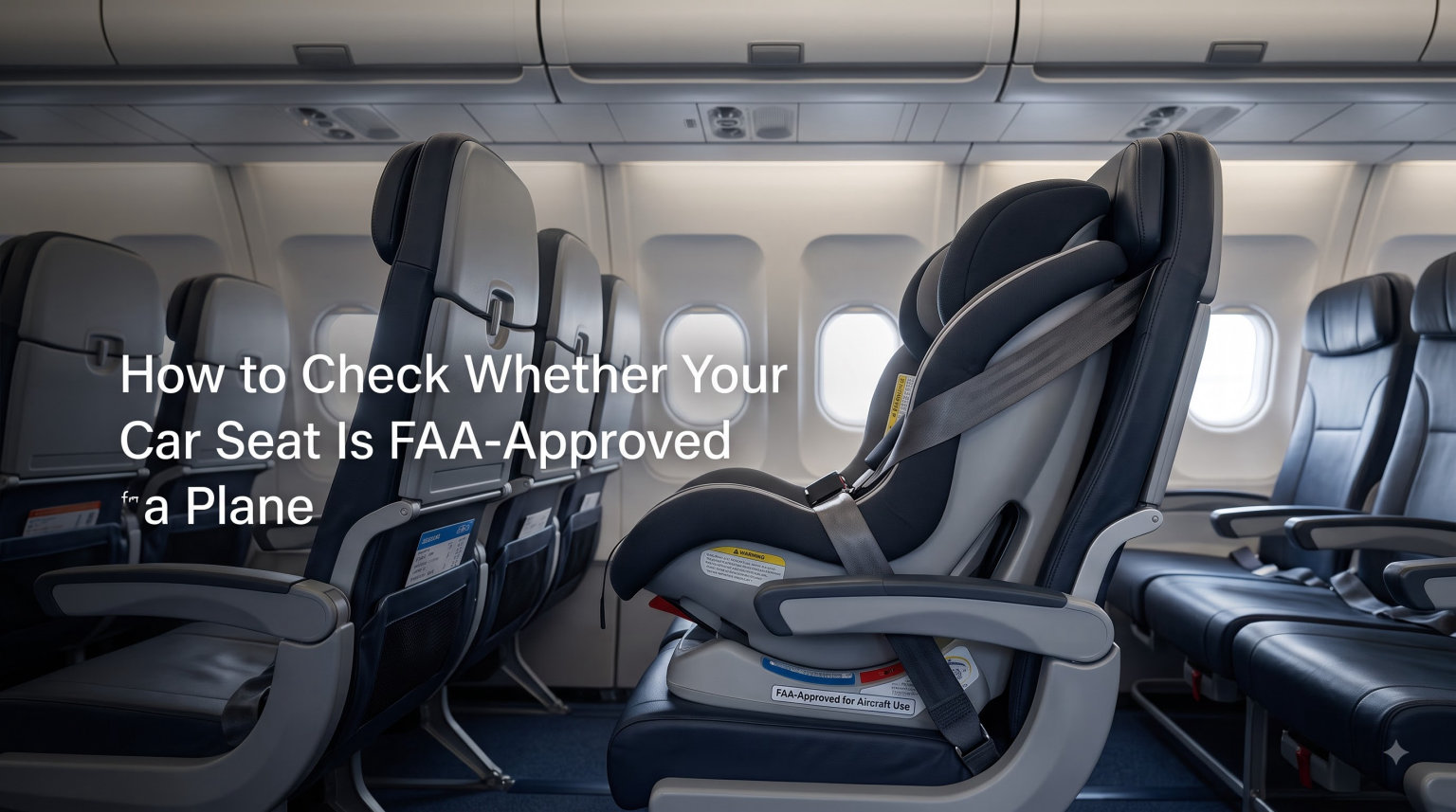
Flying with a little one brings enough stress without second-guessing whether their car seat will make it past the gate agent. I have been there, standing in the jet bridge wondering if my seat had the right sticker. That quick check can save you from being turned away at the boarding door.
Learning how to check whether your car seat is FAA-approved for a plane takes about two minutes once you know exactly what to look for. The good news is that most harnessed car seats sold in the United States already carry FAA approval. The catch is that you still need to verify it yourself, because airlines require proof visible on the seat itself. No sticker means no boarding with the seat.
In this guide, I walk you through every step of checking, understanding, and using your car seat on an airplane. You will learn what that certification label looks like, where it hides on different seat models, and which seat types are never approved. I also cover international flights, installing on the plane, and what to do if a gate agent gives you trouble. Everything here is based on FAA guidelines, real parent experiences from travel forums, and the same rules flight attendants enforce every day.
Table of Contents
What Does FAA-Approved Actually Mean for Car Seats?
FAA approval means the Federal Aviation Administration has certified a car seat for use during all phases of flight, including taxi, takeoff, landing, and turbulence. The seat meets crash protection standards specific to aircraft environments, where forces differ from highway collisions. This certification is separate from the vehicle safety standard known as FMVSS 213, which all car seats must meet to be sold in the United States.
That means a seat can be perfectly legal for your car but still lack aircraft certification. The governing regulation is 14 CFR 21.8(d), which spells out how child restraint systems qualify for aircraft use. Seats that pass this standard display a specific certification statement printed directly on the label.
The FAA classifies any approved car seat as a Child Restraint System, or CRS, when used on an aircraft. Airlines are required by federal law to accept any properly labeled CRS. They can enforce rules about seat location and orientation, but they cannot turn away a correctly labeled seat.
Think of it this way: vehicle certification means the seat passed car crash tests. Aircraft certification means it also passed additional testing or meets design criteria for airplane seat belts and turbulence forces. Most manufacturers design their harnessed seats to qualify for both, but the FAA label is what makes it official for the plane.
How to Check Whether Your Car Seat Is FAA-Approved for a Plane
Here is the fastest way to check whether your car seat is FAA-approved for a plane. The answer comes down to one sentence printed somewhere on your seat, and finding it takes less time than reading this paragraph.
The FAA requires every approved car seat to carry this exact text on its certification label: “This restraint is certified for use in motor vehicles and aircraft.” If you see those words, your seat is approved. If you do not, it is not approved for flight, regardless of brand, price, or how safe it looks.
Step 1: Locate the Labels on Your Car Seat
Flip your car seat over and look at the bottom, sides, and back shell. Manufacturers must place certification labels in a visible, permanent location. On most infant seats, the label sits on the side shell near the handle base.
On convertible and combination seats, check the lower side panel or the bottom surface beneath the padding. Sometimes the label hides under a fabric flap or behind a removable cover. Peel back any upholstery gently until you see the manufacturer information sticker.
This sticker contains the model number, manufacture date, and all certification statements in one place. Some seats also have a separate smaller round sticker near the harness slots that states aircraft approval. Check every surface until you find it.
Step 2: Read the Certification Statement
Once you find the label, scan for the phrase about aircraft. The exact wording the FAA looks for is: “This restraint is certified for use in motor vehicles and aircraft.” As long as the label explicitly mentions aircraft certification, you are covered.
A few older seats may say something slightly different, like “certified for use in aircraft” or reference FAA approval directly. If the label only says “certified for use in motor vehicles” with no mention of aircraft, the seat is not approved for flying. Some labels even spell out restrictions, such as approval only in forward-facing mode or approval only when used without the base.
Read every line carefully before you fly. Knowing the exact wording ahead of time means you can point to it confidently if a gate agent asks.
Step 3: Check for Additional Stickers
Some car seats include a round FAA approval sticker shaped like a circle, often red, white, and blue. This sticker may appear near the harness adjuster or on the back of the seat. It is an extra visual marker some manufacturers add, but the text-based certification statement on the main label is what matters legally.
I always recommend photographing the label with your phone before your trip. If a gate agent or flight attendant asks to verify approval, you can show the photo immediately rather than fumbling with the seat in a crowded aisle. That 10-second photo has saved more than one parent from a stressful boarding moment.
Step 4: Verify the Seat Mode
Certain convertible seats are FAA-approved only in specific modes. For example, a seat might be approved rear-facing and forward-facing but not as a booster. If your seat converts from a harnessed seat to a belt-positioning booster, the harness mode is typically approved while the booster mode is not.
Check whether the label specifies mode restrictions before you assume full approval. Some parents assume approval covers every configuration, but it does not. Always match the approved mode to how you plan to use the seat on the plane.
Step 5: Confirm with the Manual If Unsure
If the label is faded, partially torn, or hard to read, pull out your instruction manual. Every car seat manual includes a section on aircraft use that restates the certification. You can also find most manuals online by searching your seat model number plus “manual PDF.”
The aircraft section will confirm whether the seat is approved and in which mode. When even the manual leaves you uncertain, call the manufacturer directly with your model number and manufacture date. Keep that confirmation in writing, either as an email or a screenshot of a chat, to show airline staff if needed.
Types of Car Seats That Earn FAA Approval
Not every car seat qualifies for aircraft use, but the general rule is simple: if it has an internal harness, it probably qualifies. The FAA approves seats that secure a child using a built-in five-point harness system. This harness is what attaches the child to the seat, and the airplane lap belt then attaches the seat to the aircraft.
Infant Car Seats
Infant car seats are those rear-facing-only carriers with a handle that click in and out of a base. Nearly all infant car seats sold in the United States are FAA-approved for rear-facing use on aircraft. Brands like Graco, Chicco, Nuna, and Britax include the certification statement on virtually all their infant models.
These seats are popular for flying because they are lightweight and many parents already use them without the base when riding in taxis or rideshares. One thing to note: you may need to install the infant seat on the plane without its base. Most infant seats are designed for baseless installation using just the seat belt, which is exactly how you will secure it on an aircraft.
Check your manual for baseless belt-routing instructions before you fly. Practicing the routing once or twice at home makes the airport process much smoother.
Convertible Car Seats
Convertible car seats switch between rear-facing and forward-facing modes. Most are FAA-approved in both modes, though you should confirm this on the label. These seats tend to be bulkier and heavier than infant carriers, which makes them more challenging to carry through the airport.
However, they offer the advantage of working for a wider age and weight range, so many families bring them for older babies and toddlers. Forum parents frequently mention that rear-facing convertible seats are tough to fit in economy class because they extend deeply into the row ahead’s legroom. If you plan to use a convertible seat rear-facing on a plane, expect possible fit issues on narrow-body aircraft.
Combination Seats With a Harness
Combination seats function as a forward-facing harnessed seat first, then convert to a belt-positioning booster later. The harnessed mode is typically FAA-approved. Once you switch to booster mode, the seat loses its aircraft approval because boosters rely on the vehicle seat belt positioning a child, which aircraft belts cannot do safely.
If you bring a combination seat on a plane, use it in harness mode only. This means your child must still fit within the harness height and weight limits. Those limits usually max out around 40 to 65 pounds depending on the model.
What Is NOT FAA-Approved for Air Travel
Understanding what cannot fly is just as important as knowing what can. Several common car seat types are never approved for aircraft use, and bringing them expecting to use them mid-flight will leave you disappointed.
Belt-positioning booster seats are not FAA-approved. Boosters, both high-back and backless, work by positioning an adult seat belt across a child’s shoulders and hips. Airplane seat belts operate differently and cannot be positioned by a booster. The FAA does not certify any booster seat for in-flight use.
Travel vests like the Ride Safer Travel Vest are not FAA-approved. These vests use the vehicle belt to secure the child directly without a rigid shell. Since they depend on a specific belt geometry that aircraft do not provide, they are not certified for flight.
Inflatable or folding booster seats are not approved either. These novelty travel items may seem convenient, but they carry no FAA certification. Airlines will not allow them to be used during the flight.
If your child has outgrown their harnessed seat and uses only a booster, they will need to sit in the regular aircraft seat using the airplane lap belt for the flight. You can still bring the booster as checked or gate-checked luggage for use at your destination in a car.
The CARES Harness: A Plane-Only Alternative
If you want child restraint on a plane but do not want to carry a full car seat, the CARES (Child Aviation Restraint System) harness is the only FAA-approved alternative. It is designed exclusively for aircraft use and cannot be used in a car. The device weighs about one pound and fits in a small pouch, making it attractive for traveling families.
The CARES harness is approved for children weighing between 22 and 44 pounds who sit forward-facing. It loops around the back of the airplane seat and uses an additional strap that attaches to the passenger lap belt, creating a four-point harness for the child. Installation takes about one minute once you are seated.
The FAA has warned parents about counterfeit CARES devices sold online through third-party marketplaces. A genuine CARES harness includes a red FAA approval tag stitched into the device. If you purchase one, buy directly from the manufacturer or an authorized retailer and inspect the tag before your trip.
Keep in mind that CARES only solves the in-flight restraint problem. You will still need a car seat or booster at your destination for ground transportation. Many families use CARES for the flight and gate-check a car seat for use after landing.
Why the FAA Strongly Recommends Using a Car Seat on a Plane
The FAA allows children under age 2 to travel as lap infants, meaning they sit on an adult’s lap without their own seat or restraint. However, the FAA strongly recommends against this practice and urges parents to use an approved car seat instead. The reason comes down to physics that no parent can overcome.
During unexpected turbulence or an emergency landing, a child on a lap becomes a projectile. Turbulence can generate forces strong enough to make it impossible for an adult to maintain their grip on a child. The FAA notes that adults weighing 200 pounds or more have been unable to hold onto 20-pound infants during simulated turbulence tests.
A car seat’s harness is the only reliable way to keep a child secured during these events. Turbulence is not rare, and the FAA reports dozens of turbulence-related injuries each year. Those numbers have been rising as weather patterns shift.
Most turbulence injuries involve passengers not wearing seat belts, and unrestrained children are among the most vulnerable. When you purchase a seat for your child and install an FAA-approved car seat, you are protecting them against a real, documented risk.
Parents on travel forums often say they did not realize lap infants were so vulnerable until they read the FAA’s own guidance. The language the FAA uses is clear: they are not telling you that your child cannot fly on your lap. They are telling you it is not the safest choice, and an approved car seat is.
Practical Guide: Getting Your Car Seat Through the Airport and Onto the Plane
Knowing your seat is approved is half the battle. Actually getting it through security, down the jet bridge, and installed correctly is the other half. Here is what experienced traveling parents recommend.
Buy a Separate Ticket for Your Child
To use a car seat on a plane, your child needs their own seat. Airlines are not required to give you an empty seat for free, and during full flights, there will not be one. The safest approach is to purchase a ticket for your child, even if they are under 2 and technically eligible to fly as a lap infant.
Most airlines offer discounted infant fares when you call to book. The savings from a free lap infant are not worth the safety trade-off of flying without a restraint.
Request a Window Seat
FAA rules state that car seats must be installed in a window seat or in a seat that does not block another passenger from reaching the aisle. This prevents the car seat from obstructing an emergency evacuation path. If you are traveling with a partner, book the window and middle seat, placing the car seat at the window.
Bulkhead rows are often good choices because they provide extra legroom for rear-facing installations. Some airlines restrict car seats in exit rows, so avoid those when selecting seats.
Getting Through Security
The TSA allows car seats through the security checkpoint. You will need to place the seat on the X-ray belt, which means carrying it separately from your other bags. If the seat is too large for the belt, a TSA officer will inspect it manually.
Arrive early, because this process can add time, especially if the checkpoint is busy. Many parents use a travel cart or strap the car seat to a small rolling suitcase to wheel it through the terminal. This saves your arms and keeps a hand free for your child and boarding passes.
Installing on the Plane
Airplane seats do not have lower anchors (LATCH), so you must install the car seat using the aircraft lap belt. Thread the lap belt through the seat’s belt path, which is the same path you would use for a seat belt installation in a car. Tighten the belt by pulling the excess strap through the buckle until the seat is firmly secured.
For infant seats, use the baseless belt path specified in your manual. For convertible seats, make sure you are using the correct path for the direction the seat faces. Rear-facing and forward-facing seats have different routing channels, and using the wrong one compromises safety.
What to Do If the Seat Does Not Fit
This is the most common complaint in travel forums. Some car seats, especially large convertible models, do not fit within the narrow seat pitch of economy class. Rear-facing seats in particular can push against the seat in front, making it impossible to install properly.
If your seat does not fit rear-facing, try switching to forward-facing if your child meets the minimum weight and age requirements for that mode. If it still does not fit, ask a flight attendant for help or see if you can move to a row with more space. As a last resort, the airline may require you to gate-check the seat and hold your child on your lap for the flight.
The best strategy is to practice installing your seat at home using a seat belt before you travel. Time yourself. The more confident you are with the belt routing, the smoother boarding will go.
What to Do If Your Car Seat Label Is Missing or Worn
Labels fade, peel, and sometimes get scrubbed off during cleaning. If your certification label is illegible or missing entirely, you cannot prove your seat is FAA-approved to airline staff. That puts you in a difficult spot at the gate.
Your first move is to check the instruction manual. Every manual restates the aircraft certification in a dedicated section. If you do not have the physical manual, search online for your exact model number plus “instruction manual PDF.”
Most manufacturers provide free digital copies. If the manual confirms approval, print the relevant page or save a screenshot on your phone. Show this documentation to the gate agent if asked, since many airline staff will accept manufacturer documentation as proof.
For seats with badly damaged labels, contact the manufacturer directly with your model number and manufacture date. They can provide a replacement label or a written certification letter. Some manufacturers send replacement stickers for free.
If the seat is old enough that the label has completely disintegrated, it may be time to replace the seat altogether. Car seats have expiration dates typically ranging from 6 to 10 years from manufacture. An expired seat may not meet current safety standards even if it once carried FAA approval.
International Flights: When FAA Approval May Not Be Enough
FAA approval is recognized on all US-based airlines and most international carriers operating to and from the United States. But if you are flying on a foreign airline, especially within Europe or Asia, the rules can differ. This is a gap most travel guides overlook, and it catches parents off guard.
European airlines often look for a different certification known as TUV approval, which is a German testing standard accepted across the European Union. A car seat with only the FAA label may be questioned by airline staff who are unfamiliar with it. Before flying internationally, contact your airline directly to ask what documentation they require.
The FAA does recognize foreign government approvals. The certification statement on your seat may mention approval by a foreign government with the required label or marking. Seats sold outside the United States typically carry their own national certification labels rather than the FAA text.
The International Civil Aviation Organization, or ICAO, provides baseline standards that most member countries follow. However, enforcement varies by airline. Some foreign carriers are stricter than the FAA, while others are more lenient.
Never assume your FAA-approved seat will automatically be accepted on a non-US airline. If you are flying internationally with a US car seat, carry printed copies of both the FAA certification text from your label and any correspondence with the airline confirming acceptance. Forum parents report the most problems on smaller regional carriers where staff may not encounter car seats regularly.
Checking Your Car Seat Condition After Airline Handling
If you end up gate-checking or baggage-checking your car seat, inspect it carefully before using it in a vehicle at your destination. Baggage handlers are not gentle with car seats, and damage is not always obvious at first glance.
Look for cracks in the shell, especially around the belt path and harness slots. Check that the harness straps move freely and the adjuster tightens properly. Inspect the buckle for function and the chest clip for integrity.
If anything is broken, bent, or missing, do not use the seat. A car seat that has been dropped or impacted during baggage handling may have invisible structural damage. If you suspect rough handling, contact the manufacturer to ask whether the seat needs replacement.
Most manufacturers recommend replacing any car seat involved in a crash, and some extend that guidance to significant drops or impacts. For this reason, many experienced parents prefer to bring the car seat on board rather than check it. Not only does it protect your child during the flight, but it also protects the seat from damage that could compromise its safety later.
FAQs
What car seats are FAA approved?
Most car seats with an internal five-point harness are FAA-approved, including infant car seats, convertible car seats, and combination seats used in harness mode. If the seat has a label stating it is certified for use in motor vehicles and aircraft, it is approved for flight. Booster seats and travel vests are not FAA-approved.
How do I know if a car seat is FAA-approved?
Look for the label on the side or bottom of your car seat that reads: This restraint is certified for use in motor vehicles and aircraft. This exact statement confirms FAA approval. Some seats also have a round red, white, and blue FAA sticker. If you cannot find the label, check your instruction manual’s aircraft section.
What if my car seat is not FAA approved?
If your car seat lacks FAA approval, you cannot use it during the flight. You can still bring it as checked or gate-checked luggage for use at your destination. For in-flight restraint, consider purchasing a CARES harness, which is FAA-approved for children 22 to 44 pounds. Alternatively, your child can use the regular airplane lap belt.
Should a 3 year old be in a car seat on a plane?
Yes, the FAA strongly recommends that children under 40 pounds use an FAA-approved car seat on airplanes. A 3-year-old is safest in a forward-facing harnessed seat secured to the airplane seat with the lap belt. While the FAA allows children over 2 to use the airplane lap belt alone, a car seat provides superior protection during turbulence.
Do car seats have to be FAA approved?
Car seats do not have to be FAA-approved to be sold or used in cars. FAA approval only matters when you want to use the seat on an airplane. If you plan to fly with a car seat, it must have the FAA certification label. Airlines will not allow a non-approved seat to be used during the flight.
Are all Graco car seats FAA-approved?
Nearly all Graco infant and convertible car seats are FAA-approved, as the certification statement is printed on the label. However, Graco booster seats and belt-positioning modes are not FAA-approved. Always check the specific label on your Graco model to confirm, as approval can vary by mode and model year.
The Bottom Line
Checking whether your car seat is FAA-approved for a plane comes down to one task: finding the label that says “This restraint is certified for use in motor vehicles and aircraft.” Flip your seat over, check the side and bottom panels, and look for that exact phrase. If it is there, your seat is cleared for flight.
If it is not, you will need an alternative plan for the airplane portion of your trip. Remember that harnessed seats like infant carriers and convertibles almost always carry approval, while boosters and travel vests never do. Practice your installation at home with a seat belt before you travel, take a photo of the label on your phone, and arrive at the airport with time to spare.
Knowing the rules ahead of time means you can focus on enjoying the trip instead of arguing at the gate. Your child’s safety is worth those two minutes of label checking.