
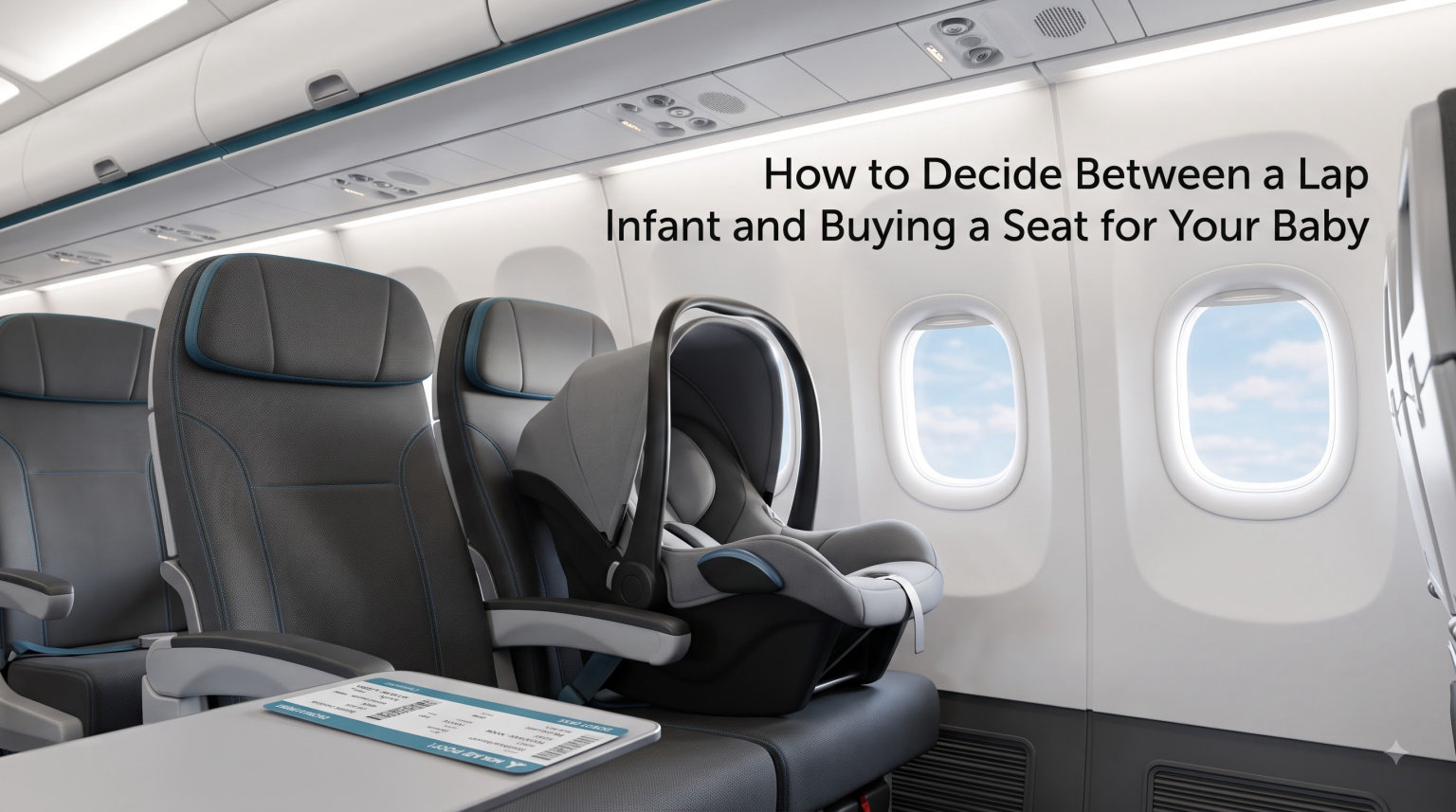
Flying with a baby under two means facing one of the biggest decisions of family travel. You can either hold your baby on your lap for free or buy them their own seat and install a car seat. The lap infant vs seat infant debate is one every traveling parent wrestles with, and there is no single right answer.
Our team has pored over FAA guidance, airline policies, parent forums, and real trip reports to build this decision framework. I have organized everything around the factors that actually change the math: your baby’s age, the length of your flight, your budget, and your comfort with the safety trade-offs.
By the end of this guide, you will know exactly how to decide between a lap infant and buying a seat for your baby. You will have clear definitions, real cost breakdowns, an age-based framework, and a step-by-step decision checklist you can run through before you book.
Let’s start with the basics so we are all working from the same definitions.
Table of Contents
What Is a Lap Infant and What Is a Seat Infant?
A lap infant is a baby under two years old who flies without their own purchased seat. They sit on a parent or guardian’s lap for the duration of the flight, secured only by the adult’s arms during normal flight conditions. On most domestic flights, a lap infant travels free of charge.
A seat infant is a baby under two who has their own ticketed seat. The parent buys a seat (often at a discounted infant fare) and can install an FAA-approved car seat or use an approved child restraint system. The baby has dedicated space and is restrained during takeoff, landing, and turbulence.
That is the core difference. One option saves money but relies on you physically holding your child. The other costs more but gives your baby a secured, dedicated space. Every other consideration flows from these two trade-offs.
How to Decide Between a Lap Infant and Buying a Seat for Your Baby
The decision comes down to four main factors that interact with each other: your baby’s age and size, the length and type of your flight, your total budget, and your personal risk tolerance around safety. No single factor wins every time. A short domestic hop with a three-month-old looks very different from a ten-hour international flight with an eighteen-month-old.
I will walk you through each factor in detail in the sections below. By the time you reach the step-by-step decision framework near the end, you will have all the context you need to make a confident call for your specific trip.
Cost Comparison: Lap Infant vs Seat Infant
Cost is usually the first thing parents calculate, and for good reason. The price gap between a lap infant and a seat infant can range from zero to thousands of dollars depending on whether you fly domestic or international.
Here is the breakdown you need to understand.
Domestic Flights
On domestic flights within the United States, a lap infant flies free. You add the baby to your reservation as a lap child, show proof of age at check-in, and pay nothing for their travel. This is the single biggest financial benefit of the lap infant option.
If you buy a seat for your baby on a domestic flight, you typically pay the full adult fare or a discounted child fare that is very close to adult pricing. On a $300 round-trip domestic ticket, buying a seat means spending roughly $300 more than going the lap infant route.
International Flights
International flights are where the calculus shifts. Lap infants are not free on most international routes. Instead, they typically pay about 10 percent of the adult fare plus taxes and fees.
That 10 percent lap infant fare sounds modest, but it can still add up. On a $1,200 international round-trip, a lap infant costs roughly $120 to $200 once taxes and fees are included. It is far cheaper than a full seat, but it is not free.
If you buy a seat for your baby on an international flight, you generally pay the full child or adult fare. That same $1,200 ticket means paying another $1,200 for the baby’s seat. The gap between lap infant and seat infant on international routes can easily exceed $1,000.
Real Cost Examples
Let’s look at concrete scenarios. Say you are flying New York to Orlando round-trip at $280 per person. A lap infant adds zero dollars. Buying a seat adds roughly $280.
Now say you are flying Los Angeles to London round-trip at $900 per person. A lap infant adds about $90 to $150 in taxes and the 10 percent fare. Buying a seat adds the full $900.
On a family of four with one baby, that international seat purchase could mean the difference between a $2,700 trip and a $3,600 trip. That real dollar gap is why so many parents agonize over this decision.
Points and Miles
If you book with airline miles or credit card points, the math changes again. Most frequent flyer programs charge a flat mileage rate for lap infants on award flights. Delta typically charges the same miles for a lap infant as an adult on domestic awards, while international partner awards may require 10 percent of the adult mileage plus taxes.
Buying a seat with miles usually costs the full adult mileage rate. If you have a large miles balance, buying a seat might cost you points rather than cash, which can soften the financial blow considerably.
Pros and Cons of Flying With a Lap Infant
Flying with a lap infant means keeping your baby on your lap for the entire flight. Here is an honest look at what works and what does not.
Advantages of a Lap Infant
The biggest advantage is cost. On domestic flights, a lap infant is free. On international flights, you pay a fraction of the adult fare. For families on a tight budget, this savings can fund an extra day of vacation or cover other travel expenses.
A lap infant also simplifies logistics. You do not need to carry a car seat through the airport or worry about whether it fits in the aircraft seat. You have fewer items to juggle at security and at the gate.
Many parents also find that a small baby sleeps better in a warm chest than in a car seat. Newborns and young infants often doze peacefully when held close, especially if you use a baby carrier.
Disadvantages of a Lap Infant
The biggest disadvantage is physical strain. Holding a baby for hours, especially a heavier or more mobile one, is exhausting. Your arms, back, and shoulders take the brunt of it.
There is also the safety question. A lap infant is not physically restrained during turbulence, takeoff, or landing. You are the only thing between your baby and potential injury if the plane hits severe turbulence.
Space is another issue. With a lap infant, you lose the use of your tray table and have limited room to eat, read, or use a laptop. On a full flight, you are also tight on elbow room.
Finally, lap infants do not get their own baggage allowance on most airlines. You are working with whatever carry-on space the adults can manage.
Pros and Cons of Buying a Seat for Your Baby
Buying a seat for your baby means giving them their own ticketed spot. Here is the trade-off.
Advantages of a Seat Infant
Safety is the strongest argument for buying a seat. With an FAA-approved car seat properly installed, your baby is fully restrained during takeoff, landing, and turbulence. This is the configuration the FAA recommends above all others.
A dedicated seat also means a dedicated car seat. Many babies sleep better in the familiar cocoon of their own car seat, which they are already used to from daily car rides. The seat provides a secure, enclosed space that can feel calming.
You get your lap and your arms back. You can eat a meal, read, or just relax while your baby naps safely in their seat. On long flights, this freedom is significant.
You also get extra baggage and storage space. A seat means another carry-on allowance and another under-seat storage area for diapers, snacks, and toys.
Disadvantages of a Seat Infant
The cost is the obvious drawback. Buying a seat can double the per-person expense for your baby on international routes. For budget-conscious families, this is a real barrier.
You also have to lug a car seat through the airport. Car seats are bulky and awkward, and installing them correctly in a plane seat takes a few minutes of effort.
Some babies resist being buckled into a car seat on a plane, especially if they associate the seat only with car rides and want to be held. You may face a period of protest before they settle.
Finally, there is no guarantee your baby’s car seat will fit well in every aircraft configuration. Narrow economy seats and certain bulkhead rows can present installation challenges.
Age-Based Decision Framework
Your baby’s age is one of the most reliable predictors of which option will work better. Here is how the decision typically breaks down by age range.
Newborn to 6 Months: Lap Infant Usually Works Well
Babies under six months are small, light, and often still sleeping in long stretches. A lap infant setup tends to work well in this age range. Your baby weighs perhaps 12 to 16 pounds, which is manageable to hold for a few hours.
Young infants are also usually content when held close, especially if you use a soft baby carrier. Many parents report that their newborn slept the entire flight when held skin-to-skin or in a wrap carrier.
The main consideration at this age is feeding. If you are breastfeeding, a lap infant makes nursing easy since your baby is already in your arms. Bottle-feeding requires a bit of juggling but is very doable.
For most families, the cost savings of a free lap infant on domestic flights makes sense at this age. The safety risk is real but relatively lower simply because the baby is small and easy to control physically.
6 to 12 Months: The Decision Gets Harder
Between six and twelve months, babies become more active, heavier, and harder to keep still. Your baby might weigh 18 to 22 pounds and want to crawl, grab, and squirm.
This is the age where many parents start regretting the lap infant choice on longer flights. A wriggling, mobile baby on your lap for hours is genuinely hard work. They want to explore, and a 24-pound infant lunging toward the aisle during beverage service is stressful.
For short domestic flights of one to three hours, a lap infant can still work at this age. For anything longer, especially international or cross-country flights, buying a seat starts to look much more attractive.
If your baby is already accustomed to sleeping in a car seat for naps, having that familiar seat on the plane can make a big difference for this age group.
12 to 24 Months: Strongly Consider Buying a Seat
Once your baby hits the one-year mark, the lap infant calculus tips firmly toward buying a seat. A toddler weighing 22 to 30 pounds who can walk, climb, and protest loudly is extremely difficult to contain on a lap.
Holding a 28-pound toddler for a four-hour flight is physically demanding and mentally draining. Toddlers this age have opinions, strong legs, and a talent for escaping even a firm grip.
An FAA-approved car seat gives your toddler a familiar, enclosed space where they are used to being restrained. It also gives you a break, which can make the difference between arriving exhausted and arriving functional.
If there is one age where I would push hard for buying a seat, it is this one. The combination of weight, mobility, and willpower makes lap travel genuinely tough for most parents.
Safety Considerations: What the FAA Recommends
Safety is the factor that gets the least attention from budget-focused parents but the most attention from aviation experts. Here is what you need to know.
The Official FAA Position
The FAA strongly recommends that parents buy a separate seat for children under two and use an FAA-approved child safety seat. The agency’s guidance is clear and direct: a child is safest in an approved car seat, properly installed in their own aircraft seat.
The FAA does not mandate this, which is why airlines can offer free lap infant travel. But the agency’s recommendation leaves no ambiguity about which option they consider safest.
Why Turbulence Matters
The core safety concern is turbulence. Clear-air turbulence can occur without warning, and during moderate to severe turbulence, an unrestrained child can be thrown from a parent’s arms.
Adults cannot reliably hold a child during severe turbulence. The forces involved exceed what human grip strength can overcome. A car seat, by contrast, keeps the child secured through forces that would be impossible to manage manually.
This does not mean lap infant travel is guaranteed to result in injury. Millions of families fly with lap infants safely every year. But the statistical risk is real, and it is concentrated in turbulence events.
What About the CARES Restraint System?
The CARES (Child Aviation Restraint System) is an FAA-approved alternative for children weighing between 22 and 44 pounds. It is a lightweight restraint system that attaches to the airplane seat back and secures the child without a car seat.
The CARES system is a good option for toddlers who have outgrown the baby carrier stage but are still small enough that a regular seatbelt does not fit properly. It does not work for infants under 22 pounds, so it is not a solution for younger babies.
If you are considering buying a seat for a toddler but do not want to lug a car seat through the airport, the CARES restraint system is worth looking into. It folds into a small pouch and weighs about a pound.
Flight Duration: When Distance Changes the Equation
How long you are in the air dramatically affects the lap infant vs seat infant decision. A one-hour hop and a ten-hour long-haul are completely different experiences.
Short Flights (Under 3 Hours)
On short domestic flights, a lap infant is usually manageable regardless of age. Even a mobile toddler can be entertained for an hour or two. The cost savings of free travel makes this the default choice for most families.
The main challenge on short flights is takeoff and landing, when pressure changes can bother a baby’s ears. Nursing, a bottle, or a pacifier during descent helps equalize pressure.
Medium Flights (3 to 6 Hours)
On medium-length flights, including most transcontinental domestic routes, the decision gets personal. A calm, small baby might do fine on your lap. An active toddler probably will not.
This is the flight duration where I see the most regret in parent forums. People who chose lap infants for five-hour flights with twelve-month-olds frequently wish they had bought a seat.
Long-Haul Flights (Over 6 Hours)
On long-haul and international flights, buying a seat becomes much more compelling. Holding any baby for eight, ten, or fourteen hours is a serious physical challenge.
Many international airlines offer bassinets in the bulkhead row for lap infants, which can help. But bassinets have weight limits (often 20 to 22 pounds), are only available on a first-come basis, and cannot be used during turbulence.
If you are flying long-haul and can afford the seat, buy it. Your back, your sanity, and your baby’s safety all benefit.
Airline Policies: What Each Carrier Allows
Airlines have their own rules for lap infants, and the details matter. Here is a quick reference for major US carriers.
Most US airlines allow one lap infant per adult traveler. You must add the lap infant to your reservation before travel, either online or by calling the airline. At check-in, you may need to show proof of age such as a birth certificate or passport.
Domestic lap infants fly free on Delta, American, United, Southwest, JetBlue, Alaska, and most other US carriers. International lap infant fares vary by airline and route but typically run 10 percent of the adult fare plus taxes.
Some airlines offer discounted infant fares when you buy a seat. These discounted fares are sometimes called infant fares and can be significantly cheaper than a full adult ticket. Always ask the airline directly about infant fare options rather than assuming the seat costs the full adult price.
If you plan to use a car seat, check the airline’s policy on which seats can accommodate one. Bulkhead rows and exit rows often cannot have car seats. Window seats are sometimes required so they do not block other passengers’ access to the aisle.
Southwest has a particularly family-friendly policy: they allow you to check a car seat and stroller for free, and families with children under two board between the A and B groups. Other carriers vary, so verify before you fly.
Essential Gear for Flying With a Baby
Whether you go lap infant or seat infant, certain gear makes the trip dramatically easier. Here is what experienced traveling parents recommend.
A soft baby carrier is essential for airport navigation. It keeps your hands free for luggage, documents, and boarding passes. Wear your baby through security and to the gate, and you will wonder how parents managed without one.
An FAA-approved car seat is mandatory if you buy a seat. Look for a seat with a label stating it is approved for aircraft use. Convertible car seats that work in both cars and planes offer the best value.
The CARES restraint system is a lightweight alternative to a car seat for toddlers over 22 pounds. It is ideal if you do not need a car seat at your destination and want to travel light.
A well-stocked diaper bag with extra supplies is non-negotiable. Pack twice as many diapers and wipes as you think you will need, plus a change of clothes for both baby and you in case of spills.
Tips for Surviving a Long Flight With a Lap Infant
If you decide on a lap infant for a longer flight, preparation is everything. Here are the strategies that experienced parents swear by.
Bring more snacks than seems reasonable. Parents on forums consistently report that a steady stream of new snacks is the single best distraction tool. Novelty matters more than quantity, so pack several small portions of different items.
Introduce a brand-new toy or activity at the gate, not before. A toy your baby has never seen will hold attention far longer than one they already own. Wrap a few small new items and reveal them one at a time during the flight.
Nurse, bottle-feed, or offer a pacifier during takeoff and landing to help with ear pressure. Swallowing helps equalize the pressure in a baby’s Eustachian tubes.
Request a bassinet in the bulkhead row if your airline offers one and your baby is under the weight limit. This gives you a safe place to set your baby down during cruising altitude.
Time your flight around nap or bedtime if possible. A red-eye or a flight during your baby’s natural sleep window can mean hours of quiet, resting baby on your chest.
Finally, give yourself permission to ignore judgmental looks from other passengers. You are doing your best, and most people understand that babies cry.
Real Parent Experiences: What Traveling Families Say
Forum discussions paint a vivid picture of what this decision feels like in practice. The consensus is nuanced and worth hearing.
Many parents who flew with lap infants on short domestic flights reported positive or neutral experiences. One parent noted that their five-hour direct flight with an eighteen-month-old lap infant went fine, especially with a well-stocked snack supply and a baby carrier.
However, safety-conscious parents and aviation experts in these forums consistently flag the turbulence risk. Comments like “lap children are prone to injury in turbulence” and “it is doable but very unsafe” appear repeatedly in safety-focused discussions.
The pattern is clear from parent reports: short flights with young babies tend to go smoothly as lap infants. Longer flights with older babies tend to generate regret. Parents who bought seats for toddlers on long-haul flights almost never regret the expense.
One recurring theme is that physical exhaustion is the real cost of a lap infant on a long flight. Multiple parents described arriving at their destination too tired to enjoy the first day because holding a heavy baby for hours took everything out of them.
Decision Framework: Your Step-by-Step Guide
Now let’s put it all together into a decision process you can actually use. Work through these questions in order.
Step 1: How Old and How Big Is Your Baby?
If your baby is under six months and under about 18 pounds, a lap infant is a reasonable choice for most flights. If your baby is between six and twelve months, consider the flight length carefully. If your baby is over twelve months or over 22 pounds, lean strongly toward buying a seat.
Step 2: How Long Is the Flight?
For flights under three hours, a lap infant is manageable at almost any age. For flights of three to six hours, factor in your baby’s temperament and mobility. For flights over six hours, buying a seat is almost always worth it if you can afford it.
Step 3: Domestic or International?
Domestic lap infants are free, which makes the savings compelling. International lap infants cost 10 percent of the fare plus taxes, so the savings are smaller. On international routes, the gap between lap infant and seat is larger in dollar terms but the flight is also longer, which intensifies the comfort and safety arguments for a seat.
Step 4: What Is Your Budget?
Be honest about what you can afford. If buying a seat means not taking the trip at all, a lap infant on a shorter flight is a perfectly defensible choice. If you have the budget, the safety and comfort benefits of a seat are significant.
Step 5: How Do You Feel About the Safety Trade-Off?
This is personal. The FAA recommends a separate seat with a car seat. The absolute risk of injury for a lap infant is low, but it is not zero. If knowing your baby is fully restrained gives you peace of mind, that peace of mind has value.
Step 6: Make Your Call
Run through the factors above and you will usually find that the decision makes itself. Young baby, short domestic flight, tight budget: lap infant. Toddler, long international flight, budget allows: buy the seat. Most scenarios fall somewhere in between, and the framework helps you weigh which factors matter most for your trip.
Frequently Asked Questions
What is the difference between lap infant and seat infant?
A lap infant is a baby under two who flies without their own seat, sitting on a parent’s lap, usually for free on domestic flights. A seat infant is a baby under two who has their own purchased ticket and seat, allowing you to install an FAA-approved car seat. The lap infant saves money, while the seat infant provides dedicated space and full restraint during turbulence.
When should I buy a seat for my baby?
You should buy a seat when your baby is over 12 months old, when the flight is longer than six hours, or when you want the safety of a fully restrained car seat during turbulence. The FAA recommends buying a seat for all children under two, but the decision is most compelling for older babies on longer flights.
Can I buy a seat for a lap infant?
Yes, you can always upgrade a lap infant to a seat infant by purchasing a ticket for your baby. Contact your airline to add a seat to your reservation, or book a separate ticket for your child. Some airlines offer discounted infant fares that are cheaper than full adult pricing.
Do I need to buy a seat for an infant?
No, you are not required to buy a seat for an infant under two on most airlines. Children under two can fly as lap infants on a parent’s lap. However, the FAA strongly recommends buying a seat and using an FAA-approved car seat for maximum safety during turbulence.
Is it safe to fly with a baby on my lap?
Flying with a lap infant is generally low risk, but it is not the safest option. During unexpected turbulence, an adult may not be able to hold onto a baby securely. The FAA recommends using an FAA-approved car seat in a separate purchased seat as the safest way for babies under two to fly.
Conclusion
Deciding how to decide between a lap infant and buying a seat for your baby comes down to weighing cost, comfort, safety, and your baby’s age against the specifics of your trip. There is no universal right answer, but there is a right answer for your situation.
Young babies on short domestic flights usually do fine as lap infants, saving you the full cost of a ticket. Older babies and toddlers on long or international flights almost always benefit from having their own seat and car seat. The FAA’s recommendation is clear: a separate seat with an approved restraint is the safest option, and the safety margin matters most when turbulence hits.
Run through the step-by-step framework, weigh the factors that matter most to your family, and book with confidence. Whatever you choose, preparation and realistic expectations will do more for your flight experience than any single decision about seating.