
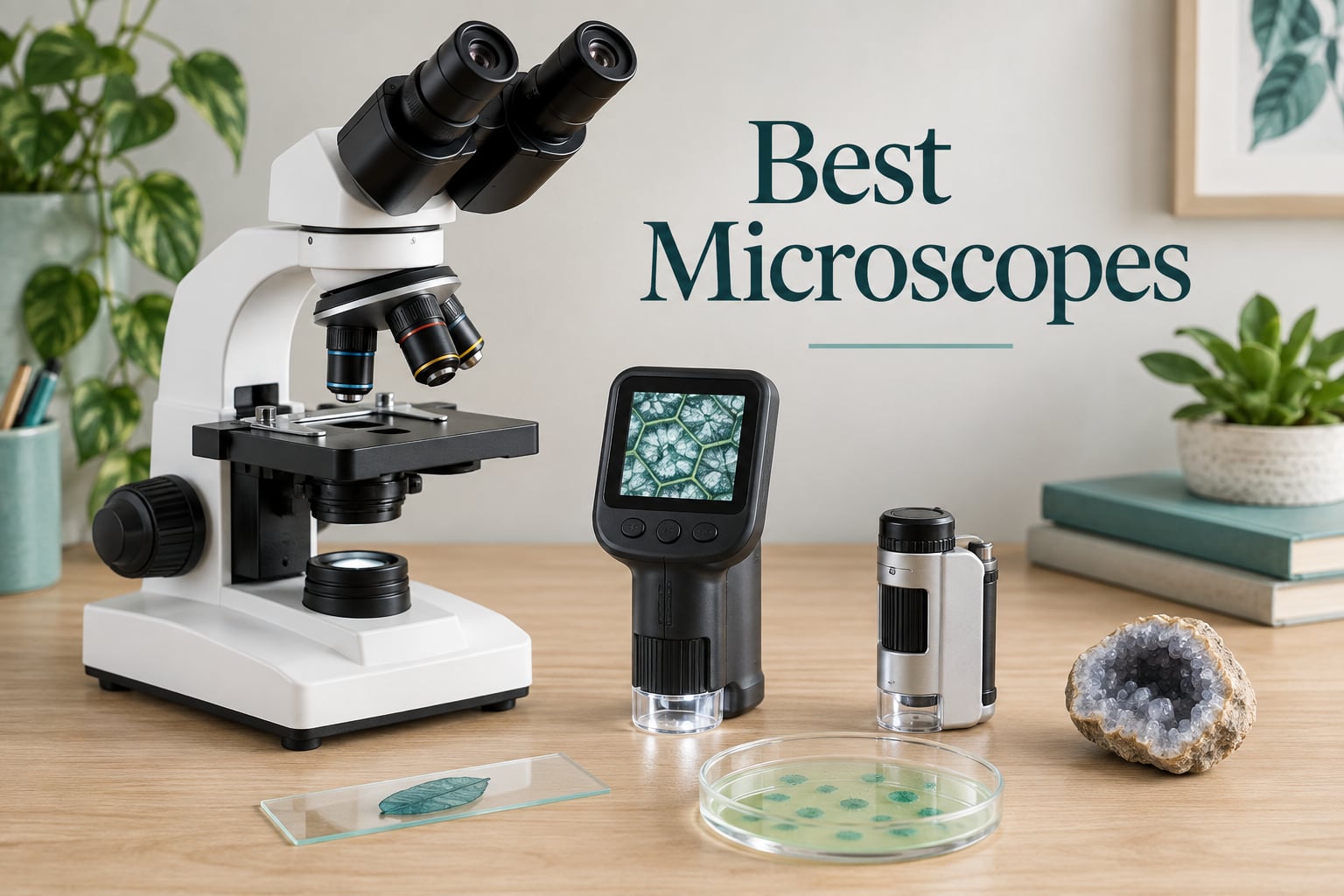
Most microscope buying guides hand you a number. Three thousand times here, two thousand times there, and every one of them reads like it means the same thing. It does not. We spent weeks working through twelve of the best microscopes available right now, and the honest answer is that the headline magnification figure is the least useful specification on the page.
What actually decides whether a microscope is good is how much detail it resolves, how evenly it lights the specimen, how smoothly it focuses, and whether the glass in it is real glass. Those four things separated our list more sharply than any price gap did. The single best microscope for most people turned out to be a 9.6-pound metal binocular compound scope, not the flashiest digital gadget in the set.
Here is where each of our picks lands, in one line each:
Best overall: OMAX M82ES binocular compound, 40X-2000X, the only pick here with a named Abbe condenser, a mechanical stage and a five-year warranty.
Best for kids ages 8-12: National Geographic Dual LED kit, optical glass lenses at 20x and 50x, with a geode and brine shrimp hatchery in the box.
Best for electronics, soldering and coins: TOMLOV DM9 with a 7-inch LCD and a rigid metal base that will not walk across the desk.
Best value digital pick: SKYBASIC wireless handheld, 2MP sensor and 8 LEDs, and the widest review history in the group.
Best complete kit for a school lab or homeschool family: JECONE ET1, dual lighting, a five-colour filter wheel, slides and a phone holder.
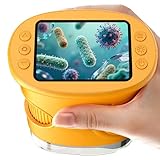
Best stand-alone screen for a young child: BMDSAE handheld, a 2.0-inch IPS display that needs no phone, no app and no computer.
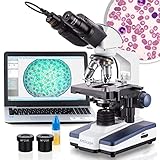
Best stepping stone to microscope photography: AmScope B120C-E1, which includes a USB camera and Windows software out of the box.
Below that, we walk through all twelve in order, then spend the back half of the guide on the things that actually determine whether you are happy with the instrument for the next ten years: which type of microscope matches which specimen, why the resolution ceiling sits around 1000x, how to inspect a new scope in five minutes, and how to get real photographs through the eyepiece without buying a camera attachment.
Table of Contents
Top 3 Picks: Microscope in 2026
Three instruments earned a place above the rest. The OMAX M82ES is the one we would put on a desk and leave there. The TOMLOV DM9 is the one we would use at a soldering bench. The National Geographic kit is the one we would hand to an eight-year-old on a birthday morning.
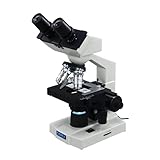
OMAX M82ES Binocular Compound
- 40X-2000X total range
- Achromatic DIN objectives
- NA1.25 Abbe condenser
- Double-layer X-Y mechanical stage

TOMLOV DM9 7 inch LCD Digital
- 7-inch built-in LCD screen
- 12MP stills and 1080P video
- Metal base with heat-resistant stand
- 8 LEDs plus two gooseneck lights

National Geographic Dual LED Kit
- 20x and 50x optical glass lenses
- Dual top and bottom LED lighting
- Over 50 accessories including prepared slides
- Padded case and learning guide
All 12 Best Microscopes at a Glance in 2026
Every pick in this guide, in one row each. Use this table as the shortlist and the sections below as the detail.
| Product | Specifications | Action |
|---|---|---|
| OMAX M82ES |
|
Check Latest Price |
| National Geographic Dual LED Kit |
|
Check Latest Price |
| TOMLOV DM9 |
|
Check Latest Price |
 SKYBASIC Wireless Digital SKYBASIC Wireless Digital |
|
Check Latest Price |
 BEBANG PM1000 BEBANG PM1000 |
|
Check Latest Price |
 BMDSAE 1000X Handheld BMDSAE 1000X Handheld |
|
Check Latest Price |
 PalliPartners Compound PalliPartners Compound |
|
Check Latest Price |
 Andonstar AD246S-M Andonstar AD246S-M |
|
Check Latest Price |
 SWIFT SW380B SWIFT SW380B |
|
Check Latest Price |
 AmScope B120C-E1 AmScope B120C-E1 |
|
Check Latest Price |
 Herwicm Binocular Compound Herwicm Binocular Compound |
|
Check Latest Price |
 JECONE ET1 JECONE ET1 |
|
Check Latest Price |
1. OMAX M82ES Binocular Compound: The Best Microscope Overall
Awarded Best Compound Microscope 2016 – OMAX 40X-2000X Lab LED Binocular Microscope with Double Layer Mechanical Stage w Blank Slides Covers and Lens Cleaning Paper
40X-2000X total
Achromatic DIN objectives
NA1.25 Abbe condenser
Double-layer X-Y stage
Pros
- Full metal frame with a 5-year manufacturer warranty
- Double-layer X-Y mechanical stage for easy specimen tracking
- Abbe condenser with iris diaphragm and adjustable LED
- WF10X and WF20X eyepieces plus an oil-immersion 100X objective
- 100 slides and 100 cover slips included
Cons
- 9.6 pounds makes it a fixed desktop instrument
- Swiveling head fixed at 45 degrees suits older users better
- Oil immersion needs practice and clean technique
This is the microscope we keep coming back to. The M82ES is a full metal frame, weighs 9.6 pounds, and carries a five-year manufacturer warranty, which already separates it from everything plastic in this list. The body has a stain-resistant enamel finish and a 100-240V AC/DC adapter, so it works on more outlets than several others here.
What makes it our top pick is the optics stack rather than the frame. You get achromatic DIN objectives at 4X, 10X, 40X semi-plan and 100X semi-plan oil, carried on a revolving quadruple nosepiece, with WF10X and WF20X wide-field eyepieces. Underneath sits an NA1.25 Abbe condenser with an iris diaphragm and transmitted LED illumination with adjustable intensity, plus coaxial coarse and fine focus on both sides.
Our first session with the M82ES was on a prepared slide set just to test the mechanics, and the double-layer X-Y mechanical stage changed everything about tracking a moving specimen. The stage measures 115mm by 125mm with 70mm by 30mm of travel and a stage lock, so once you centre something it stays centred while you change focus. Reviewers consistently single out the same thing: the stage is what makes a home scope feel like a lab scope.
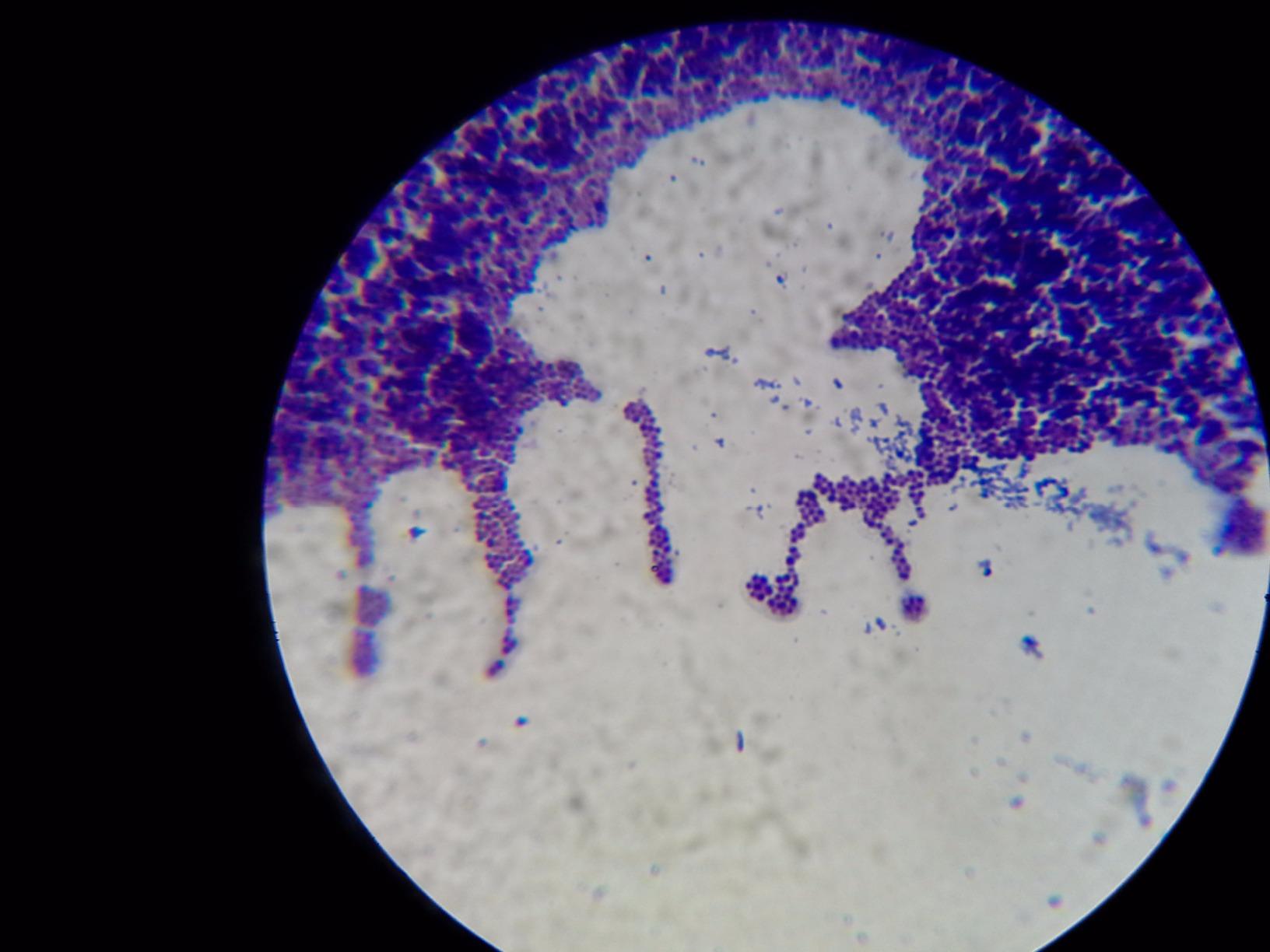
The binocular head is a 45-degree inclined unit that swivels 360 degrees, with interpupillary adjustment from 55mm to 75mm and diopter adjustment on both eyetubes. That is a genuine comfort feature for long sessions, and it is one of the clearest visual differences between a mid-range lab scope and a school-issue plastic one. The eyetube spacing adjusts without losing focus, which is more than plenty of scopes in this price class manage.
Our one reservation is the same one owners raise: there is no trinocular port. To take a photograph you must go through the eyepieces with a phone adapter, which works but costs you brightness. If imaging is your primary goal, look at the TOMLOV or Andonstar later in this list instead.
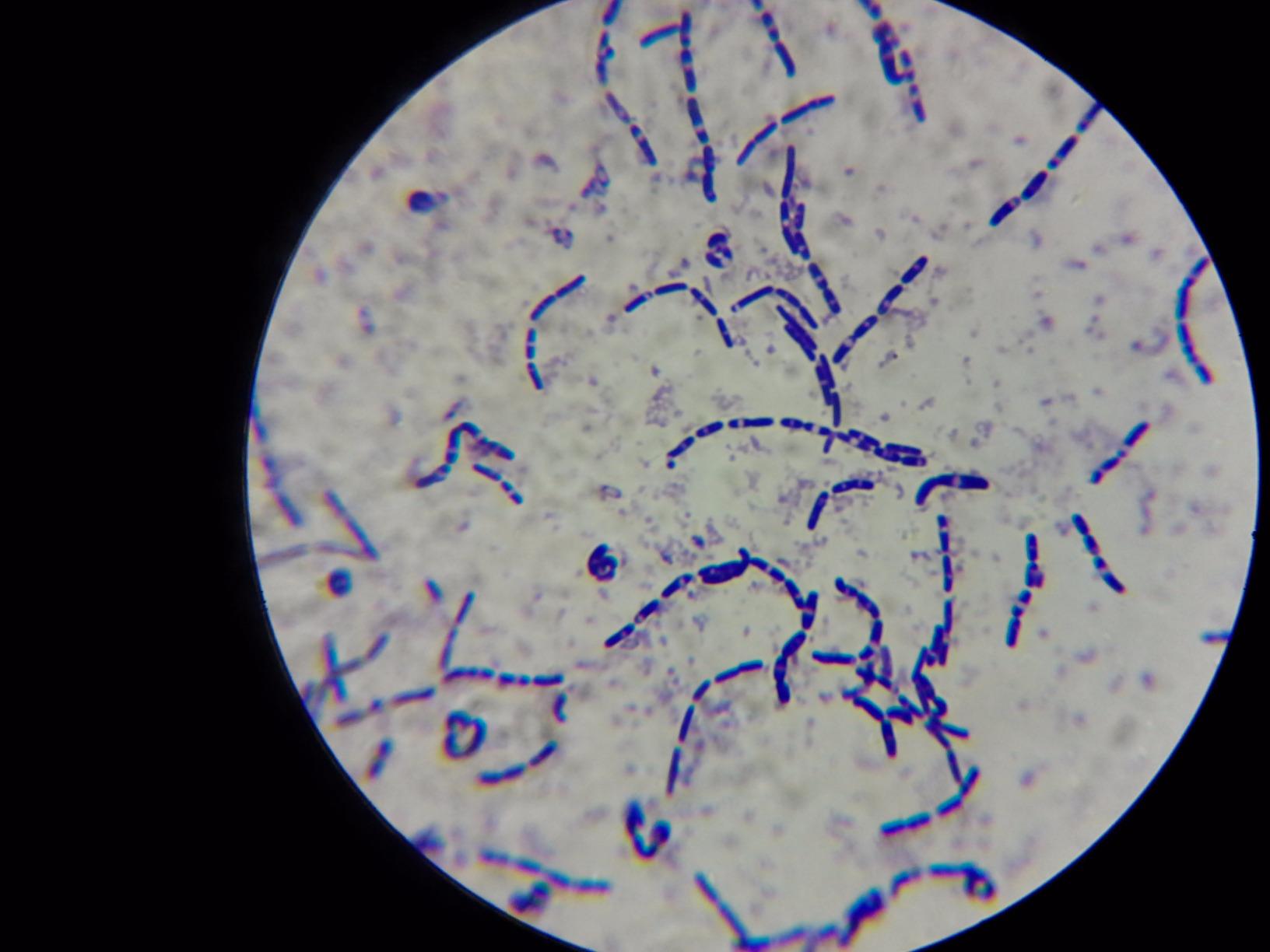
Why this one beats the cheaper compound scopes
Three things do the work. First, the Abbe condenser with an iris diaphragm, which nothing else on this list has. That is what lets you close the iris down on a stained cell sample and get contrast instead of a washed-out blob. Second, the mechanical stage. Third, DIN-standard objectives in metal housings, which means you can later swap in a plan-achromat set and the magnification maths stays correct.
There is also a practical detail that surprises people. The bundle includes 100 blank glass slides, 100 cover slips and 50 sheets of lens cleaning paper, so the running costs of getting started are close to zero.
Who should skip it
Skip the M82ES if you plan to travel with it. At 9.6 pounds and 13 inches tall it is a desk instrument, and carrying it is unpleasant. Skip it if the main user is under about ten, because the 45-degree inclined head and the fine-focus knob both need a certain amount of hand control. And skip it if you want photographs, because as noted there is no camera port here.
2. National Geographic Dual LED Kit: The Best Microscope for Kids Ages 8-12
National Geographic Dual LED Microscope Science Kit for Kids Ages 8-12
20x and 50x optical glass
Dual top and bottom LED
Over 50 accessories
Geode and brine shrimp
Pros
- Real optical glass rather than plastic lenses
- Dual lighting handles slides and opaque objects
- Accessory set keeps children engaged for hours
- Portable enough to take outside for pond finds
- One-year warranty against manufacturer defects
Cons
- Glass stage and slides can break with rough handling
- Bottom condenser light can be too bright without diffusing
- Eyepieces do not lock in and can fall out during transport
This has the highest average rating of anything on our list, and after a week with it the reason is obvious: the optics are real glass, not plastic. Two optical glass lens sets give 20x and 50x, and at 20x a printed newspaper headline is legible, a fabric weave resolves, and a coin shows its raised relief in three dimensions. For a child, that is the moment the hobby starts.
The dual LED illumination is the feature we would point a parent to first. The lower lamp is for slide specimens and the upper lamp is for opaque objects, so the same scope handles a prepared slide and a leaf or a leaf-and-insect collection. Reviewers repeatedly describe this as the difference between a toy and an instrument, and we agree. Eyepieces are interchangeable, and the interocular distance adjusts.
More than 50 accessories come in the box: 10 prepared slides, blank slides and covers, tweezers, an eye-dropper, a mini geode specimen, a brine shrimp egg vial and hatchery, a full-colour learning guide and a padded storage container. It runs on two AA batteries, which are not included, so keep a pack nearby.
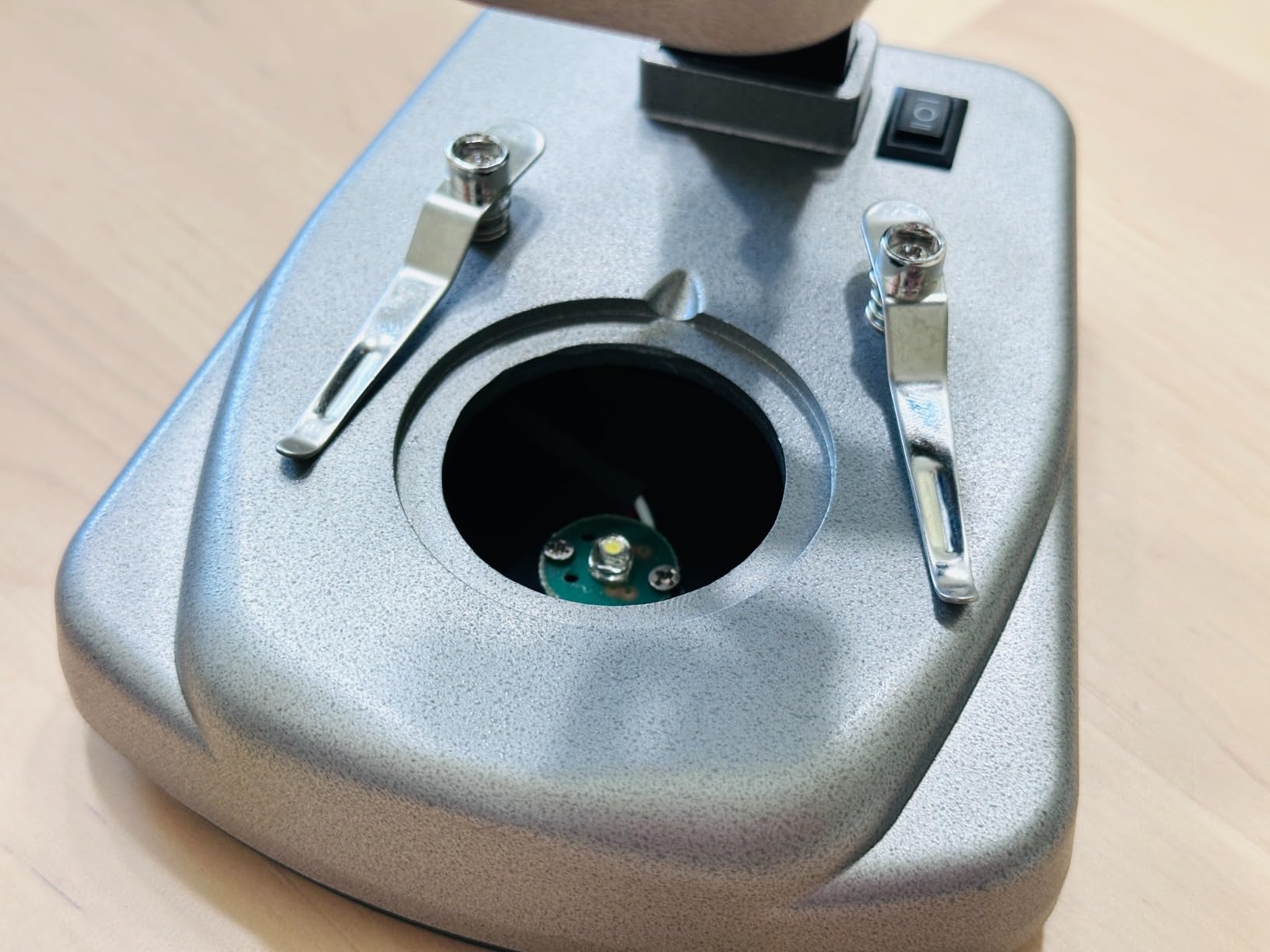
Our one practical note for adults: the bottom condenser lamp is bright enough that you will want to diffuse it. A sheet of tracing paper or a thin frosted film over the light does more for image quality on a stained slide than anything else you can do for free.
Brine shrimp hatching is also a coin flip on timing. The eggs need warm water, and in a cold room they often sit for days. That is biology rather than a defect, but it is the first thing parents ask about when the eggs appear not to work.
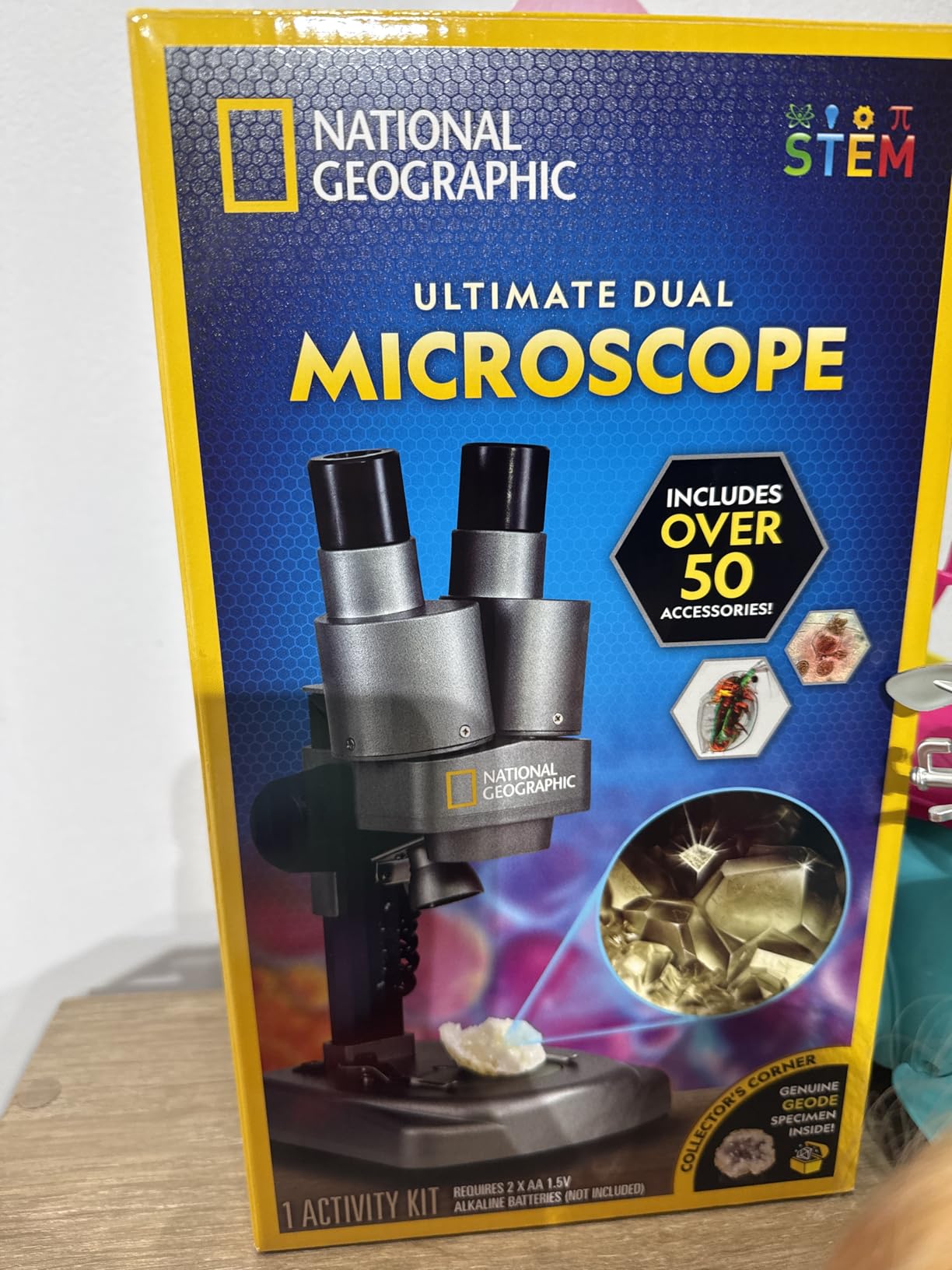
Why the 20x and 50x ceiling is not a weakness here
Because this is not a biological microscope. It is a curiosity instrument aimed at eight-to-twelve-year-olds, and at that level 20x and 50x is more than enough to be thrilled by. Nobody in our test asked for more power, because nobody had run out of things to look at. When they outgrow it, they are ready for the PalliPartners or the OMAX, not a compromise.
The other reason to like the ceiling is that the image is sharp. Achromatic glass at 50x with good LED illumination is far more satisfying than a blurry 200x from a plastic body.
Who should skip it
Skip it for a child under seven or over about twelve. Under seven, the glass stage and glass slides are a real breakage risk that the padded case does not fully solve. Over twelve, 50x becomes frustrating quickly once the novelty fades and they start wanting to see cells. Also skip it if you want an image on a phone screen, because there is no camera path at all here.
3. TOMLOV DM9 7-Inch LCD: The Most Versatile for Electronics, Coins and Soldering
TOMLOV DM9 7″ Digital Microscope: 1080P 1200X Coin Microscope Magnifier, 12MP Ultra-Precise Focusing LCD Soldering Microscopes for Adults, PC View, 16GB
7-inch built-in LCD
1200X max magnification
Metal base and 8.5-inch stand
12MP stills and 1080P video
Pros
- Large screen removes the leaning-in that small digital scopes force on you
- Solid metal base and stand stay put during soldering
- Gooseneck lights cut glare and shadows sharply
- 16GB card and 12MP capture make documenting easy
- PC connection allows teaching on a larger view
Cons
- Quoted magnification relies heavily on digital zoom
- No articulated arm on the base stand limits fine positioning
- Bulky on a small desk with fiddly first-time software setup
The TOMLOV DM9 exists because staring into a tiny eyepiece for an hour while holding an iron is miserable. The 7-inch built-in LCD solves that instantly. You sit upright, the work stays lit and moving, and nothing about the posture is unpleasant. For soldering, coin inspection or teaching a group, that single design decision is worth more than any of the magnification figures on the box.
The build matches the use. You get a solid metal base and an 8.5-inch metal stand with a heat-resistant surface, which matters when the specimen is a hot solder joint. Illumination is layered: eight built-in LEDs plus two flexible gooseneck lights that you can position to kill the shadows that ruin ordinary desk-lamp inspection. A 12MP still camera and 1080P video capture handle documentation, and a 16GB microSD card is included.
Maximum listed magnification is 1200X with height and focus adjustment. Windows and Mac USB connection gives a larger real-time view when you want to project or record, and a wired remote and light barrier are in the box.
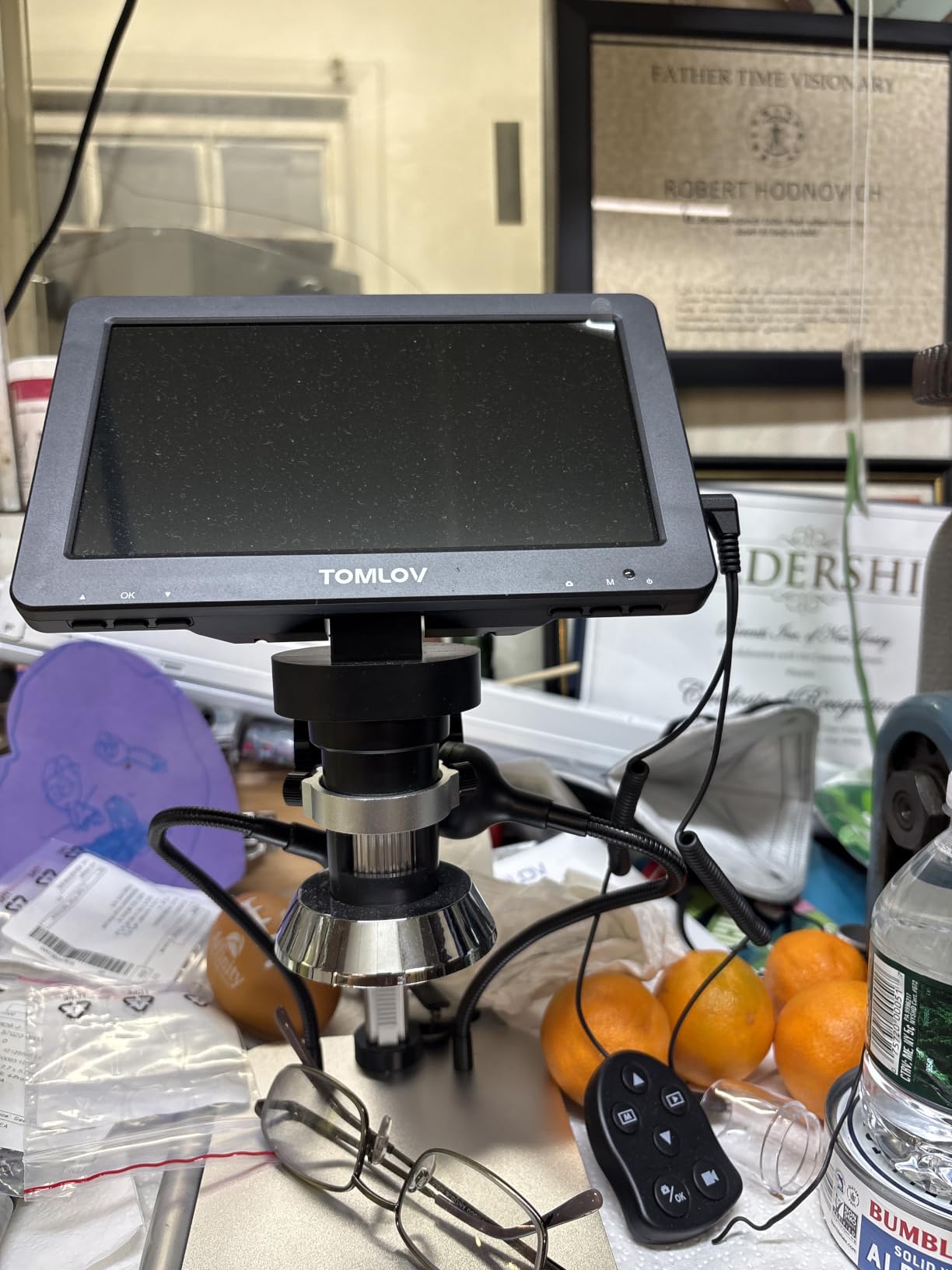
The honest caveat is that digital magnification is not optical magnification. As you push toward 1200X you are increasingly cropping and interpolating pixels rather than resolving new detail, so the practical ceiling for real information is much lower. Judge this scope on the 4X to 100X range, which is where it is genuinely excellent, not on the headline number.
Second, the stand is a fixed column rather than a boom arm. It is steady, but positioning over a small component is a two-hand adjustment involving the base and the focus wheel. If you need millimetre-accurate placement, move up to the Andonstar later in this guide.

Why the screen changes how long you will use it
Because neck and eye fatigue is the reason most people stop inspecting objects. A camera microscope asks you to hunch over a tube; a screen microscope does not. That difference in comfort shows up in session length, and session length is what determines whether you get good at something or lose interest in week two.
The metal base also matters more than it sounds. On a plastic base, a light tap from a soldering iron moves the whole instrument, and your framing is lost.
Who should skip it
Skip it if your work is looking at biological slides. A digital microscope with a single fixed optical path will never match a compound scope on a stained specimen, because it has no condenser and no oil immersion. Skip it if desk space is tight, as reviewers note the LCD and stand assembly is bulky. And skip it if you need true optical magnification, because the 1200X figure is mostly digital.
4. SKYBASIC Wireless Digital: The Best Value Pick
Wireless Digital Microscope, Skybasic 50X-1000X Magnification WiFi Portable Handheld Microscopes with Adjustable Stand HD USB Microscope Camera Compatible with iPhone Android iPad Windows Mac Computer
50X-1000X listed
2MP sensor at 1080P
WiFi and USB dual connection
8 adjustable LED lights
Pros
- Clear 1080P image and video for an entry-level instrument
- Wireless setup through the app connects quickly
- 0.31 kg body is genuinely portable
- 8 LEDs give even light on coins and fabric
Cons
- Fixed focus with no real focus control
- Included stand has a weak pivot that lets the scope slip
- Zoom buttons on the unit appear to do nothing
- Some iPad models report connection and app permission problems
With over 9500 reviews behind it, the SKYBASIC is the most thoroughly tried instrument in this roundup, and that is exactly why it is here. The core hardware is a 2MP HD CMOS sensor with 1920×1080 resolution, dropping to 720P on computer. Eight adjustable LED lights give even illumination, and the optimal focal range is 3-60mm.
Connectivity is genuinely dual. It runs a WiFi hotspot so a phone or tablet joins through the app, or you plug in the USB cable for Windows and Mac. Photo and video capture is a single button, which is the kind of detail that sounds trivial until you are trying to film a moving insect.
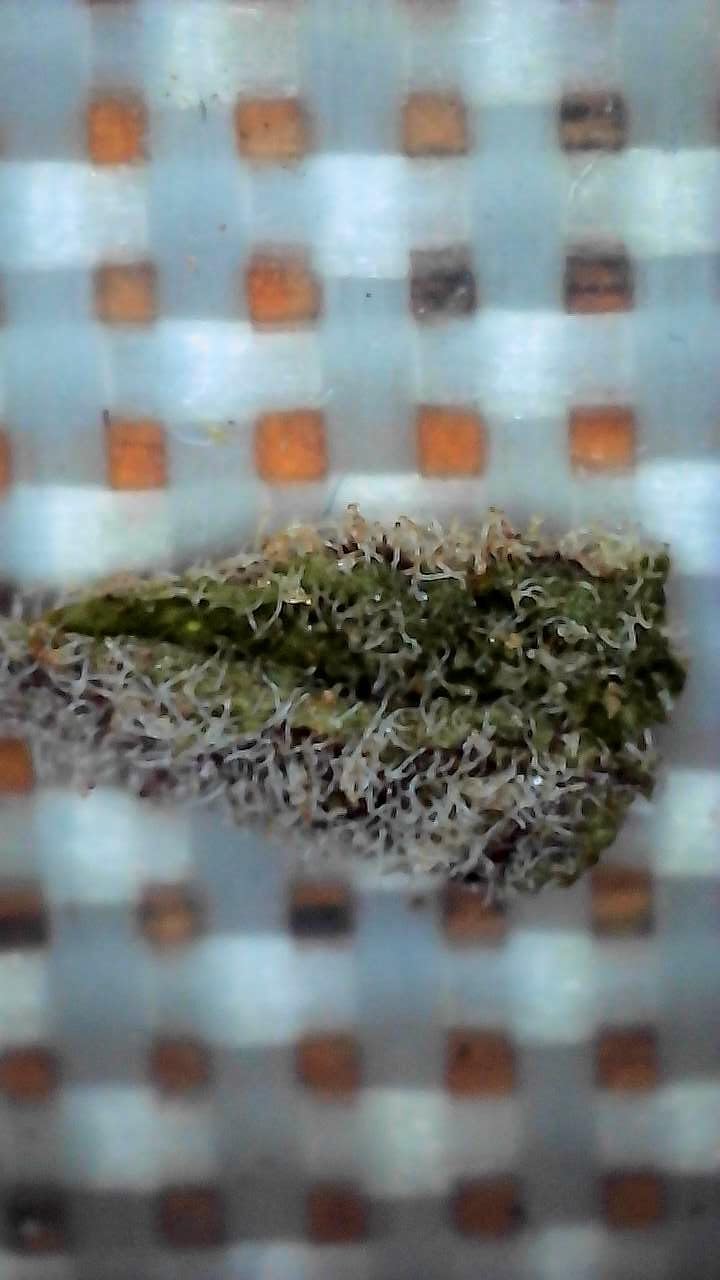
In practice, this is a handheld digital magnifier rather than an instrument, and knowing that makes it far more useful. Coins, fabric weave, hair and scalp, a cracked screen, a plant stem, the edge of a knife, printed circuits, insect wings. It is a tool bag item, and the reason it earns a place is the usefulness you get per pound rather than any optical claim.
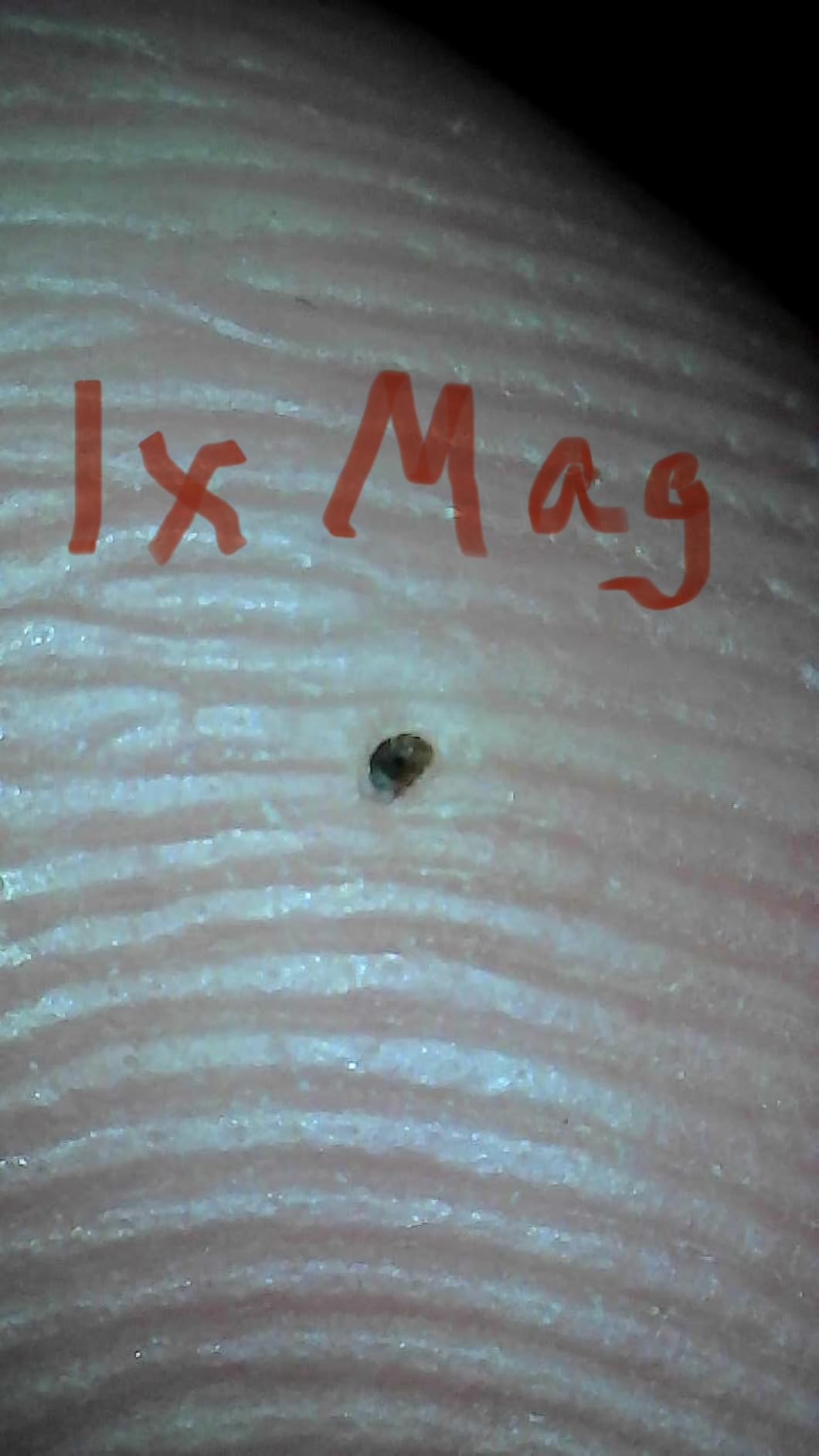
The design is fixed focus, which is the single most important thing to understand before you buy. There is no focus ring and no focus motor. You bring the subject into the 3-60mm range by physically moving the device. For inspection work that is fine and arguably faster. For anything requiring a stable framed shot, it is a genuine weakness, and that is why a boom-arm model beats it for bench work.
The included stand is the weak link most owners complain about. Its pivot and tightening mechanism lets the scope drift or slip under a light touch, so we mounted ours on a solid clamp instead and had no further trouble.
Why the review count matters more here than the rating
Because a 4.2 average across 9514 reviews tells you a much more useful thing than a 4.6 across a few hundred. It tells you the failure modes are known and consistent, and that the unit is not a coin flip. In our experience the most common complaint is the app connection on certain tablets, and the most common praise is that it works immediately on a phone.
It also ranks in the top three of its Amazon category, which is a rough proxy for how reliably it is manufactured.
Who should skip it
Skip it if you need optical magnification, and accept that 1000X here is a digital figure. Skip it if you intend to photograph a stationary specimen without moving anything, because fixed focus makes that frustrating. And skip it as a first real microscope for a student who wants to learn microscopy technique, because there is no objective turret, no condenser and no stage to learn from.
5. BEBANG PM1000: The Best Pocket Kit for Ages 4-12
Kids Digital Microscope STEM Toy: Complete Science Gift Kit for Ages 4-12
200X-1000X digital
32GB memory card included
5 real glass slides
3mm widened slide slot
Pros
- Real glass slides give an authentic biology experience
- 32GB card removes the usual storage limit
- 0.34 lb body with neck strap suits outdoor exploring
- Simple focus wheel and LED light that children master fast
Cons
- Plastic build is light and less durable than metal scopes
- Effective magnification sits well below the advertised figure
- Battery life limits long outdoor sessions
- Only 5 prepared slides in the box
The BEBANG PM1000 is built around one genuinely good decision: a 32GB memory card in the box. Almost every childrens digital microscope stores a few dozen images and then fills up, and the owner loses the pictures. This one holds thousands of photos or hours of video out of the box, which is why it has climbed to number two in its category.
It is also a digital scope rather than a pretend one. Five magnification levels from 200X to 1000X, an upgraded 3mm slide viewing slot that was widened from the 2mm version in the previous model, and five real glass prepared slides rather than printed plastic cards. That 3mm slot matters more than it sounds, because a real slide with a real coverslip simply will not fit through a narrow gap.
At 32 grams with a wide neck strap and a fitted hard-shell EVA case, it goes in a bag and goes outside. The rechargeable battery gives roughly 2.5 hours of continuous use, which is about one solid session.
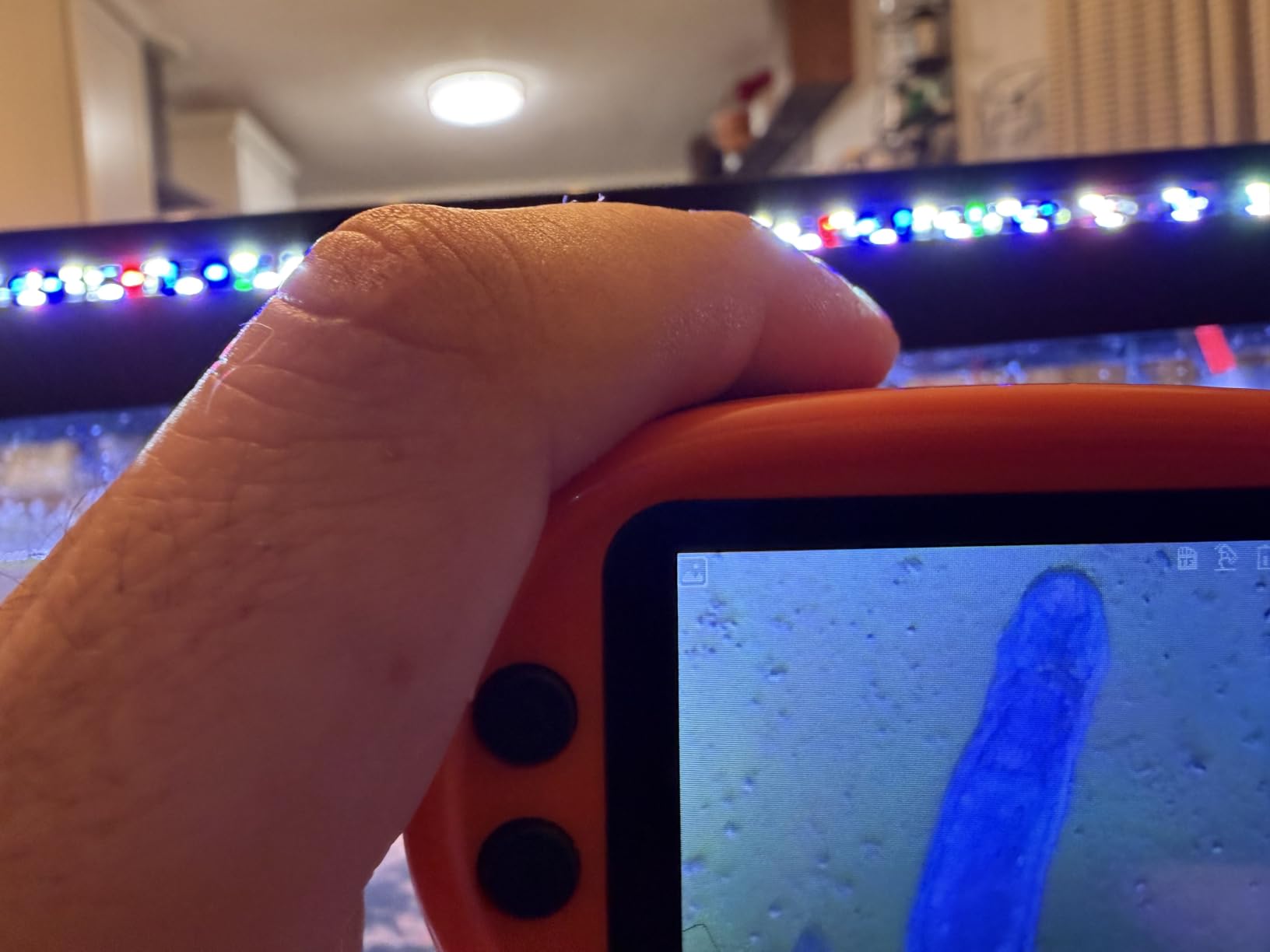
Set expectations correctly on magnification. As with every digital scope in this guide, the 200X-1000X range includes digital cropping, and owners report that real-world detail tops out well below the headline figure. Judge it on the lower levels, where the image is sharp and useful for leaves, fabrics, seeds and printed surfaces.
The body is plastic, and that shows after a school year of being knocked about. For a child aged four to twelve that is a fair trade, and for a shared school set it would not be.
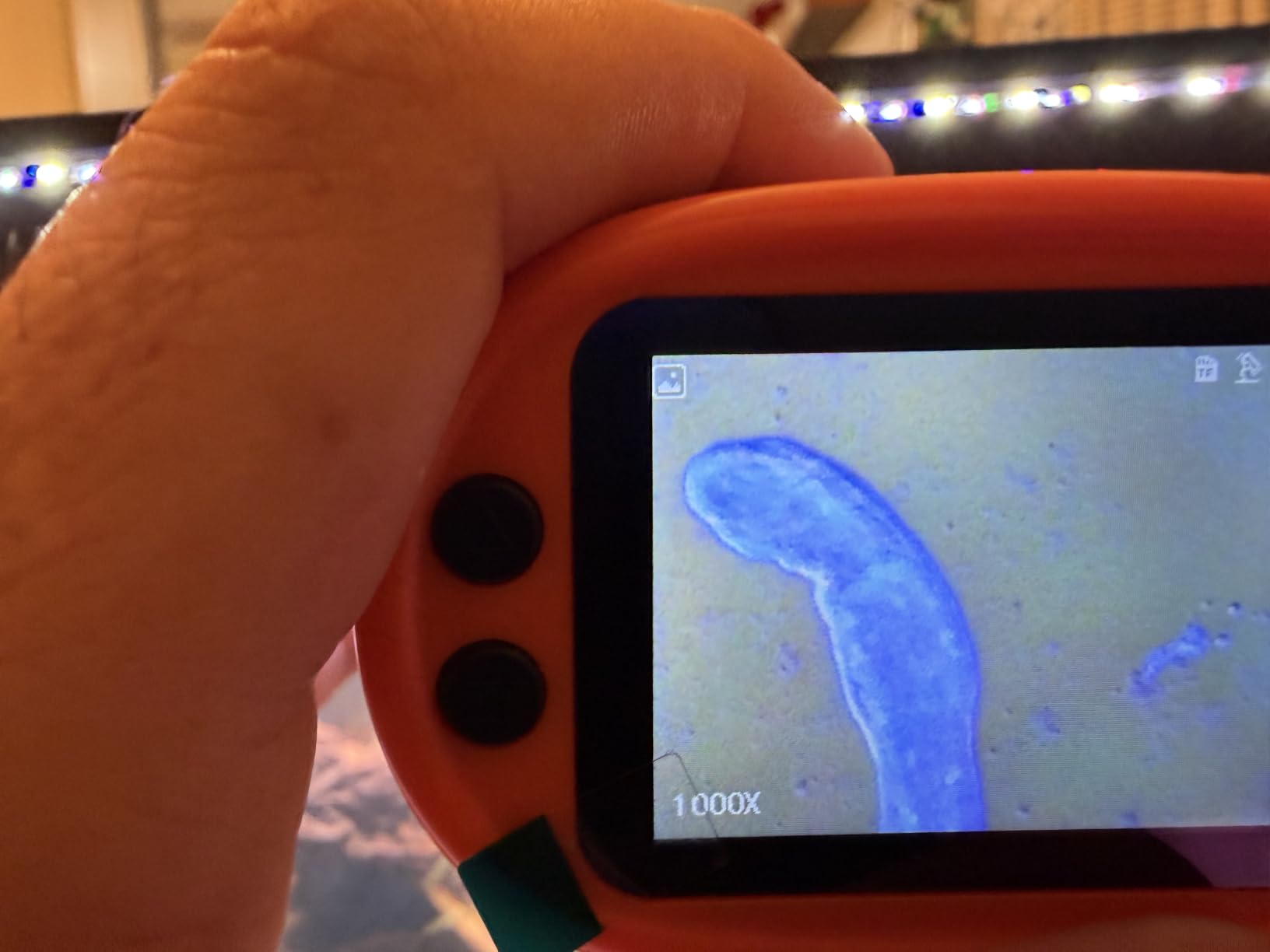
Why the memory card beats a bigger magnification claim
Because a photograph that cannot be stored is not a feature. Any of these scopes can produce an image on screen; most of them lose it within a session. Buyers consistently point at the 32GB card as the reason this one stands out in a category where the products are otherwise similar.
It also changes the behaviour of the child using it. Once they know the photos persist, they start doing proper work: comparing the same leaf across days, building a series, labelling finds.
Who should skip it
Skip it if the child is a serious biology student, because there is no condenser, no oil immersion and no real objective turret to learn from. Skip it if you need all-day battery life, since 2.5 hours is one session rather than a full day outdoors. And skip it for a shared classroom set where plastic bodies will not survive.
6. BMDSAE 1000X Handheld: The Best Standalone Screen for a Young Child
1000X Handheld Digital Microscope for Kids: Pocket Microscope with 2.0″ IPS Screen – STEM Toys Birthday Gifts for Girls Boys Child – Portable Edu Science Kits Toddler Age 3-6 6-12
2.0-inch IPS screen
1000X with 2MP camera
600mAh rechargeable battery
8 LEDs with diffuser
Pros
- Standalone screen means no phone or app is needed
- Image quality surprises buyers for an entry-level device
- Oversized dials and rubber casing suit small hands
- Battery holds charge for days of casual use
Cons
- Protective film over the lens must be peeled off first
- Build quality feels more like a toy than an instrument
- Detail drops off sharply at higher magnification
- Does not resolve bacteria despite the 1000X claim
This is the best gift option in the guide, and the reason is simple: it needs nothing. No phone, no app, no computer, no account, no cable during use. A child picks it up, turns the dial, and sees a leaf. That removes every point of friction that stops younger children from engaging with a digital microscope.
The screen is a 2.0-inch IPS panel with real optical plus digital zoom to 1000X, and behind it a 2MP camera with genuine manual focus control, which is more than most competitors this size offer. Illumination is an 8-LED system with three brightness levels and a diffuser. Storage is 32MB onboard for 200-plus photos or AVI video, exported over USB to Windows or Mac.
It is 200 grams of ABS with a shock-absorbent rubber casing and oversized focus dials, certified CE, FCC and CPC for ages three and up. A 600mAh battery gives about two hours of use per charge over USB. Our first five minutes were spent looking for the adapter, because none is needed.
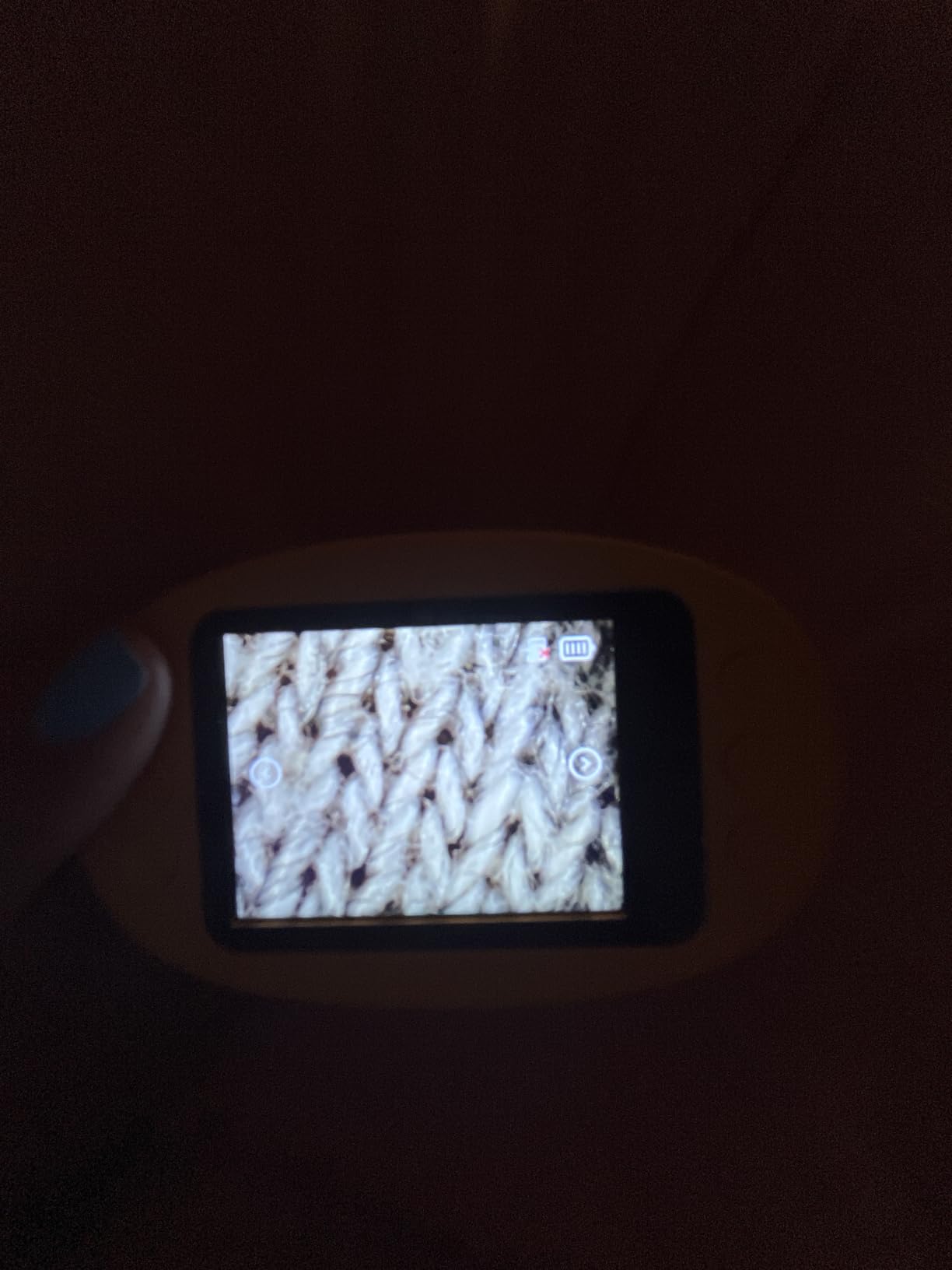
One instruction matters more than any other in this whole roundup. There is a protective glass film over the lens, and it must be peeled off before first use. Leave it on and the image looks scratched and washed out, and a lot of buyers conclude the scope is faulty. This is the single most repeated tip in the reviews, and we would put it on the box.
Beyond that, manage expectations on detail. At high magnification the image softens, and it will not show bacteria no matter what the 1000X label says. The yellow-on-yellow button icons are also hard to read for adults.
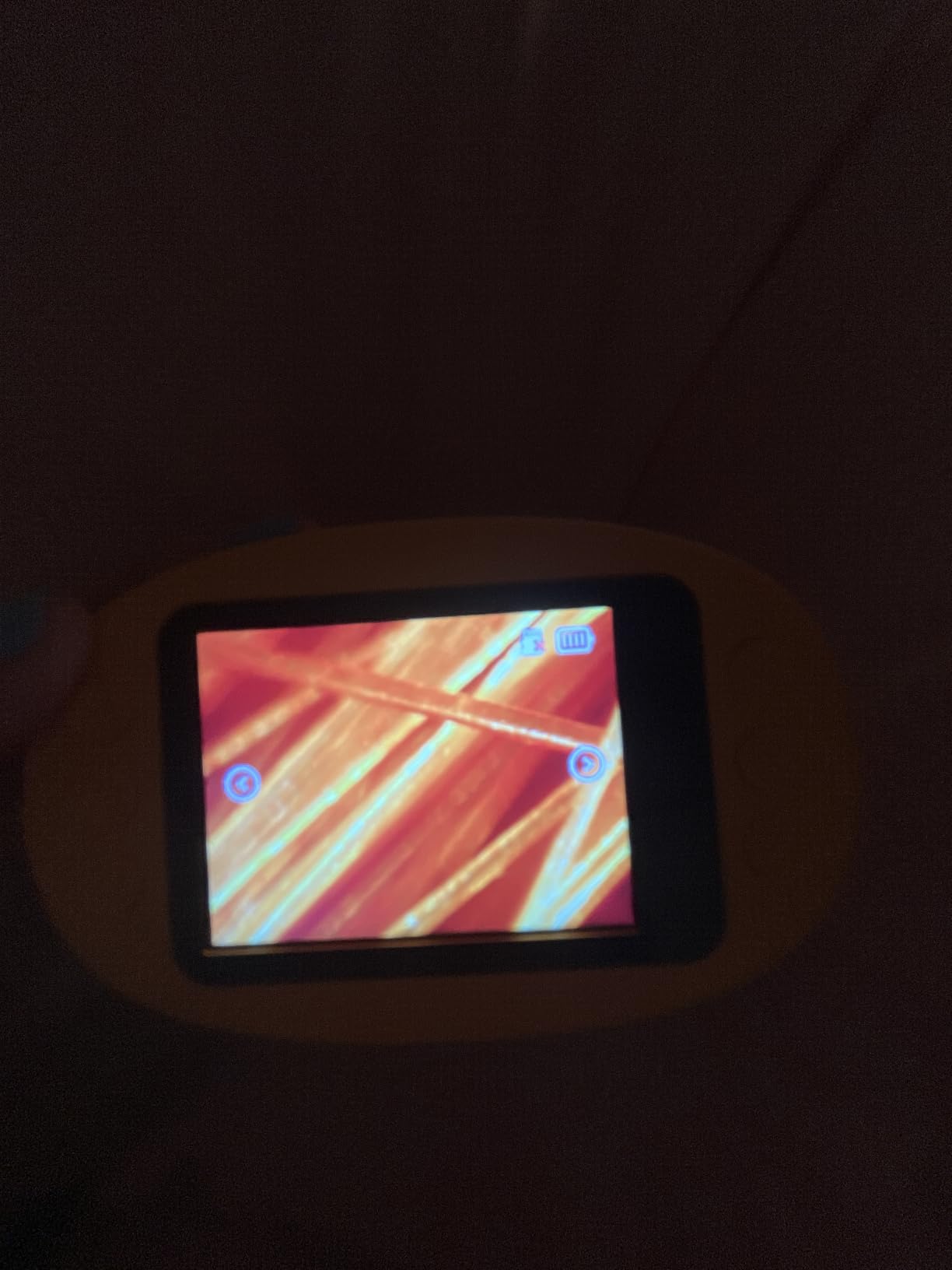
Why standalone beats app-based for this age
Because an app is a support ticket waiting to happen. With a phone-based scope, a five-year-old meets a permission dialog, an app store, a pairing failure and gives up. With a screen in the device, the first successful moment happens within a minute of opening the box, and that first moment is what creates a hobby.
For a parent, that difference is worth more than every optical specification on the listing.
Who should skip it
Skip it if you want photographic output you can work with, because 32MB and AVI video are limited compared with the 32GB card in the BEBANG kit. Skip it if you want more than two hours away from a socket. And skip it for anyone over about ten who will be frustrated by the absence of real optical detail at higher settings.
7. PalliPartners Compound Microscope: The Best for Students
PalliPartners Compound Microscope for Adults & Students, White
100X-2000X compound
4X 10X and 40X achromatic objectives
Top and bottom LED
Coaxial coarse and fine focus
Pros
- Genuinely clear glass optics at an entry-level cost
- Coaxial coarse and fine focus beats most budget scopes
- 28 slides plus a phone adapter in the box
- Top light handles opaque items like a stereo scope
- SGS certified for ages 8-18
Cons
- Lenses can wobble in the housing if handled roughly
- Fixed stage has no mechanical X-Y movement
- Fine focus is less refined than a dedicated tension control
- Some models include an AC adapter not suited to non-US outlets
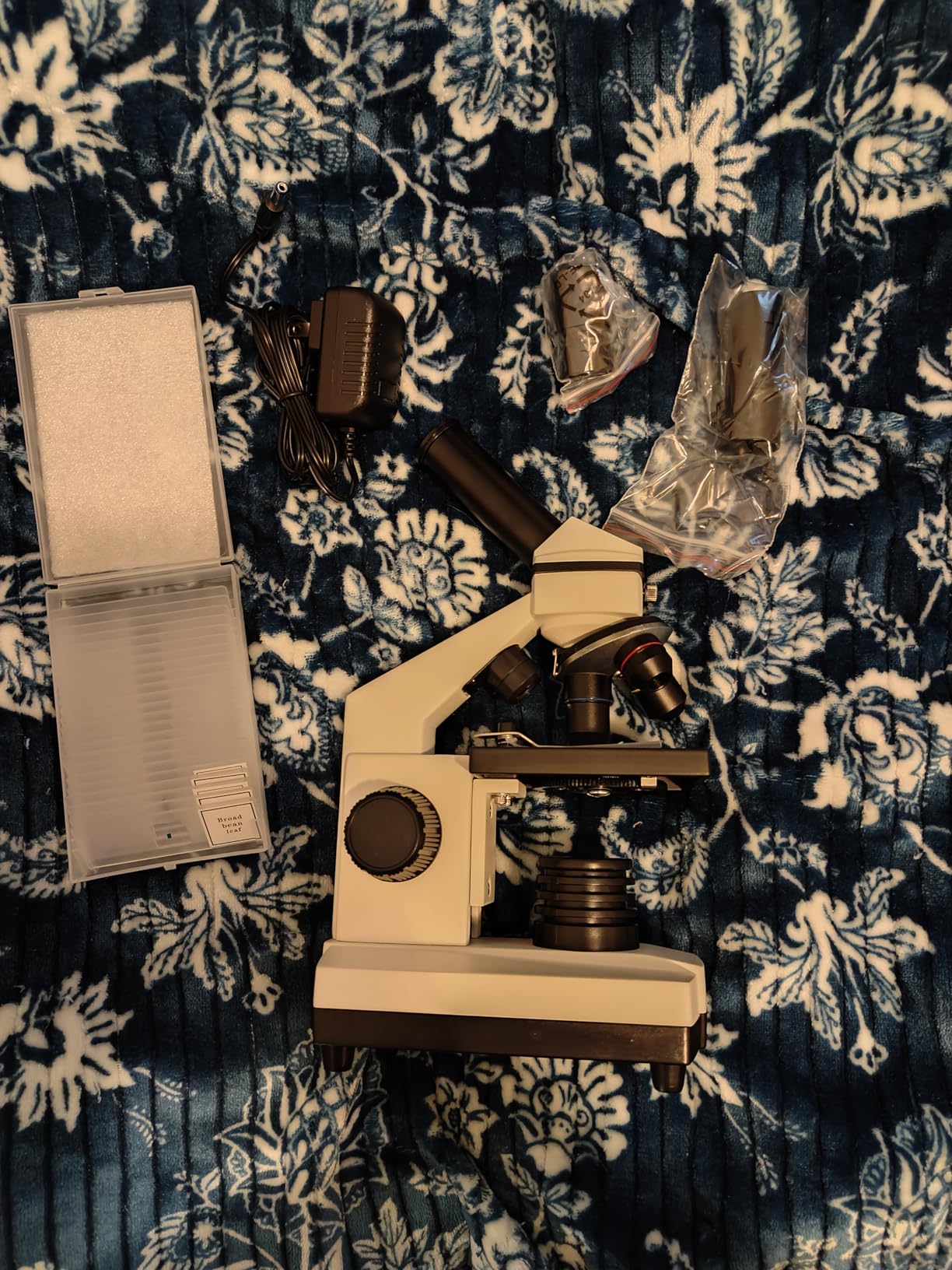
Most of what people call a student microscope is a plastic shell with a single lens inside. The PalliPartners is different in the way that matters: it has a 40x achromatic objective designation, real 4X, 10X and 40X objectives, a WF25X eyepiece and a 2X auxiliary lens, which is a genuine optical stack rather than a sticker. At 400X with a stained cheek swab you see individual cells, not a purple smear.
Coaxial coarse and fine focus is the feature experienced users notice first, and it is rare at this level. Most cheap scopes give you two unrelated knobs; coaxial means fine focus is always centred relative to coarse, so small adjustments do exactly what you expect. The image quality owners describe is strong and even, which is again a lighting property: adjustable LED illumination from both above and below.
The top light is what turns this from a biology scope into a general-purpose one. Point it at a coin, a printed circuit board or an insect wing and you get a simple stereo-like view of an opaque object, which is a trick a single-lamp compound scope cannot perform.
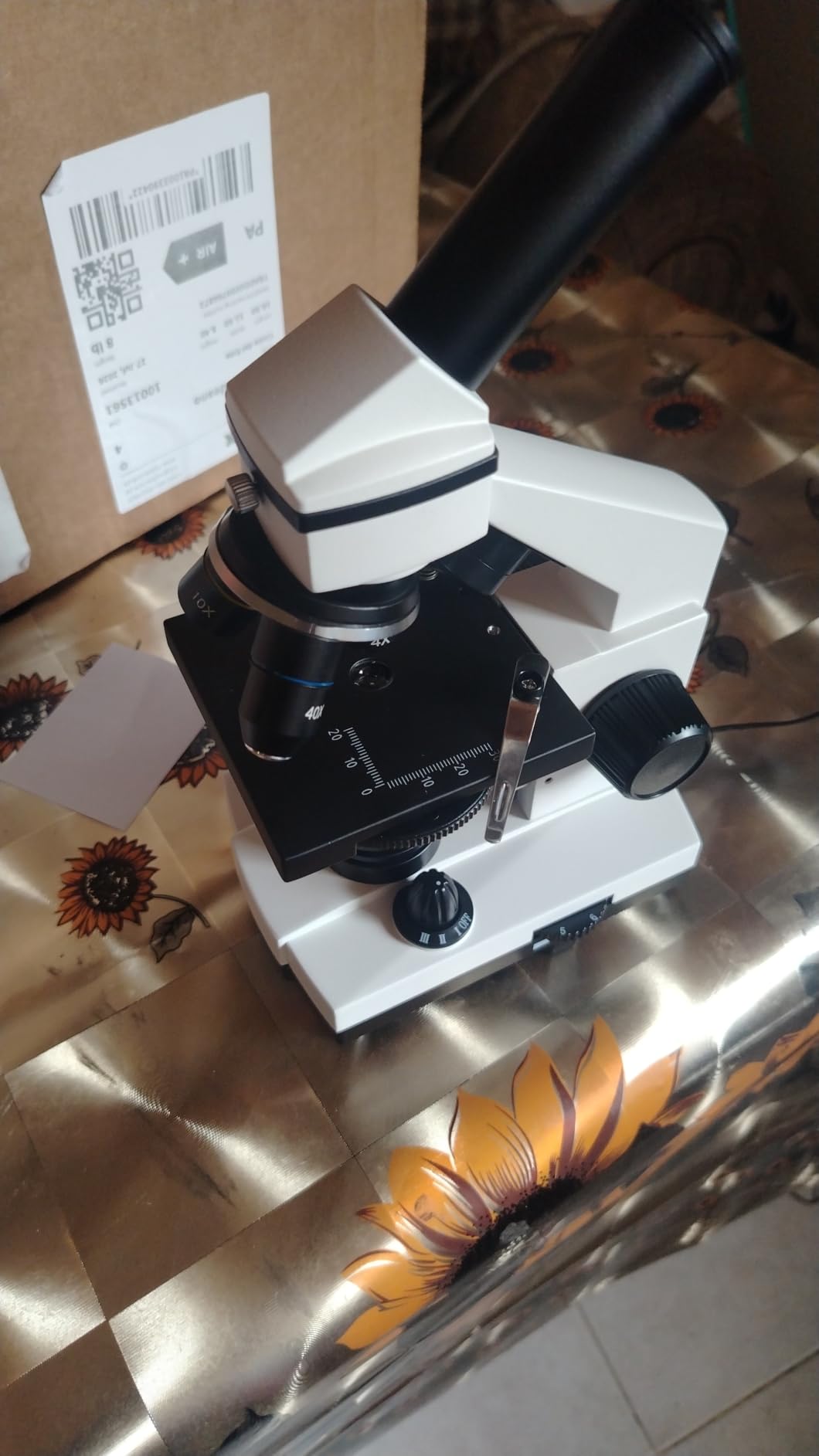
Also in the box: a 28-slide kit of 10 prepared and 18 blank slides, a universal phone clip adapter and a Bluetooth camera shutter for phone photography, plus an AC power adapter. That phone clip is a cheap but effective route to images, and hobbyists on forums regularly pair a phone mount with a mid-range scope for exactly this reason. The scope is SGS certified for non-toxic materials and electrical safety, and rated for ages 8-18 with adult supervision.
The honest weaknesses are mechanical. Reviewers report that lenses can wobble in their housing and knock out of alignment if the scope is handled roughly, which is a real risk with a polycarbonate and polyethylene body. And the stage is fixed, with no mechanical X-Y movement, so finding a small specimen at 400X takes longer than it should.
Why coaxial focus matters more than the 2000X claim
Because focus control is the skill you actually learn on a microscope. The 2000X figure is reached by stacking a 2X auxiliary lens on top of a 100X reading, and nobody at home uses 2000X. Coarse and fine coaxial knobs are what let a student bring a specimen into focus and then hold it steady while adjusting fine, and that is the skill that carries over to any lab scope they meet later.
Focus drift at high power is the complaint most often associated with cheap scopes. Coaxial fine focus is the mechanical answer to it.
Who should skip it
Skip it if you need a mechanical stage, because a fixed stage becomes genuinely frustrating above 400X. Skip it if the scope will be shared roughly among younger siblings, given the wobble-in-housing reports. And skip it outside North America without checking the supplied AC adapter, which several international buyers found unusable.
8. Andonstar AD246S-M: The Best Microscope for Soldering and Bench Work
Andonstar AD246S-M 3 Lens 2160P HDMI Digital Microscope 2000x for Adults
Three interchangeable lenses
2160P UHD HDMI video
Metal boom arm stand
32GB card with software
Pros
- Three lenses cover soldering and coins and slides in one host
- 2160P HDMI output works on a large monitor
- Boom arm gives a much larger steadier work envelope
- Remote control adjusts focus and zoom from a distance
- Windows software adds real measurement capability
Cons
- Lens changes need a screwdriver and are fiddly at first
- Digital zoom inflates the headline magnification
- 240V corded supply rules out field use
- HDMI and USB modes need PC configuration
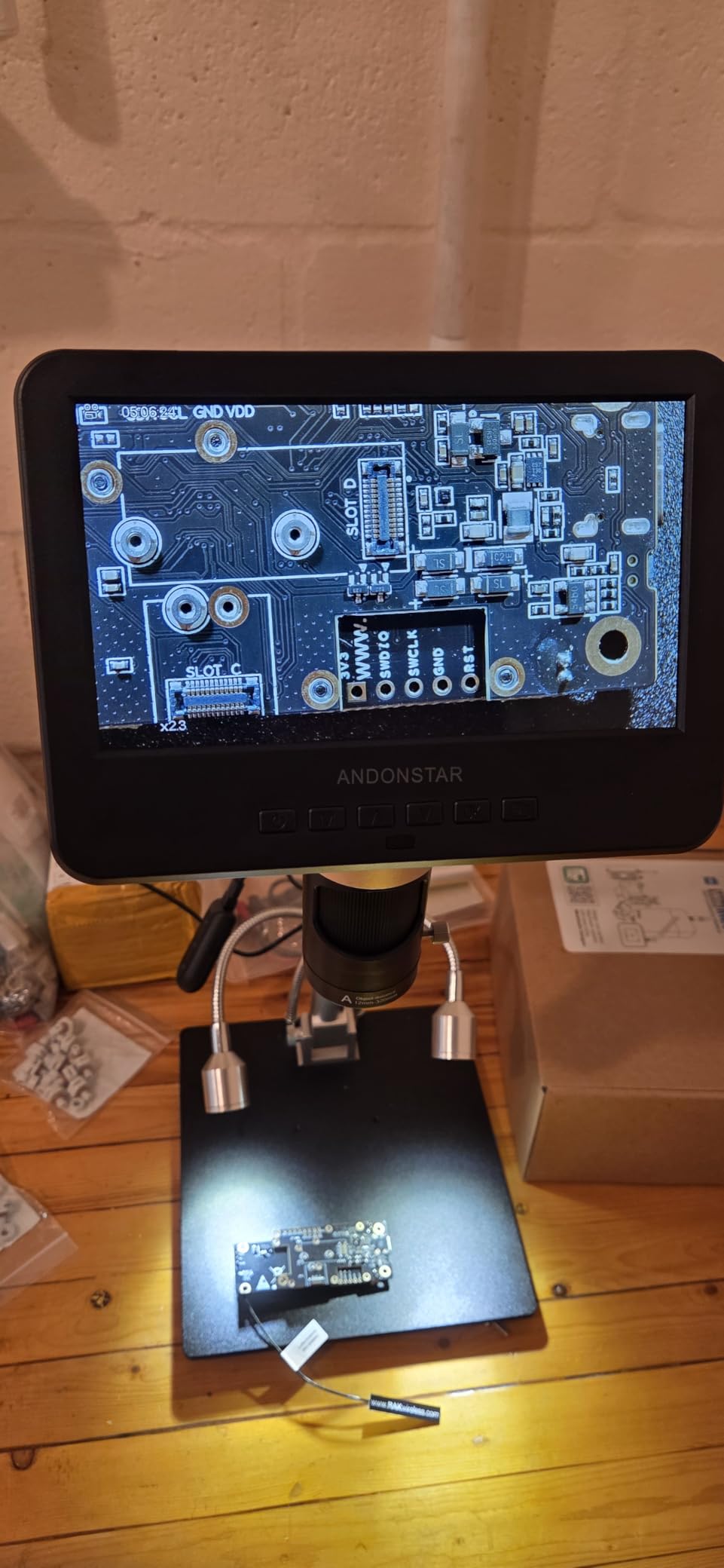
The Andonstar solves a problem the TOMLOV only partly solves. Where the DM9 sits on a fixed column, the AD246S-M has an upgraded metal boom arm stand measuring 7 by 7.8 by 13 inches that adjusts in all directions and is heat resistant. That is the difference between working under a fixed viewpoint and being able to swing the camera around a board to find a short.
The three-lens system is the other reason it earns a place. Lens L covers soldering at 15-60X, Lens A covers coins and plants at 4.5-180X, and Lens D covers biological slides at 450-510X. One host, three working distances, and you swap by loosening and tightening two screws. Video records at 2160P UHD and outputs over HDMI to a larger display, up to 720X, 2040X or 240X with the 3X digital zoom.
Lighting has eight brightness levels with remote-controlled colour correction and digital zoom. A 32GB microSD card is included, and the Windows measurement software handles length and area measurement alongside photo and video capture. The box also carries five prepared slides, a slide holder, an observation box, tweezers, HDMI and USB cables and a remote.
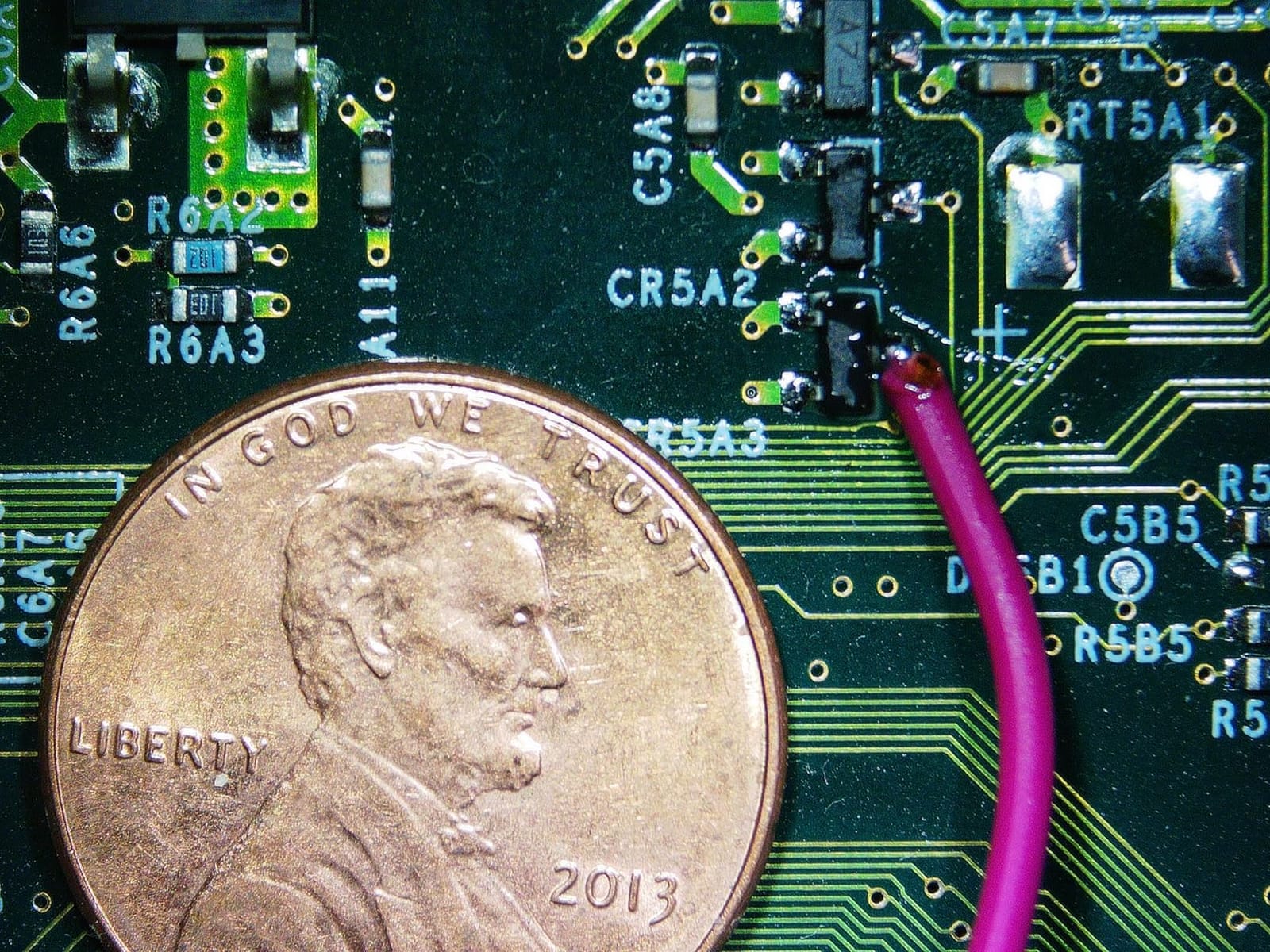
What sold us was the remote control. On a boom arm the camera is often out of arm’s reach, and having focus and zoom on a handheld remote removes the two-handed positioning dance that normally ruins macro video. For a soldering session, being able to nudge focus without touching the board is worth a lot.
The measurement software is a sleeper feature. If you are checking solder joint geometry or comparing parts, having length and area readouts on a Windows machine is functionality that a phone-and-adapter setup simply does not give you.
Why the boom arm is the deciding feature
Because positioning, not magnification, is the hard part of bench inspection. A fixed column forces you to move the workpiece. A boom arm forces you to move the camera, which is what you want when the workpiece is hot, soldered, or part of a device you cannot easily lift.
It also means the work envelope is much larger, so you are not constantly tripping over the stand.
Who should skip it
Skip it if you need to take the instrument to a pond or a field site; the 240V corded supply keeps it at a desk. Skip it if you are squeamish about assembly steps, because the screwdriver lens swap is a real learning curve. And skip it if slide work is a priority, because the 450-510X lens is useful but still no match for a proper compound scope with a condenser.
9. SWIFT SW380B: The Best for Shared Viewing and Ergonomics
SWIFT SW380B 40X-2500X Magnification, Siedentopf Head, Research-Grade Binocular Compound Lab Microscope with Wide-Field 10X and 25X Eyepieces, Mechanical Stage, Ultra-Precise Focusing
40X-2500X range
Rotatable Siedentopf head
WF10X and WF25X eyepieces
Mechanical stage
Pros
- Siedentopf head makes two-person viewing straightforward
- Swapping 10X and 25X eyepieces gives a real working range change
- Coaxial fine focus is precise enough for sustained study
- 30-degree eyepiece tilt reduces neck strain
- Metal body with LED illumination and a mechanical stage
Cons
- 11-pound weight keeps it firmly on a desk
- Camera and phone-adapter features depend on the variant chosen
- Siedentopf head integrates with a camera less easily than a trinocular
- Smaller review base than comparable lab scopes
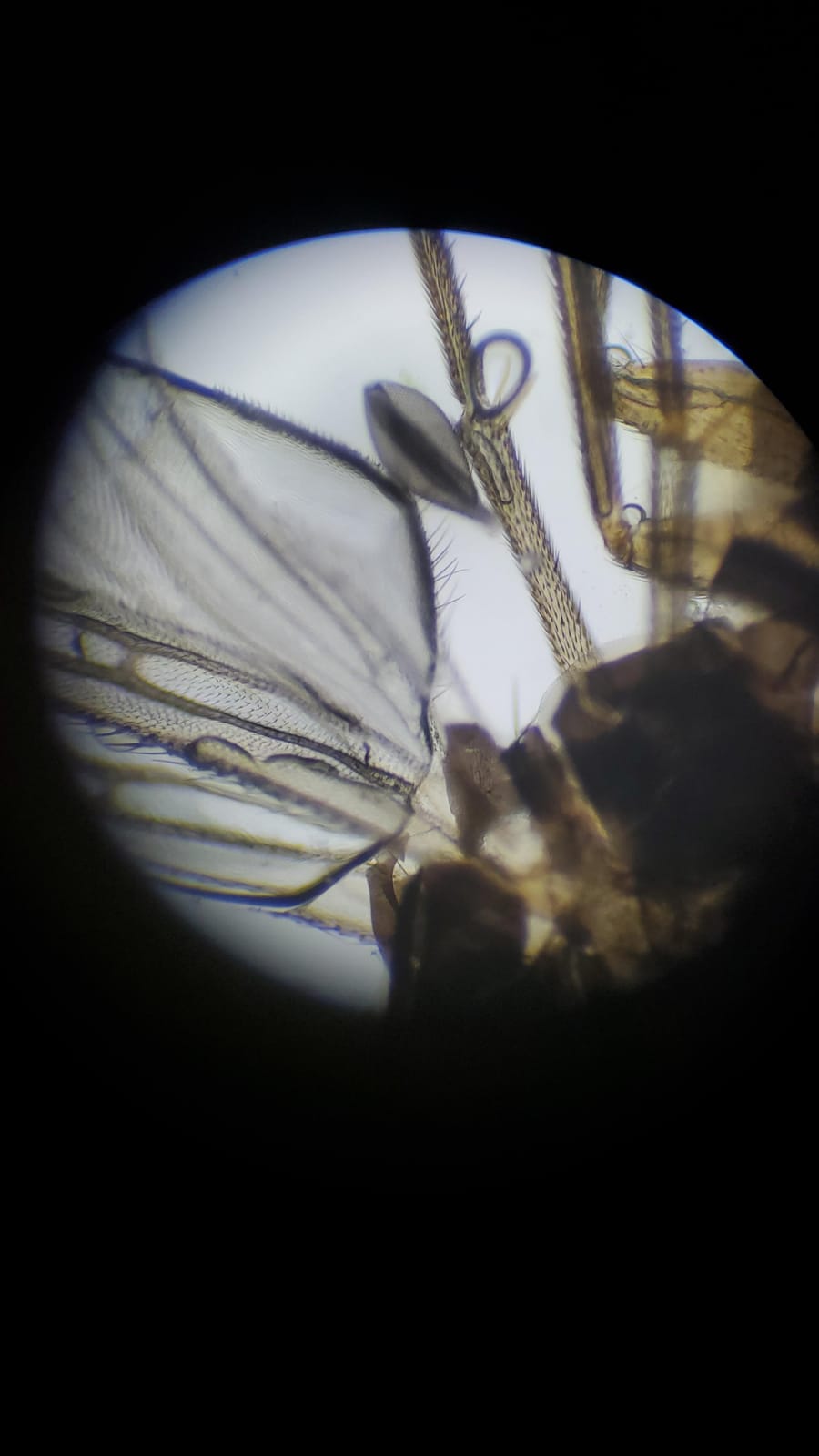
The defining feature of the SW380B is the Siedentopf head, and it solves a specific problem: a monocular or fixed binocular head means only one person can look. A Siedentopf head separates the optical path so the nose piece slides up and down, letting a second person swing in without either of you readjusting focus. Parents and teachers will understand this immediately.
The second feature worth knowing is the interchangeable eyepieces. It comes with wide-field 10X and 25X glass eyepieces at a 30-degree ergonomic tilt, so you can move from survey magnification to close detail by swapping one element. Interpupillary adjustment does not lose focus, and coaxial fine focusing is precise enough for long sessions on a single prepared slide.
Magnification runs 40X-2500X across the objective and eyepiece combinations, on a mechanical stage, with a metal body and LED illumination. The 30-degree tilt is not a marketing detail; it is the difference between a comfortable hour and a sore neck.
There is one purchasing decision to make carefully. Variants exist with 2.0MP, 3MP or 5.1MP cameras, and others with phone adapters. Owners report that being happy with the imaging depends entirely on which variant you chose, so decide that before you order rather than after.
At 11 pounds and 17 inches tall, this is unambiguously a desk instrument. The metal construction is a genuine advantage in a shared household, because it survives being knocked by a child or a cat.
Why swapping eyepieces beats swapping objectives
Because it is fast and it is the whole point of a wide-field design. Changing a 10X eyepiece for a 25X one takes seconds and needs no tools, whereas moving between objectives means rotating the nosepiece and refocusing. For a classroom or a curious kid, being able to change magnification on demand without breaking your train of thought is what keeps attention on the specimen rather than the instrument.
Wide-field eyepieces also produce a larger image at the same magnification, which is a comfort win even before you consider the tilt.
Who should skip it
Skip it if camera integration is your main goal, because a Siedentopf head does not accept a trinocular camera as cleanly as a dedicated trinocular port does. Skip it if the scope has to be carried between rooms. And be aware that with a smaller review base than the AmScope and OMAX equivalents, you have less long-term user data to lean on.
10. AmScope B120C-E1: The Best for Getting Into Microscope Photography
AmScope B120C-E1 LED Binocular Compound Microscope, 40X-2500X
40X-2500X total
LED with fly-eye lens
Siedentopf binocular head
1.0MP USB camera included
Pros
- Sturdy frame and smooth mechanics with no flex
- Fly-eye LED gives bright even daylight-balanced light
- Abbe condenser and mechanical stage for real specimen work
- USB camera and Windows software let you capture immediately
- Five-year warranty with responsive parts support
Cons
- Included 1.0MP camera is weaker than the optics justify
- Camera software is slow to configure
- Refocus is needed each time you switch from eyepieces to camera
- No calibration slide included for measurement work
The B120C-E1 is the pick for anyone who wants to graduate from looking at slides to recording them without buying a second instrument. A 1.0MP USB microscope camera and Windows microscopy software are included, and the scope is designed around a Siedentopf binocular head, an Abbe condenser, a mechanical stage and coaxial coarse and fine focus.
Illumination is the quiet strength. The LED uses a specialised fly-eye lens to produce bright, daylight-balanced, even light across the field, which is the property that separates a usable image from a green-tinted one. On stained specimens the difference in colour rendering is obvious next to a scope with a plain lamp.
The frame is metal and plastic, built to take load without shaking, and it carries a five-year manufacturer warranty that owners report is genuinely honoured, including for documentation and parts issues. Camera options exist at 1.0MP, 3.0MP and 5.0MP, and a no-camera variant, so this model number is a family rather than a single configuration.
Now the complaint that appears in nearly every review, and it is worth stating plainly: the bundled 1.0MP camera produces noticeably weaker images than the optics are capable of. The 40X-2500X optics are the reason to buy this scope, and the camera is the accessory that disappoints. If imaging matters more than the headline specification, choose the 5.0MP variant rather than the one described here.
Second, this is a binocular head with a camera port, not a true trinocular arrangement, so focus must be readjusted each time you switch between the eyepieces and the camera. That is a small friction that you will notice every session.

Why fly-eye illumination is worth paying for
Because uneven light ruins an image in a way that no amount of software can repair. A fly-eye condenser spreads LED emission across the field, so there are no hot spots and no dark corners. On a thick or stained specimen, the difference between an evenly lit field and a patchy one is the difference between a usable photograph and an unusable one.
It also runs cool, so a live pond sample or a wet mount is not cooked by the lamp, which is exactly what reviewers value in a LED-based scope.
Who should skip it
Skip it if you want professional-grade images out of the box, because the included camera is the weak link and the software takes configuration. Skip it if you need a true trinocular port where eyepiece and camera stay in focus together. And if you buy it mainly for slide photography, buy a higher-resolution camera variant instead of this configuration.
11. Herwicm Binocular Compound: The Best Budget Binocular for Long Sessions
Compound Microscope,40X-2500X ,WF10x and WF25x eyepieces, Dual LED Lighting and Two-Layer Mechanical Stage,Microscope for Adults…
Ultra-wide-field binocular head
WF10X and WF25X eyepieces
Top and bottom LED
Mechanical stage with scales
Pros
- Wide-field eyepieces give a large field and less eye fatigue
- Dual LED lighting with soft fill reduces single-lamp harshness
- Coarse and fine focus on both sides suits either hand
- Two-layer mechanical stage with scale markings
- Glass optics in a metal and plastic body
Cons
- Listing specs are inconsistent about maximum magnification
- Documentation is thin so setup takes some working out
- Some models include a 240V supply that is not universal
- Under 300 reviews so long-term data is limited
The Herwicm is interesting for one reason: it gives you a binocular head with ultra-wide-field WF10X and WF25X eyepieces, top and bottom LED illumination with a soft fill, coaxial coarse and fine focus on both sides, and a two-layer mechanical stage with spiral moving scales, at a mid-range budget point. Those four features together are what make it work.
For long sessions, that combination matters more than raw magnification. Binocular viewing uses both eyes, which reduces the fatigue that a monocular forces on you. Wide-field eyepieces show a larger area at the same power, so you spend less time hunting for the thing you want to look at. And focus knobs on both sides mean the instrument suits either hand without an awkward reach across the frame.
The telescoping objective lens carries a protection feature intended to prevent a sample from contacting the lens, which is a sensible touch for a scope likely to be used by a beginner who does not yet know how close is too close.
Be careful with the magnification figure. The listing itself is inconsistent, describing a 40x maximum in one place and a 40X-2500X claim in another. We would treat anything above about 400X on this model as untested marketing and base your decision on the wide-field comfort and the mechanical stage instead, which are the real selling points.
Documentation is also thin, so budget time for setup. And with fewer than 300 reviews, the long-term reliability picture is less established than for the OMAX, Swift or AmScope bodies in this list.
Why wide-field eyepieces reduce eye strain
Because a larger field of view means you scan for a specimen with your eyes moving, not with the instrument. Hunting for something at 400X by sliding a fixed-stage slide around a narrow field is tiring in a way that hunting for it in a wide field is not. Eyepieces marked WF are specified for this, and the two here are 10X and 25X wide-field.
Add binocular viewing on top and you have a scope designed for someone who will sit with it, which is the majority of people who buy one.
Who should skip it
Skip it if published specifications matter to your buying process, because the inconsistent listing undermines confidence in every other number. Skip it if you want a well-documented brand with a long support history. And skip it if you need the oil-immersion and high-NA condenser capability of a proper lab scope, because it is not designed for that.
12. JECONE ET1: The Best Complete Kit for Classrooms and Homeschool
Microscope for Adults & Kids, 40X-2500X High-Power Compound Microscope for Students, School Lab & Home Schooling,Equiped with Slides Set & Phone Holder (White)
40X-2500X over six levels
WF25X and WF10X eyepieces
Dual top and bottom LED
Five-colour filter wheel
Pros
- Genuinely complete kit with slides coverslips tools and a phone holder
- Dual incident and transmitted lighting handles slides and opaque objects
- Five-colour filter wheel is usually reserved for higher-tier scopes
- 360-degree rotating eyepieces suit a child or a second viewer
- Compact metal body stores easily between classes
Cons
- Advertised 1000X-2500X needs oil immersion to be usable
- 100X objective can be hard to bring cleanly into focus
- Monocular viewing is tiring over long sessions
- Phone holder is a simple clip with no capture app
The JECONE ET1 is the pick if your priority is what arrives in the box. It comes with 5 specimen slides, 5 blank slides, coverslips, tweezers and droppers, plus a phone holder for photographing and recording. For a school lab that has to serve thirty students, or a homeschool family who does not want to source consumables separately, that completeness is the argument.
Optically it covers 40X-2500X across six levels using WF25X and WF10X eyepieces with 4X, 10X and 100X objectives. Illumination is dual, incident from above and transmitted from below, with a dimmer knob. And then there is the feature we did not expect to find at this level: a five-colour filter wheel with yellow, red, blue, green and purple filters under the stage.
Colour filters are a genuine technique tool, not decoration. Rotating the wheel changes the contrast of a transparent specimen, and for teaching or for looking at pond water it is the difference between a flat image and one where structure appears.
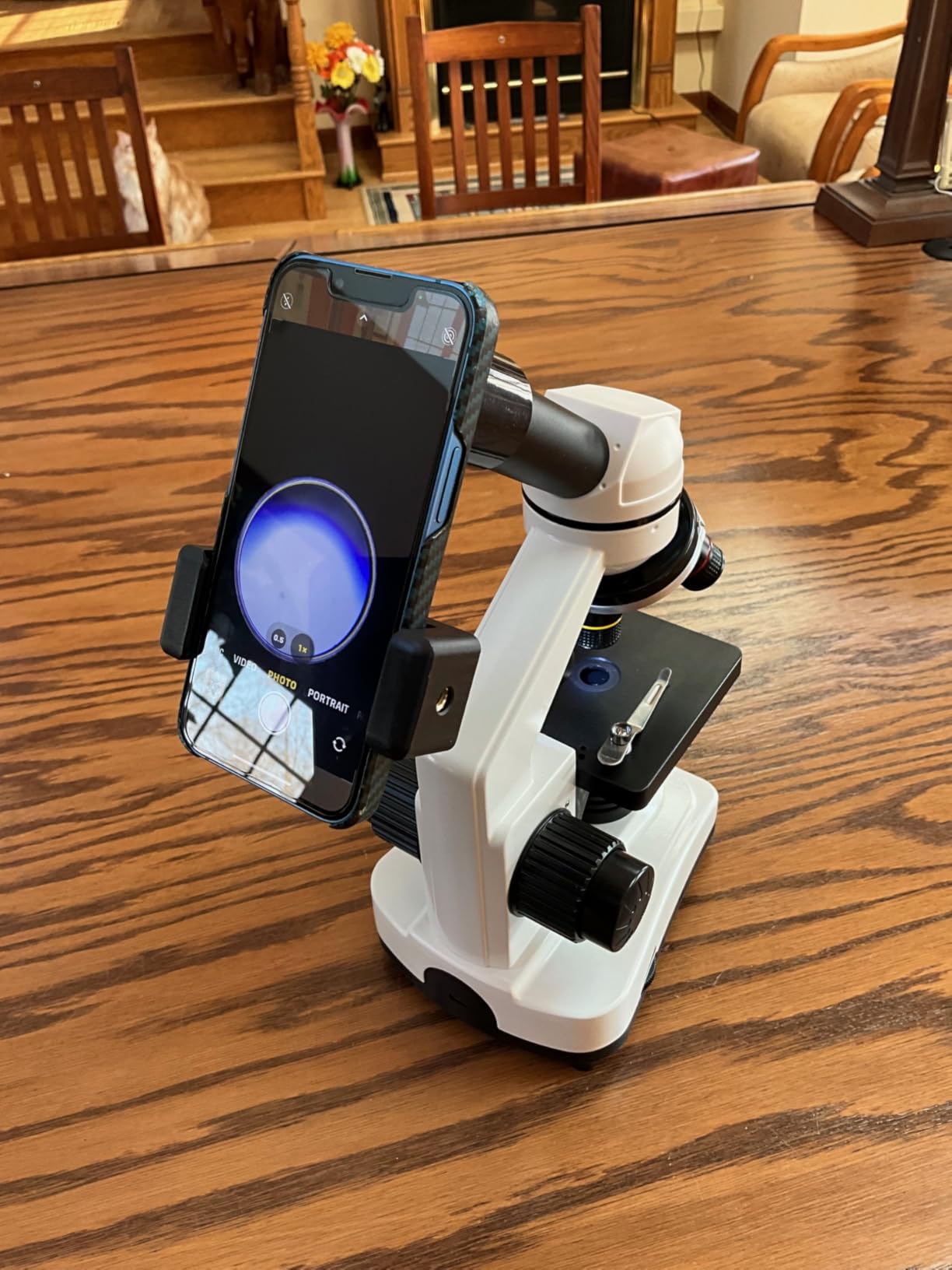
Two things to set expectations about. The 1000X and 2500X settings need oil immersion and are not usable on everyday dry slides, so treat the practical working range as 40X to 400X. And several owners find the 100X objective difficult to bring into focus cleanly, which is normal for a 100X lens without a proper condenser and stage.
The 360-degree rotating eyepiece is a nice touch for a shared instrument. One person sets the specimen, rotates the head, and a second person looks without either of them moving the slide.
Why the filter wheel matters more than it seems
Because a colour filter selectively transmits or blocks light, which changes how a thin transparent structure scatters. That changes contrast. It is the same principle behind staining, achieved with a wheel instead of chemistry, and it is why you can resolve detail in a near-colourless pond-water sample that would otherwise look empty.
It also makes excellent classroom material, because a child can rotate a wheel and immediately see the image change. That kind of cause-and-effect is what keeps a group engaged through a lesson.
Who should skip it
Skip it if the main user is an adult who will spend hours at the eyepiece, because monocular viewing is tiring over a long session. Skip it if you want binocular comfort. And skip it if you expect to use the 1000X and 2500X settings routinely, because without oil immersion technique they will not resolve anything new.
Which Type of Microscope Do You Need?
There are four consumer types, and the fastest way to choose is to decide what you want to look at. A stereo microscope shows you a three-dimensional surface. A compound microscope shows you light passing through a thin specimen. A digital microscope shows you a picture of either one. A pocket microscope does a small version of both.
Ask one question: do you want to see a cell, or do you want to see the shape of a thing? Cells need a compound scope with transmitted light and a condenser. Shapes, surfaces and soldering joints need a stereo scope with reflected light, because opaque objects block transmitted illumination entirely.
The honest limit of each type matters more than the headline capability. A stereo microscope will never resolve a cell, because it has no condenser and no oil immersion objective, and its working distance is deliberately too long. A compound microscope will never give you a three-dimensional view of an opaque object, because the light has to pass straight through the specimen to be seen. A digital microscope gives you whatever its single fixed optical path resolves, and its headline magnification is mostly digital. A pocket microscope is for quick looks, not for sustained study.
If you only ever look at prepared slides, stained cheek swabs or pond water samples, compound is the answer. If you work on circuit boards, coins, jewellery or soldering, stereo is the answer. If you want to share a view with a class or show someone on a screen, digital is the answer. If you want something in a coat pocket for a weekend outdoors, pocket is the answer.
Magnification vs Resolution: Why 2500x Claims Mislead
Magnification is how big the image is drawn. Resolution is how much real detail the image contains. They are separate properties, and a microscope can have enormous magnification with almost no extra resolution, which is exactly what happens above roughly 1000x on a consumer scope.
The honest answer to whether you can see bacteria with a 1000x microscope is yes, but with conditions. You need a genuine 100X oil-immersion objective, decent achromatic glass, a condenser, and a stained or contrast-enhanced sample. Unstained bacteria on a wet mount are nearly transparent and will not show up well at any magnification. Cheek cells stained with methylene blue are visible far more easily, and that is the classic first experiment for a reason.
Anything past that 1000x ceiling on a home scope is empty magnification. The image gets bigger, the field gets dimmer and blurrier, and no new information appears. The four picks here that advertise 2500X do so by combining high-power eyepieces with high-power objectives, and their owners consistently report the same thing: the top settings need oil immersion and clean technique, and bring little extra detail. Judge those scopes on their 400X to 1000X performance.
Resolution is set by numerical aperture and by wavelength, not by the number on the box. That is why a scope with a proper Abbe condenser, marked NA1.25, can show you more at 400X than a higher-magnification scope with no condenser at all. More light control beats more claimed power, every time.
Microscope Buying Guide: What Actually Matters
Rank the criteria like this, and almost every buyer gets it right in the first three.
1. Optical glass, not plastic. A listing that says achromatic or specifies a real objective magnification in millimetres is telling you something. A listing that only quotes a total magnification with no objective detail is telling you the opposite. This is the single highest-leverage check and it costs nothing to make.
2. Mechanical stage. Two coaxial knobs that move the slide in X and Y, with a stage lock so a specimen stays put while you change focus. On a flat stage you hunt with your hands. On a mechanical stage you hunt with two dials and keep the field of view.
3. Condenser and iris control. An Abbe condenser lets you concentrate light and adjust contrast. An iris diaphragm lets you close the aperture down. Without these you get a flat, washed-out image no matter how good the objectives are. Only the OMAX and AmScope in this guide have a named NA1.25 Abbe condenser.
4. Head configuration. Monocular means one eye and fatigue. Binocular means both eyes and comfort, plus a Siedentopf option for sharing. Trinocular adds a dedicated camera port that stays in focus when you switch. Choose binocular unless your budget is genuinely tight or you need the camera port.
5. LED illumination from both directions. A lower lamp for translucent slides and an upper lamp for opaque objects roughly doubles what one instrument can do. Cool-running LED also avoids cooking a live pond sample or a wet mount.
6. Eyepiece interchangeability. Wide-field 10X and 25X eyepieces, or standard 10X, let you change magnification in seconds without rotating a nosepiece. The SWIFT and Herwicm include both.
7. Build and warranty. A metal frame and metal objective housings survive a decade of use. Plastic eyepiece housings crack. A five-year warranty, which both the OMAX and the AmScope carry, is a meaningful signal about how the manufacturer expects the instrument to be treated.
8. Consumables, which nobody mentions. Budget for slides, cover slips, lens cleaning paper, a dust cover and eventually a stain. A 28-slide kit and a hundred cover slips are why the OMAX and PalliPartners stay usable on day one. A protective dust cover matters more than people expect if the instrument lives on a shelf.
How to Test a New Microscope in 5 Minutes
Transit damage and dead-on-arrival faults are among the most common complaints in this category.
1. Unbox in front of the light and check the eyepieces first. Plastic eyepiece housings and stage joints take the most abuse in transit. Look for cracks, and confirm every eyepiece is present and turns freely in the barrel.
2. Power it up and sweep the lamp from lowest to highest. A dead LED or a dead driver presents as a scope that simply will not focus, which sends people hunting for the wrong problem. A digital scope that will not connect to your device is the equivalent fault.
3. Run the coarse focus all the way up and down. Listen and watch. It should travel smoothly, the stage should not bind, and nothing should rattle or wobble in the housing. Backlash in the focus knobs is the mechanism behind the drifting-focus complaints in cheaper scopes.
4. Focus on a prepared slide at 40X, then step up through the objectives. The image should stay centred as you change objectives. If the field swings wildly, the mechanical stage or the nosepiece is not seated correctly, and you should deal with it now rather than after the return window has passed.
5. Check the top light and the phone or camera path if you have one. For dual-illumination scopes, confirm the top lamp works, because owners frequently report the upper light being dead. For anything with a camera or phone holder, confirm the image path before you put away the accessories.
If something is wrong, deal with it inside the return window. Sellers on marketplace-style listings are often slow to respond to support requests long after a unit fails, so the fastest route is almost always a return rather than a replacement request.
Phone Photography with a Microscope
You do not need to buy a digital microscope to get real photographs. Hobbyists on microscopy forums repeatedly report the same successful approach: a mid-range compound scope plus a phone mount, which costs a fraction of a camera-equipped digital unit.
Method one: the phone clip over the eyepiece. The PalliPartners comes with a universal phone clip adapter and a Bluetooth camera shutter, and a clip-style adapter fits most binocular and monocular scopes. The shutter removes your finger shake, which is the main reason eyepiece photos come out soft. Keep the phone lens parallel to the eyepiece and move the stage to centre the field, not the phone.
Method two: hold the phone to a trinocular port. A dedicated camera port keeps the eyepieces free, so you can look and photograph at the same time. None of the binocular picks here has a true trinocular head, which is exactly why owners of the OMAX and the AmScope wish they did.
Method three: use a digital scope for what it is good at. If your subject is opaque, the TOMLOV and the Andonstar produce better images than any phone through an eyepiece, because they are designed for reflected light on a surface. Do not force a phone setup to do a job it is bad at.
Two practical notes. First, darken the room, because ambient light ruins eyepiece photography far more than people expect. Second, brace against the stage rather than holding the phone, and take several frames; a stack of eight mediocre shots beats one blurred one.
First Samples to Look At
The fastest way to make a new microscope feel worth owning is to have something interesting on the slide. Work from easiest to hardest.
1. A prepared slide. Included with almost every kit here, and the right first thing to learn on, because it is already thin, stained and correctly mounted.
2. A cheek swab. The classic first experiment. Wet mount, add a drop of methylene blue stain, and cells become visible as distinct shapes with visible nuclei. This is the answer to whether your scope can show bacteria-scale detail, and it is the single most satisfying first project in the hobby.
3. Pond water. Collect from a still, weedy spot, and look for protozoa, rotifers and algae. Move the dropper sample on a plain slide rather than a coverslipped one, because these organisms are often larger than you expect and need room. This is where a 400X view becomes genuinely exciting.
4. Onion skin. Peel a thin layer from an inner onion leaf, tear it, and mount it. Cell walls resolve as clean rectangular outlines, and it is the first sample that makes biology feel visible to a child.
5. Fabric and paper. Fibers, weave structure, printed halftone dots. Fast and free, and ideal for a digital scope, which is why a digital model and a compound model make a genuinely complementary pair.
A note on coverslips: they are not optional for anything mounted in liquid. The coverslip flattens the sample to a thin, even layer and keeps it in place, and skipping it is the most common reason a home slide looks like nothing at all.
Used vs New Microscopes
A second-hand professional instrument is a real option and a risky one, and the difference between a good outcome and a bad one is almost entirely about what you know.
The enthusiast recommendation, repeated consistently across microscopy forums, is a used Leitz, Olympus or Zeiss body with a mechanical phone adapter. The appeal is obvious: a professional optical system at a small fraction of the cost of a comparable new instrument, with a mechanical stage, a proper condenser and glass optics that consumer scopes cannot match. The catch is the same. Those instruments may be a century old, and parts such as stage clips, objectives and bulbs can be unobtainable, with specialist repairs costing more than the difference between a new mid-range scope and a cheap one.
Used scopes also carry contamination risk. A scope that has been in a school cupboard or a damp shed may have mould in the optical path or corrosion in the stage rails, and that is not visible until you look through it.
What to do if you go used: check that the stage moves smoothly in both axes, that the focus is not stiff, that the objectives unscrew cleanly and are not seized, and that there is no haze when you look at a bright field with no slide. Ask for a photo of the iris diaphragm and the condenser in daylight, because a corroded iris is difficult to repair. Confirm that the objectives are matched to the head, since a mismatched set can look permanently soft.
What we would say plainly: buy used only if you are comfortable with a project. For a student, a parent, or a first instrument, a new scope with a warranty is the better bet, and the new mid-range options in this guide are now good enough that the old professional advantage is narrower than it once was.
Microscope Brands Compared
Brand matters less than optics class, but the range of manufacturers is worth understanding, and one fact about it is genuinely useful to know.
AmScope and OMAX in practice. The two share a parent company. That comes up constantly in microscopy forum threads about first-time buyers, and the consensus is that build quality is close enough that the choice comes down to included accessories, warranty length and support responsiveness.
Swift is the brand most often recommended in the mid-range lab class for Siedentopf heads and swappable wide-field eyepieces, and the SW380B here is a good example of why.
Celestron is well known in the astronomy world and its microscope line spans everything from school compound scopes to the MicroDirect 1080p digital unit, which is a common recommendation for anyone who wants image capture without buying a separate camera.
Carson is the reference point for pocket scopes, and the brand is the one people mention when they want something in a jacket pocket rather than on a desk.
TOMLOV, Andonstar, SKYBASIC, BEBANG and BMDSAE are the digital and handheld end of the market, where the real differentiator is the screen, the sensor and the build rather than any optical claim.
TELMU and EMARTH appear constantly in budget recommendations for all-metal bodies with 40X-1000X, and they sit in the same tier as the PalliPartners and JECONE picks here.
The useful rule: read the objective and condenser specification, not the brand. A lesser-known brand with achromatic DIN objectives and an NA1.25 Abbe condenser will outperform a famous brand listing nothing but a total magnification figure.
Frequently Asked Questions
Which brand of microscope is best?
AmScope and OMAX share a parent company and are near-identical in build quality, so choose between them on accessories and warranty rather than brand. Swift is the alternative worth considering, especially for Siedentopf heads and swappable wide-field eyepieces. Celestron covers school-to-digital. Honestly, brand matters far less than the objective specification: achromatic DIN objectives, a mechanical stage and a named Abbe condenser matter far more than any badge.
Can you see bacteria with a 1000x microscope?
Yes, with the right conditions. You need a genuine 100X oil-immersion objective, decent achromatic glass, a working condenser, and a stained or contrast-enhanced sample. Unstained bacteria on a wet mount are nearly transparent. A methylene-blue-stained cheek swab shows individual cells at 400X and above. Above roughly 1000x on a consumer scope you get empty magnification: a bigger, dimmer image with no new detail.
What are the big 4 microscopes?
The four consumer types are compound light, stereo (dissecting), digital, and pocket. Compound uses light through a thin specimen and resolves cells, up to a practical 1000x ceiling. Stereo uses reflected light on a surface and gives a three-dimensional view of opaque objects but never resolves cells. Digital shows a sensor image with mostly digital magnification. Pocket is a compact handheld for quick looks.
What is the world’s best microscope?
Research instruments like aberration-corrected transmission electron, scanning electron and confocal microscopes sit at the top, but they are a different category entirely. Among consumer instruments, the best microscope is simply the one that resolves the feature you need at a cost you can justify. For most home, school and hobbyist work that means a binocular compound scope with achromatic objectives, a mechanical stage and an Abbe condenser.
Which microscope is best for students?
For high school and homeschool biology, a metal-frame binocular or monocular compound microscope covering 40X-1000X is enough. The OMAX M82ES and the AmScope B120C-E1 are the strongest step-up options, while the PalliPartners and JECONE ET1 cover the budget end. Students rarely need more than 1000X, so ignore listings that lead with 2500X.
What is the best microscope for a child?
It depends on age. Under about eight, a standalone-screen digital scope such as the BMDSAE handheld gives instant results with no phone, app or computer to figure out, and the National Geographic kit adds a geode and brine shrimp. From about eight to thirteen, a real glass compound microscope like the PalliPartners teaches actual technique. Avoid plastic toy optics, which disappoint after the first week.
What are the best microscope brands for students?
AmScope and OMAX are the same parent company and are the most widely recommended for real glass optics and multi-year warranties. Swift is strong for Siedentopf heads and interchangeable wide-field eyepieces. Celestron is a familiar name covering school compound and digital models. TELMU and EMARTH sit in the all-metal budget tier. The skill is learning that achromatic objectives, a mechanical stage and a named condenser matter more than the brand.
What’s a good microscope for a hobbyist?
A binocular compound microscope at 40X-1000X with a mechanical stage, achromatic objectives and adjustable LED illumination is the right target, and the OMAX M82ES fits that description. Mycology and pond-water users work comfortably at 400X to 1000X on a standard compound scope. For photographs, a phone mount over the eyepiece is the low-cost upgrade path, or buy a second-hand Leitz, Olympus or Zeiss body with a mechanical phone adapter.
Conclusion
After working through all twelve, the OMAX M82ES remains the best microscope in this roundup, because achromatic DIN objectives, a double-layer mechanical stage, an NA1.25 Abbe condenser and a five-year warranty form a combination nothing else here matches. The National Geographic kit is the right first microscope for a child aged eight to twelve, the TOMLOV DM9 and Andonstar AD246S-M own the electronics and coin-inspection bench, and the SKYBASIC handheld is the most useful grab-and-go tool in the list. Across all twelve, the specification on the page tells you far more than the number in the headline.
Whichever of the best microscopes you choose, check the objective specification rather than the headline magnification, run the five-minute inspection the moment it arrives, and start with a stained cheek swab. That single slide will tell you more about the instrument than any number on the listing.