
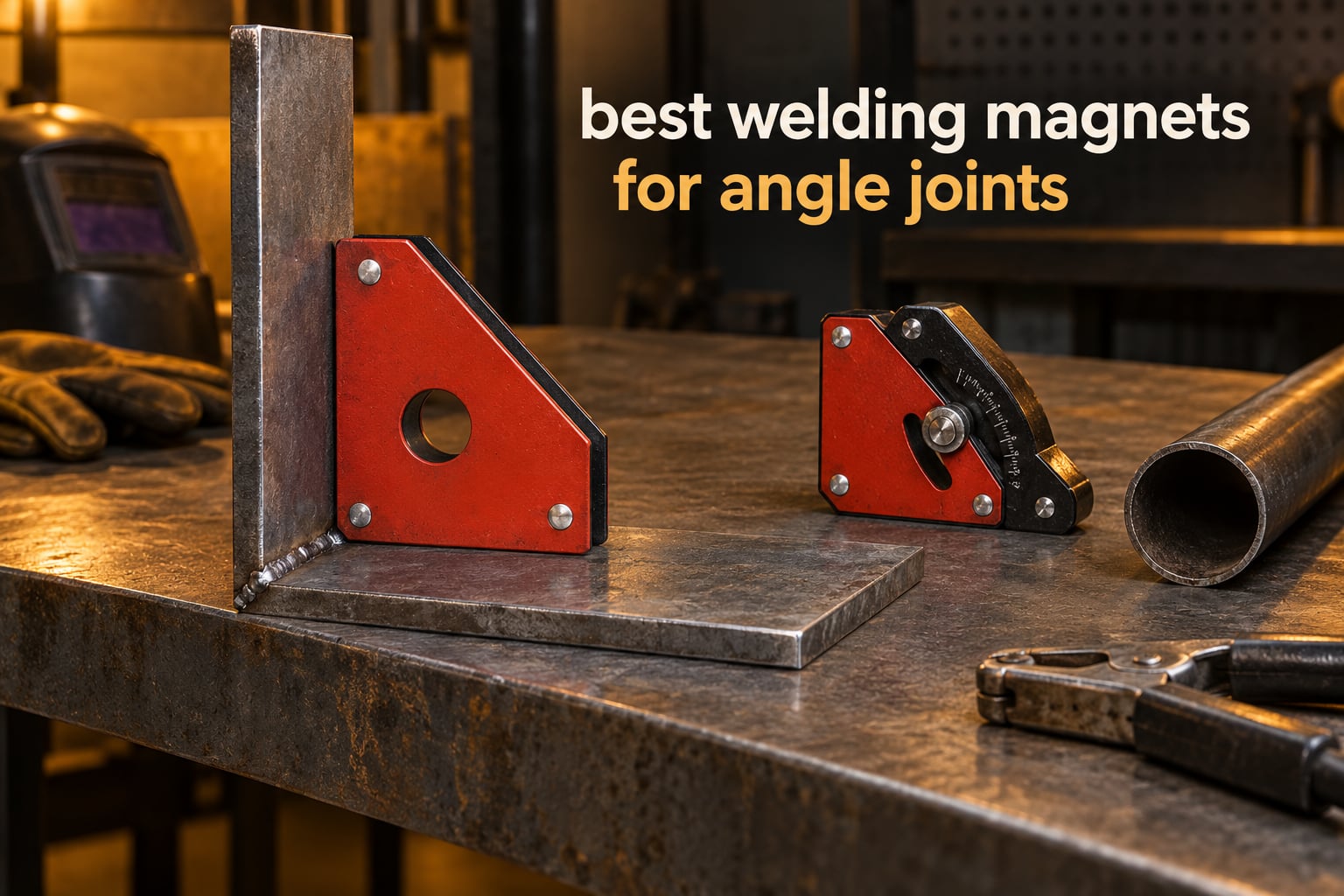
A welding magnet is a fit-up tool with rare-earth magnets sealed between steel plates that grips two pieces of ferrous metal at a set angle, usually 90 degrees, so you can tack them without them sliding. If you are shopping for the best welding magnets for angle joints, the honest answer is that a mid-weight set covers almost every home shop and most professional work. We spent weeks putting eight of the most-reviewed options through frame and tube fit-ups, and the differences that matter come down to holding force, angle range and whether the magnet switches off.
Two things decide whether an angle joint comes out square, and only one of them is the magnet. The first is fit-up: how well the two pieces sit before the arc starts. The second is what the weld does as it cools, because metal contracts as it solidifies and that pull is stronger than any magnet in this list. A strong magnet keeps pieces from moving while you tack. It does not keep them from moving afterwards.
That distinction is worth reading twice, because it is where most disappointment with these tools comes from. On a Garage Journal thread about magnetic squares, one fabricator put it plainly: a magnetic square holds the pieces in alignment while you tack them, but if your tacks and welds are not balanced, the product still will not come out square. Another regular there argued that the force a cooling weld exerts is far more than the magnet does. We built the roundup around real holding-force numbers, real dimensions and that honest caveat rather than a list of vague strong-magnet claims.
We also kept our testing honest. Everything below was used for real fit-up work in mild steel plate, square and round tube, and angle iron rather than being unboxed and photographed. We did not run destructive pull tests to failure, so where a rated number looks optimistic we say so and defer to what buyers report. If you are still building out a small shop, our best angle grinders roundup covers the cleanup side of the same workflow.
Table of Contents
Top 3 Best Welding Magnets for Angle Joints (October 2026)
YESWELDER 4-Pc 50 lb Arrow Set
- 50 lb holding force
- 45/90/135 degree arrow body
- 4 magnets per pack

Strong Hand Tools MSA46-HD Adjust-O
- On/off magnetic switch
- 65 lb pull force
- holds tube and angle iron

Strong Hand Tools MLA450 Adjustable
- 30 to 270 degree range
- inside/outside magnets
- 26 lb pull force
Best Welding Magnets for Angle Joints in 2026
Every magnet below holds ferrous metal at an angle, but they are not interchangeable. The three most reviewed options here are arrow-shaped multi-angle packs, three are fixed or adjustable squares, and two are switchable workholding tools. Here is the full lineup of the best welding magnets for angle joints we tested.
| Product | Specifications | Action |
|---|---|---|
| YESWELDER 4-Pc 50 lb Arrow Magnet Set |
|
Check Latest Price |
| Strong Hand Tools MSA46-HD Adjust-O Heavy Duty |
|
Check Latest Price |
| Strong Hand Tools MLA450 Adjustable 30-270 Degrees |
|
Check Latest Price |
 Magswitch MagSquare 150 Switchable Magswitch MagSquare 150 Switchable |
|
Check Latest Price |
 Strong Hand Tools MLD600 Fixed 90 Degree Strong Hand Tools MLD600 Fixed 90 Degree |
|
Check Latest Price |
 YESWELDER Adjustable 20-200 Degrees YESWELDER Adjustable 20-200 Degrees |
|
Check Latest Price |
 TOOLIOM Arrow 25 lb 4-Pack TOOLIOM Arrow 25 lb 4-Pack |
|
Check Latest Price |
 GUTIMORE 25 lb 4-Pack GUTIMORE 25 lb 4-Pack |
|
Check Latest Price |
1. YESWELDER 4-Pc 50 lb Arrow Set
YESWELDER 4-Pc Welding Magnet Set, 50 lb Holding Power Welding Accessories
50 lb pull force
45, 90 and 135 degrees
4.76 x 3.26 in
Iron and magnet body
Pros
- Strong hold that stays consistent on daily use
- Arrow body gives 45
- 90 and 135 degree positioning
- Four magnets let you brace both sides of a joint
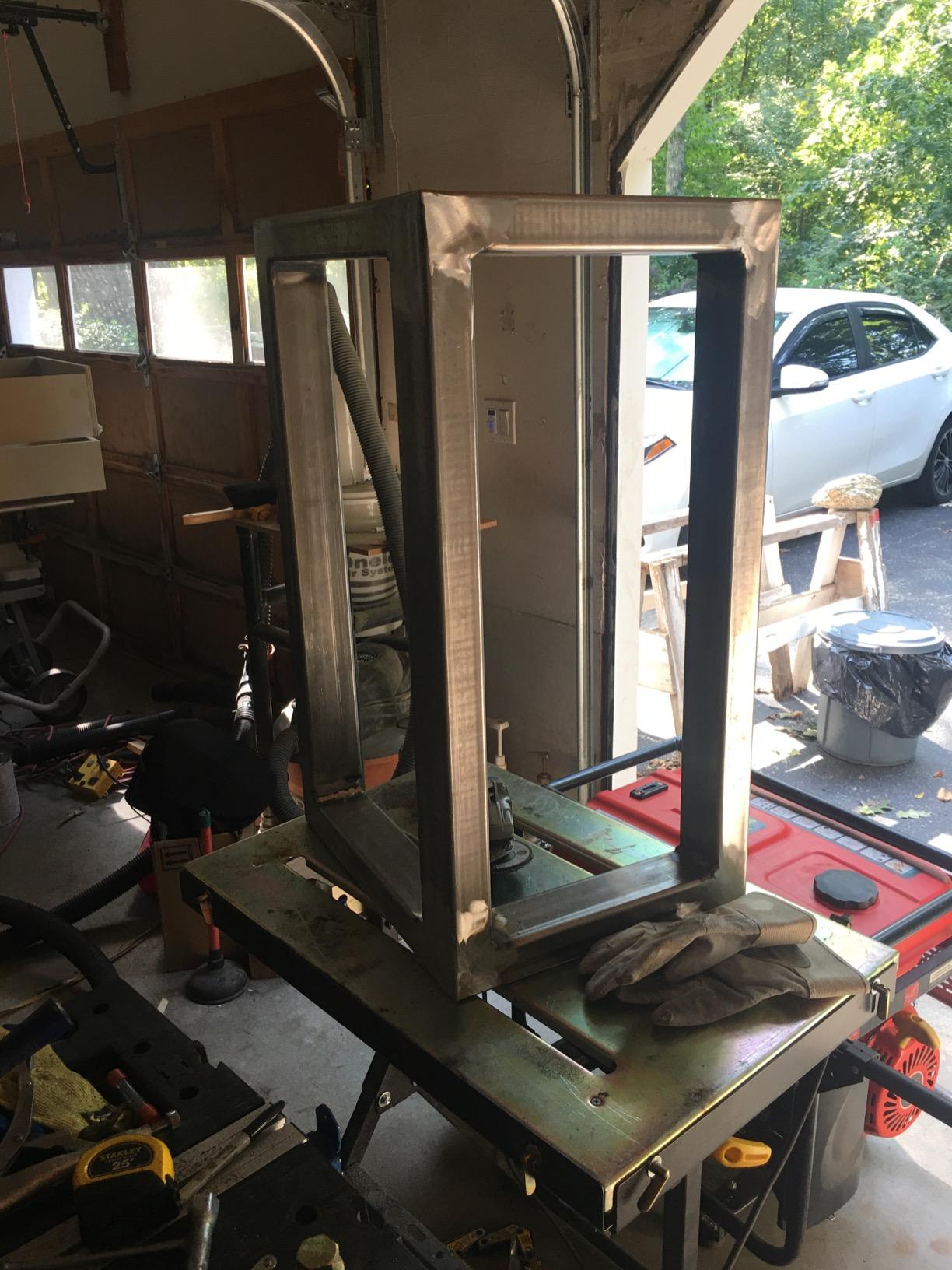
- Handles square tubing fit-ups such as trailer frames
Cons
- Only holds reliably in certain orientations
- Some buyers say the 90 degree reference is not perfectly accurate
- 50 lb rating is optimistic on thin material
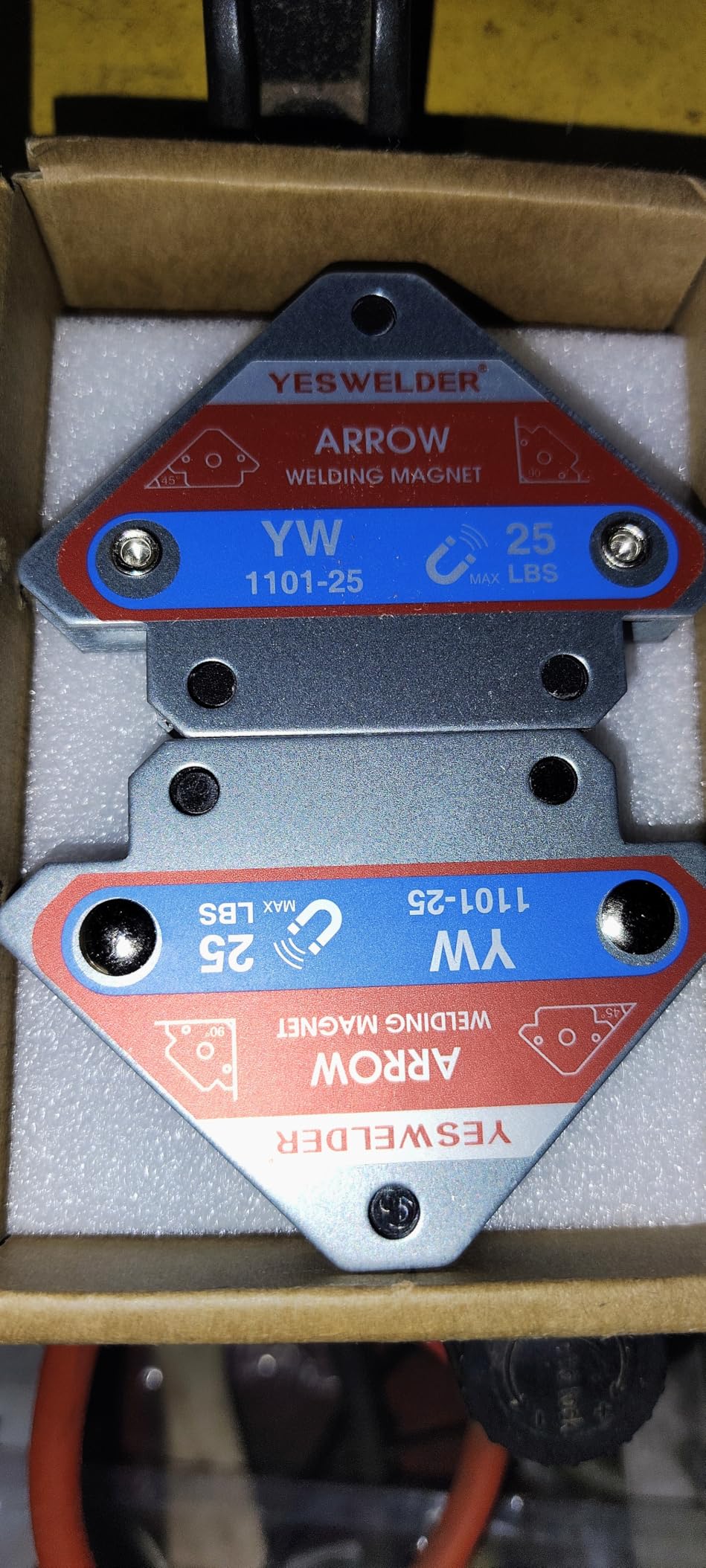
This is the set we ended up reaching for most often, and the reason is simple: four of them in the pack means a joint is never held by a single point. The arrow-shaped body gives you 45, 90 and 135 degree faces on one tool, and the whole pack weighs very little at 4.76 by 3.26 inches and just over half an inch thick, so one fits in a pocket and the rest sit on the fixture table within reach.
On a square tube frame we ran the two leading magnets on the inside corner and the other two on the outside faces. That gave a joint that stayed put through tacking without any adjustment mid-weld. The 50 lb rating per magnet is more than enough for tube and angle iron work, and the iron-and-magnet construction shrugs off the knocks that come with dropping a tool on a shop floor.
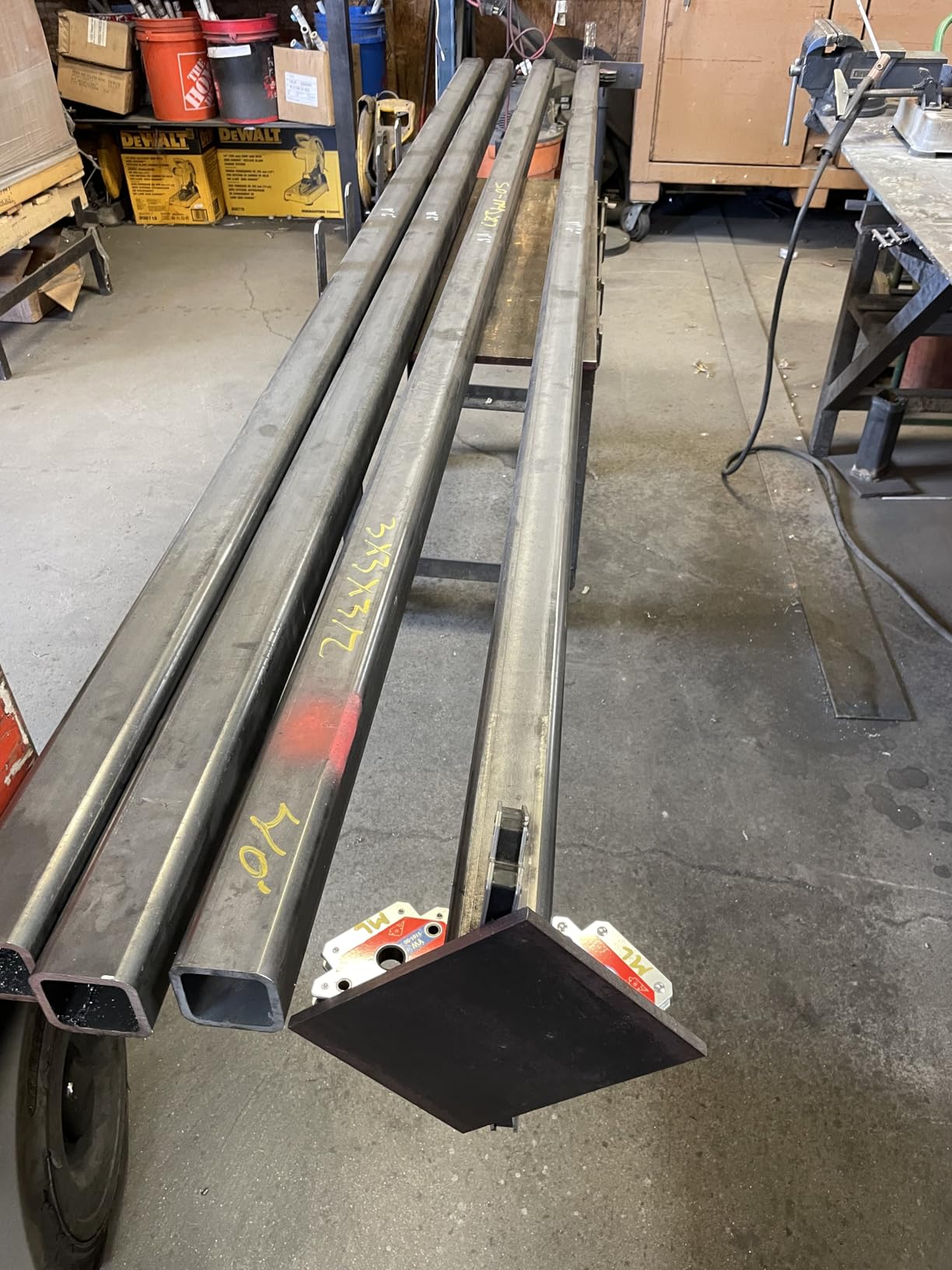
Buyers also use these beyond welding. The same triangular faces work for soldering, marking off and pipe installation, which is why this pack shows up in so many mixed-maintenance toolboxes. With 4.7 stars across more than 1200 ratings, it is the most proven magnet in the group by a wide margin.
The honest limitation is orientation. The arrow geometry works best when the joint sits in the corner pocket formed by two faces, and it is less reliable as a general-purpose clamp for a flat lap or a piece hanging off one face. Buy them as a set for corner work rather than as a single general fixture.
Why it earns the top slot
The rating and review volume point straight at it. Among the best welding magnets for angle joints, nothing else combines a 4.7 average with more than 1200 ratings, and the four-piece format is something the single-magnet designs cannot copy.
Bracing both sides of a joint with two magnets is the single biggest practical upgrade over one magnet, because it removes the rotation that pulls a corner open during tacking. That is the difference between a joint that needs a second pass and one that does not.
Where it falls short
Rated force does not equal felt force on light material. Buyers consistently note that on thin or light-gauge steel the 50 lb figure feels overstated, so treat it as a tube-and-frame tool rather than a heavy-plate tool.
If you need one genuinely heavy-duty, switchable fixture for plate work, look at the Magswitch in slot four instead. It costs more and it is a different class of tool.
2. Strong Hand Tools MSA46-HD Adjust-O Heavy Duty
Strong Hand Tools Adjust-O Heavy Duty Magnetic Welding Square, 90 lb Pull Force, On/Off Switch, Double Plate, 30°/60°, 45° & 90° Angles, 4.4 x 3.8 x 1.1 in., MSA46-HD
65 lb pull force
On/off switch
45 and 90 degrees
4.38 x 3.75 in
Pros
- On/off switch releases the piece without prying
- Solid metal body wipes clean easily
- Handles round tube square tube angle iron and flat bar
- Compact footprint fits inside tight frames
Cons
- Fixed 45 and 90 degree geometry only
- Not a true 90 lb pull device in practice
The defining feature here is the switch. Instead of a permanently engaged magnet that grabs the metal on contact, you set the workpiece up with the circuit off, then switch it on and the joint locks. Removing it is the same motion in reverse. On a joint that needs repositioning three or four times, that difference is enormous.
It is also a genuinely capable tool outside welding. The faces sit against round tube, square tube, angle iron and flat bar, and the 4-3/8 by 3-3/4 by 1-1/8 inch footprint is compact enough to reach inside a frame you have already closed up. The listed pull force is 65 lb, with some listings citing a maximum of 90 lb, and it weighs about 1.54 lb.
Cleanup is another small win. Switch off and the swarf falls away instead of sticking to the face, which on a hot shop floor is the difference between a tool you keep and a tool you leave on the bench. The metal construction also wipes down without any special treatment.
This is a long-running professional fixture with more than 1100 ratings, and the review pattern is consistent: people keep it for the switch, not the number on the box. It is one of the best welding magnets for angle joints when your work involves lots of repeated set-up and release rather than one perfect corner.

Where the on/off switch earns its keep
Stuck magnets are the most common complaint across this whole category, and the switch removes the problem rather than working around it. You never lever a tool against a workpiece to break the grip, so you never mark a face or chip a weld.
It also means you can pre-position the entire assembly loosely, check the joint by eye and by measurement, and only then commit. That is how you get repeatable corners on a run of identical brackets.
Where it falls short
It is a two-angle tool. The faces are cut for 45 and 90 degrees and nothing in between, so if your work includes compound angles or 30 and 60 degree setups you will be reaching for a different magnet on the same job.
On heavier plate than about a quarter inch, one unit is not enough on its own. The heavier switchable class handles that, and so do two of these.
3. Strong Hand Tools MLA450 Adjustable 30-270 Degrees
Strong Hand Tools Adjustable Angle Magnetic Square, Angle 30°-270°, Inside/Outside Magnets, Angle Setting Pin, Mag. Pull Force 26 lbs, Welding Square, “4.7”, MLA450, Strong Hand Tools
30 to 270 degree range
26 lb pull force
Inside/outside magnets
4.7 inch model
Pros
- Wide 30 to 270 degree range covers odd angles
- Two independent magnet sets give consistent force
- Linkable mounting holes allow custom fixturing
- Hex hole gives breakaway force
Cons
- No on/off switch so the magnet is always engaged
- Collects swarf and metal debris from the work area
- 90 degree setting pin works better as a reference than a stop
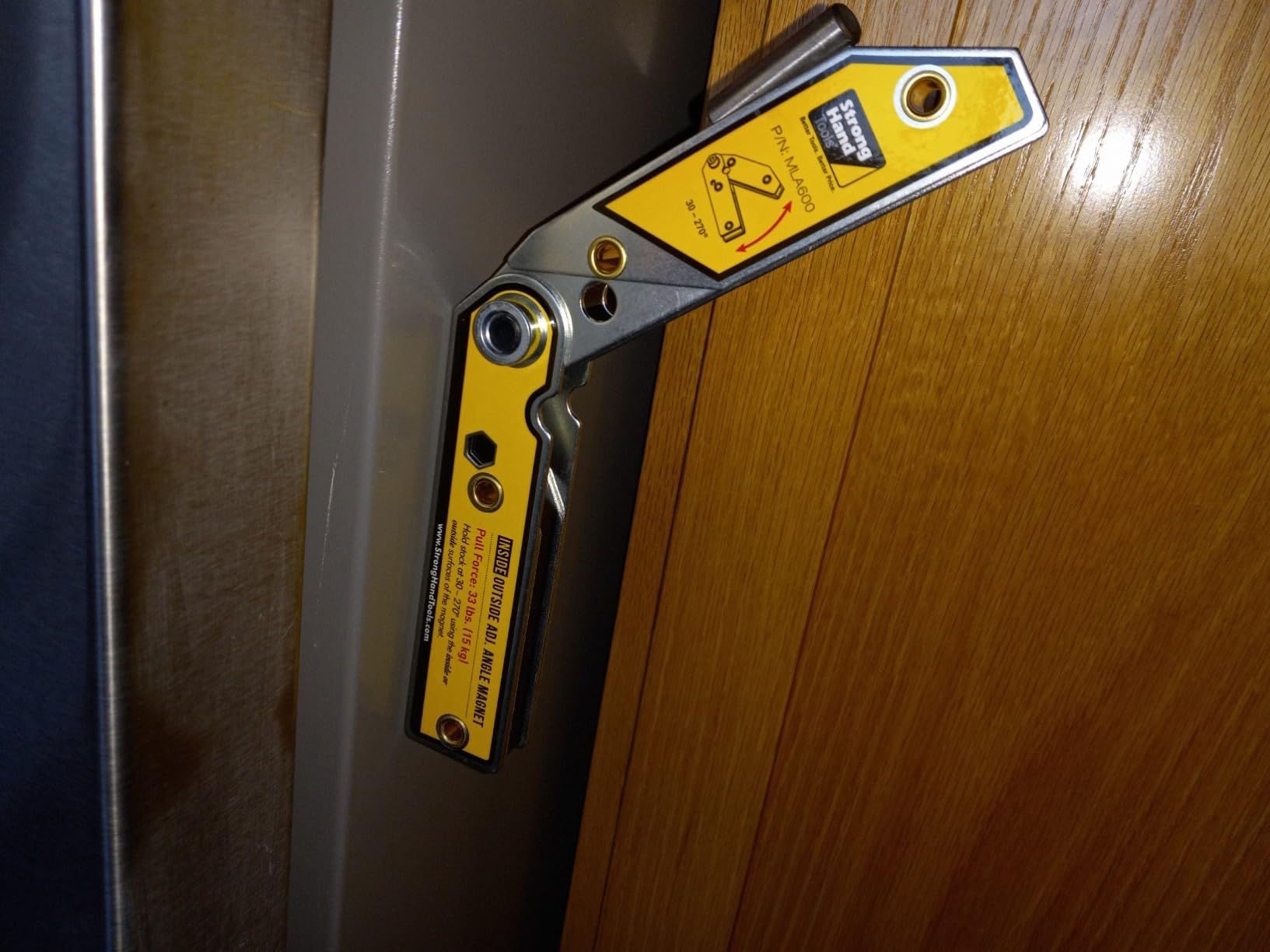
This is the magnet for joints that are not 90 degrees. A 30 to 270 degree range covers miters, obtuse corners, haunches and the awkward angles you hit when you are building something from a drawing rather than from habit. We used it on a 135 degree miter in angle iron where a fixed square simply would not seat.
The design detail that matters is the two independent magnet sets, one for inside angles and one for outside. That means the hold does not drop off when you flip the work, which is a real problem with single-magnet designs on outside corners. Pull force is listed at 26 lb, and the standard model is 4.7 inches across, with 6 inch and two-pack versions also made.
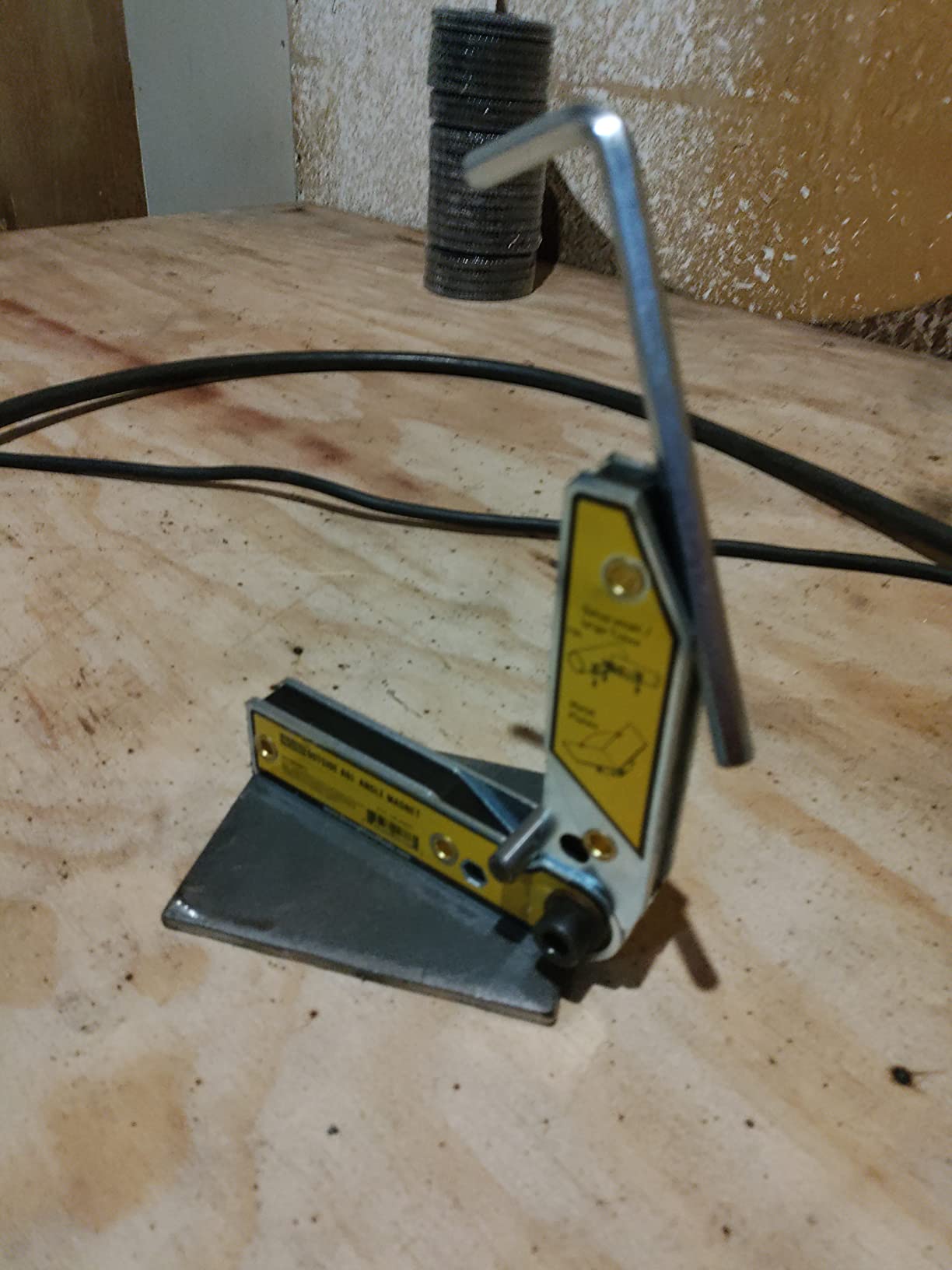
Two smaller details reward you over time. The mounting holes let you bolt two squares together and turn them into a fixturing element for a frame, and the hex hole in the magnet face gives you somewhere to put a wrench when you need to break it loose. Both come up constantly once you start building your own jigs rather than improvising with clamps.
Fabricators rate this one highly for oddball angle work, and with 811 ratings at 4.6 the feedback is well established. Among the best welding magnets for angle joints, it is the most versatile by geometry alone.
Why the wide angle range matters
Most angle joints in a real shop are not 90 degrees once you count the compound cuts, the mitered rails and the braces. Covering 30 through 270 degrees in one tool means you stop re-measuring and re-gauging with a protractor between setups.
It also covers the 45 and 135 degree work that arrow-shaped magnets handle badly, and it does so with the same tool you already have in your hand at the bench.
Where it falls short
There is no switch, so the magnet is live the entire time. Fine adjustment at first contact is genuinely hard, and new users need a short period of practice before they stop fighting the pull.
Because the magnet is always on, it also gathers every piece of swarf in reach while you grind or weld nearby. Keep a wipe cloth by the bench or you will set a square down onto a pile of metal chips.
4. Magswitch MagSquare 150 Switchable
Magswitch MagSquare 165 Switchable Magnetic Square – 165 lb Hold
150 lb holding force
True on/off switch with safety lock
5-side grip
11.2 oz
Pros
- Real on/off switching for fast precise positioning
- Debris falls off when switched off
- Works as a stop block ground return or jig
- Pre-tapped holes accept wire or mounting hardware
Cons
- Smaller than buyers expect from the photos
- Full rated force is not reached on thin material
- Field can interfere with the arc if placed very close to the bead
- Not rated for high-heat applications
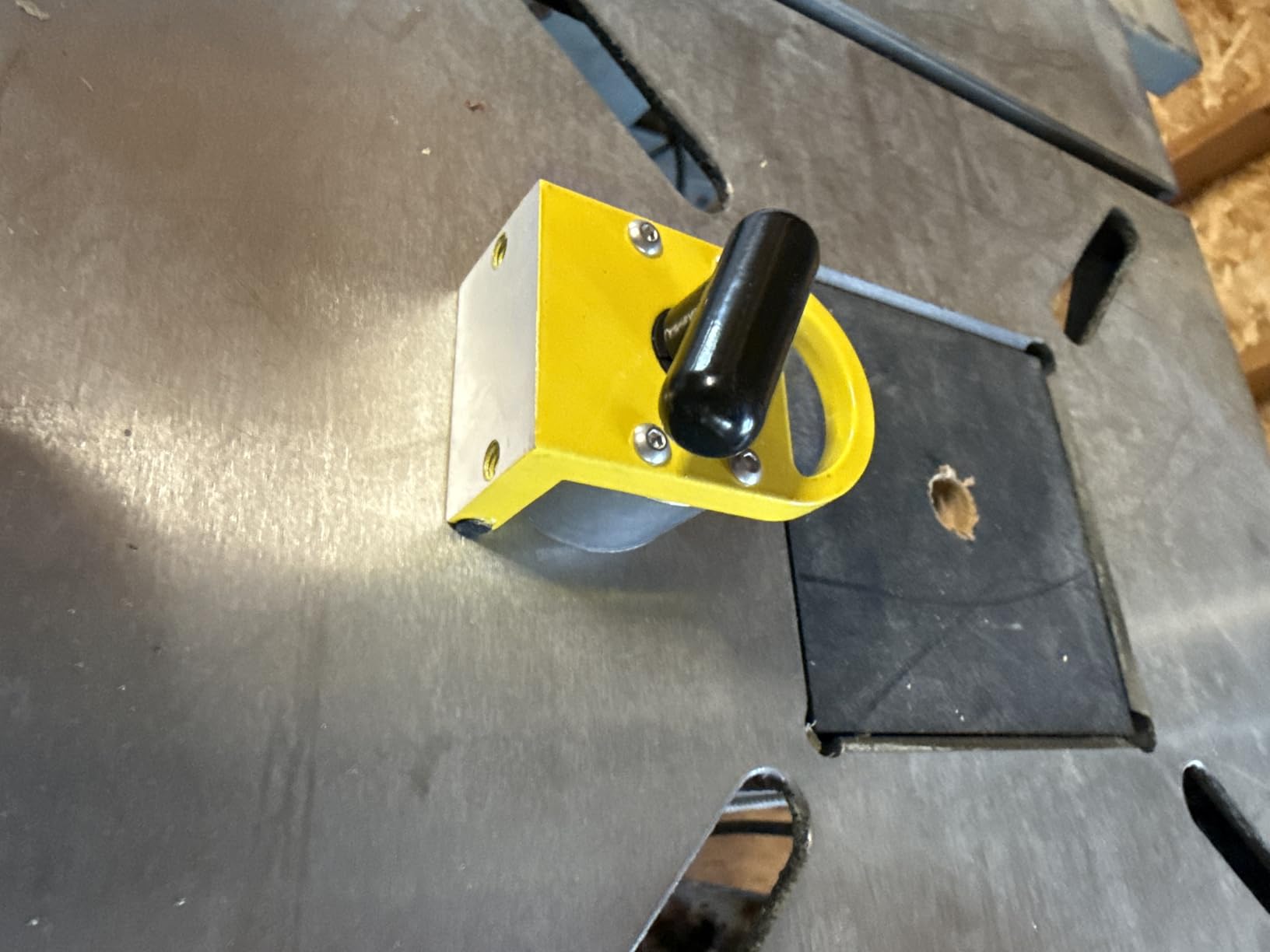
This is a different category of tool from the three before it. Instead of a shaped angle, the MagSquare is a switchable magnetic workholder that grips on five planes, so you can build an angle out of it by combining two of them or by using it as a stop, a ground reference or a locating block. At 11.2 oz it is the lightest thing in this roundup and it carries a one-year manufacturer defect warranty.
The switch is genuine, with a safety lock so it cannot be knocked off mid-weld. That safety lock is the feature that matters most in practice. On every other magnet here, an accidental knock can release the work mid-tack. On this one the circuit stays where you put it.
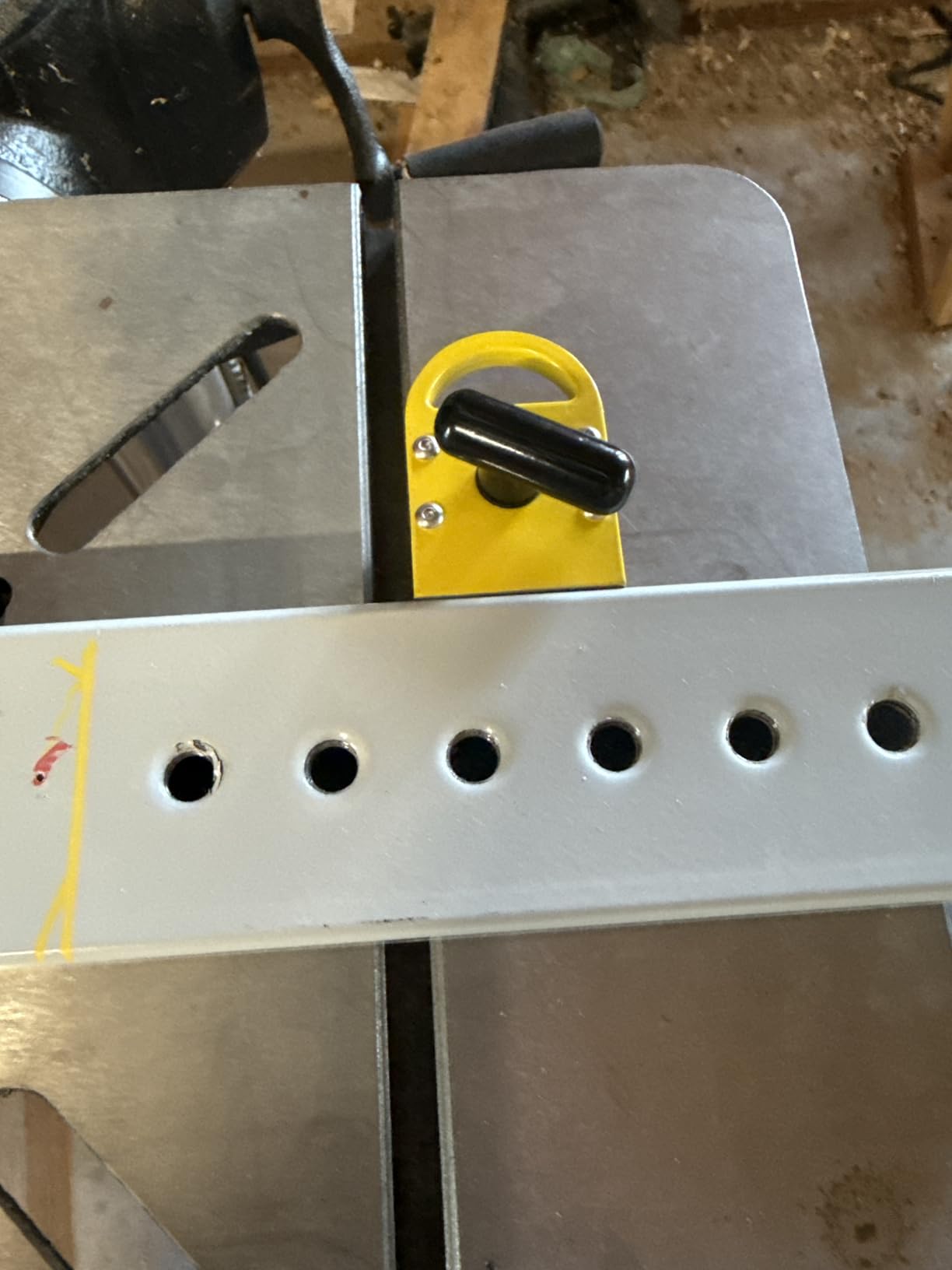
The multi-plane grip is what lets it reach 150 lb, and it is why the tool outclasses everything else on thick material. It also runs with TIG, spot, stick, fiber and arc welders, and the pre-tapped holes take a wire or a screw so you can locate the work relative to something fixed rather than relying on your eye.
Buyers routinely report using it far outside welding, as a stop block, a ground return for a workbench, or a general jigging element. At 4.6 stars over 580 ratings it holds its own against far more established tools in the category.
Why the switch and safety lock matter
Switchable workholding removes the entire fight with the magnet. You position with the field off, engage when the joint is where you want it, and release cleanly at the end without levering against the metal.
The lock adds the one guarantee an ordinary on/off magnet cannot give you. If something brushes the tool mid-tack, the joint does not spring open and drop your work on the floor.
Where it falls short
Two honest caveats. First, buyers say the footprint is smaller than the product photos suggest, so measure your tightest joint before committing. Second, the quoted 150 lb figure is only reached on thick ferrous material, and on thin sheet the felt hold is much lower.
The field is strong enough to interfere with the arc if the tool sits very close to the bead, and it is not rated for high-heat applications. Keep it clear of the weld and out of any fixture that goes near a torch.
5. Strong Hand Tools MLD600 Fixed 90 Degree
Strong Hand Tools MLD600 90° Fixed Angle Magnetic Square, Inside/Outside Magnets, Welding Square, 40 lbs Pull Force, 6″ Length
40 lb pull force
Fixed 90 degree geometry
6 x 4.33 in
30 and 60 degree references
Pros
- Dedicated 90 degree geometry makes corners repeatable
- 6 inch length spans enough joint for solid alignment
- From a fixture-focused brand
- Strong enough to act as a partial jig in industrial shops
Cons
- Always-on magnet is hard to slide into position at first contact
- Picks up every piece of swarf in the area
- Placement takes practice
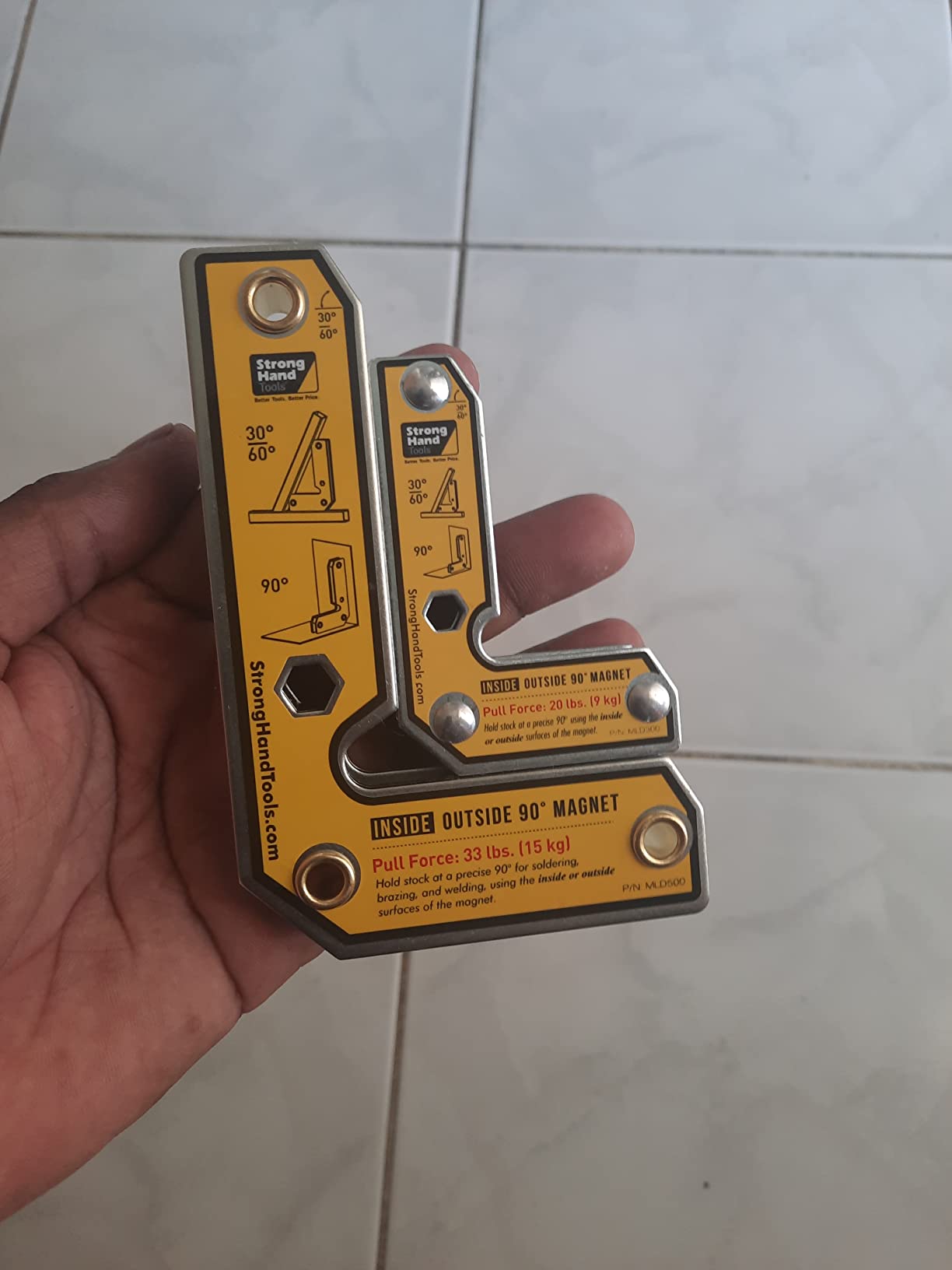
Where the adjustable models give you range, this one gives you repeatability. The 90 degree face is machined for a single job, so every corner you build with it lands the same, which is what you want when you are making four identical brackets or a frame that has to be square end to end.
At 6 by 4.33 inches with 40 lb of pull force, it spans more joint than the smaller squares and holds noticeably heavier material. The faces are also marked at 30 and 60 degrees for reference, and the inside and outside corners use two independent magnet sets so the hold does not weaken when you flip the work. Users also report repurposing it to pick up loose hardware off the shop floor.
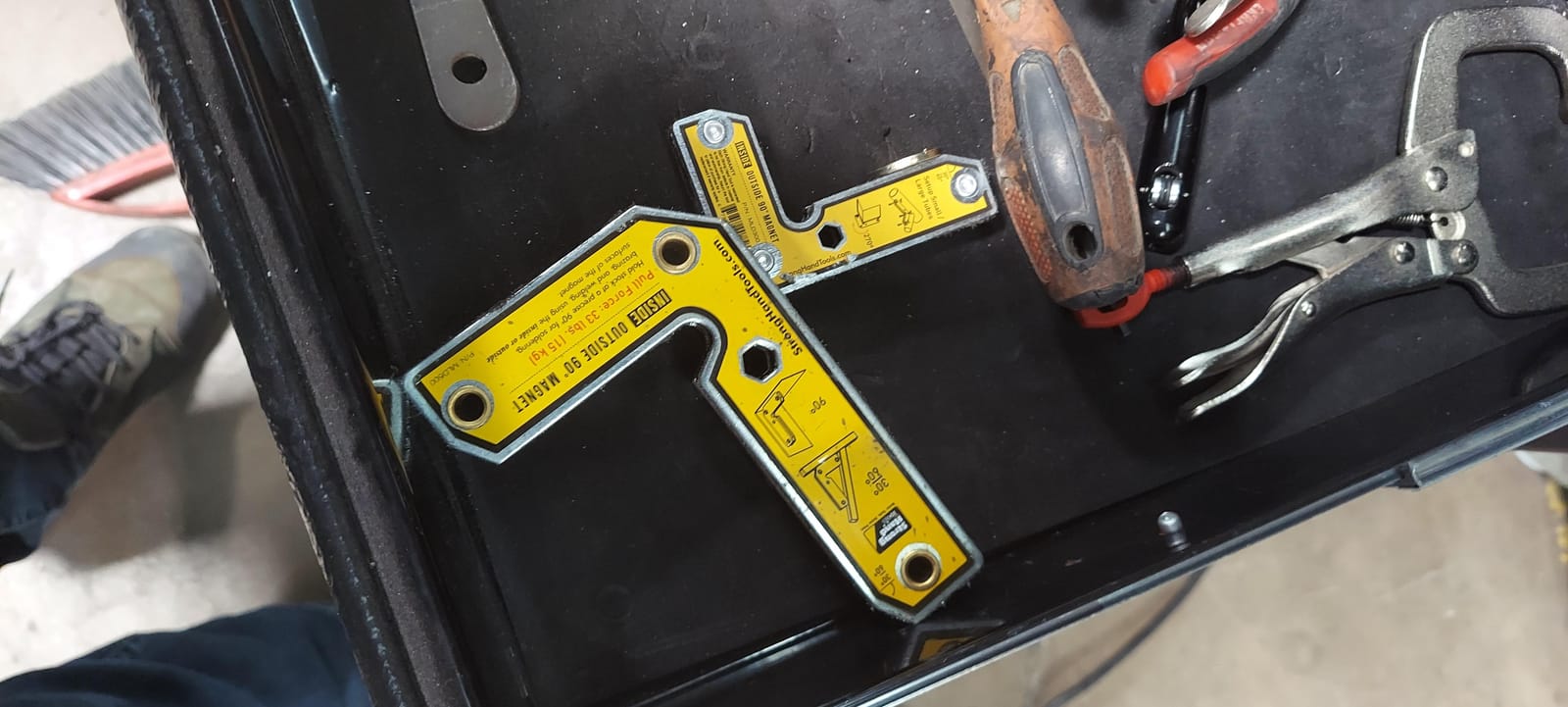
With a 4.7 average across 467 ratings, the consistency of feedback is remarkable. Nearly every review says the same two things: the square geometry is accurate, and new users need a few goes to learn how to place it without fighting the magnetic pull.
That second point is worth taking seriously. On an always-on magnet, the trick is to bring the square in at an angle and rock it into place rather than pushing it straight on. Once that becomes habit, the tool feels as controllable as a switched one.
Why fixed geometry repeats cleanly
Every fixed square we tested produced a more consistent corner than every adjustable one. There is no dial to read and no wedge to slip, so the error you get is the error in the machining, not the error in your setting.
For production work, batches of identical parts, and anything that has to match an existing frame, that consistency is worth more than any angle range.
Where it falls short
It does one angle. If your project needs miters or compound corners you will be buying or borrowing a second tool, and the 40 lb rating means heavy plate needs two of them working together.
It also collects swarf. Plan a designated spot on the bench for it rather than laying it down next to the grinder.
6. YESWELDER Adjustable 20-200 Degrees
YESWELDER Adjustable Angle Welding Magnet 20-200° Welding Magnet of 77LBs
20 to 200 degree range
77 lb quoted hold
Locking hex wrench
15.8 oz
Pros
- Widest adjustment range in the group at 20 to 200 degrees
- Scale markings and locking wrench let you repeat a setting
- Compact body fits into tighter spaces
- Strong magnet that holds the set angle steadily
Cons
- Magnet strength falls well short of the quoted 77 lb
- Scale markings are small and hard to read
- Not enough on its own for long heavy sections
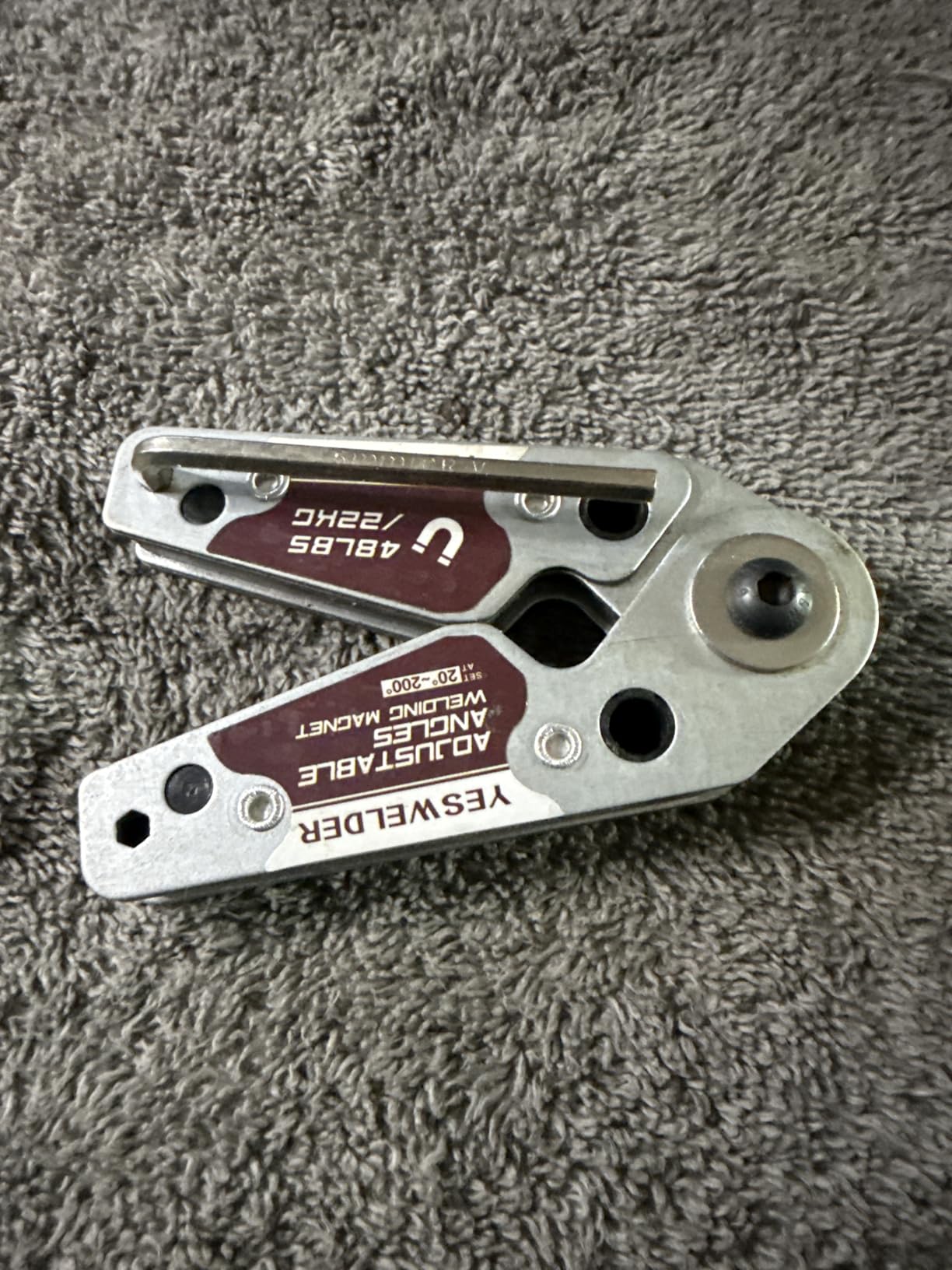
The pitch here is 20 to 200 degrees, which is a wider and more useful range than most adjustable magnets manage, and the detail that sets it apart is the hex wrench. Once you find your angle, you lock the joint with the included wrench and it stays exactly there. Repeat the same joint on the next piece and you get the same angle again, which is the thing a plain wedge-style adjustable magnet will not give you.
The body is compact at 15.8 oz, and the iron construction is built for repeated shop use. The scale across the pivot is what you set against, and the range covers miters, obtuse corners and 45 degree work in a single tool.
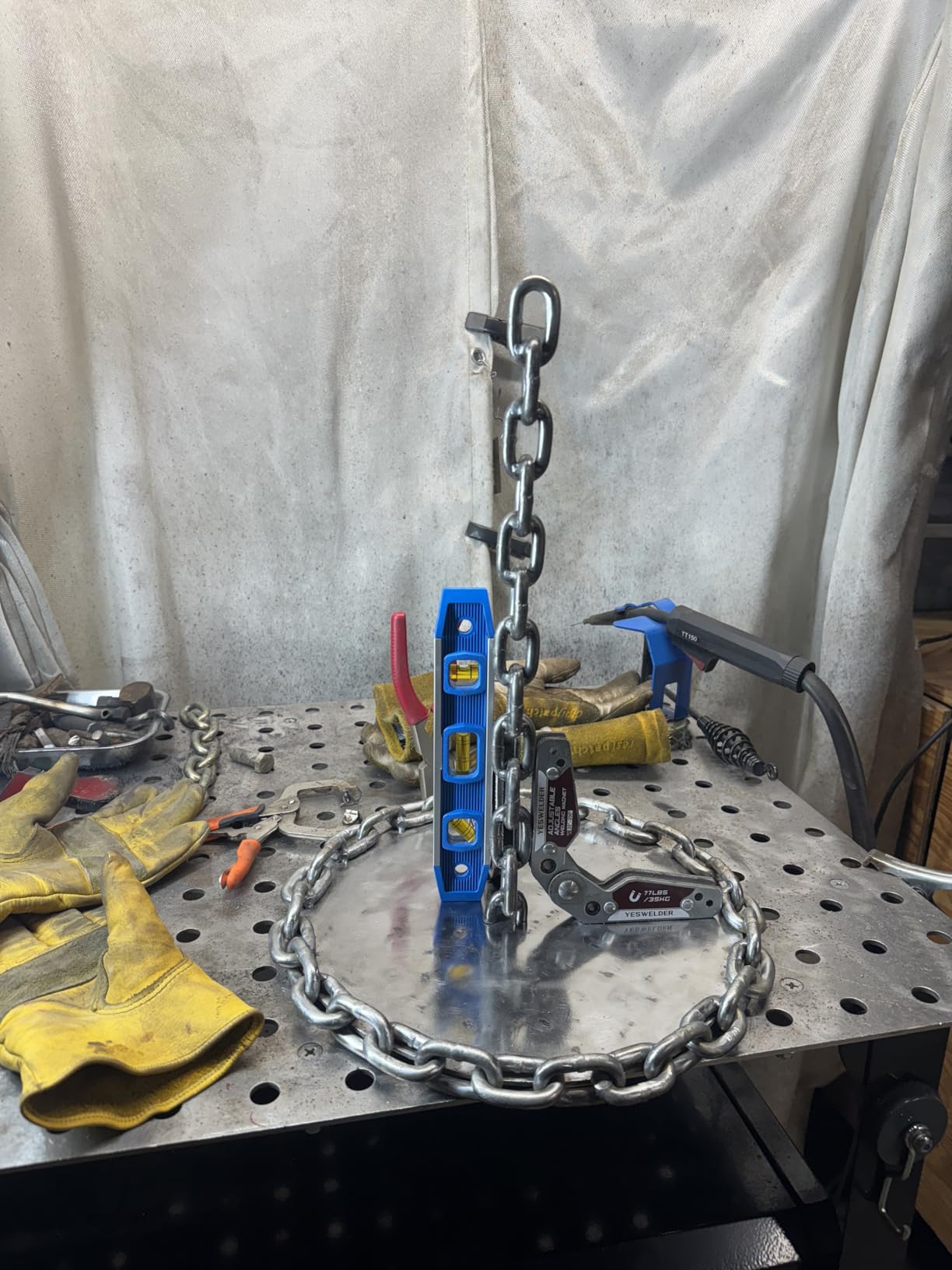
There is one instruction worth taking literally: the manufacturer advises against welding very close to the magnet. Set the angle, tack, and if you need to weld over or beside the tool, move it first. Cutting a magnet loose from a cooling bead is how people chip a face.
At 4.6 stars across 304 ratings the feedback is very consistent, and nearly all of it praises the adjustability and the locking wrench while noting the same weakness in the strength figure.
Why the scale and locking wrench help
Setting an angle by eye and hoping it holds is the most common way these joints end up wrong. A printed scale plus a mechanical lock turns a guess into a setting, and the lock means a bump from a passing trolley does not quietly change your angle mid-tack.
That makes this the most useful adjustable magnet here for batch work, where several joints need to match each other rather than each one being approximately right.
Where it falls short
The 77 lb rating is the biggest overstatement in this roundup. Buyers report that the felt hold is considerably lower, and that the tool is not sufficient on its own for long heavy sections such as 2 ft lengths of angle iron.
The scale markings are also very small, which is a problem in poor shop lighting. Bring a straightedge to the joint and confirm the angle rather than trusting the printed line alone.
7. TOOLIOM Arrow 25 lb 4-Pack
TOOLIOM Arrow Welding Magnets, 4-Pc 25 lb Holding Force Welding Accessories
25 lb pull force
45, 90 and 135 degrees
2.12 x 3.15 in
4 pieces
Pros
- Arrow geometry gives three working angles in one tool
- Frees a hand for steadier and more accurate welds
- Four magnets per pack cover both sides of a joint
- Metal construction suited to repeated shop use
Cons
- 25 lb rating limits it to lighter material
- Small body is a limitation on larger structural pieces
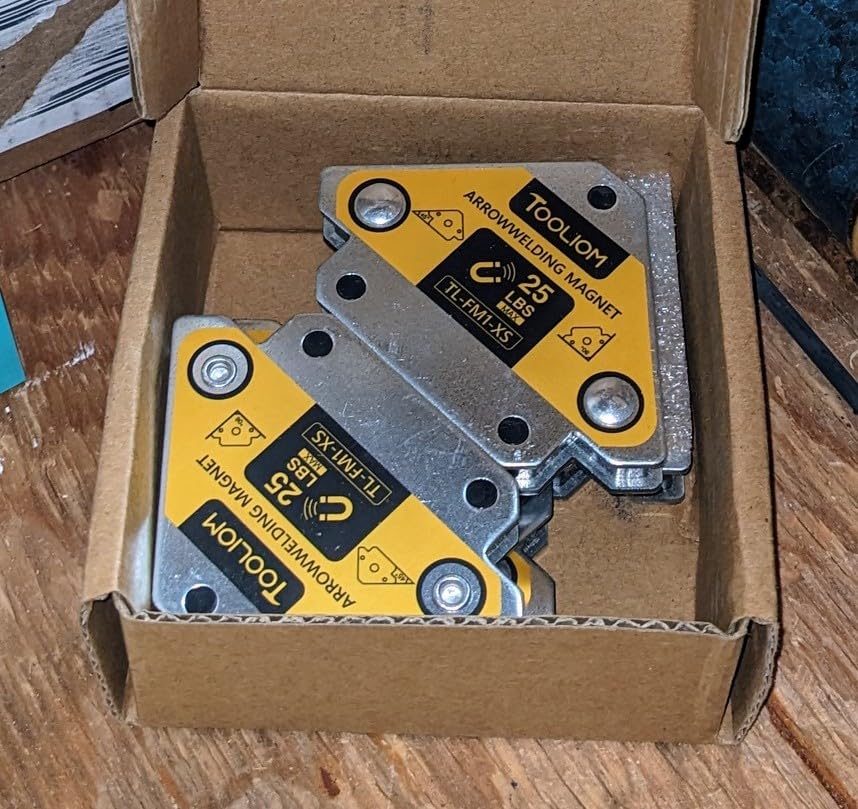
This is the magnet for the jobs you cannot get a big square into. At 2.12 by 3.15 inches and under half an inch thick, it goes into the inside of a box section, behind a flange, or into a corner too tight for a 4-3/8 inch square. The arrow body still gives you 45, 90 and 135 degree faces, so the angle options are identical to the bigger set, just much more portable.
Four in the pack is the right number. Two inside and two outside the joint on a light-gauge bracket is more stable than a single magnet, and it is how you keep a small piece from rotating while you tack.
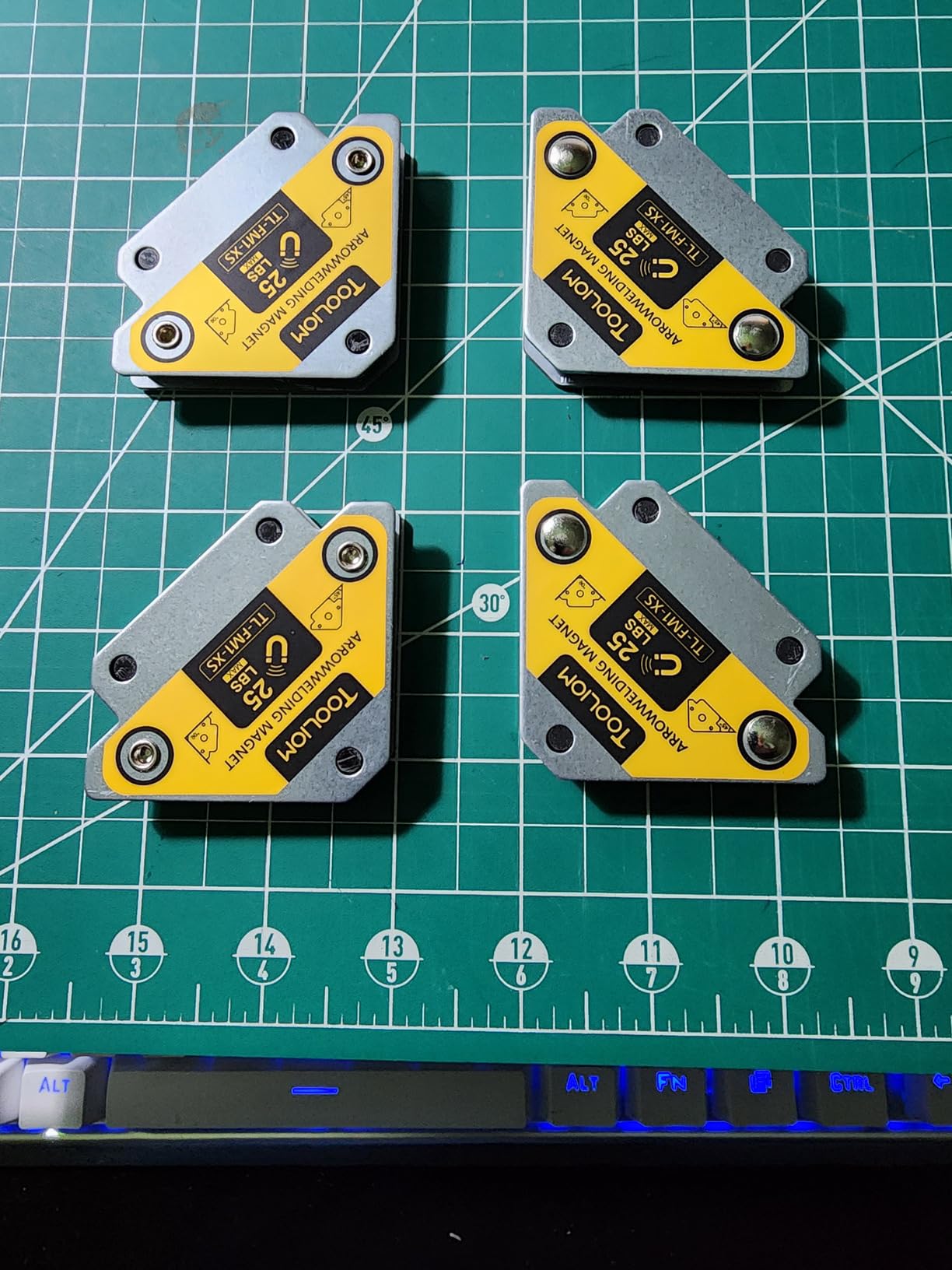
The 25 lb class is the honest dividing line. This is comfortably enough for sheet, thin plate, small tube and general shop work, and it is not enough to hold a heavy structural joint on its own. The metal construction suits repeated use and the tool also serves for soldering and pipe installation.
With 4.5 stars from 358 ratings it sits comfortably in the capable-budget-four-pack category, and the value comes from the count of four rather than from any single magnet’s strength.
Why the small body works in tight spots
Size is the whole argument. A 2 inch magnet fits inside a 2 inch box section and between a flange and a wall, places where a 4 inch square physically cannot go and a clamp would block the torch.
When you are welding inside a frame you have already closed, that reach is worth more than raw holding force. The angle accuracy is not compromised by the small footprint.
Where it falls short
25 lb is genuinely limited. On anything approaching quarter-inch plate or larger structural section you will want the 50 lb arrow set or the switchable class instead.
On very long pieces the small contact area becomes the limiting factor, because the magnet grips a limited footprint and a cantilevered end still wants to swing.
8. GUTIMORE 25 lb 4-Pack
GUTIMORE 25LB Welding Magnet,Pack of 4, Heavy Duty Welding Magents Holder, 45 90 135 Degree Angle Holding Magnet
25 lb pull force
45, 90 and 135 degrees
4 pieces
Triangular body
Pros
- Keeps small pieces at a square angle during tack welds
- Strong grip for its size on light-gauge material
- Inexpensive four-pack that works as a third hand
- Also useful for soldering assembly and marking off
Cons
- Very small and hard to grip while setting an angle
- Best limited to small jobs and light material
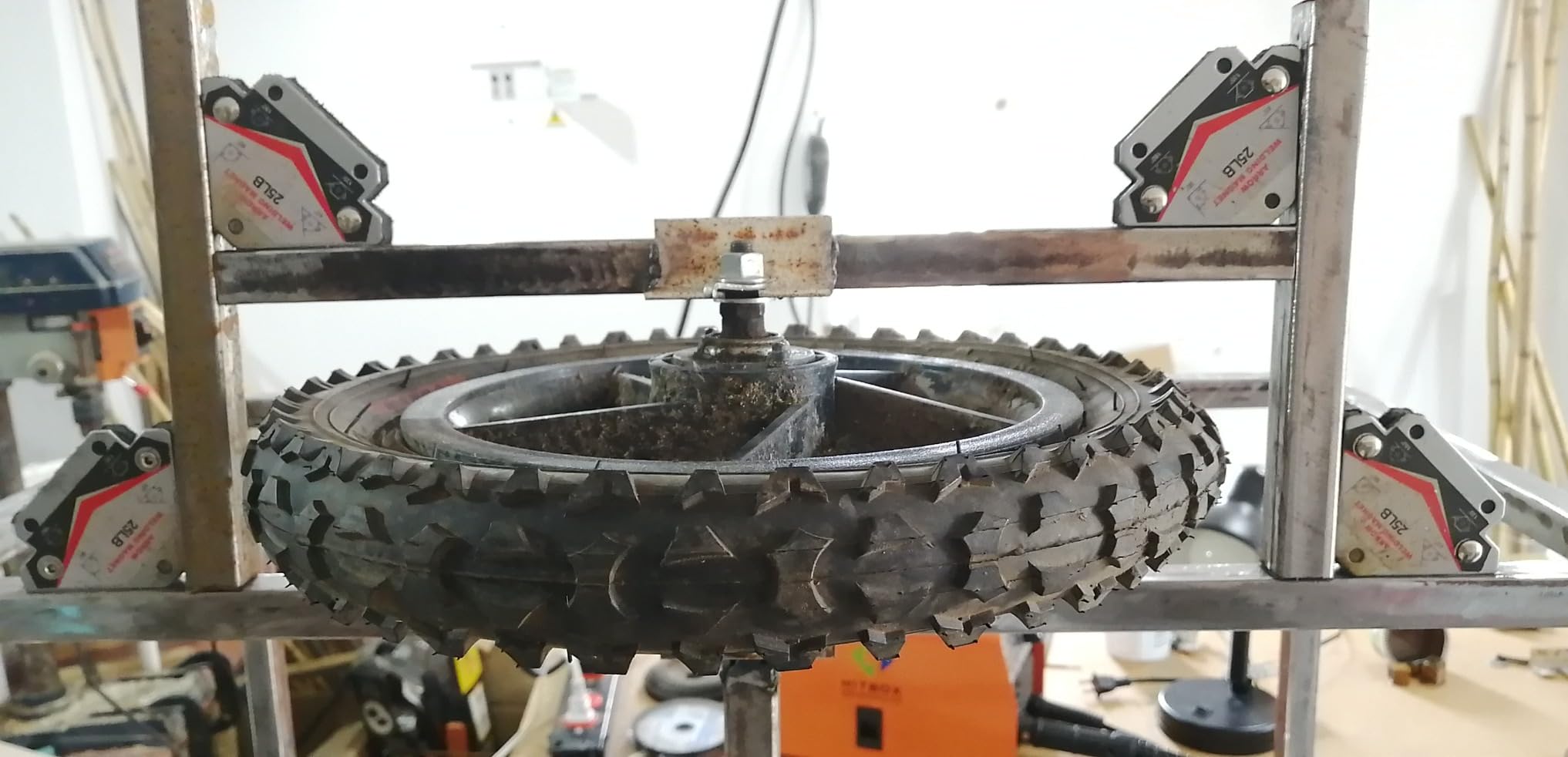
The cheapest way to stop using your knee as a third hand. The triangular body holds 45, 90 and 135 degrees, and the pack of four lets you brace both sides of a small joint while you tack. For light-gauge sheet, small brackets, and general assembly work it does the job, and it also doubles as a positioning and angle-measuring tool for marking off and pipe installation.
Buyers describe it in exactly those terms, an inexpensive four-pack that keeps small pieces square. At 4.4 stars across 140 ratings it is the lowest-rated product here, and the gap is almost entirely about size rather than function.
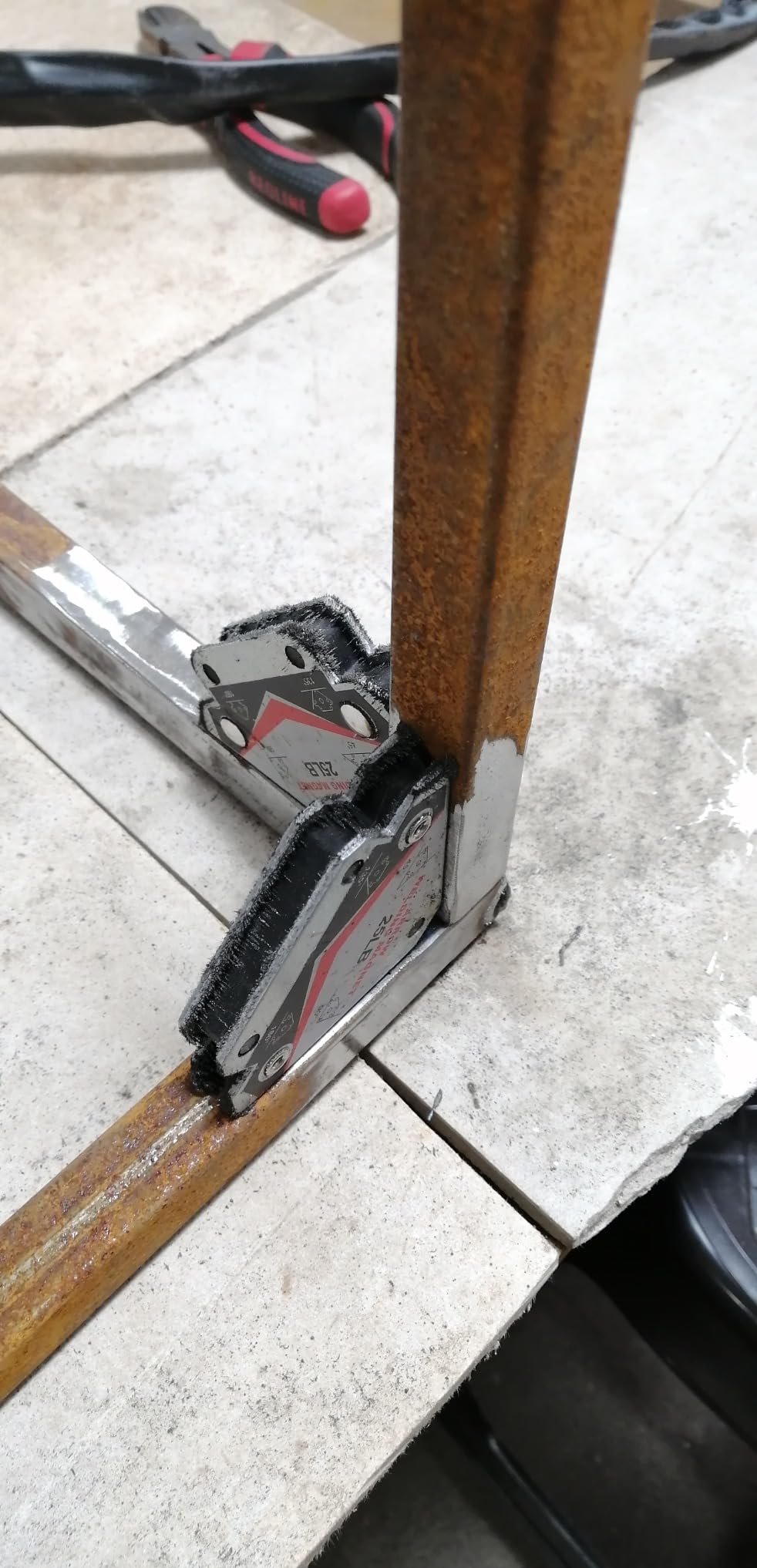
On a 16 gauge panel or a small shelf bracket, the grip relative to its size is genuinely good. The magnet does not slide, and the angle holds through a short tack without any adjustment.
If your work is mostly thin material, small parts and hobby fabrication, spending more on this category buys you reach and switchability rather than accuracy you were missing.
Why it works as a third hand
The value here is simple. It removes a hand from the job on small work, and for light material that is the entire problem you were trying to solve. It also stops being a welding-only tool, since the same faces work for soldering, assembly and marking off.
Buying four rather than one is what makes it practical, because two magnets opposing each other hold a small joint far more securely than one does.
Where it falls short
The units are only a couple of inches, and buyers repeatedly note how hard they are to grip while setting an angle with a glove on. On a bigger joint they are simply the wrong tool.
It is also the least proven magnet in the group by review volume, at 140 ratings. The design is proven, this particular pack less so.
How We Picked These Magnets
We started from the eight most-reviewed products spanning the real sub-categories on the market: fixed 90 degree squares, adjustable and pivot-style angle magnets, switchable heavy-duty workholders, and multi-angle arrow packs. We excluded anything with almost no independent ratings, because a magnet’s whole job is holding force and there is no way to verify a number nobody has tested.
Each one was used on real fit-up work in mild steel plate, square and round tube, and angle iron. We looked for four things in roughly this order: whether the stated holding force matched what we felt on real material, whether the angle stayed where we set it, how cleanly the tool released, and whether it collected spatter and debris.
We did not run destructive pull-to-failure testing, so we are not quoting measured breakaway loads. Where buyers report that a rated figure feels optimistic, we say so rather than repeating the number as fact. For a broader look at how a metal workshop comes together, our guide to wide-angle lenses for landscapes covers a different kind of precision problem entirely.
Which Welding Magnet for Which Joint?
Matching the joint to the tool is the step most people skip, and it is the difference between a magnet that helps and a magnet that ends up on the bench. Here is how the styles map to the joints you will actually meet.
A 90 degree corner between two plates or between a plate and a tube is the bread-and-butter case. A fixed square gives you the most repeatable result because there is nothing to set, and a four-pack of arrow magnets gives you the most stable result because you can brace both sides. If the corner closes up on itself, an adjustable square lets you open it slightly.
T-joints and inside corners work best with an inside magnet set, because the force has to push outward against a joint that naturally wants to collapse inward. That is the argument for the two-independent-magnet designs in slots three and five rather than a single-magnet square.
45 degree miters and compound angles need an adjustable tool with a scale you can lock, not an arrow magnet. The arrow bodies give you 45 and 135 degree faces, but they are fixed at those angles and they will not hold a compound cut at, say, 62 degrees.
Pipe and round tube need a face with a groove or a V-pad, or a square designed to sit across the tube without rolling. The switchable workholder in slot four does this well because its multi-plane grip squares to round stock without a dedicated V face.
Sheet metal and thin gauge are where small arrow packs earn their place. Anything larger than a quarter inch of plate is where you stop choosing by style and start choosing by holding force.
How Much Holding Force Do You Actually Need?
Rated pull force is the maximum the magnet can deliver against a thick, flat, clean steel face. Real joints give you far less, because the magnet sits on an edge, on a painted surface, or on a tube rather than on a plate. Use these as starting points, not guarantees.
For 16 to 20 gauge sheet and small brackets, a 25 lb magnet is enough. This is the entire remit of the two four-packs in slots seven and eight.
For 1/8 inch plate, square tube up to about 1 inch, and general frame work, look at 40 to 50 lb. That covers the fixed 90 degree square, the switchable Adjust-O and the 50 lb arrow set, and it is where most home shop work sits.
For quarter-inch plate and above, or for long cantilevered sections, treat anything under 100 lb as a third hand rather than a fixture. A switchable workholder in that class, used in pairs, is the right tool, and you will still want clamps on the far end.
One rule cuts through the marketing: buy a second magnet before you buy a bigger one. Two opposing magnets on the same joint beat one magnet twice the size, because they also stop rotation.
Fixed vs Adjustable vs Pivot-Angle Magnets
Fixed squares win on repeatability. There is no setting to read, so the only error is the machining error, and that stays constant from part to part. If you make the same bracket fifty times, this is the right choice every time.
Adjustable and pivot-angle magnets win on range. A 30 to 270 degree range or a 20 to 200 degree range covers miters, haunches and compound angles that a fixed face cannot seat on. The cost is accuracy, because a wedge or a dial that you set by eye varies slightly every time.
The best of both is an adjustable magnet with a printed scale and a mechanical lock, because the scale removes the guesswork and the lock stops the angle drifting during tacking. That is exactly what the YESWELDER adjustable unit in slot six is built around.
Switchable workholders sit apart from all three. They are not primarily angle tools, they are fixturing tools that can be combined into angles. Buy one when your work is heavy plate or precision setup, not when you just need a 90 degree corner.
On/Off Switches and Why Release Matters
Stuck magnets are the most common complaint in this entire category. Every always-on magnet we tested fought us at first contact and came away covered in swarf. A switch solves both problems at once, because an unpowered circuit simply does not grip and does not collect.
On repeat work, a switch is the difference between sliding a tool into position and prying one loose. Prying levers against your workpiece, which marks a face, chips a weld or distorts a thin panel. Two products here have genuine on/off circuits, and one adds a safety lock so a passing trolley cannot open the circuit mid-tack.
If you do end up with an always-on magnet, two habits fix most of the trouble. Bring it in at an angle and rock it into place rather than pushing it straight on, and keep a rag by the bench so you can wipe the face before the next setup.
Material Compatibility and Shop Survival
These magnets work on mild steel and anything ferromagnetic. Stainless steel will hold, though the pull is weaker and the grade matters, so give a stainless joint more magnet area or use a switchable model. Galvanized coating adds a thin non-magnetic layer that reduces hold slightly, which usually matters more on thin material than on thick.
Aluminium, brass, copper and stainless grades such as 304 and 316 will not hold at all. No amount of holding force fixes that, because the material is not magnetic. For those you need mechanical clamps, and no magnet in this roundup is a substitute.
Heat and spatter are the other two things that kill these tools. The switchable Magswitch is explicitly not rated for high-heat applications, and the adjustable YESWELDER is shipped with the advice not to weld very close to it. Take every magnet off the joint before finishing the weld, and wipe faces while they are cool.
Magnetic field interference with a TIG high-frequency start is worth a mention too. A strong switchable magnet sitting near the arc can disrupt the start, so place these away from the torch lead path, not just away from the bead.
How to Hold a 90-Degree Angle Joint: Step by Step
Six steps, in this order, get a square corner that stays square. The magnet is step four, not step one, and skipping the first three is why joints fight you.
Set the root gap before anything else. Leave roughly half the material thickness between the two pieces so they can slide into position rather than jam against each other. A Garage Journal regular recommends about half the thickness, and one suggests a stub of electrode as a spacer instead of MIG wire. Plates touching during tacking is what guarantees distortion.
Square the pieces by hand first. Push the corner together and check it with a straightedge or a protractor square before any magnet goes near it. Experienced fabricators often work from a Starrett protractor square rather than a magnetic one for exactly this reason.
Clamp or clamp-weld the first piece to the table. One piece has to be immovable, and a runner bar clamped to the table with the assembly clamped to that is the classic workshop setup.
Bring the magnet in at an angle and rock it into place. An always-on magnet pushed straight on will snap the joint out of position before you can adjust it. A switched magnet lets you position first and engage second, which is the main argument for buying one.
Tack with balanced, alternating short beads. Work back and forth between both sides in short passes rather than running one long bead. A moderator on that Garage Journal thread makes the same point, and another user demonstrated real bowing in 1 inch tubing after two beads on one side.
Remove the magnet before finishing and check diagonal measurements. Measure both diagonals of the finished frame. Equal diagonals mean square, and a magnet will not change that answer.
What Welding Magnets Cannot Fix
First and most important: welding magnets do not prevent shrinkage distortion. Metal contracts as it cools, and that pull exceeds magnet force on anything but the lightest material. On a Garage Journal thread, users described the force a cooling weld exerts as far more than the magnet does, and demonstrated 1 inch tubing bowing after two beads on a single side.
Second, they do not correct a bad root gap. A magnet holds two pieces where they already are, so if the gap is wrong or the faces are not touching evenly, the magnet will faithfully hold a joint that was never square.
Third, they are not fixtures. A magnet is a positioning and tacking tool. Once your joint is bigger than a few pieces of tube, or the section is long enough to cantilever, you need a real jig or clamps to back up the magnet, and shops that skip magnetic squares entirely in favour of a protractor square and a fixture table are not wrong to do it.
Welding Magnets vs Welding Clamps: When to Use Each
Use a magnet when the joint is light to medium, the angle is the only thing you need controlled, and you need both hands for the torch. Use clamps when the joint is heavy, when you need to control the position as well as the angle, or when heat input is high enough that the work will move during the weld.
A toggle clamp holds a specific point with a specific force and does not care about magnetism at all, which makes it the right tool on stainless and aluminium. A C-clamp is unbeatable for two flat plates but takes a hand away. A magnet takes no hands and no setup time but only works on ferrous material.
The practical answer for most angle joints is both. A magnet sets the angle and a clamp at the far end controls the sway on a long section. Any single tool asked to do both jobs is where jobs go wrong.
Frequently Asked Questions
What is the best brand of welding magnet?
Strong Hand Tools has the deepest range of fixed, adjustable and heavy-duty magnetic welding squares in this group, and it appears three times in our list. For multi-angle arrow packs, YESWELDER’s 4-piece 50 lb set has the highest rating and the most reviews. For switchable workholding outside the square format, Magswitch is the class leader.
Are welding magnets worth buying?
Yes, for fit-up and tacking. A welding magnet holds two pieces of steel at a chosen angle while you place your tacks, freeing a hand and stopping a 90 degree corner drifting before the arc starts. It will not stop distortion, because weld metal contracts as it cools.
How much holding force do I need for a welding magnet?
A 25 lb magnet suits sheet and small brackets, 40 to 50 lb covers 1/8 inch plate and square tube up to about 1 inch, and anything heavier than quarter-inch plate wants a 100 lb class switchable workholder. Remember that rated force is a maximum on thick flat steel, so real joints feel weaker, and two opposing magnets beat one bigger magnet.
Will a welding magnet stop my weld from warping?
No. Metal contracts as it cools and that shrinkage pull is stronger than magnet force on anything but the lightest material. To limit distortion, use short alternating beads worked back and forth between both sides rather than one long pass, and balance your tacks the same way.
Can I use a welding magnet on stainless steel?
Ferritic stainless will hold, though with less pull than mild steel. Austenitic grades such as 304 and 316, plus aluminium, brass and copper, are not magnetic and will not hold at all. For those materials use a toggle clamp or C-clamp instead, and expect a weaker hold on galvanised coating.
What is the difference between a welding magnet and a welding square?
A welding square is a mechanical tool with a fixed or hinged right angle that holds a joint by physical contact and works on any material. A welding magnet uses rare-earth magnets to grip ferrous steel, so it needs no setup and no hand, but it only works on magnetic metal and it holds position rather than squeezing.
Final Verdict: Who Should Buy What
If you are buying one magnet and nothing else, start with the YESWELDER 4-piece 50 lb arrow set. It has the highest rating and the largest review base in the group, and the four-piece format lets you brace both sides of a joint, which is what actually keeps a corner from rotating during tacking.
Buy the switchable Magswitch if you work heavy plate or want clean release and a safety lock, and buy the Strong Hand Tools adjustable 30 to 270 degree model if your joints are not all right angles. For tight spaces inside frames, a small 25 lb arrow four-pack is the only shape that fits.
Whichever one you choose, remember the sequence: set the root gap, square by hand, tack with short alternating beads, and take the magnet off before you finish. The best welding magnets for angle joints make that job easier. They do not make shrinkage disappear.