
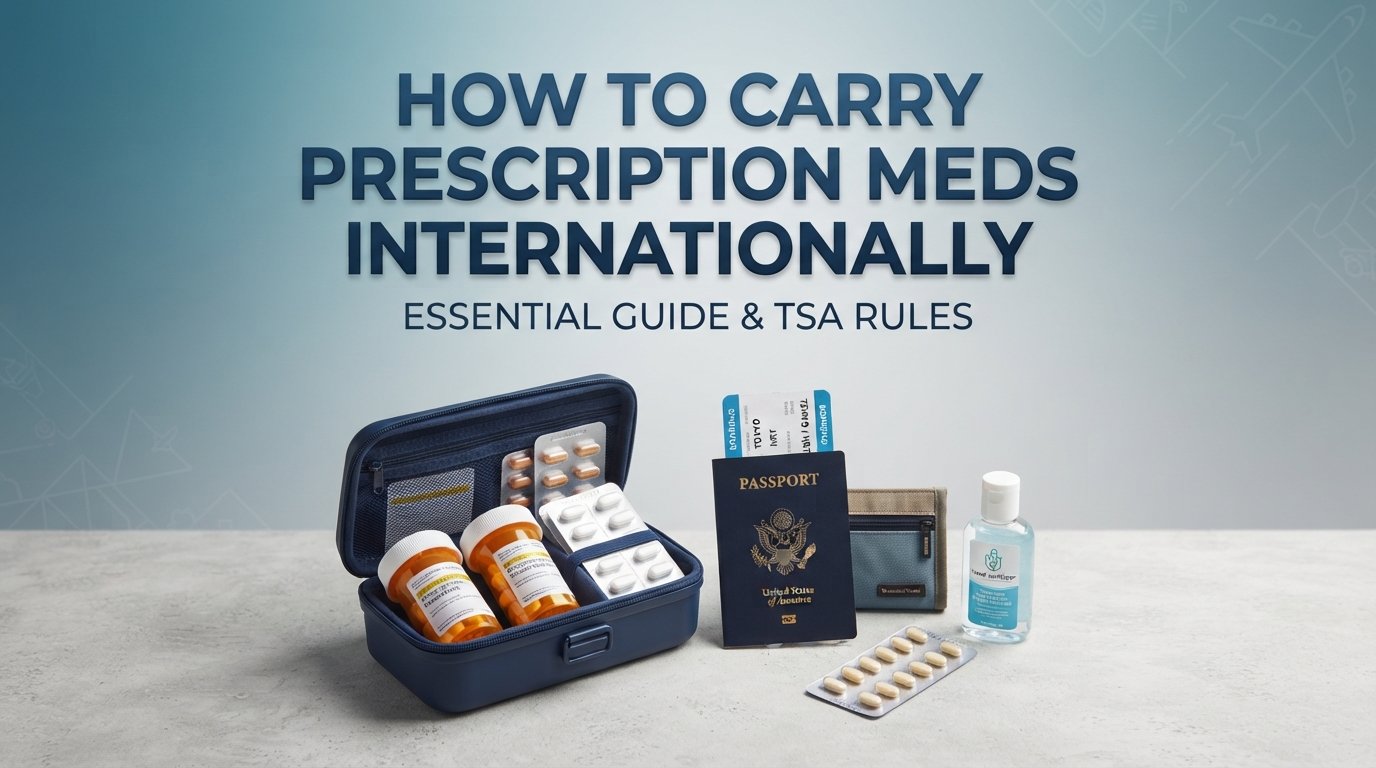
I learned this lesson the hard way. On a trip to Tokyo, I packed my ADHD medication in a daily pill organizer to save space. Customs officers pulled me aside for 90 minutes while they verified my prescription over the phone with my doctor’s office back home. The medication stayed with me, but my heart rate did not come down for hours. After that, I rebuilt my entire approach to traveling internationally with prescription medications legally. This guide shares what I now follow on every trip.
If you take any prescription medication and plan to cross a border, this article will walk you through exactly how to do it without risking confiscation, fines, or worse. You will learn the documentation you need, how to pack your medication, which countries have the strictest rules, and what to do if something goes wrong at customs.
Table of Contents
Pre-Trip Planning: Your First Step to Legal International Medication Travel
Pre-trip planning is the single most important part of traveling internationally with prescription medications legally. Most problems I see on travel forums start with travelers who skipped this step entirely.
Start by contacting the embassy or consulate of your destination country at least 4 to 6 weeks before departure. The U.S. State Department recommends this exact step for every traveler carrying medication abroad. Embassy staff can tell you whether your specific medication is legal to import, whether you need a special permit, and how much you are allowed to bring in.
Many countries operate on a 30-day supply rule. The CDC confirms that travelers can typically bring up to a 30-day supply of certain medicines for personal use, but the exact rules vary. Some nations allow 90 days. Others restrict you to 14 days. A few ban common medications outright.
During my pre-trip research for an upcoming trip, I check three sources every time: the destination country’s official health authority website, the U.S. State Department’s country information page, and the International Narcotics Control Board database. That last one is gold for understanding which controlled substances face restrictions in which countries.
For long-term travel (3 months or more), the planning phase gets harder. Most doctors will not write a 6-month prescription without re-evaluation. I now schedule a checkup 8 weeks before any extended trip so I have time to refill, document, and prepare.
Documentation You Need to Carry Prescription Medication on International Flights
Documentation is what separates a legal international traveler from someone who ends up in a foreign customs office. I carry three documents with me on every trip, and you should too.
The first document is a signed letter from your doctor on official letterhead. This letter should include your full name, date of birth, the medical condition being treated, the medication name (both brand and generic), the dosage, and the prescribing doctor’s contact information. I also ask my doctor to include a statement that the medication is for personal medical use. This is sometimes called a medical certificate or a doctor’s letter for medication travel, and it is required by many countries.
The second document is a copy of your original prescription. Make sure it includes the generic drug name, not just the brand. Brand names differ from country to country, but generic names like “amoxicillin” or “methylphenidate” are recognized worldwide. Travel forums consistently mention this as a common mistake.
The third document is your medication’s pharmacy label. Keep every pill in its original prescription container with the pharmacy label attached. Officers want to see that the name on the bottle matches the name on your passport and your doctor’s letter. A pill organizer with no labels is a red flag at most international borders.
For Schengen Area countries (most of the European Union plus a few others), you may need an additional document called a Schengen certificate. This is a special form your doctor fills out that authorizes you to carry controlled substances for personal use across Schengen borders. Apply for it at least 2 weeks before travel because some countries require prior approval.
Packing Prescription Medications for Air Travel: Original Containers and Carry-On Rules
Packing prescription medications for air travel comes down to two non-negotiable rules: original containers and carry-on luggage. Every government source and every travel forum I have read says the same thing.
Keep all medications in your carry-on bag, never in checked luggage. Reddit users in r/TravelHacks and r/HerOneBag warn repeatedly that “meds get stolen and sold on the black market” from checked bags. Beyond theft, your checked bag can be delayed or lost, and you do not want to be stuck in a foreign country without critical medication. I split my supply into two carry-on bags when I travel with my partner, so we are never depending on a single bag.
Keep medications in their original, labeled containers. Do not combine multiple prescriptions into one bottle. Do not use unmarked daily pill organizers as your primary container. You can use a pill organizer for daily use at your hotel, but keep the original labeled bottles with you for inspection. This is a hard rule I now follow without exception.
For liquid medications over 3.4 ounces (100 ml), the TSA’s standard 3-1-1 rule does not apply to prescription liquids. You can bring medically necessary liquids in larger quantities, but you must declare them at the security checkpoint. Keep them separate from your other liquids and inform the officer.
Country-Specific Rules for Prescription Medications: Japan, UAE, and Schengen Area
Country-specific rules for prescription medications are where most travelers get caught off guard. I have researched the strictest destinations, and here is what you need to know.
Japan has some of the strictest medication import laws in the world. Common medications like Sudafed (pseudoephedrine), codeine, Adderall, and even some inhalers are either banned or require special pre-approval through Japan’s Ministry of Health. Travelers have been detained for carrying prohibited medications, even in small amounts. If you take any controlled substance, apply for a Yunyu Kakunin-sho (import certificate) before traveling. I always check the official Japan Ministry of Health website for the current list of restricted ingredients.
The United Arab Emirates (UAE) has similarly strict rules. Medications containing codeine, diazepam, or any narcotic require prior approval from the UAE Ministry of Health. Medical marijuana is illegal even with a valid U.S. prescription. Carry only the original packaging and a doctor’s letter, and expect extra screening at Dubai or Abu Dhabi airports.
Schengen Area countries accept the Schengen certificate for controlled substances, but the rules on which medications require certification change regularly. As of 2026, countries like Germany, France, and Italy generally follow the same 30-day personal supply rule, but the documentation must be specific. A general letter from your doctor may not be enough for stimulants or strong painkillers.
For most other destinations (Canada, Mexico, the UK, Australia, New Zealand), bringing a 30 to 90-day supply with original containers and a doctor’s letter is usually enough. Always verify before you fly.
Controlled Substances and Common Problematic Medications When Traveling Internationally
Controlled substances are the medications that get travelers into the most trouble when traveling internationally. If you take any of these, you need extra planning time.
ADHD medications (Adderall, Ritalin, Vyvanse, Concerta) are heavily regulated because they contain stimulants like amphetamine or methylphenidate. These are controlled in most countries and outright banned in some. The U.S. State Department specifically calls out ADHD medications as high-risk for international travel.
Sleeping pills and anti-anxiety medications (Ambien, Xanax, Ativan, Valium) are also controlled substances. Some countries allow a 30-day personal supply, others require a Schengen certificate, and a few (including Japan and the UAE) restrict them heavily or ban specific drugs.
Medical marijuana and CBD products are a minefield. Even though CBD is widely available in the U.S., many countries classify it as a narcotic. Do not bring marijuana, cannabis edibles, or high-THC CBD products across international borders. Some travelers have been arrested for trace amounts in their luggage.
Opioid painkillers (oxycodone, hydrocodone, morphine) require documentation in nearly every country. Carry the smallest supply that covers your trip, the original container, and a doctor’s letter stating the medical necessity.
TSA Rules and Airport Security: Flying With Prescription Medications in 2026
TSA rules in 2026 are straightforward once you know the exceptions. The agency screens millions of travelers, and medical items are handled with clear procedures.
Solid prescription medications (pills, tablets, capsules) can go through the X-ray machine in your carry-on without issue. You do not need to declare them at the security checkpoint unless an officer asks.
Liquid medications, creams, and gels over 3.4 oz must be declared separately. Pull them out of your bag at the checkpoint and inform the TSA officer. They are allowed in reasonable quantities for the duration of your trip, including medical supplies like insulin, saline, or liquid antibiotics.
Medical devices (insulin pumps, glucose monitors, EpiPens, inhalers) are permitted through security. Tell the officer if you are wearing a device that cannot be removed.
International departure rules can differ from TSA. Once you clear TSA and arrive at your gate, the rules of the destination country’s airport authority take over. Some countries screen medications again at the gate. Have your documentation ready at every step.
Refrigerated, Injectable, and Long-Term Travel Medication Planning
Refrigerated medications like insulin, biologics, or some antibiotics need extra care. I pack mine in an insulated travel case with reusable ice packs. The case keeps medication at 36 to 46 degrees Fahrenheit for up to 12 hours, which covers most international flights.
Tell TSA officers in advance if you are carrying refrigerated medication. Ice packs must be fully frozen at the checkpoint. If they have started to melt, TSA may require additional screening.
Injectable medications (insulin, fertility drugs, biologics like Humira) require a sharps container for used needles. Pack a small travel-sized sharps container and never put loose needles in your luggage. Some countries have strict rules about importing syringes, so a doctor’s letter becomes especially important.
For long-term travel (3 to 6 months), work with your doctor to plan a full supply before departure. Some pharmacies offer 90-day mail-order refills. For trips longer than that, research pharmacies and doctors in your destination country ahead of time. The International Association for Medical Assistance to Travelers (IAMAT) maintains a directory of English-speaking doctors worldwide.
Time Zone Adjustments and What to Do If Your Medication Gets Confiscated
Time zone adjustments can mess with your medication schedule, especially for insulin, thyroid medication, or anything time-sensitive. I keep a simple watch set to my home time zone and adjust my doses gradually over the first 2 to 3 days. For insulin specifically, your endocrinologist can give you a sliding scale based on the time difference.
If your medication is confiscated at customs, stay calm and ask to speak with a senior officer or a customs medical liaison. Provide all your documentation, including the doctor’s letter and original prescription. Ask for a written record of the confiscation. Contact your embassy or consulate for assistance. They cannot override local law, but they can help you communicate and sometimes point you to a local equivalent medication.
Always carry your doctor’s contact information and your pharmacy’s number. In a worst-case scenario, your doctor can sometimes arrange a same-day prescription transfer to a partner pharmacy abroad. This is rare, but having the information ready saves precious hours.
Frequently Asked Questions About Carrying Prescription Medication Abroad
How do I fly internationally with prescription medication?
To fly internationally with prescription medication, contact the destination country’s embassy 4 to 6 weeks before travel to confirm your medication is legal. Carry medications in original labeled containers in your carry-on bag, along with a signed doctor’s letter, a copy of your prescription, and any required permits such as a Schengen certificate.
Do prescription meds need to be in original containers when flying internationally?
Yes. Customs and security officers in most countries require prescription medication to remain in original pharmacy-labeled containers that match the name on your passport. Combining pills into unmarked organizers can lead to confiscation or delays. You can use a daily organizer for personal convenience, but keep the labeled bottles with you for inspection.
How to legally travel with prescription medication?
To legally travel with prescription medication internationally, verify destination country laws through the embassy, get a signed letter from your doctor on official letterhead, keep medications in original containers with pharmacy labels, pack everything in your carry-on luggage, and declare medications at customs when required. Some controlled substances need a Schengen certificate or country-specific pre-approval.
Do I need to declare my prescription medication at customs?
In most countries, you must declare prescription medications at customs if they exceed a certain quantity, contain controlled substances, or are entering under a personal importation allowance. Even when not legally required, declaring your medication upfront speeds up the screening process and protects you if an officer questions your supply. Keep documentation ready in your carry-on.
Conclusion
Learning how to travel internationally with prescription medications legally is not hard, but it does require planning. Start with your embassy check, get your doctor’s letter, pack in original containers, and keep everything in your carry-on. Do that, and you will clear customs smoothly on your next trip. Bookmark this guide and share it with anyone you know who travels with daily medication.
1 thought on “How to Carry Prescription Meds Internationally (September 2026)”