

An RV vent fan is a 12V-powered roof unit that fits a standard 14 x 14 inch opening and pulls stale, humid air out of your rig, or reverses to draw fresh air in through a hinged lid with a rain cover and insect screen. That single line is the whole difference between a stuffy cabin and a comfortable one, and picking the right one is harder than it looks because airflow claims are inflated everywhere. We compared ten of the top-selling 12V roof vent fans side by side for this 2026 update, weighed the spec sheets against what owners actually report after living with them, and picked the best rv vent fans for airflow at every budget and rig size.
The core problem is that airflow is not the same number on every listing. Some manufacturers print a spec-sheet figure measured at the fan hub. Others print a marketing number that assumes an open window somewhere else in the rig. A fan that looks like a monster on paper can feel underpowered in a small trailer if it is exhausting into a closed space with no make-up air path, which is the single most common reason owners say a vent fan is bad. The other half of the problem is noise. A fan that moves plenty of air at 3 a.m. is not a good fan.
We spent our time on reversible intake and exhaust capability, real speed counts instead of claimed ones, motor size, roof cut-out compatibility, and the electrical draw that decides whether you can run it all afternoon on a boondock battery. If you also care about airflow management away from the roof, our guide to blocking windows and managing airflow while sleeping in a vehicle is worth a read. The picks below are the ones we would actually install.
Table of Contents
Top 3 Picks: Best RV Vent Fans for Airflow (October 2026)
These three cover the most common buying situations: the fan we would put in any rig regardless of budget, the one to buy if you want the most control, and the one that gives you the most air per dollar spent.

MAXXAIR Maxxfan Deluxe 00-07500K
- 10-speed reversible fan with thermostat
- Built-in rain cover
- Remote control
- Fits 14 x 14 inch openings

MAXXAIR Maxxfan Plus 00-04500K
- 10-speed reversible intake and exhaust
- Rain sensor auto-closes lid
- 28W DC motor
- Remote or manual opening

RVLOVENT 14 Inch 10 Speed Manual
- Manual lift
- no remote needed
- Reversible intake and exhaust
- Spare screen and fuses in the box
All 10 RV Vent Fans Compared Side by Side
Every fan in this roundup runs on 12V and mounts in a standard roof cut-out. The differences are in motor size, speed count, whether the fan reverses, and whether the lid opens itself.
| Product | Specifications | Action |
|---|---|---|
| MAXXAIR Maxxfan Deluxe 00-07500K |
|
Check Latest Price |
| MAXXAIR Maxxfan Plus 00-04500K |
|
Check Latest Price |
| RVLOVENT 14 Inch 10 Speed Manual |
|
Check Latest Price |
 Ventline CW001 Vent with 12V Fan Ventline CW001 Vent with 12V Fan |
|
Check Latest Price |
 caqeg 14 Inch Universal Vent with Fan caqeg 14 Inch Universal Vent with Fan |
|
Check Latest Price |
 Starvent 6-Speed Reversible Starvent 6-Speed Reversible |
|
Check Latest Price |
 Heng’s Industries 71112A Heng’s Industries 71112A |
|
Check Latest Price |
 2012RVAccessories F36AR LED 2012RVAccessories F36AR LED |
|
Check Latest Price |
 Kohree KR5312 10 Speed Kohree KR5312 10 Speed |
|
Check Latest Price |
 GDDGHS 14×14 with 12V Fan GDDGHS 14×14 with 12V Fan |
|
Check Latest Price |
1. MAXXAIR Maxxfan Deluxe 07500K – The Best All-Around Airflow Fan
MAXXAIR Maxxfan Deluxe Vent, Fan and Vent Cover All in One – Powerful 10-Speed Reversible Fan with Thermostat, Built-in Rain Cover, Remote Control, Intake & Exhaust Fan, Smoke (00-07500K)
60W motor
10 speeds reversible
10 blades at 14 inch
Thermostat and rain cover
Pros
- Vent
- fan and rain cover in one low-profile assembly
- Ten-speed reversible motor with built-in thermostat for temperature control
- Built-in rain cover lets the fan run in rain or while driving
- Tool-free removable interior insect screen
- Backed by a 2-year limited warranty and a lifetime limited warranty on the lid
Cons
- Highest price point in this roundup
- Thermostat and ten-speed controls take time to master on the remote
With 1701 reviews and a 4.6 average, the Maxxfan Deluxe is the most proven unit in this roundup by a wide margin, and it is the one we would install without hesitating. The all-in-one design means vent, fan and rain cover come as a single assembly, so there is no separate FANMATE cover to lose or forget. If you have ever had an owner quote you the Deluxe and then talk you out of it because of the remote, that owner has not lived with it.
The motor is a 60 watt reversible unit driving a 10-blade, 14 inch rotor across ten speeds, and the built-in thermostat will start and stop the fan against a temperature you set rather than making you reach for the remote every time the sun moves. The lid is 12.75 inches deep, 14.76 inches wide and 5.23 inches tall, so it sits genuinely low on the roof, which matters on a high-roof van where every inch of drag costs you fuel.
Owners consistently single out three things: the sense that the fan moves real volume, the ability to run it in bad weather, and the fact that nothing else needs servicing. A long-term owner on the RV forums reports 14 years with a MaxxAir unit where the only failure was the interlock switch that stops the fan once the lid closes. That is a serviceable part, not a motor death, and it is a meaningful difference when you consider that most cheap fans in this list are sealed units with no replaceable electronics.
The catch is the 60 watt draw, the highest figure in this roundup, and the remote. Owners do report a short learning curve on the thermostat and speed mapping. Neither is a defect, but if you want a fan you can set once and forget, this is not that fan.
What you should check before buying
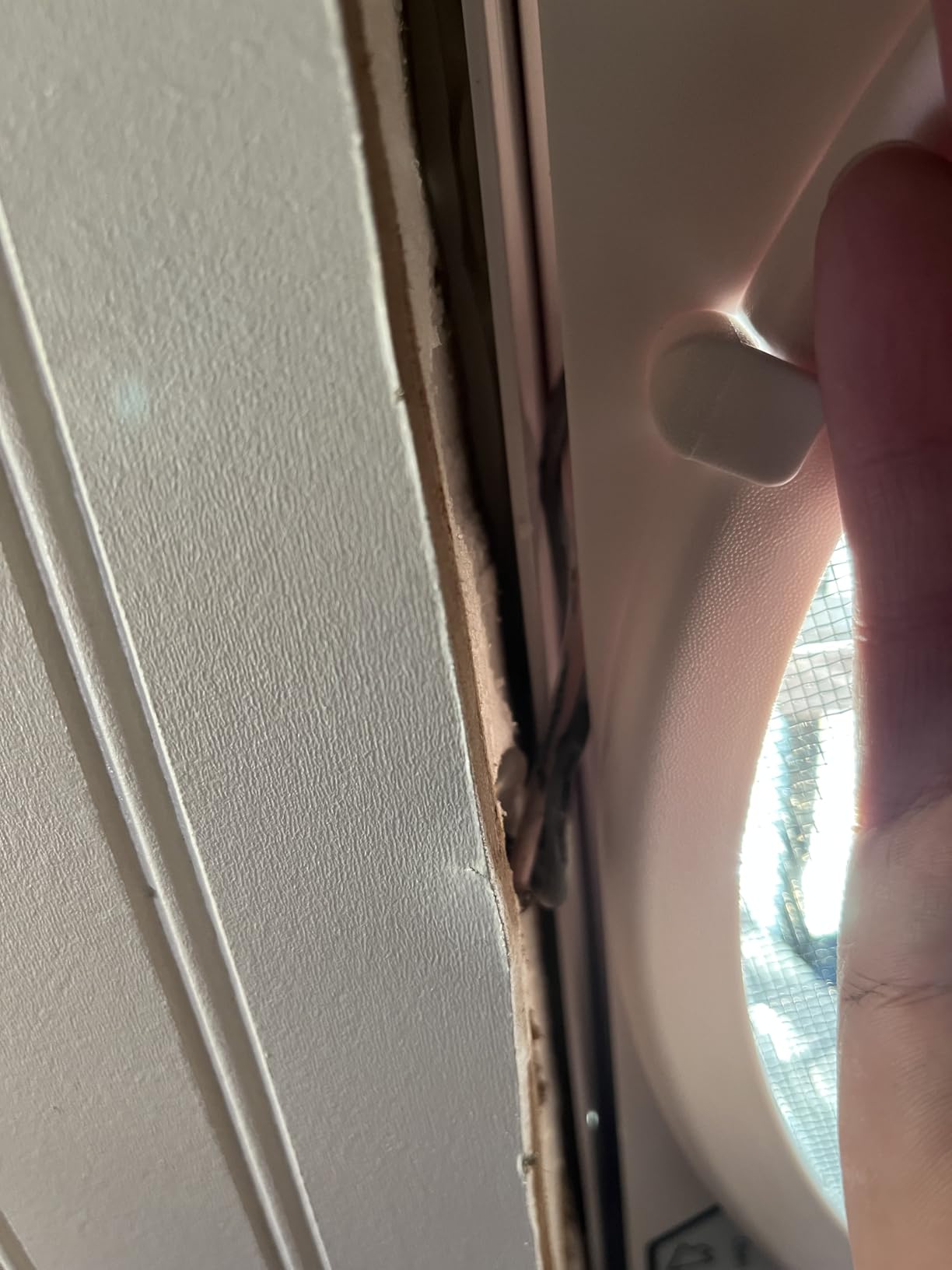
Check that your existing opening measures a true 14 x 14 inch. This model fits all standard 14 x 14 inch roof openings, but it will not drop into a 14.25 or 14.5 inch hole without modification. Also confirm you can reach the ceiling control. On a high-roof Sprinter the interior trim ring can sit well above head height, which is exactly the situation the remote solves.
Check your electrical circuit too. A 60 watt motor on 12V draws about 5 amps, and forums repeatedly report blown 20 amp fuses when vent fans share a circuit with other ceiling equipment. If the fan trips a fuse at high speed, the fix is a dedicated circuit, not a different brand of fan.
Who should skip it
Skip this if you are building on a strict budget and cannot justify the spend, or if your rig is so small that 60 watts is more than you need. It is also the wrong call for someone who wants a simple manual crank with nothing to program. Everything about the thermostat and ten-speed mapping is wasted if your use is one speed, on or off.
Owners who regret this purchase most often are the ones who bought it for a camper they later sold, where the cost was never recovered. If you are renting or swapping rigs every season, a mid-tier reversible model is the smarter buy.
2. MAXXAIR Maxxfan Plus 00-04500K – Best When You Want the Lid to Handle Rain
MAXXAIR Maxxfan Plus High Powered 10-Speed RV Intake and Exhaust Fan – Manual or Remote Control Electric Opening, Easy Ceiling Controls, Rain Sensor with Automatic Lid Closure, Smoke (00-04500K)
28W DC motor
10-speed reversible
Rain sensor with auto lid close
Remote or manual opening options
Pros
- High-powered 10-speed intake and exhaust airflow
- Rain sensor automatically closes the lid when it detects rain
- Ceiling-mounted controls for convenient operation
- Waterproof molded mounting tabs simplify installation
- DC motor draws only 28 watts
Cons
- FANMATE vent cover sold separately
- Higher one-star review share than the Deluxe on fit and accessory complaints
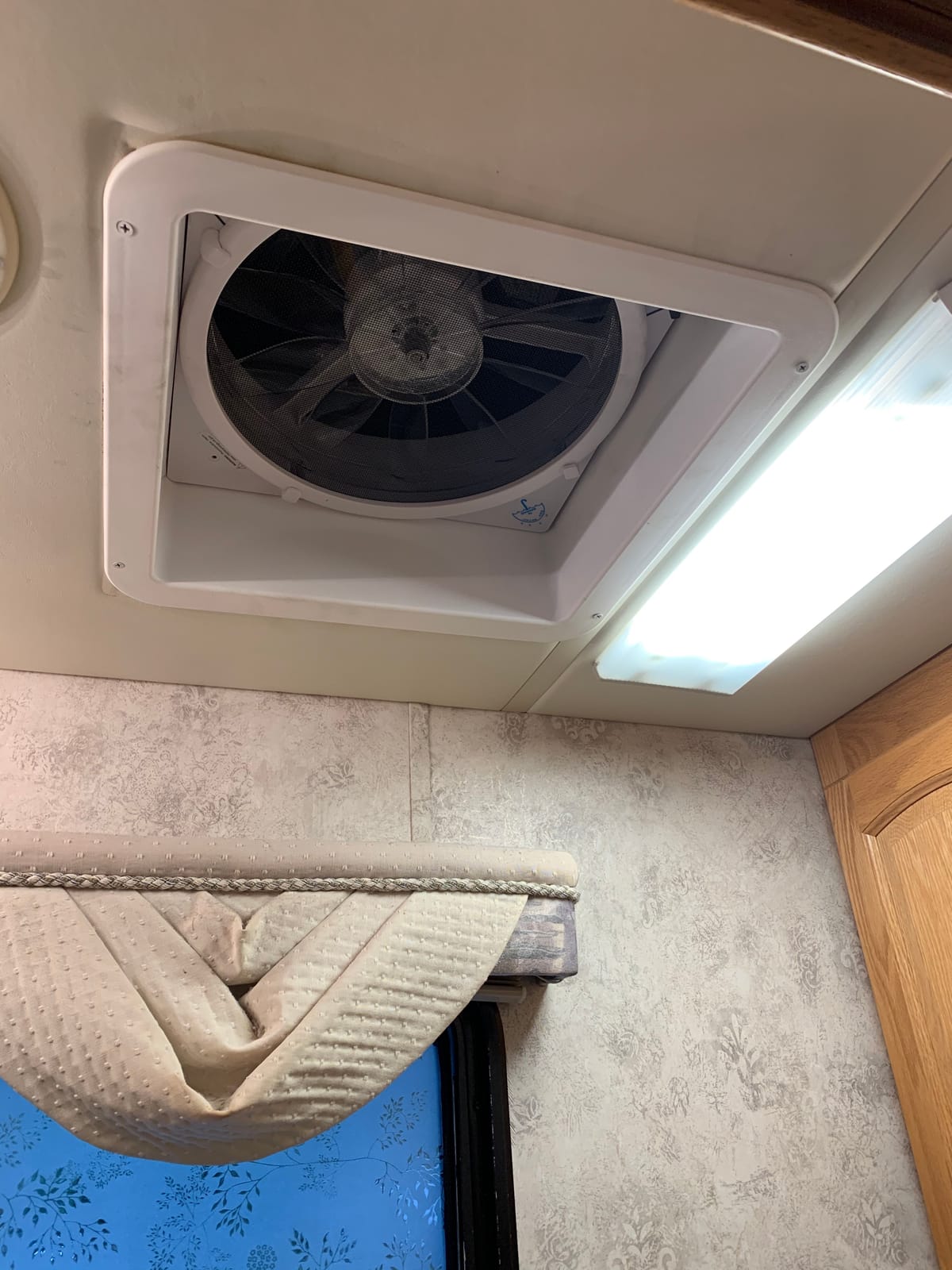
The Maxxfan Plus is the model to consider when your climate actually rains while you are parked. Its rain sensor detects water and closes the lid automatically, and verified buyer reports confirm the sensor genuinely works, shutting a comparable Fan-Tastic unit down after the first few sprinkles rather than waiting for a downpour. That is the difference between a fan you use in a summer storm and a fan you only use in dry weather.
Airflow is the same class as the Deluxe, with a 10-blade reversible motor across ten speeds, but the motor is rated at 28 watts instead of 60. That is a real battery saving, roughly half the draw, and it matters if you run the fan for hours on a boondock setup. The unit is deeper at 18.88 by 17.75 by 10 inches, so it is a taller profile on the roof than the Deluxe and worth checking against a tight garage or overheight situation.
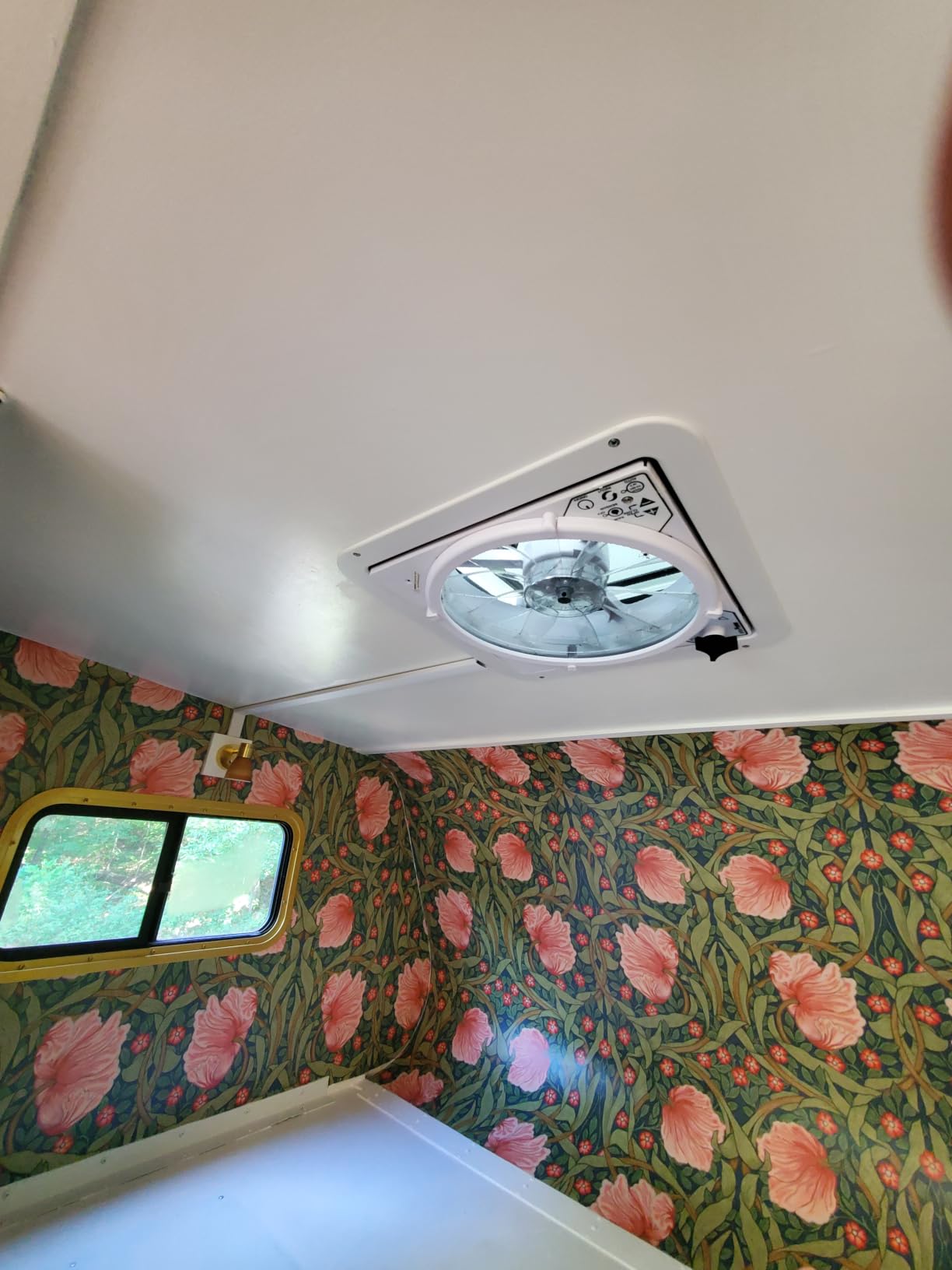
It also works as a circulation fan with the lid closed, which is a genuinely useful mode most buyers do not discover. In that setting it pushes air around the cabin, and several owners use it as a quiet ceiling fan. If you are curious about the difference between a real ceiling fan and a lid-closed roof unit, our ceiling fan testing and review roundup is a useful comparison.
The important limitation: this is the bare vent and fan. The FANMATE vent cover is sold separately, so the all-weather running capability that the Deluxe gives you out of the box is not included here unless you pair it with the sensor and let the lid close on water. If you are not comfortable adding a second accessory, the Deluxe is the more complete package.
What you should check before buying
Decide whether you want remote electric opening or the manual version. Both exist within this model family, and this listing is the remote-capable one with ceiling-mounted controls. The molded waterproof mounting tabs let you install a FANMATE cover later without redoing the roof, which is a good reason to pick this unit even if you skip the cover.
Confirm the roof thickness. This unit is noticeably taller than a low-profile Deluxe, and on a curved van roof the extra height can affect the fit of an aftermarket solar panel or rack. Measure the stack height above the roof skin before you commit.
Who should skip it
Skip it if buying two accessories to get rain protection is going to bother you, or if roof profile height is critical. It is also redundant for most buyers who are only installing one fan, since it shares the core motor platform with the Deluxe and offers less out of the box.
The 1-star share of 5 percent is slightly higher than the Deluxe’s 4 percent, and the complaints cluster around fit and missing accessories rather than airflow. If you are fussy about a single-box install, this is the wrong shape of product.
3. RVLOVENT 14 Inch 10 Speed Manual – Best Value for Real Airflow
RVLOVENT 12V RV Roof Fan Vent 14” 10 Speed Reversible Manual Lift (NO REMOTE)
18W motor
3 speeds
10 blades at 14 inch
Marketed 1000 CFM max
45 dB
Pros
- Strong airflow that owners say beats cheaper small-motor competitors
- Quiet on low and medium speeds
- Manual lift removes remote-control complexity entirely
- Spare insect screen and extra 5 amp slow-blow fuses in the box
- Fits the standard 14 x 14 inch roof opening for direct replacement
Cons
- Intake airflow is weaker than exhaust at roughly 60 percent as effective
- Some owners report more noise than the advertised 45 dB on higher speeds
- Interior garnish ring may need trimming on sloped roofs
This is the fan we point people to when they say the phrase budget brand with a very small motor. The RVLOVENT runs a 10-blade, 14 inch rotor, which is the same blade size as the Maxxair units, on only 18 watts. That combination is why owners keep reporting it moves more air than the cheaper Amazon competitors they replaced, and why a large share of its 1068 reviews are five stars.
It is also the most honest mechanical design in the list for anyone who does not want electronics. A manual pull-chain control runs the fan, and the lid lifts by hand. There is no remote to lose, no keypad to fail, and no firmware to be confused by. For owners with a 14-year-old MaxxAir whose interlock switch finally gave out, that simplicity is a feature, not a compromise.
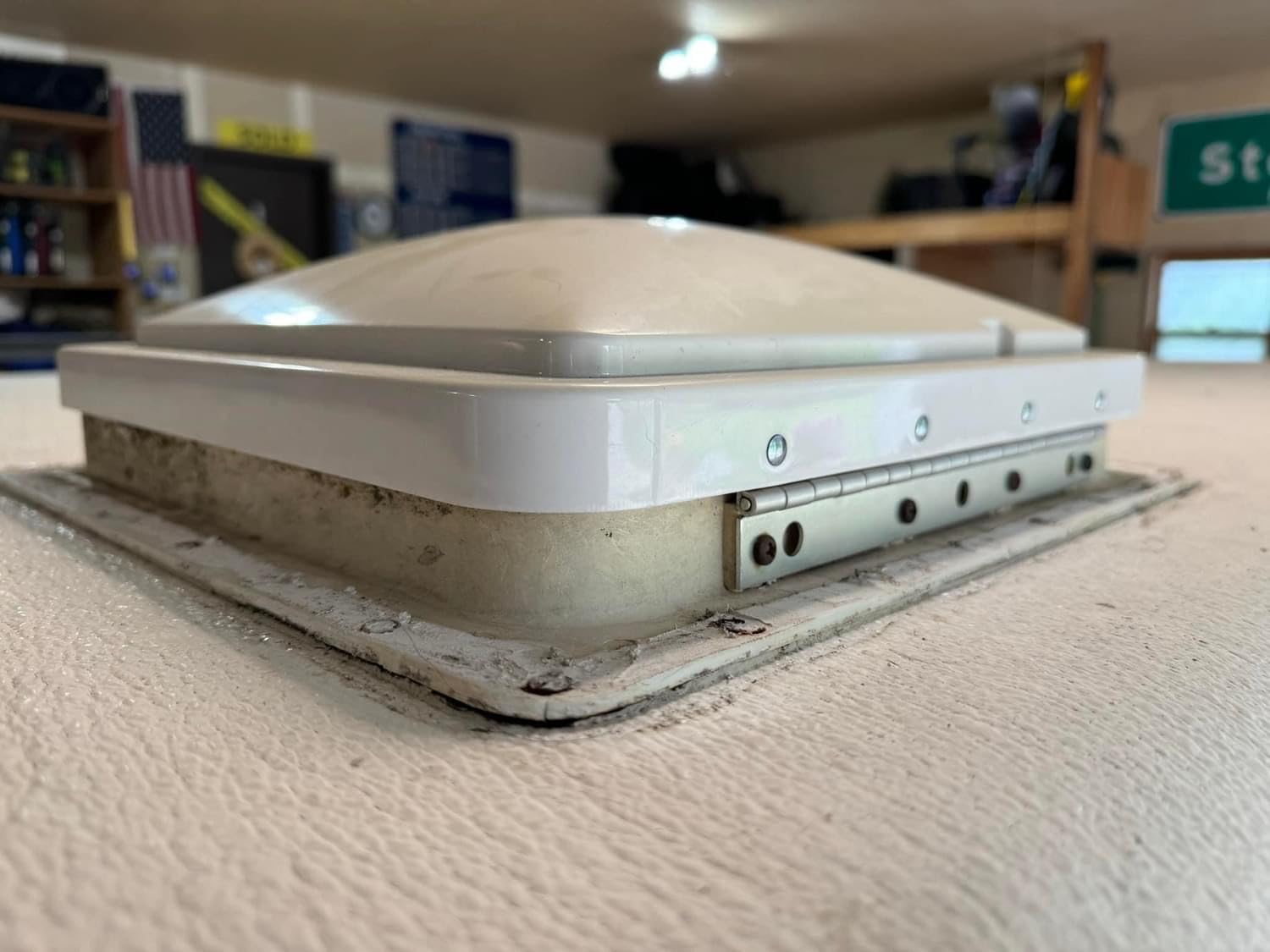
Two things to know before you commit. The marketing names 10 speeds, but the unit actually delivers three speed settings, so manage your expectations. And while the listing quotes a 1000 CFM maximum, the same listing also carries a much smaller manufacturer airflow figure, which tells you to treat the big number as a marketing ceiling. Nobody in this roundup publishes a verified airflow measurement, so compare blade size and speed count instead.
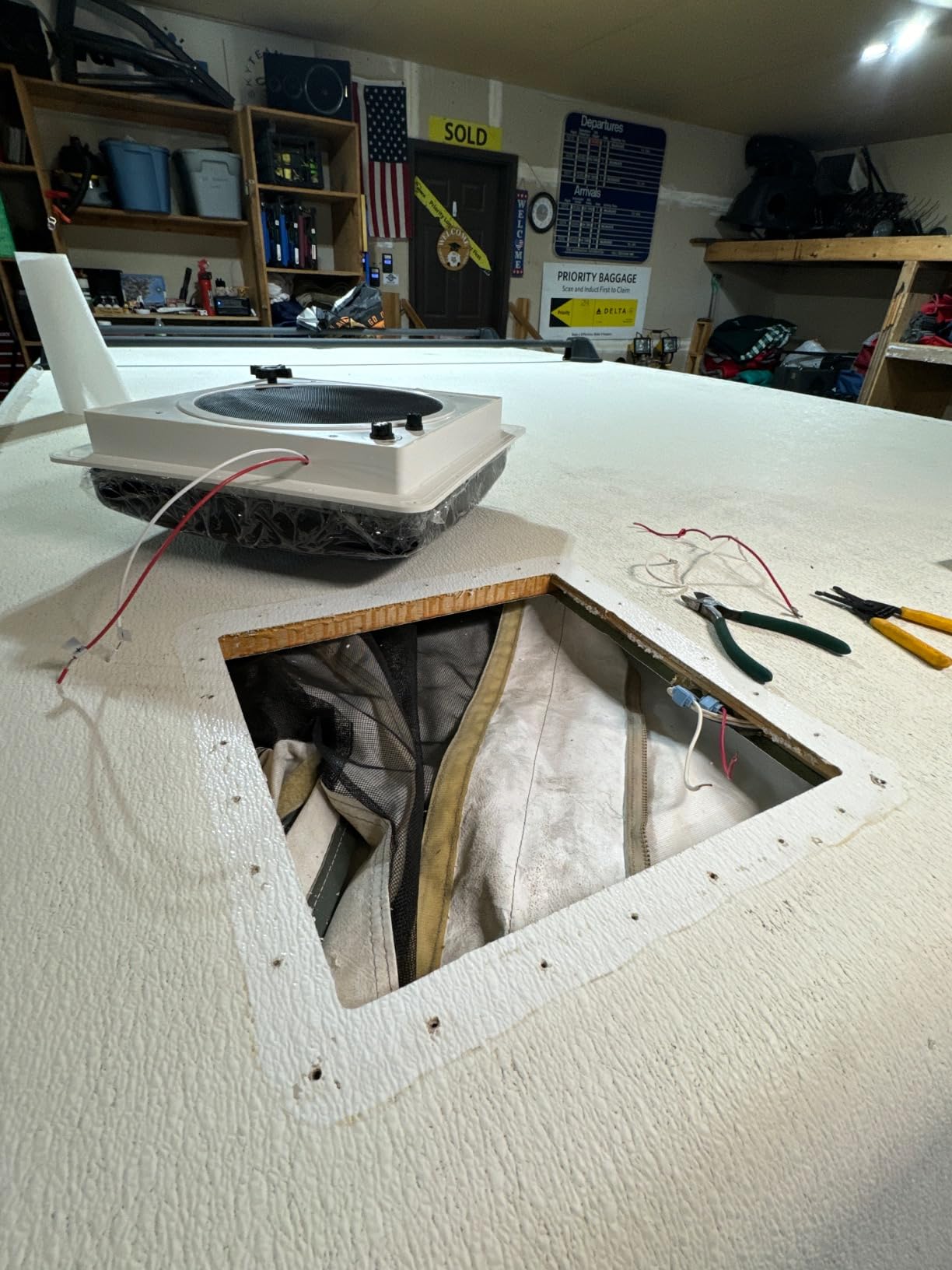
The box is unusually generous: a spare insect screen frame so you have a clean one ready when the original gets filthy, extra 5 amp slow-blow fuses, screws, and a white interior garnish. That consumables-first approach is exactly what a long-term owner appreciates after three seasons of bugs and dust.
What you should check before buying
Check whether you can live with three speeds and a manual lid. There is no powered lift and no rain sensor, so you close the lid yourself when the weather turns. Plenty of owners do exactly that and never look back, but it is a change in habit from a Deluxe.
Check the garnish ring on a sloped roof. Owners report trimming the interior flange where the roof angle means the ring does not sit flat. That is ten minutes with a file, not a deal breaker, but it is a known step rather than a surprise.
Who should skip it
Skip it if you need to run the fan unattended in rain, or if you want fine-grained speed control for quiet nighttime use. It is also the wrong choice for a high-roof van where reaching a manual pull chain in the ceiling is awkward, which is a reach problem more than a product problem.
The 45 dB figure holds up well on low and medium settings according to most owners. On the top setting several report it is louder than advertised, so if you plan to run it at full blast while sleeping, test it first.
4. Ventline CW001 Vent with 12V Fan – Best for Battery Life
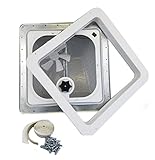
Ventline RV Roof Vent White w/ 12 Volt Fan, Putty & Screws¡
3.6W DC motor
6 blades at 14.25 inch
Single speed exhaust only
Fits 14.25 inch rough opening
Pros
- Very low 3.6 watt draw makes it a practical always-on ventilation fan
- Complete install kit with a garnish ring plus putty tape and screws in the box
- Aerodynamic white wedge lid sheds water well
- Dependable factory-style replacement for an OEM vent
Cons
- Single speed with no reverse airflow
- Mounting flange edges are sharp and need caution during install
- Only modestly moves air compared with multi-speed premium units
Where the Maxxair units ask how much air you can move, this one asks how long you can run. At 3.6 watts, the Ventline CW001 draws less than a tenth of what the Deluxe pulls and is the lowest-draw fan in this roundup by a wide margin. On a 100 amp-hour battery that difference runs into hours of continuous ventilation, which is exactly what you want for overnight humidity control on boondock.
It is a factory-style replacement rather than a performance machine. A 6-blade rotor at 14.25 inches, one speed, exhaust only, and a push-button switch. Owners treat it as a dependable swap for a cracked or broken original vent and rate it accordingly, with satisfaction centred on the included hardware and the low draw rather than on airflow performance.

Because it is exhaust-only, it needs a second opening somewhere else in the rig to pull from, the same rule as every fan here. In a small trailer the wet bath vent is often the natural partner. In a van with no other opening, an exhaust-only fan will simply recirculate.
The wedge-shaped white lid is genuinely aerodynamic, which matters more than it sounds. A flat or domed lid catches wind and can lift at highway speed, while a wedge profile sheds water and resists uplift. This is the reason many factory RV vents have looked like this for decades.

What you should check before buying
Measure the opening carefully. This unit wants a 14.25 x 14.25 inch rough opening, which is slightly different from the 14 x 14 inch standard that most modern units and most 14-inch slots in this roundup target. If your existing hole is a true 14 inches, you are looking at an adapter or a different product.
Handle the galvanized mounting flange with gloves. The manufacturer explicitly warns it is sharp, and several owners mention the install as the only fiddly part. Everything you need otherwise, including putty tape and screws, is in the box, which saves a hardware store trip.
Who should skip it
Skip it if airflow is your primary goal, since there is no reverse mode and only one speed to work with. It is built for background ventilation, not for clearing a hot cabin quickly after a long drive.
It is also the wrong pick for anyone who wants remote or thermostat control. There is no remote, no sensor, and no powered lift. You get a switch and a wedge lid, which is all some rigs need.
5. caqeg 14 Inch Universal Vent with Fan – Best for First-Time Builders
14″ RV Roof Vent for Camper Trailer Universal White Lid Roof Vent with 12V RV Vent Fan 6″ Blades White lid Inner for Garnish Ring
24W motor
6 inch blades
Single speed reversible
Fits 1.25-2.25 inch roof thickness
Pros
- Fits standard 14 x 14 inch openings with a wide 1.25 to 2.25 inch roof thickness range
- Reversible fan moves air in or out and runs with the lid closed
- Complete kit including a white interior garnish ring and sealing tape
- High sales rank in RV Ventilation reflects strong real demand
Cons
- Thin plastic can crack if flexed during installation
- Single speed with basic push-button controls
- Acrylic lid is thin and could be more rigid
If you are cutting a new hole in a cargo trailer roof and want a vent and fan in one purchase without hunting for parts, this is the easiest box in the roundup. The vent cover, the 12V fan, the white interior garnish, screws and sealing tape all arrive together, and the two-wire design means one positive and one negative run to the ceiling switch.
The roof thickness range of 1.25 to 2.25 inches is the useful detail here. Many budget vents only cover a narrower band, and a mismatch means a leaking or loose flange. It also runs air with the lid closed, so you get circulation mode on a unit that otherwise looks like a basic add-on.
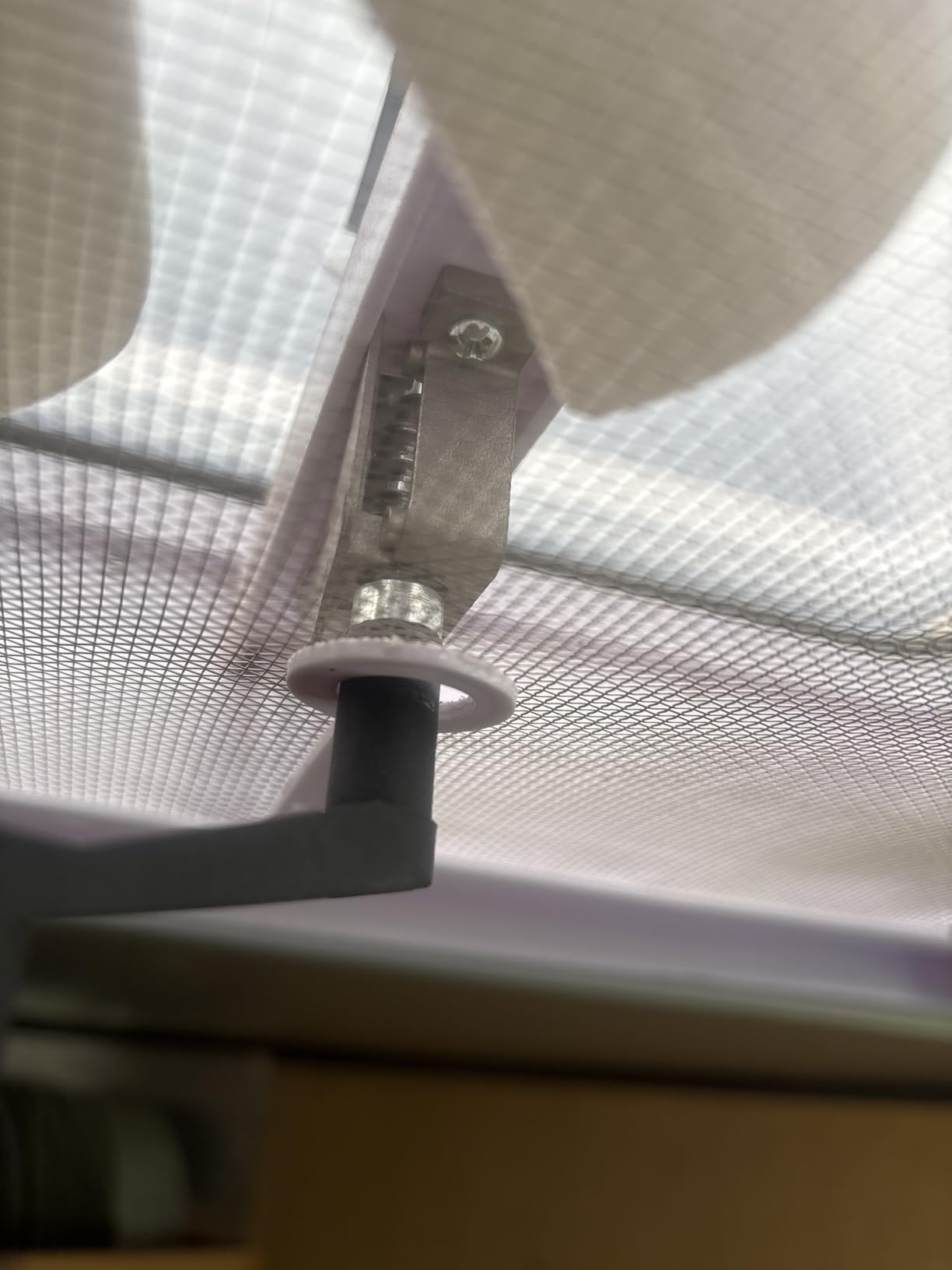
Owners report the fit is excellent and installation is straightforward, which is why 73 percent of its 904 reviews are five stars. The consistent complaint is the plastic. The lid and flange are thin enough that flexing them while aligning the unit can crack them, so treat it as a careful install rather than a rough one. Fit it square on the first attempt.
Blade size is where this one gives ground. At 6 inches across with six blades, it is a fraction of the swept area of a 14 inch 10-blade rotor, so the 24 watt draw is doing less useful work than you would expect. It moves air. It does not clear a hot cabin in minutes.
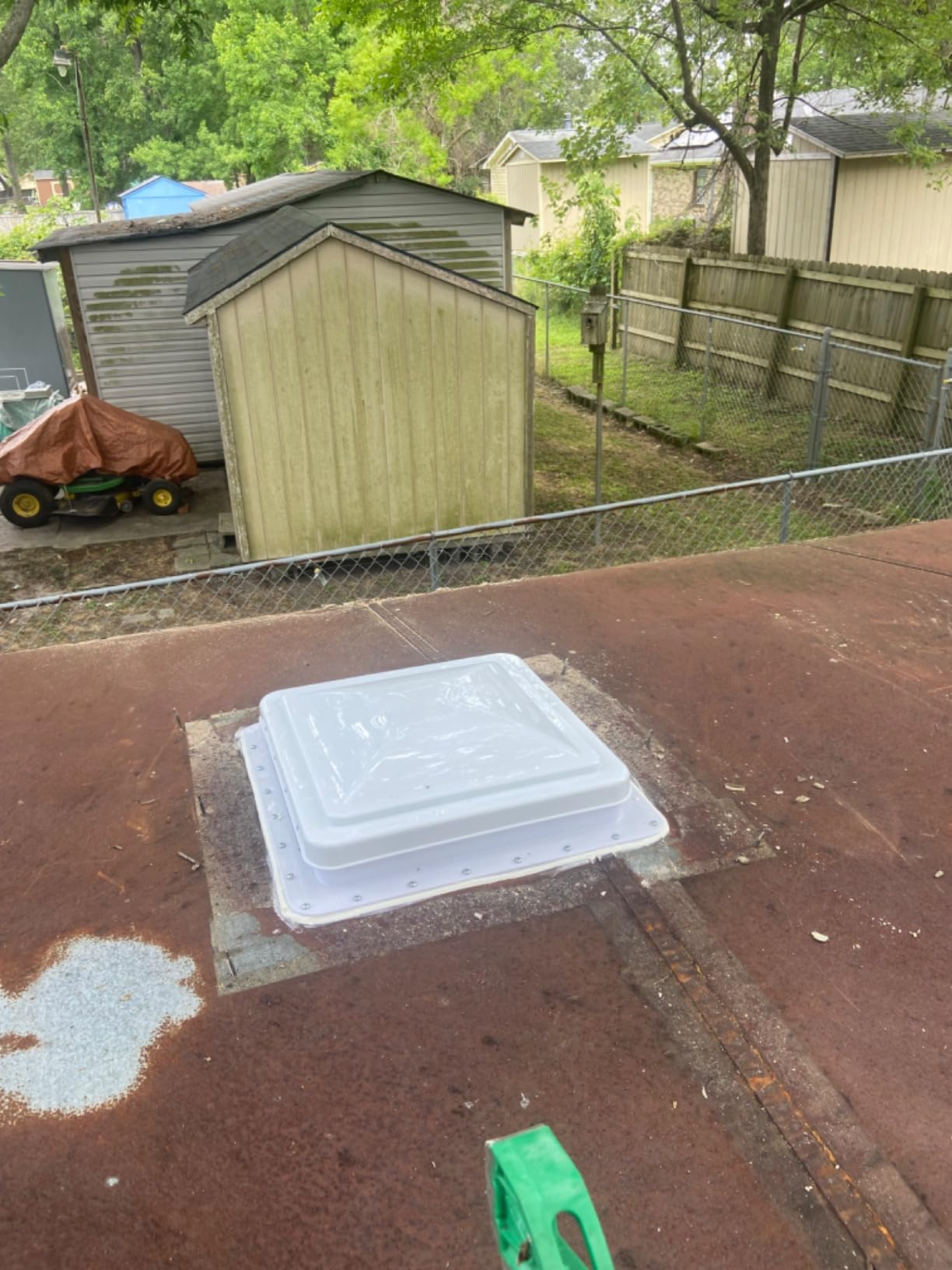
What you should check before buying
Check your roof deck thickness before anything else. If your build is thicker than 2.25 inches, this unit will not seat properly and you should look at a fan with a deeper flange range instead. That single measurement saves a return.
Check that you can reach the switch. A push-button on the ceiling plate is fine in a trailer, but in a high-roof van you will want to run the switch somewhere reachable or step up a chair every time.
Who should skip it
Skip it if maximum airflow is the goal, or if you have a heavy hand and a history of dropping tools onto trim. The thin acrylic and plastic parts are the main reason for the 4.4 average rather than a 4.6.
It is also a single-speed unit with a basic push button, so there is no fine control for sleeping or for gentle circulation. If you want variable output, step up to the six-speed Starvent or the 10-speed Kohree.
6. Starvent 6-Speed Reversible – Best for Raw CFM and Thick Roofs
Starvent RV Roof Vent Fan 6-Speed-Reversible
1100 CFM
6 speeds reversible
17 blades at 5 inch
59.5 dB
Fits 1.16-5.5 inch roofs
Pros
- Six speed settings with reversible intake and exhaust airflow
- Quiet on low speeds and a slow ramp-up that avoids sudden noise jolts
- Works as a ceiling fan with the lid closed
- Widest roof thickness compatibility here at 1.16 to 5.5 inches
- Removable screen cleans from inside the RV
Cons
- 10 percent of reviews are 1-star with reports of speed buttons sticking
- Manual lid crank feels cheap and sits awkwardly in the corner
- Lid rattles when closed too quickly and the screen mesh can rub the blades
The Starvent is the specification standout of this list. It publishes 1100 CFM, runs 17 blades across six reversible speeds at 1350 rpm, and tolerates a roof deck from 1.16 inches all the way to 5.5 inches thick. No other fan here accepts a roof that thick, which makes it the one to look at for a bus conversion or a high-roof van with a layered build.
Owners also rate it well above what its price suggests, with many describing it as equal or better than premium-brand units. The slow ramp-up and ramp-down is a nice engineering touch: the fan accelerates gradually instead of jolting to speed, which is the difference between a fan you start quietly at midnight and one that wakes the whole rig.
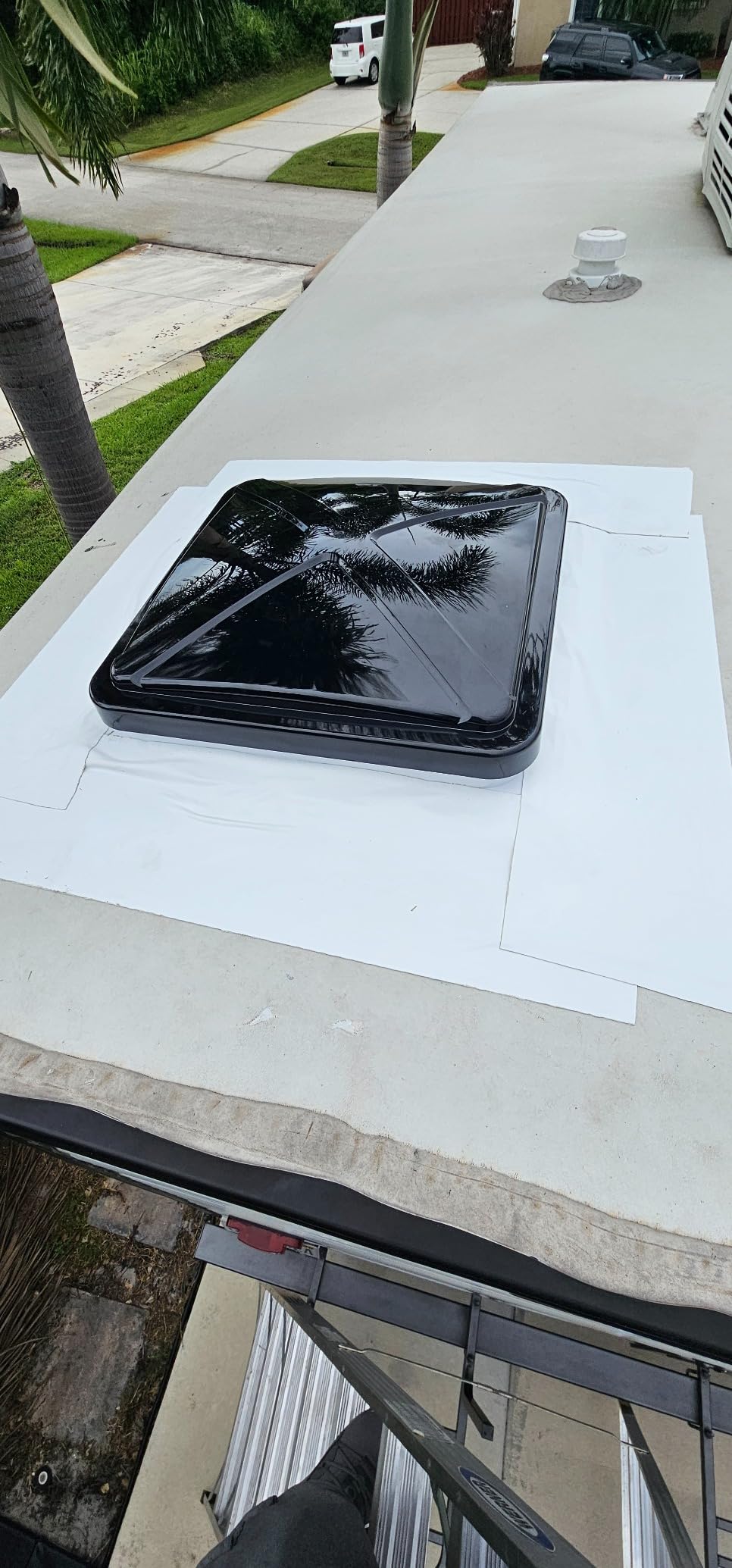
It is also the most polarizing pick here, with a 4.2 average and a 10 percent one-star share, driven by hardware rather than airflow. The complaints are mechanical: push buttons that stick, a manual lid crank that feels inexpensive and is positioned in an awkward corner, and lid rattle if you close it too fast. A few owners also report the screen mesh lifting into the blade path.
One compatibility note: it does not work with standard vent fan rain covers without modification, so this is not the fan to choose if your plan depends on running in rain with the lid up.
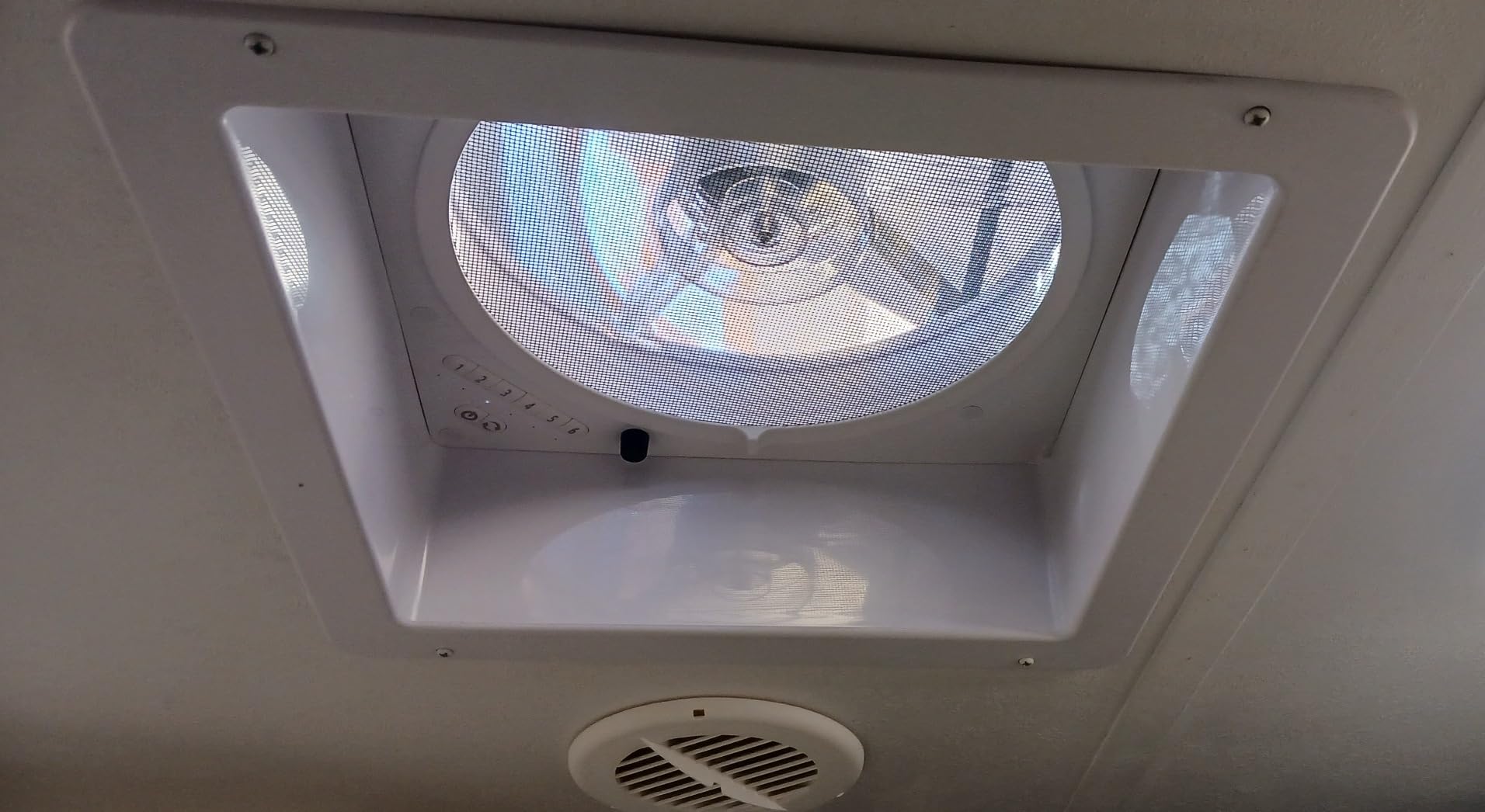
What you should check before buying
Check noise tolerance at speed. The published figure is 59.5 dB, which is the highest number in this roundup, and it is measured under load. Owners are generally happy on low settings, but if the fan will run at full speed in a sleeping space, that is worth testing.
Check the roof thickness band against your build, and this unit will likely be the only one on the list that fits. It also fits standard 14 x 14 inch ceiling openings, so a standard trailer hole works fine.
Who should skip it
Skip it if you need a powered lid or any rain capability, and skip it if you are rough on hardware. The crank and buttons are the weak points, and a stuck speed button is a bad day when you are parked at a site with no power.
It is a 22.2 watt-hour rated unit drawing on a DC motor, so battery use sits in the middle of the pack. Budget-wise it lands between the entry vents and the premium Maxxair models.
7. Heng’s Industries 71112A – Budget Pick for a Basic 12V Vent
HENG’S INDUSTRIES 14″ RV Roof Vent 12 Volt Powered Fan with WHITE Wedge Style Lid – 1” Garnish Ring | 71112A
4W motor
3 blades
Single speed exhaust
Manual crank lid
Fits 14.5 inch rough opening
Pros
- Lowest cost vent and fan assembly in this roundup
- Simple manual crank operation with no electronics to fail
- Very low 4 watt power draw
- Includes a 1 inch interior garnish and trim ring
- White wedge lid matches most RV roof colours
Cons
- Mounting hardware is not included so bring your own caulk and screws
- Single speed and exhaust only airflow
- Needs a 14.5 x 14.5 inch cut-out and the metal flanges are sharp
Heng’s is a name that comes up constantly in owner forums, and the reason is consistent: it is the cheapest dependable way to get a powered vent into a rig. On the Keystone Forums an owner describes the three-speed reversible version in each direction as much cheaper than most, easy to install, and fairly quiet. This specific model is the simpler one-speed sibling, and it earns its 4.5 average from owners who wanted a factory-style replacement and got one.
At 4 watts it sits alongside the Ventline at the bottom of the power draw range, which makes it suitable for continuous background ventilation. The 3-blade rotor is small, so treat this as a moisture and odor control fan rather than a heat remover.

Two practical cautions. The manufacturer states plainly that all vent metal flanges are very sharp, and with an alloy steel flange that is worth taking seriously. And no mounting hardware is included at all. You need to bring your own caulk or putty and screws, which is part of why the box price looks as low as it does.
The cut-out is 14.5 x 14.5 inches, larger than the common 14 inch slot, with a 16.5 inch exterior flange and a 1 inch vertical garnish ring inside. The 3 percent one-star share in the reviews is mostly fit frustration for anyone whose existing opening is not 14.5 inches.
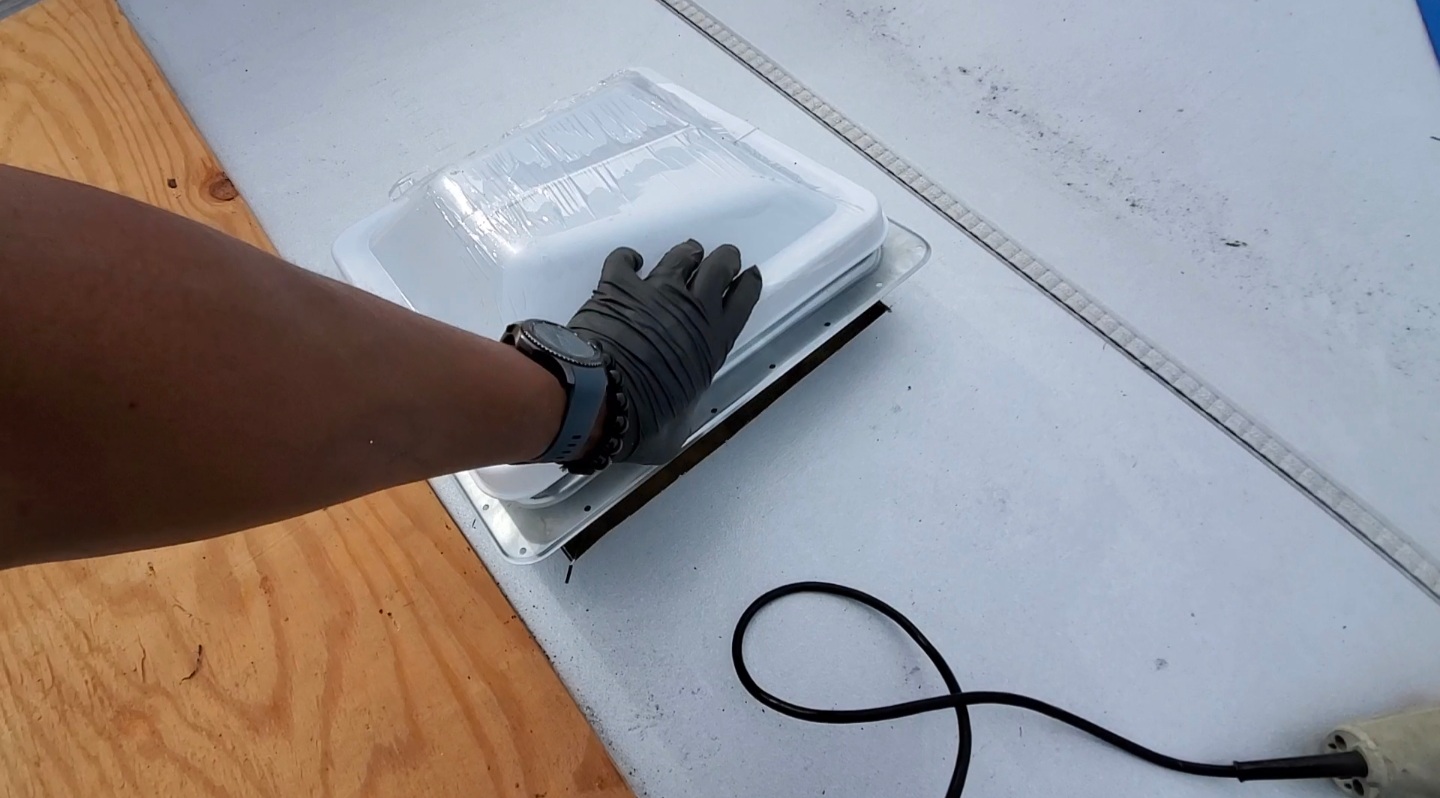
What you should check before buying
Measure your cut-out before ordering. This is the one model in the roundup that does not suit a 14 x 14 inch opening, and that is the most common size in RVs, travel trailers and cargo trailer conversions. If your hole is 14 inches, this is the wrong unit and you should look at the caqeg or the GDDGHS instead.
Plan the sealing materials into your install. There is no putty tape in the box, so budget a trip to a hardware store and a bead of roof-compatible sealant before you climb the ladder.
Who should skip it
Skip it if you want intake mode, variable speed, a remote, or a powered lid. It is exhaust only, one speed, hand-cranked, and that is the whole design.
It is also a poor match for anyone who expects a fan to fix a hot cabin. With 3 small blades and no reverse, the realistic use is pulling moisture out of a bathroom or a closed-up trailer after a long absence.
8. 2012RVAccessories F36AR – Best for Quiet Night Operation
RV Roof Vent Fan 14×14 with 4 Color LED Ambiance Light, Reversible Airflow, Ultra-Quiet 12V (24V Max) Vent Fan with Remote & Rain Sensor
25 dB brushless motor
4 speeds from 3W to 40W
674 CFM
Rain sensor, LED light and remote
Pros
- Extremely quiet brushless motor that is inaudible on low settings
- Four-colour LED ambience lighting for the cabin at night
- Rain sensor closes the lid automatically and owners report it works reliably
- Two lid support arms hold the lid secure in wind
- Three-year parts warranty with lifetime repair support
Cons
- Installation and operating instructions are sparse and unclear
- Short 3 inch interior flange may not reach thicker roof builds and a longer one is sold separately
- Some users report the fan keeps running after the rain sensor closes the lid
Noise is the reason this one exists. The brushless motor runs at 25 dB or less, with the full range spanning 10 to 45 dB across the four settings, and owners describe the low settings as effectively inaudible in a sleeping cabin. If your rig sleeps two people and the fan runs all night, this is the model that will not start an argument.
The four speed settings map to four power levels, which is a rare level of honesty in this category: 3 watts, 10 watts, 20 watts, and 40 watts. You can run the lowest setting for hours on a battery and still move air, then jump to the top setting when you need to clear heat. Published airflow is 674 CFM across seven 4 inch blades.
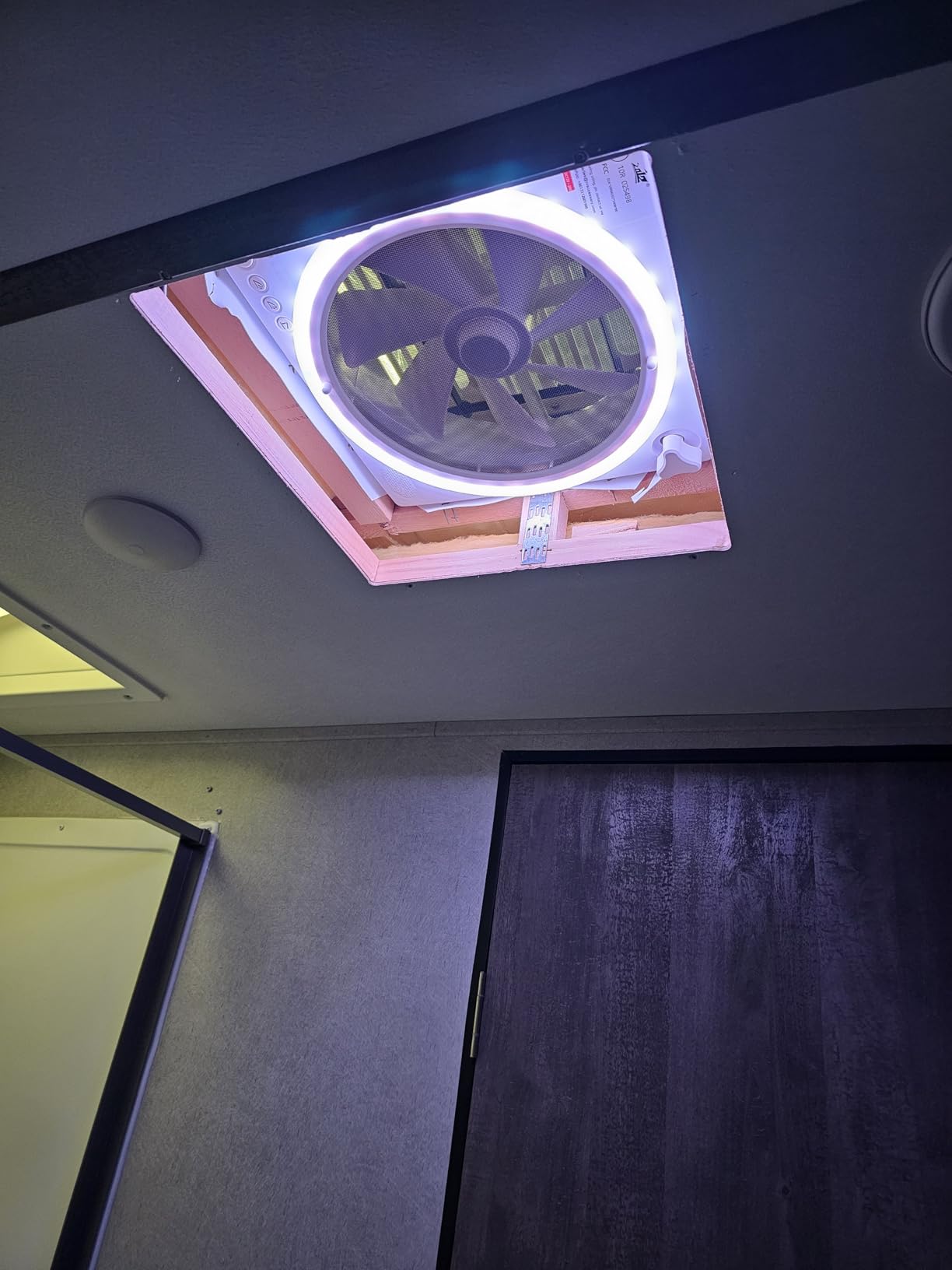
It also fits both 14 x 14 inch US openings and 400 x 400 mm European cut-outs, which makes it one of the more universal options if your rig was built or converted in Europe. Roof thickness range is 1.5 to 3.3 inches, and the adjustable lid opens to 50 degrees on two support arms that owners say hold firm in wind.
Two complaints recur. The documentation is sparse enough that a few owners needed help to work out the wiring, and the 3 inch interior flange is short on builds with a thick roof or a dropped ceiling, so some people had to buy a longer trim skirt. The screen twists out 90 degrees for cleaning, which owners appreciate.
What you should check before buying
Check your total roof and ceiling build thickness against the 1.5 to 3.3 inch range, and measure whether the included 3 inch skirt actually reaches your interior. That is the single most common reason for returns on this model, and the fix is a separate longer flange.
Check your wiring convention. Several owners report black and grey leads rather than the standard red positive and black negative, so confirm polarity at the ceiling switch before powering it up. Reversed polarity is a fast way to convince a brushless motor that it has failed.
Who should skip it
Skip it if daylight through the lid matters to you. The tinted acrylic lid reduces cabin brightness, and while it filters sun, it is not a skylight. The four-colour LED is a partial answer, but it is an artificial one.
It is also worth weighing the 9 percent one-star share, which is driven by the rain sensor not always cutting the fan when it shuts the lid. If unattended rain operation is your main requirement, verify that behaviour for yourself before relying on it.
9. Kohree KR5312 – Best for Smart Controls and Set-and-Forget Operation
Kohree 14″ RV Vent Fan, 12V for Camper Vent, Green
934 CFM
10-speed reversible
25W high mode, 50 dB max
Rain sensor, powered lid and LCD remote
Pros
- Ten speed settings with a published 934 CFM airflow figure
- Motorized powered-lift lid that opens and closes automatically
- Built-in temperature sensor triggers the fan above 78.8F
- Rain sensor closes the lid automatically
- Kit includes extra sealing tape screws and a removable screen
Cons
- Audible beep on every setting change disturbs sleeping companions
- Heaviest unit here at 11 pounds
- Reports of fan blades cracking after several months and a lid actuator that may not prove durable
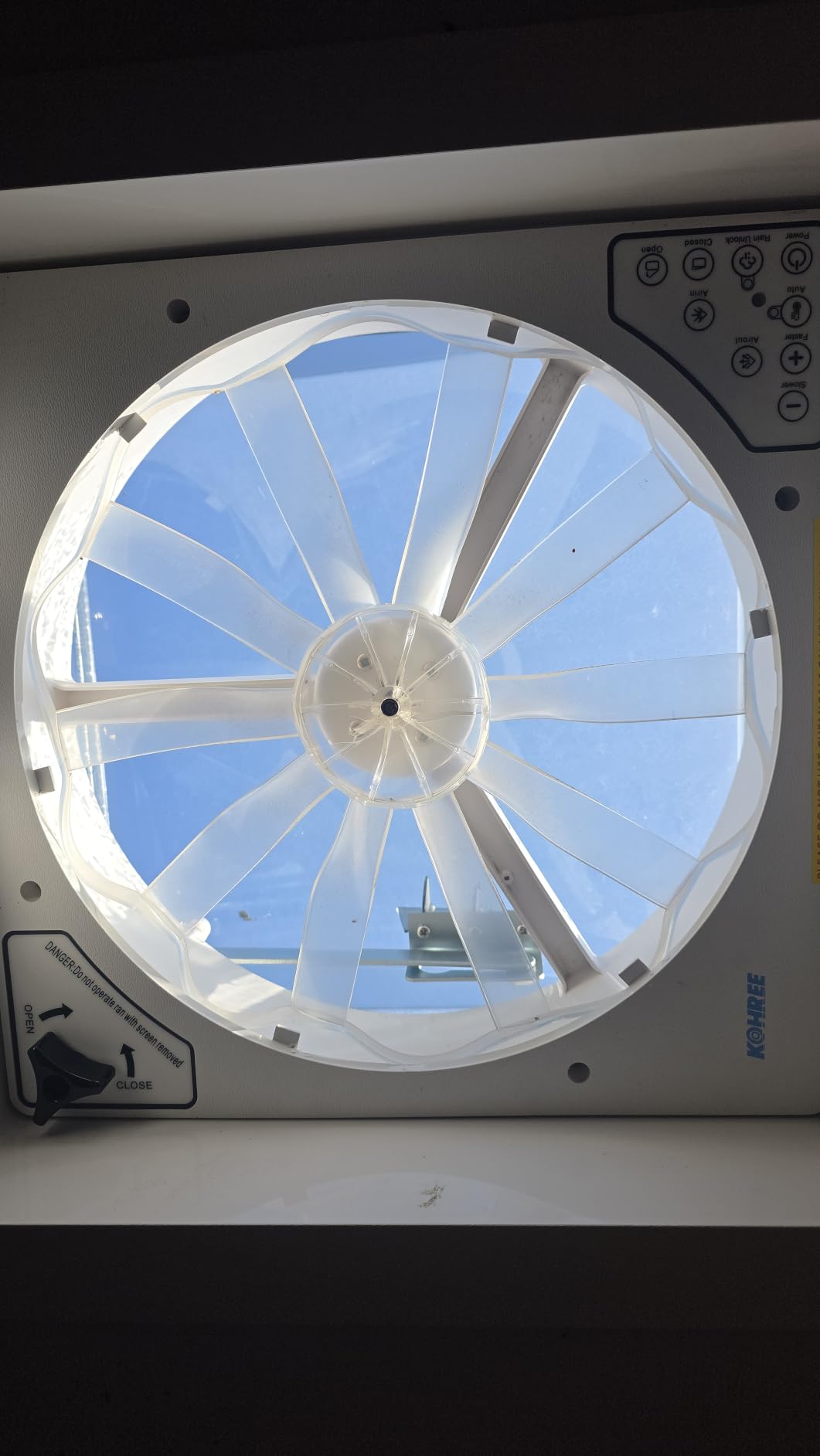
The Kohree is the most automated fan in this roundup and the most divisive. It publishes 934 CFM across 10 speeds with a brushless DC motor drawing 25 watts in high-power mode, and it adds two sensors that almost nothing else here combines: a rain sensor that closes the lid, and a temperature sensor that starts the fan above 78.8F and shuts it off below that threshold. Once configured, it runs itself.
The powered-lift lid is a real convenience. You do not reach up and crank anything; the remote or the interior control opens and closes the lid on command, and the lid tilts to let the fan work as a ceiling fan. Owners report the LCD remote makes speed and direction changes straightforward.
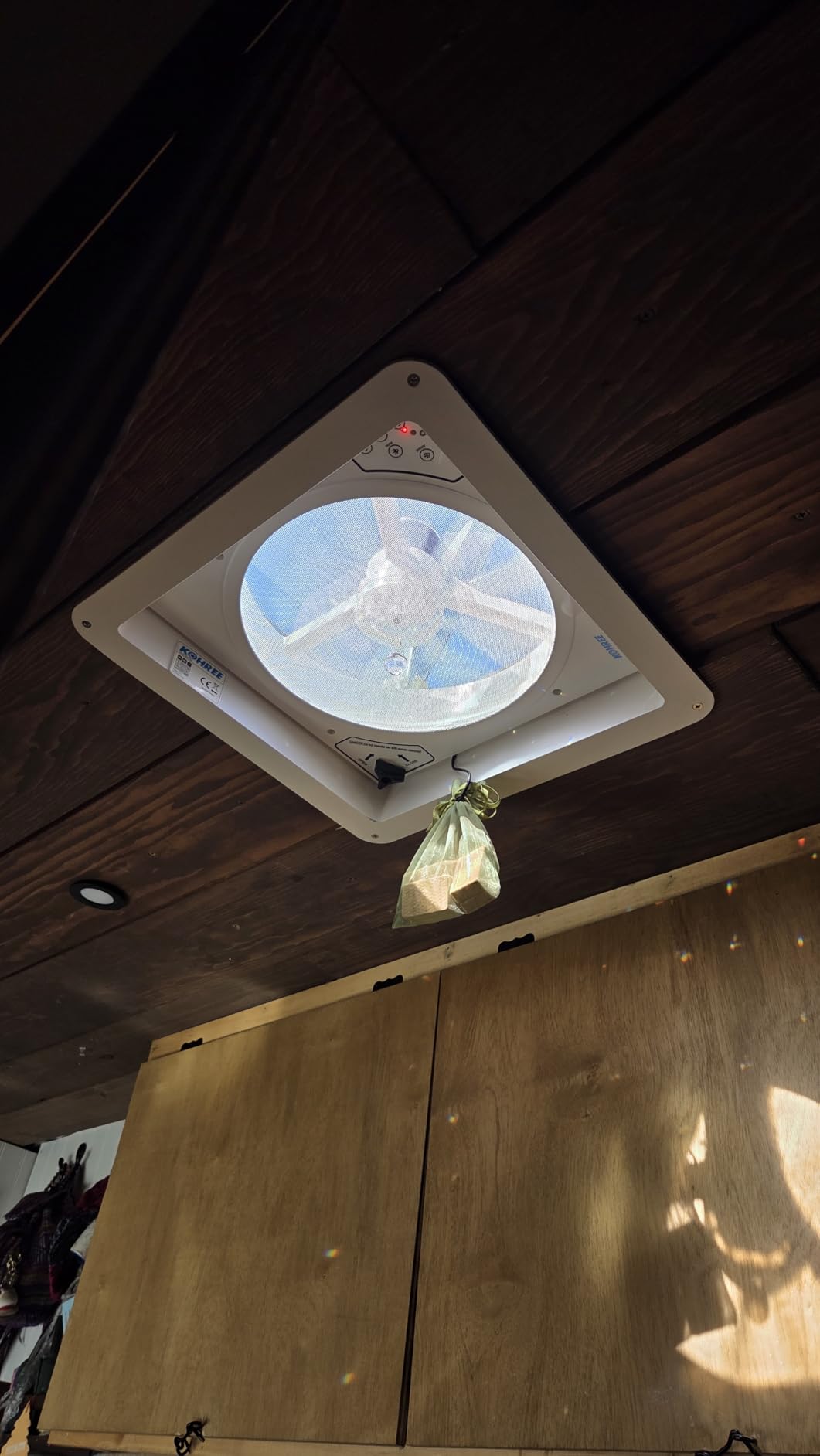
Now the honesty part. This unit carries a 12 percent one-star share, the highest in the roundup, and the complaints are consistent: fan blades cracking after a few months, a manual knob that can detach, a lid actuator built from a single metal bar on three screws, and lid vibration in wind. Several owners also say it outperforms more expensive Dometic units on airflow, so the function is not in question, only the longevity.
It is also the heaviest at 11 pounds, which is a real consideration for a plastic lid in high wind, and the confirmation beep on every setting change is genuinely annoying at night. If you share a sleeping space, turn the sound off or pick something quieter.
What you should check before buying
Check the beep before you commit. Every speed and direction change confirms audibly, and that is fine in daylight and unacceptable at midnight for some people. This is the most common reason owners return it.
Check the roof thickness and confirm the standard 14 x 14 inch opening fit. The package includes screws, extra sealing tape, and a removable mosquito-proof screen, so the consumables are covered. At 50 dB maximum it is not the quietest unit here, though the lower speeds are much better behaved.
Who should skip it
Skip it if you are rough on hardware or expect a fan to last a decade. The durability complaints are not isolated. If you already know you will be replacing this unit in three seasons, buy the manual fan and spend nothing.
It is also heavier and louder than the quiet brushless alternative in this list, so anyone prioritising silence over automation should look there instead. You are trading build quality for sensors and remote control.
10. GDDGHS 14×14 with 12V Fan – Best for Bathroom Vent Replacement
GDDGHS 14×14“ RV Roof Vent with 12V Fan for Camper Trailer
12W motor
6 inch blades
3 speeds
Manual crank to 45 degrees
16 ounce build
Pros
- Complete kit with the vent cover plus 12V fan putty tape and two manual handles
- Fits the standard 14 x 14 inch opening used by most RVs and campers
- Light at only 16 ounces and easy to handle during installation
- Three speed settings for basic airflow control
- Protective screen frame blocks some fallen leaves
Cons
- Very light 16 ounce construction feels insubstantial
- Only a 30-day warranty
- Manual crank with no electric lid and no rain sensor
- Limited 45 degree opening angle
This is the swap for a cracked or hard-open wet bath vent. It comes as a complete 14 x 14 inch roof vent with a 12V fan already installed, plus putty tape and two manual crank handles, so the whole job is a remove-and-reseal. At 16 ounces it is trivially easy to hold over a ladder, which is a bigger deal than it sounds when you are working alone on a roof.
Three speed settings across a 6-blade, 6 inch rotor at 12 watts is more control than the single-speed budget options, and still less than half the draw of the premium reversible units. The manual crank opens the lid to 45 degrees, which is a real opening for airflow rather than a token tilt.
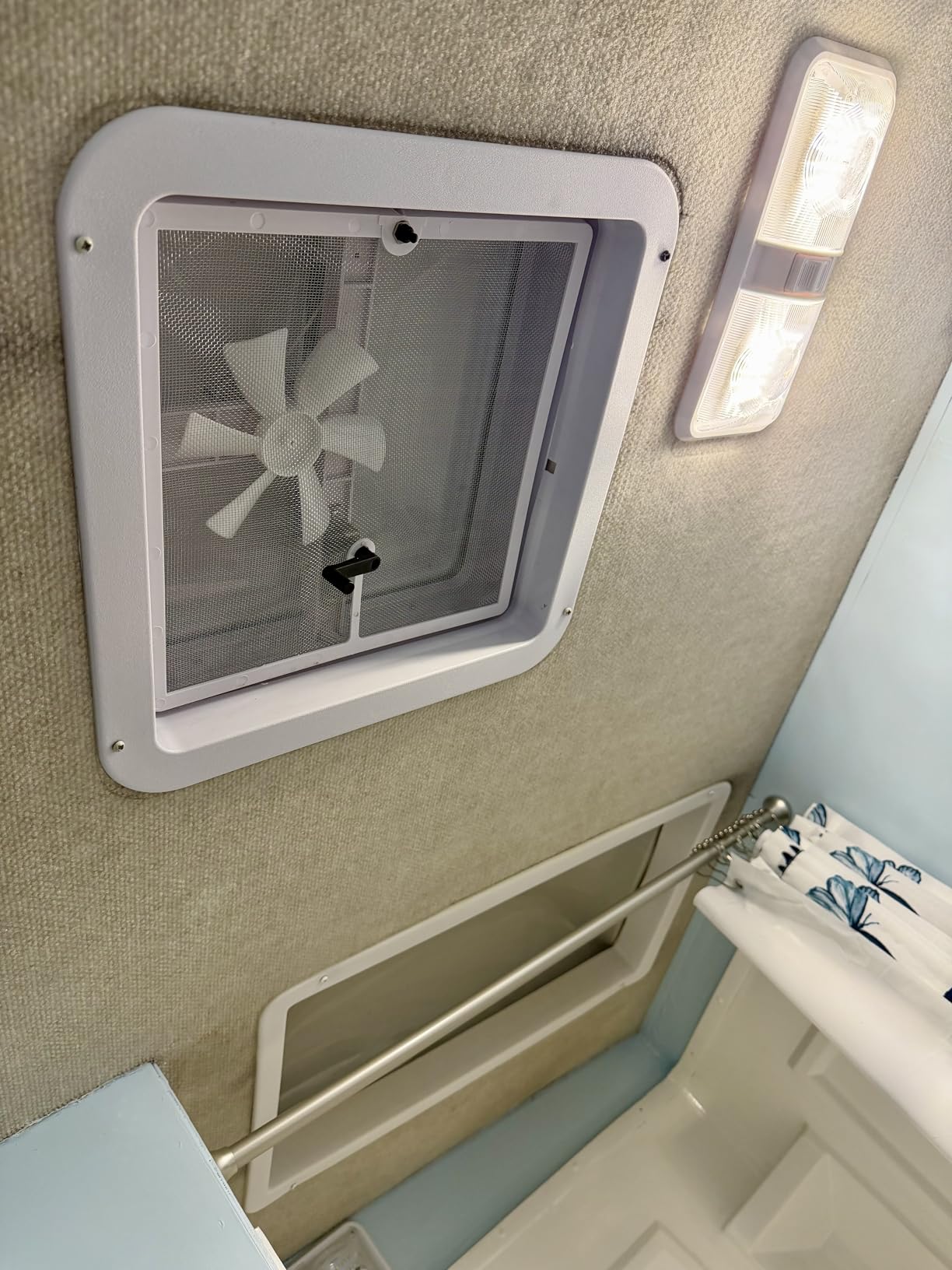
The screen frame is a nice touch for a bathroom location, where hair, insects and lint are the main complaint. The plastic cover is designed to keep out sun and rain with the lid closed, and the included putty tape handles the seal to the roof flange.
The honest limitation is weight and warranty. Sixteen ounces is light for a roof-mounted assembly, and the 30-day warranty is the shortest of anything in this roundup. The 9 percent three-star share reflects the same thing: this is a lightweight unit that does a small job well.

What you should check before buying
Check the warranty length against how long you plan to keep the rig. Thirty days is essentially a defect window, not a service promise, and it is a fair reason to step up to a fan with a multi-year warranty if this is a permanent installation rather than a trailer you will sell.
Check your opening. This is a true 14 x 14 inch universal vent, which is the most common size, so compatibility is easier here than with the 14.25 or 14.5 inch units. Verify roof deck thickness fits the flange before you start.
Who should skip it
Skip it if you want a powered lid, remote control, reverse airflow, or any rain automation. It is a hand-cranked exhaust fan with three speeds and nothing more.
It is also not the choice for a main living area. A 6 inch rotor in a large space will feel underpowered, and owners tend to use these where the volume is small and the job is odor and moisture control.
Power Draw and What It Costs You Off Grid
Here is the number almost nobody publishes in a roundup like this, and it is the one that decides whether you can run your fan all afternoon on a boondock battery. Fan motors run on 12V, so divide the wattage by 12 to get amps. A 60 watt motor pulls 5 amps. A 3.6 watt motor pulls 0.3 amps. On a 100 amp-hour battery bank, ignoring everything else, the 60 watt fan would run for roughly 20 hours and the 3.6 watt fan for closer to 270.
Measured at the published rating, the spread across this roundup is enormous. The Ventline CW001 sits at 3.6 watts, the Heng’s 71112A at 4 watts, the GDDGHS at 12 watts, the RVLOVENT at 18 watts, the Starvent at 22.2 watt-hours, the caqeg at 24 watts, the Kohree at 25 watts in high-power mode, the Maxxfan Plus at 28 watts, the 2012RVAccessories brushless at 40 watts, and the Maxxfan Deluxe at 60 watts.
One model gives you genuinely granular control, which is the underrated feature here. The 2012RVAccessories F36AR runs 3W, 10W, 20W, and 40W across its four speeds, so you can idle it overnight at 3 watts and push it to 40 watts for an hour when you need real ventilation. The Kohree is similar in spirit with ten speeds but does not publish per-speed draw.
Two practical warnings from owner forums. First, vent fans on a shared circuit cause repeated blown 20 amp fuses, and the fix is a dedicated circuit rather than a quieter fan. Second, remember that a high-wattage fan on a low battery means a voltage drop that can make the motor sound strained. If you are sizing a power system, our roundup on power stations for RV camping covers how much headroom you actually want.
The Seven Specs That Actually Decide Airflow
1. Blade diameter and count. This is the number that predicts real airflow better than any CFM claim. The 10-blade, 14 inch rotors here are the serious machines. The 6-blade, 5 to 6 inch rotors move a fraction of the air at full power. Compare swept area, not speed settings.
2. Reversible direction. If you can only exhaust, you are permanently dependent on a second opening for fresh air. Reversible models let you run intake in the morning for a five-minute air change and exhaust during cooking.
3. Real speed count. Ten speeds matters less than the count implies, because the bottom three do most of the useful work quietly. But a listing that claims 10 speeds and delivers 3 is telling you something about the rest of its claims.
4. Rain strategy. A built-in rain cover (Deluxe), a rain sensor (Plus, Kohree, brushless F36AR), or a hand-closed lid all work. They are not equivalent, and only the first two let you leave the fan running unattended in weather.
5. Blade arm support. Dual-arm lids hold stable in wind and at highway speed. Single-arm lids pivot and rattle. On a van that drives fast, dual arms are worth a lot.
6. Motor type and serviceability. Brushless motors last longer than brushed ones, and a fan with a replaceable interlock switch can be repaired rather than thrown away. Sealed products with no spare parts eventually go in the bin.
7. Roof and ceiling fit. Cut-out size, roof deck thickness range, and interior flange depth. These are the three numbers that determine whether the unit actually fits your build, and they are the ones most listings bury.
Replacing an Existing Roof Vent Without Cutting the Roof
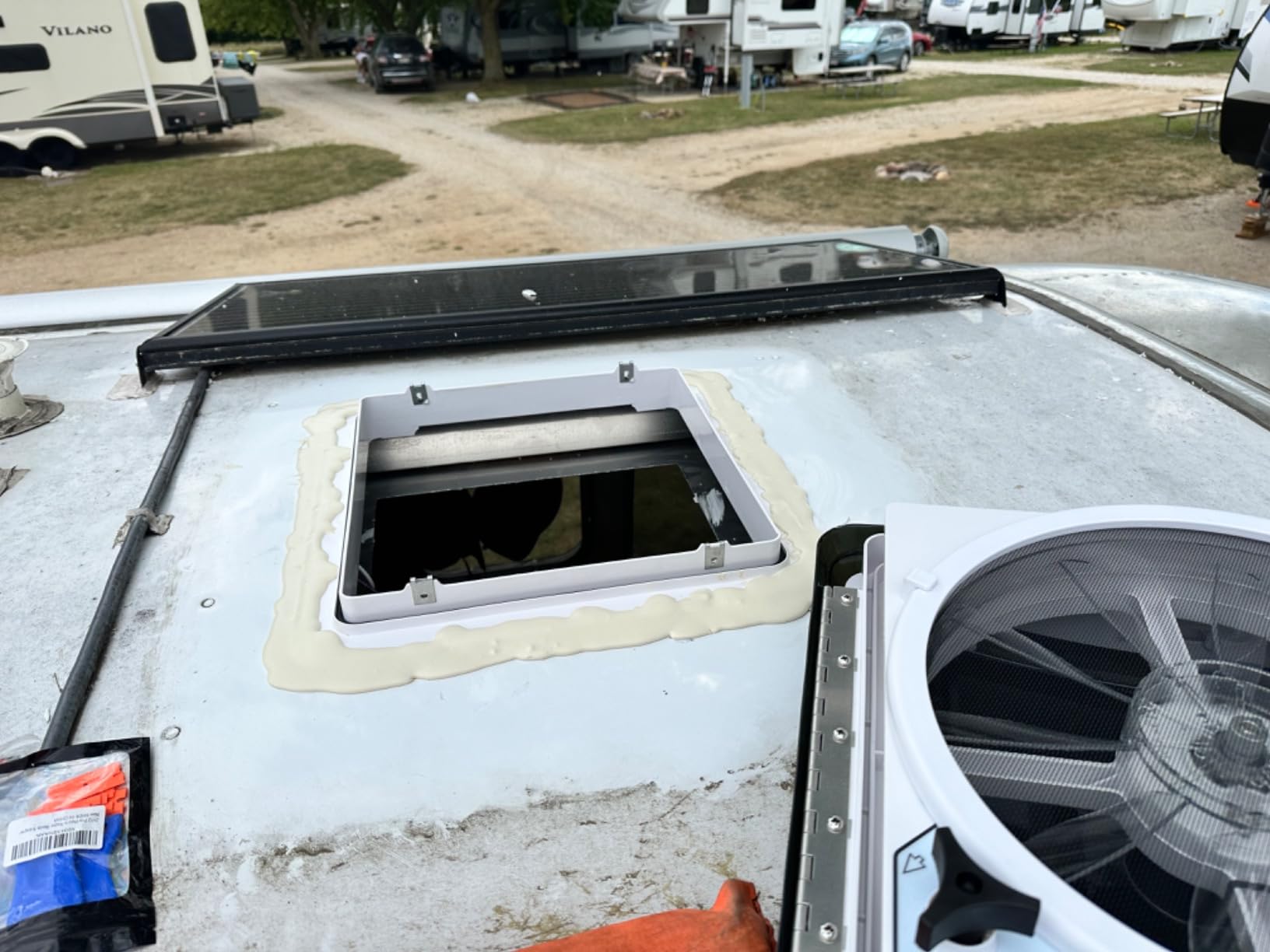
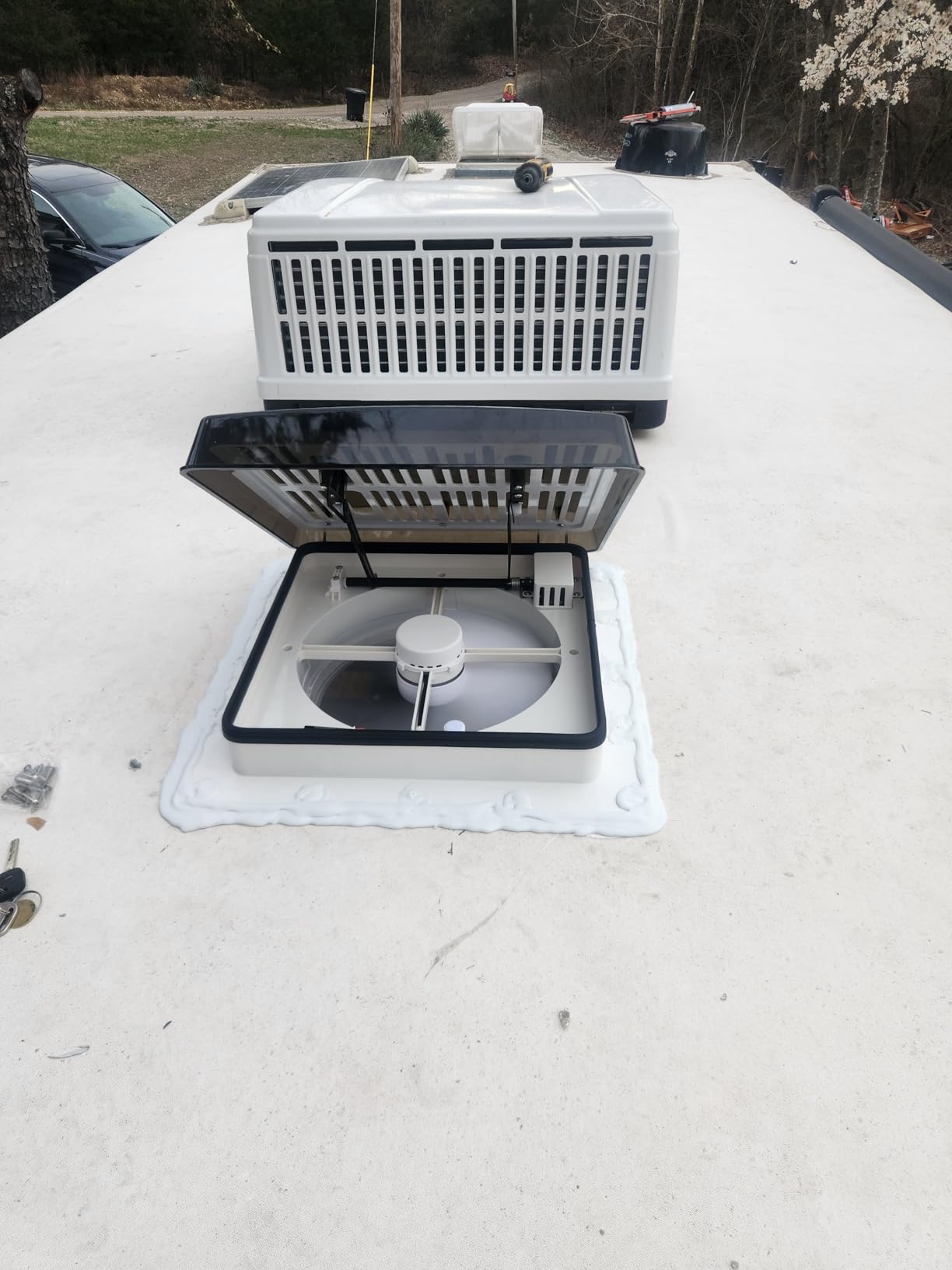
Swapping a vent rather than cutting a new one is the easiest install in this category, and owners report a cracked 12 foot trailer vent replaced in about 30 minutes using new screws, butyl tape, and sealant, with no leak in the rain the next day. The reason is that the standard 14 x 14 inch opening was designed for this swap.
The steps: measure the existing rough opening first, since you will find 14, 14.25, or 14.5 inches. Disconnect the 12V wiring at the ceiling switch and label the positive lead. Remove the interior garnish ring, then the four flange screws, then lift the old vent out. Scrape and dry the roof deck, apply fresh butyl tape or sealant, set the new flange, and torque the screws evenly in a cross pattern so the frame does not bow.
Then run the wiring to the switch, checking polarity before you power up. Fit the interior garnish, trimming it where a sloped roof will not let it sit flat. Finish with a water test: pour water across the flange and check the ceiling from inside before you go to bed. A fuse in the ceiling plate protects the circuit, and 5 amp slow-blow fuses are the common spec on multi-speed units.
Portable 12V Fans vs Roof Vent Fans
Worth separating these, because they solve different problems. A portable 12V fan sits on a table, plugs into a 12V socket or a USB adapter, and moves air across you. It needs no roof hole and can be pointed at whoever is hot. A roof vent fan moves air through the entire volume of the rig, which is what actually clears humidity and cooking odors rather than just chilling the person nearest it.
Use a portable fan for personal circulation and a roof vent for air quality. For indoor models and how they compare, our tower fan testing roundup covers airflow per watt in a different form factor. The rule is simple: a portable fan cannot replace a vent, and a vent fan will not stop you from wanting a portable one on a hot afternoon.
Frequently Asked Questions
What is the best 12 volt fan for an RV?
For most rigs the MAXXAIR Maxxfan Deluxe 00-07500K is the strongest all-round choice: a 10-speed reversible 10-blade motor, a built-in rain cover, a thermostat, and remote control in one assembly, with 1701 owner reviews averaging 4.6 stars. If you want to spend less and prefer manual controls, the RVLOVENT 14 inch manual lift model gives comparable 14 inch 10-blade airflow on only 18 watts. If noise at night is your top concern, the 2012RVAccessories F36AR brushless motor runs at 25 dB or less on its low settings.
What are some good alternatives to the Maxxair fan for RVs and campers?
The strongest alternatives in this roundup are the RVLOVENT 14 inch manual lift fan, which uses a 14 inch 10-blade rotor on 18 watts with no electronics to fail; the Starvent 6-speed reversible unit, which publishes 1100 CFM and fits roof decks from 1.16 to 5.5 inches thick; the Kohree KR5312, which adds a powered lid, a rain sensor, and a temperature sensor that starts the fan above 78.8F; and the 2012RVAccessories F36AR, which pairs a 25 dB brushless motor with a rain sensor and four-colour LED lighting. The Ventline CW001 and the Heng’s 71112A are the low-cost options if you only need background ventilation.
How many watts does a Maxxair fan use?
It depends on which MaxxAir you mean. The Maxxfan Deluxe 00-07500K is rated at 60 watts, which is about 5 amps on a 12V system. The Maxxfan Plus 00-04500K uses a 28 watt DC motor, roughly 2.3 amps, which is why it is the better pick for long boondock runs. Neither figure is unusual for a multi-speed reversible fan, but they are more than ten times the draw of single-speed budget vents such as the 3.6 watt Ventline CW001. Remember that 60 amps of available circuit capacity does not equal a 60 watt fan, and that sharing a vent fan circuit with other ceiling equipment is a common cause of blown fuses.
Do I need a vent fan if I have an RV air conditioner?
Yes, and they do different jobs. A roof air conditioner cools and dehumidifies the air that is already inside, and it works best on a closed envelope, so running it with a roof vent open wastes efficiency. A vent fan is for everything the air conditioner cannot handle: clearing cooking smoke and propane fumes, moving stale air out without running the compressor, and pulling humidity down in a parked trailer where the air conditioner is off. The practical pattern is to run the air conditioner with the vents closed during peak sun, then open a vent and run the fan hard once you are parked in the shade.
How do I replace an RV roof vent fan?
First measure the existing rough opening, which is usually 14 x 14 inches but is sometimes 14.25 or 14.5 inches. Disconnect and label the 12V wiring at the ceiling switch, remove the interior garnish ring, remove the four flange screws, and lift out the old vent. Clean and dry the roof deck, apply fresh butyl tape or sealant, set the new flange, and tighten the screws evenly in a cross pattern. Connect the wiring, confirm polarity before powering up, and fit the garnish, trimming it if the roof slope prevents it sitting flat. Most owners complete this in about 30 minutes. Pour water over the flange afterwards to confirm the seal before the first real rain.
The Best RV Vent Fan for Airflow, Final Word
After ten comparisons, the best rv vent fans for airflow come down to blade size, reversibility, and how much you care about noise. The MAXXAIR Maxxfan Deluxe 00-07500K wins on the strength of a 14 inch 10-blade reversible motor, a built-in rain cover, and 1701 reviews averaging 4.6 stars. It is the pick we would install in almost any rig without asking follow-up questions.
Below it, the RVLOVENT 14 inch manual lift model gives you the same class of blade on 18 watts with no electronics to fail, which makes it the best value in the roundup and the right answer for anyone who prefers a pull chain to an LCD remote. The Maxxfan Plus 00-04500K is the pick for climates that actually rain while you are parked, thanks to its automatic lid closure. The 2012RVAccessories F36AR is the one to buy if a fan running overnight would keep you awake.
Whatever you choose, measure the roof opening first, confirm you have a second opening for make-up air, and give it a water test before the first storm. Then start the fan, pick the lowest speed that clears the humidity, and let it run.