
Most people buy their first telescope for the wrong reason. They read a box that says 700x magnification, assume bigger numbers mean a better view, and end up with a shaky aluminium tripod and an 80mm lens that turns Saturn into an orange smudge. We spent the last few months working through nine of the most-reviewed beginner telescopes on the market, comparing aperture, mount stability, glass coatings, included eyepieces and what real owners say after a few months of use. This is what survived.
If you only have two minutes, here is the short answer. The Koolpte 80mm reflector is the best all-round starter kit in this group, because it ships with a phone adapter, a carrying bag, a Barlow lens and a wireless remote, and it holds a 4.3 rating across nearly 4000 reviews without breaking the bank. The Celestron AstroMaster 70AZ is the better buy if your priority is sharp, colour-true views of the Moon and the planets, since a refractor needs no collimation and doubles as a daytime spotting scope. And if you genuinely want to see galaxies and nebulae rather than just the lunar surface, the Celestron AstroMaster 130EQ gives you 130mm of aperture on an equatorial mount, which is the smallest step up that actually changes what is visible in the eyepiece.
Our criteria were deliberately boring, because boring criteria are what separate a good telescope from a disappointing one. We ranked each scope on aperture first, then mount steadiness, then optical quality per millimetre of glass, then what is actually in the box, and finally the consistency of owner feedback. Aperture is the diameter of the main lens or mirror, and it governs how much light the instrument gathers, which is what sets both the faintest object you can see and the level of detail you can resolve on the planets. Magnification, by contrast, is just a ratio you can reach with the right eyepiece. A scope that claims 700x through a shaky mount delivers less usable detail than one claiming 120x on a solid base.
Two safety notes before we go any further, because both trip people up every year. Never point any telescope at the Sun unless you have a certified filter that covers the full front aperture; a filter that clips over the eyepiece or that sits over a smaller lens than the objective can cook the optics and damage your eye. And if you plan to look at the Moon, start with a 25mm eyepiece before dropping to 10mm, because a full Moon at high power will blind you to detail you did not know was there.
Table of Contents
Our Top 3 Picks: Telescope (September 2026)
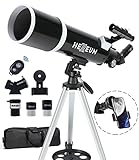
Koolpte 80mm Reflector
- 80mm multi-coated aperture
- Phone adapter and wireless remote
- 25mm and 10mm eyepieces plus 3x Barlow
- Tool-free assembly
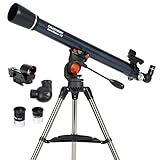
Celestron AstroMaster 70AZ
- Fully coated 70mm achromatic refractor
- No collimation needed
- StarPointer red dot finder
- Two-year warranty

Celestron AstroMaster 130EQ
- 130mm Newtonian reflector
- German equatorial mount with slow-motion knobs
- 650mm focal length f/5
- TheSkyX software included
The Best Telescopes at a Glance in 2026
Every scope below is in the lineup, ordered from the most complete starter package to the most capable optics. The features column pulls the spec that matters most for each one, so you can scan the list and eliminate the wrong purchases fast.
| Product | Specifications | Action |
|---|---|---|
| Koolpte 80mm Reflector |
|
Check Latest Price |
| Celestron AstroMaster 70AZ |
|
Check Latest Price |
| Celestron AstroMaster 130EQ |
|
Check Latest Price |
 Celestron NexStar 8SE Celestron NexStar 8SE |
|
Check Latest Price |
 Gskyer 600x90mm Refractor Gskyer 600x90mm Refractor |
|
Check Latest Price |
 Hawkko 90mm Refractor Hawkko 90mm Refractor |
|
Check Latest Price |
 MEEZAA 150EQ Newtonian MEEZAA 150EQ Newtonian |
|
Check Latest Price |
 Sky-Watcher Classic 200 Dobsonian Sky-Watcher Classic 200 Dobsonian |
|
Check Latest Price |
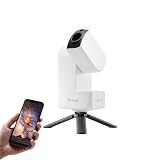 ZWO Seestar S30 Pro ZWO Seestar S30 Pro |
|
Check Latest Price |
1. Koolpte 80mm Reflector – The Best All-Round Starter Kit
Koolpte Telescope for Adults & Beginner Astronomers – 80mm Aperture 600mm Fully Multi-Coated High Transmission Coatings with AZ Mount Tripod Phone Adapter, Carrying Bag, Wireless Control.
80mm aperture
600mm focal length f/6.7
25mm and 10mm eyepieces
Phone adapter and remote
Pros
- Holds 4.3 out of 5 across nearly 4000 reviews
- Tool-free assembly a beginner can finish in minutes
- Phone adapter
- wireless remote and carrying bag in the box
- 3x Barlow lens plus 5x24 reflex finder included
Cons
- 80mm aperture shows deep-sky objects as faint haze
- Altitude-azimuth mount needs manual repositioning
- Supplied magnifications outrun what the aperture supports
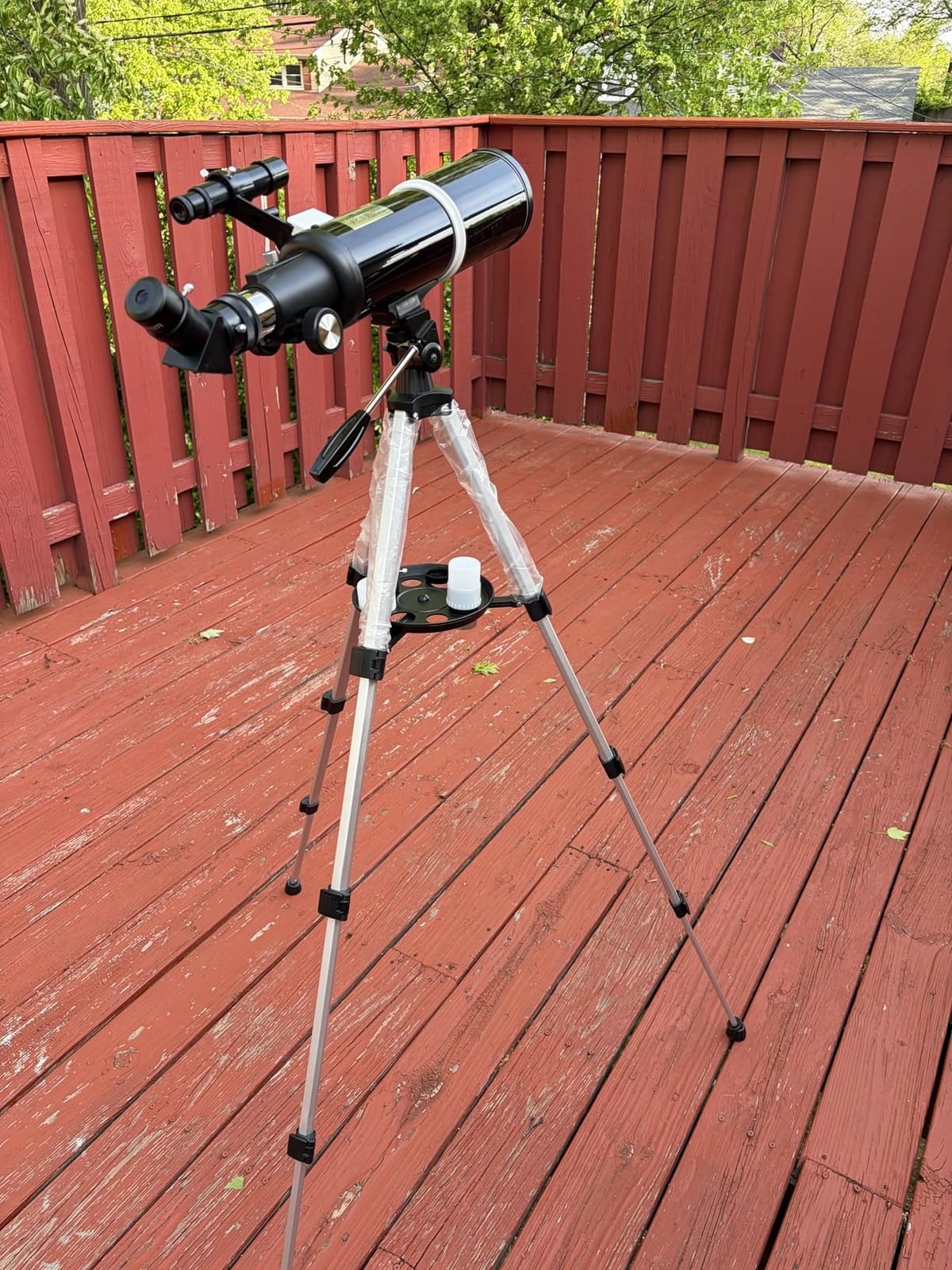
This is the scope I hand to friends who want to try astronomy without committing to a hobby. The optical tube runs on a straightforward altazimuth mount with an adjustable aluminium tripod, and the whole thing breaks down into a kit that fits in the supplied carrying bag. Assembly genuinely is tool-free, which matters more than it sounds, because the first session with a telescope that needs a hex key is the first session that ends early.
What makes it our top pick is the box contents. You get two eyepieces at 24x and 60x, a 3x Barlow lens, a 5×24 reflex finder, a phone adapter, a wireless hand remote and the bag, and the 600mm focal length at f/6.7 gives a wide, forgiving field on the Moon. Owners repeatedly mention the no-tool design and the included phone adapter as the reason they kept the scope instead of returning it.
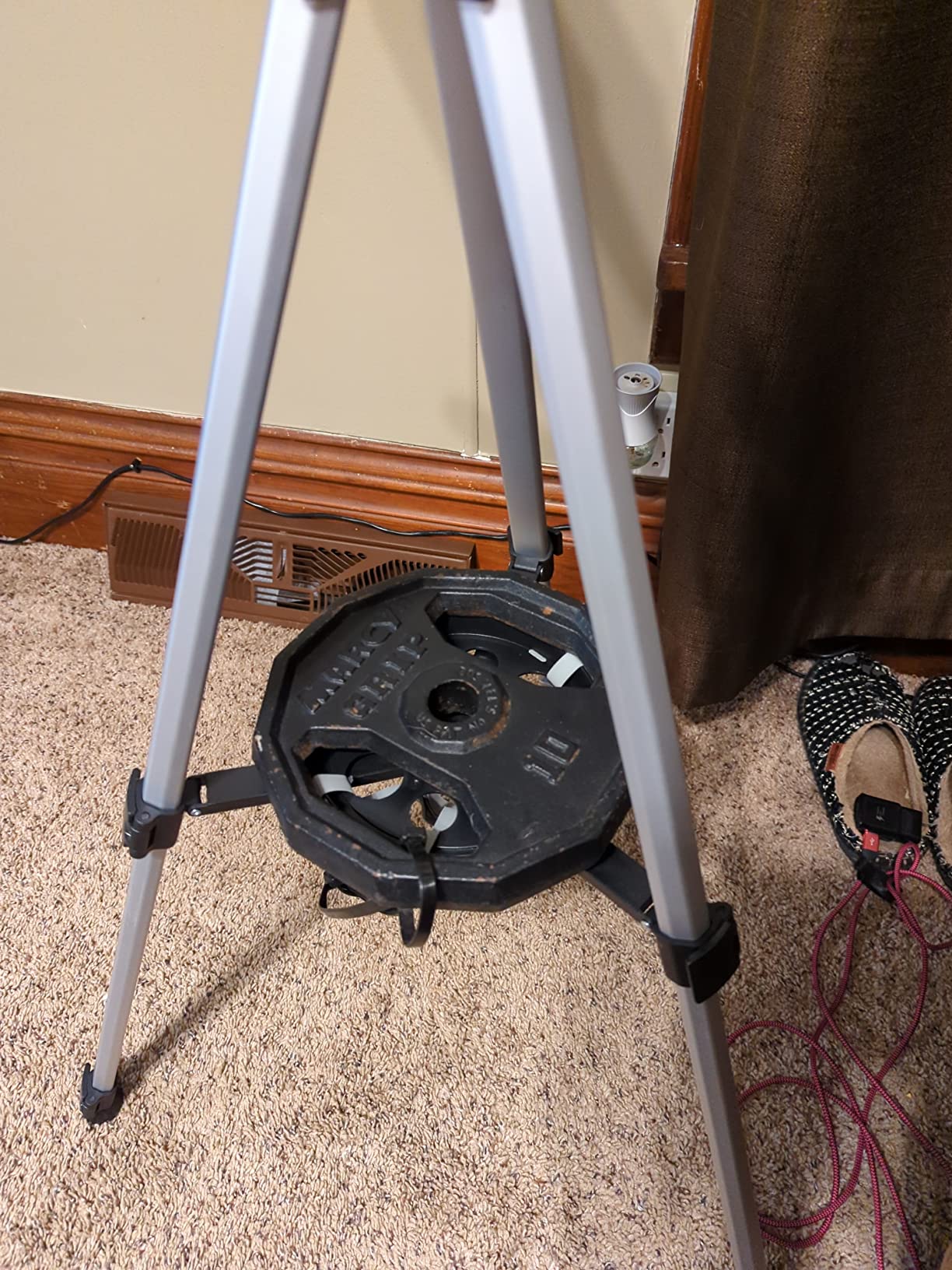
The honest limitation is aperture, and no amount of included accessories changes that. Eighty millimetres of light-gathering power is enough to show you craters, mountains and the terminator line on the lunar surface, and it will give you a coloured dot for Jupiter’s largest moons. It will not show you Saturn’s rings cleanly, and deep-sky galaxies will stay as vague smudges no matter which eyepiece you fit.
The other thing to know is that this is a manual altazimuth mount. Saturn does not stay where you left it, so every few minutes you will need to push the tube yourself. That is honestly not a bad way to learn, since you end up learning the sky rather than a menu, but if you want the scope to hold a target while you watch a long time-lapse, look at the equatorial options further down this page.
Why the 4.3 rating from nearly 4000 reviews matters here
That is the largest review base of any scope in this roundup, and it means the rating is not a lucky handful of early buyers. When a rating holds steady across thousands of purchases spanning several years of production, the recurring praise and the recurring complaints are both reliable. Buyers consistently praise the value and the setup, and consistently note the aperture ceiling.
Who should skip it
Skip it if your goal is deep-sky observing from a dark site, or if you already know you want to photograph the sky. Also skip it if you are buying for a child who will lose interest in a few weeks, because a 90mm or 130mm aperture gives a much more dramatic first view of Saturn and will hold attention longer.
2. Celestron AstroMaster 70AZ – Best Refractor for the Moon and Planets
Celestron AstroMaster 70AZ Refractor Telescope for Moon & Planet Viewing
70mm coated achromatic refractor
900mm focal length f/12.8
StarPointer red dot finder
10.8 pounds
Pros
- No collimation maintenance
- ever
- Two-year limited warranty and free planetarium software
- Doubles as a daytime wildlife and landmark scope
- Sharp bright lunar views with visible craters and ridges
Cons
- Included 10mm eyepiece has short eye relief
- Altitude adjustment can be jerky at high power
- Deep-sky objects appear as faint grey smudges
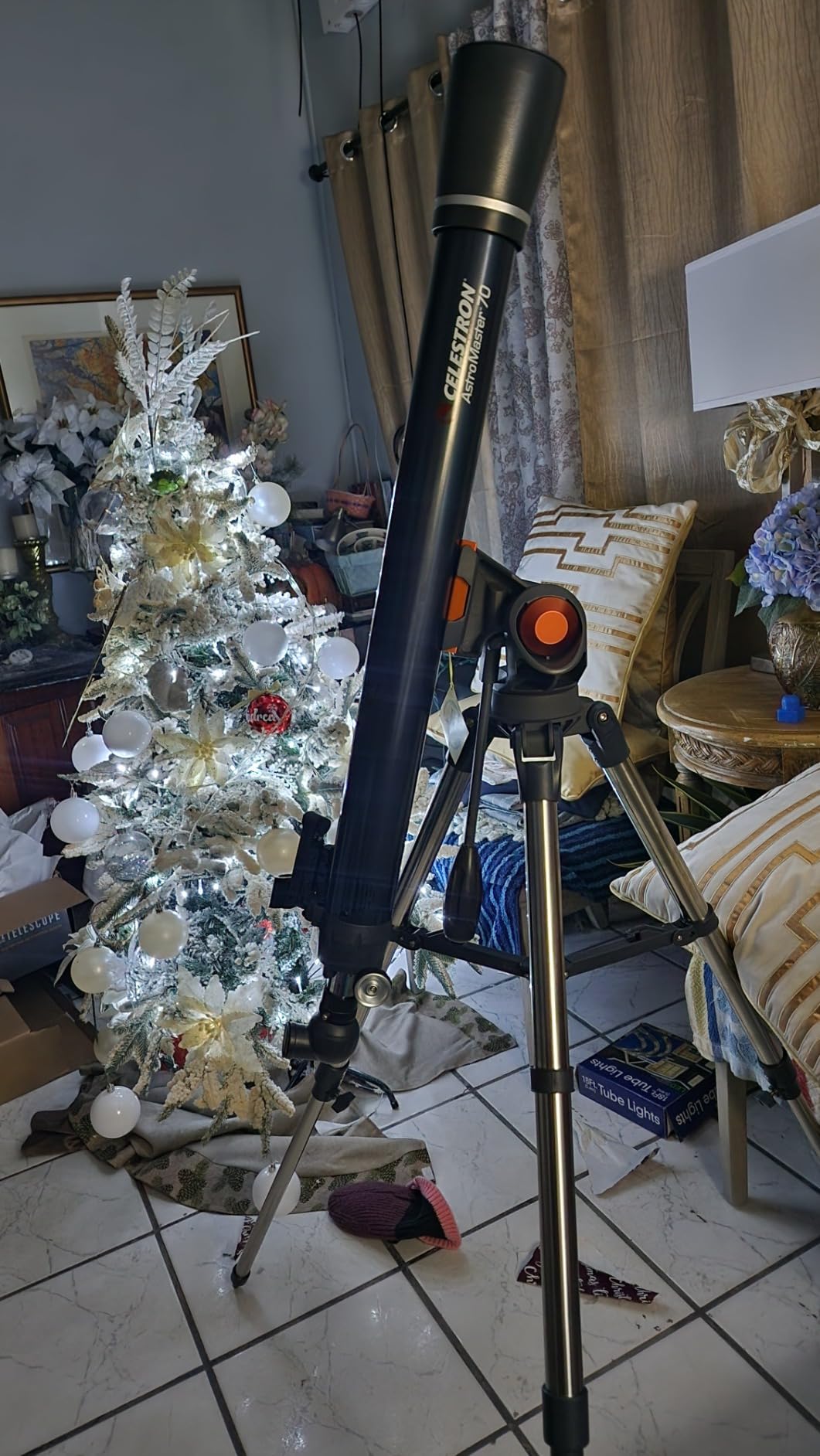
A refractor bends light through a glass objective instead of bouncing it off a mirror, and the practical consequence for a beginner is that there is nothing to align. No collimation means no laser collimator, no fiddling with secondary mirror screws, and no dark-room session wondering whether you have made the image worse. If the idea of maintaining optics puts you off, this is the design that removes the problem entirely.
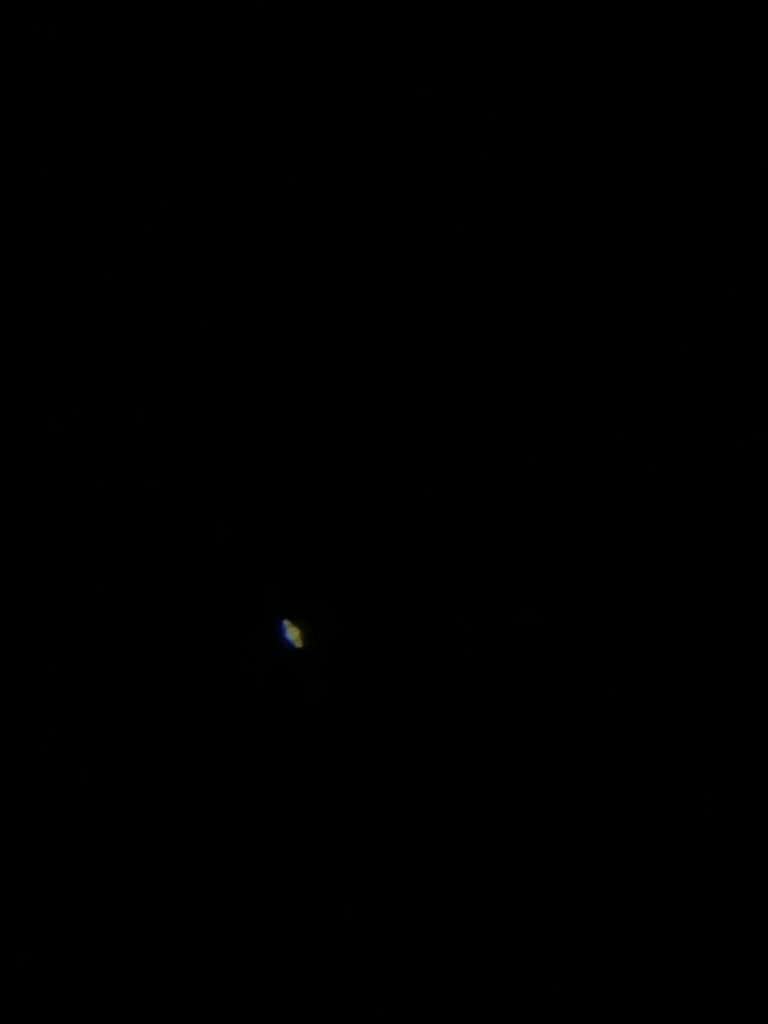
Owners report assembling it in under ten minutes and then getting straight to lunar detail, with craters and ridges resolving clearly. The 900mm focal length at f/12.8 gives a long, narrow, high-contrast view that suits the Moon and the inner planets, and the included 20mm and 10mm eyepieces with an erect-image diagonal are enough to see Saturn’s rings and Jupiter’s four Galilean moons without buying anything else.
Reviewers flag the supplied 10mm eyepiece most often, and the complaint is eye relief rather than optical quality. A short eye relief means your eyebrow presses against the eyepiece barrel, which is uncomfortable and makes it harder to centre the star. Budget for a longer, better-corrected planetary eyepiece in your first year rather than trying to make the bundled one work.
The mount uses a panhandle for pointing, and while it is perfectly adequate for scanning the sky, fine altitude adjustment can feel jerky when you are working at high power on Jupiter. It is a minor irritation, not a dealbreaker, and the same mechanism is what keeps the whole package down to 10.8 pounds, which is genuinely easy to carry out of a door and set up on a patio.
What 70mm aperture can and cannot show you
Seventy millimetres is not enough aperture for galaxies, globular clusters or most nebulae, and pretending otherwise wastes your time. It is comfortably enough for the Moon in any lighting, for the phases of Venus, for Jupiter’s belts and its four moons, and for Saturn’s rings as a small but unmistakable ellipse that resolves further as you gain experience.
Who should skip it
Skip it if your observing list is dominated by galaxies and nebulae, or if you want a single instrument that can do daytime birdwatching and deep-sky observing equally well. The 70mm aperture wins on low maintenance and portability, not on raw light gathering, and no eyepiece upgrade will change that ceiling.
3. Celestron AstroMaster 130EQ – Best for Deep-Sky Beginners
Celestron AstroMaster 130EQ Telescope for Deep-Sky Beginners
130mm Newtonian reflector
650mm focal length f/5
German equatorial mount
17 pounds
Pros
- 130mm aperture shows real deep-sky structure
- Slow-motion knobs make manual tracking practical
- Aluminum and silicon dioxide coated mirrors
- Two-year warranty with TheSkyX software included
Cons
- Newtonian optics need periodic collimation
- StarPointer red dot finder is fiddly to align
- Tripod vibrates and drifts when fully extended
Going from 70mm to 130mm is the single biggest jump in what you can see, and that is why this sits third even though it is not the cheapest. Light gathering scales with the square of aperture, so this reflector collects roughly three and a half times what the 70AZ does. Owners mention resolving the Andromeda galaxy, the Virgo cluster and nebulae in Orion as the moment the hobby clicked for them.
The German equatorial mount is the part that matters here. Rather than pivoting left and right, it tilts the tube to align with the Earth’s axis, so when you turn the right-ascension slow-motion knob the target drifts smoothly across the field instead of jumping out of frame. That single feature turns deep-sky observing from a frustrating hunt into something you can actually sit and enjoy.
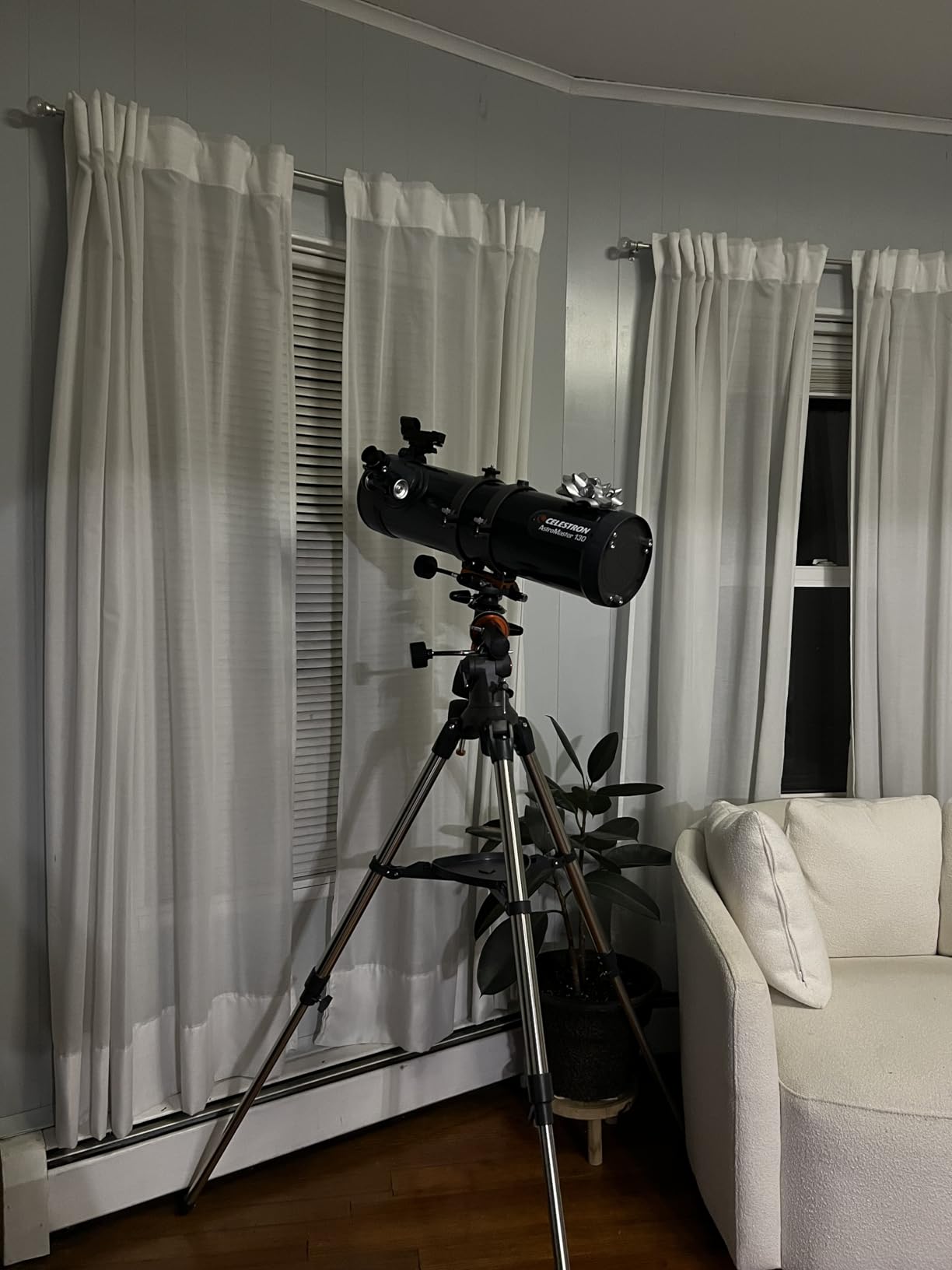
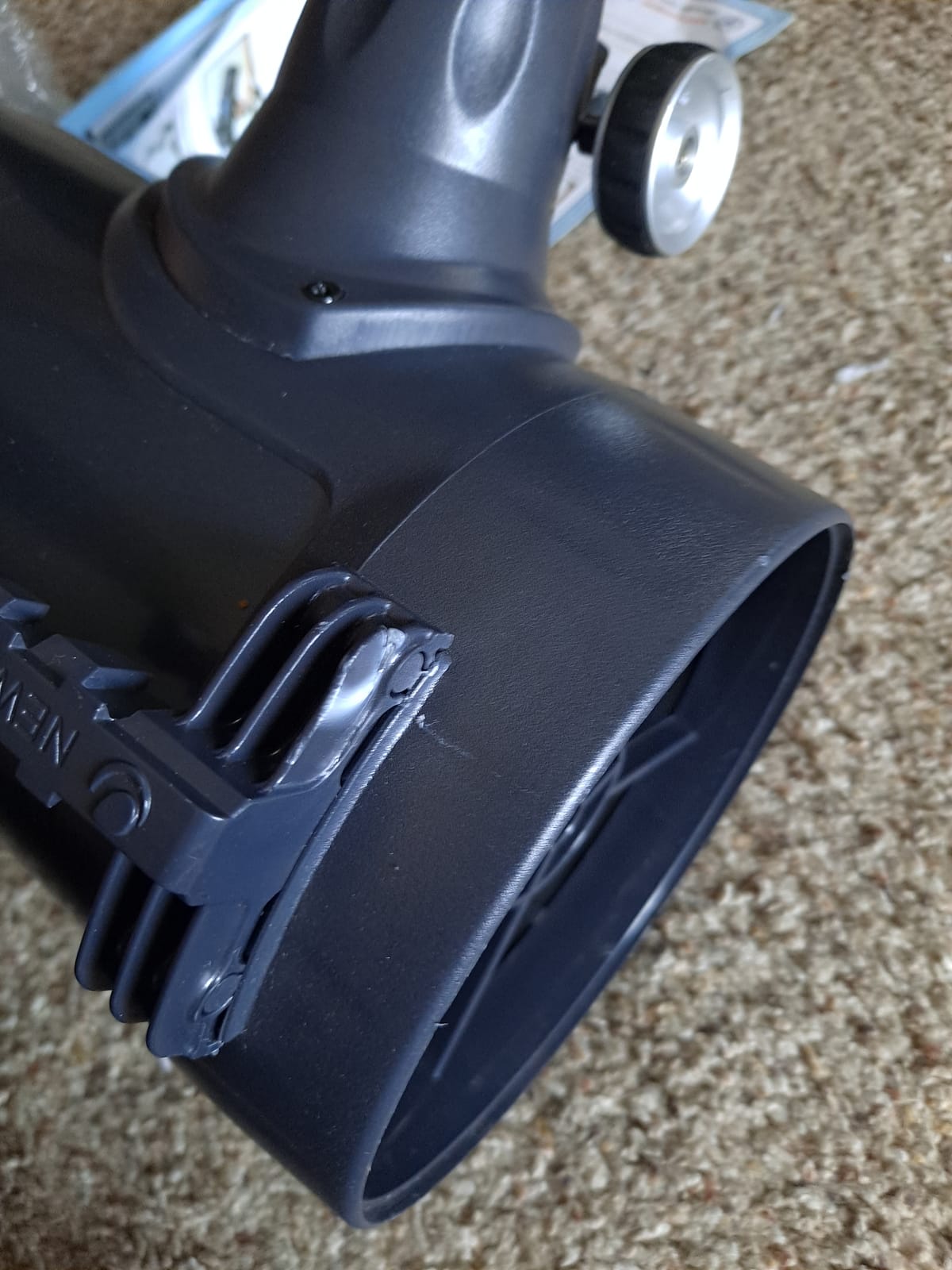
It is a Newtonian reflector, which means you are looking at the image at the side of the tube rather than the back, and it means the mirrors need collimating. Collimation is not scary, but it is a real recurring task, and the absence of a collimation cap or laser in the box means buying one is likely. Budget an evening for the first alignment.
Two further caveats show up repeatedly in owner feedback. The bundled StarPointer red dot finder is genuinely hard to align accurately, and the tripod tends to vibrate and drift when all three legs are fully extended, so tightening them a quarter turn and keeping one leg slightly shorter helps. At 17 pounds assembled, this is also the point where carrying the whole thing in one go stops being convenient.
Whether the equatorial mount is worth the extra weight
For visual deep-sky work, yes. The slow-motion controls are the reason this scope earns its place in the lineup, because without them a Newtonian at 130mm is a lot of light going to waste while you chase it back to the centre of the field. If you are sticking strictly to the Moon and planets, the simpler altazimuth setups are lighter and more forgiving.
Who should skip it
Skip it if you have zero interest in ever touching a collimation tool, or if you want to photograph deep-sky objects. Long-exposure imaging needs a tracking mount that holds for minutes, and a German equatorial mount on a lightweight tripod is not that. It is a visual instrument first and foremost.
4. Celestron NexStar 8SE – Best Computerized GoTo Telescope
Celestron NexStar 8SE Computerized Telescope – Schmidt-Cassegrain
8 inch Schmidt-Cassegrain
2032mm focal length f/10
NexStar+ GoTo hand control
SkyAlign alignment
Pros
- Eight inches of aperture in a compact tube
- GoTo database of more than 40000 objects
- SkyAlign works from any three bright objects
- Far easier to transport than an 8 inch Dobsonian
Cons
- Runs on batteries or external power
- not included
- Single fork arm can be finicky in heavy dew
- Cost sits far above entry-level scopes
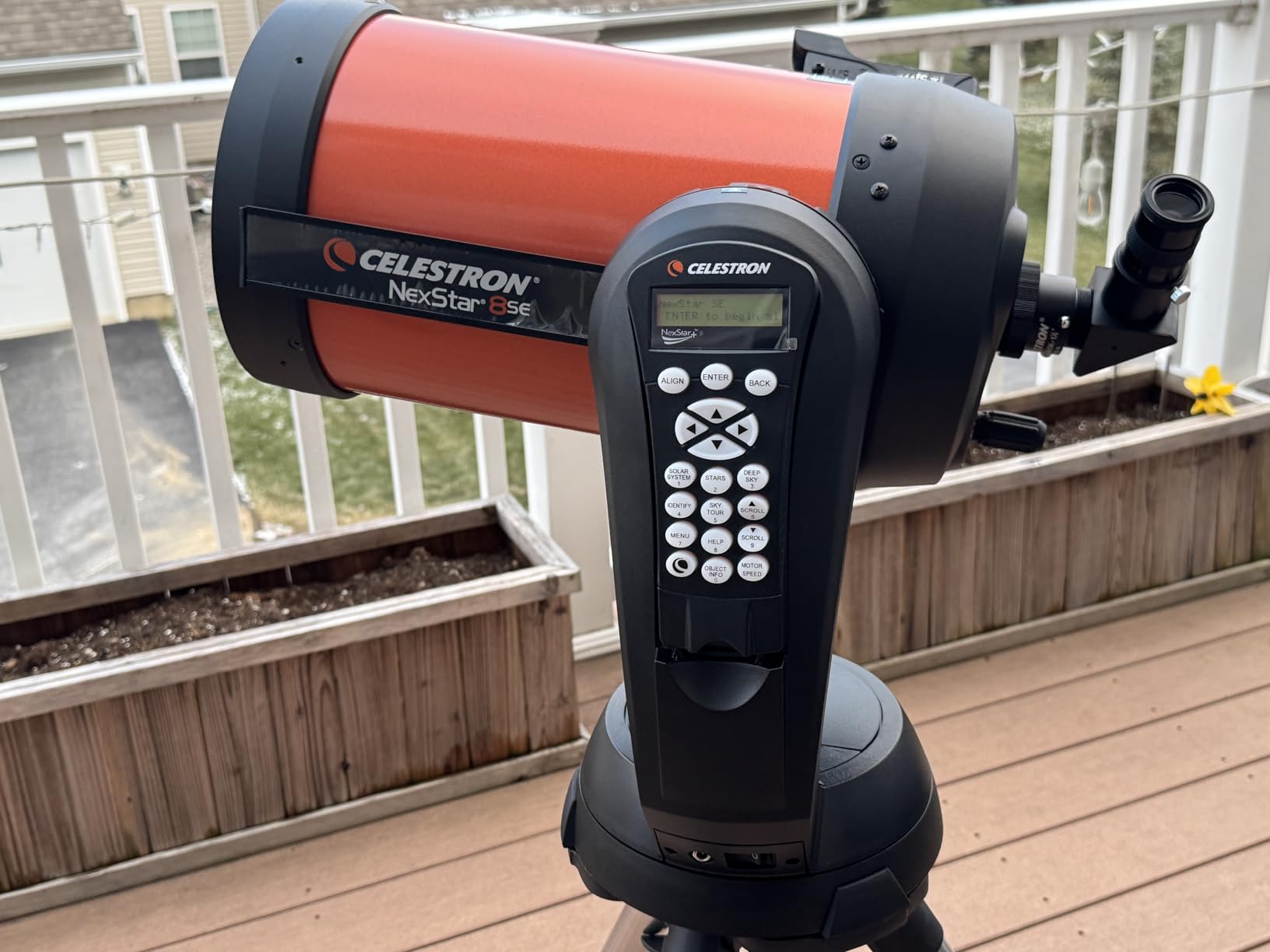
A Schmidt-Cassegrain folds a long 2032mm focal length into a tube just 43.2cm long, using a primary mirror and a convex secondary at the front. Paired with a single fork arm GoTo mount, you get 8 inches of aperture in a package you can actually lift onto a car seat, which is the compromise an 8 inch Dobsonian never manages.
The computerized side is the reason this is on the list. The NexStar+ hand control carries a database of more than 40,000 objects, the mount slews to targets and tracks them, and SkyAlign gets you operational by centring any three bright objects in the sky. You do not need to know a single star name, and under light pollution where only the brightest things are visible, being pointed at the right part of the sky is a genuine advantage.
Owners say the value of the pointing system becomes obvious once you move past the Moon and start hunting fainter targets by hand. Many also point out that the tube is upgradeable, so the same setup can grow with Celestron’s wider accessory range as your skills improve, rather than locking you into one closed system.
The caveats are practical rather than optical. It runs on eight AA batteries, an AC adapter or a PowerTank, and none of those power sources come in the box, so plan for a session-length power supply before a long evening. The single fork arm mount can also behave oddly in heavy dew, and the price gap between this and an entry-level refractor is large enough that it is a step up, not a starting point.
What 8 inches of aperture actually unlocks
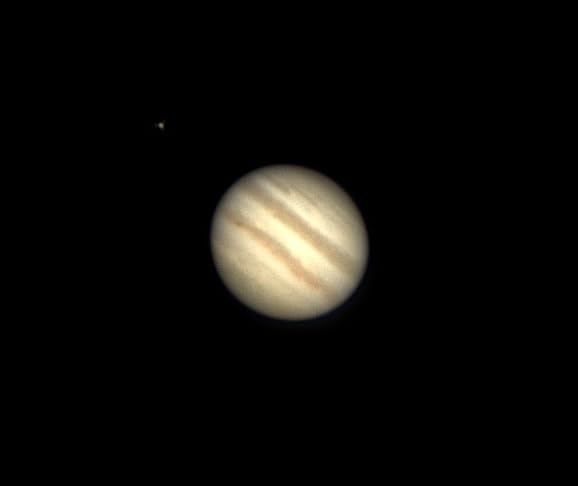
At this aperture the limit reaches around magnitude 14 under good skies, which is well past the Pointer Sisters cluster, several globulars, the Ring Nebula and the brighter Messier galaxies. The Moon shows detail at 300x that a 130mm Newtonian cannot approach, and Jupiter’s belts resolve into banding with a good eyepiece. Owners consistently describe this as the point where the hobby stops feeling like a beginner’s compromise.
Who should skip it
Skip it if your interest is planetary-only, because at f/10 an 8 inch scope is built for long focal length views where vibration and seeing become the limiting factors rather than aperture. Also skip it if you are starting out, since the electronics add a learning curve before you have learned the sky itself, and most newcomers get more out of a simpler manual scope.
5. Gskyer 600x90mm Refractor – Best Telescope for Kids and Families
Gskyer Telescope 600x90mm AZ Astronomical Refractor Telescope for Adults
90mm coated aperture
600mm focal length f/6.7
Three eyepieces and a Barlow
48 degree erecting prism
Pros
- Largest aperture in the budget refractor class
- Three eyepieces plus a 3x Barlow give a wide range
- 48 degree erecting prism for daytime wildlife viewing
- Rated 4.2 with a top bestseller rank in refractors
Cons
- Advertised magnification range outruns the aperture
- Alt-azimuth mount needs manual repositioning
- Tripod less stable at full extension
Ninety millimetres of aperture puts this refractor ahead of most of what a family can buy as a single first instrument, and 600mm of focal length at f/6.7 keeps the image reasonably bright and contrasty. Owners typically describe it as an affordable first real refractor, with satisfying detail on the lunar surface and colour that stays reasonably neutral.
The accessory list is unusually generous for the tier. You get three eyepieces at 24x, 60x and 120x, a 3x Barlow lens, a 6×30 finderscope, and a 48 degree erecting BAK7 prism that turns the image the right way up for daytime use. That prism is the detail most families value, because it makes the scope usable for birds, distant landmarks and boats rather than being a night-only instrument.
Be realistic about the 120x eyepiece. Ninety millimetres of aperture cannot support that magnification usefully, and pushing past roughly twice the aperture in millimetres gives you a dim, soft, shaky image rather than more detail. The honest useful range on this scope runs from wide-field views of the Moon down to mid-range planetary detail, and buying one good planetary eyepiece beats using the bundled highest-power option.
The tripod is adjustable from about 31.5 to 49 inches, which lets adults view standing and children view seated from the same setup, and the whole thing is tool-free to assemble. Some owners report the tripod being less stable at full extension, so setting it up with a shorter leg is the safer default for children.
What this scope does for a family that shares one instrument
The 48 degree erecting prism plus the smartphone-free simplicity of the mount means one person can hand it around at a star party without re-aligning anything. The wide field at low power also makes it the easiest of this group for showing several people the Moon at once, since you can sweep the terminator across the whole disc and point out craters as they appear.
Who should skip it
Skip it if you want galaxies and nebulae, since 90mm of achromatic glass will show you very little beyond the brightest targets. Also consider the Celestron AstroMaster 70AZ instead if the tripod wobble is a dealbreaker for your setup, because the shared ergonomics are similar but the mount feels more solid.
6. Hawkko 90mm Refractor – Best Long-Focal-Length Scope for the Moon
Hawkko 90mm Aperture 900mm Telescope for Adults High Powered – Professional Multi-Coated Refractor Telescope for Astronomy Beginners (36X-270X) with AZ Mount, Phone Adapter and Carry Bag
90mm multi-coated aperture
900mm focal length f/10
Stainless steel tripod
Phone adapter included
Pros
- f/10 long focal length reduces chromatic aberration
- Stainless steel tripod feels more solid than typical budget mounts
- Complete kit with phone adapter
- tray and carry bag
- Assembles in about 15 minutes
Cons
- Advertised 36x to 270x range limited by aperture
- Zenith mirror is cheaply made
- Alt-azimuth mount needs manual tracking
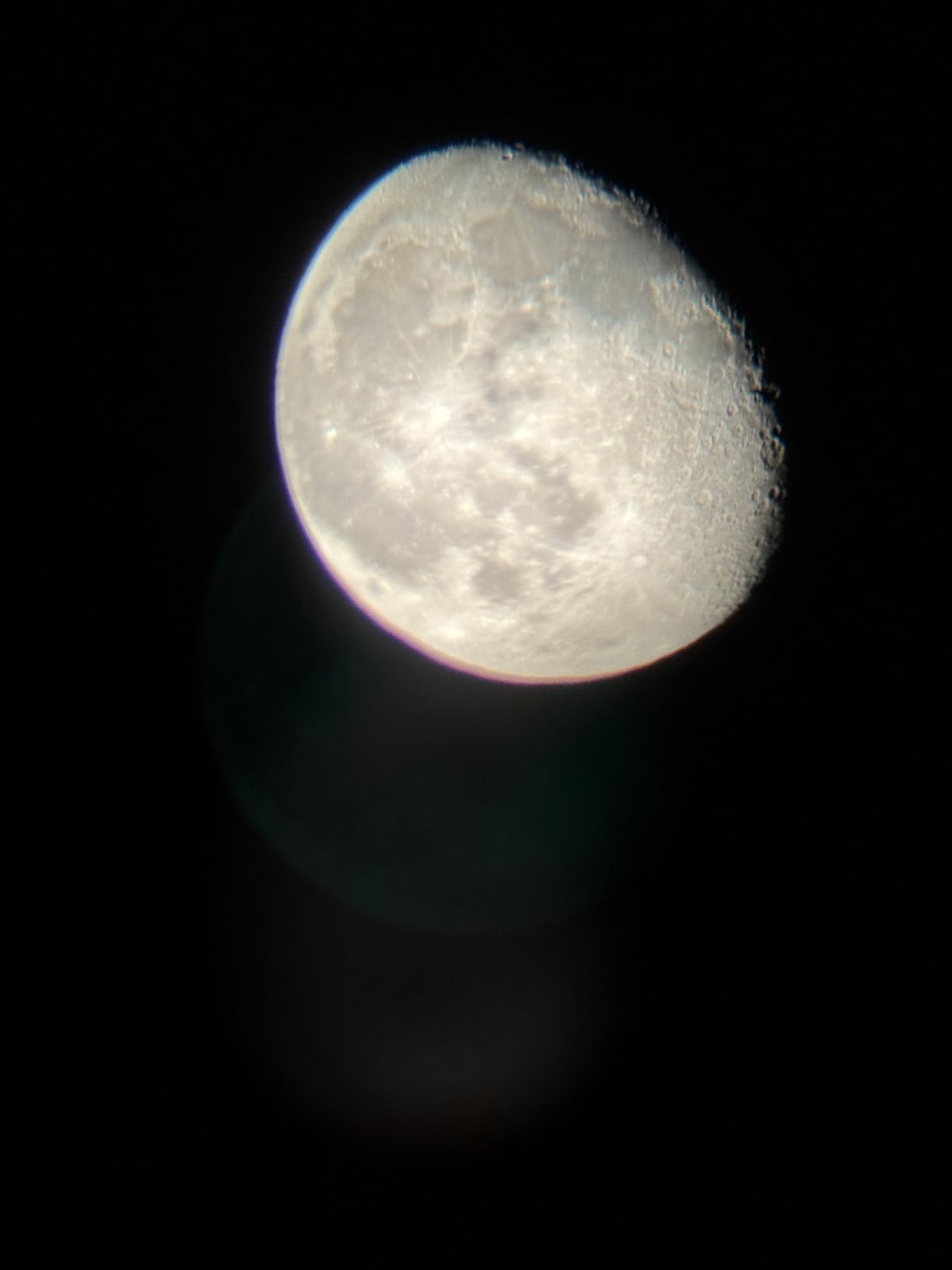
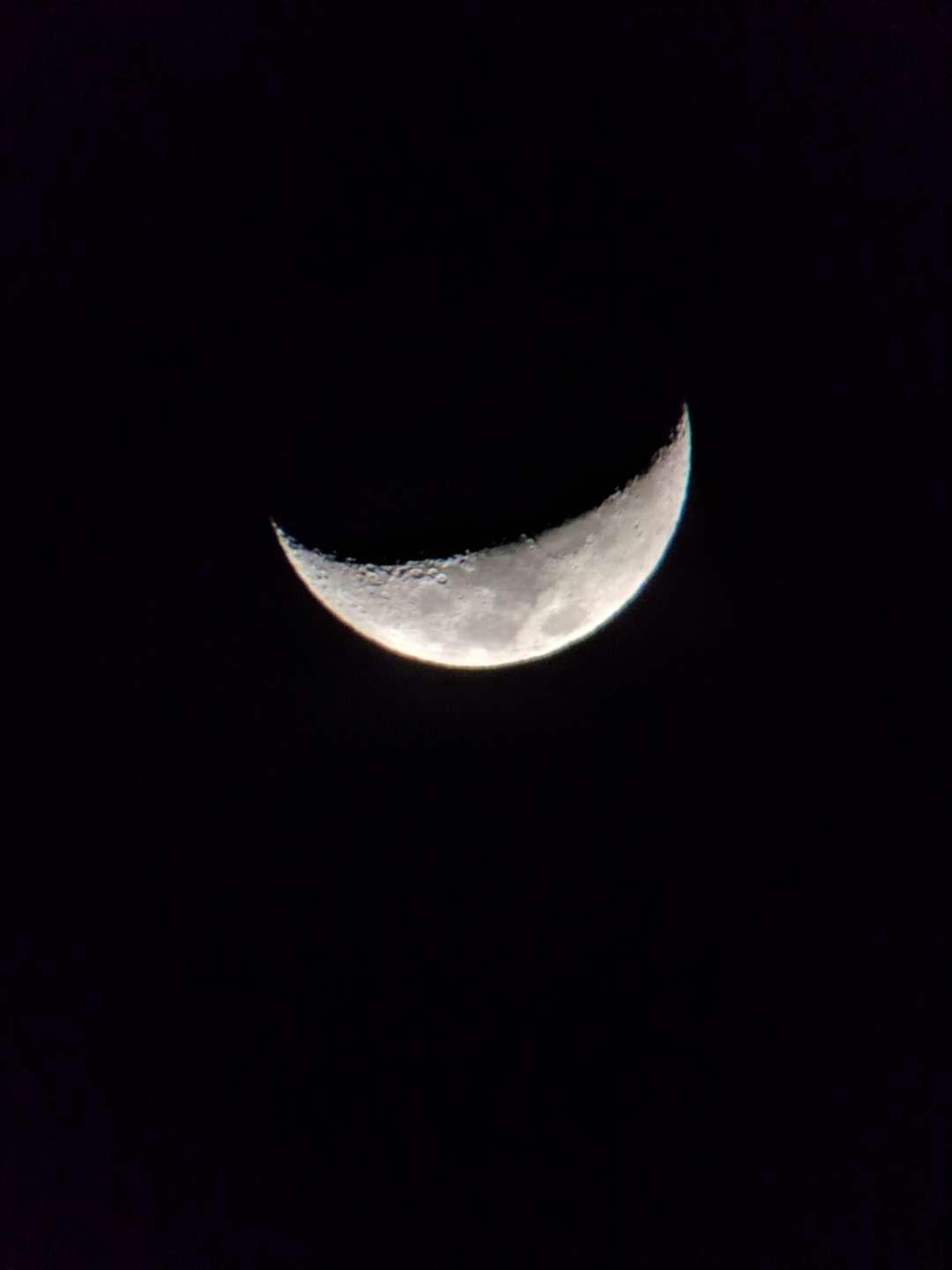
The difference between this and a typical budget refractor is focal length. At 900mm, the light travels a long way through the objective, which produces a tighter, higher-contrast image and, importantly, keeps the coloured fringing around bright objects noticeably under control. Reviewers single out sharp lunar views and a crisper result than shorter-tube refractors of the same aperture.
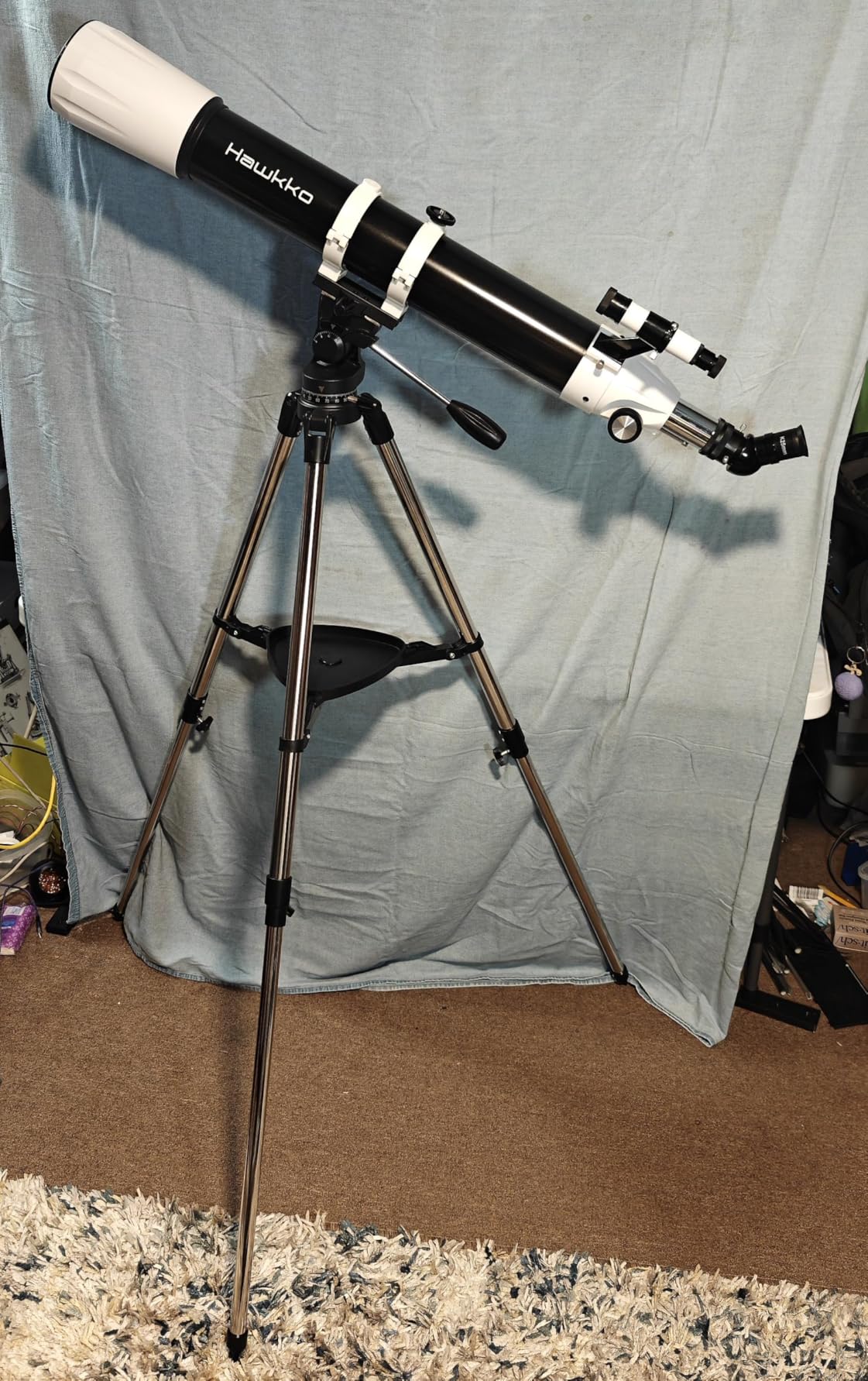
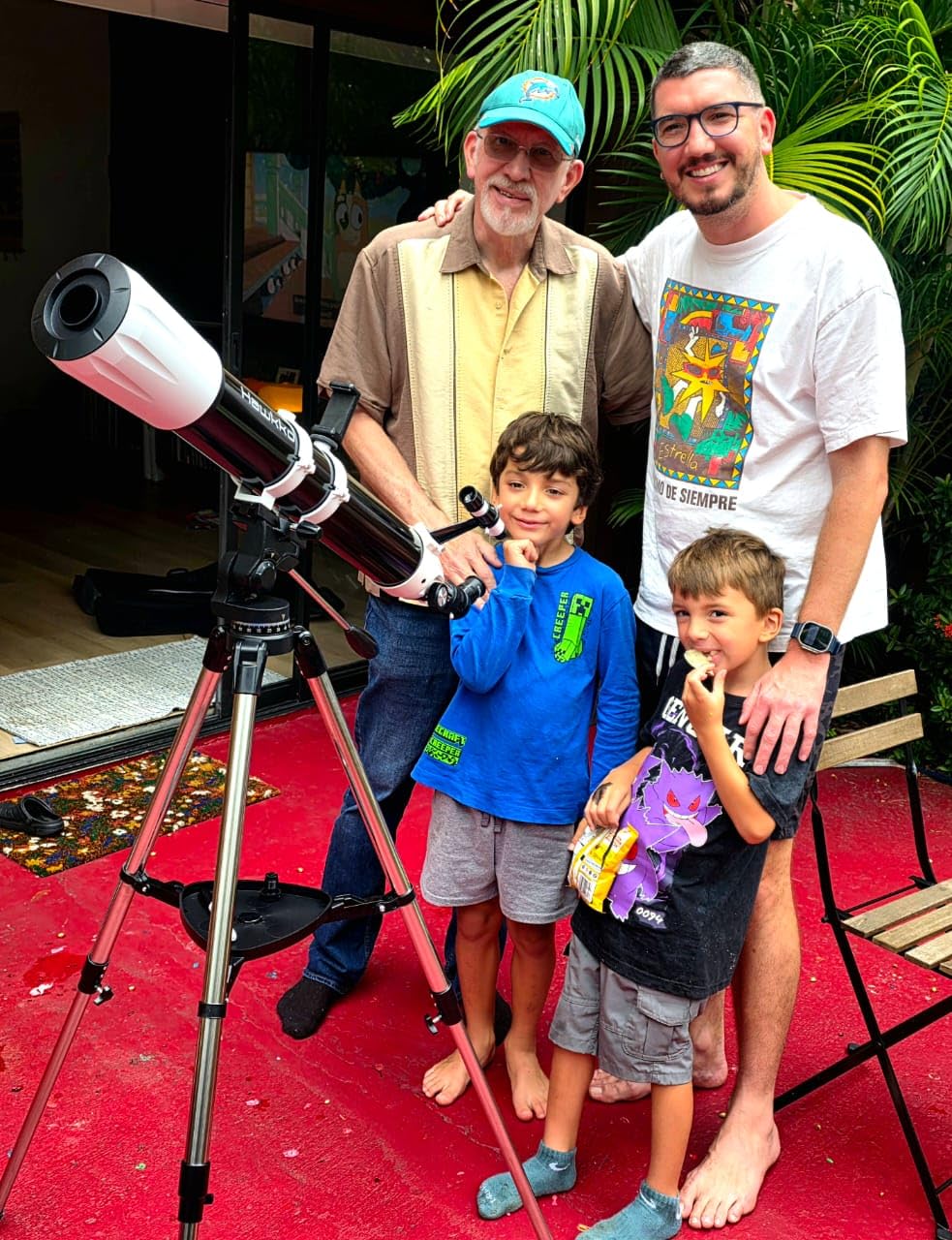
Build quality is the other argument. The stainless steel tripod, with smooth 360 degree rotation and a height range of 28 to 46 inches, feels a class above the folding aluminium legs used by most competitors in this bracket. The kit also includes 10mm and 25mm eyepieces, a 3x Barlow, a straight-through finderscope, a zenith mirror, an accessory tray, a phone adapter and a carry bag, which removes almost every reason to buy a second thing later.
Where it falls down is the same place most budget refractors fall down, which is the marketing figure. The 36x to 270x range is a theoretical maximum using the Barlow lens at full stretch, and at 270x through a 90mm objective the image is empty and dim. Treat 270x as a number to ignore and work between 36x and roughly 120x instead.
The zenith mirror in the box is also the cheapest component in the kit, and owners occasionally report a slight image quality penalty when light passes through it. If you find colour or contrast disappointing, testing without it tells you quickly whether it is the mirror or the objective, and at 5kg the whole package is still light enough to carry in one hand once assembled.
Why f/10 matters more than the power number
Long focal length is the reason this scope earns its place alongside shorter budget refractors. Chromatic aberration shows up as purple or blue fringing around high-contrast objects, and it gets worse as the focal ratio gets shorter. At f/10 the objective spreads the correction across a longer light path, so the Moon’s limb and Jupiter’s moons look cleaner than the same aperture in a short-tube design.
Who should skip it
Skip it if you want a wide-field grab-and-go scope for sweeping the Milky Way, because a 900mm focal length gives a narrow view that is better pointed at planets than at star fields. Also skip it if you are fussy about image quality and the included zenith mirror is the part you will end up replacing.
7. MEEZAA 150EQ Newtonian – Best Equatorial Setup for Manual Tracking
MEEZAA Telescope, 150EQ Newtonian Reflector Telescope for Adults Astronomy Beginners, Professional Astronomical Telescopes with Equatorial Mount, Tripod, Phone Adapter, Moon Filter and Large Carry Bag
150mm Newtonian reflector
650mm focal length
German equatorial mount
26x to 130x range
Pros
- Largest aperture available in this price bracket
- German equatorial mount with precision dials and slow-motion knobs
- Moon filter and phone adapter included as standard
- Build quality owners consistently praise for the money
Cons
- Newtonian mirrors need periodic collimation
- Real magnification ceiling is well below 130x
- Phone adapter setup is fiddly at first
One hundred and fifty millimetres is the largest aperture in this lineup below the 8 inch Dobsonian, and owners are blunt about why that matters: it is the point where globular clusters start to resolve into individual stars and bright nebulae develop visible structure. The 4.4 rating with a 72 per cent five-star share is the strongest rating mix in the group, and the comments back it up.
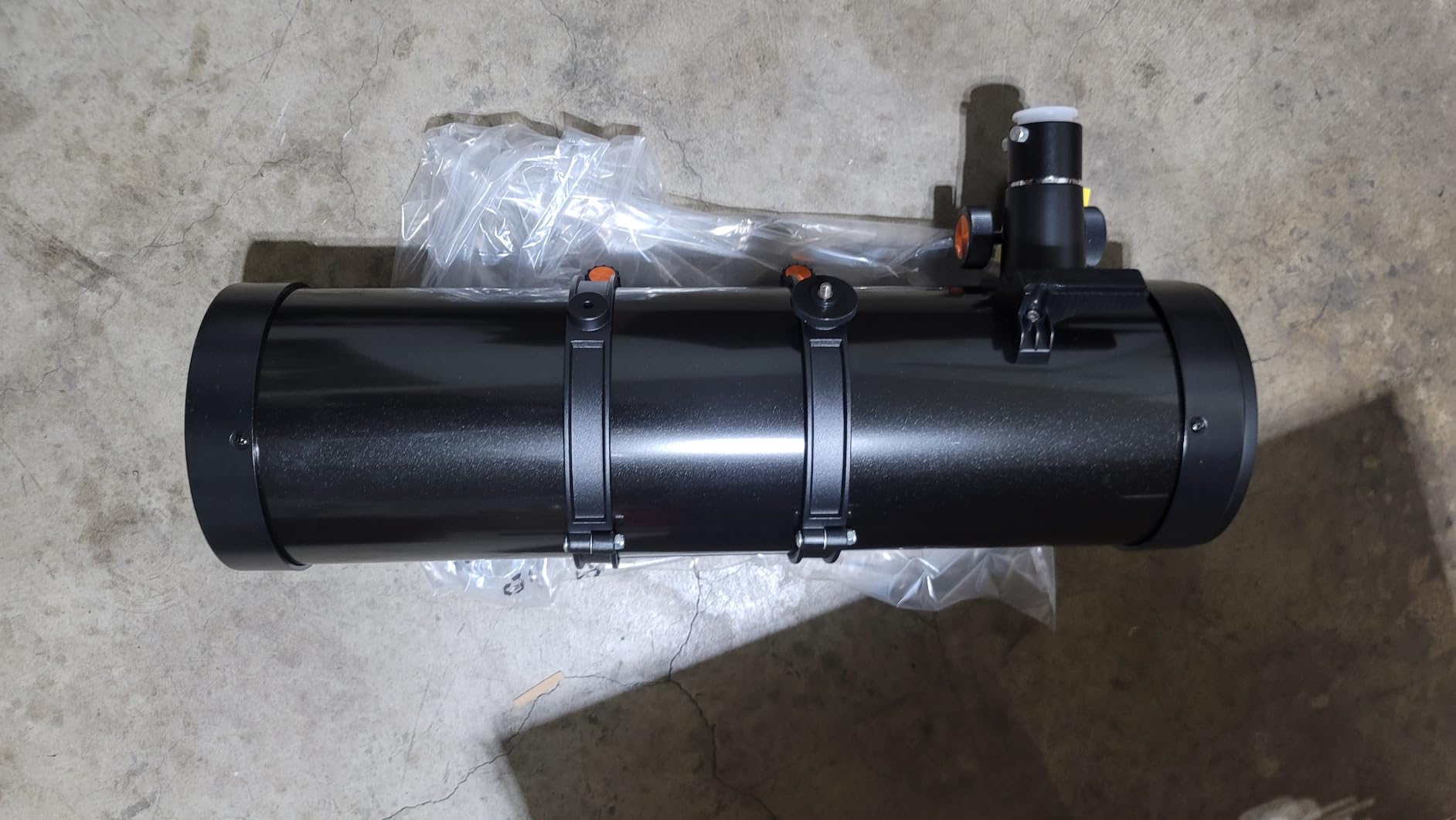
Like the 130EQ, it uses a German equatorial mount, and that is where the practical value sits. The precision dials and slow-motion knobs make it possible to nudge a drifting target back to the centre of the field without losing the object, so a 20-minute session at the eyepiece stays productive rather than becoming a repeated hunting exercise. The stainless steel tripod and accessory tray add to a package that owners describe as substantial rather than flimsy.
The included red dot finder plus a moon filter are a nice touch at this level, and the filter genuinely reduces glare on a full Moon so you can work at higher power without being blinded. The 25mm and 10mm eyepieces with the 2x Barlow give a stated 26x to 130x, though as always the real useful ceiling is set by the aperture, and owners note the top of that range disappoints.
Two things to plan around. Newtonian collimation applies, so a collimation tool is a sensible early purchase, and the equatorial head plus stainless tripod means more assembly steps and more weight than a simple altazimuth setup. The phone adapter is also fiddly to get right the first time, though it does produce usable snapshots of the Moon once you have worked out the orientation.
How 150mm compares with the 130mm alternative
Moving from 130mm to 150mm adds roughly a third more light gathering, which is a visible but not dramatic step. It is not the jump from 70mm to 130mm. What it does buy you is a noticeably cleaner view at high planetary power, brighter images of the same targets, and a shorter trip from first light to seeing genuine detail on the Orion Nebula and the Hercules cluster.
Who should skip it
Skip it if your storage is a small flat or your observing is on a balcony, because a 150mm Newtonian on an equatorial head is bulky and awkward to move once assembled. If portability is your top priority, the app-controlled smart telescope further down this list does the same job from a much smaller box.
8. Sky-Watcher Classic 200 Dobsonian – Best 8-Inch Dobsonian
Sky-Watcher Classic 200 Dobsonian 8-inch Telescope – Solid-Tube – Simple, Traditional Design – Easy to Use, Perfect for Beginners, White (S11610)
8 inch parabolic primary
1200mm focal length
Dobsonian altazimuth base
45 pounds assembled
Pros
- Eight inch aperture shows galaxies and globulars smaller scopes render as haze
- Patented tension control handles for controlled movement
- Teflon bearings give smooth azimuth motion
- Comes with a 2 inch Crayford-style focuser and wide-angle eyepieces
Cons
- 45 pounds assembled is the heaviest option here
- Newtonian mirrors need collimation after transport
- Altitude tracking is fully manual
- Lowest average rating in the group at 3.9
If you want the most starlight per unit of spending and you have somewhere to keep 45 pounds of telescope, this is the instrument. Community consensus on astronomy forums has converged on one principle for years, and it is that a large-aperture reflector on a simple base gives more usable observing time per pound spent than any other combination. That is why Dobsonians are recommended so widely for first-time visual observers.
The design has almost nothing to fail. The tube swings on Teflon bearings, the patented tension control handles let you move 20 pounds of glass without perfectly balancing it, and there is no electronics, no alignment procedure and no database to learn. The mirrors are fully multi-coated borosilicate rated at 94 per cent reflectivity, and the spec sheet lists a faintest stellar magnitude of 14.2 under good conditions.
The box is properly equipped for a scope this size. You get a 2 inch Crayford-style focuser with a 1.25 inch adapter, 25mm and 10mm super wide-angle eyepieces, and a 9×50 straight-through finder, which means the wide-field views of the summer Milky Way and the Andromeda galaxy are available from night one. Serious planetary and wide-field pairs still cost extra, but nothing essential is missing.
The 3.9 rating is the lowest in this lineup, and the distribution behind it explains why: 63 per cent five-star alongside 19 per cent one-star. Enthusiastic reviews credit the aperture and the smooth base, while critical ones focus on bulk, the fact that it does not move as one piece, and fully manual altitude tracking that means nudging the tube upward every few minutes during a long session at high power.
Why 8 inches changes the list of visible objects
At 8 inches the practical observing list changes category rather than degree. Galaxies, globular clusters, planetary nebulae and the fainter Messier objects go from ambiguous smudges to recognisable shapes, and the Trapezium in Orion, the Hercules cluster and the Ring Nebula all become straightforward targets. That step is not reachable with a 90mm or 130mm aperture no matter how good the eyepiece is.
Who should skip it
Skip it if you need to carry it anywhere, since 45 pounds breaks down into a 20 pound tube and a 25 pound base that you will be reassembling in a dark field. Also weigh the 3.9 rating carefully, because a wide spread of experiences usually means quality control is inconsistent, and a steadier computerized alternative at 8 inches costs more but asks far less of you physically.
9. ZWO Seestar S30 Pro – Best Smart App-Controlled Telescope
ZWO Seestar S30 Pro Smart Telescope, App-Controlled Astrophotography
30mm apochromatic lens
160mm focal length
App GoTo and tracking
Dual-camera 4K imaging
Pros
- App handles GoTo
- tracking and stacking with no learning curve
- Produces usable astrophotography in under ten minutes
- Built-in light pollution filters suit urban skies
- At 3.6 pounds it is the most portable scope here
Cons
- Fixed 30mm aperture limits faint deep-sky reach
- Deep-sky imaging needs the unit to stay stationary
- Tied to the app and firmware for most functions
- Battery life limits all-night sessions
This is the category the rest of this roundup does not cover. Instead of an eyepiece and a hand controller, the S30 Pro runs on your phone: power it on, open the app, and it does the GoTo, holds the target and stacks the images for you. There is no alignment routine, no polar axis to level, and no object database to learn, which removes the single biggest reason people give up on a first telescope.
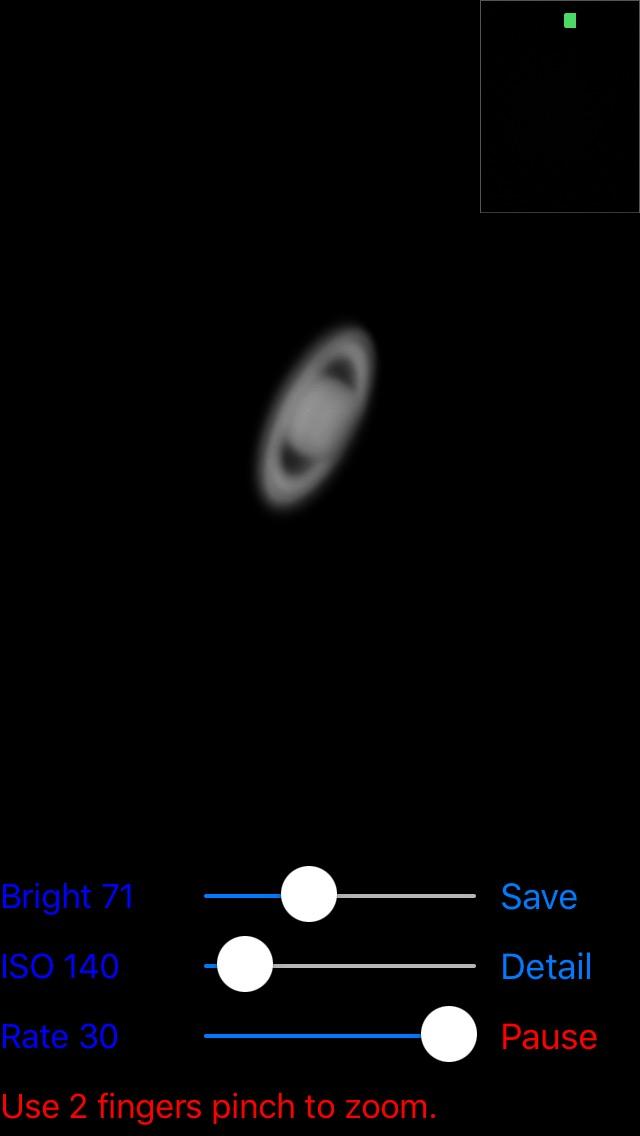
For that reason it is also the best entry point if you are travelling, camping, or observing from a balcony with a lot of ambient light. Apochromatic optics cut down the colour fringing that plagues budget refractors, built-in light pollution filters help in brighter skies, and the dual-camera system delivers 4K-quality captures with one-tap modes for the Milky Way, star trails, planets and galaxies, including automatic mosaic stitching for wide fields.
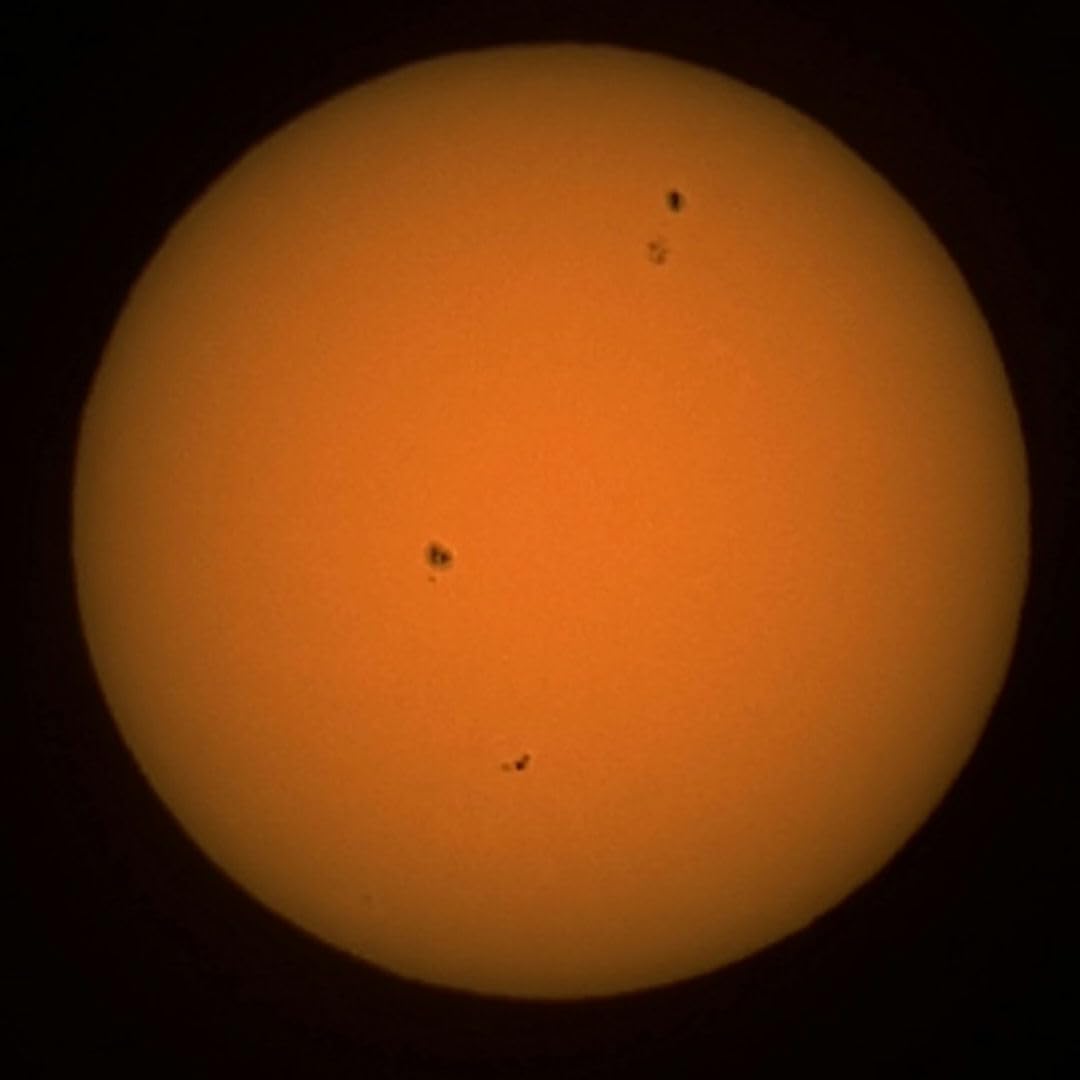
Imaging reviewers are the most enthusiastic group here, with 73 per cent five-star ratings, and they report recognisable deep-sky frames from a first session in a light-polluted location. Equatorial mode, AI noise reduction and sky and foreground separation are the features that turn what would be a frustrating night of stacking into a single button press.
Set expectations carefully, though. The aperture is a fixed 30mm, which is tiny next to the 150mm and 8 inch options here, so faint galaxies stay faint and it cannot compete with a Newtonian for visual deep-sky detail. Longer sessions also need USB power, the unit must stay stationary for deep-sky imaging, and you are dependent on the app and its firmware for nearly every function.
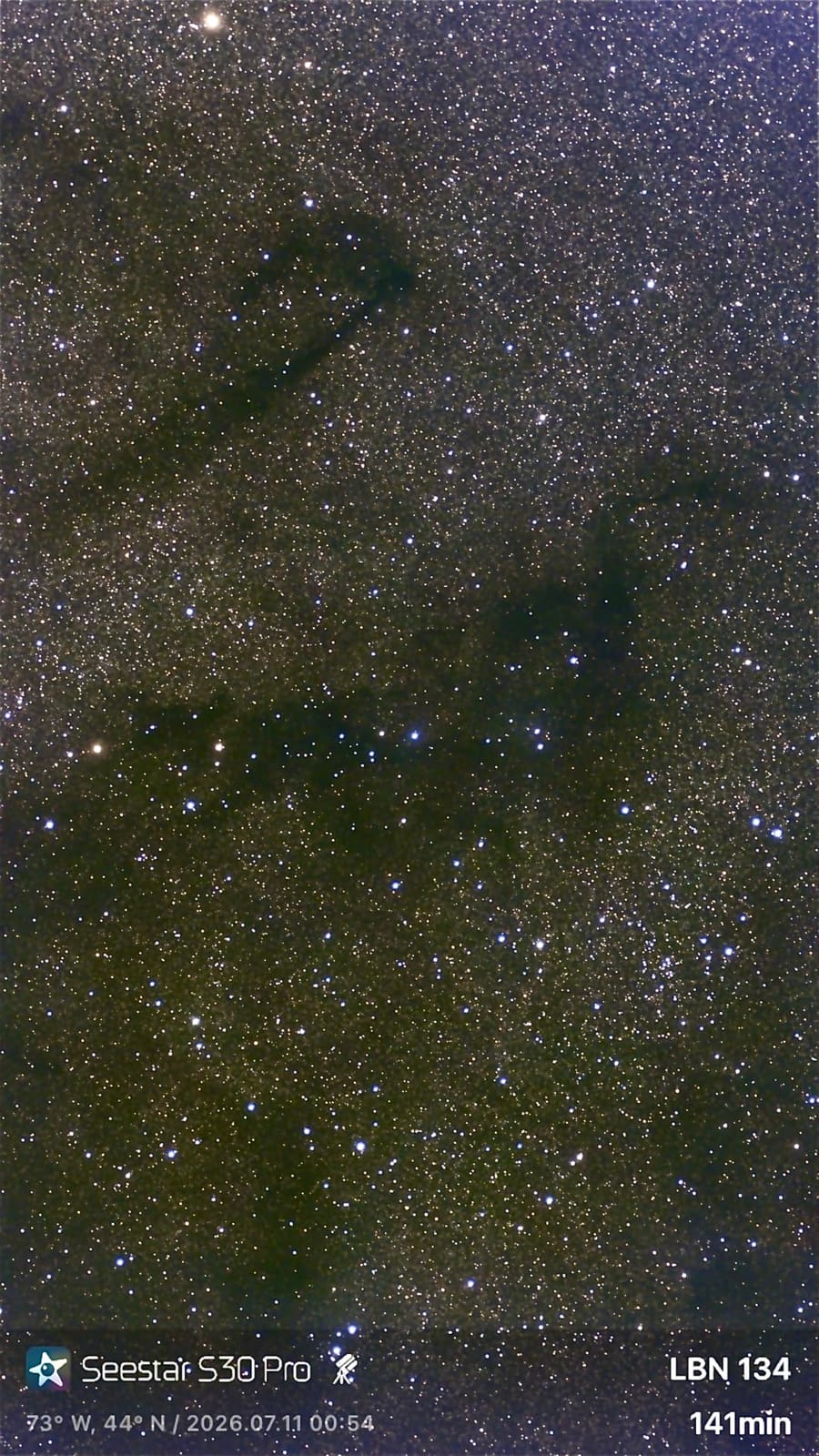
Whether a 30mm aperture is a real limitation
For imaging, less than you would think, because the app compensates for a small aperture with long sub-exposure stacking and noise reduction. For visual observing through the app screen, more than you would think, because you are effectively looking at a small sensor rather than through an eyepiece, so resolution is governed by the sensor and the screen rather than by aperture alone.
Who should skip it
Skip it if you want to sit at an eyepiece on a cold night and explore the sky manually, or if you are the kind of buyer who wants a physical optical instrument rather than an app-driven device. Skip it if you plan deep-sky imaging from a remote site without mains power, because the battery will not last a long capture session.
How to Choose a Telescope Without Regretting It
Aperture beats magnification every time
Aperture is the diameter of the main lens or mirror, and it is the number that decides what you can see. Light gathering scales with the square of aperture, so doubling the diameter collects four times the light, which translates directly into fainter objects and finer detail. Magnification, on the other hand, is just focal length divided by eyepiece focal length, and it costs you brightness, field of view and stability every time you push it.
The practical rule most experienced observers use is that magnification beyond roughly twice the aperture in millimetres produces an empty, dim image rather than extra detail. On an 80mm scope, 160x is already the point of diminishing returns. If a listing leads with a power figure, look for the aperture instead, and treat the magnification as noise.
Refractor, reflector or catadioptric: which optical design fits you
Refractors use a glass objective and need no maintenance at all, which makes them the lowest-friction starting point and the best choice for the Moon and planets. Reflectors use a mirror instead, gather far more light per pound, and are the value choice for deep-sky work, but they need periodic collimation and you look into the side of the tube. Catadioptrics combine a mirror with a convex lens to fold a long focal length into a short tube, which makes them portable and excellent on planets, at the cost of electronics and a steeper price.
Beyond that, the deciding factor is how much attention you want the optics to need. If the answer is none, choose a refractor. If you want the most starlight for the least money and you are willing to collimate once in a while, choose a reflector.
Choosing a mount: AZ, EQ and Dobsonian
An altitude-azimuth mount simply pivots up and down and side to side, which is intuitive and needs no alignment. It is the right choice for the Moon, planets and any scope that will be moved between rooms. An equatorial mount tilts the tube to match the Earth’s axis so slow-motion knobs can follow a drifting target, which is what makes visual deep-sky observing practical rather than an exercise in chasing.
A Dobsonian base is a third option: a smooth azimuth swivel combined with a simple friction-controlled altitude, giving the steadiest possible base for a large reflector with no electronics. Whatever the mount, the honest test is whether the image stops shaking within a couple of seconds of you taking your hand off the focuser. If it does not, the rest of the specification is irrelevant.
Eyepieces and true field of view
Almost every telescope here ships with two eyepieces, one wide and one narrow, and almost every owner eventually replaces the narrow one. Wide-field eyepieces are what you use to find things and to sweep the Milky Way, while a good planetary eyepiece in the 5mm to 7mm range is what reveals Jupiter’s belts and the Cassini division in Saturn’s rings. The true field of view is the apparent field of the eyepiece divided by the telescope’s magnification, so a longer focal length telescope shows a wider true field at the same magnification.
Budgeting for one good eyepiece within your first year is the single highest-value accessory purchase. It costs a fraction of a new telescope and it is the thing that turns a blurry blob into a recognisable planet.
Do you need GoTo or a smart telescope?
GoTo mounts are worth it if you are under heavy light pollution and cannot see enough stars to navigate by, or if you simply do not want to learn the sky. They are less valuable if you are observing from a dark site, where a red dot finder and a decent star chart will get you anywhere for free. Smart telescopes take this further, replacing the eyepiece with a phone, and they suit travel, automated observation and people who want astrophotography without learning stacking software.
Buyers do report a learning curve before the first successful observation with a computerized unit, so set aside an evening for alignment rather than planning to point it at something on your first night out.
What aperture do you actually need?
Match the aperture to the target, not to the marketing. A 70mm to 90mm refractor gives you the Moon, Venus’s phases, Jupiter’s belts and moons, and Saturn’s rings as a small ellipse. Around 130mm you start to reach globular clusters and the brighter nebulae. At 150mm the deep-sky catalogue opens up noticeably, and at 8 inches galaxies and planetary nebulae become recognisable objects rather than smudges.
Light pollution changes the calculation more than people expect. Under a bright urban sky, faint galaxies are effectively invisible regardless of aperture, so filters and darker sites matter more than another two inches of glass. If you can travel to a dark location a few hours away, that single change does more for your observing than any upgrade short of doubling the aperture.
Telescopes to avoid and why
Forum consensus is remarkably consistent about what goes wrong. The first category is the department-store hobby killer: a 70mm or 114mm lens on a folding aluminium tripod with a plastic altazimuth head, advertised at 700x. The shake means nothing stays in focus, and there is a consensus on astronomy forums that some 114mm equatorial variants have contrast problems serious enough that experienced users recommend avoiding them entirely.
The second category is advertised magnification without aperture to back it up. A 120x or 270x figure produced by stacking a Barlow lens onto a small objective tells you nothing about the view. The third is cheap achromatic refractors with heavy purple fringing, which is why the f/10 design in this lineup produces noticeably cleaner images than a short-tube equivalent. The fourth is bad bundled eyepieces with short eye relief, which is why almost every owner in this roundup mentions buying a better one.
Used gear is the other place people save real money, and astronomy clubs are consistently treated as the sensible route rather than a risky one. Inspect the mount for wobble, check the tripod legs for cracks, confirm that the focuser moves smoothly, and assume you will need to collimate a reflector before you use it. That last task is easy, but do it in daylight before you rely on it at night.
Frequently Asked Questions
What telescope is best for viewing planets?
The best telescope for viewing planets is a long-focal-length design on a steady mount, because planetary detail comes from magnification and contrast rather than light gathering. A refractor such as the Celestron AstroMaster 70AZ at 900mm focal length gives clean, colour-true views of Jupiter and Saturn with no collimation, while the Sky-Watcher Classic 200 at 8 inches shows far finer detail if you can manage the weight. Start with a 25mm eyepiece and only increase power once the image is steady.
What size telescope do I need to see Saturn’s rings?
You need roughly 70mm of aperture to see Saturn’s rings at all, though at that size they appear as a small ellipse rather than a resolved ring system. Around 130mm the rings separate from the planet’s disc and the Cassini division begins to show, and at 150mm or 8 inches the detail becomes obvious. Magnification matters too, but only within the limit of about twice the aperture in millimetres before the image turns dim and empty.
Are cheap telescopes worth buying as a first telescope?
A cheap telescope is worth it only if the mount is stable and the box includes a real finder and a usable eyepiece. Budget refractors and 80mm reflectors such as the Koolpte 80mm or the Gskyer 600x90mm do give satisfying Moon views and are far better than nothing, but advertised magnifications above roughly twice the aperture in millimetres produce dim, soft images. Spend on aperture and a solid mount rather than on power figures.
Is a Dobsonian a good first telescope?
Yes, and it is the most commonly recommended first telescope on astronomy forums for visual observing. A Dobsonian gives a large aperture on a smooth, simple base with no electronics and no alignment routine, so almost all of your money goes into the mirror. The trade-offs are weight, since an 8 inch model like the Sky-Watcher Classic 200 is 45 pounds assembled, and fully manual altitude tracking that means nudging the tube upward during long sessions.
Do I need a GoTo or computerized telescope?
Only in specific situations. A GoTo mount is worth it if you are under heavy light pollution and cannot see enough stars to navigate by, or if you would rather not learn the sky. From a dark site, a red dot finder and a star chart will get you to any target for free. A smart app-controlled scope like the ZWO Seestar S30 Pro goes further, replacing the eyepiece with your phone for travel and automated imaging, at the cost of a much smaller aperture.
Our Final Verdict on the Best Telescopes in 2026
The best telescopes in 2026 are not the ones with the biggest numbers on the box. Our pick for most people is the Koolpte 80mm reflector, because the included phone adapter, remote, Barlow lens, finder and carrying bag mean you can start the same evening you open the box, and nearly 4000 reviews at 4.3 suggest it will not disappoint. If you care most about a clean image of the Moon and Saturn with zero maintenance, choose the Celestron AstroMaster 70AZ instead.
When you are ready to see further, the Celestron AstroMaster 130EQ or the MEEZAA 150EQ move you into real deep-sky territory, and the Sky-Watcher Classic 200 takes the same idea to 8 inches if you have somewhere to store it. For travel, apartments and astrophotography without a learning curve, the ZWO Seestar S30 Pro is the category that did not exist a few years ago and now does the job in a 3.6 pound box.
One next step: check your local sky darkness before you buy, and borrow or rent the telescope you are considering for a single evening. Ten minutes with the real instrument on a real night will tell you more than any specification list, and it is the fastest way to avoid an expensive mistake.