
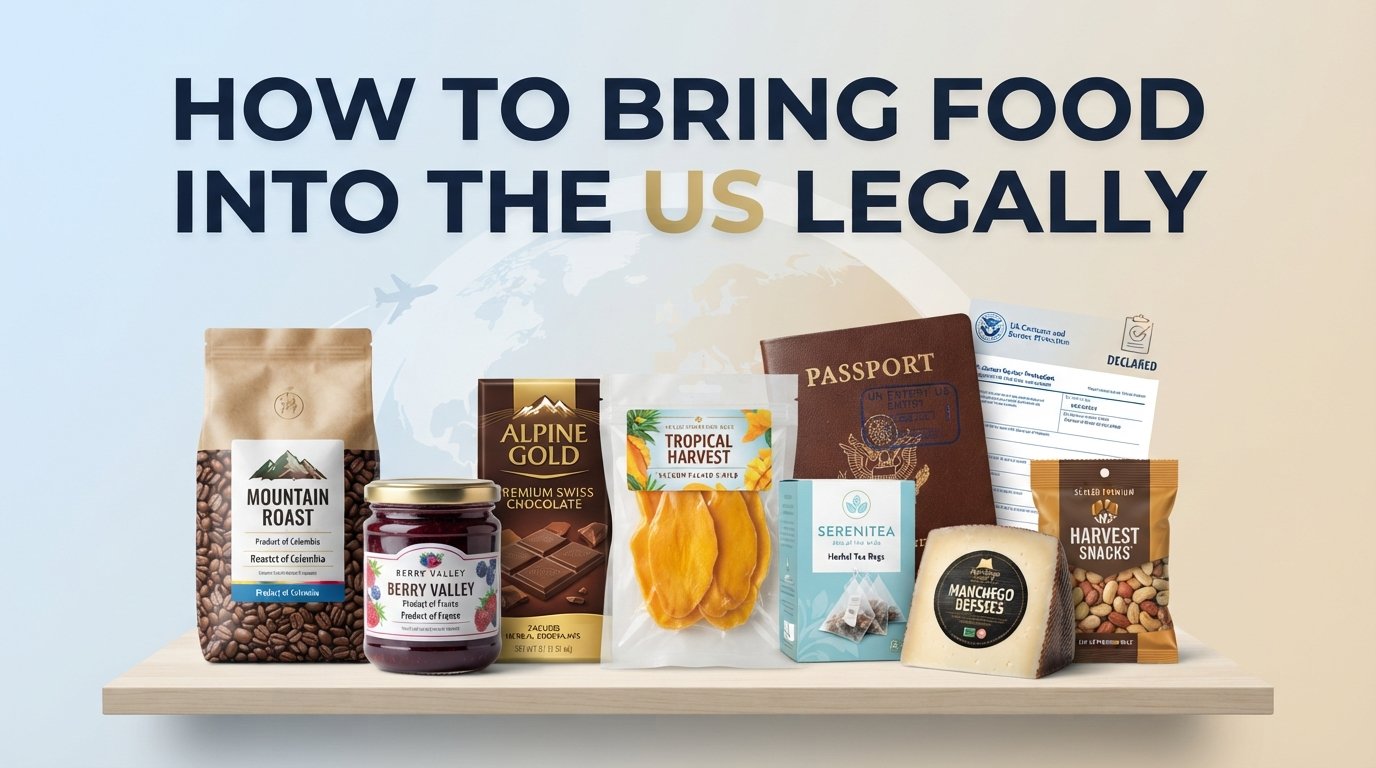
All food items brought into the US must be declared to Customs and Border Protection (CBP), even if you believe they are allowed. According to the CBP, every traveler must declare all agricultural products on the customs form and present them for inspection. Failure to declare can lead to confiscation, fines of up to $10,000, or criminal charges in serious cases.
I have helped dozens of travelers prepare for international trips, and the single most common mistake I see is treating the customs form like a formality. I wrote this guide so you can walk through the airport with confidence, knowing exactly which snacks, gifts, and homemade foods will pass and which will not. Below you will find the official CBP rules, real traveler stories, and a packing checklist I share with my own family.
Table of Contents
How to Bring Food into the US Legally: The Core Rule
The core rule for bringing food into the US legally is simple: declare every food item you are carrying, no exceptions. CBP Agriculture Specialists screen travelers to prevent the introduction of plant pests and foreign animal diseases into American farmland. The rule is not optional and the declaration form is a federal document.
If you declare a prohibited item, an officer will usually confiscate it and let you continue. If you fail to declare it and they find it anyway, the consequences escalate fast. I have seen travelers lose entire suitcases, pay thousands in fines, and even face misdemeanor charges for hidden meat or fresh produce.
Two federal agencies share oversight of imported food: CBP enforces entry rules at the border, and USDA APHIS sets the agricultural standards. Together, they publish the official lists you will rely on at the airport. The Food and Drug Administration (FDA) also weighs in on items that affect public health, such as baby formula and certain supplements.
The reason this rule exists is not paperwork bureaucracy. A single piece of fruit tossed in a hotel trash can, a handful of seeds in a coat pocket, or a salami in checked luggage can introduce pests that cost American farms billions of dollars. Citrus greening, Mediterranean fruit fly, and emerald ash borer are real examples of how traveler-borne items have reshaped US agriculture.
What Foods Cannot Be Taken Into the USA
Most prohibited foods fall into three buckets: animal products, fresh plant products, and soil-bearing items. Here is the breakdown I share with my own family before every trip abroad, organized by category so you can scan it quickly.
Meats, Poultry, and Animal Products
Almost all fresh, dried, cured, and smoked meats from foreign countries are prohibited. This includes beef jerky, sausages, salami, prosciutto, biltong, chorizo, and even homemade jerky made from a family recipe. USDA APHIS maintains this ban because of diseases like foot-and-mouth disease, BSE (mad cow), classical swine fever, and African swine fever.
The only common exception is fully cooked, shelf-stable, commercially packaged meat from countries with disease-free status. Even then, I recommend declaring it and keeping the original packaging visible. Countries with active outbreaks currently include many in South America, Asia, and parts of Africa, so always check the APHIS list before you pack.
Pet food and treats that contain animal products fall under the same rules. A bag of beef-flavored dog treats from abroad can be confiscated for the same reason a salami would be.
Fresh Fruits, Vegetables, and Plants
Fresh fruits and vegetables are almost always confiscated at the border. The single most-seized item, by volume, is the humble apple carried in a lunch bag. Officers find them daily, and they always end up in the inspection trash.
Plants, seeds, bulbs, and soil are also banned because they can harbor invasive insects and pathogens. Live plants require a USDA permit and a phytosanitary certificate from the country of origin. Seeds brought in for planting need to be declared and inspected, and many will be refused entry.
Cut flowers can usually pass through if they are free of soil and pests, but arrangements with fruit, seeds, or bulbs will be inspected and likely trimmed or confiscated.
Animal Products Beyond Meat
Raw eggs, unpasteurized milk and cheeses, and items containing raw animal products fall under the same prohibition. If you bought a wheel of cheese from a street vendor in Europe, expect it to be confiscated. Soft cheeses made from unpasteurized milk, like some French bries or Italian mozzarellas, are commonly seized.
Honeycomb, bee products from regions with colony collapse disorder concerns, and royal jelly can also be restricted. These items are treated as vectors for foreign animal diseases, even though they look harmless.
Foods You Must Declare at US Customs
You must declare every food item you are carrying, regardless of whether you think it is allowed. Declaration is not the same as confiscation; it is simply telling the officer what is in your bag. Most declared items pass without issue.
The customs declaration form (CBP Form 6059B for air and sea travelers) has a dedicated line for agricultural products. Mark “Yes” whenever you have any food, plant products, soil, or animal products. Lying on this form is a federal offense and can lead to penalties even if the items themselves are legal.
Items That Always Require Declaration
Even when items are allowed, they still need to be declared. This includes packaged spices, tea, coffee, condiments, honey, baked goods, candy, chocolate, dried pasta, instant noodles, and canned goods. A box of pocky from Tokyo, a bag of dried herbs from Tuscany, or a jar of curry paste from Bangkok all fall under the declaration requirement.
Souvenirs that look like food also count: decorative gourds, coconut shells with food residue, and wooden utensils that held food. If you are unsure, declare it. Officers are far more forgiving about an over-declared bag than an under-declared one.
Food gifts purchased for family, food from religious or cultural ceremonies, and items received as host gifts during travel all need to be declared as well. Travelers often forget gifts received abroad, which then sit undeclared in their luggage.
Foods Generally Allowed Through US Customs
Many travelers are surprised by how much they can legally bring in. The CBP allows most commercially prepared, shelf-stable foods as long as they pose no pest risk. Below is what consistently passes inspection based on official guidance and traveler reports.
Packaged and Shelf-Stable Foods
Condiments, vinegars, oils, packaged spices, honey, coffee, and tea are generally admissible. Baked goods, candy, chocolate, dried pasta, and instant noodles are also allowed. The key word here is “commercially packaged.” Homemade versions are treated as higher risk because they lack the standardized processing that kills pests and pathogens.
I always tell travelers: keep foods in their original sealed packaging with the label visible. A bag of Indonesian kripik or Japanese senbei in its store wrapper will pass inspection smoothly. The same snack in a zip-lock bag will get extra scrutiny and may not make it through.
Commercially labeled dried herbs, packaged spice blends, and sealed tea bags are also generally allowed. Loose herbs or unlabeled powders raise flags because officers cannot confirm their origin or composition.
Canned and Hermetically Sealed Goods
Canned foods are admissible as long as the seal is intact. This is a relief for travelers bringing back staples from home, like canned fish, preserved fruits, or canned meats from approved countries. The hermetic seal is what matters: if the can is dented, swollen, or leaking, it will be confiscated regardless of its contents.
Vacuum-sealed pouches, retort pouches, and similar heat-processed packaging fall under the same category. Soups, curries, and ready-to-eat meals in this format are commonly allowed.
Dried Goods and Snacks
Dried fruits, nuts, crackers, chips, and roasted coffee beans are typically allowed. The exception is fresh or dried fruit from regions with fruit fly infestations; check the USDA APHIS country list before packing dried mango from Hawaii-bound flights through the mainland.
Roasted and salted seeds, popcorn, rice cakes, and most dry baked goods are admissible. Fresh-baked items that contain meat or fresh dairy may be subject to additional scrutiny, but plain breads, cookies, and pastries are fine.
Food Declaration Process Step by Step
The declaration process begins before you land. Here is the exact sequence I walk my clients through, from the airplane seat to the inspection counter.
Step 1: Mark Yes on the Customs Form
On the plane or ship, fill out CBP Form 6059B. On the line that asks whether you are bringing food, fruits, vegetables, plants, seeds, soil, animals, or animal products, check “Yes.” Do this even for a single granola bar. The form is scanned electronically, so accurate answers matter for your record.
If you have Global Entry, the kiosk process still asks about agricultural items. Answer accurately there too. Lying on the kiosk form is treated the same as lying on the paper form.
Step 2: Keep Food Accessible in Your Bag
Pack food items together in one section of your suitcase, ideally on top. If your bag is selected for inspection, this saves you from unpacking your entire wardrobe at the checkpoint. Officers appreciate travelers who make the inspection fast and easy, and that often translates to a quicker release.
Step 3: Approach the CBP Officer
When you reach the customs booth, hand over your declaration form and passport. If you marked “Yes” for agricultural items, the officer will either wave you through to the agricultural inspection line or send you to the main inspection area. Most travelers with declared food go through the agricultural line.
Step 4: Present Items for Inspection
Place your declared food on the counter. A CBP Agriculture Specialist will visually inspect items and may swab them for traces of pests or pathogens. Be patient; this process usually takes two to five minutes. The swab is a quick test, and a negative result clears the item immediately.
Step 5: Follow the Officer’s Direction
The specialist will tell you to either keep the item, surrender it (with a receipt), or in rare cases, abandon it. If they offer an “abandonment” option, that is usually the cleanest outcome. Surrendering means the item goes to destruction, and you receive a receipt that proves you cooperated.
If the officer determines that an item is admissible, you repack it and continue. Most declared items end up back in your bag. Confiscation is the exception, not the rule, for travelers who declare openly.
Country-Specific Disease Restrictions and the 50-Pound Rule
Some countries have disease outbreaks that tighten food import rules. USDA APHIS publishes a list of regions affected by foot-and-mouth disease, African swine fever, classical swine fever, highly pathogenic avian influenza, and Newcastle disease. The list is updated regularly, so check it close to your travel date.
If you are traveling from a country with active outbreaks, expect stricter scrutiny of all animal products, including dried pet food and treats. Some travelers from affected regions are turned away entirely for carrying prohibited meat. Even processed items from restricted regions can be confiscated if the officer cannot verify disease-free sourcing.
The 50-Pound Personal Use Limit
CBP allows returning residents to bring in up to 50 pounds of personal-use food per person without commercial import paperwork. Anything over that weight or intended for resale triggers FDA and USDA commercial import requirements. The 50-pound rule is per person, not per family, so a family of four can bring 200 pounds total under the personal allowance.
If your suitcase contains more than 50 pounds of edible items, declare that on the form and expect additional documentation. I have seen this trip up travelers bringing back large quantities of specialty items for family. The paperwork for commercial import includes FDA registration, USDA permits, and possibly lab testing for safety.
What Counts as Personal Use
Personal use means for you and your immediate household to consume, not to sell or distribute commercially. Selling imported food without proper permits is a separate violation that carries its own penalties. Gifts given in small quantities are typically treated as personal use.
Packing Tips to Avoid Confiscation
After years of helping travelers prepare, I have a packing checklist that consistently reduces friction at customs. These are simple habits that work and take only a few minutes to implement before you zip your suitcase.
Keep Original Packaging
Commercially sealed packages with English-readable labels are processed faster. Loose items in zip-lock bags raise flags. If you bought something at a local market, ask the vendor for a sealed bag at purchase. Many markets will vacuum-seal items for an extra fee, which is worth it for items you want to bring home.
Separate Food in One Clear Section
Use a clear, resealable plastic bag or a dedicated packing cube. Place it on top of your checked luggage. When the officer opens your bag, food is immediately visible, and the inspection finishes in minutes. This single trick saves travelers an average of ten minutes at inspection based on reports from frequent flyers.
Keep Receipts
Receipts prove items were purchased for personal use and not for resale. They also document the country of origin, which matters for disease restrictions. Place receipts in your carry-on so they are available even if checked luggage is delayed.
Avoid Wrapping Food as Gifts
Wrapped gifts force officers to unwrap them for inspection, which can damage the gift and slow the process. Travel with items unwrapped or in see-through wrapping. If you are bringing a gift box, leave it open until you have cleared customs.
Declare Souvenirs That Look Like Food
Decorated gourds, coconut shells, and wooden serving spoons can carry pests. Declare them on the form under “agricultural products” even though they are not edible. Officers will inspect them and either release them or confiscate them based on what they find.
Photograph Your Items
Before you pack, take photos of all food items in their original packaging. If something is confiscated, the photo helps you remember what you lost and provides documentation for insurance claims. It also helps if you need to replace specialty items online.
Penalties for Undeclared Food Items
CBP takes undeclared agricultural items seriously because of the economic and environmental damage invasive species cause. Penalties scale with intent and severity. Below is what travelers actually face based on CBP enforcement data.
For first-time, unintentional failures to declare, civil penalties typically start at $300 to $500 per violation and can climb to $10,000 for serious cases. Items are confiscated and destroyed. The exact fine depends on the type of item and whether the officer believes the violation was negligent or willful.
For intentional concealment, smuggling, or repeat offenses, criminal charges are possible. These can include felony counts carrying prison sentences of up to five years and additional fines. Cases involving commercial quantities or fraudulent documents almost always result in criminal prosecution.
Travelers have shared on Reddit and travel forums that officers are generally understanding when travelers declare openly and honestly. The harshest penalties hit people who hide food and lie on the form. One traveler described a colleague losing $1,200 worth of French cheese and cured meats because they failed to declare a single wheel of brie that an x-ray flagged.
Quick Reference Checklist Before You Fly
Use this checklist the night before you fly home. Going through it once takes about five minutes and prevents 90 percent of customs issues based on traveler reports.
Did you mark “Yes” on the agricultural products line of CBP Form 6059B?
Is all food in original sealed packaging with labels visible?
Are receipts stored in your carry-on for quick access?
Did you remove fresh fruits, vegetables, and meats from your bag?
Are all food items grouped in one clear, accessible section?
Do you have documentation for any country-restricted animal products?
Are unwrapped gift items left in see-through packaging?
Did you photograph all food items for insurance purposes?
FAQs
What foods cannot be taken into the USA?
Most fresh fruits, fresh vegetables, raw meats, poultry, and pork products from foreign countries are prohibited. Items containing raw eggs, unpasteurized dairy, soil, and live plants are also banned. Canned, cooked, and commercially packaged versions from approved countries are typically allowed.
What food can’t you take through customs?
You cannot bring fresh or dried meats from countries with animal disease outbreaks, fresh produce that can harbor fruit flies, and items containing raw animal products. Live plants, seeds, bulbs, and soil are also prohibited without USDA permits.
What food do you need to declare at customs USA?
You must declare every food item you are carrying, including commercially packaged snacks, spices, coffee, tea, baked goods, canned goods, and condiments. Declaration does not mean the item will be confiscated; it simply notifies CBP of what you are bringing in.
Can I pack food in my suitcase to the USA?
Yes, you can pack commercially sealed, shelf-stable food in checked luggage. Keep items in original packaging and grouped in one accessible section. Avoid fresh produce, raw meats, and homemade foods, which are almost always confiscated.
Do I have to declare my snacks?
Yes, you must declare every food item including sealed snacks, candy, chocolate, instant noodles, and dried fruit. Mark ‘Yes’ on the agricultural products line of CBP Form 6059B even for a single granola bar. Failing to declare snacks can result in civil fines starting at $300.
What is the 50-pound food rule for travelers?
Returning US residents may bring up to 50 pounds of personal-use food per person without triggering commercial import paperwork. Items over 50 pounds or intended for resale require FDA and USDA documentation and inspection beyond standard customs processing.
Final Thoughts on Bringing Food into the US Legally
Knowing how to bring food into the US legally comes down to two habits: declare everything, and keep commercially packaged items in their original wrapping. Those two actions cover roughly 90 percent of the rules travelers ask me about.
Before your next trip, check the CBP and USDA APHIS websites for any updates tied to your destination country. Outbreaks change quickly, and the rules I have shared here reflect 2026 standards, which can shift after each agricultural emergency.
When in doubt, declare it. The cost of declaring an extra snack is a few seconds at the booth. The cost of not declaring it can be a $10,000 lesson, a destroyed suitcase, or worse, an accidental contribution to a pest outbreak that hurts American farmers for years.