
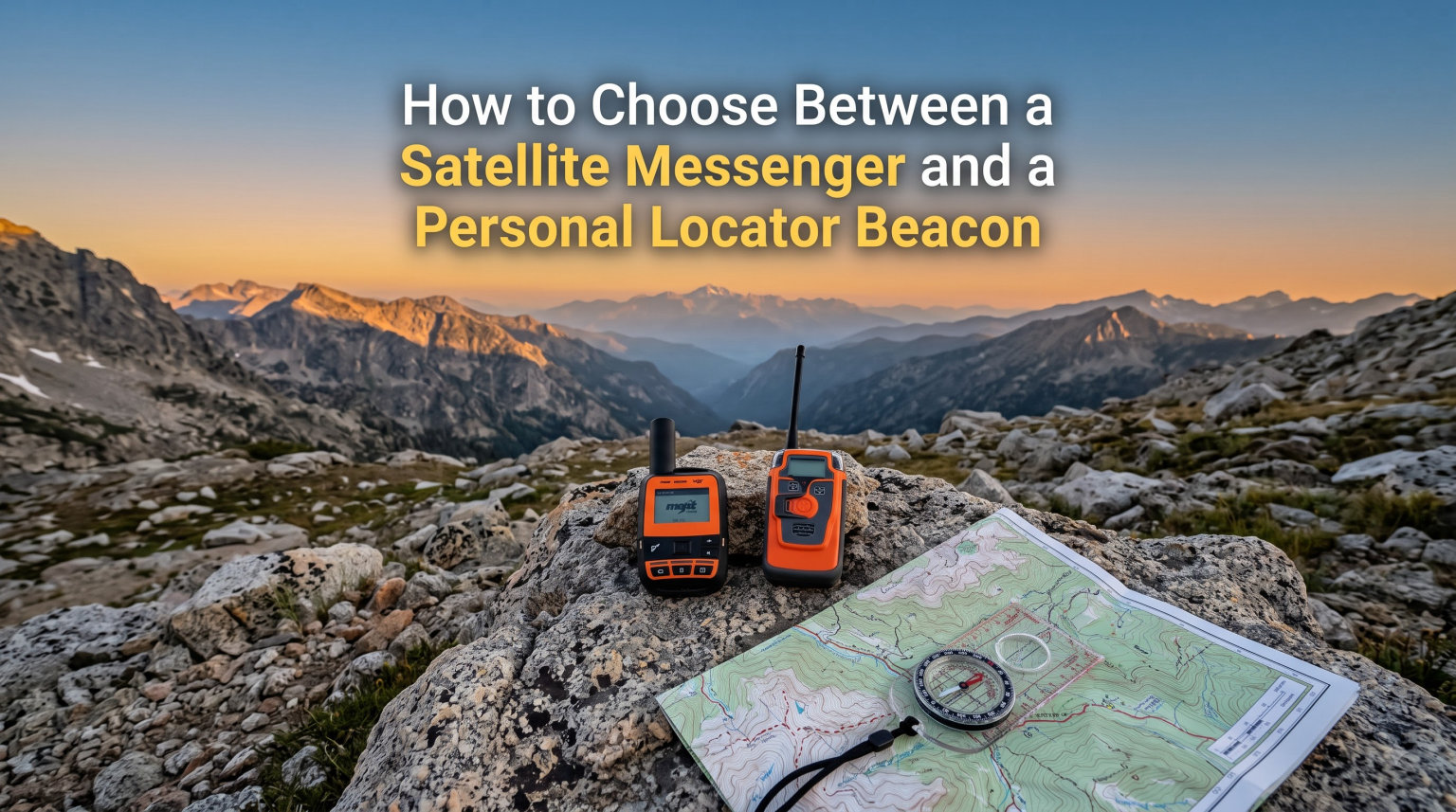
Choosing between a satellite messenger vs personal locator beacon can feel overwhelming, especially when your safety depends on the device you pick. Both tools send emergency signals from places where cell phones fail, but they work differently and serve different needs.
After researching dozens of models and digging into the technical specs, our team put together this complete decision guide for 2026. I’ll walk you through how each device works, what makes them different, and how to pick the right one for your outdoor adventures.
The wrong choice can leave you paying for features you’ll never use, or worse, stuck without help when you need it most. Let’s fix that.
Table of Contents
What Is a Personal Locator Beacon (PLB)?
A personal locator beacon is a one-way emergency device that broadcasts your GPS location to search and rescue services through the Cospas-Sarsat satellite system. When you press the SOS button, a 406 MHz distress signal goes out to a network of international satellites, then bounces to the nearest rescue coordination center.
PLBs are subscription-free for life. You buy the device, register it with NOAA (in the US) or your country’s authority, and that’s it. The battery typically lasts 5 to 7 years before needing replacement, which is a major cost saver over time.
The catch? PLBs only send one message: “I’m in trouble, here’s where I am.” You cannot update your status, tell rescuers about injuries, or reassure worried family members. It’s a last-resort tool, designed specifically for life-threatening emergencies.
When activated, PLBs are treated as genuine distress signals. Rescue teams respond with full urgency, unlike satellite messengers, which sometimes trigger “welfare check” responses first.
The Cospas-Sarsat system itself is worth understanding. It began as a joint project between the US, Canada, France, and the Soviet Union in the late 1970s, originally focused on maritime safety. Today it operates as a humanitarian network funded by participating governments, with no commercial interests. Your PLB distress signal reaches rescue authorities without going through any private company, which is part of why it gets priority treatment.
What Is a Satellite Messenger?
A satellite messenger is a two-way communication device that uses commercial satellite networks like Iridium to send and receive text messages, track your location, and trigger SOS alerts. Most models pair with your smartphone via Bluetooth to enable full keyboard typing and app-based features.
These devices require an active subscription. Plans range from basic monthly safety tiers to annual packages with unlimited tracking and messaging. Some providers charge $14.95 monthly, while others offer annual plans starting around $200.
Beyond SOS, satellite messengers let you send check-in messages to family, share your track with friends, get weather forecasts, and in some cases navigate via topographic maps on paired apps. The Garmin inReach Mini 2, ZOLEO, and ACR Bivy Stick are popular examples.
The trade-off is ongoing cost and slightly weaker emergency signal compared to PLBs. The 406 MHz frequency used by PLBs is specifically reserved for international distress, giving it regulatory priority over commercial satellite frequencies.
Iridium, the dominant satellite network for these devices, operates a constellation of 66 low-Earth-orbit satellites that provide true global coverage including the poles. The network has been operational since 1998 and handles everything from aviation communications to scientific research, in addition to consumer satellite messengers.
Satellite Messenger vs Personal Locator Beacon: Key Differences
The core difference comes down to this: a PLB is a dedicated emergency beacon, while a satellite messenger is a versatile communication tool that includes emergency features. Here’s how they stack up across the factors that matter most.
| Feature | Personal Locator Beacon | Satellite Messenger |
|---|---|---|
| Subscription Required | No, lifetime use after purchase | Yes, monthly or annual fees |
| Two-Way Messaging | No, one-way SOS only | Yes, full text messaging |
| Satellite Network | Cospas-Sarsat (governmental) | Iridium or similar (commercial) |
| Signal Strength | Stronger, dedicated 406 MHz frequency | Slightly weaker, shared bandwidth |
| Battery Life | 5-7 years standby, replaceable | Days to weeks, rechargeable |
| Device Cost | $250 to $400 typical | $200 to $500 typical |
| Ongoing Cost | $0 | $12 to $65 monthly |
| Coverage | Truly global including polar regions | Global, with some dead zones |
| Registration | Required by government agency | Not required, but plan activation needed |
| Family Check-Ins | Not possible | Yes, send custom messages anytime |
Notice how PLBs win on reliability and cost predictability, while satellite messengers dominate on communication features. Your choice depends on which trade-offs you can live with.
Coverage and Network Reliability
PLBs use the Cospas-Sarsat system, a multinational satellite network operated for humanitarian rescue purposes. Because distress is the only thing they transmit, the signal gets regulatory priority and works even in extreme environments like the Arctic or open ocean.
Satellite messengers rely on commercial networks like Iridium, which cover the entire planet but share bandwidth with paying customers. Coverage is excellent in most regions, but you may encounter brief delays during peak usage or at the edges of coverage cells.
Subscription and Cost Structure
PLBs require no subscription. Once registered, they function for the entire life of the battery. Replacement batteries cost around $100 to $150 and last another 5 to 7 years.
Satellite messengers need an active plan to function. Most providers offer tiered subscriptions: a basic safety plan ($12 to $20 monthly) covers SOS and limited messages, while premium plans ($35 to $65 monthly) add unlimited tracking and weather data.
PLB Advantages and Limitations
Personal locator beacons shine when reliability matters more than features. Here’s what makes them attractive and where they fall short.
Why Choose a PLB
- No subscription fees ever. You pay once and the device works for years.
- Stronger emergency signal. The 406 MHz frequency has priority access to satellites.
- True global coverage. Works at the poles, mid-ocean, and in remote deserts.
- Long battery life. 5 to 7 years standby means you can store it in your pack and forget about it.
- Simpler operation. One button, one purpose, hard to mess up under stress.
- Rescue priority. PLB activations are treated as confirmed distress, not missing person reports.
Where PLBs Fall Short
- No two-way communication. You cannot tell rescuers about your injuries or update your status.
- No family check-ins. Loved ones won’t know you’re safe until you’re back home.
- No tracking or navigation. These are SOS-only devices, nothing more.
- False alarm risk. Accidental activation triggers real rescue operations, and you may face fines.
- No weather data. You cannot request forecasts before a storm rolls in.
If you’re the type who heads out for a week-long expedition and doesn’t want to think about monthly bills, a PLB makes sense. Many ultralight backpackers prefer them for the weight savings and zero-maintenance profile.
Satellite Messenger Advantages and Limitations
Satellite messengers earn their subscription cost through features that go beyond emergency use. They function like a satellite phone lite, with apps and tracking that PLBs cannot match.
Why Choose a Satellite Messenger
- Two-way text messaging. Send and receive messages from anywhere on Earth.
- Family peace of mind. Daily check-ins keep loved ones informed.
- Trip tracking. Share your route in real-time with a follow-along link.
- Weather forecasts. Get localized forecasts to plan around storms.
- Navigation features. Some models include topographic maps and routing.
- Flexible plans. Activate monthly only during peak season, pause in winter.
Where Satellite Messengers Fall Short
- Monthly or annual fees. Adds up to hundreds of dollars over years of use.
- Shorter battery life. Rechargeable batteries last days, not years.
- Slightly weaker SOS signal. Commercial networks have lower priority than Cospas-Sarsat.
- Coverage gaps. Minor dead zones in some remote canyons or dense forests.
- Activation lag. Some providers treat initial SOS as missing person, not confirmed distress.
- Subscription lapse risk. Forget to pay, and your emergency device becomes a paperweight.
If you take frequent trips, travel with family who worries, or want weather updates and tracking, a satellite messenger pays for itself in convenience and safety insight.
When to Choose a PLB Over a Satellite Messenger
Pick a PLB if any of these describe your situation. These scenarios favor the simplicity and reliability of a subscription-free emergency beacon.
- You take 3 or more multi-day trips per year and want one device that handles all of them.
- You hate subscriptions and prefer buying things outright.
- You venture into extreme environments like high alpine routes or ocean crossings.
- You want the strongest possible emergency signal with regulatory priority.
- You rarely need to communicate with people back home during trips.
- You prioritize low maintenance and long battery storage.
Many experienced mountaineers and ocean sailors carry PLBs as their primary emergency device, sometimes paired with a satellite messenger for non-emergency communication. The redundancy is worth the cost for serious backcountry users.
When to Choose a Satellite Messenger Over a PLB
Pick a satellite messenger if these scenarios fit your style. The extra features justify the subscription for many outdoor enthusiasts.
- You take frequent weekend trips and want a single device that does it all.
- Your family wants check-ins during your trips.
- You want weather forecasts before committing to a summit or crossing.
- You like sharing your route with friends in real-time.
- You’re new to backcountry travel and want navigation assistance.
- You can budget $15 to $40 monthly for ongoing safety features.
Weekend hikers, backpackers on shorter routes, and people who travel to remote areas for work (photographers, researchers, guides) often prefer satellite messengers for the communication features alone.
Total Cost of Ownership: 5-Year Breakdown
The sticker price is just the start. Here’s what each option really costs over five years of regular use, including device, subscriptions, and battery replacements.
| Cost Category | PLB | Satellite Messenger |
|---|---|---|
| Device (Year 1) | $300 | $350 |
| Subscription (Years 1-5) | $0 | $1,800 ($30/month avg) |
| Battery Replacement (Year 6) | $120 | $0 (rechargeable) |
| 5-Year Total | $420 | $2,150 |
Over five years, the PLB costs roughly $420 total, while the satellite messenger runs $2,150 with a mid-tier subscription. The math flips significantly in favor of PLBs for users who take frequent trips.
You can reduce satellite messenger costs by activating plans seasonally. Some users pay only during summer hiking months, dropping the annual expense to around $200 to $400.
Battery Life and Maintenance Comparison
PLBs use lithium batteries designed for 5 to 7 years of standby, then require professional replacement. The ACR ResQLink and Ocean Signal rescueME both feature user-replaceable batteries, while others need factory service.
Satellite messengers run on rechargeable lithium-ion batteries. Battery life ranges from 50 hours of active use (tracking on, frequent messaging) to several weeks in low-power mode. Most users charge their device weekly during trips.
For multi-month expeditions, PLBs have a clear advantage. You don’t need to worry about finding power in remote locations. For shorter trips with regular resupply, rechargeable messengers work fine.
Temperature affects both device types. PLB batteries hold charge better in extreme cold than lithium-ion cells, which lose capacity quickly below freezing. If you’re winter camping or planning high-altitude mountaineering, this matters.
Real-World Rescue Scenarios
Both devices have saved countless lives, but the rescue experience differs. When a PLB activates, search and rescue teams treat it as confirmed distress. Helicopters and ground teams deploy immediately, often arriving within hours.
When a satellite messenger SOS triggers, the response depends on the provider. Most modern systems contact emergency services on your behalf, but the initial response may be slower as the provider verifies the alert. Some providers now offer Return Link Service (RLS), which sends a confirmation back to your device when rescue is dispatched, easing the wait.
Reddit users in backpacking forums consistently report that PLBs get faster rescue responses. However, satellite messengers shine in non-emergency situations: the ability to text family, get weather updates, and coordinate logistics has prevented many emergencies from happening at all.
One notable case involved a hiker in the Sierra Nevada who activated a PLB after breaking his leg miles from any trail. Rescue teams pinpointed his location within an hour, and a helicopter evacuation followed. Without the PLB’s precise GPS coordinates and immediate distress signal, search efforts could have taken days.
How to Register Your Device
PLBs require registration with your country’s beacon registry. In the US, register through NOAA’s beacon registration site. In other countries, contact your national maritime or aviation authority.
Registration is free and includes a unique ID linked to your name and emergency contacts. When you activate your PLB, rescuers know who you are and who to call. Update your registration every two years or when your contact information changes.
Satellite messengers don’t require government registration, but you do need to set up your account and emergency contacts through the manufacturer’s app. Make sure your profile includes medical conditions and detailed trip plans, since this information gets relayed to rescuers if you trigger SOS.
Smartphone Satellite Features: Do You Still Need a Separate Device?
Modern smartphones offer some satellite features. iPhone 14 and later supports Emergency SOS via satellite, and several Android models now include satellite messaging. These built-in options have improved, but they don’t replace dedicated devices.
Smartphone satellite features work only in clear sky conditions, drain your phone battery quickly, and lack the robust signal of dedicated PLBs. For true backcountry use, a separate device remains the safer choice.
If you already own a recent smartphone with satellite capability, you might pair it with a PLB for redundancy. The phone handles minor check-ins, while the PLB serves as your guaranteed emergency beacon.
EPIRB vs PLB: What’s the Difference?
EPIRBs (Emergency Position Indicating Radio Beacons) work like PLBs but are designed for marine use. They’re larger, float-free in water, and connect to the same Cospas-Sarsat system.
For land-based activities like hiking and mountaineering, PLBs are the right choice. EPIRBs are required on boats operating beyond cell range and are overkill for backpackers. The marine versions are bulkier and pricier than personal locator beacons.
One key distinction: EPIRBs can be automatically activated by water pressure if a vessel sinks, sending a distress signal without manual intervention. PLBs require you to press the button, since they’re meant to be carried, not mounted to a craft.
Use Cases by Activity
Different outdoor pursuits demand different safety tools. Here’s how to match the device to your activity, based on what our team has seen work best in real conditions.
Day Hiking and Short Backpacking Trips
For weekend trips under three days, a satellite messenger usually wins. The two-way messaging lets you check in with family, and weather forecasts help you avoid afternoon thunderstorms on exposed ridges. The monthly subscription easily justifies itself when you’re in cell range only twice a week.
Multi-Day Backcountry Expeditions
For trips lasting five days or longer, especially in remote terrain, PLBs start making more sense. The longer your trip, the more your subscription costs add up. A PLB’s 5-year battery and zero ongoing fees make it the practical choice for serious backpackers who head out monthly.
Mountaineering and Alpine Climbing
High-altitude environments favor PLBs. The dedicated 406 MHz signal penetrates through atmospheric interference better than commercial frequencies. Climbers on routes like the Cascades or Alaska Range often carry PLBs as primary beacons, with satellite messengers as backup communication.
Ocean Sailing and Marine Use
For offshore sailing, EPIRBs are the standard, but many sailors also carry a PLB for personal use while on deck or in dinghies. Satellite messengers add weather routing capabilities that serious cruisers value, especially when crossing oceans where forecasts change hourly.
Remote Work and Long-Term Travel
Photographers, researchers, and guides working in remote areas benefit most from satellite messengers. The ability to send detailed messages, share locations, and coordinate logistics from the field makes the subscription cost a business expense. PLBs alone feel limiting when you need to communicate daily with colleagues or clients.
Frequently Asked Questions
What are the disadvantages of a personal locator beacon?
A personal locator beacon only sends one-way SOS signals. You cannot communicate with rescuers, send check-ins to family, get weather updates, or track your route. It works only for true emergencies, requires careful handling to avoid false alarms, and has no navigation features.
What is the difference between satellite messenger and PLB?
A PLB is a one-way emergency beacon that uses the Cospas-Sarsat satellite system with no subscription required. A satellite messenger is a two-way communication device using commercial networks like Iridium, requiring monthly fees but offering messaging, tracking, and weather features beyond emergency SOS.
Should I buy an EPIRB or a PLB?
Choose a PLB for land-based activities like hiking, backpacking, and mountaineering. EPIRBs are designed for marine use on boats and are larger, more expensive, and overkill for backcountry travel. Both use the same 406 MHz Cospas-Sarsat system for emergency signaling.
Is a personal locator beacon worth it?
Yes, a personal locator beacon is worth it for anyone who ventures into areas without cell coverage. The one-time cost of $250 to $400 covers years of emergency protection with no subscription fees. For weekend hikers and multi-day backpackers, the reliability and global coverage justify the investment.
Final Verdict: Satellite Messenger vs Personal Locator Beacon
Choosing between a satellite messenger vs personal locator beacon depends on your priorities. Pick a PLB for zero-cost reliability and the strongest emergency signal. Pick a satellite messenger for two-way communication, tracking, and weather forecasts.
Many serious outdoor enthusiasts carry both: a PLB as the primary emergency beacon, plus a satellite messenger for daily check-ins and non-emergency coordination. If budget allows, this combination covers every scenario.
Either way, carrying some form of satellite emergency communication is one of the smartest safety investments you can make for backcountry travel in 2026. Don’t leave home without one.