
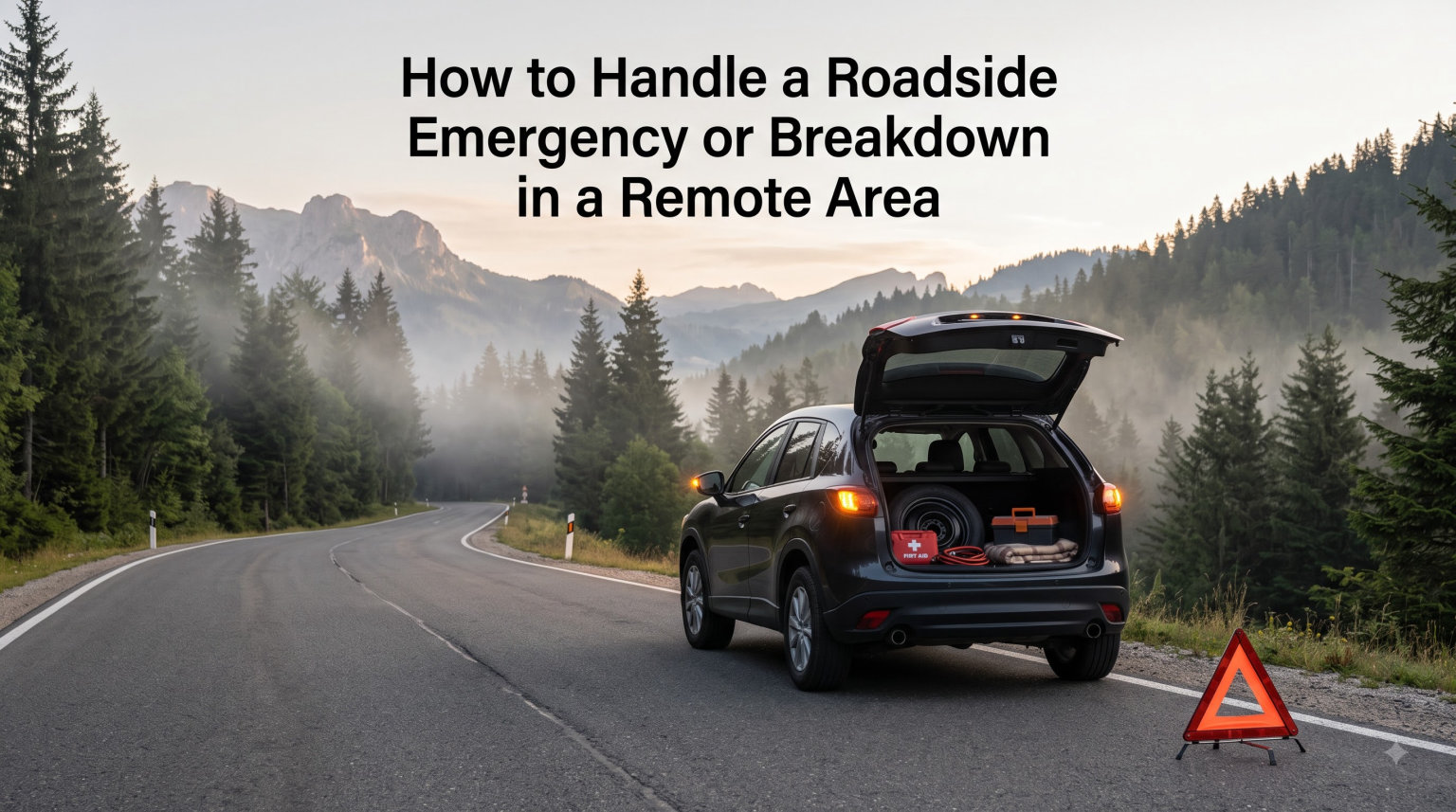
Breaking down on a lonely stretch of highway is one of the most unsettling experiences a driver can face. When the nearest town is 40 miles behind you and your phone shows zero bars, panic can set in fast. Knowing how to handle a roadside emergency breakdown in a remote area before it happens is what separates a manageable inconvenience from a survival situation.
Remote breakdowns are fundamentally different from urban ones. Help is farther away, cell service is often nonexistent, and you may be exposed to extreme temperatures, wildlife, or long stretches with no passing traffic. In 2026, drivers are logging more miles on rural routes than ever before, which means more of us are facing these risks without realizing it.
This guide walks you through every step of the process: what to do in the first 60 seconds, how to make your vehicle visible on a deserted road, how to call for help when there is no cell service, and how to stay safe while you wait. We also cover gaps that most other guides miss entirely, including satellite communicator options, wildlife precautions, tow truck scam avoidance, and when walking for help is the right call versus a dangerous mistake.
Whether you are planning a cross-country road trip, commuting through rural areas, or heading into the mountains for a weekend getaway, the information below could save your life. Let us start with the moments that matter most.
Table of Contents
Immediate Safety Steps: Your First 60 Seconds
The actions you take in the first minute after your vehicle starts failing are the most critical for your safety. Here is exactly what to do, in order, to handle a roadside emergency breakdown in a remote area.
Step 1: Pull over as far as possible. The moment you sense trouble, whether it is engine sputtering, a flat tire, or smoke from under the hood, turn on your hazard lights immediately. Coast to the right shoulder and get as far off the road surface as you safely can. On narrow rural roads with no shoulder, look for a pullout, driveway, or wide spot.
Step 2: Set the parking brake and assess. Once stopped, engage your parking brake, put the car in park (or leave it in gear if manual), and take a breath. Rushing leads to poor decisions. Take ten seconds to look at your surroundings before exiting.
Step 3: Make yourself visible. Keep your hazard lights on. If it is safe to do so, pop your hood, which is the universal sign that a vehicle needs help. Only exit the car if you can do so away from traffic.
Step 4: Decide whether to stay or exit. In almost all remote area situations, the safest choice is to stay inside your vehicle with the doors locked. Exiting exposes you to traffic, weather, and wildlife. Only leave if there is an immediate danger, such as a fire or if your vehicle is in a traffic lane and cannot be moved.
Step 5: Call for help. If you have cell service, call roadside assistance or 911 (more on this in the next sections). If you have no signal, move to the no-cell-service strategies outlined below.
One forum user who frequently drives through rural Nevada put it well: “The first thing I learned after breaking down on a desert highway was that staying calm and staying put saved me. The people who get into trouble are the ones who panic and start walking.”
Making Your Vehicle Visible on Remote Roads
On a busy highway, other drivers will see your hazard lights within seconds. On a remote road, you might go an hour or more without a single car passing. Visibility is about attracting the right kind of attention: rescuers, not predators.
Here is how to maximize your visibility:
Keep hazard lights on at all times. Even during the day, flashing lights catch attention from a greater distance than solid taillights.
Raise your hood. An open hood is the universal distress signal that tells passing drivers you need help. Only do this if you can safely reach the front of your vehicle.
Deploy reflective triangles or road flares. Place them 50, 100, and 200 feet behind your vehicle to warn oncoming traffic. Reflective triangles are safer than flares in dry, fire-prone areas.
Tie a bright cloth to your antenna or door handle. A red, orange, or yellow bandana or shirt signals distress and is visible from a distance.
Use a reflective emergency blanket. Drape it over the roof or trunk. These blankets are designed to reflect light and are visible for long distances, especially at night when headlights hit them.
Turn on interior lights at night. A lit interior signals occupancy and makes your vehicle more noticeable to passing drivers and law enforcement.
At night, a flashlight or headlamp aimed at the road can signal for help. Three short flashes is an internationally recognized distress signal. Avoid using your phone flashlight for this, since preserving battery for emergency calls is more important.
Calling for Help When You Have Cell Service
If your phone shows even one bar, you may be able to get help. The key is knowing who to call and in what order. Here is the priority chain for getting assistance.
Call 911 if you are in danger. If you are injured, your vehicle is in a dangerous position (like blocking a blind curve), or you feel threatened, 911 is always the right first call. Dispatchers can connect you with highway patrol, who can arrange towing. 911 calls can sometimes connect through any available tower, even if your phone shows no signal from your own carrier.
Call your roadside assistance provider. If you have AAA, insurance-based roadside assistance, or a manufacturer program, call them next. Have your membership number and location ready. Be as specific as possible about your location: note the highway number, mile marker, nearest exit, or any landmarks.
Call a local towing company. If you do not have roadside assistance, search for towing services in the nearest town. Your insurance company may also be able to recommend a provider and coordinate payment.
When you call, communicate these details clearly: your exact location or nearest landmark, the nature of your problem, your vehicle make and model, the number of people with you, and whether anyone needs medical attention. Write down the name of the dispatcher and the estimated arrival time.
Experienced travelers on road trip forums consistently recommend carrying a roadside assistance membership. AAA, insurance add-ons, and even some credit cards offer coverage that pays for itself in a single tow, especially in remote areas where towing distances and costs are much higher.
No Cell Service: Satellite Communicators and Other Solutions
This is where most roadside emergency guides fall short. They tell you to call for help, but what happens when you have zero signal and you are 50 miles from the nearest town? No competitor in our research covers this scenario in any meaningful depth. Here is what actually works.
Satellite communicators are the best solution for remote travel. These devices work where cell phones do not, using satellite networks to send messages and SOS signals from virtually anywhere on the planet. If you regularly travel through remote areas, a satellite communicator is the single most important piece of emergency gear you can carry.
The most commonly recommended options include:
Garmin inReach Mini 2: A compact, two-way satellite messenger that lets you send and receive text messages, trigger an interactive SOS to a 24/7 monitoring center, and share your GPS location. Battery life is excellent, often lasting days on a single charge. Forum users in r/roadtrip and r/socalhiking recommend this device more than any other.
Zoleo Satellite Communicator: Connects to an app on your phone and automatically switches between Wi-Fi, cellular, and satellite networks. It is more affordable than the Garmin inReach but still offers two-way messaging and SOS. A great option for occasional remote travelers.
SPOT Gen4 or SPOT X: Offers one-way or two-way messaging and SOS functionality at a lower price point. The SPOT X includes a keyboard for texting without a phone.
Apple iPhone Emergency SOS (iPhone 14 and later): Newer iPhones include built-in satellite emergency SOS capabilities, allowing you to text emergency services without cell service. This is a major advantage if you already carry a recent iPhone, though coverage depends on your region and satellite availability.
All satellite communicators require an active subscription or service plan, so factor that into your travel preparation. The monthly cost is a small price for the ability to call for help from anywhere.
If you have no satellite communicator and no cell service, here are your remaining options:
Text over Wi-Fi calling: If you have access to Wi-Fi (some remote gas stations, visitor centers, or ranger stations have it), enable Wi-Fi calling on your phone to send texts and make calls.
CB radio: Channel 9 is the emergency channel. Truckers monitor CB radios, and if you are near a highway, you may be able to reach someone. Range is limited to a few miles.
Ham radio: If you are a licensed operator, ham radios have much greater range than CB radios and can reach repeaters that connect to phone networks. This requires a license and equipment, but experienced remote travelers swear by it.
Flag down a passing driver: This is a last resort. Ask them to call for help at the next location with service. Be cautious about who you approach, as discussed in the stranger safety section below.
The single most important thing you can do before a remote trip is to tell someone your exact route and expected arrival time. If you do not arrive as expected, they can alert authorities who will start a search along your planned route. This costs nothing and has saved countless lives.
Staying Safe While You Wait
Once you have called for help (or sent an SOS), the waiting begins. In remote areas, wait times can stretch from one hour to eight hours or more, depending on distance, weather, and tow truck availability. How you handle that wait is just as important as how you handle the breakdown itself.
Wildlife Precautions in Remote Areas
No competitor we analyzed addresses wildlife safety during a remote breakdown. This is a serious oversight, because in many remote areas, wildlife is a genuine threat.
If you are in bear country (parts of Alaska, Montana, Wyoming, the Pacific Northwest, and Canada), keep all food sealed and stored inside the vehicle. Never leave food wrappers or scented items outside. If a bear approaches, stay inside your locked vehicle and make noise by honking the horn. Bears are generally not interested in vehicles, but food odors can attract them.
In mountain lion territory, keep children and pets close. Make yourself appear large if you must exit the vehicle. In areas with venomous snakes (deserts, the Southwest), watch where you step if you get out, and never reach into areas you cannot see. Snakes often shelter in the shade under vehicles.
The general rule: stay inside your vehicle with windows up and doors locked. A car is excellent protection against virtually all North American wildlife. Only exit briefly if absolutely necessary, and scan your surroundings first.
Stranger Danger: Accepting Help Safely
A well-meaning stranger may stop to help, and most people who pull over genuinely want to assist. However, you should exercise caution. Roll your window down just an inch or two to speak with someone you do not know.
If a stranger offers help, ask them to call roadside assistance or 911 for you rather than accepting a ride. If you accept a ride to the nearest town, text the stranger’s license plate number and vehicle description to someone you trust before getting in. Trust your instincts. If something feels off, politely decline and wait.
One Reddit user in r/AskOldPeople recalled advice that still holds: “In the old days, you flagged down anyone. Today, if someone stops and your gut says no, just say help is already on the way. You do not owe a stranger an explanation.”
Mental Resilience During Long Waits
The psychological toll of waiting hours alone on a remote road is real. Anxiety, fear, and boredom all set in. Keep your mind occupied by reading a book, listening to downloaded podcasts or music (if your battery permits), or playing offline games on your phone. Conserve your phone battery by dimming the screen and closing unnecessary apps.
If you are traveling with children or pets, keep them calm with snacks, games, and reassurance. Explain the situation in age-appropriate terms. Children take their cues from adults, so staying composed helps them feel safe. Keep pets restrained and never let them roam outside the vehicle in an unfamiliar area.
Surviving Extreme Weather in Your Vehicle
Your car is a shelter, and managing the temperature inside it is one of your primary jobs while waiting. Here is how to handle the most dangerous weather scenarios.
Cold Weather Survival
In freezing temperatures, hypothermia is the biggest threat. Run your engine for 10 minutes every hour to generate heat, but first confirm that your exhaust pipe is not blocked by snow, mud, or debris. A blocked exhaust pipe forces carbon monoxide into the cabin, which is lethal. Crack a window slightly for ventilation while the engine runs.
Conserve body heat by bundling up in blankets, extra clothing, or sleeping bags. The emergency blanket in your kit reflects body heat back toward you. Huddle together if you have passengers. Keep moving your fingers and toes to maintain circulation.
Clear snow from around the vehicle to improve visibility for rescuers, but only if you can do so quickly and safely. Frostbite can set in within minutes of exposure in extreme cold.
Extreme Heat Survival
In desert or high-heat environments, the opposite problem exists. A parked car can reach 130 degrees Fahrenheit within minutes in direct sun. Heat stroke and dehydration are the primary dangers.
Stay in the vehicle but keep windows cracked for airflow. Park in shade if possible, or create shade by hanging a tarp or emergency blanket over the roof. Drink water consistently in small sips, not all at once. Avoid exertion during the hottest part of the day (roughly 10 AM to 4 PM).
If the interior temperature becomes dangerously high, it may be safer to sit in the shade beside the vehicle. The ground temperature is often cooler than the car’s interior. Keep a wide-brimmed hat and sunscreen in your kit for this scenario.
Storms and Flooding
During thunderstorms, stay inside the vehicle with windows up. A hard-topped vehicle is one of the safest places during a lightning storm because the metal frame acts as a Faraday cage. Avoid touching metal surfaces inside the car.
If you are in a flash flood zone, abandon the vehicle and move to higher ground. Never drive or wade through moving water. Six inches of water can stall a vehicle, and two feet can carry most cars away.
Tow Truck Verification: Avoiding Scams
Predatory towing is a real problem, and it gets worse in remote areas where you have fewer options. A tow truck that appears uninvited may charge you double or triple the going rate, and some operate without proper licensing or insurance. Here is how to protect yourself.
Always verify the towing company. Ask the driver for the company name, phone number, and their dispatcher’s name. Cross-reference this with the information you received when you called for help. If you did not call anyone, ask which company dispatched them and call to confirm.
Check for legitimate markings. A reputable tow truck should have the company name printed on the vehicle, a DOT number visible, and a professional appearance. Unmarked trucks or drivers who cannot provide documentation are a red flag.
Confirm the destination and price before hooking up. Ask where your vehicle will be towed and get a price quote in writing or by text message. If the driver refuses to provide a price before starting, that is a warning sign.
Pay by card, not cash, when possible. A credit card provides a transaction record and dispute protection. Forum users note that carrying some cash is wise for remote travel since card processing may not work everywhere, but for tow services, a card leaves a paper trail.
Call law enforcement if something feels wrong. If an unmarked tow truck arrives and you did not call one, or if the driver pressures you, call 911 or highway patrol. They can verify the tow company and protect your safety.
When Walking for Help Makes Sense (and When It Doesn’t)
One of the hardest decisions in a remote breakdown is whether to stay with your vehicle or walk for help. Forum discussions reveal that this is one of the most common and anxiety-inducing questions drivers face. Here is a clear framework.
Stay with your vehicle in almost all cases. A vehicle is a large, visible, sheltered object that rescuers can find easily. A person walking along a remote road is small, exposed, and hard to spot. Search and rescue professionals consistently say that people who leave their vehicles are much harder to find.
Walking may be appropriate only if all of these conditions are true:
You know exactly where you are and how far away help is (for example, you can see a gas station a mile ahead).
Weather conditions are safe and stable (no extreme heat, cold, or storms).
You have water, appropriate clothing, and footwear for walking.
You have a way to mark your vehicle’s location (GPS coordinates written down, a note on the dashboard).
You told someone you are leaving and where you are going.
You are physically capable of the walk without risking injury.
Never walk if any of these apply: it is dark, weather is severe, you do not know which direction leads to help, you are injured, you have children or elderly passengers who cannot walk safely, or you are in extreme heat or cold. In these situations, your vehicle is your lifeline.
If you must leave, leave a visible note on the dashboard with your name, the time you left, the direction you are walking, and your destination. Take water, your phone, and a flashlight. Walk on the shoulder facing oncoming traffic so drivers can see you.
The Complete Remote Area Emergency Kit Checklist
Preparation is the single biggest factor in how well a remote breakdown goes. Every vehicle that travels through rural areas should carry a well-stocked emergency kit. Here is the full checklist, organized by priority.
Visibility and Signaling:
Three reflective warning triangles
Road flares (check local laws and fire danger restrictions)
High-visibility vest or reflective clothing
Bright cloth or bandana for tying to the antenna
Whistle for signaling
Flashlight or headlamp with extra batteries
Communication:
Portable phone charger or power bank (fully charged)
Car phone charger with a spare cable
Satellite communicator (for frequent remote travelers)
Written list of emergency phone numbers (in case your phone dies)
Vehicle Tools and Repair:
Spare tire, jack, and lug wrench (check tire pressure regularly)
Tire repair kit or tire sealant (such as Fix-a-Flat)
Portable air compressor (12V)
Jumper cables or portable jump starter battery pack
Basic tool kit (screwdrivers, pliers, adjustable wrench, duct tape)
One quart of motor oil and a gallon of coolant
Survival and Comfort:
One gallon of water per person per day (plan for at least 24 hours)
Non-perishable food (energy bars, trail mix, crackers)
Emergency blankets or sleeping bags (one per person)
Warm clothing, including hats and gloves
First aid kit with bandages, antiseptic, pain relievers, and any prescription medications
Emergency shelter (small tarp or space tent)
Miscellaneous Essentials:
Cash in small bills (card readers may not work in remote areas)
Paper maps of the areas you travel through
Sunscreen and insect repellent
Paper towels and wet wipes
Spare car key (kept on your person, not in the car)
Store your kit in a sturdy container in the trunk. Check it twice a year to replace expired food, medications, and batteries. A kit you build once and forget about is not reliable when you actually need it.
FAQs
What to do if a car breaks down in a rural setting?
Turn on your hazard lights immediately and pull as far off the road as possible. Set your parking brake, stay inside the vehicle with doors locked, and call roadside assistance or 911 if you have cell service. If you have no signal, use a satellite communicator or ask a passing driver to call for help. Make your vehicle visible with reflective triangles, an open hood, or a bright cloth tied to the antenna.
How do you handle emergency breakdowns?
Stay calm and follow five steps: pull over safely with hazard lights on, set the parking brake, make your vehicle visible, call for professional help, and stay with your vehicle while waiting. Do not attempt major repairs on the roadside. Keep doors locked and only exit if there is immediate danger.
What to do if your car breaks down with no cell service?
If you have no cell service, use a satellite communicator like a Garmin inReach, Zoleo, or SPOT device to send an SOS or text message. If you do not have one, try Wi-Fi calling if you can reach a building with Wi-Fi, use a CB radio on channel 9, or flag down a passing driver and ask them to call for help at the next location with service. Always tell someone your route before traveling to remote areas.
Who do you call if your car breaks down in the middle of nowhere?
Call 911 first if you are in immediate danger, injured, or blocking traffic. If you are safe but stranded, call your roadside assistance provider such as AAA, your auto insurance company, or your vehicle manufacturer program. If you have no roadside assistance coverage, search for a towing company in the nearest town or ask 911 dispatch to connect you with highway patrol.
What happens if you break down in the middle of nowhere?
You should stay with your vehicle, make it visible to rescuers, and wait for help. In remote areas, tow truck response times can range from one to eight hours depending on distance and road conditions. Keep doors locked, conserve phone battery, manage interior temperature, and stay hydrated. A vehicle is much easier for rescuers to find than a person walking on foot.
What is the difference between roadside assistance and breakdown cover?
Roadside assistance is a service that sends a technician to attempt on-the-spot repairs, such as jump-starts, tire changes, or lockout help. Breakdown cover (a term more common in the UK and Europe) is broader and typically includes towing to a repair facility if the vehicle cannot be fixed at the roadside. In the US, most roadside assistance plans from AAA, insurers, and manufacturers bundle both services together.
Final Thoughts on Remote Area Breakdown Safety
Learning how to handle a roadside emergency breakdown in a remote area comes down to three core principles: preparation, visibility, and patience. Build your emergency kit before you need it. Make your vehicle easy to find. And when in doubt, stay put and wait for professional help.
The drivers who handle remote breakdowns best are the ones who planned for them. A roadside assistance membership, a satellite communicator, a stocked emergency kit, and a travel plan shared with someone you trust are the four investments that turn a frightening situation into a manageable one.
Drive smart, prepare thoroughly, and remember that staying calm is your most powerful tool when the unexpected happens on a lonely road.