
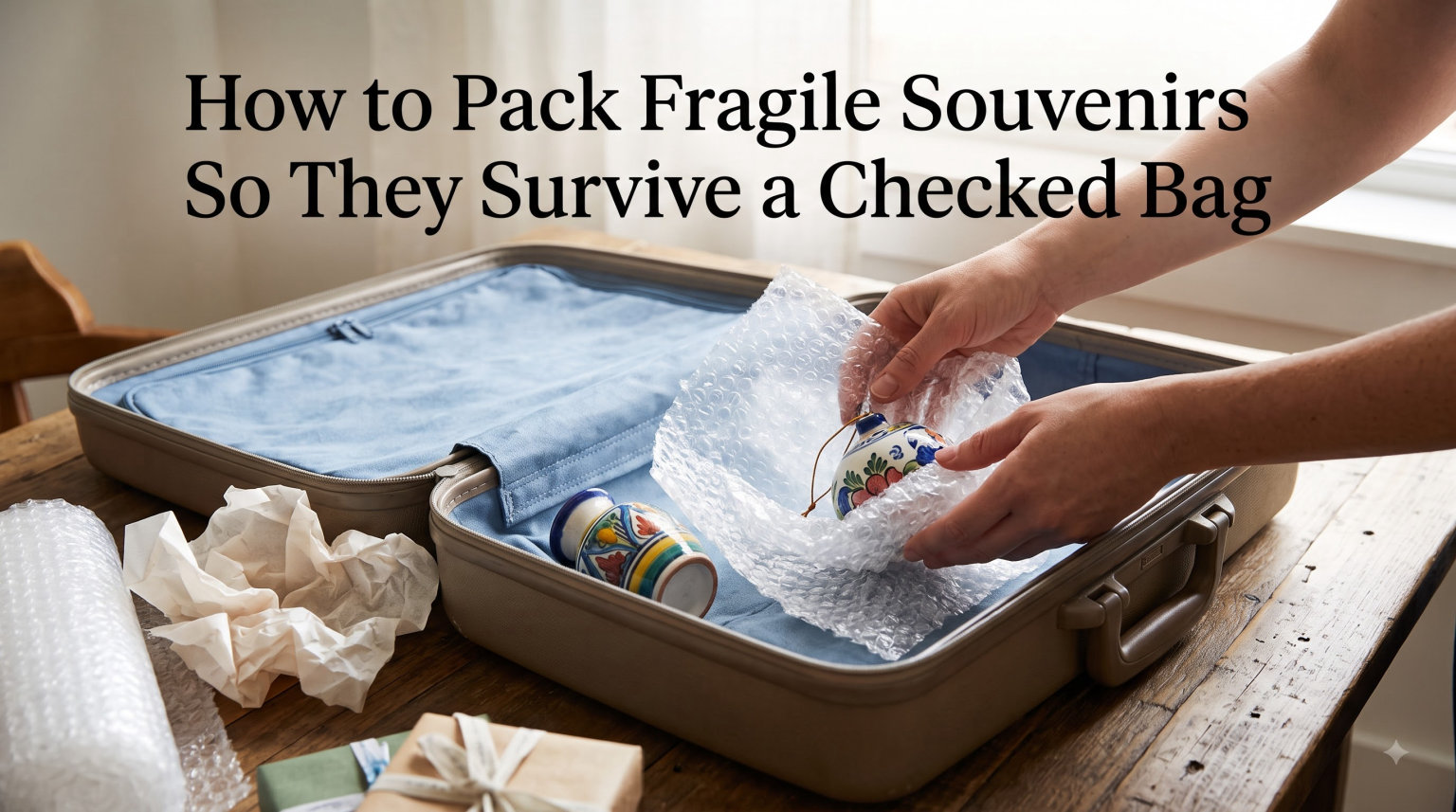
There is nothing worse than opening your suitcase after a long flight and finding your carefully chosen souvenirs shattered into pieces. I have watched a hand-painted ceramic plate from Portugal crack clean in half because I rushed the packing job at the hotel. That moment taught me everything I know about how to pack fragile souvenirs so they survive a checked bag.
Checked luggage gets thrown onto conveyor belts, stacked under heavier bags, and jostled through cargo holds. None of that is gentle. The good news is that with the right technique, even delicate items like Murano glass and wine bottles can make it home in one piece.
In this guide, I will walk you through the exact step-by-step process I use every time I travel. You will learn which packing materials actually work, where to position fragile items inside your suitcase, the truth about those fragile stickers, and when you should skip the checked bag entirely.
Whether you are hauling ceramics from a market in Marrakech or a framed art print from a gallery in Paris, this guide will help you get it home safely.
Table of Contents
Essential Packing Materials You Need
The right materials make all the difference between a souvenir arriving intact and arriving as confetti. You do not need every item on this list for every trip, but having a few key supplies on hand gives you options.
Bubble wrap is the gold standard for fragile packing. Small-bubble wrap works best for delicate ceramics and glassware because the tighter cushioning absorbs impact more efficiently. Aim for at least two layers around each item.
Packing tape holds your wrapping in place. A small roll travels easily and prevents your careful wrapping from unraveling mid-flight.
Tissue paper or newspaper is perfect for the first layer against delicate surfaces. It prevents scratches and adds a thin cushion before you add bulkier padding.
Your own clothing is the most underrated packing material. Socks, t-shirts, towels, and sweaters compress around fragile items and cost nothing extra. I have packed entire sets of glassware using nothing but rolled-up socks and sweaters.
Plastic zip-top bags contain any leaks or tiny shards if something does break. They also keep small items like jewelry or loose figurines organized.
Cardboard sheets or shoebox lids create rigid barriers between fragile items and the rest of your luggage. A simple piece of corrugated cardboard can stop a ceramic bowl from getting crushed.
How to Pack Fragile Souvenirs So They Survive a Checked Bag: Step-by-Step
Follow these steps in order and your fragile souvenirs will have the best possible chance of making it home unscathed. This is the exact method I use after years of trial and error.
Step 1: Assess Your Souvenir
Look at what you bought and identify its weak points. A ceramic mug with a handle needs protection around that handle. A glass bottle needs padding on all sides. Understanding the shape tells you where to focus your wrapping.
Step 2: Wrap in Tissue Paper First
Start with a layer of tissue paper or soft cloth directly against the item. This prevents scratches on painted or glazed surfaces. Wrap it loosely enough to cover the entire piece without applying pressure.
Step 3: Add Bubble Wrap or Clothing Padding
Now add your cushioning layer. If using bubble wrap, wrap at least two full layers around the item and secure with packing tape. If using clothing, roll socks or small garments tightly and pack them around every side of the item. The goal is zero empty space where the item can shift.
Step 4: Create a Rigid Outer Shell
For extra protection, sandwich the wrapped item between two pieces of cardboard. This creates a rigid shell that distributes pressure if something heavy gets stacked on your bag. Tape the cardboard edges together so the item cannot slide out.
Step 5: Place the Item in the Center of Your Suitcase
The center of your bag is the safest spot. It is farthest from the exterior walls where impacts happen during loading and unloading. Surround the item on all sides with soft items like rolled clothing, towels, or a folded jacket.
Step 6: Fill Every Gap
Items break when they shift. Fill every gap around your wrapped souvenir with socks, underwear, or packing cubes. The suitcase should feel like a solid block when you are done, with nothing moving when you shake it gently.
Step 7: Add a Top Cushion Layer
Lay a thick layer of clothing or a towel across the top of your packed items before zipping the lid compartment. This absorbs pressure from above when bags get stacked in the cargo hold.
Step 8: Test by Shaking
Pick up your suitcase and give it a gentle shake. If you hear or feel anything moving inside, open it up and add more padding. That movement is exactly what causes breakage during transit.
Step 9: Request a Fragile Sticker at Check-In
When you drop off your bag, ask the airline agent for a fragile tag. Not all airlines honor them, but it costs nothing and can result in gentler handling. I always ask, and it has made a visible difference on several flights.
Proper Placement in Checked Bag
Where you put your fragile item inside the suitcase matters as much as how you wrap it. The wrong placement turns good wrapping into wasted effort.
The center of the bag is always your safest zone. Items placed against the outer walls of a hard-shell suitcase take the brunt of every impact. Even with thick padding, the walls transmit shock directly to whatever is touching them.
Build a nest of soft items first, then place your wrapped souvenir in the middle. Put a layer of clothing on the bottom of the bag, position the fragile item, then pack more clothing around all sides and on top. Think of it as building a protective cocoon.
Avoid placing fragile items near the wheels or handle mechanism. Those areas concentrate the mechanical stress of dragging and lifting the bag. The space directly above the wheels is particularly vulnerable to vibration damage.
Never put fragile items in the outer pockets of a soft-sided bag. Those pockets offer zero protection and are the first point of contact during rough handling.
The Fragile Sticker Trick Explained
The fragile sticker trick is simple: you ask the airline check-in agent to attach a “Fragile” tag to your bag, and the baggage handlers are supposed to treat it with more care. Some travelers report noticeably gentler handling when the tag is visible.
Not every airline offers these stickers, and policies vary widely. United Airlines, for example, explicitly addresses fragile baggage on their website and advises placing items in the middle of the bag wrapped securely. Delta and American have similar guidance but handle the tags differently at each airport.
Here is the honest truth from my experience and from what travelers report on forums like Reddit and the Rick Steves community: a fragile sticker may get your bag placed on top of the cargo pile rather than buried at the bottom. That is a real benefit. But it is not a guarantee.
Airlines do not accept liability for fragile items in checked baggage, even with a sticker attached. The tag is a request, not a contract. This is exactly why proper packing is your real safety net.
To request one, simply ask at the check-in counter when you drop off your bag. Some airports have self-serve sticker dispensers near the bag drop area. If the agent says no, thank them and rely on your packing technique instead.
Carry-On vs Checked Bag: Which Is Better for Fragile Souvenirs?
For truly irreplaceable or highly fragile items, carry-on is almost always the better choice. You control how the bag is handled, and it stays with you through the entire trip. The overhead bin is far gentler than a cargo hold.
The trade-off is space. Carry-on bags have strict size limits, usually around 22 by 14 by 9 inches. If your souvenir is large or oddly shaped, it may not fit. You also need to consider liquid restrictions if you are carrying wine or olive oil, since the TSA 3-1-1 rule limits liquids to 3.4 ounces in carry-on bags.
I recommend carry-on for these types of souvenirs:
Small ceramics, handmade jewelry, delicate figurines, framed small art prints, and anything you would be genuinely heartbroken to lose. These items fit easily in a personal item bag padded with a scarf or sweater.
Checked bag works better for larger items like big ceramic plates, wine bottles, oversized art, or multiple fragile purchases that will not fit in overhead bins. The key is packing them so well that rough handling does not matter.
One clever strategy travelers on the Rick Steves forum recommend: use a small, soft-sided bag as your carry-on containing only inflight essentials and your most fragile item, padded thoroughly. Then check your main suitcase with the rest of your belongings.
If you have a liquid souvenir like wine or spirits and it exceeds carry-on limits, your only option is checked baggage. Wrap the bottle in bubble wrap, place it inside a sealed plastic bag to contain potential leaks, and position it in the center of your bag surrounded by clothing.
Budget-Friendly Packing Alternatives Without Bubble Wrap
You do not need to buy bubble wrap to pack fragile items well. On plenty of trips I have arrived at my hotel, bought souvenirs, and realized I had no packing supplies. Here is what works instead.
Rolled socks are excellent padding. Stuff them inside hollow items like vases or mugs, then pack more around the outside. The wool or cotton absorbs shock effectively.
T-shirts and sweaters wrapped tightly around a fragile item create a soft, thick barrier. Fold them into padded layers and stack them around the souvenir.
Hotel towels are thick and readily available. Wrap your item in a towel, roll it, and tuck the ends in. Just remember that the towel takes up significant suitcase space.
Plastic grocery bags or dry-cleaning bags scrunched up create a surprisingly effective shock-absorbing layer. They are lightweight and conform to any shape.
The hotel laundry bag can serve as an outer wrapper, keeping all your padding layers together while adding a thin extra cushion.
I have packed entire sets of glassware using nothing but hotel towels and rolled socks, and every piece arrived intact. The principle is the same regardless of material: surround the item with soft, compressible layers and eliminate all empty space.
Common Packing Mistakes to Avoid
Most broken souvenirs happen because of preventable mistakes. Avoid these and you will immediately improve your success rate.
Placing fragile items near the edges of the bag. The outer walls of a suitcase bear the full force of impacts. Items placed against the walls are essentially unprotected no matter how much bubble wrap you use.
Leaving empty space around wrapped items. Movement is the enemy of fragile items. If your wrapped souvenir can shift even an inch inside the bag, it can build up enough momentum to crack on impact.
Forgetting to test the pack. A quick shake test takes five seconds and catches loose items before you reach the airport. If you hear rattling, fix it before you fly.
Overpacking the suitcase. A bag bursting at the seams puts constant pressure on everything inside. If the lid barely closes, that ceramic plate is under stress for the entire flight. Leave some breathing room.
Not inspecting items at baggage claim. If something breaks in transit, you need to report it before leaving the airport. Most airlines require damage claims to be filed within a specific window. Inspect your souvenirs immediately at the carousel.
Types of Fragile Souvenirs and Their Specific Needs
Different souvenirs require different packing approaches. Here is how I handle the most common types.
Ceramics and pottery need padding on all surfaces, especially around handles and rims. Stuff the inside with socks or tissue paper, wrap the outside in bubble wrap or clothing, and place cardboard around the whole package.
Glassware is the most fragile category. Wrap each piece individually, never let glass touch glass, and pad heavily on all sides. Wine bottles should go inside a sealed plastic bag first in case of leakage, then wrapped in clothing and placed in the center of the bag.
Framed art prints need rigid protection. Place the frame between two pieces of cardboard cut slightly larger than the frame itself, then wrap the whole bundle in clothing. The cardboard prevents the frame from bending under pressure.
Antiques require extra caution because they may be structurally weak. Wrap them more generously than you think necessary, and consider shipping them separately if they are valuable. Use tissue paper as the first layer to avoid damaging aged finishes.
Small figurines and ornaments can be tucked inside socks or shoes for quick protection. Each one should be wrapped individually so they do not clink against each other.
Airline Policies on Fragile Items
Airlines generally do not accept liability for fragile items in checked baggage. This is stated in nearly every airline contract of carriage. Even with a fragile sticker, the airline is not responsible if your item breaks.
United Airlines advises placing fragile items in the middle of the bag wrapped securely in bubble wrap or clothing. Delta and American offer similar guidance through their baggage policy pages. None of them guarantee special handling for fragile-tagged bags.
If your item is extremely valuable, look into whether your travel insurance or credit card trip protection covers breakage. Some premium cards offer baggage protection that goes beyond what airlines provide.
TSA screenings add another layer of unpredictability. Security officers may open your checked bag for inspection, which means your carefully arranged packing could get disrupted. Wrapping items so they are self-contained bundles, rather than relying on the overall arrangement of the bag, helps minimize disruption if TSA opens it.
FAQs
How do you pack fragile items in checked luggage?
Wrap each fragile item first in tissue paper, then add at least two layers of bubble wrap or tightly rolled clothing. Secure everything with packing tape, place the item in the center of your suitcase surrounded by soft items like rolled shirts and towels, and fill every gap so nothing shifts during transit. Shake the bag gently to test for movement before checking it.
Do airlines care about fragile stickers?
Airlines do not guarantee special handling for fragile-tagged bags, but the sticker can result in gentler treatment. Some handlers place fragile-tagged bags on top of the cargo pile rather than burying them at the bottom. Airlines do not accept liability for broken fragile items even with a sticker attached, so proper packing remains your primary protection.
Can you take fragile souvenirs through carry-on?
Yes, and for highly fragile or irreplaceable items, carry-on is the safer option. You control how the bag is handled, and the overhead bin is far gentler than a cargo hold. Keep in mind that liquids like wine or olive oil must follow the TSA 3-1-1 rule, limiting carry-on liquids to 3.4 ounces per container.
What is the fragile sticker luggage trick?
The fragile sticker trick involves asking the airline check-in agent to attach a Fragile tag to your bag. The idea is that baggage handlers will treat the bag more carefully and place it on top of the cargo pile. You simply ask for the tag when you drop off your bag at the counter, and most agents will provide one at no cost.
Where should fragile items be placed in a suitcase?
Fragile items should go in the exact center of the suitcase, surrounded on all sides by soft items like clothing and towels. This position keeps them farthest from the exterior walls where impacts occur during loading and unloading. Avoid placing fragile items near the wheels, handle mechanism, or outer pockets.
Wrapping Up
Learning how to pack fragile souvenirs so they survive a checked bag comes down to three core principles: wrap thoroughly, place items in the center of your bag, and eliminate all movement. Whether you use bubble wrap or rolled socks, the technique is the same.
Request a fragile sticker when you check in, but never rely on it alone. For irreplaceable items, keep them in your carry-on where you control the handling. And always inspect your souvenirs at baggage claim before leaving the airport.
With this step-by-step approach, you can shop with confidence on your next trip and bring every treasure home in one piece.