
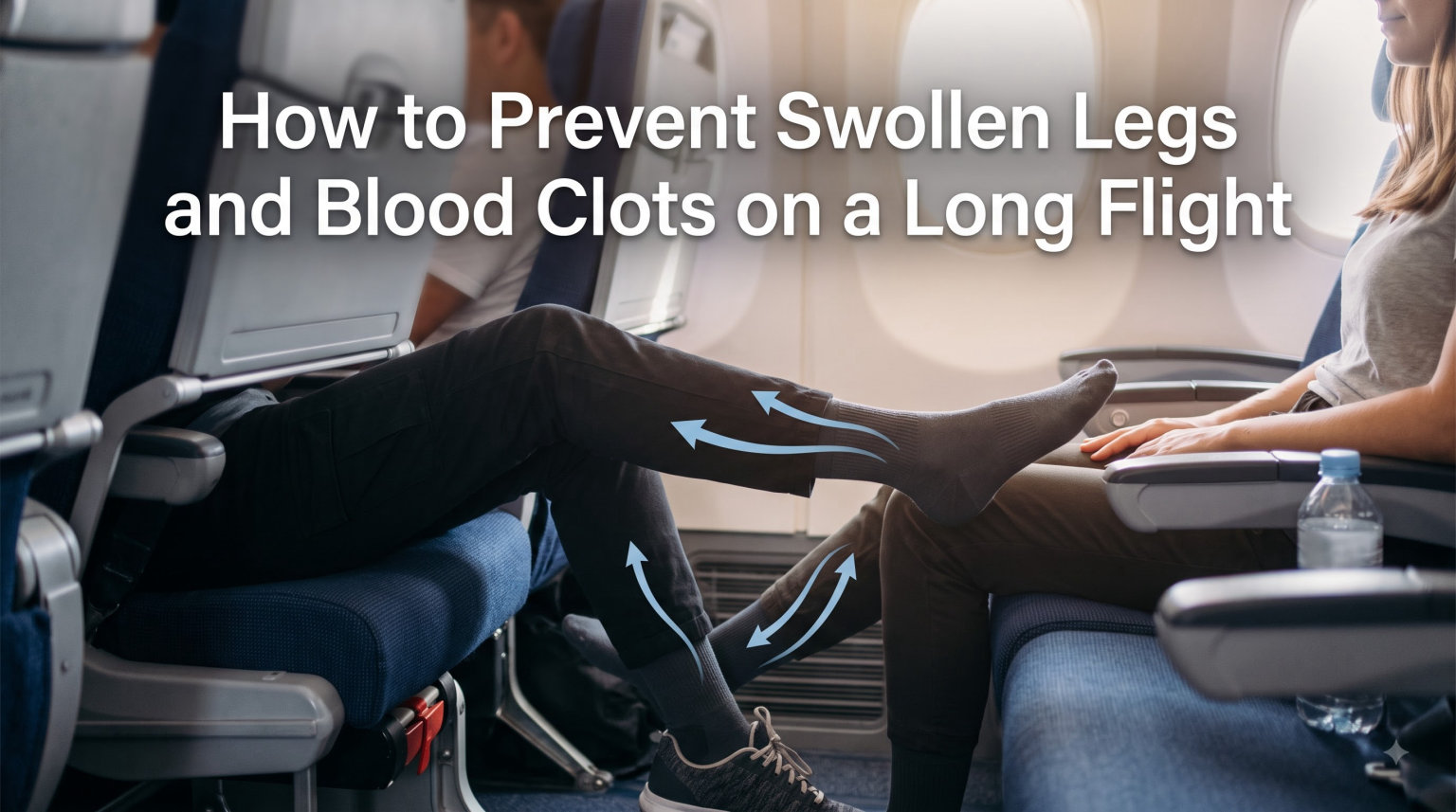
Long flights can leave your legs feeling heavy, swollen, and achy, but for some travelers, the risks go far beyond discomfort. Sitting still for hours at a time creates the perfect conditions for a dangerous blood clot to form in the deep veins of your legs, a condition known as deep vein thrombosis (DVT). I’ve spent the last month researching vascular surgeon advice, CDC guidelines, and Clot Survivor forums to put together the most complete guide on how to prevent swollen legs and blood clots on a long flight.
Whether you’re flying for 4 hours or 14, the strategies below work. I’ll walk you through the science behind flight-related clots, share specific exercises you can do in your seat, and explain the warning signs you should never ignore. By the end, you’ll have a clear pre-flight checklist to protect your circulation on every journey you take this year and beyond.
Table of Contents
What Is Deep Vein Thrombosis (DVT) and Why Should You Care?
Deep vein thrombosis (DVT) is a blood clot that forms in a deep vein, most commonly in the calf, thigh, or pelvis. According to the CDC, DVT affects up to 900,000 Americans each year, and a portion of these cases are directly linked to long-distance travel.
The real danger arises when a piece of the clot breaks off and travels to the lungs. This life-threatening condition is called a pulmonary embolism (PE), and it can cause sudden death if not treated immediately. Medical organizations often call DVT and PE together “venous thromboembolism” (VTE), one of the most common causes of preventable death in travelers.
Key DVT Facts Every Flyer Should Know
- Around 1 in 1,000 people develop a travel-related blood clot each year.
- Risk roughly doubles on flights longer than 4 hours.
- Symptoms can appear up to 2 weeks after landing, not just immediately.
- Most cases are preventable with simple movement and hydration.
Why Long Flights Increase Your Blood Clot Risk
Flying combines three factors that, together, make your circulatory system work harder than it should. Understanding each one helps you fight back with the right strategy.
Cruise Factor: Prolonged Immobility
Your calf muscles act as a second heart. Every time you flex them, they squeeze blood back up toward your torso. When you sit still for hours, that pump stops working, and blood pools in the lower legs. The American Society of Hematology notes that this pooling can stretch vein walls and activate the body’s clotting cascade, the chemical chain reaction that forms clots.
Silent Factor: Low Cabin Pressure and Humidity
Cabin pressure on most commercial flights is equivalent to standing at 6,000 to 8,000 feet elevation. This causes mild dehydration and slight changes in blood viscosity. Dr. Danielle Bajakian, a vascular surgeon at Columbia Surgery, explains that even modest dehydration makes blood thicker, which can slow return flow from the legs and increase clot risk.
Hidden Factor: Compression and Restricted Movement
Economy seats give you just 28 to 32 inches of legroom. Your knees stay bent, your back rests against the seat, and there’s no room to fully extend. This unnatural posture, combined with tight quarters, restricts blood flow even when you do move.
In-Flight Exercises to Prevent Swollen Legs and Blood Clots
Movement is the single most effective prevention method. You don’t need an aisle seat or a fancy gadget. You can do all of these exercises right in your seat, even in a window seat during a packed flight. I recommend doing one exercise every 30 to 60 minutes during your flight.
Exercise 1: Ankle Circles (1 minute each direction)
Lift your feet slightly off the floor. Rotate your ankles in a slow circle, first clockwise, then counterclockwise. This activates the calf and foot muscles and keeps blood moving through the deep veins. Aim for 10 circles in each direction, every foot.
Exercise 2: Foot Pumps (20 reps)
Keep your heels on the floor and lift your toes toward your shins as high as you can. Hold for a second, then lower. Repeat 20 times. This mimics the natural motion of walking and forces blood out of the lower leg.
Exercise 3: Calf Raises (20 reps)
With both feet flat on the floor, lift your heels as high as possible while keeping your toes down. Hold for 2 seconds, then lower. This is the same exercise you do before a long run. It directly engages the calf muscle pump.
Exercise 4: Knee-to-Chest Stretch (hold 15 seconds each leg)
Bring one knee toward your chest, gently hugging it with your hands. Hold for 15 seconds, then switch legs. This stretches the hip flexors and improves circulation through the thigh.
Exercise 5: Forward Flex (hold 15 seconds)
With both feet flat on the floor, slowly lean forward and reach toward your toes. Keep your back rounded. Hold for 15 seconds. This stretch compresses the calf muscles and pushes blood upward.
Exercise 6: Shoulder Rolls and Overhead Reach (10 reps each)
Roll your shoulders backward 10 times, then lift both arms overhead and stretch toward the ceiling. This helps upper body circulation and prevents the stiffness that makes you want to stay frozen in your seat.
Exercise 7: Aisle Walks (every 2 to 3 hours)
When the seatbelt sign is off, take a 5-minute walk up and down the aisle. If the flight is mostly full, wait for a calm moment and do a quick lap. Walking activates the largest muscle groups in your body and resets your circulation.
How to Prevent Swollen Legs and Blood Clots on a Long Flight: Complete Strategy
Movement alone isn’t enough. The best prevention plan combines several habits, working together. Here’s what the vascular surgery experts at Columbia and the CDC recommend.
Stay Aggressive With Hydration
Drink at least 8 ounces of water for every hour of flight time. Avoid alcohol and caffeine, both of which dehydrate you further. Many experienced travelers carry 2 to 4 bottles through the airport to stay ahead of cabin dryness. Yes, it means more bathroom trips, which is actually a hidden benefit, since each trip forces you to stand and walk.
Choose Your Seat Wisely
If you have any risk factors at all, pay extra for an aisle seat. The CDC and Stop the Clot both flag aisle seats as a meaningful prevention tool simply because they make it easier to get up and move without disturbing seatmates. If you must take a window seat, commit to doing in-seat exercises every 30 minutes.
Wear Compression Stockings (15 to 20 mmHg)
Graduated compression stockings apply more pressure at the ankle and less pressure as they move up the leg. This gentle squeeze helps push blood back toward the heart. For flights over 4 hours, the CDC recommends compression stockings rated 15 to 20 mmHg for most travelers and higher pressure for those with prior DVT. They also reduce the leg swelling that makes economy class so uncomfortable.
Avoid Crossing Your Legs
Crossing your legs at the knee compresses the veins behind your knee and slows blood flow. Keep both feet flat on the floor or use your carry-on as a footrest to elevate your legs slightly.
Skip the Sleeping Pill
It sounds counterintuitive, but sleeping for 6 straight hours on a plane is a major risk factor. You won’t move, your calves stay inactive, and you won’t drink water. If you do nap, set a phone alarm for every 90 minutes to wake up and do a quick set of foot pumps.
Pre-Flight Preparation
Walk briskly for at least 30 minutes before boarding. This warms up your muscles and primes your circulation. Avoid heavy meals right before the flight, since digestion pulls blood flow away from your legs.
Who Is Most at Risk for Flight-Related Blood Clots?
Anyone on a long flight has some risk, but certain factors raise it significantly. Check this list before booking.
High-Risk Factors to Consider
- Previous blood clot or family history of DVT
- Recent surgery (within 3 months), especially orthopedic or abdominal
- Pregnancy or postpartum (within 6 weeks)
- Estrogen-based birth control or hormone replacement therapy
- Cancer or active cancer treatment
- Obesity (BMI over 30)
- Age over 60
- Smoking
- Varicose veins (severe)
- Heart failure or chronic inflammatory conditions
If you have any of these factors, talk to your doctor before long-haul travel. They may recommend a higher-compression stocking, a low-dose anticoagulant, or a heparin injection before departure.
Blood Clot Symptoms After Flying: When to Worry
Most travelers feel some leg swelling or stiffness after a long flight, and that’s normal. The danger signs are different. The CDC lists clear symptoms that should send you to a doctor immediately, not just to your hotel bed.
DVT Symptoms (usually in one leg)
- Swelling in one leg, especially the calf or thigh
- Pain or tenderness that feels like a cramp, often starting in the calf
- Red or discolored skin on the leg
- Warmth in the affected area
Pulmonary Embolism Symptoms (medical emergency)
- Sudden shortness of breath
- Chest pain that worsens when you breathe deeply or cough
- Lightheadedness, dizziness, or fainting
- Rapid or irregular heartbeat
- Coughing up blood
When to Seek Help
Don’t wait. If you notice any DVT symptoms within 2 weeks after a flight, contact your doctor. If you develop any pulmonary embolism symptoms, call emergency services immediately. The CDC and the National Blood Clot Alliance both emphasize that DVT symptoms can show up days after flying, not just hours. This is the most common mistake travelers make, ignoring a “weird cramp” that doesn’t go away.
Frequently Asked Questions
How to not get a blood clot on a long flight?
Move every 30 to 60 minutes with ankle circles, foot pumps, and calf raises. Walk the aisle every 2 to 3 hours. Drink 8 ounces of water per flight hour, avoid alcohol, and wear 15 to 20 mmHg graduated compression stockings. Avoid crossing your legs and skip sleeping pills so you wake up to move.
Does wiggling toes prevent blood clots?
Wiggling toes helps, but it’s not enough on its own. Toe movement engages small foot muscles that support venous return. Pair it with ankle circles, foot pumps, and calf raises to fully activate the calf muscle pump, which is the main driver of blood flow back to the heart.
How likely are you to get a blood clot from flying?
About 1 in 1,000 travelers develop a flight-related blood clot each year. Risk roughly doubles on flights longer than 4 hours and is higher for people with obesity, recent surgery, pregnancy, or estrogen use. The overall risk is low for healthy travelers, but the consequences can be severe, so prevention matters.
Does drinking lots of water prevent blood clots?
Staying well-hydrated helps prevent blood clots on flights by keeping blood less viscous and supporting healthy circulation. Aim for at least 8 ounces of water per flight hour. Avoid alcohol and caffeine, which pull fluid out of your bloodstream and make dehydration worse.
When to worry about leg pain after flying?
Worry if leg pain appears in only one leg, feels like a cramp that doesn’t loosen, comes with swelling, redness, or warmth, or starts days after the flight. DVT symptoms can show up up to 2 weeks after travel. Call your doctor right away or go to urgent care if these signs appear.
Quick Pre-Flight Checklist
Save this on your phone before your next trip. It takes about 5 minutes to run through.
- Book an aisle seat if you have any risk factors
- Wear loose, comfortable clothing and slip-on shoes
- Put on 15 to 20 mmHg compression stockings before boarding
- Pack an empty water bottle and fill it after security
- Walk briskly for 30 minutes before boarding
- Set a phone alarm for every 90 minutes during the flight
- Pack anti-snack options to avoid salty, dehydrating foods
Final Thoughts: How to Prevent Swollen Legs and Blood Clots on a Long Flight
Knowing how to prevent swollen legs and blood clots on a long flight isn’t complicated. It comes down to three habits: keep moving, keep hydrated, and keep your blood flowing in the right direction. The exercises take 30 seconds. The hydration is just water. The compression stockings cost far less than a hospital visit.
I’ve written this guide because the cost of getting it wrong is severe, and the cost of getting it right is just a little pre-flight planning. If you have any risk factors from the list above, talk to your doctor before booking. Otherwise, commit to the in-seat exercises and the hydration routine, and you’ll land feeling far better than the passenger next to you.
Safe travels in 2026 and beyond.
Sources and Further Reading
- CDC Travelers’ Health: Blood Clots During Travel
- Columbia Surgery: Vascular Surgeon Advice on Flying
- Stop the Clot: In-Flight Fitness Guide
- American Society of Hematology: Clots and Travel
- National Blood Clot Alliance: Travel and Blood Clots