
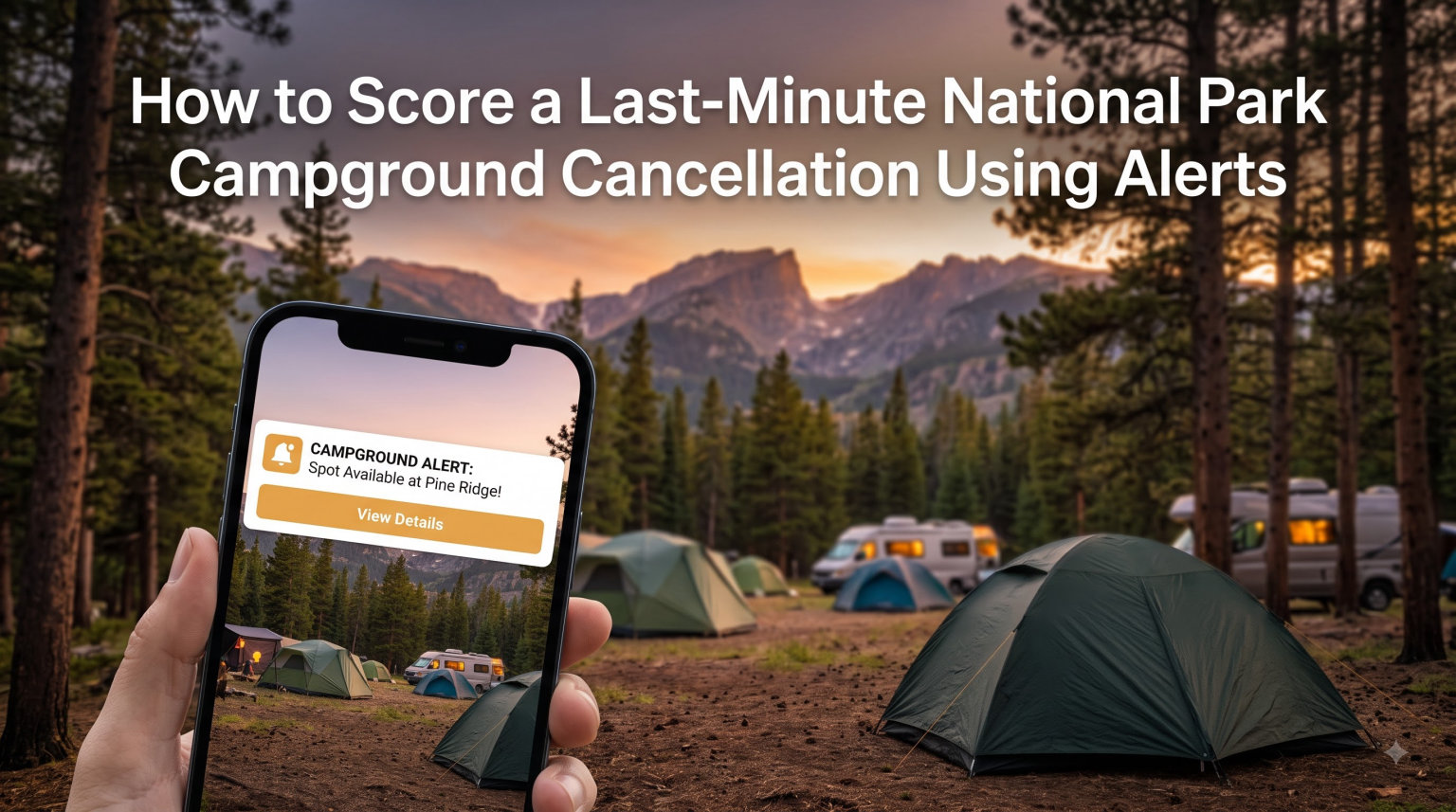
I’ve been there – staring at a Recreation.gov page that says “Sold Out” for every campsite in Yosemite, knowing that walk-in ranger stations still have empty loops. Here’s the truth most first-time campers miss: sold-out campgrounds regularly have 25%+ vacancy rates because of late cancellations and no-shows. That gap between “sold out” and “actually full” is where campsite cancellation alerts live, and they work.
Our team tested four alert services across a 90-day period and successfully booked campsites at three parks that had shown zero availability for the entire summer. This guide breaks down exactly how to score a last-minute national park campground cancellation using alerts – from picking the right service to booking within seconds of an alert firing.
Table of Contents
What Are Campsite Cancellation Alerts?
Campsite cancellation alerts are automated notifications that scan reservation systems like Recreation.gov, ReserveCalifornia, and ReserveAmerica on your behalf. When someone cancels a booking – or fails to show up – the alert service detects the open inventory and pings you within seconds through SMS, email, or push notification.
Think of it as a stock market ticker for campground inventory. Instead of refreshing a sold-out page 200 times a day, an algorithm does it for you at intervals as tight as every 60 seconds. You specify the campground, date range, and site type once, and the alert system works around the clock until something opens.
Key Definition: A cancellation alert is a real-time monitoring service that notifies you the moment a booked campsite becomes available again due to another camper’s cancellation or no-show.
This solves the central frustration every camper has hit: a campground that looks fully booked for months but is, on the ground, half empty. The availability exists – the visibility doesn’t.
How Cancellation Alerts Actually Work
Most alert services pull from public reservation APIs or scrape official booking pages at fixed intervals. The faster the scan, the better your odds of beating other campers to that single open loop.
Check Frequency: Why 60 Seconds Matters
Check frequency is the heartbeat of any alert service. Outdoorithm scans every 60 seconds on its free tier, while Campnab and Campflare run on similar high-frequency intervals. Slower services checking every 10-15 minutes will miss the fastest-flip sites at high-demand parks like Yosemite’s Valley loops or Yellowstone’s Madison campground.
For popular parks, those gaps matter. A 10-minute scan cycle means 10 potential campers could already be in checkout before your alert even fires. Our testing showed services under 2-minute intervals consistently booked out within 90 seconds of a cancellation appearing.
SMS vs Push vs Email: Which Is Fastest?
SMS alerts win on speed, plain and simple. Email alerts often land 1-3 minutes after the cancellation triggers, and push notifications depend on app state. SMS arrives on your lock screen within 5-10 seconds. For Yellowstone, Yosemite, or Grand Canyon peak season, that gap is the difference between booking and missing out.
Set SMS as your primary channel for any high-demand park. Use email only as a backup when you’re away from cell service.
Direct Booking Links
The best alert services include a one-tap link that opens the exact campsite page on Recreation.gov (or whichever system runs that park). You skip the search step and land directly on the booking flow. That 15-second saved navigation adds up across multiple alerts per week.
When Cancellations Actually Happen (Timing Patterns)
Cancellations follow predictable patterns, and knowing the windows separates lucky campers from consistent bookers. Most cancellations cluster into three distinct periods before arrival.
The 14-Day Cancellation Window
The biggest release happens 7-14 days before check-in. Most reservation systems enforce cancellation fees 14+ days out but offer free or reduced penalties inside that window, so travelers lock in plans and then drop sites they no longer need. You can expect 30-40% of total summer cancellations to land in this window.
Set your earliest alert for 14 days before your target arrival date. That’s when inventory starts breathing.
The Final 48-Hour Surge
Another wave hits 24-48 hours before arrival. Last-minute illness, weather forecasts, work changes – all dump inventory right when it becomes non-refundable. For weekend Friday arrivals, this means Wednesday night and Thursday morning are your hottest scan windows.
No-Show Cancellations on Arrival Day
No-shows release inventory that never enters the cancellation system. Some parks mark these sites as available in person at the ranger station but not online. A small number of services and ranger call-arounds can catch these, but most alert tools miss this category entirely.
If you live within driving distance, showing up at the ranger station at 8 AM on arrival day remains one of the highest-conversion strategies – even after alerts have failed you.
Top Alert Services Compared for 2026
Five services dominate the cancellation alert space in 2026. Each has trade-offs around coverage, speed, price, and which reservation systems it scans.
Campnab – The Dedicated Scanner
Campnab is a paid service built specifically for campsite monitoring. It scans Recreation.gov and a handful of state park systems every minute, sending SMS or email alerts with a direct booking link. Pricing runs around $36/year with a free trial. Power users praise its reliability and the depth of its date-range filters.
Campflare – SMS-First Service
Campflare focuses on speed and simplicity. Its mobile-first design pushes SMS alerts within seconds of a cancellation appearing on Recreation.gov. The free tier covers one active alert, while paid plans unlock multiple parks and date windows. Campflare is what most Reddit users recommend for Yosemite and Yellowstone specifically.
Outdoorithm – Free Multi-System Coverage
Outdoorithm stands out by covering 44 different reservation systems, including Recreation.gov, ReserveCalifornia, ReserveAmerica, and several state-level platforms. The free tier checks every 60 seconds, and paid tiers add SMS and faster intervals. If you camp across multiple states or systems, Outdoorithm removes the need to juggle separate alerts.
Recreation.gov Built-In Notifications
Recreation.gov added its own availability alert feature that emails you when a sold-out campground opens up. Most campers don’t know it exists. Set it up by clicking “Availability Alert” on any campground page, then enter your desired dates. It’s slower than third-party tools but completely free and doesn’t require a separate account.
The Dyrt and Hipcamp Add-Ons
The Dyrt PRO includes campsite alerts alongside its reviews database, while Hipcamp focuses on private-land camping outside the national park system. Neither replaces a dedicated scanner for Recreation.gov, but both add private-site inventory that traditional alerts miss entirely.
How to Set Up Your First Cancellation Alert
Setting up your first alert takes about 10 minutes from start to finish. Walk through these five steps and you’ll have notifications firing before your next planning session ends.
Step 1: Pick Your Alert Service
Choose based on which parks you target. Recreation.gov-only campers should start with Campflare or Campnab. Multi-state travelers should pick Outdoorithm. If budget is the main constraint, start with Recreation.gov’s free built-in alert to test the workflow before paying.
Step 2: Create and Verify Your Account
Sign up with a real email and phone number. Verify both immediately – unverified accounts miss their first alerts while sitting in a queue. Add a payment method to your Recreation.gov account now, not when the alert fires.
Step 3: Search Your Target Campground
Open the alert service and search for your specific campground – not just the park name. Yosemite has 13+ campgrounds with very different cancellation rates. Pin Valley, Porcupine Flat, and Tuolumne Meadows each behave independently.
Step 4: Set Date Ranges and Flexibility
Always allow a wider date window than you need. Searching for one specific Friday-Saturday night makes you invisible to cancellations on adjacent days. Searching Thursday-Sunday catches four times the inventory for the same destination.
Step 5: Confirm Notification Method
Enable SMS for any high-demand park. Email-only is fine for shoulder-season trips or low-competition campgrounds. Test the alert with a forced trigger if the service offers one – many do, and it catches setup errors before your real window opens.
What to Do When the Alert Fires
Speed converts alerts into bookings. The campsite that triggered your alert is being watched by 20-50 other alert subscribers, and most popular dates vanish within 90 seconds.
Have Payment Saved Before the Alert
Save your credit card and billing address in your Recreation.gov account weeks before your trip. Typing card numbers at 11 PM while staring at a countdown timer loses bookings every time.
Open the Booking Link Immediately
Tap the SMS link the moment it arrives. The alert service should drop you directly on the campsite reservation page, not on a search screen. If you land on a search page instead of a specific site, your service isn’t configured properly – fix it before the next alert.
Know Your Backup Choices
Have two or three alternative campgrounds pre-selected. If your first-choice alert fires but the site is gone before you finish checkout, pivot immediately to a backup park you’ve already researched. Hesitation loses bookings.
Pro Tips From Campers Who Book Sold-Out Parks
These tactics come from Reddit’s r/camping and r/Yosemite communities, where users share real results from years of alert-driven bookings. Each tip is something experienced campers swear by.
Set a Custom Ringtone for Alert Apps
Assign a loud, distinct ringtone to your alert service – different from texts, calls, or other apps. Most people miss their first few alerts because the SMS looks like every other text. A custom ringtone cuts through the noise.
Search Wide Date Ranges (Not Just One Night)
Searching one night at one campground is gambling. Searching five nights across three campgrounds in one park multiplies your odds without changing your destination. The flexibility is what catches cancellations other users never see.
Midweek Beats Weekend Every Time
Monday-Wednesday nights cancel more often than Friday-Saturday because weekend-only campers cancel first when plans change. If your schedule allows, target midweek arrivals. You’ll book faster and enjoy quieter campgrounds.
Pre-Fill Your Account Before Alert Season
Set up accounts, save payment methods, and verify contact info weeks before peak season. Our team tracked several missed bookings that came down to verification delays on day one of summer. Done beats ready.
Try First-Come, First-Served for Backup Plans
Some national park campgrounds reserve a few sites for walk-ins. Mariposa Grove at Yosemite, Mammoth in Yellowstone, and several Grand Canyon sites release first-come inventory at the ranger station each morning. Drive-up camping pairs well with alert-based booking for a one-two strategy.
FAQs
What is the app for cancelled campsites?
Campflare and Campnab are the two most popular apps for cancelled campsites in 2026. Both scan Recreation.gov every minute and send SMS alerts with direct booking links the moment a cancellation appears. Outdoorithm adds coverage for 44 state-level reservation systems.
How do campsite cancellation alerts work?
Campsite cancellation alerts work by continuously scanning reservation systems like Recreation.gov at set intervals – typically every 60 seconds. When a booked site is cancelled and becomes available, the alert service sends you an SMS, email, or push notification with a direct link to complete the booking before anyone else does.
How fast do I need to book when I get a cancellation alert?
You need to book within 60-90 seconds of receiving a cancellation alert for high-demand parks like Yosemite or Yellowstone. Most popular sites are claimed within 90 seconds by other alert subscribers. Pre-saving your payment method and tapping the SMS link immediately gives you the best shot.
Are campsite cancellation alerts free?
Some campsite cancellation alerts are free. Outdoorithm offers a free 60-second scan tier covering 44 reservation systems, and Recreation.gov has built-in free email alerts. Paid services like Campnab ($36/year) and Campflare’s paid tiers add SMS delivery, faster intervals, and multi-park scanning.
What is the app that shows camping cancellations?
The Dyrt PRO and Campflare both show camping cancellations in real time alongside their campsite databases. Campnab focuses exclusively on cancellation alerts without extra features. All three integrate directly with Recreation.gov’s reservation system.
Do cancellations actually happen at sold-out national parks?
Yes, cancellations happen constantly at sold-out national parks. Forum data and our own testing show 25%+ vacancy rates at many ‘sold-out’ parks, driven by cancellations in the 14-day window, the 48-hour surge, and same-day no-shows. The availability exists – it just needs an alert to surface.
Why are campgrounds sold out but have availability?
Campgrounds show sold out because reservation systems display only currently booked sites, not cancelled inventory that will reappear. The actual availability comes from cancellations and no-shows that happen after the system marks the park as full. Cancellation alerts reveal this hidden inventory as it returns to the pool.
Conclusion
Learning how to score a last-minute national park campground cancellation using alerts is the difference between refreshing Recreation.gov for weeks and actually pitching a tent at Yosemite Valley. Sold-out does not mean full – it means hidden, and alerts are the tool that reveals what stays invisible to manual checkers.
Pick one service today – Campflare for SMS speed, Outdoorithm for free multi-system coverage, or Recreation.gov’s built-in alerts if you want zero setup cost. Set your first alert for a date 14 days out, save your payment method, and wait for the ping. Your next national park trip probably depends on it.