
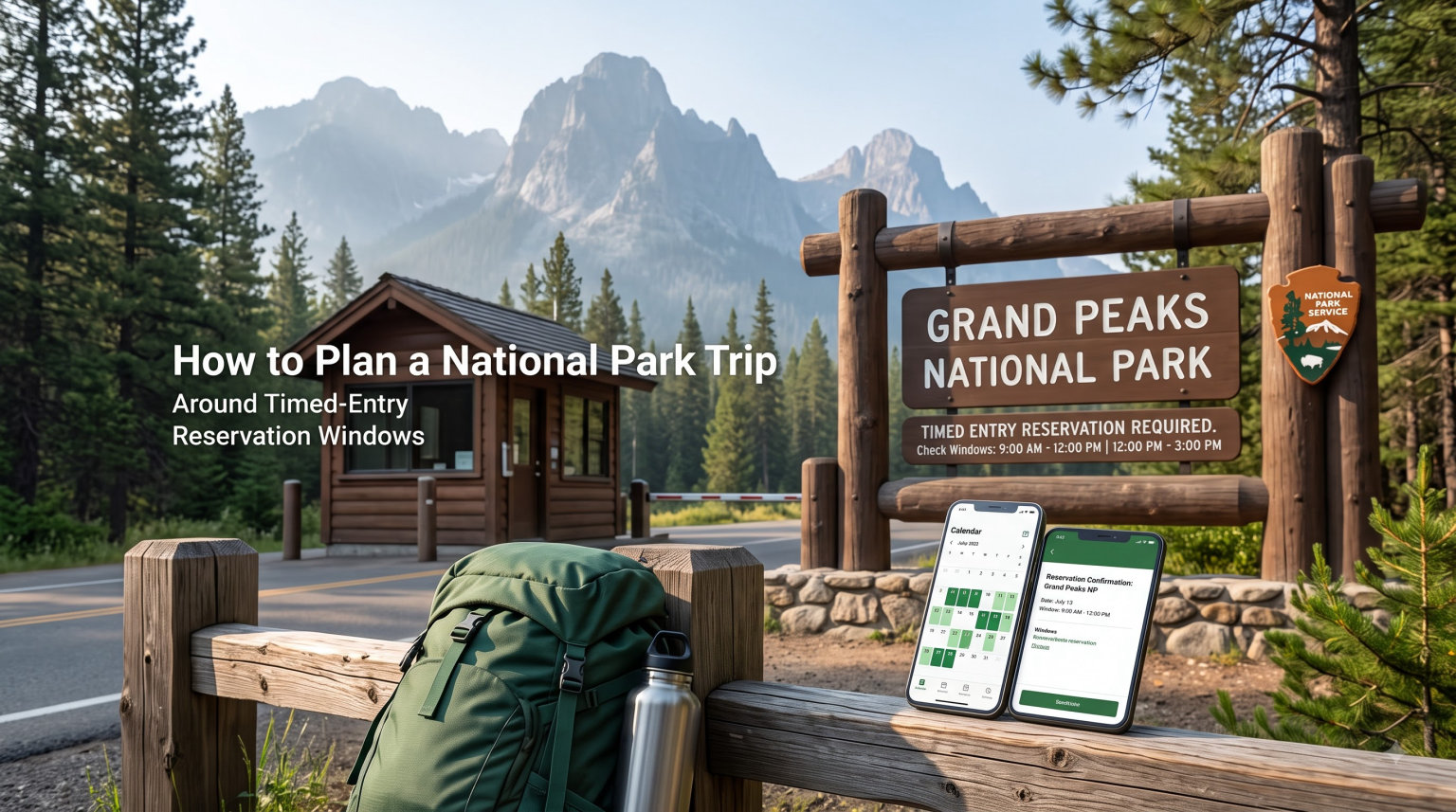
I planned my first timed-entry reservation on a stressed-out Tuesday night, six months before my Rocky Mountain trip. Tickets vanished in under three minutes after the 10 a.m. MT release. By the time I clicked through, the only slot left was 7:45 p.m. on a Thursday in October. That scramble taught me something every national park traveler eventually learns: the system rewards people who understand how the windows work, not people who hope for the best.
Learning how to plan a national park trip around timed-entry reservation windows saves you from showing up at a closed gate, paying nothing but losing an entire day of travel. In 2026, more than a dozen parks use some form of reservation or timed-entry system during peak months, and a few new parks have quietly joined the list while others dropped their requirements. Below, I’ll walk you through every piece you need to handle before you ever load the car.
Table of Contents
What Is the National Park Timed-Entry Reservation System
A timed-entry reservation is a free or low-cost permit that grants park access during a specific arrival window, typically one to two hours long. Each reservation covers one vehicle and everyone inside it, and it is separate from the standard park entrance fee you pay at the gate or through the America the Beautiful pass.
The system is run almost entirely through recreation.gov, the federal booking platform used by the National Park Service, the U.S. Forest Service, and the Bureau of Land Management. You create a free account, choose your park, pick an available time slot, and pay a small reservation fee (usually $2 per vehicle). After that, you show up at the park within your window with your confirmation email or QR code.
Timed-entry is different from a vehicle reservation, which is required at parks where access is controlled by a specific road or corridor. It is also different from a hiking permit, which only covers a specific trail or wilderness area such as Angels Landing or Half Dome. I’ll break down those differences in detail below.
How the System Works in Plain English
The reservation window opens at a fixed date and time, often 30 to 90 days before your visit. You log in, refresh the recreation.gov page, and book a slot for the day you want to enter. Some parks release slots in monthly batches, while others open new dates every morning at 8 a.m. MT. Each member of your party only needs the one vehicle reservation, but you may also need a separate hiking permit for popular trails inside the park.
If you fail to book on release day, you can still try for cancellations. Many parks release returned slots the night before or 24 hours ahead, but those go fast.
Why National Parks Use Timed Entry and Vehicle Reservations
Rocky Mountain National Park drew 4.6 million visitors in 2024, Glacier topped 3 million, and Zion’s shuttle lines regularly ran two hours long before the pandemic. Crowding became the single biggest threat to the visitor experience, and the National Park Service responded by testing timed entry at the busiest parks starting in 2020.
The stated goals are simple: reduce gridlock, protect fragile ecosystems, restore quiet to backcountry areas, and make sure first-come visitors do not get shut out because the parking lots filled at 9 a.m. From the Park Service’s perspective, the system works when wait times drop, traffic spreads across more hours, and visitors actually get to see what they came for.
I noticed the difference myself on a September morning in Rocky Mountain. The Bear Lake lot filled by 7:45 a.m., but the timed-entry slots between 9 and 11 a.m. kept traffic flowing instead of stacking up at the entrance station. Without the system, that same morning would have produced the two-mile backup we saw in 2019 before the pilot program began.
Complete List of Parks Requiring Reservations in 2026
The list of parks that require reservations changes almost every season. Below is the confirmed 2026 lineup based on National Park Service releases. Always confirm on the official park page within a week of travel because rules change.
| Park | Type of Reservation | When Required | Cost |
|---|---|---|---|
| Rocky Mountain | Timed Entry + Bear Lake Corridor | Late May to mid-October | $2 per vehicle |
| Glacier (Going-to-the-Sun Road) | Vehicle Reservation | Late May to mid-September | $2 per vehicle |
| Acadia (Cadillac Summit Road) | Vehicle Reservation | Late May to mid-October | $6 per vehicle |
| Zion (Angels Landing) | Hiking Permit (lottery) | Year-round | $6 per person + $3 lottery |
| Yosemite (Half Dome) | Hiking Permit (lottery) | Late May to mid-October | $10 per person |
| Haleakala (Summit) | Vehicle Reservation | Year-round, 3 a.m. to 7 a.m. and sunset | $1 per vehicle |
| Arches | Timed Entry | April 1 to October 31 | $2 per vehicle |
| Carlsbad Caverns | Timed Entry | Year-round | Free |
| Shenandoah (Old Rag) | Hiking Permit | Year-round | $1 per person |
| Mt. Rainier (Sunrise) | Timed Entry | Mid-July to early September | $2 per vehicle |
| Sequoia & Kings Canyon (Wuhanoki) | Vehicle Reservation | Late May to mid-September | $2 per vehicle |
This table reflects the parks most travelers ask about, but smaller parks add timed entry every year. Check recreation.gov and the individual park website for the current schedule before booking flights or hotels.
Timed Entry vs Vehicle Reservation vs Hiking Permit
These three terms get mixed up constantly on forums, so here is the simple breakdown:
Timed entry: Covers the entire park or a defined corridor. You must arrive within a window of one to two hours.
Vehicle reservation: Covers access to a specific road, lot, or feature such as Cadillac Summit Road or Going-to-the-Sun Road.
Hiking permit: Required for a specific trail or wilderness zone, typically booked through a separate lottery or seasonal window.
Some parks, like Rocky Mountain, layer two systems on top of each other. You need the timed-entry slot to enter the park, plus a separate Bear Lake Corridor reservation if you plan to drive past Moraine Park before 4 p.m. on weekends.
How to Book Timed-Entry Reservations Step by Step
The booking flow is similar across most parks. Here is the process I walk through with first-time visitors in our travel groups.
Step 1. Create a recreation.gov account at least one week before you plan to book. Add a payment method so you are not fumbling during the release rush.
Step 2. Log in 5 minutes before the release time. Release times are listed on each park’s page, and they are stated in Mountain Time even for East Coast parks.
Step 3. Search by park name or facility. Sort by date. Click your preferred slot the moment the page refreshes.
Step 4. Confirm your vehicle plate number, party size, and email. You will get a confirmation with a QR code or PDF attachment within five minutes.
Step 5. Save the confirmation to your phone’s wallet or print a backup. Park rangers scan codes at the entrance station even when the gate is open.
Mobile App vs Website
I prefer the mobile app for last-minute bookings because the queue tends to clear faster. The recreation.gov app also stores your permits offline, which helps if you lose signal in the park.
The website works better for batch planning across multiple parks. You can compare dates side by side, hold two tabs open for related parks, and copy your plate info faster. For most travelers, the app wins on speed, but the website wins on planning.
Reservation Windows: When Each Park Opens Bookings
Each park sets its own release schedule, and missing the release is the most common reason travelers end up locked out. Here is how the major parks handle their windows.
Rocky Mountain: Releases timed-entry slots in monthly batches 30 days before the visit date, with a second wave 14 days out. Bear Lake Corridor releases 30 days ahead as well.
Glacier: Going-to-the-Sun Road reservations open roughly 60 days in advance for the entire summer. Once they sell out, you are relying on cancellations.
Acadia: Cadillac Summit Road reservations open 90 days ahead, and they sell out faster than almost any other vehicle reservation in the country.
Arches: Releases timed-entry tickets 3 months ahead in monthly waves. April reservations open January 10, May reservations open February 10, and so on.
Haleakala: Sunrise reservations open 60 days in advance. Sunset reservations open 90 days out.
If your travel dates are flexible, look at the release calendar before locking flights. Booking your flight to match the release often beats booking the flight first and hoping for availability.
Parks That Discontinued Timed Entry in 2026
Not every park that piloted timed entry kept it. Yosemite dropped its full-park timed entry after the 2022 season, citing improved traffic flow and lower visitation pressure. Glacier ended its North Fork area reservation in 2024 after congestion dropped by 60 percent.
The pattern is clear: parks that saw dramatic overcrowding kept the system, while parks where the pilot produced limited gains dropped it. Expect more changes in 2026 as Park Service staff review the data each winter.
If a park you want to visit dropped its timed-entry requirement, you still need a valid entrance pass or America the Beautiful pass, but you no longer need to plan around an arrival window. Always double-check the park’s homepage, because dropping the system does not mean dropping parking reservations at popular trailheads.
Tips for Getting Reservations on Sold-Out Days
When reservations sell out, the trip is not necessarily over. Forum users on r/nationalparks have collected a long list of workarounds that real travelers use.
Check recreation.gov at midnight MT. Cancellations often post right when the next day’s window opens. Setting an alarm for 12:05 a.m. has worked for me twice in three years.
Use the next-day release window. Many parks release a final batch of slots 24 hours in advance. It is competitive, but it is the best option for same-week trips.
Arrive before 9 a.m. at parks that allow it. Several parks exempt early-morning arrivals from the timed-entry requirement. This trick works at Acadia’s Cadillac Summit Road and Haleakala outside sunrise hours.
Try the lottery for hiking permits. Zion’s Angels Landing lottery charges a non-refundable $3 fee, but winning slots show up days before the trip.
Join a guided tour. Tour operators reserve their own commercial slots, which usually do not appear on recreation.gov. We saw a family get into Arches on a sold-out Saturday through a local Jeep tour.
Pick shoulder seasons. Late September and early October are still warm at most Western parks, but the crowds thin by 30 to 40 percent.
Common Mistakes to Avoid
After three summers of helping friends plan trips, I keep seeing the same mistakes trip up first-timers. Forgetting the entrance pass on top of the reservation. Booking the wrong date when the time zone shifts. Assuming a hiking permit covers the timed-entry fee (it does not). And most painful: showing up at the gate without any reservation because someone in the group thought the entrance fee was the only cost.
Print every confirmation. Carry digital and paper backups. The 15 minutes of prep saves an entire day of driving back to town.
Planning a Multi-Park Trip Around Reservation Windows
Multi-park road trips are where timed-entry planning gets genuinely hard. Each park opens reservations on its own schedule, releases them in different batches, and requires different documents. Trying to book Glacier, Yellowstone, and Grand Teton in one stretch takes weeks of planning.
The approach I recommend to readers is to start with the hardest reservation first. Glacier’s Going-to-the-Sun Road fills within hours, so lock that 60 days out. Then build the rest of the trip around the dates you secured.
For Yellowstone and Grand Teton, plan to enter Yellowstone’s Northeast Entrance via Lamar Valley, which avoids the West Entrance reservation system entirely. You can hit Mammoth Hot Springs, Lamar Valley wildlife, and the Grand Canyon of the Yellowstone without a reservation, then cross into Grand Teton where the Jenny Lake and String Lake parking lots fill at sunrise but do not require reservations.
Southwest loops work the same way. Zion requires Angels Landing lottery entries but not park-wide timed entry. Bryce Canyon has no reservation system. Capitol Reef and Canyonlands are wide open. You can build a two-week loop from Las Vegas through Utah’s Mighty 5 without ever needing a single timed-entry slot, except for the optional Angels Landing hike.
Sample 14-Day Rockies Itinerary
Day 1-3: Denver to Rocky Mountain with Bear Lake Corridor reservation. Day 4-6: Drive to Arches, then Canyonlands. Day 7-9: Capitol Reef and Bryce Canyon (no reservations). Day 10-12: Zion with Angels Landing lottery. Day 13-14: Return through Las Vegas.
This itinerary avoids the highest-stress reservations while keeping the highlights. The only lottery to enter is Angels Landing, and that lottery runs daily for next-day slots.
America the Beautiful Pass Integration
The $80 America the Beautiful pass covers entrance fees at every national park and federal recreation site for one year. It does not cover reservation fees, but it is the cheapest option for anyone visiting three or more parks in a year. You can buy it at any park entrance station or order it online before you leave home.
Active-duty military, seniors 62 and over, and people with permanent disabilities get free or discounted versions. Veterans get free access to national parks through the free Military Lifetime Pass, expanded in 2026 to include all veterans regardless of disability rating.
If you visit multiple parks, the math always favors the annual pass. The entrance fee at Rocky Mountain alone is $35 per vehicle per week. Two visits and you have already cleared the $80 cost.
FAQs
How far in advance do you need to make national park reservations?
Most parks release timed-entry or vehicle reservations 30 to 90 days before your visit date. Acadia’s Cadillac Summit Road opens 90 days out, while Rocky Mountain releases monthly batches 30 days ahead. For the most popular parks, booking the day reservations open is the only reliable way to get the slot you want.
What are the biggest mistakes visitors make at national parks?
The most common mistakes are forgetting that a reservation is separate from the entrance fee, showing up after the arrival window has closed, booking the wrong date because of time zone confusion, and assuming that early-morning or late-evening entries never require reservations at certain parks. Always print your confirmation and carry both digital and paper copies.
Why are national parks getting rid of timed entry?
Parks drop timed entry when the pilot data shows limited congestion relief, when staffing shortages make enforcement impractical, or when visitation patterns even out naturally. Yosemite ended its park-wide timed entry after 2022 because traffic patterns improved, and Glacier dropped North Fork reservations after crowding dropped by 60 percent.
What are the best tips for booking a national park trip?
Book the hardest reservation first, build the rest of your itinerary around those dates, check recreation.gov at midnight Mountain Time for cancellations, and try next-day release windows for last-minute trips. Shoulder seasons in late September and early October have 30 to 40 percent fewer crowds than peak summer months while keeping good weather at most Western parks.
Do I need a reservation for Rocky Mountain National Park?
Yes, Rocky Mountain requires timed-entry reservations from late May to mid-October for most areas. You also need a separate Bear Lake Corridor reservation to drive that section before 4 p.m. on weekends. Early morning arrivals before 9 a.m. and late afternoon entries after 4 p.m. do not need the timed-entry permit but still need a Bear Lake Corridor reservation when active.
How does recreation.gov work for national parks?
You create a free account on recreation.gov, search for your park by name or facility, pick an available arrival window, and pay the reservation fee. You receive a confirmation email with a QR code that park rangers scan at the entrance station. The platform also handles hiking permits, wilderness permits, and campground reservations across federal recreation sites.
Final Thoughts on Planning Around Reservation Windows
Learning how to plan a national park trip around timed-entry reservation windows is really about shifting your mindset from spontaneity to strategy. The parks that feel the most rewarding are the ones that reward travelers who prepare. Build your itinerary backwards from the hardest reservation, check the release calendar before you book flights, and treat recreation.gov like the booking system it is, not a hopeful refresh page.
Once you have used the system once, the rest of your national park trips get easier. You will know exactly when to set your alarm, which tabs to keep open, and how to read the calendar release patterns. That preparation is the difference between driving into a closed gate and watching sunrise over Glacier with two hours to spare.