
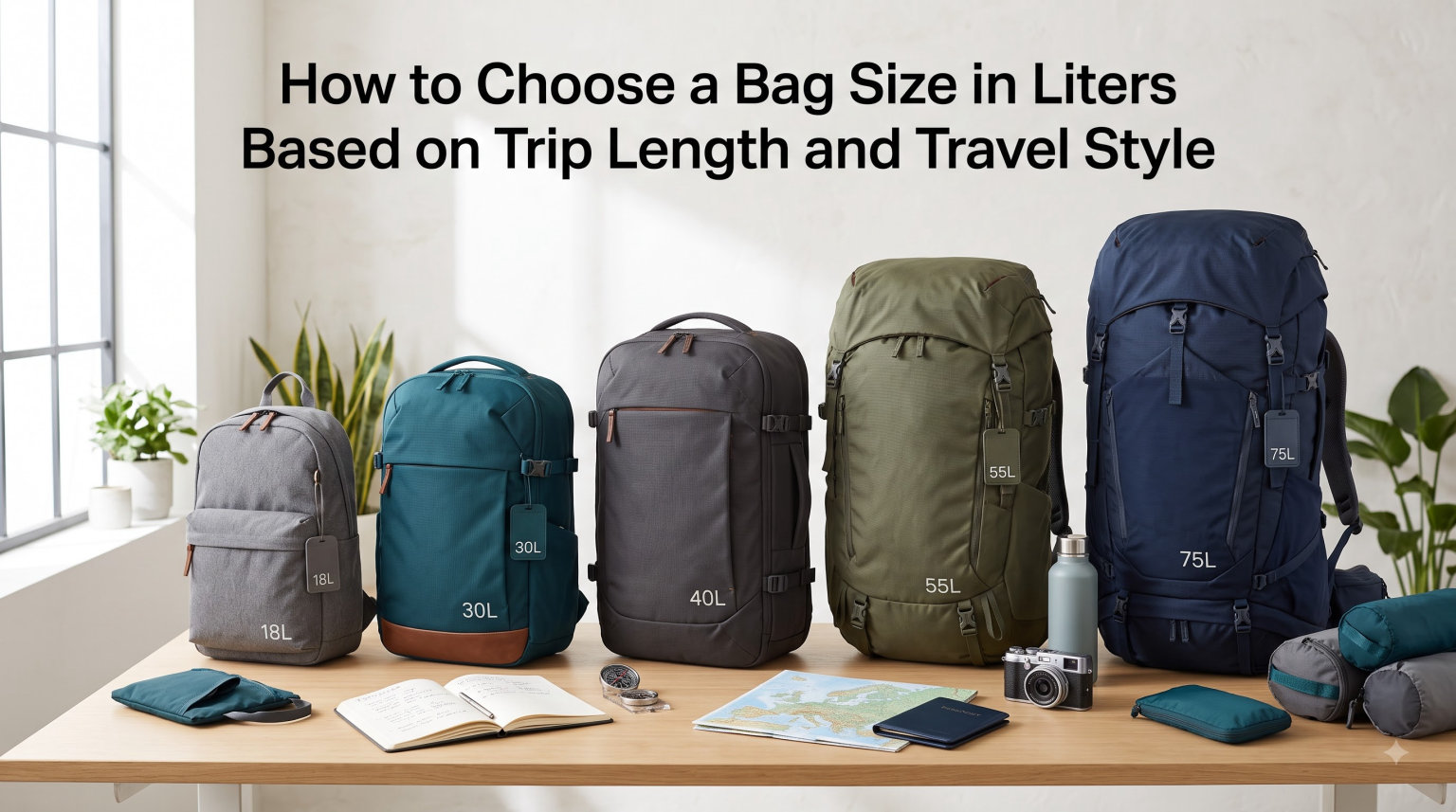
Choosing the right bag size has become even more important in 2026 as airlines tighten carry-on enforcement and checked-bag fees keep climbing. Pick the wrong bag and you will either drag a heavy brick through airports or pay surcharges on every flight. Pick the right one and every trip gets easier before it even starts.
I learned this the hard way on a 10-day Southeast Asia trip when my 65-liter pack felt like hauling bricks through Bangkok markets, and again on a 3-day Lisbon weekend when my 22-liter bag could not fit a single jacket.
Knowing how to choose backpack size liters saves you from both problems. The right size keeps your essentials covered without forcing you to drag extra weight through airports or pay checked-bag fees on every flight.
In this guide, I will walk you through the exact liter ranges I use for different trips, how to match those liters to your personal packing style, and the airline rules that decide whether your bag ever makes it into the overhead bin. By the end, you will know exactly which backpack size to grab for your next trip.
Table of Contents
What Do Backpack Liters Actually Mean
Backpack size in liters measures the total interior volume of a bag, indicating how much gear it can hold. One liter equals 61.024 cubic inches, so a 30-liter backpack holds the same volume as roughly 1,830 cubic inches of stuff.
Most brands follow the ASTM F2153-07 standard, which fills the main compartment with small plastic balls and measures the volume they displace. This is why two brands can rate their bags at 30L and have wildly different real-world capacity.
That standard has limits though. The measurement usually ignores front pockets, side mesh, and the top lid. A bag rated at 30L might really hold 35L once you count every pocket, or only 26L if the shape makes the pockets useless.
How to Convert Liters to Cubic Inches
The math is simple: multiply liters by 61.024. A 40L backpack equals about 2,441 cubic inches. If you see a vintage pack rated in cubic inches, divide by 61.024 to get the liter figure.
This conversion matters when you are comparing an old pack to a new one, or matching luggage from brands that use different units. I keep a note on my phone with this conversion because I always forget it at the airport.
Why Real Volume Differs from Stated Volume
Brand marketing tends to round up. A bag labeled 45L might have only 41L of usable space once you account for the laptop sleeve, hydration pocket, and stiff frame sheet.
Shape also changes how much you can actually fit. A tall narrow cylinder wastes space when you pack flat clothing. A wider rectangle with a front-loading clamshell opening fits far more real-world cargo at the same stated volume.
Bag Size by Trip Length
Trip length is the single biggest factor in choosing backpack size liters. Here is the breakdown I use after testing more than 40 bags across the last decade of travel.
| Trip Length | Recommended Size | What Fits |
|---|---|---|
| Day trip (under 1 day) | 15 to 25L | Water, snacks, light jacket, phone charger, small first-aid kit |
| Weekend (2 to 3 days) | 25 to 35L | 2 outfits, toiletries, laptop, change of shoes, paperback |
| Week-long (4 to 7 days) | 35 to 45L | 5 outfits, shoes, full toiletries, electronics, souvenirs room |
| Extended (1 to 4 weeks) | 45 to 65L | Full wardrobe, multiple shoes, gear, room for purchases |
| Long-term (1 month+) | 50 to 75L | Everything above plus cold-weather layers and specialty gear |
Day Trips (1 Day)
A 15 to 25L pack handles any single-day outing. For hiking, sightseeing, or commuting, this range gives you room for water, snacks, a light jacket, and your daily electronics without bulk.
I use a 20L daypack for everything from city walks in Tokyo to 8-mile day hikes in the Rockies. The trick is keeping it under 4 pounds empty so you barely feel it on your back after 6 hours.
Weekend Trips (2 to 3 Days)
Weekend travel needs 25 to 35L. This range covers two changes of clothes, basic toiletries, your laptop, and a paperback without forcing you to wear the same outfit twice.
On a 3-day Lisbon trip last spring, my 28L bag fit everything I needed including a collapsible umbrella and a packed lunch for the train ride. A 22L would have been too tight, and a 40L would have been half empty and hard to balance on the cobblestones.
Week-Long Trips (4 to 7 Days)
A 35 to 45L backpack is the sweet spot for week-long trips. You get space for 5 outfits, two pairs of shoes, full-size toiletries, and enough slack to bring home souvenirs.
Carry-on compliant options live in the 35 to 40L range, which is why this size is the most popular for one-bag travelers. Going below 35L for 7 days means rewearing clothes or skipping layers. Going above 45L usually means checking the bag.
Extended Travel (1+ Weeks)
Travel longer than a week needs at least 45L. I lean toward 50 to 55L for trips of 2 weeks or more because laundry access varies and weather can shift mid-trip.
On a 3-week New Zealand road trip, my 55L pack held hiking boots, two jackets, and enough layers for a sudden cold snap. A 45L would have forced me to either skip the boots or buy layers there.
Matching Bag Size to Your Travel Style
Trip length alone is not enough. Your packing style changes the liter math dramatically. I learned this from hundreds of forum posts and my own overpacking years.
Three main traveler personas exist, and each maps to a different bag size for the same trip length. Most people fall somewhere between the moderate and ultralight categories.
| Traveler Type | Pack Weight (empty) | Packing Approach | Recommended Size Adjustment |
|---|---|---|---|
| Ultralight packer | Under 8 kg (17 lbs) | 2 sets of clothes, sink laundry, no shoes beyond 2 pairs | Subtract 5 to 10L from trip recommendation |
| Moderate packer | 8 to 14 kg (17 to 31 lbs) | Mix of laundry and fresh clothes, 2 to 3 shoes, full toiletries | Use standard trip-length recommendation |
| Heavy packer | Over 14 kg (31 lbs) | Fresh clothes daily, multiple outfits, specialty gear, tech | Add 5 to 10L above standard recommendation |
Ultralight Packer Style
Ultralight packers can drop 5 to 10L below the standard recommendation for any trip length. They wear each item multiple times, wash in the sink, and skip non-essentials.
For a 7-day trip, an ultralight packer fits in a 25 to 30L bag. The Reddit r/onebag community has proven this works across Europe, Asia, and South America. The trade-off is planning outfits around a tiny wardrobe.
Moderate Packer Style
Moderate packers use the standard trip-length recommendations without adjustment. They pack enough for 4 to 5 outfit rotations, hit a laundromat weekly, and bring two pairs of shoes.
Most travelers I have met over 15 years fall into this category. They pack what feels comfortable without overthinking cubes or sink laundry. A 40L bag for a week is the typical moderate packer setup.
Heavy Packer Style
Heavy packers add 5 to 10L above the standard recommendation because they bring options. Multiple outfit changes, full-size beauty products, dedicated electronics bags, and backup shoes all add up.
For a 7-day trip, a heavy packer needs 45 to 50L. My wife is a heavy packer, and her 50L bag weighs 18 kg fully loaded for a week. It is heavier than my 40L at 11 kg, but she never runs out of options.
Carry-On Only Travelers
Carry-on only travelers need a hard size cap, usually 40L or below. They use packing cubes, compression bags, and one-bag strategies to fit a week of life into a single overhead-bin bag.
This style saves checked-bag fees, which add up fast. Budget airlines charge $40 to $80 each way, so a carry-on bag pays for itself in two flights. The constraint forces discipline though, and ultralight habits are almost required.
Airline Carry-On Size Rules You Should Know
Carry-on sizing follows the airline industry standard of 22 x 14 x 9 inches (56 x 36 x 23 cm). Most bags in the 35 to 45L range fit this envelope when not overstuffed, but always check the linear inch total of your specific bag.
The real issue is that airlines enforce these limits strictly now. Budget carriers in Europe and Asia are especially strict, with gate agents measuring bags at boarding.
Standard Carry-On Dimensions by Region
| Region | Standard Carry-On | Personal Item | Weight Limit |
|---|---|---|---|
| United States (domestic) | 22 x 14 x 9 in | 18 x 14 x 8 in | No standard limit |
| Europe (IATA) | 22 x 14 x 9 in | 16 x 12 x 6 in | 8 to 10 kg |
| Budget Europe (Ryanair, EasyJet) | 21.5 x 15.5 x 7.9 in | 15.7 x 11.8 x 5.9 in | Varies |
| Asia (most carriers) | 22 x 14 x 9 in | 16 x 12 x 6 in | 7 to 10 kg |
| Australia (Qantas, Virgin) | 22 x 14 x 9 in | 15.7 x 13.8 x 5.9 in | 7 kg |
These numbers shift slightly by carrier, but the 22 x 14 x 9 envelope covers 80% of the world. Check your specific airline before any international flight, especially if you fly budget carriers.
Personal Item vs Carry-On
A personal item is a smaller bag that fits under the seat in front of you. A carry-on is the larger bag that goes in the overhead bin. Most airlines allow one of each, and this is the foundation of the two-bag travel setup.
Personal items usually max out at 18 x 14 x 8 inches, which is roughly 20 to 25L. A laptop bag, small backpack, or tote counts here. The catch is the bag has to slide under the seat, so bulky frames often fail even when within the stated dimensions.
Is 40L Too Big for Carry-On
A 40L backpack fits most airline carry-on limits if it measures close to 22 x 14 x 9 inches and you do not overstuff it. Once you start loading 40L with heavy gear, the bag bulges past the limit and gets gate-checked.
Most 40L travel backpacks measure 21 to 22 inches tall, 13 to 14 inches wide, and 8 to 9 inches deep. That fits within carry-on on paper. The risk is compression. A 40L stuffed to capacity is wider and taller than the limit, so go light or expect to gate-check on full flights.
Climate and Seasonal Adjustments
Cold-weather trips need extra liters because of bulky layers. A 7-day Iceland winter trip needs 50L minimum, while the same 7 days in summer Bali fits in 35L.
Snow boots alone add the volume of a medium packing cube. Winter jackets, gloves, hats, and base layers all stack up. Plan to add 10 to 15L for any destination with winter conditions.
Practical Tips for Choosing and Using Your Bag
Knowing your size range is only half the battle. How you use the bag matters as much as the liters on the tag. These tips come from 15 years of trips and dozens of packing disasters.
The 5-4-3-2-1 Packing Rule
The 5-4-3-2-1 packing rule limits you to 5 tops, 4 bottoms, 3 pairs of socks, 2 pairs of shoes, and 1 hat for any trip length. This formula works for trips up to 2 weeks if you do sink laundry every 3 to 4 days.
I tried this rule on a 10-day Italy trip and came home with unworn socks. The math works because tops wear out faster than bottoms, and shoes are the heaviest items per wear. Stick to the formula and you can fit it all in a 30L bag.
Common Mistakes to Avoid
The biggest mistake is buying too much bag for your trip. A 65L pack for a weekend trip guarantees overpacking, weight problems, and airline surcharges. Match the bag to the trip, not the other way around.
The second mistake is trusting stated liters without testing. A 30L clamshell opens fully and fits more than a 30L top-loader because of how the space works. Try the bag in person with your typical packing load before committing.
The third mistake is ignoring body frame and torso length. A 55L pack is uncomfortable on a 5-foot-4 frame no matter how fit you are. Torso length, not height, decides whether a pack rides well on your back. Most travel packs offer adjustable suspension, but range varies wildly.
Smart Packing Strategies
Packing cubes save more space than any compression bag. They organize by category and let you find items without unpacking the whole bag. I use three medium cubes for tops, bottoms, and underwear, and one flat cube for electronics.
Compression straps on the outside of the bag cinch down a half-empty pack to fit smaller spaces. This is how 40L bags squeak into overhead bins on strict airlines.
Wear your bulkiest items on the plane. A jacket and boots take up 8L of bag space. Wearing them saves room and keeps them accessible for temperature swings in the cabin.
Body Size and Frame Considerations
Pack comfort scales with torso length, not liter size. A 50L pack with a long adjustable harness fits a 6-foot-2 traveler fine but torques a smaller frame. Most brands publish torso range measurements in centimeters. Match your torso to the bag before you match the liters to your trip.
Hip belts also need to sit on the iliac crest, not the waist. A bag that sits high on the back pulls on your shoulders, and a bag that sits low pulls on your hips. Aim for about 60% of weight on hips and 40% on shoulders for any pack over 30L.
Expandable Bags for Flexibility
Expandable bags with zipper expansion panels give you 5 to 10L of extra room when needed. They stay compact for carry-on and expand for souvenirs on the way home. Most 35 to 45L travel packs offer this option.
The downside is structural weakness when fully expanded. The bag can collapse under load, and weight distribution gets weird. Use the expansion for soft items like clothing, never for hard gear or electronics.
Try Before You Buy
Fill any candidate bag with weight before buying. Load it with 10 to 15 pounds and walk around the store for 10 minutes. Real-world weight feels nothing like an empty pack on display.
Backpack volume is also subjective. A 25L from one brand feels like a 30L from another. If possible, pack your actual gear into the candidate bag at the store. If it does not fit your laptop, shoes, and three days of clothes, walk away.
FAQs
What is the 5 4 3 2 1 rule for packing?
The 5 4 3 2 1 packing rule limits you to 5 tops, 4 bottoms, 3 pairs of socks, 2 pairs of shoes, and 1 hat for any trip length. It works for trips up to 2 weeks when combined with sink laundry every 3 to 4 days. This formula fits inside a 30L backpack for most travelers and is popular among r/onebag users.
How many litres should a travel bag be?
A travel bag should be 30 to 45L for most week-long trips, 25 to 35L for weekend trips, and 15 to 25L for day trips. For trips longer than 2 weeks, plan for 45 to 65L. Adjust based on your packing style: subtract 5 to 10L for ultralight packers and add 5 to 10L for heavy packers.
How to determine bag liter size?
Bag liter size is measured under the ASTM F2153-07 standard, which fills the main compartment with plastic balls and measures the displaced volume. One liter equals 61.024 cubic inches. To convert, multiply liters by 61.024 for cubic inches or divide cubic inches by 61.024 for liters.
Is 40L too big for carry-on?
A 40L backpack is at the edge of carry-on compliance but fits most airline limits of 22 x 14 x 9 inches if not overstuffed. Once fully loaded, 40L bags bulge past standard dimensions and risk gate checking on strict airlines. Carry-on compliance is reliable for 35L bags and below.
Final Thoughts on Choosing the Right Bag Size
Knowing how to choose backpack size liters comes down to three inputs: trip length, packing style, and airline rules. Match the liters to your trip window first, then adjust for whether you are an ultralight, moderate, or heavy packer, then verify the dimensions against your carrier carry-on policy.
Start with the trip-length table above and pick the middle of the range for your duration. Test the bag with weight before committing, and remember that real-world volume differs from the label. With the right size, every trip in 2026 and beyond gets easier before it even starts.